Observing a 542-day transiting giant with large TTVs: The 2025 transit of HIP 41378 f and new constraints on the outer system
Pith reviewed 2026-06-26 07:14 UTC · model grok-4.3
The pith
The 2025 transit of HIP 41378 f arrived seven hours earlier than its linear ephemeris predicted, confirming large TTVs.
A machine-rendered reading of the paper's core claim, the machinery that carries it, and where it could break.
Core claim
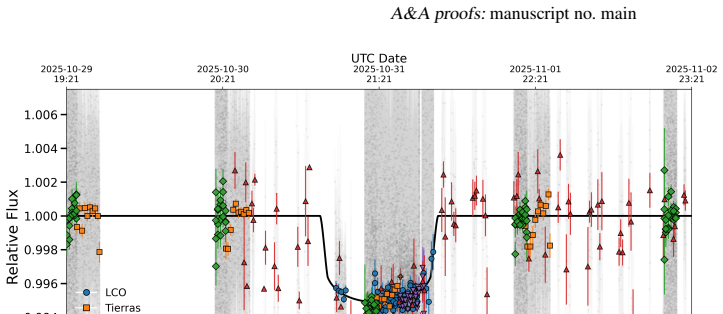
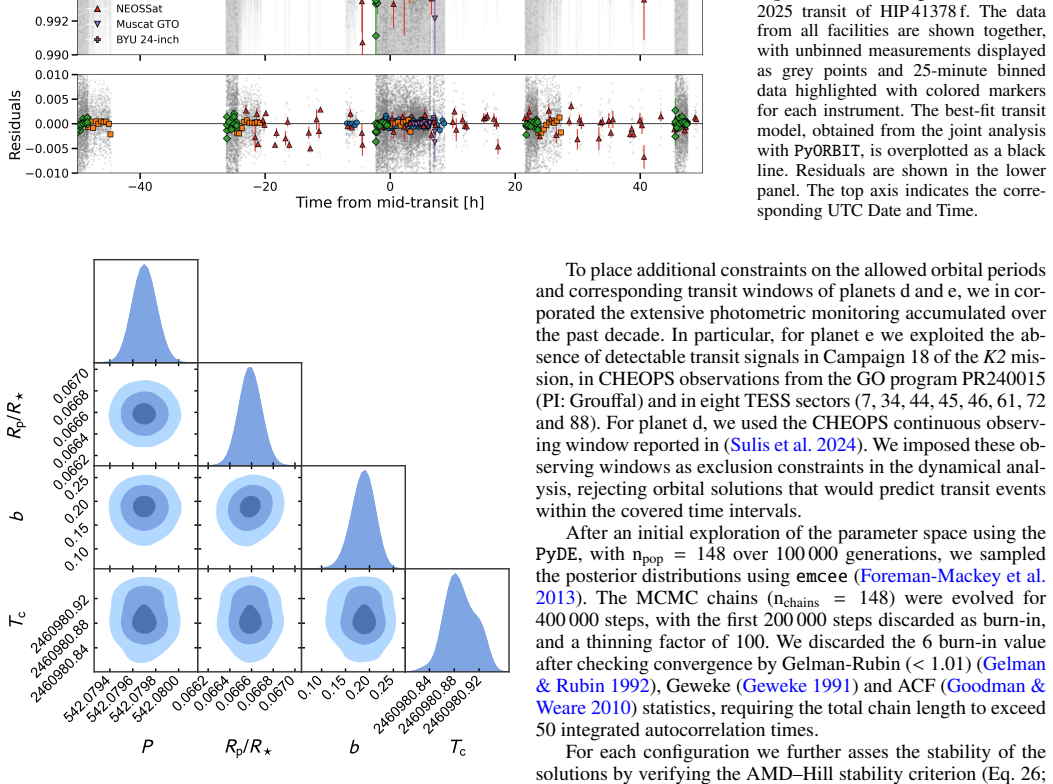
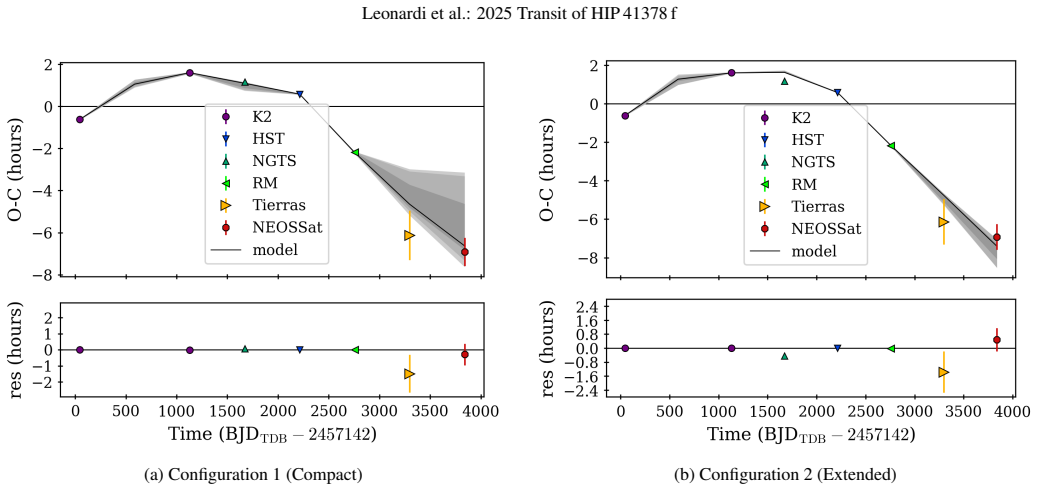
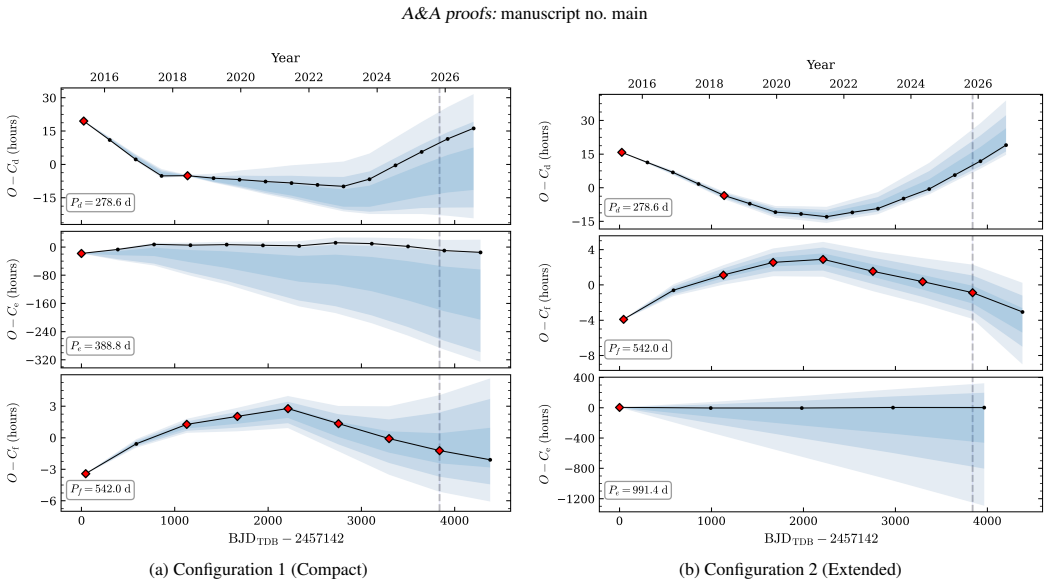
Coordinated observations from NEOSSat, LCOGT, MuSCAT, MuSCAT3, Tierras and NGTS on 31 October 2025 yield an inferior conjunction time T_C = 2460980.888 ± 0.029 BJD_TDB for HIP 41378 f. This epoch lies ~7 hours earlier than the linear ephemeris extrapolation, matching the pattern of TTVs already seen in the planet. When the new timing is combined with the transit times of HIP 41378 d and e inside the TRADES N-body integrator, the fit refines the ephemeris of f and generates updated predictions for all three outer transiting planets.
What carries the argument
The TRADES N-body integrator, which fits the observed transit timings of HIP 41378 d, e and f simultaneously to extract the gravitational perturbations responsible for the measured TTVs.
If this is right
- The updated ephemeris gives more accurate windows for the next transits of HIP 41378 f.
- Continued monitoring of d, e and f will tighten mass and eccentricity constraints on the outer planets.
- The system becomes a test bed for TTV signals in long-period, near-resonant architectures.
- Similar coordinated campaigns can be used to detect unseen companions around other long-period transiting giants.
Where Pith is reading between the lines
- The large TTV amplitude implies that the interacting planets have substantial masses, which radial-velocity observations could verify.
- The presence of measurable TTVs at a 542-day period suggests the outer system is dynamically compact or locked in resonance.
- Additional high-precision timings could separate planet-planet TTVs from possible exomoon signals.
Load-bearing premise
The seven-hour timing offset is produced by gravitational interactions among the outer planets rather than by unmodeled photometric systematics or stellar activity.
What would settle it
A future transit of HIP 41378 f whose measured time deviates from the TRADES-predicted TTV curve by more than the 0.029-day uncertainty would falsify the dynamical interpretation.
Figures
read the original abstract
Characterizing long-period transiting exoplanets is inherently challenging due to the rarity and long duration of transit events. Yet, these systems provide unique insights into planetary formation, migration, the detection of exomoons, and primordial atmospheres by occupying a sparsely populated region of the exoplanet parameter space. The complexity increases further for long-period planets near mean-motion resonances, where transit timing variations (TTVs) can reach amplitudes of several hours to days. We present a coordinated space- and ground-based observing campaign, using photometry from NEOSSat, multiple LCOGT sites, MuSCAT, MuSCAT3, Tierras and NGTS, to capture the 19-hour transit of the long-period giant exoplanet HIP 41378 f ($P$ = 542 d, $R$ = 9.5 $R_{\oplus}$) on 31 October 2025. Our transit analysis constrains the time of inferior conjunction to $T_{\mathrm{C}} = 2460980.888 \pm 0.029~\mathrm{BJD_{TDB}}$, occurring $\sim 7$ hours earlier than predicted from its linear ephemeris. This significant offset is consistent with the previously reported TTVs of HIP 41378 f, making it the longest-period exoplanet known to exhibit measurable TTVs. By combining this new precise measurement to the transit timings of the two outer planets in the system (HIP 41378 d and HIP 41378 e), we perform a dynamical modeling of the system, using the N-body integrator TRADES, refine the ephemeris of HIP 41378 f, and predict future transit events for all three outer transiting planets.
Editorial analysis
A structured set of objections, weighed in public.
Referee Report
Summary. The manuscript reports a coordinated multi-telescope campaign (NEOSSat + LCOGT + MuSCAT + MuSCAT3 + Tierras + NGTS) to observe the 19-hour transit of HIP 41378 f (P=542 d) on 31 October 2025. The derived mid-transit time is T_C = 2460980.888 ± 0.029 BJD_TDB, ~7 hours earlier than the linear ephemeris prediction; this offset is interpreted as a TTV. The new timing is combined with prior measurements of planets d and e in a TRADES N-body dynamical model to refine the outer-system ephemerides and predict future transits.
Significance. If the timing offset is dynamical, the result would establish measurable TTVs for the longest-period known transiting exoplanet and tighten constraints on the outer architecture. The space-plus-ground multi-site strategy is well-matched to the long transit duration, and the TRADES integrator is a standard, reproducible tool for such modeling. The new T_C datum is independent of the prior linear ephemeris.
major comments (1)
- [Abstract] Abstract, final paragraph: the claim that the ~7-hour early T_C is produced by gravitational interactions (and is therefore suitable for direct input to the TRADES fit) assumes that non-dynamical contributions are negligible. No explicit alternative model (e.g., Gaussian-process timing noise, site-specific red-noise kernels, or stellar-activity-induced centroid shifts) is presented to test whether the offset could arise from systematics across the six-instrument data set. This assumption is load-bearing for the TTV interpretation and the subsequent dynamical conclusions.
Simulated Author's Rebuttal
We thank the referee for their detailed review and constructive feedback on our manuscript. We address the single major comment below.
read point-by-point responses
-
Referee: [Abstract] Abstract, final paragraph: the claim that the ~7-hour early T_C is produced by gravitational interactions (and is therefore suitable for direct input to the TRADES fit) assumes that non-dynamical contributions are negligible. No explicit alternative model (e.g., Gaussian-process timing noise, site-specific red-noise kernels, or stellar-activity-induced centroid shifts) is presented to test whether the offset could arise from systematics across the six-instrument data set. This assumption is load-bearing for the TTV interpretation and the subsequent dynamical conclusions.
Authors: We acknowledge the referee's point that the manuscript does not present explicit alternative models (such as Gaussian processes or red-noise kernels) to quantify the probability that the observed 7-hour offset arises from systematics rather than dynamics. The current interpretation rests on the fact that the offset is detected coherently across six independent instruments (NEOSSat space photometry plus five ground-based facilities with distinct pipelines, filters, and sites), which would require a highly correlated systematic to mimic a dynamical TTV. We also note that the new timing is consistent in sign and approximate amplitude with the TTVs previously reported for HIP 41378 f. Nevertheless, we agree that an explicit discussion strengthens the claim. In the revised manuscript we will expand the discussion section to include a brief assessment of possible non-dynamical contributions (instrumental timing offsets, stellar activity, and correlated noise) and explain why they are unlikely to produce a uniform shift across the heterogeneous dataset. No new modeling is required, but the added text will make the assumption more transparent. revision: yes
Circularity Check
New transit timing measurement is independent; no derivation reduces to prior fits by construction
full rationale
The paper's core result is a new photometric determination of T_C = 2460980.888 ± 0.029 BJD_TDB from the 2025 multi-site transit light curve. This datum is compared against a linear ephemeris extrapolated from earlier observations and then supplied as an input to a standard TRADES N-body integration that also incorporates prior timings of planets d and e. No equation in the reported chain defines the measured offset in terms of the TTV model itself, renames a fitted parameter as a prediction, or imports a uniqueness result from self-citation that forces the outcome. The consistency statement with previously reported TTVs is a post-hoc comparison, not a definitional identity. The analysis therefore remains self-contained against external photometric data.
Axiom & Free-Parameter Ledger
free parameters (2)
- planet masses and eccentricities in TRADES fit
- updated linear ephemeris parameters for d, e, f
axioms (2)
- standard math Newtonian N-body dynamics accurately describe the timing variations
- domain assumption The multi-site photometry has been corrected for all instrumental and atmospheric effects at the level of the quoted 0.029-day uncertainty
Reference graph
Works this paper leans on
-
[1]
The True Stellar Obliquity of a Sub-Saturn Planet from the Tierras Observatory and the Keck Planet Finder. , keywords =. doi:10.3847/1538-3881/add530 , archivePrefix =. 2505.03628 , primaryClass =
-
[2]
Ground-based and Airborne Telescopes VIII , year = 2020, editor =
The Tierras Observatory: An ultra-precise photometer to characterize nearby terrestrial exoplanets. Ground-based and Airborne Telescopes VIII , year = 2020, editor =. doi:10.1117/12.2561467 , archivePrefix =. 2012.09744 , primaryClass =
-
[3]
A planetary system around the millisecond pulsar PSR1257 + 12. , keywords =. doi:10.1038/355145a0 , adsurl =
-
[4]
, year = 1995, month = nov, volume =
A Jupiter-mass companion to a solar-type star. , year = 1995, month = nov, volume =. doi:10.1038/378355a0 , adsurl =
-
[5]
Optica Acta: International Journal of Optics , volume =
Peter Fellgett , title =. Optica Acta: International Journal of Optics , volume =. 1955 , publisher =. doi:10.1080/713820996 , adsurl =
-
[6]
, year = 1967, month = may, volume =
A Photoelectric Radial-Velocity Spectrometer. , year = 1967, month = may, volume =. doi:10.1086/149168 , adsurl =
-
[7]
A Planetary Companion to 70 Virginis. , keywords =. doi:10.1086/310096 , adsurl =
-
[8]
A Planet Orbiting 47 Ursae Majoris. , keywords =. doi:10.1086/310102 , adsurl =
-
[9]
Three New ``51 Pegasi-Type'' Planets. , keywords =. doi:10.1086/310444 , adsurl =
-
[10]
Evidence for Multiple Companions to Andromedae. , keywords =. doi:10.1086/308035 , adsurl =
-
[11]
Detection of Planetary Transits Across a Sun-like Star
Detection of Planetary Transits Across a Sun-like Star. , keywords =. doi:10.1086/312457 , archivePrefix =. astro-ph/9911436 , primaryClass =
work page internal anchor Pith review Pith/arXiv arXiv doi:10.1086/312457
-
[12]
A Transiting ``51 Peg-like'' Planet. , keywords =. doi:10.1086/312458 , adsurl =
-
[14]
TASTE: The Asiago Search for Transit timing variations of Exoplanets. I. Overview and improved parameters for HAT-P-3b and HAT-P-14b. , keywords =. doi:10.1051/0004-6361/201015199 , archivePrefix =. 1011.6395 , primaryClass =
work page internal anchor Pith review Pith/arXiv arXiv doi:10.1051/0004-6361/201015199
-
[15]
Astronomical Data Analysis Software and Systems XV , year = 2006, editor =
New Features of SAOImage DS9. Astronomical Data Analysis Software and Systems XV , year = 2006, editor =
2006
-
[16]
Orbital Perturbations of Transiting Planets: A Possible Method to Measure Stellar Quadrupoles and to Detect Earth-Mass Planets. , keywords =. doi:10.1086/324279 , archivePrefix =. astro-ph/0104034 , primaryClass =
work page internal anchor Pith review Pith/arXiv arXiv doi:10.1086/324279
-
[17]
Astronomische Nachrichten , keywords =
ESPRESSO: The next European exoplanet hunter. Astronomische Nachrichten , keywords =. doi:12.1002/asna.201312004 , adsurl =
-
[18]
Experimental Astronomy , keywords =
The PLATO 2.0 mission. Experimental Astronomy , keywords =. doi:10.1007/s10686-014-9383-4 , archivePrefix =. 1310.0696 , primaryClass =
-
[19]
The science of ARIEL (Atmospheric Remote-sensing Infrared Exoplanet Large-survey). Space Telescopes and Instrumentation 2016: Optical, Infrared, and Millimeter Wave , year = 2016, editor =. doi:10.1117/12.2232370 , adsurl =
-
[20]
American Astronomical Society Meeting Abstracts , year = 2005, series =
Science with the James Webb Space Telescope. American Astronomical Society Meeting Abstracts , year = 2005, series =
2005
-
[21]
Ground-based and Airborne Telescopes IV , year = 2012, editor =
Science with the re-baselined European Extremely Large Telescope. Ground-based and Airborne Telescopes IV , year = 2012, editor =. doi:10.1117/12.926087 , adsurl =
-
[22]
Handbook of Exoplanets , year = 2018, editor =
Transit-Timing and Duration Variations for the Discovery and Characterization of Exoplanets. Handbook of Exoplanets , year = 2018, editor =. doi:10.1007/978-3-319-55333-7\_7 , adsurl =
-
[23]
High accuracy transit photometry of the planet OGLE-TR-113b with a new deconvolution-based method
High accuracy transit photometry of the planet OGLE-TR-113b with a new deconvolution-based method. , keywords =. doi:10.1051/0004-6361:20065844 , archivePrefix =. astro-ph/0606395 , primaryClass =
work page internal anchor Pith review Pith/arXiv arXiv doi:10.1051/0004-6361:20065844
-
[24]
The Transit Light Curve Project. V. System Parameters and Stellar Rotation Period of HD 189733. , keywords =. doi:10.1086/512159 , archivePrefix =. astro-ph/0612224 , primaryClass =
-
[25]
The Transit Light Curve Project. VII. The Not-So-Bloated Exoplanet HAT-P-1b. , keywords =. doi:10.1086/521599 , archivePrefix =. 0707.1908 , primaryClass =
work page internal anchor Pith review Pith/arXiv arXiv doi:10.1086/521599 1908
-
[26]
Tidally Distorted Barytropes and Their Roche Limits, with Application to WASP-12b. , keywords =. doi:10.3847/1538-4357/ac978e , archivePrefix =. 2108.01675 , primaryClass =
-
[27]
, year = 1996, month = apr, volume =
Orbital migration of the planetary companion of 51 Pegasi to its present location. , year = 1996, month = apr, volume =. doi:10.1038/380606a0 , adsurl =
-
[28]
The WASP Project and the SuperWASP Cameras
The WASP Project and the SuperWASP Cameras. , keywords =. doi:10.1086/508556 , archivePrefix =. astro-ph/0608454 , primaryClass =
work page internal anchor Pith review Pith/arXiv arXiv doi:10.1086/508556
-
[29]
, year = 1846, month = nov, volume =
Explanation of the observed irregularities in the motion of Uranus, on the hypothesis of disturbance by a more distant planet; with a determination of the mass, orbit, and position of the disturbing body. , year = 1846, month = nov, volume =. doi:10.1093/mnras/7.9.149 , adsurl =
-
[30]
The Use of Transit Timing to Detect Terrestrial-Mass Extrasolar Planets. Science , keywords =. doi:10.1126/science.1107822 , archivePrefix =. astro-ph/0412028 , primaryClass =
-
[31]
On detecting terrestrial planets with timing of giant planet transits. , keywords =. doi:10.1111/j.1365-2966.2005.08922.x , adsurl =
-
[32]
The Kepler-19 System: A Transiting 2.2 R _ Planet and a Second Planet Detected via Transit Timing Variations. , keywords =. doi:10.1088/0004-637X/743/2/200 , archivePrefix =. 1109.1561 , primaryClass =
work page internal anchor Pith review Pith/arXiv arXiv doi:10.1088/0004-637x/743/2/200
-
[33]
The Kepler-19 System: A Thick-envelope Super-Earth with Two Neptune-mass Companions Characterized Using Radial Velocities and Transit Timing Variations. , keywords =. doi:10.3847/1538-3881/aa6897 , archivePrefix =. 1703.06885 , primaryClass =
-
[34]
The Planetary Mass–Radius Relation and Its Dependence on Orbital Period as Measured by Transit Timing Variations and Radial Velocities , volume =
Mills, Sean and Mazeh, Tsevi , year =. The Planetary Mass–Radius Relation and Its Dependence on Orbital Period as Measured by Transit Timing Variations and Radial Velocities , volume =. The Astrophysical Journal , doi =
-
[35]
Rebekah I. Dawson and Chelsea X. Huang and Rafael Brahm and Karen A. Collins and Melissa J. Hobson and Andr. Precise Transit and Radial-velocity Characterization of a Resonant Pair: The Warm Jupiter. doi:10.3847/1538-3881/abd8d0 , url =
-
[36]
Transit timing variations, radial velocities, and long-term dynamical stability of the system Kepler-410. , keywords =. doi:10.1093/mnras/stz305 , archivePrefix =. 1901.08485 , primaryClass =
work page internal anchor Pith review Pith/arXiv arXiv doi:10.1093/mnras/stz305 1901
-
[37]
Seven temperate terrestrial planets around the nearby ultracool dwarf star TRAPPIST-1. , keywords =. doi:10.1038/nature21360 , archivePrefix =. 1703.01424 , primaryClass =
-
[38]
WASP-12b: The Hottest Transiting Extrasolar Planet Yet Discovered. , keywords =. doi:10.1088/0004-637X/693/2/1920 , archivePrefix =. 0812.3240 , primaryClass =
-
[39]
doi:10.3847/1538-3881/ab7374 , url =
-
[40]
WASP-4b Arrived Early for the TESS Mission
WASP-4b Arrived Early for the TESS Mission. , keywords =. doi:10.3847/1538-3881/ab189f , archivePrefix =. 1903.02573 , primaryClass =
work page internal anchor Pith review Pith/arXiv arXiv doi:10.3847/1538-3881/ab189f 1903
-
[41]
WASP-4 Is Accelerating toward the Earth. , keywords =. doi:10.3847/2041-8213/ab8563 , archivePrefix =. 2004.00637 , primaryClass =
-
[42]
Is the orbit of the exoplanet WASP-43b really decaying? TESS and MuSCAT2 observations confirm no detection. , keywords =. doi:10.1093/mnras/stab2929 , archivePrefix =. 2110.04761 , primaryClass =
-
[43]
Investigation of Orbital Decay and Global Modeling of the Planet WASP-43 b. , keywords =. doi:10.3847/1538-3881/ac1baf , adsurl =
-
[44]
Decaying Orbit of the Hot Jupiter WASP-12b: Confirmation with TESS Observations. , keywords =. doi:10.3847/1538-3881/abd178 , archivePrefix =. 2012.02211 , primaryClass =
-
[45]
On the detection of satellites of extrasolar planets with the method of transits. , keywords =. doi:10.1051/aas:1999148 , adsurl =
-
[46]
Transit timing effects due to an exomoon. , keywords =. doi:10.1111/j.1365-2966.2008.13999.x , archivePrefix =. 0810.2243 , primaryClass =
-
[47]
Transit timing effects due to an exomoon - II. , keywords =. doi:10.1111/j.1365-2966.2009.14869.x , archivePrefix =. 0904.2565 , primaryClass =
-
[48]
Stellar companions to exoplanet host stars: Lucky Imaging of transiting planet hosts
Stellar companions to exoplanet host stars: Lucky Imaging of transiting planet hosts. , keywords =. doi:10.1093/mnras/sts019 , archivePrefix =. 1209.4087 , primaryClass =
work page internal anchor Pith review Pith/arXiv arXiv doi:10.1093/mnras/sts019
-
[49]
Transiting Planets , year = 2009, editor =
The WASP transit surveys. Transiting Planets , year = 2009, editor =. doi:10.1017/S1743921308026203 , adsurl =
-
[50]
European Planetary Science Congress , year = 2015, month = oct, eid =
The WASP and NGTS ground-based transit surveys. European Planetary Science Congress , year = 2015, month = oct, eid =
2015
-
[51]
L. Fossati and C. A. Haswell and C. S. Froning and L. Hebb and S. Holmes and U. Kolb and Ch. Helling and A. Carter and P. Wheatley and A. C. Cameron and B. Loeillet and D. Pollacco and R. Street and H. C. Stempels and E. Simpson and S. Udry and Y. C. Joshi and R. G. West and I. Skillen and D. Wilson , title =. doi:10.1088/2041-8205/714/2/l222 , url =
-
[52]
Tidal Decay of Close Planetary Orbits
Tidal Decay of Close Planetary Orbits. , keywords =. doi:10.1086/177941 , archivePrefix =. astro-ph/9605059 , primaryClass =
work page internal anchor Pith review Pith/arXiv arXiv doi:10.1086/177941
-
[53]
The New Transiting Planet OGLE-TR-56b: Orbit and Atmosphere
The New Transiting Planet OGLE-TR-56b: Orbit and Atmosphere. , keywords =. doi:10.1086/378145 , archivePrefix =. astro-ph/0303403 , primaryClass =
work page internal anchor Pith review Pith/arXiv arXiv doi:10.1086/378145
-
[54]
Monthly Notices of the Royal Astronomical Society , volume =
Bailey, Avery and Goodman, Jeremy , title = ". Monthly Notices of the Royal Astronomical Society , volume =. 2018 , month =. doi:10.1093/mnras/sty2805 , url =
-
[55]
JATIS , year = 2015, month = jan, volume =
Transiting Exoplanet Survey Satellite (TESS). Journal of Astronomical Telescopes, Instruments, and Systems , year = 2015, month = jan, volume =. doi:10.1117/1.JATIS.1.1.014003 , adsurl =
work page internal anchor Pith review doi:10.1117/1.jatis.1.1.014003 2015
-
[56]
Falling Transiting Extrasolar Giant Planets. , keywords =. doi:10.1088/0004-637X/692/1/L9 , archivePrefix =. 0901.2048 , primaryClass =
-
[57]
Kipping, David M. , title = ". Monthly Notices of the Royal Astronomical Society , volume =. 2013 , month =. doi:10.1093/mnras/stt1435 , url =
-
[58]
Samuel W. Yee and Joshua N. Winn and Heather A. Knutson and Kishore C. Patra and Shreyas Vissapragada and Michael M. Zhang and Matthew J. Holman and Avi Shporer and Jason T. Wright , title =. doi:10.3847/2041-8213/ab5c16 , url =
-
[59]
Karen A. Collins and John F. Kielkopf and Keivan G. Stassun , title =. , year = 2017, month =. doi:10.3847/1538-3881/153/2/78 , url =
-
[60]
WASP-12b as a prolate, inflated and disrupting planet from tidal dissipation
WASP-12b as a prolate, inflated and disrupting planet from tidal dissipation. , keywords =. doi:10.1038/nature08715 , archivePrefix =. 1002.4608 , primaryClass =
work page internal anchor Pith review Pith/arXiv arXiv doi:10.1038/nature08715
-
[61]
Monthly Notices of the Royal Astronomical Society , volume =
Debrecht, Alex and Carroll-Nellenback, Jonathan and Frank, Adam and Fossati, Luca and Blackman, Eric G and Dobbs-Dixon, Ian , title = ". Monthly Notices of the Royal Astronomical Society , volume =. 2018 , month =. doi:10.1093/mnras/sty1164 , url =
-
[62]
High-precision photometry of WASP-12 b transits
High-precision photometry of WASP-12 b transits. , keywords =. doi:10.1051/0004-6361/201016268 , archivePrefix =. 1102.2421 , primaryClass =
work page internal anchor Pith review Pith/arXiv arXiv doi:10.1051/0004-6361/201016268
-
[63]
Departure from the constant-period ephemeris for the transiting exoplanet WASP-12. , keywords =. doi:10.1051/0004-6361/201628312 , archivePrefix =. 1602.09055 , primaryClass =
-
[64]
Kishore C. Patra and Joshua N. Winn and Matthew J. Holman and Liang Yu and Drake Deming and Fei Dai , title =. doi:10.3847/1538-3881/aa6d75 , url =
-
[65]
A Mechanism for Orbital Period Modulation in Close Binaries. , keywords =. doi:10.1086/170967 , adsurl =
-
[66]
Pulsars as Probes of Newtonian Dynamical Systems. Philosophical Transactions of the Royal Society of London Series A , year = 1992, month = oct, volume =. doi:10.1098/rsta.1992.0084 , adsurl =
-
[67]
Planet-Star Interactions with Precise Transit Timing. I. The Refined Orbital Decay Rate for WASP-12 b and Initial Constraints for HAT-P-23 b, KELT-1 b, KELT-16 b, WASP-33 b and WASP-103 b. , keywords =. doi:10.32023/0001-5237/68.4.4 , archivePrefix =. 1812.02438 , primaryClass =
work page internal anchor Pith review Pith/arXiv arXiv doi:10.32023/0001-5237/68.4.4
-
[68]
Eric B. Bechter and Justin R. Crepp and Henry Ngo and Heather A. Knutson and Konstantin Batygin and Sasha Hinkley and Philip S. Muirhead and John Asher Johnson and Andrew W. Howard and Benjamin T. Montet and Christopher T. Matthews and Timothy D. Morton , title =. doi:10.1088/0004-637x/788/1/2 , url =
-
[69]
Monthly Notices of the Royal Astronomical Society , volume =
Baluev, R V and Sokov, E N and Jones, H R A and Shaidulin, V Sh and Sokova, I A and Nielsen, L D and Benni, P and Schneiter, E M and Villarreal D’Angelo, C and Fernández-Lajús, E and Di Sisto, R P and Baştürk, Ö and Bretton, M and Wunsche, A and Hentunen, V-P and Shadick, S and Jongen, Y and Kang, W and Kim, T and Pakštienė, E and Qvam, J K T and Knight, ...
2019
-
[70]
Orbital Decay of Short-period Exoplanets via Tidal Resonance Locking. , keywords =. doi:10.3847/1538-4357/ac088e , archivePrefix =. 2105.09335 , primaryClass =
-
[71]
Andrew W. Howard and Geoffrey W. Marcy and Stephen T. Bryson and Jon M. Jenkins and Jason F. Rowe and Natalie M. Batalha and William J. Borucki and David G. Koch and Edward W. Dunham and Thomas N. Gautier and Jeffrey Van Cleve and William D. Cochran and David W. Latham and Jack J. Lissauer and Guillermo Torres and Timothy M. Brown and Ronald L. Gilliland ...
-
[72]
Dressing and David Charbonneau , title =
Courtney D. Dressing and David Charbonneau , title =. doi:10.1088/0004-637x/767/1/95 , url =
-
[73]
Natalie M. Batalha and Jason F. Rowe and Stephen T. Bryson and Thomas Barclay and Christopher J. Burke and Douglas A. Caldwell and Jessie L. Christiansen and Fergal Mullally and Susan E. Thompson and Timothy M. Brown and Andrea K. Dupree and Daniel C. Fabrycky and Eric B. Ford and Jonathan J. Fortney and Ronald L. Gilliland and Howard Isaacson and David W...
-
[74]
TASTE. III. A homogeneous study of transit time variations in WASP-3b. , keywords =. doi:10.1051/0004-6361/201219601 , archivePrefix =. 1210.3045 , primaryClass =
work page internal anchor Pith review Pith/arXiv arXiv doi:10.1051/0004-6361/201219601
-
[75]
Tinetti and P
G. Tinetti and P. Drossart and P. Eccleston and P. Hartogh and A. Heske and J. Leconte and G. Micela and M. Ollivier and G. Pilbratt and L. Puig and D. Turrini and B. Vandenbussche and P. Wolkenberg and E. Pascale and J.-P. Beaulieu and M. Güdel and M. Min and M. Rataj and T. Ray and I. Ribas and J. Barstow and N. Bowles and A. Coustenis and V. Coudé du F...
2016
-
[76]
Tidal Dissipation in WASP-12. , keywords =. doi:10.3847/2041-8213/aa9113 , archivePrefix =. 1710.00858 , primaryClass =
-
[77]
Exomoon candidates from transit timing variations: eight Kepler systems with TTVs explainable by photometrically unseen exomoons. , keywords =. doi:10.1093/mnras/staa3743 , archivePrefix =. 2006.12997 , primaryClass =
-
[78]
Andrew Cumming and Geoffrey W. Marcy and R. Paul Butler , title =. doi:10.1086/308020 , url =
-
[79]
Discovery of a cool planet of 5.5 Earth masses through gravitational microlensing. , keywords =. doi:10.1038/nature04441 , archivePrefix =. astro-ph/0601563 , primaryClass =
-
[80]
arXiv e-prints , keywords =
Ariel: Enabling planetary science across light-years. arXiv e-prints , keywords =
-
[81]
Experimental Astronomy , keywords =
A chemical survey of exoplanets with ARIEL. Experimental Astronomy , keywords =. doi:10.1007/s10686-018-9598-x , adsurl =
discussion (0)
Sign in with ORCID, Apple, or X to comment. Anyone can read and Pith papers without signing in.