REVIEW 4 major objections 4 minor 75 references
Scalable Dynamic Optimal Transport via Distributed Linearized ADMM
T0 review · 4 major / 4 minor · reviewed 2026-08-01 · deepseek-v4-flash
Pith's one-line read This paper claims that dynamic optimal transport with near-zero densities becomes tractable by replacing gradient steps with an exact proximal mapping inside a distributed linearized ADMM.
desk verdict The algorithm is genuinely new and the numerical results are strong, but the unstated omission of M0≥0 in the discretized problem is a real gap that should be addressed before the claim of solving dynamic OT is accepted. read the letter →
The pith
A machine-rendered reading of the paper's core claim, the machinery that carries it, and where it could break.
The reading
What carries the argument
The engine is the exact proximal mapping of the dynamic transport energy F(ρ,m)=||m||²/(2ρ): given an input pair (ρ̂,m̂), it returns (0,0) when ρ̂≤0 and ||m̂||²≤−2γρ̂, and otherwise a unique positive root ρ of the cubic ρ³+(2γ−ρ̂)ρ²+(γ²−2γρ̂)ρ−γ||m̂||²/2−γ²ρ̂=0, with m=m̂ρ/(ρ+γ). This exact map replaces gradient-type updates, so no step size must absorb the local Lipschitz constant 1/ρ³. Around it, LADMM alternates that proximal step with an exact projection onto the linear continuity-equation constraint, which amounts to solving a Poisson (or Sylvester, in 1D) equation via the fast cosine transform; the projection keeps every iterate feasible and makes the primal residual near machine preci
What would settle it
Solve a small 1D example with a source density that is exactly zero on some cells, run LADMM to convergence, and inspect the raw density values at half-integer grid points: if any are negative and forcing them nonnegative changes the objective beyond the stopping tolerance, the method is solving a relaxed problem, not the original transport problem.
Extended reading notes
Core claim
The central claim is that the discretized dynamic OT problem can be reorganized into a form whose subproblem over the transport energy F(ρ,m)=||m||²/(2ρ) is exactly solvable: the proximal mapping of F at a given pair either returns (0,0) or the unique positive root of a cubic, with momentum rescaled accordingly. Wrapped in a linearized ADMM, this exact-prox step keeps iterates away from the blow-up caused by the energy's Hessian scaling like 1/ρ³, while an exact projection onto the continuity equation — a Poisson or Sylvester step computed with a fast cosine transform — keeps the mass-conservation constraint satisfied at every iteration. The paper reports that in 1D and 2D experiments where
Load-bearing premise
The load-bearing premise is that letting the discretized density values take negative values during the computation does not change the final answer; the paper assumes this relaxation is harmless without stating it.
Editorial extensions
If this is right
- Problems with source or terminal densities that are exactly zero in places no longer force tiny step sizes; the paper's experiments show convergence with smallest densities around 10⁻¹⁰.
- Per-agent memory drops because each agent stores only its slice of the space–time variables, making finer grids and higher dimensions more practical.
- The distributed version gets a reported 6–7× speedup with 12 CPU cores, with communication limited to shared spatial boundaries.
- Because a projection step is performed each iteration, mass conservation is never violated, and reported primal residuals are 10⁻¹¹ to 10⁻¹³.
- The ergodic convergence guarantee O(1/K) of LADMM applies, so averaged iterates give a feasible point with a controlled objective gap.
Reading between the lines
- The same exact-proximal trick should extend to other homogeneous transport costs and to mean-field planning problems where the same 1/ρ³ gradient blow-up appears; any cost of the form ||a||²/ρ yields a polynomial root-finding proximal step.
- The projection step is the main communication bottleneck in the distributed scheme; replacing the cosine-transform solver with a multigrid or basis-free Poisson solver could extend the speedup curve to many more agents.
- Stability near zero density is demonstrated empirically rather than by a rate; a quantitative bound relating iteration count to the minimum density would turn the stability claim into a theorem.
- The discretized problem is solved without an explicit nonnegativity constraint on the staggered density, so a direct comparison against a nonnegative-constrained solve would show whether the reported transport paths are realizable by true densities.
Signed reviews
Editorial analysis
A structured set of objections, weighed in public.
Referee Report
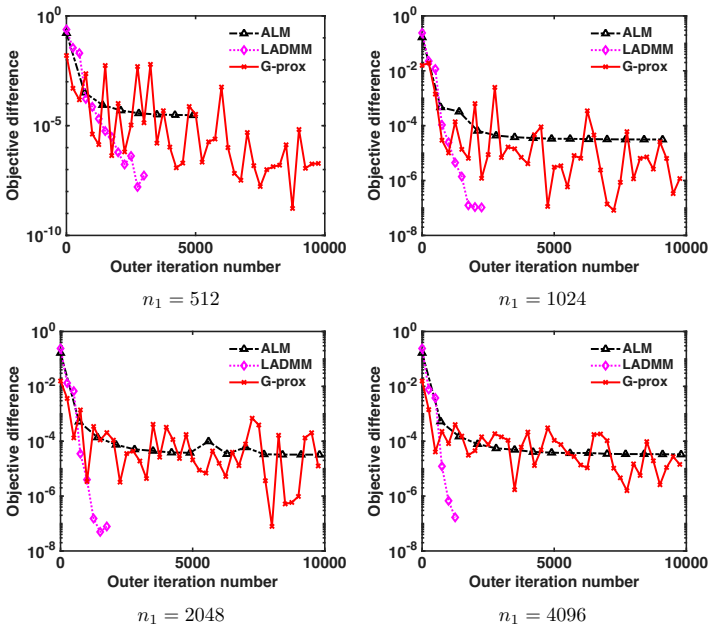
Summary. The paper proposes a linearized ADMM for the discretized Benamou–Brenier dynamic optimal transport problem. The key idea is to introduce auxiliary averaged variables so that the subproblem involving the dynamic OT energy can be solved exactly by a proximal mapping, thereby avoiding gradient-based steps whose Lipschitz constants blow up when the density approaches zero. A distributed variant partitions the space–time variables along the first spatial dimension to reduce per-agent memory and enable parallelism. Numerical experiments in 1D and 2D compare the method with FISTA, ALM, and G-prox, including challenging near-zero density settings, and report speedups of roughly 6–7× when scaling from 1 to 12 agents. A convergence statement is imported from Gao–Zhang and Xu.
Significance. If the technical gaps are repaired, the exact-proximal reformulation is a genuinely useful idea for the vanishing-density regime, and the distributed implementation addresses a real memory bottleneck in dynamic OT. The numerical study is extensive and includes systematically chosen comparisons in one and two spatial dimensions. However, as written, the paper does not yet establish that the algorithm solves the stated dynamic OT problem: the nonnegativity constraint on the discrete density is missing, the proximal lemma contains a false uniqueness claim, the pseudocode has a sign inconsistency, and the convergence theorem is asserted without verifying its hypotheses.
major comments (4)
- [§2.1, Eqs. (2.11)–(2.13); §2.3, Eq. (2.16)] The discretized problem never imposes M0 ≥ 0. In the continuous problem (1.1), F enforces ρ ∈ R_+; the staggered array M0 is the discrete counterpart of ρ, so feasible M0 should be nonnegative. The set C in (2.10) is only the linear continuity equation, and the projection (2.16) is an unconstrained projection onto C. Lemma 2.1 guarantees nonnegativity only of the auxiliary variable Mbar0, not of M0. Thus the algorithm may converge to points with negative entries in M0 that are not densities for (1.1). The paper neither states this relaxation nor proves that every relaxed feasible point can be replaced by a nonnegative staggered density with the same objective. Because the lower objective values reported in Tables 4–6 may arise from this relaxed, nonphysical problem, the central claim that LADMM solves the dynamic OT problem is not established. Relatedly, f in (2.6) is undefined when Avg0
- [§2.3, Algorithm 2.1 line 3 and Eqs. (2.14),(2.17),(2.18)] There is a sign inconsistency in the auxiliary-variable update. With the augmented Lagrangian defined in (2.14) and the dual updates in (2.17), completing the square over Mbar0 with M0 fixed gives an input c + Λ^k/β_k to the proximal map, not c − Λ^k/β_k (and similarly for Mbar). Algorithm 2.1 line 3 writes minus signs. These minus signs are inconsistent with the gradient step (2.18), whose gradient is Avg0^*(Λ^k + β_k(c^k − Mbar0^{k+1})); with the correct plus sign that gradient vanishes at the proximal point, as expected in ADMM. As written, the algorithm is not the LADMM scheme analyzed in Theorem 2.4, and the reported numerical convergence cannot be attributed to the stated updates unless the code uses a different sign convention. The authors should correct the sign or clarify the convention.
- [Lemma 2.1 and Appendix A] The claim that ρ in (2.12) is “the unique real-number solution” of the cubic (A.7) is false. For example, with γ=1, ρ̂=10, m̂=0, the cubic is (ρ+1)^2(ρ−10)=0, which has real roots −1 and 10, while the correct proximal value is ρ=10. Non-uniqueness of real roots can also occur in the “otherwise” branch. Since Algorithm 2.1 requires solving this cubic, the paper must specify a deterministic selection rule (e.g., the unique nonnegative real root, or the largest real root) and prove that this root gives the proximal minimizer. As stated, the lemma is incorrect.
- [§2.3, Theorem 2.4] The convergence theorem is asserted by direct citation of [18, Thm 4.3] and [47, Thm 2.13] without verifying their hypotheses. In particular, the objective f in (2.6) is not a closed proper convex function unless its domain and extended-value convention are specified; Algorithm 2.1 as written does not match the scheme covered by those references because of the sign issue above; and the numerical schedule (4.1) uses β_k nonconstant, whereas Theorem 2.4 assumes constant β. The O(1/K) guarantee is therefore not established for the implemented method. The authors should either verify the hypotheses of the cited results, or prove convergence directly for the actual algorithm and parameter schedule.
minor comments (4)
- [Tables 1–7] The table formatting is garbled in the manuscript text: column separators are missing and several rows appear to have entries merged or omitted (e.g., Table 1, n1=4096). This makes the numerical claims difficult to verify and should be corrected.
- [§2.2, near Eq. (2.28)] Typo: “egivenvectors” should be “eigenvectors”.
- [Figure 9 caption] Typo: “dentity setting” should be “density setting”.
- [Eqs. (2.2)–(2.3)] The domain/codomain conventions for V_d and V in the definitions of Avg_d and Avg_d^* are terse. A brief statement that bJ_d indexes the staggered grid and how boundary entries are handled would improve readability.
Circularity Check
Central LADMM derivation is self-contained, but one experimental benchmark defines the reference optimal value as LADMM's own output, making that accuracy comparison circular by construction.
-
fitted input called prediction
[Section 4.2.3, paragraph following Table 4 (definition of obj*_num used in Table 5)]
"We use the best objective values obtained by LADMM in the 7-th column of Table 4 as obj*_num to calculate |obj−obj*_num| and report it in Table 5"
The reference 'optimal' objective obj*_num is not an independently computed optimum; it is taken from LADMM's own lowest objective in Table 4. Consequently, LADMM's reported |obj−obj*_num| in Table 5 is just the difference between two LADMM runs (one at tolerance 10^-8, one at 10^-4), not a distance to an external ground truth. The favorable accuracy comparison for LADMM in that table is forced by construction: the method is being measured against a yardstick defined by its own output. This does not invalidate the algorithmic derivation, but it makes the 'near-optimal' validation in Table 5 self-referential.
full rationale
The algorithmic derivation itself is largely self-contained. Lemma 2.1 is proved in the appendix; the projection subproblem is reduced to a Poisson/Sylvester equation solved by eigendecomposition; and the LADMM updates follow from standard variable splitting. The convergence guarantee in Theorem 2.4 is imported from [18] and [47]; [47] is co-authored by Xu, but it is a published, parameter-free convergence result and is independently available from [18], so it is real evidence rather than a circular self-citation. The penalty parameter beta0 is tuned by grid search, which is ordinary parameter fitting and not a prediction. The reported speedups are direct timing comparisons across agent counts. The one genuinely circular element is the experimental reference obj*_num: the paper defines the 'optimal objective value' as LADMM's own best objective and then measures LADMM's error against it, so that specific accuracy comparison reduces to self-consistency by construction. This is confined to Section 4.2.3 / Table 5 and does not compromise the core proximal/projection derivation. Separately, and as a correctness concern rather than circularity, the discretized problem (2.13) and projection (2.16) never enforce M0 >= 0, so the method may solve a relaxed problem with negative staggered densities that do not correspond to a valid density for the original Benamou-Brenier problem; this omission should be weighed in assessing the claim that the method solves dynamic OT as originally posed.
Assumptions & free parameters
free parameters (1)
- β0 (LADMM penalty parameter) =
grid-selected per experiment; e.g., 1e-4 in distributed runs
assumptions (4)
- domain assumption M0 is allowed to take negative values in (2.13) and (2.16); only the linear continuity constraint C is enforced.
- domain assumption The convergence theorem from [18,47] applies to Algorithm 2.1 with the non-globally-Lipschitz objective f.
- domain assumption The staggered-grid discretization (2.6)–(2.10) faithfully approximates the continuum problem (1.1).
- standard math The eigen-decomposition in (2.28) of the tridiagonal matrices A_d is orthonormal and can be applied via DCT.
Cite this review
Pith. "Pith review of Scalable Dynamic Optimal Transport via Distributed Linearized ADMM." pith.science (2026). https://pith.science/paper/2LZTXMK6
@misc{pith2026260726407,
  author       = {Pith},
  title        = {Pith review of: Scalable Dynamic Optimal Transport via Distributed Linearized ADMM},
  year         = {2026},
  howpublished = {\url{https://pith.science/paper/2LZTXMK6}},
  note         = {Machine review of arXiv:2607.26407}
}
read the original abstract
In this paper, we address two fundamental challenges in the numerical solution of dynamic opti- mal transport (OT) problems. The first challenge arises when the initial and/or terminal densities approach zero and no positive lower bound is available. In this regime, conventional methods may become unstable or computationally inefficient, since the Lipschitz constant of the objective can scale like the reciprocal of the cube of the density. As a result, near-zero regions may lead to slow convergence or even divergence. The second challenge concerns the substantial memory cost of the dynamic formulation, whose discretization over fine spatial and temporal grids requires storing vari- ables across the entire space-time domain. This storage burden quickly becomes prohibitive as the grid is refined or the spatial dimension increases. To overcome the first difficulty, we reformulate the classical discretized dynamic OT problem so that the resulting objective admits an exact proximal mapping. When combined with a linearized alternating direction method of multipliers (LADMM), this reformulation yields an efficient and robust algorithm that remains stable even in challenging settings where the density may vanish. To reduce the memory burden, we further introduce a dis- tributed formulation in which the optimization variables are partitioned across multiple agents. This design substantially lowers the storage requirement for each agent and can also lead to computational acceleration. We validate the proposed framework through numerical experiments in one- and two- dimensional spatial settings under varying levels of difficulty. The results demonstrate the stability, robustness, and scalability of the proposed method in comparison with conventional approaches.
Figures


Figures from the paper (8 more)




Reference graph
Works this paper leans on
-
[47]
Advances in mathematics , volume=
A convexity principle for interacting gases , author=. Advances in mathematics , volume=. 1997 , publisher=
1997
-
[1]
Contemporary mathematics , volume=
A numerical method for the optimal time-continuous mass transport problem and related problems , author=. Contemporary mathematics , volume=. 1999 , publisher=
1999
-
[2]
Mathematics of Computation , volume=
A fast proximal gradient method and convergence analysis for dynamic mean field planning , author=. Mathematics of Computation , volume=
-
[3]
Journal of mathematical imaging and vision , volume=
A first-order primal-dual algorithm for convex problems with applications to imaging , author=. Journal of mathematical imaging and vision , volume=. 2011 , publisher=
2011
-
[4]
1998 , school=
The optimal time-continuous mass transport problem and its augmented Lagrangian numerical resolution , author=. 1998 , school=
1998
-
[5]
Journal of the Operations Research Society of China , volume=
First-order algorithms for convex optimization with nonseparable objective and coupled constraints , author=. Journal of the Operations Research Society of China , volume=. 2017 , publisher=
2017
-
[6]
Numerische Mathematik , volume=
A computational fluid mechanics solution to the Monge-Kantorovich mass transfer problem , author=. Numerische Mathematik , volume=. 2000 , publisher=
2000
-
[7]
Variational Methods for Discontinuous Structures: International Workshop at Villa Erba (Cernobbio), Italy, July 2001 , pages=
Optimal transportation problems with free Dirichlet regions , author=. Variational Methods for Discontinuous Structures: International Workshop at Villa Erba (Cernobbio), Italy, July 2001 , pages=. 2002 , organization=
2001
Show all 75 references
-
[8]
ESAIM: Control, Optimisation and Calculus of Variations , volume=
A variational model for urban planning with traffic congestion , author=. ESAIM: Control, Optimisation and Calculus of Variations , volume=. 2005 , publisher=
2005
-
[9]
2006 , publisher=
Mass Transportation Problems: Volume 1: Theory , author=. 2006 , publisher=
2006
-
[10]
2005 , school=
Optimisation de problemes de transport , author=. 2005 , school=
2005
-
[11]
Advances in neural information processing systems , volume=
Sinkhorn distances: Lightspeed computation of optimal transport , author=. Advances in neural information processing systems , volume=
-
[12]
International conference on machine learning , pages=
Fast computation of Wasserstein barycenters , author=. International conference on machine learning , pages=. 2014 , organization=
2014
-
[13]
ACM Transactions on Graphics (ToG) , volume=
Convolutional wasserstein distances: Efficient optimal transportation on geometric domains , author=. ACM Transactions on Graphics (ToG) , volume=. 2015 , publisher=
2015
-
[14]
International conference on machine learning , pages=
Wasserstein generative adversarial networks , author=. International conference on machine learning , pages=. 2017 , organization=
2017
-
[15]
arXiv preprint arXiv:1803.05573 , year=
Improving GANs using optimal transport , author=. arXiv preprint arXiv:1803.05573 , year=
-
[16]
The review of economic studies , volume=
Income and wealth distribution in macroeconomics: A continuous-time approach , author=. The review of economic studies , volume=. 2022 , publisher=
2022
-
[17]
2018 , publisher=
Optimal transport methods in economics , author=. 2018 , publisher=
2018
-
[18]
Proceedings of the National Academy of Sciences , volume=
A machine learning framework for solving high-dimensional mean field game and mean field control problems , author=. Proceedings of the National Academy of Sciences , volume=. 2020 , publisher=
2020
-
[19]
arXiv preprint arXiv:1807.01083 , year=
A mean-field optimal control formulation of deep learning , author=. arXiv preprint arXiv:1807.01083 , year=
-
[20]
2021 , publisher=
Topics in optimal transportation , author=. 2021 , publisher=
2021
-
[21]
2009 , publisher=
Optimal transport: old and new , author=. 2009 , publisher=
2009
-
[22]
PhD Thesis (Univ
Mean field games and applications to economics , author=. PhD Thesis (Univ. Paris-Dauphine , year=
-
[23]
Paris-Princeton lectures on mathematical finance 2010 , pages=
Mean field games and applications , author=. Paris-Princeton lectures on mathematical finance 2010 , pages=. 2011 , publisher=
2010
-
[24]
Doklady Akademii Nauk , volume=
On the transfer of masses (in Russian) , author=. Doklady Akademii Nauk , volume=
-
[25]
Journal of Convex Analysis , volume=
Dynamic formulation of optimal transport problems , author=. Journal of Convex Analysis , volume=. 2008 , publisher=
2008
-
[26]
ESAIM: Mathematical Modelling and Numerical Analysis , volume=
A generalized model for optimal transport of images including dissipation and density modulation , author=. ESAIM: Mathematical Modelling and Numerical Analysis , volume=. 2015 , publisher=
2015
-
[27]
ESAIM: Mathematical Modelling and Numerical Analysis , volume=
Eulerian models and algorithms for unbalanced optimal transport , author=. ESAIM: Mathematical Modelling and Numerical Analysis , volume=
-
[28]
Archive for Rational Mechanics and Analysis , volume=
Generalized Wasserstein distance and its application to transport equations with source , author=. Archive for Rational Mechanics and Analysis , volume=. 2014 , publisher=
2014
-
[29]
IEEE transactions on automatic control , volume=
Large-population cost-coupled LQG problems with nonuniform agents: Individual-mass behavior and decentralized varepsilon -Nash equilibria , author=. IEEE transactions on automatic control , volume=. 2007 , publisher=
2007
-
[30]
COMMUNICATIONS IN INFORMATION AND SYSTEMS , volume =
Large population stochastic dynamic games: closed-loop McKean-Vlasov systems and the Nash certainty equivalence principle , author=. COMMUNICATIONS IN INFORMATION AND SYSTEMS , volume =
-
[31]
SIAM Journal on Control and Optimization , volume=
Mean field games: numerical methods for the planning problem , author=. SIAM Journal on Control and Optimization , volume=. 2012 , publisher=
2012
-
[32]
Journal of Optimization Theory and Applications , volume=
Augmented Lagrangian methods for transport optimization, mean field games and degenerate elliptic equations , author=. Journal of Optimization Theory and Applications , volume=. 2015 , publisher=
2015
-
[33]
Proceedings of the ARPA image understanding workshop , volume=
The earth mover’s distance, multi-dimensional scaling, and color-based image retrieval , author=. Proceedings of the ARPA image understanding workshop , volume=
-
[34]
Computer Vision--ECCV 2008: 10th European Conference on Computer Vision, Marseille, France, October 12-18, 2008, Proceedings, Part III 10 , pages=
A linear time histogram metric for improved sift matching , author=. Computer Vision--ECCV 2008: 10th European Conference on Computer Vision, Marseille, France, October 12-18, 2008, Proceedings, Part III 10 , pages=. 2008 , organization=
2008
-
[35]
Economic Theory , volume=
Hedonic price equilibria, stable matching, and optimal transport: equivalence, topology, and uniqueness , author=. Economic Theory , volume=. 2010 , publisher=
2010
-
[36]
Advances in neural information processing systems , volume=
Near-linear time approximation algorithms for optimal transport via Sinkhorn iteration , author=. Advances in neural information processing systems , volume=
-
[37]
IEEE signal processing magazine , volume=
Optimal mass transport: Signal processing and machine-learning applications , author=. IEEE signal processing magazine , volume=. 2017 , publisher=
2017
-
[38]
Sixth international conference on computer vision (IEEE Cat
A metric for distributions with applications to image databases , author=. Sixth international conference on computer vision (IEEE Cat. No. 98CH36271) , pages=. 1998 , organization=
1998
-
[39]
SIAM Journal on Scientific Computing , volume=
Numerical simulation of diffusive and aggregation phenomena in nonlinear continuity equations by evolving diffeomorphisms , author=. SIAM Journal on Scientific Computing , volume=. 2010 , publisher=
2010
-
[40]
SIAM journal on mathematical analysis , volume=
The variational formulation of the Fokker--Planck equation , author=. SIAM journal on mathematical analysis , volume=. 1998 , publisher=
1998
-
[41]
Foundations of Computational Mathematics , volume=
Numerical analysis of a robust free energy diminishing finite volume scheme for parabolic equations with gradient structure , author=. Foundations of Computational Mathematics , volume=. 2017 , publisher=
2017
-
[42]
ESAIM: Control, Optimisation and Calculus of Variations , volume=
On the total variation Wasserstein gradient flow and the TV-JKO scheme , author=. ESAIM: Control, Optimisation and Calculus of Variations , volume=. 2019 , publisher=
2019
-
[43]
Nature , volume=
A reconstruction of the initial conditions of the universe by optimal mass transportation , author=. Nature , volume=. 2002 , publisher=
2002
-
[44]
2017 , school=
Unbalanced optimal transport: Models, numerical methods, applications , author=. 2017 , school=
2017
-
[45]
Foundations of Computational Mathematics , volume=
An interpolating distance between optimal transport and Fisher--Rao metrics , author=. Foundations of Computational Mathematics , volume=. 2018 , publisher=
2018
-
[46]
SIAM Journal on Imaging Sciences , volume=
Optimal transport with proximal splitting , author=. SIAM Journal on Imaging Sciences , volume=. 2014 , publisher=
2014
-
[48]
HAL , year=
Primal-dual formulation of the Dynamic Optimal Transport using Helmholtz-Hodge decomposition , author=. HAL , year=
-
[49]
2012 , publisher=
Finite element methods for Navier-Stokes equations: theory and algorithms , author=. 2012 , publisher=
2012
-
[50]
2015 , publisher=
Optimal Transport for applied mathematicians, progress in nonlinear differential equations and their applications , author=. 2015 , publisher=
2015
-
[51]
Numerische Mathematik , volume=
Domain decomposition for entropy regularized optimal transport , author=. Numerische Mathematik , volume=. 2021 , publisher=
2021
-
[52]
SIAM journal on numerical analysis , volume=
A domain decomposition method for the polar factorization of vector-valued mappings , author=. SIAM journal on numerical analysis , volume=. 1995 , publisher=
1995
-
[53]
Pacific Journal of Mathematics , volume=
Concerning nonnegative matrices and doubly stochastic matrices , author=. Pacific Journal of Mathematics , volume=. 1967 , publisher=
1967
-
[54]
SIAM Journal on Optimization , volume=
Accelerated first-order primal-dual proximal methods for linearly constrained composite convex programming , author=. SIAM Journal on Optimization , volume=. 2017 , publisher=
2017
-
[55]
SIAM Journal on Scientific Computing , volume=
Iterative Bregman projections for regularized transportation problems , author=. SIAM Journal on Scientific Computing , volume=. 2015 , publisher=
2015
-
[56]
arXiv preprint arXiv:2301.12065 , year=
Decentralized Entropic Optimal Transport for Privacy-preserving Distributed Distribution Comparison , author=. arXiv preprint arXiv:2301.12065 , year=
-
[57]
SIAM Journal on Numerical Analysis , volume=
Solving large-scale optimization problems with a convergence rate independent of grid size , author=. SIAM Journal on Numerical Analysis , volume=. 2019 , publisher=
2019
-
[58]
Journal of Computational Physics , volume=
Gradient enhanced ADMM algorithm for dynamic optimal transport on surfaces , author=. Journal of Computational Physics , volume=. 2025 , publisher=
2025
-
[59]
ACM Transactions on Graphics (TOG) , volume=
Dynamical optimal transport on discrete surfaces , author=. ACM Transactions on Graphics (TOG) , volume=. 2018 , publisher=
2018
-
[60]
Transactions on Machine Learning Research , year=
Neural monge map estimation and its applications , author=. Transactions on Machine Learning Research , year=
-
[61]
SIAM Journal on Scientific Computing , volume=
A scalable deep learning approach for solving high-dimensional dynamic optimal transport , author=. SIAM Journal on Scientific Computing , volume=. 2023 , publisher=
2023
-
[62]
Journal of Computational Physics , volume=
Bridging mean-field games and normalizing flows with trajectory regularization , author=. Journal of Computational Physics , volume=. 2023 , publisher=
2023
-
[63]
Journal of Computational Physics , volume=
Unsupervised solution operator learning for mean-field games , author=. Journal of Computational Physics , volume=. 2025 , publisher=
2025
-
[64]
2019 , publisher=
Computational optimal transport: With applications to data science , author=. 2019 , publisher=
2019
-
[65]
Journal of Computational Physics , volume=
Computational mean-field games on manifolds , author=. Journal of Computational Physics , volume=. 2023 , publisher=
2023
-
[66]
Journal of Scientific Computing , volume=
A parallel method for earth mover’s distance , author=. Journal of Scientific Computing , volume=. 2018 , publisher=
2018
-
[67]
Annals of operations research , volume=
The auction algorithm: A distributed relaxation method for the assignment problem , author=. Annals of operations research , volume=. 1988 , publisher=
1988
-
[68]
Naval research logistics quarterly , volume=
The Hungarian method for the assignment problem , author=. Naval research logistics quarterly , volume=. 1955 , publisher=
1955
-
[69]
SIAM review , volume=
Tensor decompositions and applications , author=. SIAM review , volume=. 2009 , publisher=
2009
-
[70]
Advances in neural information processing systems , volume=
Linearized alternating direction method with adaptive penalty for low-rank representation , author=. Advances in neural information processing systems , volume=
-
[71]
East Asian Journal on Applied Mathematics , volume=
Linearized alternating direction method of multipliers for constrained linear least-squares problem , author=. East Asian Journal on Applied Mathematics , volume=. 2012 , publisher=
2012
-
[72]
SIAM Journal on Imaging Sciences , volume=
An accelerated linearized alternating direction method of multipliers , author=. SIAM Journal on Imaging Sciences , volume=. 2015 , publisher=
2015
-
[73]
Foundations of Computational Mathematics , volume=
An extragradient-based alternating direction method for convex minimization , author=. Foundations of Computational Mathematics , volume=. 2017 , publisher=
2017
-
[74]
Signal, Image and Video Processing , volume=
Fast linearized alternating direction method of multipliers for the augmented _1 -regularized problem , author=. Signal, Image and Video Processing , volume=. 2015 , publisher=
2015
-
[75]
SIAM Journal on Numerical Analysis , volume=
On the O(1/n) convergence rate of the Douglas--Rachford alternating direction method , author=. SIAM Journal on Numerical Analysis , volume=. 2012 , publisher=
2012
Reviewed August 1, 2026 · model on record in the stance chip above.
Discussion (0). Continue with ORCID to comment.