REVIEW 4 major objections 5 minor 58 references
ADVMEM: Adversarial Memory Initialization for Realistic Test-Time Adaptation via Tracklet-Based Benchmarking
T0 review · 4 major / 5 minor · reviewed 2026-08-05 · deepseek-v4-flash
Pith's one-line read Test-time adaptation fails on object tracklets from real video—error jumps to about 94%—and pre-filling the memory bank with class-balanced adversarial images cuts it to 48.9%.
desk verdict The ITD tracklet benchmark is a real contribution and the 94%-error finding is worth knowing, but the ADVMEM headline gain is not isolated and the paper's own Section 6.1 contradicts Table 2. read the letter →
The pith
A machine-rendered reading of the paper's core claim, the machinery that carries it, and where it could break.
The reading
What carries the argument
The two load-bearing mechanisms are the ITD tracklet construction and the ADVMEM initialization. ITD extracts object-centric crops from tracking videos (TrackingNet) at 5-frame intervals, resizes them, and applies corruptions consistently across each tracklet, so the stream has genuine temporal dependencies instead of independent corrupted images. ADVMEM is the algorithmic fix: for each memory slot, draw Gaussian noise, assign a random class label, and run gradient descent on the cross-entropy loss until the frozen model classifies the noise as that label; the resulting synthetic images form a class-diverse memory that biases early adaptation steps toward all classes. It is a plug-in because
What would settle it
Re-run the tracklet-wise experiments under a strict video-level split of TrackingNet (assign all tracklets from a source video to one split) and compare ADVMEM's gains; if the 44-point SHOT-IM improvement shrinks or vanishes, the benchmark's overlap, not the memory initialization, produced the effect. Separately, initialize the memory with real training images (TrainMem), random Gaussian noise with random labels, and adversarial images at different attack strengths; if any of these match ADVMEM's performance, the adversarial optimization is not the active ingredient.
Extended reading notes
Core claim
On its own terms, the paper's central discovery is two-part. First, realistic temporal dependence—the same object appearing in consecutive frames—breaks current TTA methods in a way that standard shuffled benchmarks do not reveal; under ITD's tracklet-wise i.i.d. protocol, SHOT-IM and TENT hover near 93–95% error, close to random guessing on the 21-class task. Second, a large share of that failure is attributable to the empty initialization of memory banks: when the memory is pre-filled with one synthetic image per class, each generated by adversarially perturbing Gaussian noise until the frozen model classifies it as a given label, the same methods adapt stably. The strongest numbers are fo
Load-bearing premise
The benchmark's realism and the reported gains assume that no video appears in both the ITD fine-tuning split and the test split; if tracklets from the same source video leak across splits, the model could be matching memorized object appearances rather than adapting to genuinely new ones.
Editorial extensions
If this is right
- Memory-based TTA methods should not start with empty banks; class-balanced initialization is a cheap, plug-in fix that preserves the original adaptation rule.
- Standard shuffled-image TTA evaluation overstates robustness: SHOT-IM averages 39.3% error in the frame-wise i.i.d. setting but 93.4% in the tracklet-wise i.i.d. setting without ADVMEM.
- ADVMEM's benefit grows as the stream becomes more non-i.i.d.; in near-uniform streams (γ→∞) the memory is quickly overwritten by real samples and the initialization neither helps nor hurts.
- The largest gains are in entropy/information-maximization methods (TENT, SHOT-IM); for the already memory-based RoTTA the gain is concentrated in non-i.i.d. streams and specific corruptions such as pixelate and zoom.
- Initializing memory with real training images (TrainMem) helps less than adversarial synthetic initialization, so class coverage alone is not sufficient; the synthetic samples themselves contribute.
Reading between the lines
- A natural next test is to vary what the memory is filled with—random noise, one-class samples, or adversarial examples with a range of attack strengths—to isolate whether the active ingredient is class coverage, perceptual plausibility, or regularization of early batch statistics.
- The same empty-memory failure should appear in online continual learning and replay-based methods: any buffer that starts empty under a class-incremental stream will bias updates toward early classes, so an ADVMEM-style initialization could transfer beyond TTA.
- Because ADVMEM's synthetic entries are generated once with the frozen model, they become stale as adaptation shifts the weights; regenerating or re-weighting entries during the stream is a natural extension.
Editorial analysis
A structured set of objections, weighed in public.
Referee Report
Summary. The paper introduces ITD, a test-time adaptation (TTA) benchmark constructed from TrackingNet tracklets, i.e., object-centric image sequences from real video, with consistent corruptions applied to preserve temporal dependencies. The authors argue that this is more realistic than prior frame-level benchmarks and evaluate eight TTA methods under frame-wise i.i.d., tracklet-wise i.i.d., and tracklet-wise non-i.i.d. settings. They also propose ADVMEM, an adversarial memory initialization scheme that populates a TTA memory bank with synthesized examples obtained by targeted adversarial attacks on the deployed model, and show large error-rate reductions when it is applied to memory-based TTA methods. In the headline result, equipping SHOT-IM with ADVMEM reduces the average tracklet-wise i.i.d. error from 93.4% to 48.9%, and in non-i.i.d. settings RoTTA+ADVMEM improves from 79.3% to 75.5%.
Significance. If the claims hold, the ITD benchmark is a useful step toward realistic TTA evaluation, because it combines distribution shift with genuine temporal dependencies rather than synthetic label correlations. The paper is extensive: it covers multiple corruptions, several state-of-the-art TTA methods, two architectures, dynamic severity, and includes a public code link. ADVMEM is a simple plug-in that could transfer to other memory-based TTA methods. However, the benchmark's validity depends on an unspecified split procedure, and the central attribution of the gains to adversarial initialization is not supported by appropriate controls for the methods and settings where the gains are largest. The empirical core is therefore defensible but currently incomplete.
major comments (4)
- [§3.1 (Dataset Construction)] The split into training/validation/test is only stated as 50/30/20. ITD is built from TrackingNet videos, so if the split is not performed at the video level, tracklets from the same source video can appear in both training and test sets. Since the source models are fine-tuned on the training split, this could cause near-duplicate frame leakage and inflate the measured TTA gains. Please specify whether the split is video-level, tracklet-level, or frame-level, and report the number of unique videos in each split and any overlap statistics.
- [§5.1, Table 2; Appendix §11, Table 5] The headline improvement of SHOT-IM and TENT with ADVMEM is compared only against an empty memory bank. The necessary control is the same memory bank initialized with class-balanced, non-corrupted training samples (Algorithm 2, TrainMem). This control is reported only for RoTTA in the non-i.i.d. setting, where TrainMem itself improves RoTTA from 79.3% to 78.2% — which contradicts the main-text statement that training-sample initialization 'does not improve performance.' Without TrainMem results for TENT and SHOT-IM in the tracklet-wise i.i.d. setting, the large gains in Table 2 cannot be attributed to adversarial optimization rather than to simply pre-populating the memory with class-balanced examples.
- [§5.1, Algorithm 1; §4.2] Key hyperparameters for ADVMEM are missing: the memory bank capacity N, the adversarial step size α, the termination condition beyond the hard label check, the maximum number of iterations, and the number of samples per class. Algorithm 1 loops until fθ(x)=y with no cap, which is both hard to reproduce and potentially very expensive. Since the performance of memory initialization is likely sensitive to N and to the optimization budget, please report these values and provide a complete pseudo-code specification.
- [Supplementary §9 (Dynamic Corruption)] The severity function is defined as S(t)=s·|sign(t)|. For positive frame indices t this reduces to a constant severity s, which contradicts the intended time-varying severity described in the text and in Figure 6. If this formula is implemented literally, the 'dynamic severity' experiments do not actually vary severity over time. Please correct the formula (e.g., to a sinusoidal or otherwise time-varying function) and confirm the experiments use that corrected version.
minor comments (5)
- [Abstract and §1] The phrase 'reduces error rates by 44%' should be 'by 44.5 percentage points' (93.4% to 48.9%); the relative reduction is about 48%. This also affects several similar statements in the text.
- [Main text, Tables 2 and 3] Table numbers are duplicated: Table 2 is used both for the method overview and for the ADVMEM tracklet-wise results, and Table 3 is similarly reused. Please renumber all tables for unambiguous referencing.
- [§4.2 / Appendix §13] Please clarify whether reported error rates are sample-averaged or averaged equally across corruption types, and whether class imbalance in ITD is handled by per-class averaging. Given the non-uniform class distribution in Figure 5, this choice can affect reported comparisons.
- [Appendix §9] The function S(t)=s·|sign(t)| is presumably a typo for something like s·|sin(t)|. Please verify and correct.
- [§3.1] The paper provides a code repository link but no dataset download link or full preprocessing script for ITD. Please add instructions for obtaining the benchmark and reproducing the tracklet extraction, so that the benchmark can be used by the community.
Circularity Check
No circular derivation: ADVMEM's gains are empirical and not fitted to test labels; self-citations are present but not load-bearing.
full rationale
The paper's central derivation chain is empirical. ADVMEM generates synthetic samples by optimizing the deployed model's cross-entropy (Eq. 1), populates the memory, and then measures error on the ITD test stream. No equation is defined in terms of the target result, and no fitted parameter is renamed as a prediction. The adversarial-generation recipe is attributed to self-cited work [1] and standard adversarial examples [14], but that citation supplies an algorithm, not a uniqueness theorem or a fitted value; the claimed improvements are evaluated on real tracklets and compared against baselines, so the central claim does not reduce to the citation. The benchmark uses TrackingNet [34], from the same group, again as a data source rather than as a load-bearing theoretical premise. One inconsistency should be weighed as a correctness risk, not circularity: Section 5.1 states that initializing with training samples "does not improve performance," yet appendix Section 11/Table 5 shows TrainMem improves RoTTA from 79.3 to 78.2 in the non-i.i.d. setting, and no TrainMem control is reported for TENT/SHOT-IM in the tracklet-wise i.i.d. setting that produces the headline 44-point gain. This weakens the causal attribution to the 'adversarial' component but does not make the result equivalent to its input. Overall circularity is minimal: the paper contains self-citations, but they are not load-bearing and the central claims are independently evaluated.
Assumptions & free parameters
free parameters (6)
- Memory bank capacity N
- Adversarial optimization step size alpha and termination condition
- Dirichlet concentration gamma =
1e-4 (also 1e-1, 1e3)
- Batch size =
64 (ablations at 8, 16, 32)
- Corruption severity =
5 (highest)
- TTA method hyperparameters =
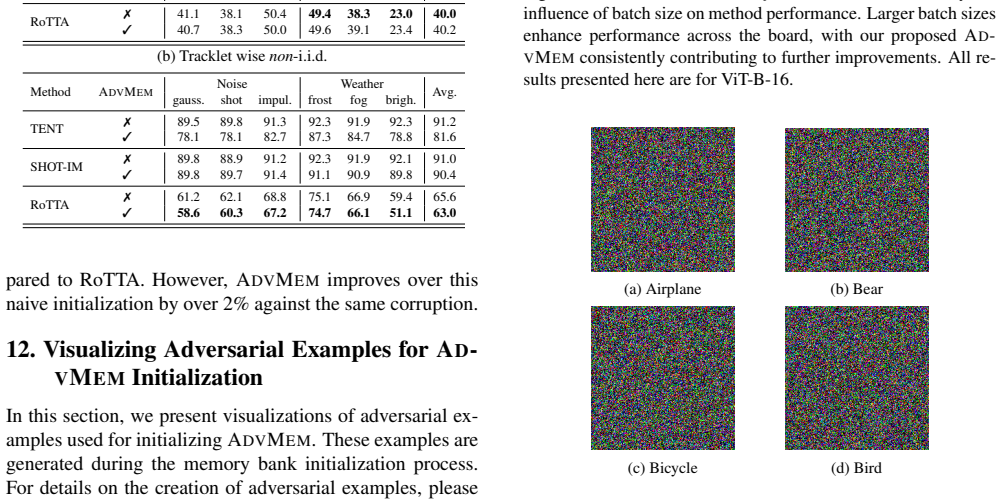
optimal, values not listed
assumptions (4)
- domain assumption Applying ImageNet-C corruptions at severity 5 consistently across tracklets models real-world distribution shifts with temporal dependence.
- domain assumption The ITD dataset split (50/30/20) is representative and free of temporal leakage between train and test.
- standard math Dirichlet sampling Dir(gamma) creates label-correlated non-i.i.d. streams as in RoTTA.
- domain assumption Fine-tuning ImageNet-pretrained models on ITD's training set yields a suitable source model for TTA evaluation.
invented entities (2)
-
Adversarial memory samples (ADVMEM)
-
ITD dataset
Cite this review
Pith. "Pith review of ADVMEM: Adversarial Memory Initialization for Realistic Test-Time Adaptation via Tracklet-Based Benchmarking." pith.science (2026). https://pith.science/paper/2MLEC6UR
@misc{pith2026250902182,
  author       = {Pith},
  title        = {Pith review of: ADVMEM: Adversarial Memory Initialization for Realistic Test-Time Adaptation via Tracklet-Based Benchmarking},
  year         = {2026},
  howpublished = {\url{https://pith.science/paper/2MLEC6UR}},
  note         = {Machine review of arXiv:2509.02182}
}
read the original abstract
We introduce a novel tracklet-based dataset for benchmarking test-time adaptation (TTA) methods. The aim of this dataset is to mimic the intricate challenges encountered in real-world environments such as images captured by hand-held cameras, self-driving cars, etc. The current benchmarks for TTA focus on how models face distribution shifts, when deployed, and on violations to the customary independent-and-identically-distributed (i.i.d.) assumption in machine learning. Yet, these benchmarks fail to faithfully represent realistic scenarios that naturally display temporal dependencies, such as how consecutive frames from a video stream likely show the same object across time. We address this shortcoming of current datasets by proposing a novel TTA benchmark we call the "Inherent Temporal Dependencies" (ITD) dataset. We ensure the instances in ITD naturally embody temporal dependencies by collecting them from tracklets-sequences of object-centric images we compile from the bounding boxes of an object-tracking dataset. We use ITD to conduct a thorough experimental analysis of current TTA methods, and shed light on the limitations of these methods when faced with the challenges of temporal dependencies. Moreover, we build upon these insights and propose a novel adversarial memory initialization strategy to improve memory-based TTA methods. We find this strategy substantially boosts the performance of various methods on our challenging benchmark.
Figures


Figures from the paper (4 more)


Reference graph
Works this paper leans on
-
[1]
Combating adver- saries with anti-adversaries
Motasem Alfarra, Juan C P ´erez, Ali Thabet, Adel Bibi, Philip HS Torr, and Bernard Ghanem. Combating adver- saries with anti-adversaries. In Proceedings of the AAAI Conference on Artificial Intelligence , pages 5992–6000,
-
[2]
Pitfalls of in-domain uncertainty es- timation and ensembling in deep learning
Arsenii Ashukha, Alexander Lyzhov, Dmitry Molchanov, and Dmitry Vetrov. Pitfalls of in-domain uncertainty es- timation and ensembling in deep learning. arXiv preprint arXiv:2002.06470, 2020
arXiv 2002
-
[3]
Parameter-free online test-time adaptation
Malik Boudiaf, Romain Mueller, Ismail Ben Ayed, and Luca Bertinetto. Parameter-free online test-time adaptation. In Proceedings of the IEEE/CVF Conference on Computer Vi- sion and Pattern Recognition (CVPR) , pages 8344–8353,
-
[4]
Parameter-free online test-time adaptation
Malik Boudiaf, Romain Mueller, Ismail Ben Ayed, and Luca Bertinetto. Parameter-free online test-time adaptation. In Proceedings of the IEEE/CVF Conference on Computer Vi- sion and Pattern Recognition, pages 8344–8353, 2022
work page 2022
-
[5]
Online con- tinual learning with natural distribution shifts: An empiri- cal study with visual data
Zhipeng Cai, Ozan Sener, and Vladlen Koltun. Online con- tinual learning with natural distribution shifts: An empiri- cal study with visual data. In Proceedings of the IEEE/CVF International Conference on Computer Vision, pages 8281– 8290, 2021
work page 2021
-
[6]
Dataset shift in machine learning
J Quinonero Candela, Masashi Sugiyama, Anton Schwaighofer, and Neil D Lawrence. Dataset shift in machine learning. The MIT Press, 1:5, 2009. 1
work page 2009
-
[7]
Contrastive test-time adaptation
Dian Chen, Dequan Wang, Trevor Darrell, and Sayna Ebrahimi. Contrastive test-time adaptation. In Proceedings of the IEEE/CVF Conference on Computer Vision and Pat- tern Recognition, pages 295–305, 2022
work page 2022
-
[8]
Evaluating the adversarial robustness of adaptive test-time defenses
Francesco Croce, Sven Gowal, Thomas Brunner, Evan Shel- hamer, Matthias Hein, and Taylan Cemgil. Evaluating the adversarial robustness of adaptive test-time defenses. In In- ternational Conference on Machine Learning , pages 4421–
Show all 58 references
-
[9]
Imagenet: A large-scale hierarchical image database
Jia Deng, Wei Dong, Richard Socher, Li-Jia Li, Kai Li, and Li Fei-Fei. Imagenet: A large-scale hierarchical image database. In 2009 IEEE conference on computer vision and pattern recognition, pages 248–255. Ieee, 2009. 3
2009
-
[10]
Back to the source: Diffusion-driven test-time adaptation
Jin Gao, Jialing Zhang, Xihui Liu, Trevor Darrell, Evan Shelhamer, and Dequan Wang. Back to the source: Diffusion-driven test-time adaptation. arXiv preprint arXiv:2207.03442, 2022
2022 arXiv
-
[11]
Real-time evaluation in online continual learning: A new paradigm.arXiv preprint arXiv:2302.01047, 2023
Yasir Ghunaim, Adel Bibi, Kumail Alhamoud, Motasem Alfarra, Hasan Abed Al Kader Hammoud, Ameya Prabhu, Philip HS Torr, and Bernard Ghanem. Real-time evaluation in online continual learning: A new paradigm.arXiv preprint arXiv:2302.01047, 2023
2023 arXiv
-
[12]
Un- supervised representation learning by predicting image rota- tions
Spyros Gidaris, Praveer Singh, and Nikos Komodakis. Un- supervised representation learning by predicting image rota- tions. arXiv preprint arXiv:1803.07728, 2018
2018 arXiv
-
[13]
Note: Robust continual test- time adaptation against temporal correlation
Taesik Gong, Jongheon Jeong, Taewon Kim, Yewon Kim, Jinwoo Shin, and Sung-Ju Lee. Note: Robust continual test- time adaptation against temporal correlation. In Advances in Neural Information Processing Systems
-
[14]
Explaining and harnessing adversarial examples
Ian J Goodfellow, Jonathon Shlens, and Christian Szegedy. Explaining and harnessing adversarial examples. arXiv preprint arXiv:1412.6572, 2014. 6
2014 arXiv
-
[15]
Deep residual learning for image recognition
Kaiming He, Xiangyu Zhang, Shaoqing Ren, and Jian Sun. Deep residual learning for image recognition. In Proceed- ings of the IEEE conference on computer vision and pattern recognition, pages 770–778, 2016. 1
2016
-
[16]
Benchmarking neu- ral network robustness to common corruptions and perturba- tions
Dan Hendrycks and Thomas Dietterich. Benchmarking neu- ral network robustness to common corruptions and perturba- tions. Proceedings of the International Conference on Learn- ing Representations, 2019. 1, 2, 3, 5
2019
-
[17]
The many faces of robustness: A critical analysis of out-of-distribution generalization
Dan Hendrycks, Steven Basart, Norman Mu, Saurav Kada- vath, Frank Wang, Evan Dorundo, Rahul Desai, Tyler Zhu, Samyak Parajuli, Mike Guo, Dawn Song, Jacob Steinhardt, and Justin Gilmer. The many faces of robustness: A critical analysis of out-of-distribution generalization. ICC...
2021
-
[18]
Denoising diffu- sion probabilistic models
Jonathan Ho, Ajay Jain, and Pieter Abbeel. Denoising diffu- sion probabilistic models. Advances in Neural Information Processing Systems, 33:6840–6851, 2020
2020
-
[19]
Test-time classifier adjustment module for model-agnostic domain generaliza- tion
Yusuke Iwasawa and Yutaka Matsuo. Test-time classifier adjustment module for model-agnostic domain generaliza- tion. Advances in Neural Information Processing Systems , 34:2427–2440, 2021. 1, 3
2021
-
[20]
Test-time classifier adjustment module for model-agnostic domain generaliza- tion
Yusuke Iwasawa and Yutaka Matsuo. Test-time classifier adjustment module for model-agnostic domain generaliza- tion. Advances in Neural Information Processing Systems , 34:2427–2440, 2021
2021
-
[21]
3d common corruptions and data augmentation
O ˘guzhan Fatih Kar, Teresa Yeo, Andrei Atanov, and Amir Zamir. 3d common corruptions and data augmentation. In Proceedings of the IEEE/CVF Conference on Computer Vi- sion and Pattern Recognition, pages 18963–18974, 2022. 1, 2, 3, 5
2022
-
[22]
Overcoming catastrophic forgetting in neu- ral networks
James Kirkpatrick, Razvan Pascanu, Neil Rabinowitz, Joel Veness, Guillaume Desjardins, Andrei A Rusu, Kieran Milan, John Quan, Tiago Ramalho, Agnieszka Grabska- Barwinska, et al. Overcoming catastrophic forgetting in neu- ral networks. Proceedings of the national academy of sc...
2017
-
[23]
Ro- bustifying vision transformer without retraining from scratch by test-time class-conditional feature alignment
Takeshi Kojima, Yutaka Matsuo, and Yusuke Iwasawa. Ro- bustifying vision transformer without retraining from scratch by test-time class-conditional feature alignment. arXiv preprint arXiv:2206.13951, 2022
2022 arXiv
-
[24]
Learning multiple layers of features from tiny images
Alex Krizhevsky, Geoffrey Hinton, et al. Learning multiple layers of features from tiny images. 2009. 3
2009
-
[25]
Pseudo-label: The simple and effi- cient semi-supervised learning method for deep neural net- works
Dong-Hyun Lee et al. Pseudo-label: The simple and effi- cient semi-supervised learning method for deep neural net- works. In Workshop on challenges in representation learn- ing, ICML, page 896, 2013
2013
-
[26]
Revisiting batch normalization for practical do- 9 main adaptation
Yanghao Li, Naiyan Wang, Jianping Shi, Jiaying Liu, and Xiaodi Hou. Revisiting batch normalization for practical do- 9 main adaptation. arXiv preprint arXiv:1603.04779, 2016. 2, 4
2016 arXiv
-
[27]
Do we really need to access the source data? source hypothesis transfer for unsupervised domain adaptation
Jian Liang, Dapeng Hu, and Jiashi Feng. Do we really need to access the source data? source hypothesis transfer for unsupervised domain adaptation. CoRR, abs/2002.08546,
2002 arXiv
-
[28]
Do we really need to access the source data? source hypothesis transfer for un- supervised domain adaptation
Jian Liang, Dapeng Hu, and Jiashi Feng. Do we really need to access the source data? source hypothesis transfer for un- supervised domain adaptation. In International Conference on Machine Learning, pages 6028–6039. PMLR, 2020. 2, 4
2020
-
[29]
A comprehensive survey on test-time adaptation under distribution shifts, 2023
Jian Liang, Ran He, and Tieniu Tan. A comprehensive survey on test-time adaptation under distribution shifts, 2023. 1
2023
-
[30]
Ttt++: When does self-supervised test-time training fail or thrive? Advances in Neural Information Processing Systems , 34: 21808–21820, 2021
Yuejiang Liu, Parth Kothari, Bastien Van Delft, Baptiste Bellot-Gurlet, Taylor Mordan, and Alexandre Alahi. Ttt++: When does self-supervised test-time training fail or thrive? Advances in Neural Information Processing Systems , 34: 21808–21820, 2021
2021
-
[31]
Kitting in the wild through online domain adaptation
Massimiliano Mancini, Hakan Karaoguz, Elisa Ricci, Patric Jensfelt, and Barbara Caputo. Kitting in the wild through online domain adaptation. In 2018 IEEE/RSJ International Conference on Intelligent Robots and Systems (IROS), pages 1103–1109. IEEE, 2018
2018
-
[32]
The norm must go on: dynamic unsuper- vised domain adaptation by normalization
M Jehanzeb Mirza, Jakub Micorek, Horst Possegger, and Horst Bischof. The norm must go on: dynamic unsuper- vised domain adaptation by normalization. In Proceedings of the IEEE/CVF Conference on Computer Vision and Pat- tern Recognition, pages 14765–14775, 2022
2022
-
[33]
Act- mad: Activation matching to align distributions for test-time- training, 2022
Muhammad Jehanzeb Mirza, Pol Jan ´e Soneira, Wei Lin, Ma- teusz Kozinski, Horst Possegger, and Horst Bischof. Act- mad: Activation matching to align distributions for test-time- training, 2022
2022
-
[34]
Trackingnet: A large-scale dataset and benchmark for object tracking in the wild
Matthias Muller, Adel Bibi, Silvio Giancola, Salman Al- subaihi, and Bernard Ghanem. Trackingnet: A large-scale dataset and benchmark for object tracking in the wild. In Proceedings of the European conference on computer vision (ECCV), pages 300–317, 2018. 1, 4
2018
-
[35]
Efficient test-time model adaptation without forgetting
Shuaicheng Niu, Jiaxiang Wu, Yifan Zhang, Yaofo Chen, Shijian Zheng, Peilin Zhao, and Mingkui Tan. Efficient test-time model adaptation without forgetting. In Interna- tional conference on machine learning, pages 16888–16905. PMLR, 2022. 2, 4
2022
-
[36]
To- wards stable test-time adaptation in dynamic wild world
Shuaicheng Niu14, Jiaxiang Wu, Yifan Zhang, Zhiquan Wen, Yaofo Chen, Peilin Zhao, and Mingkui Tan15. To- wards stable test-time adaptation in dynamic wild world. 2, 4, 13
-
[37]
Pytorch: An imperative style, high-performance deep learning library
Adam Paszke, Sam Gross, Francisco Massa, Adam Lerer, James Bradbury, Gregory Chanan, Trevor Killeen, Zem- ing Lin, Natalia Gimelshein, Luca Antiga, Alban Desmai- son, Andreas Kopf, Edward Yang, Zachary DeVito, Mar- tin Raison, Alykhan Tejani, Sasank Chilamkurthy, Benoit Steine...
2019
-
[38]
Enhancing adversarial robustness via test-time transforma- tion ensembling
Juan C P ´erez, Motasem Alfarra, Guillaume Jeanneret, Laura Rueda, Ali Thabet, Bernard Ghanem, and Pablo Arbel ´aez. Enhancing adversarial robustness via test-time transforma- tion ensembling. In Proceedings of the IEEE/CVF Interna- tional Conference on Computer Vision, pages ...
2021
-
[39]
Rdumb: A simple approach that questions our progress in continual test-time adaptation
Ori Press, Steffen Schneider, Matthias K ¨ummerer, and Matthias Bethge. Rdumb: A simple approach that questions our progress in continual test-time adaptation. Advances in Neural Information Processing Systems, 36, 2024
2024
-
[40]
Youtube-boundingboxes: A large high-precision human-annotated data set for object detection in video
Esteban Real, Jonathon Shlens, Stefano Mazzocchi, Xin Pan, and Vincent Vanhoucke. Youtube-boundingboxes: A large high-precision human-annotated data set for object detection in video. CoRR, abs/1702.00824, 2017. 4
2017 arXiv
-
[41]
Adapting visual category models to new domains
Kate Saenko, Brian Kulis, Mario Fritz, and Trevor Darrell. Adapting visual category models to new domains. In Com- puter Vision–ECCV 2010: 11th European Conference on Computer Vision, Heraklion, Crete, Greece, September 5- 11, 2010, Proceedings, Part IV 11, pages 213–226. Spri...
2010
-
[42]
Acdc: The adverse conditions dataset with correspondences for se- mantic driving scene understanding
Christos Sakaridis, Dengxin Dai, and Luc Van Gool. Acdc: The adverse conditions dataset with correspondences for se- mantic driving scene understanding. In Proceedings of the IEEE/CVF International Conference on Computer Vision , pages 10765–10775, 2021
2021
-
[43]
Improving robustness against common corruptions by covariate shift adaptation
Steffen Schneider, Evgenia Rusak, Luisa Eck, Oliver Bring- mann, Wieland Brendel, and Matthias Bethge. Improving robustness against common corruptions by covariate shift adaptation. Advances in Neural Information Processing Sys- tems, 2020. 2
2020
-
[44]
Online learning and online convex optimization
Shai Shalev-Shwartz et al. Online learning and online convex optimization. Foundations and Trends® in Machine Learn- ing, 4(2):107–194, 2012
2012
-
[45]
Revisiting realistic test- time training: Sequential inference and adaptation by an- chored clustering
Yongyi Su, Xun Xu, and Kui Jia. Revisiting realistic test- time training: Sequential inference and adaptation by an- chored clustering. arXiv preprint arXiv:2206.02721, 2022
2022 arXiv
-
[47]
Test-time training with self- supervision for generalization under distribution shifts
Yu Sun, Xiaolong Wang, Zhuang Liu, John Miller, Alexei Efros, and Moritz Hardt. Test-time training with self- supervision for generalization under distribution shifts. In International conference on machine learning, pages 9229–
-
[48]
Unbiased look at dataset bias
Antonio Torralba and Alexei A Efros. Unbiased look at dataset bias. In CVPR 2011, pages 1521–1528. IEEE, 2011
2011
-
[49]
Adversarial discriminative domain adaptation
Eric Tzeng, Judy Hoffman, Kate Saenko, and Trevor Darrell. Adversarial discriminative domain adaptation. In Proceed- ings of the IEEE conference on computer vision and pattern recognition, pages 7167–7176, 2017. 6
2017
-
[51]
Tent: Fully test-time adaptation by entropy minimization
Dequan Wang, Evan Shelhamer, Shaoteng Liu, Bruno Ol- shausen, and Trevor Darrell. Tent: Fully test-time adaptation by entropy minimization. arXiv preprint arXiv:2006.10726,
2006 arXiv
-
[52]
Continual test-time domain adaptation
Qin Wang, Olga Fink, Luc Van Gool, and Dengxin Dai. Continual test-time domain adaptation. In Proceedings of 10 the IEEE/CVF Conference on Computer Vision and Pattern Recognition, pages 7201–7211, 2022. 2, 4
2022
-
[53]
Robust test- time adaptation in dynamic scenarios
Longhui Yuan, Binhui Xie, and Shuang Li. Robust test- time adaptation in dynamic scenarios. In Proceedings of the IEEE/CVF Conference on Computer Vision and Pattern Recognition, pages 15922–15932, 2023. 1, 2, 3, 4, 6, 7, 12
2023
-
[54]
Memo: Test time robustness via adaptation and augmentation
Marvin Zhang, Sergey Levine, and Chelsea Finn. Memo: Test time robustness via adaptation and augmentation. arXiv preprint arXiv:2110.09506, 2021. 11 ADVMEM: Adversarial Memory Initialization for Realistic Test-Time Adaptation via Tracklet-Based Benchmarking Supplementary Material
2021 arXiv
-
[55]
ITD Construction Analysis & Experimental Setup Details 8.1. Dataset Distribution Overview The dataset distribution of the 21 object classes, as shown in Figure 5, presents a varied representation in terms of the number of objects and instances across different classes. The dis...
-
[56]
This dynamic approach enables us to precisely control the severity level of each corruption, closely mimicking real-world scenarios
Dynamic Corruption Incorporation: Analy- sis and Results Incorporating dynamic corruptions, as illustrated in Fig- ure 6, into our experiments involves the continuous appli- cation of corruptions within the tracklet, where the sever- ity level is defined as a function of time....
-
[57]
ViT outperforms ResNet-18, even at lower batch sizes, due to its reduced sensitivity to batch size [36]
Additional Ablations: Vision Transformer (ViT) Experiments We extend our experiments to include the Vision Trans- former (ViT) architecture. ViT outperforms ResNet-18, even at lower batch sizes, due to its reduced sensitivity to batch size [36]. Our ViT experiments focus on th...
-
[58]
Evaluation of Memory Initialization using Training Samples Algorithm 2 TrainMem function INITIALIZE MEMORY(K, N) Initialize M = {} while |M| < Ndo y ∼ U {1, 2, . . . , K} x ∼ U(D{x|y}) M ← M ∪x D ← D \ {x} end while return M end function In contrast to the approach outlined in...
-
[59]
These examples are generated during the memory bank initialization process
Visualizing Adversarial Examples for A D- VMEM Initialization In this section, we present visualizations of adversarial ex- amples used for initializing ADVMEM. These examples are generated during the memory bank initialization process. For details on the creation of adversari...
-
[60]
These tables contain additional data and de- tailed results
Supplementary Table Details This appendix we present the expanded versions of the ta- bles from the main paper, maintaining the same titles for consistency. These tables contain additional data and de- tailed results. The supplementary information includes de- tailed breakdown...
Reviewed August 5, 2026 · model on record in the stance chip above.
Discussion (0). Sign in to comment.