REVIEW 4 major objections 6 minor 127 references
FLOWR.root: A flow matching based foundation model for joint multi-purpose structure-aware 3D ligand generation and affinity prediction
T0 review · 4 major / 6 minor · reviewed 2026-08-04 · deepseek-v4-flash
Pith's one-line read FLOWR.ROOT claims that a single SE(3)-equivariant flow-matching model can jointly generate pocket-aware 3D ligands and predict binding affinity at FEP-competitive accuracy, enabling affinity-guided sampling and fast project-specific adaptat
desk verdict Solid generation paper with a leaky affinity benchmark; the authors are honest about the FEP+ overlap, but the abstract still overstates it. read the letter →
The pith
A machine-rendered reading of the paper's core claim, the machinery that carries it, and where it could break.
The reading
What carries the argument
The central object is an SE(3)-equivariant flow-matching transport map with a pocket encoder and a ligand decoder carrying three output heads: structure, affinity, and confidence. Continuous flow matching transports coordinates while discrete flow matching handles atom types, bonds, charges, and hybridization. Training follows a three-stage curriculum: pretraining on roughly 1.5 billion small molecules and 2.5 million mixed-fidelity protein-ligand complexes, fine-tuning on curated co-crystal data, and project-specific adaptation via parameter-efficient fine-tuning. Inference-time steering uses sequential Monte Carlo importance sampling to resample particles by a reward such as predicted affi
What would settle it
Compute the overlap between the FEP-type benchmark complexes and the pretraining/fine-tuning corpora (by ligand and target identity, and by protein-ligand interaction similarity). If the overlap is high, the benchmark comparison cannot support the generalization claim. Alternatively, prospectively rank a set of newly synthesized analogs for a target absent from all training data: if the Kendall tau between predicted and measured affinities falls below about 0.4, the generalization claim fails.
Extended reading notes
Core claim
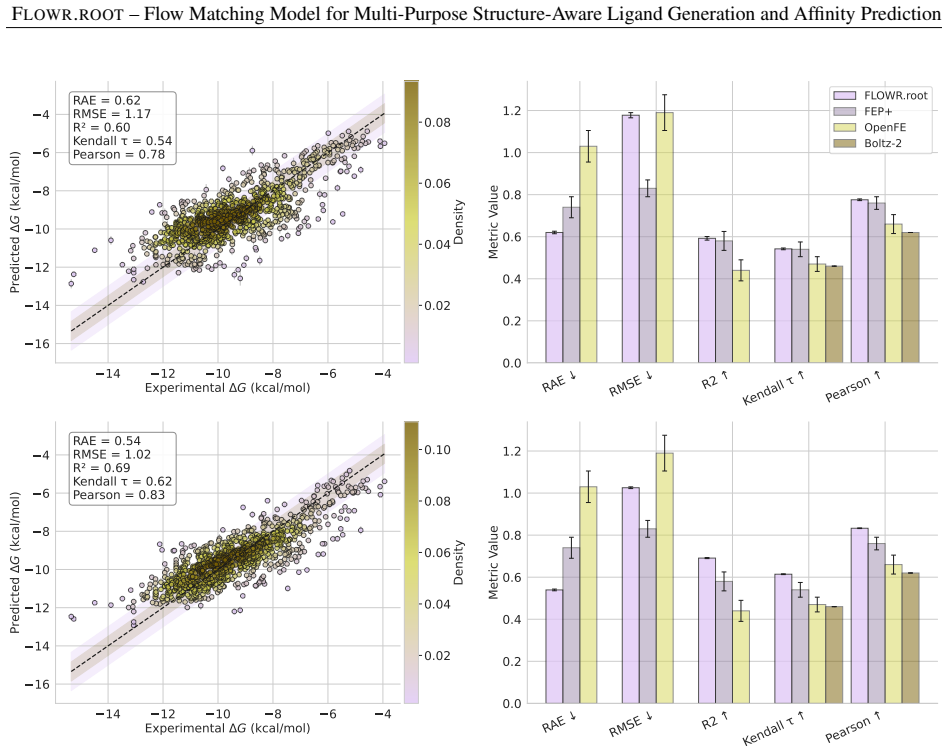
FLOWR.ROOT is an SE(3)-equivariant flow-matching model that jointly predicts ligand structure, binding affinity, and pose confidence conditioned on a protein pocket. The central claim is that this joint training is not incremental: it lets affinity gradients shape the generative distribution, so that inference-time importance sampling can push generation toward higher predicted potency, and a small amount of project-specific fine-tuning can shift the model onto an unseen structure-activity landscape. Evidence offered: state-of-the-art validity and low strain on GEOM-DRUGS, CrossDocked2020, and SPINDR; affinity correlations of R2=0.84 (pIC50) and Pearson=0.78 (aggregated) on SPINDR; accuracy
Load-bearing premise
The affinity results are taken as evidence of generalization, but the free-energy perturbation benchmark likely overlaps the training data, and the paper provides no overlap analysis; if the overlap is substantial, the reported superiority is memorization, not prediction.
Editorial extensions
If this is right
- A single model can replace separate generative and scoring stages: generated ligands carry affinity and confidence estimates at no extra cost.
- Because affinity and structure are trained jointly, fine-tuning the affinity head on project data also adjusts the generated chemical distribution, enabling rapid campaign-specific adaptation.
- Inference-time importance sampling shifts the distribution of generated ligands toward higher predicted affinity while preserving chemical validity and geometry, as demonstrated on SPINDR and in the CK2-alpha/CLK3 selectivity study.
- The speed advantage over alchemical free-energy methods makes it practical to rank large generative libraries on the fly, not just post hoc.
- Quantum-mechanical validation on TYK2, ER-alpha, and BACE1 suggests that predicted affinities track real binding-energy trends, supporting use as a prioritization filter.
Reading between the lines
- The FEP-type benchmark results likely overstate generalization: the paper concedes the benchmark overlaps the training data, and no overlap analysis is provided; the honest reading is that the model is very fast and competitive on near-distribution data, while out-of-distribution affinity prediction still requires fine-tuning (the paper's own in-house experiment shows negligible zero-shot correlat
- The claimed benefit of joint training could be tested directly by ablating the affinity head during generation and measuring whether steering effectiveness drops; the paper does not isolate this mechanism.
- The Hsp90 appendix result suggests the model does not capture explicit solvation layers; a testable extension would be conditioning generation on water positions, which could improve affinity ranking in solvent-dominated pockets.
- A prospective corollary: the most valuable deployment is not zero-shot prediction but continuous learning loops where each round of experimental data is fed back via fine-tuning; the paper gestures at this but does not demonstrate a multi-round loop.
Editorial analysis
A structured set of objections, weighed in public.
Referee Report
Summary. The paper presents FLOWR.ROOT, an SE(3)-equivariant flow-matching model that jointly learns 3D ligand generation, binding-affinity prediction (pIC50, pKi, pKd, pEC50), and confidence estimation. The model is trained in three stages: large-scale pre-training on small molecules and mixed-fidelity protein–ligand complexes, fine-tuning on curated high-fidelity datasets (SPINDR, HiQBind), and project-specific adaptation via parameter-efficient fine-tuning. The authors report state-of-the-art unconditional and pocket-conditional ligand generation on GEOM-DRUGS, CrossDocked2020, and SPINDR, competitive affinity prediction on SPINDR, and superior benchmark performance on the Schrödinger FEP+ and OpenFE benchmarks compared with AEV-PLIG, OpenFE, FEP+, and Boltz-2. The paper also demonstrates inference-time importance-sampling steering of generated molecules toward predicted higher affinity, and validates generated compounds through QM calculations in case studies on CK2α/CLK3, TYK2, ERα, and BACE1.
Significance. If the claims hold, FLOWR.ROOT would be a notable contribution: a single backbone unifying structure-aware generation, affinity prediction, confidence scoring, and transferable fine-tuning, with publicly available code and data. The generation results are extensive and internally consistent, with large improvements in PoseBusters validity, strain energy, and Vina scores over strong baselines. The QM-based case studies (especially the CK2α/CLK3 selectivity analysis) provide external evidence beyond the model's own predictions and are a genuine strength. The affinity-prediction contribution, however, is weakened by the authors' own admission that the FEP+/OpenFE benchmark overlaps with training data, and the inference-time steering demonstration is partly circular because the reward is the model's own affinity head. These issues are fixable within scope, so the paper merits revision rather than rejection.
major comments (4)
- [§5.5, Figs. 5–6] The abstract and conclusion state that FLOWR.ROOT 'outperforms recent models on the Schrödinger FEP+/OpenFE benchmark,' but §5.5 itself says the FEP+ dataset 'is likely significantly overlapping with the training data in terms of ligand and target space' and that the results should not be read as generalization. This is a load-bearing inconsistency: the affinity-superiority claim rests on a benchmark that may substantially overlap with Stage 1/Stage 2 training data. No overlap analysis (e.g., ligand Tanimoto similarity, target sequence identity, or complex-level redundancy) is provided. As written, the headline comparison against Boltz-2 is not a matched out-of-distribution test. Please either add a quantitative overlap analysis and report results on a non-overlapping subset, or explicitly reframe all FEP+/OpenFE statements as benchmark-specific recall, removing the unqualified 'superior
- [§5.4, Fig. 4; §5.8, Fig. 8] The importance-sampling steering evaluation is circular for the claim that the model 'steers design toward higher-affinity compounds.' In Fig. 4 the reward is FLOWR.ROOT's own affinity head, so showing that the mean predicted pIC50 increases is a self-consistency check, not evidence of improving true binding affinity. The CK2α/CLK3 study (Fig. 8–9) partly mitigates this by using QM binding energies as an external metric, but the SPINDR steering results remain unexplained by any external validation. Please either add an external evaluation for the steered molecules (e.g., QM, docking, or experimental data) or clearly label Fig. 4 as illustrating reward optimization against the learned model, not as evidence of true affinity improvement. In addition, the importance weight in §4.3 is written as exp(ŷ_i)/Σ exp(ŷ_j) without a temperature parameter, while the text refers to 'exp(λr)'; clarify
- [§4.2, Eq. (2)] The overall loss function as written, L_total = λ_c MSE + λ_t CE + λ_ch CE + λ_h CE + λ_b CE, contains only structure losses. The affinity loss (Huber on pIC50/pKi/pKd/pEC50) and the pLDDT confidence cross-entropy loss, both described later in the same section, are absent from the equation. Since the paper's central novelty is 'jointly trains its confidence and affinity prediction modules with structure generation,' the total loss must include these terms, or the text should explicitly explain why they are omitted from the equation. This is a technical inconsistency that should be corrected.
- [§5.6, Fig. 7] The domain-adaptation evaluation uses a random split of ~1,000 in-house ligands for fine-tuning and testing. A random split can overstate adaptation performance because analogs of the same chemical series and similar SAR can appear in both training and test partitions. As the authors frame fine-tuning as the route to 'unseen structure-activity landscapes,' a temporal or scaffold-based split—or at minimum a similarity-based analysis of train/test overlap—should be provided to support that claim. The pre-fine-tuning result (Pearson 0.39, R² −2.18) already shows poor generalization, which makes the split choice more consequential.
minor comments (6)
- [§5.5] Typo: 'high-fidelty' should be 'high-fidelity'.
- [§5.8] The sentence 'we excluded all complexes for which CLK3 binding energies were above 40.0 kcal/mol, as these resulted from structural clashes ( ˚A5.6 % of all complexes)' contains a garbled symbol placement; the percentage and the Angstrom symbol are mixed. Please fix the formatting.
- [§4.2] In the pairwise interaction definition, the text says 'Both S and P are stacked to the existing pairwise message tensor,' but P is not defined. The cross-product tensor is denoted C. This is either a typo (P should be C) or a missing definition.
- [§4.2] The normalization constant C=100 in the affinity head z_lig computation is introduced without explanation. Please state how it is chosen and whether it is a fixed hyperparameter or learned.
- [Tables 1–3] The phrase 'non-pretrained FLOWR.ROOT base model' is ambiguous. Table 1 appears to evaluate a ligand-only model trained from scratch, while Tables 2–3 evaluate a 'base model' that may or may not have received the full Stage 1 pre-training. Define the training protocol for each table explicitly.
- [References] The reference for O'Boyle et al. (Open Babel) contains an inadvertent insertion of 'Del Moral, Arnaud Doucet, and Ajay Jasra' in the author list. Also, some URLs appear malformed (e.g., the DOI in the PoseBusters reference).
Circularity Check
No significant circularity: generation and affinity claims rest on independent benchmarks and explicit caveats; self-citations are not load-bearing.
full rationale
The paper's central derivation chain is not circular. Unconditional and pocket-conditional generation are evaluated on external benchmarks (GEOM-DRUGS and CROSSDOCKED2020) against independently published baselines, with SPINDR as an additional comparison. Affinity prediction is based on a multi-stage training pipeline and evaluated on held-out SPINDR test splits and the external FEP+/OpenFE benchmarks. The authors explicitly flag the main threat to the FEP+/OpenFE comparison: 'the Schrodinger FEP+ dataset (and with that the OpenFE dataset) is likely significantly overlapping with the training data in terms of ligand and target space... we do not expect these results to indicate significant generalization capabilities' (§5.5). This is an acknowledged data-overlap validity limitation, not a construction-level circularity. The inference-time steering figure (§5.4) measures the model's own predicted pIC50 under importance-sampling weights derived from that same predicted affinity; this is a self-consistency demonstration rather than an independent empirical prediction, and the paper separately provides independent quantum-mechanical validation (TYK2, ERα, BACE1, CK2α/CLK3) for the steering claims. Self-citations to FLOWR, SPINDR, and PILOT refer to prior architecture and baseline work; no uniqueness theorem or prior result by the authors is invoked to force the conclusions. No equation is defined in terms of the quantity it is used to predict, and no fitted parameter is renamed as a prediction.
Assumptions & free parameters
free parameters (7)
- Pocket cutoff radius =
7 Å
- Pocket size limits =
10-800 atoms
- pLDDT distance thresholds and bins =
τ={0.5,1,2,4} Å, 50 bins
- Importance sampling weight/steering duration =
not specified (steering from 0.3 to 0.5 of trajectory)
- Multi-task loss weights =
unspecified
- Affinity head normalization constant C =
100
- LoRA rank / trainable params =
~10M trainable
assumptions (6)
- standard math Flow matching transport map and ODE integration are valid for molecular generation
- domain assumption SE(3)-equivariant message passing captures relevant protein-ligand interactions
- domain assumption Affinity labels from different datasets can be treated as comparable despite different assay types
- domain assumption The Plinder split prevents information leakage across all aggregated datasets
- domain assumption Semi-empirical GFN2-xTB binding energies are a proxy for experimental affinity in case studies
- domain assumption Schrödinger FEP+ experimental values are reliable ground truth
Cite this review
Pith. "Pith review of FLOWR.root: A flow matching based foundation model for joint multi-purpose structure-aware 3D ligand generation and affinity prediction." pith.science (2026). https://pith.science/paper/2N4TOUOA
@misc{pith2026251002578,
  author       = {Pith},
  title        = {Pith review of: FLOWR.root: A flow matching based foundation model for joint multi-purpose structure-aware 3D ligand generation and affinity prediction},
  year         = {2026},
  howpublished = {\url{https://pith.science/paper/2N4TOUOA}},
  note         = {Machine review of arXiv:2510.02578}
}
abstract
We present FLOWR.root, an SE(3)-equivariant flow-matching model for pocket-aware 3D ligand generation with joint potency and binding affinity prediction and confidence estimation. The model supports de novo generation, interaction- and pharmacophore-conditional sampling, fragment elaboration and replacement, and multi-endpoint affinity prediction (pIC50, pKi, pKd, pEC50). Training combines large-scale ligand libraries with mixed-fidelity protein-ligand complexes, refined on curated co-crystal datasets and adapted to project-specific data through parameter-efficient finetuning. The base FLOWR.root model achieves state-of-the-art performance in unconditional 3D molecule and pocket-conditional ligand generation. On HiQBind, the pre-trained and finetuned model demonstrates highly accurate affinity predictions, and outperforms recent state-of-the-art methods such as Boltz-2 on the FEP+/OpenFE benchmark with substantial speed advantages. However, we show that addressing unseen structure-activity landscapes requires domain adaptation; parameter-efficient LoRA finetuning yields marked improvements on diverse proprietary datasets and PDE10A. Joint generation and affinity prediction enable inference-time scaling through importance sampling, steering design toward higher-affinity compounds. Case studies validate this: selective CK2$\alpha$ ligand generation against CLK3 shows significant correlation between predicted and quantum-mechanical binding energies. Scaffold elaboration on ER$\alpha$, TYK2, and BACE1 demonstrates strong agreement between predicted affinities and QM calculations while confirming geometric fidelity. By integrating structure-aware generation, affinity estimation, property-guided sampling, and efficient domain adaptation, FLOWR.root provides a comprehensive foundation for structure-based drug design from hit identification through lead optimization.
Figures


Figures from the paper (14 more)




Reference graph
Works this paper leans on
-
[1]
Robert Abel, Lingle Wang, Edward D. Harder, B. J. Berne, and Richard A. Friesner. Advancing drug discovery through enhanced free energy calculations. Accounts of Chemical Research, 50 0 (7): 0 1625--1632, 2017. doi:10.1021/acs.accounts.7b00083
-
[2]
Ballard, Joshua Bambrick, Sebastian W
Josh Abramson, Jonas Adler, Jack Dunger, Richard Evans, Tim Green, Alexander Pritzel, Olaf Ronneberger, Lindsay Willmore, Andrew J. Ballard, Joshua Bambrick, Sebastian W. Bodenstein, David A. Evans, Chia-Chun Hung, Michael O'Neill, David Reiman, Kathryn Tunyasuvunakool, Zachary Wu, Akvil \. e Z emgulyt \. e , Eirini Arvaniti, Charles Beattie, Ottavia Bert...
2024
-
[3]
Albergo and Eric Vanden-Eijnden
Michael S. Albergo and Eric Vanden-Eijnden. Building normalizing flows with stochastic interpolants. ICLR, 2023. arXiv:2209.15571
arXiv 2023
-
[4]
Stochastic interpolants: A unifying framework for flows and diffusions
Michael S Albergo, Nicholas M Boffi, and Eric Vanden-Eijnden. Stochastic interpolants: A unifying framework for flows and diffusions. arXiv preprint, 2023. arXiv:2303.08797
arXiv 2023
-
[5]
Bodkin, Stefan Knapp, and Philip C
Matteo Aldeghi, Alexander Heifetz, Michael J. Bodkin, Stefan Knapp, and Philip C. Biggin. Accurate calculation of the absolute free energy of binding for drug molecules. Chem. Sci., 7: 0 207--218, 2016. doi:10.1039/C5SC02678D. URL http://dx.doi.org/10.1039/C5SC02678D
-
[6]
Evaluating the use of absolute binding free energy in fragment optimization
Ibrahim Alibay et al. Evaluating the use of absolute binding free energy in fragment optimization. Communications Chemistry, 5 0 (1): 0 93, 2022
2022
-
[7]
Guided docking as a data generation approach facilitates structure-based machine learning on kinases
Michael Backenk \"o hler, Joschka Gro , Verena Wolf, and Andrea Volkamer. Guided docking as a data generation approach facilitates structure-based machine learning on kinases. Journal of Chemical Information and Modeling, 64 0 (10): 0 4009--4020, May 2024. ISSN 1549-9596. doi:10.1021/acs.jcim.4c00055. URL https://doi.org/10.1021/acs.jcim.4c00055
-
[8]
Pedro J. Ballester and John B. O. Mitchell. A machine learning approach to predicting protein--ligand binding affinity with applications to molecular docking. Bioinformatics, 26 0 (9): 0 1169--1175, 2010. doi:10.1093/bioinformatics/btq112
Show all 127 references
-
[9]
Gfn2-xtb---an accurate and broadly parametrized self-consistent tight-binding quantum chemical method with multipole electrostatics and density-dependent dispersion contributions
Christoph Bannwarth, Sebastian Ehlert, and Stefan Grimme. Gfn2-xtb---an accurate and broadly parametrized self-consistent tight-binding quantum chemical method with multipole electrostatics and density-dependent dispersion contributions. Journal of Chemical Theory and Computat...
2019 doi
-
[10]
Unprecedented selectivity and structural determinants of a new class of protein kinase CK2 inhibitors in clinical trials for the treatment of cancer
Roberto Battistutta, Giorgio Cozza, Fabrice Pierre, Elena Papinutto, Graziano Lolli, Stefania Sarno, Sean E O'Brien, Adam Siddiqui-Jain, Mustapha Haddach, Kenna Anderes, David M Ryckman, Flavio Meggio, and Lorenzo A Pinna. Unprecedented selectivity and structural determinants ...
2011
-
[11]
Bolton, Jie Chen, Sunghwan Kim, Lianyi Han, Siqian He, Wenyao Shi, Vahan Simonyan, Yan Sun, Paul A
Evan E. Bolton, Jie Chen, Sunghwan Kim, Lianyi Han, Siqian He, Wenyao Shi, Vahan Simonyan, Yan Sun, Paul A. Thiessen, Jiyao Wang, Bo Yu, Jian Zhang, and Stephen H. Bryant. Pubchem3d: a new resource for scientists. Journal of Cheminformatics, 3 0 (1): 0 32, Sep 2011. ISSN 1758-...
2011 doi
-
[12]
Absolute binding free energies: A quantitative approach for their calculation
Stefan Boresch, Franz Tettinger, Martin Leitgeb, and Martin Karplus. Absolute binding free energies: A quantitative approach for their calculation. The Journal of Physical Chemistry B, 107 0 (35): 0 9535--9551, 2003. doi:10.1021/jp0217839
2003 doi
-
[13]
Prolif: a library to encode molecular interactions as fingerprints
C \'e dric Bouysset and S \'e bastien Fiorucci. Prolif: a library to encode molecular interactions as fingerprints. Journal of Cheminformatics, 13 0 (1): 0 72, Sep 2021. ISSN 1758-2946. doi:10.1186/s13321-021-00548-6. URL https://doi.org/10.1186/s13321-021-00548-6
2021 doi
-
[14]
Deane, and Garrett M
Fergus Boyles, Charlotte M. Deane, and Garrett M. Morris. Learning from the ligand: using ligand-based features to improve binding affinity prediction. Bioinformatics, 36 0 (3): 0 758--764, 2020. doi:10.1093/bioinformatics/btz665
2020 doi
-
[15]
Morris, and Charlotte M
Martin Buttenschoen, Garrett M. Morris, and Charlotte M. Deane. Posebusters: Ai-based docking methods fail to generate physically valid poses or generalise to novel sequences, 2024. URL http://dx.doi.org/10.1039/D3SC04185A
2024 doi
-
[16]
Generative flows on discrete state-spaces: Enabling multimodal flows with applications to protein co-design, 2024
Andrew Campbell, Jason Yim, Regina Barzilay, Tom Rainforth, and Tommi Jaakkola. Generative flows on discrete state-spaces: Enabling multimodal flows with applications to protein co-design, 2024. URL https://arxiv.org/abs/2402.04997
2024 arXiv
-
[17]
Relative binding free energy calculations in drug discovery: Recent advances and practical considerations
Zoe Cournia, Bryce Allen, and Woody Sherman. Relative binding free energy calculations in drug discovery: Recent advances and practical considerations. Journal of Chemical Information and Modeling, 57 0 (12): 0 2911--2937, 2017. doi:10.1021/acs.jcim.7b00564
2017 doi
-
[18]
Julian Cremer, Tuan Le, Frank Noé, Djork-Arné Clevert, and Kristof T. Schütt. Pilot: equivariant diffusion for pocket-conditioned de novo ligand generation with multi-objective guidance via importance sampling. Chem. Sci., 15: 0 14954--14967, 2024. doi:10.1039/D4SC03523B. URL ...
2024 doi
-
[19]
Flowr: Flow matching for structure-aware de novo, interaction- and fragment-based ligand generation
Julian Cremer, Ross Irwin, Alessandro Tibot, Jon Paul Janet, Simon Olsson, and Djork-Arné Clevert. Flowr: Flow matching for structure-aware de novo, interaction- and fragment-based ligand generation. arXiv preprint, 2025
2025
-
[20]
Daniel Crusius, Flaviu Cipcigan, and Philip C. Biggin. Are we fitting data or noise? analysing the predictive power of commonly used datasets in drug-, materials-, and molecular-discovery. Faraday Discussions, 256: 0 304--321, 2025. doi:10.1039/D4FD00091A
2025 doi
-
[21]
Davis, Jeremy P
Mindy I. Davis, Jeremy P. Hunt, Sanna Herrgard, Pietro Ciceri, Lisa M. Wodicka, Gabriel Pallares, Michael Hocker, Daniel K. Treiber, and Patrick P. Zarrinkar. Comprehensive analysis of kinase inhibitor selectivity. Nature Biotechnology, 29 0 (11): 0 1046--1051, Nov 2011. ISSN ...
2011 doi
-
[22]
Sequential monte carlo samplers
Pierre Del Moral, Arnaud Doucet, and Ajay Jasra. Sequential monte carlo samplers. Journal of the Royal Statistical Society Series B: Statistical Methodology, 68 0 (3): 0 411--436, 05 2006. ISSN 1369-7412. doi:10.1111/j.1467-9868.2006.00553.x. URL https://doi.org/10.1111/j.1467...
2006
-
[23]
Plinder: The protein-ligand interactions dataset and evaluation resource
Janani Durairaj, Yusuf Adeshina, Zhonglin Cao, Xuejin Zhang, Vladas Oleinikovas, Thomas Duignan, Zachary McClure, Xavier Robin, Danny Kovtun, Emanuele Rossi, Guoqing Zhou, Srimukh Veccham, Clemens Isert, Yuxing Peng, Prabindh Sundareson, Mehmet Akdel, Gabriele Corso, Hannes St...
2024 doi
-
[24]
Tillack, and Stefano Forli
Jerome Eberhardt, Diogo Santos-Martins, Andreas F. Tillack, and Stefano Forli. Autodock vina 1.2.0: New docking methods, expanded force field, and python bindings. Journal of Chemical Information and Modeling, 61 0 (8): 0 3891--3898, Aug 2021. ISSN 1549-9596. doi:10.1021/acs.j...
2021 doi
-
[25]
Robust and efficient implicit solvation model for fast semiempirical methods
Sebastian Ehlert, Marcel Stahn, Sebastian Spicher, and Stefan Grimme. Robust and efficient implicit solvation model for fast semiempirical methods. Journal of Chemical Theory and Computation, 17 0 (7): 0 4250--4261, Jul 2021. ISSN 1549-9618. doi:10.1021/acs.jctc.1c00471. URL h...
2021 doi
-
[26]
Absolute binding free energy calculations improve virtual screening in structure-based drug discovery
Mingyue Feng et al. Absolute binding free energy calculations improve virtual screening in structure-based drug discovery. Scientific Reports, 12 0 (1): 0 14355, 2022 a
2022
-
[27]
Syntalinker-hybrid: A deep learning approach for target specific drug design
Yu Feng, Yuyao Yang, Wenbin Deng, Hongming Chen, and Ting Ran. Syntalinker-hybrid: A deep learning approach for target specific drug design. Artificial Intelligence in the Life Sciences, 2: 0 100035, 2022 b . ISSN 2667-3185. doi:https://doi.org/10.1016/j.ailsci.2022.100035. UR...
2022
-
[28]
Francoeur, Tomohide Masuda, Jocelyn Sunseri, Andrew Jia, Richard B
Paul G. Francoeur, Tomohide Masuda, Jocelyn Sunseri, Andrew Jia, Richard B. Iovanisci, Ian Snyder, and David R. Koes. Three-dimensional convolutional neural networks and a cross-docked data set for structure-based drug design. Journal of Chemical Information and Modeling, 60 0...
2020 doi
-
[29]
Friesner et al
Richard A. Friesner et al. Glide: a new approach for rapid, accurate docking and scoring. 1. method and assessment of docking accuracy. Journal of Medicinal Chemistry, 47 0 (7): 0 1739--1749, 2004
2004
-
[30]
Gumbart, Fran c ois Dehez, Beno \^i t Roux, Wensheng Cai, and Christophe Chipot
Haohao Fu, Haochuan Chen, Marharyta Blazhynska, Emma Goulard Coderc de Lacam, Florence Szczepaniak, Anna Pavlova, Xueguang Shao, James C. Gumbart, Fran c ois Dehez, Beno \^i t Roux, Wensheng Cai, and Christophe Chipot. Accurate determination of protein:ligand standard binding ...
2022 doi
-
[31]
Niklas W. A. Gebauer, Michael Gastegger, and Kristof T. Schütt. Symmetry-adapted generation of 3d point sets for the targeted discovery of molecules, 2020. URL https://arxiv.org/abs/1906.00957
2020 arXiv
-
[32]
u ller, and Kristof T. Sch \
Niklas W. A. Gebauer, Michael Gastegger, Stefaan S. P. Hessmann, Klaus-Robert M \"u ller, and Kristof T. Sch \"u tt. Inverse design of 3d molecular structures with conditional generative neural networks. Nature Communications, 13 0 (1): 0 973, Feb 2022. ISSN 2041-1723. doi:10....
2022 doi
-
[33]
Mahdi Ghorbani, Leo Gendelev, Paul Beroza, and Michael J. Keiser. Autoregressive fragment-based diffusion for pocket-aware ligand design. arXiv preprint arXiv:2401.05370, 2023
2023 arXiv
-
[34]
Gilson and Huan-Xiang Zhou
Michael K. Gilson and Huan-Xiang Zhou. Calculation of protein--ligand binding affinities. Annual Review of Biophysics and Biomolecular Structure, 36: 0 21--42, 2007. doi:10.1146/annurev.biophys.36.040306.132550
2007
-
[35]
Gilson, James A
Michael K. Gilson, James A. Given, Bruce L. Bush, and J. Andrew McCammon. The statistical‐thermodynamic basis for computation of binding affinities: A critical review. Biophysical Journal, 72 0 (3): 0 1047--1069, 1997. doi:10.1016/S0006-3495(97)78866-9
1997 doi
-
[36]
Holger Gohlke and David A. Case. Converging free energy estimates: Mm-pb(gb)sa studies on the protein–protein complex ras–raf. Journal of Computational Chemistry, 25 0 (2): 0 238--250, 2004. doi:10.1002/jcc.10379
2004 doi
-
[37]
Popowicz, Oliver Plettenburg, Grzegorz Dubin, Filipe Menezes, and Anna Czarna
Przemyslaw Grygier, Katarzyna Pustelny, Jakub Nowak, Przemyslaw Golik, Grzegorz M. Popowicz, Oliver Plettenburg, Grzegorz Dubin, Filipe Menezes, and Anna Czarna. Silmitasertib (cx-4945), a clinically used ck2-kinase inhibitor with additional effects on gsk3b and dyrk1a kinases...
2023 doi
-
[38]
3d equivariant diffusion for target-aware molecule generation and affinity prediction
Jiaqi Guan, Wesley Wei Qian, Xingang Peng, Yufeng Su, Jian Peng, and Jianzhu Ma. 3d equivariant diffusion for target-aware molecule generation and affinity prediction. In The Eleventh International Conference on Learning Representations, 2023. URL https://openreview.net/forum?...
2023
-
[39]
Link-invent: generative linker design with reinforcement learning
Jeff Guo, Franziska Knuth, Christian Margreitter, Jon Paul Janet, Kostas Papadopoulos, Ola Engkvist, and Atanas Patronov. Link-invent: generative linker design with reinforcement learning. Digital Discovery, 2: 0 392--408, 2023. doi:10.1039/D2DD00115B. URL http://dx.doi.org/10...
2023 doi
-
[40]
Hadfield et al
Thomas E. Hadfield et al. Strife: Structure-informed fragment elaboration. Journal of Chemical Information and Modeling, 62 0 (10): 0 2343--2357, 2022
2022
-
[41]
Denoising diffusion probabilistic models
Jonathan Ho, Ajay Jain, and Pieter Abbeel. Denoising diffusion probabilistic models. Advances in neural information processing systems, 33: 0 6840--6851, 2020 a
2020
-
[42]
Denoising diffusion probabilistic models
Jonathan Ho, Ajay Jain, and Pieter Abbeel. Denoising diffusion probabilistic models. NeurIPS, 2020 b . arXiv:2006.11239
2020 arXiv
-
[43]
Free energy calculations by the molecular mechanics poisson–boltzmann surface area method
Nadine Homeyer and Holger Gohlke. Free energy calculations by the molecular mechanics poisson–boltzmann surface area method. Molecular Informatics, 31 0 (2): 0 114--122, 2012. doi:10.1002/minf.201100135
2012 doi
-
[44]
Equivariant diffusion for molecule generation in 3 D
Emiel Hoogeboom, V\' ctor Garcia Satorras, Cl \'e ment Vignac, and Max Welling. Equivariant diffusion for molecule generation in 3 D . In Kamalika Chaudhuri, Stefanie Jegelka, Le Song, Csaba Szepesvari, Gang Niu, and Sivan Sabato, editors, Proceedings of the 39th International...
2022
-
[45]
Benson, Randy D
Li Hu, Matthew L. Benson, Randy D. Smith, Matthew G. Lerner, and Heather A. Carlson. Binding moad (mother of all databases). Proteins: Structure, Function, and Bioinformatics, 60 0 (3): 0 333--340, 2005. doi:10.1002/prot.20512
2005 doi
-
[46]
Equivariant 3d-conditional diffusion model for molecular linker design
Ilia Igashov, Hannes St \"a rk, Cl \'e ment Vignac, Arne Schneuing, Victor Garcia Satorras, Pascal Frossard, Max Welling, Michael Bronstein, and Bruno Correia. Equivariant 3d-conditional diffusion model for molecular linker design. Nature Machine Intelligence, 6 0 (4): 0 417--...
2024 doi
-
[47]
Deep generative models for 3d linker design
Fergus Imrie et al. Deep generative models for 3d linker design. Journal of Chemical Information and Modeling, 60 0 (4): 0 1983--1995, 2020
1983
-
[48]
Irwin, Khanh G
John J. Irwin, Khanh G. Tang, Jennifer Young, Chinzorig Dandarchuluun, Benjamin R. Wong, Munkhzul Khurelbaatar, Yurii S. Moroz, John Mayfield, and Roger A. Sayle. Zinc20---a free ultralarge-scale chemical database for ligand discovery. Journal of Chemical Information and Model...
2020 doi
-
[49]
Efficient 3d molecular generation with flow matching and scale optimal transport, 2024
Ross Irwin, Alessandro Tibo, Jon Paul Janet, and Simon Olsson. Efficient 3d molecular generation with flow matching and scale optimal transport, 2024. URL https://arxiv.org/abs/2406.07266
2024 arXiv
-
[50]
Interactiongraphnet: A novel and efficient deep graph representation learning framework for accurate protein--ligand interaction predictions
Dejun Jiang, Chang-Yu Hsieh, Zhenxing Wang, Yue Kang, Jing Wang, Binbin Liao, Chun Shen, and Li Xu. Interactiongraphnet: A novel and efficient deep graph representation learning framework for accurate protein--ligand interaction predictions. Journal of Medicinal Chemistry, 64 ...
2021 doi
-
[51]
k\_ DEEP : Protein–ligand absolute binding affinity prediction via 3d-convolutional neural networks
Jos \'e Jim \'e nez, Miha S kali c , Gerard Mart \' nez-Rosell, and Gianni De Fabritiis. k\_ DEEP : Protein–ligand absolute binding affinity prediction via 3d-convolutional neural networks. Journal of Chemical Information and Modeling, 58 0 (2): 0 287--296, 2018. doi:10.1021/a...
2018 doi
-
[52]
Torsional diffusion for molecular conformer generation, 2023
Bowen Jing, Gabriele Corso, Jeffrey Chang, Regina Barzilay, and Tommi Jaakkola. Torsional diffusion for molecular conformer generation, 2023. URL https://arxiv.org/abs/2206.01729
2023 arXiv
-
[53]
Johnston, Kun Yao, Zachary Kaplan, Monica Chelliah, Karl Leswing, Sean Seekins, Shawn Watts, David Calkins, Jackson Chief Elk, Steven V
Ryne C. Johnston, Kun Yao, Zachary Kaplan, Monica Chelliah, Karl Leswing, Sean Seekins, Shawn Watts, David Calkins, Jackson Chief Elk, Steven V. Jerome, Matthew P. Repasky, and John C. Shelley. Epik: pk _ a and protonation state prediction through machine learning. Journal of ...
2023 doi
-
[54]
Development and validation of a genetic algorithm for flexible docking
Gareth Jones et al. Development and validation of a genetic algorithm for flexible docking. Journal of Molecular Biology, 267 0 (3): 0 727--748, 1997
1997
-
[55]
Jorgensen
William L. Jorgensen. The many roles of computation in drug discovery. Science, 303 0 (5665): 0 1813--1818, 2004. doi:10.1126/science.1096361
2004 doi
-
[56]
Karlov, Sergey Sosnin, Maxim V
Dmitry S. Karlov, Sergey Sosnin, Maxim V. Fedorov, and Petr Popov. graphdelta: Mpnn scoring function for the affinity prediction of protein--ligand complexes. ACS Omega, 5 0 (10): 0 5150--5159, 2020. doi:10.1021/acsomega.9b04162
2020 doi
-
[57]
Inference-time scaling for flow models via stochastic generation and rollover budget forcing, 2025
Jaihoon Kim, Taehoon Yoon, Jisung Hwang, and Minhyuk Sung. Inference-time scaling for flow models via stochastic generation and rollover budget forcing, 2025. URL https://arxiv.org/abs/2503.19385
2025
-
[58]
Variational diffusion models
Diederik P Kingma, Tim Salimans, Ben Poole, and Jonathan Ho. Variational diffusion models. In Advances in Neural Information Processing Systems (NeurIPS), 2021
2021
-
[59]
Peter A. Kollman, Irina Massova, Carolina Reyes, Bernd Kuhn, Shuanghong Huo, Lillian Chong, Matthew Lee, Taisung Lee, Yong Duan, Wei Wang, Oreola Donini, Piotr Cieplak, Jayaraman Srinivasan, David A. Case, and Thomas E. Cheatham. Calculating structures and free energies of com...
-
[60]
A machine learning approach towards the prediction of protein--ligand binding affinity based on fundamental molecular properties
Indrajit Kundu, Gopal Paul, and Ranjan Banerjee. A machine learning approach towards the prediction of protein--ligand binding affinity based on fundamental molecular properties. RSC Advances, 8 0 (22): 0 12127--12137, 2018. doi:10.1039/C8RA00003D
2018 doi
-
[61]
Navigating the design space of equivariant diffusion-based generative models for de novo 3d molecule generation, 2023
Tuan Le, Julian Cremer, Frank Noé, Djork-Arné Clevert, and Kristof Schütt. Navigating the design space of equivariant diffusion-based generative models for de novo 3d molecule generation, 2023
2023
-
[62]
Structural basis for the selective inhibition of Cdc2-Like kinases by CX-4945
Joo Youn Lee, Ji-Sook Yun, Woo-Keun Kim, Hang-Suk Chun, Hyeonseok Jin, Sungchan Cho, and Jeong Ho Chang. Structural basis for the selective inhibition of Cdc2-Like kinases by CX-4945 . Biomed Res Int, 2019: 0 6125068, August 2019
2019
-
[63]
Fragfm: Efficient fragment-based molecular generation via discrete flow matching
Joongwon Lee, Seonghwan Kim, and Wou Youn Kim. Fragfm: Efficient fragment-based molecular generation via discrete flow matching. arXiv preprint, 2025
2025
-
[64]
Shields, Thomas Merth, Punit K
Pablo Lemos, Zane Beckwith, Sasaank Bandi, Maarten van Damme, Jordan Crivelli-Decker, Benjamin J. Shields, Thomas Merth, Punit K. Jha, Nicola De Mitri, Tiffany J. Callahan, AJ Nish, Paul Abruzzo, Romelia Salomon-Ferrer, and Martin Ganahl. Sair: Enabling deep learning for prote...
2025 doi
-
[65]
Levine, Muhammed Shuaibi, Evan Walter Clark Spotte-Smith, Michael G
Daniel S. Levine, Muhammed Shuaibi, Evan Walter Clark Spotte-Smith, Michael G. Taylor, Muhammad R. Hasyim, Kyle Michel, Ilyes Batatia, Gábor Csányi, Misko Dzamba, Peter Eastman, Nathan C. Frey, Xiang Fu, Vahe Gharakhanyan, Aditi S. Krishnapriyan, Joshua A. Rackers, Sanjeev Raj...
2025
-
[66]
Structure-aware interactive graph neural networks for the prediction of protein–ligand binding affinity
Shuangli Li, Jingbo Zhou, Tong Xu, Liang Huang, Fan Wang, Hui Xiong, Weili Huang, and Dejing Dou. Structure-aware interactive graph neural networks for the prediction of protein–ligand binding affinity. In Proceedings of the 27th ACM SIGKDD Conference on Knowledge Discovery an...
2021
-
[67]
A high-quality data set of protein--ligand binding interactions via comparative complex structure modeling
Xuelian Li, Cheng Shen, Hui Zhu, Yujian Yang, Qing Wang, Jincai Yang, and Niu Huang. A high-quality data set of protein--ligand binding interactions via comparative complex structure modeling. Journal of Chemical Information and Modeling, 64 0 (7): 0 2454--2466, Apr 2024. ISSN...
2024 doi
-
[68]
Assessing protein--ligand interaction scoring functions with the casf-2013 benchmark
Yan Li, Minyi Su, Zhihai Liu, Jian Li, Jie Liu, Li Han, and Renxiao Wang. Assessing protein--ligand interaction scoring functions with the casf-2013 benchmark. Nature Protocols, 13 0 (4): 0 666--680, 2018. doi:10.1038/nprot.2017.114
2013 doi
-
[69]
Yaron Lipman, Ricky T. Q. Chen, Heli Ben-Hamu, Maximilian Nickel, and Matt Le. Flow matching for generative modeling. ICLR, 2023. arXiv:2210.02747
2023 arXiv
-
[70]
Classification of current scoring functions
Jie Liu and Renxiao Wang. Classification of current scoring functions. Journal of Chemical Information and Modeling, 55 0 (3): 0 475--482, 2015. doi:10.1021/ci500731a
2015 doi
-
[71]
Flow straight and fast: Learning to generate and transfer data with rectified flow
Xingchao Liu, Chengyue Gong, and Qiang Liu. Flow straight and fast: Learning to generate and transfer data with rectified flow. arXiv preprint, 2022. arXiv:2209.03003
2022 arXiv
-
[72]
An autoregressive flow model for 3d molecular geometry generation from scratch
Youzhi Luo and Shuiwang Ji. An autoregressive flow model for 3d molecular geometry generation from scratch. In International Conference on Learning Representations, 2022. URL https://openreview.net/forum?id=C03Ajc-NS5W
2022
-
[73]
Inference-time scaling for diffusion models beyond scaling denoising steps, 2025
Nanye Ma, Shangyuan Tong, Haolin Jia, Hexiang Hu, Yu-Chuan Su, Mingda Zhang, Xuan Yang, Yandong Li, Tommi Jaakkola, Xuhui Jia, and Saining Xie. Inference-time scaling for diffusion models beyond scaling denoising steps, 2025. URL https://arxiv.org/abs/2501.09732
2025 arXiv
-
[74]
Manning, D
G. Manning, D. B. Whyte, R. Martinez, T. Hunter, and S. Sudarsanam. The protein kinase complement of the human genome. Science, 298 0 (5600): 0 1912--1934, 2002. doi:10.1126/science.1075762. URL https://www.science.org/doi/abs/10.1126/science.1075762
1912 doi
-
[75]
Morris, and Philip C
Rocco Meli, Garrett M. Morris, and Philip C. Biggin. Scoring functions for protein--ligand binding affinity prediction using structure-based deep learning: A review. Frontiers in Bioinformatics, 2: 0 885983, 2022. doi:10.3389/fbinf.2022.885983
2022
-
[76]
Popowicz
Filipe Menezes and Grzegorz M. Popowicz. Ulysses: An efficient and easy to use semiempirical library for c++. Journal of Chemical Information and Modeling, 62 0 (16): 0 3685--3694, 2022. doi:10.1021/acs.jcim.2c00757. URL https://doi.org/10.1021/acs.jcim.2c00757. PMID: 35930308
2022 doi
-
[77]
Antonia S. J. S. Mey et al. Best practices for alchemical free energy calculations. Living Journal of Computational Molecular Science, 2 0 (1): 0 18378, 2020
2020
-
[78]
Mobley and Pavel V
David L. Mobley and Pavel V. Klimovich. Perspective: Alchemical free energy calculations for drug discovery. The Journal of Chemical Physics, 137 0 (23): 0 230901, 2012
2012
-
[79]
Accurate protein--ligand binding free energy estimation using qm/mm and the mining minima method
Farzaneh Molani et al. Accurate protein--ligand binding free energy estimation using qm/mm and the mining minima method. Communications Chemistry, 7 0 (1): 0 49, 2024
2024
-
[80]
Quinn, Trung Nguyen, and Svetha Venkatesh
Thin Nguyen, Thao Minh Le, Thomas P. Quinn, Trung Nguyen, and Svetha Venkatesh. Graphdta: Predicting drug–target binding affinity with graph neural networks. Bioinformatics, 37 0 (8): 0 1140--1147, 2021. doi:10.1093/bioinformatics/btaa921
2021 doi
-
[81]
O'Boyle, Michael Banck, Craig A
Noel M. O'Boyle, Michael Banck, Craig A. James, Chris Morley, Tim Vandermeersch, Pierre Hutchison, Geoffrey R. Del Moral, Arnaud Doucet, and Ajay Jasra. Open babel: An open chemical toolbox. Journal of Cheminformatics, 3 0 (33): 0 1758--2946, 2011. doi:10.1186/1758-2946-3-33
2011 doi
-
[82]
O zt \"u rk, Arzucan \
Hakime \"O zt \"u rk, Arzucan \"O zg \"u r, and E. Ozkirimli. Deepdta: Deep drug–target binding affinity prediction. Bioinformatics, 34 0 (17): 0 i821--i829, 2018. doi:10.1093/bioinformatics/bty593
2018 doi
-
[83]
Review and analysis of synthetic dataset generation methods and techniques for application in computer vision
Goran Paulin and Marina Iva s i \'c -Kos. Review and analysis of synthetic dataset generation methods and techniques for application in computer vision. Artificial Intelligence Review, 56: 0 9221--9265, 2023. doi:10.1007/s10462-022-10358-3
2023 doi
-
[84]
Sqm2.20: Semiempirical quantum-mechanical scoring function yields dft-quality protein--ligand binding affinity predictions in minutes
Adam Pecina, Jind r ich Fanfrl \' k, Martin Lep s \' k, and Jan R ez \'a c . Sqm2.20: Semiempirical quantum-mechanical scoring function yields dft-quality protein--ligand binding affinity predictions in minutes. Nature Communications, 15: 0 1127, 2024
2024
-
[85]
Data augmentation techniques in natural language processing
Lucas Francisco Amaral Orosco Pellicer, Taynan Maier Ferreira, and Anna Helena Reali Costa. Data augmentation techniques in natural language processing. Applied Soft Computing, 132: 0 109803, 2023. doi:10.1016/j.asoc.2022.109803
2023
-
[86]
Blum, and Lars Ruddigkeit
Jean-Louis Reymond, Ruben van Deursen, Lorenz C. Blum, and Lars Ruddigkeit. Chemical space as a source for new drugs. MedChemComm, 1: 0 30--38, 2010. doi:10.1039/C0MD00020E
2010 doi
-
[87]
Biggin, and Aniket Magarkar
Benjamin Ries, Irfan Alibay, Nithishwer Mouroug Anand, Philip C. Biggin, and Aniket Magarkar. Automated absolute binding free energy calculation workflow for drug discovery. Journal of Chemical Information and Modeling, 64 0 (14): 0 5357--5364, Jul 2024. ISSN 1549-9596. doi:10...
2024 doi
-
[88]
High-resolution image synthesis with latent diffusion models
Robin Rombach, Andreas Blattmann, Dominik Lorenz, Patrick Esser, and Bj \"o rn Ommer. High-resolution image synthesis with latent diffusion models. In CVPR, 2022. arXiv:2112.10752
2022 arXiv
-
[90]
Ross, Chao Lu, Guido Scarabelli, and Lingle Wang
Gregory A. Ross, Chao Lu, Guido Scarabelli, and Lingle Wang. The maximal and current accuracy of rigorous protein--ligand binding free energy calculations. Communications Chemistry, 6: 0 222, 2023 b . doi:10.1038/s42004-023-01019-9
2023 doi
-
[91]
Madhavi Sastry, Matvey Adzhigirey, Tyler Day, Ramakrishna Annabhimoju, and Woody Sherman
G. Madhavi Sastry, Matvey Adzhigirey, Tyler Day, Ramakrishna Annabhimoju, and Woody Sherman. Protein and ligand preparation: parameters, protocols, and influence on virtual screening enrichments. Journal of Computer-Aided Molecular Design, 27 0 (3): 0 221--234, 2013. doi:10.10...
2013 doi
-
[92]
Hadfield, Oliver M
Jack Scantlebury, Lucy Vost, Adam Carbery, Tristan E. Hadfield, Oliver M. Turnbull, Nathan Brown, Vijil Chenthamarakshan, Payel Das, Hugues Grosjean, Frank von Delft, and Charlotte M. Deane. A small step toward generalizability: Training a machine learning scoring function for...
2023 doi
-
[93]
Structure-based drug design with equivariant diffusion models, 2023
Arne Schneuing, Yuanqi Du, Charles Harris, Arian Jamasb, Ilia Igashov, Weitao Du, Tom Blundell, Pietro Lió, Carla Gomes, Max Welling, Michael Bronstein, and Bruno Correia. Structure-based drug design with equivariant diffusion models, 2023. URL https://arxiv.org/abs/2210.13695
2023 arXiv
-
[94]
Dobbelstein, Thomas Castiglione, Michael M
Arne Schneuing, Ilia Igashov, Adrian W. Dobbelstein, Thomas Castiglione, Michael M. Bronstein, and Bruno Correia. Multi-domain distribution learning for de novo drug design. In The Thirteenth International Conference on Learning Representations, 2025. URL https://openreview.ne...
2025
-
[95]
Schütt, Oliver T
Kristof T. Schütt, Oliver T. Unke, and Michael Gastegger. Equivariant message passing for the prediction of tensorial properties and molecular spectra, 2021. URL https://arxiv.org/abs/2102.03150
2021 arXiv
-
[96]
Rewarding progress: Scaling automated process verifiers for llm reasoning, 2024
Amrith Setlur, Chirag Nagpal, Adam Fisch, Xinyang Geng, Jacob Eisenstein, Rishabh Agarwal, Alekh Agarwal, Jonathan Berant, and Aviral Kumar. Rewarding progress: Scaling automated process verifiers for llm reasoning, 2024. URL https://arxiv.org/abs/2410.08146
2024 arXiv
-
[97]
A general framework for inference-time scaling and steering of diffusion models
Raghav Singhal, Zachary Horvitz, Ryan Teehan, Mengye Ren, Zhou Yu, Kathleen McKeown, and Rajesh Ranganath. A general framework for inference-time scaling and steering of diffusion models. In Forty-second International Conference on Machine Learning, 2025. URL https://openrevie...
2025
-
[98]
Scaling llm test-time compute optimally can be more effective than scaling model parameters, 2024
Charlie Snell, Jaehoon Lee, Kelvin Xu, and Aviral Kumar. Scaling llm test-time compute optimally can be more effective than scaling model parameters, 2024. URL https://arxiv.org/abs/2408.03314
2024 arXiv
-
[99]
Deep unsupervised learning using nonequilibrium thermodynamics
Jascha Sohl-Dickstein, Eric Weiss, Niru Maheswaranathan, and Surya Ganguli. Deep unsupervised learning using nonequilibrium thermodynamics. In International conference on machine learning, pages 2256--2265. PMLR, 2015
2015
-
[101]
Kingma, Abhishek Kumar, Stefano Ermon, and Ben Poole
Yang Song, Jascha Sohl-Dickstein, Diederik P. Kingma, Abhishek Kumar, Stefano Ermon, and Ben Poole. Score-based generative modeling through stochastic differential equations, 2021 b . URL https://arxiv.org/abs/2011.13456
2021 arXiv
-
[102]
Clark Still, Anna Tempczyk, Ronald C
W. Clark Still, Anna Tempczyk, Ronald C. Hawley, and Thomas Hendrickson. Semianalytical treatment of solvation for molecular mechanics and dynamics. Journal of the American Chemical Society, 112 0 (16): 0 6127--6129, 1990. doi:10.1021/ja00172a038
1990 doi
-
[103]
Comparative assessment of scoring functions: The casf-2016 update
Minyi Su, Qifan Yang, Yun Du, Guoli Feng, Zhihai Liu, Yan Li, and Renxiao Wang. Comparative assessment of scoring functions: The casf-2016 update. Journal of Chemical Information and Modeling, 59 0 (2): 0 895--913, 2019. doi:10.1021/acs.jcim.8b00545
2016 doi
-
[104]
Drug–target interaction prediction with the kiba dataset
Jian Tang, Andrzej Szwajda, Shweta Shakyawar, Tianyun Xu, Pekka Hintsanen, Krister Wennerberg, and Tero Aittokallio. Drug–target interaction prediction with the kiba dataset. PLoS Computational Biology, 10 0 (12): 0 e1003765, 2014 a . doi:10.1371/journal.pcbi.1003765
2014 doi
-
[105]
Making sense of large-scale kinase inhibitor bioactivity data sets: A comparative and integrative analysis
Jian Tang, Andrzej Szwajda, Sumeet Shakyawar, Tianyun Xu, Perttu Hintsanen, Krister Wennerberg, and Tero Aittokallio. Making sense of large-scale kinase inhibitor bioactivity data sets: A comparative and integrative analysis. Journal of Chemical Information and Modeling, 54 0 ...
2014 doi
-
[106]
Improving and generalizing flow-based generative models with minibatch optimal transport
Alexander Tong, Kilian FATRAS, Nikolay Malkin, Guillaume Huguet, Yanlei Zhang, Jarrid Rector-Brooks, Guy Wolf, and Yoshua Bengio. Improving and generalizing flow-based generative models with minibatch optimal transport. Transactions on Machine Learning Research, 2024. ISSN 283...
2024
-
[107]
Mathis, and Pietro Li \`o
Jos Torge, Charles Harris, Simon V. Mathis, and Pietro Li \`o . Diffhopp: A graph diffusion model for novel drug design via scaffold hopping. In ICML Workshop on Computational Biology, 2023
2023
-
[108]
Oleg Trott and Arthur J. Olson. Autodock vina: improving the speed and accuracy of docking with a new scoring function, efficient optimization, and multithreading. Journal of Computational Chemistry, 31 0 (2): 0 455--461, 2010
2010
-
[109]
Warren, Charlotte M
\'I sak Valsson, Matthew T. Warren, Charlotte M. Deane, Aniket Magarkar, Garrett M. Morris, and Philip C. Biggin. Narrowing the gap between machine learning scoring functions and free energy perturbation using augmented data. Communications Chemistry, 8 0 (1): 0 41, Feb 2025. ...
2025 doi
-
[110]
Midi: Mixed graph and 3d denoising diffusion for molecule generation
Cl \' e ment Vignac, Nagham Osman, Laura Toni, and Pascal Frossard. Midi: Mixed graph and 3d denoising diffusion for molecule generation. In Machine Learning and Knowledge Discovery in Databases: Research Track - European Conference, ECML PKDD 2023, Turin, Italy, September 18-...
2023 doi
-
[111]
Turk, Nicolas Drizard, Nicolas Martin, Bernd Hoffmann, Martine Stahl, Nikolay P
Mikhail Volkov, James A. Turk, Nicolas Drizard, Nicolas Martin, Bernd Hoffmann, Martine Stahl, Nikolay P. Todorov, Gianni De Fabritiis, John D. Chodera, Gilles Marcou, and Didier Rognan. On the frustration to predict binding affinities from protein--ligand structures with deep...
2022 doi
-
[112]
A review on fragment-based de novo 2d molecule generation
Sergei Voloboev. A review on fragment-based de novo 2d molecule generation. arXiv preprint, 2024
2024
-
[113]
Molcraft: Structure-based drug design in continuous parameter space
Chenyang Wang, Shiqi Xu, Yiheng Wang, et al. Molcraft: Structure-based drug design in continuous parameter space. arXiv preprint, 2024. arXiv:2404.12141
2024 arXiv
-
[114]
Accurate and reliable prediction of relative ligand binding potency in prospective drug discovery by way of a modern free-energy calculation protocol and force field
Lingle Wang et al. Accurate and reliable prediction of relative ligand binding potency in prospective drug discovery by way of a modern free-energy calculation protocol and force field. Journal of the American Chemical Society, 137 0 (7): 0 2695--2703, 2015. doi:10.1021/ja512751q
2015 doi
-
[115]
The pdbbind database: methodologies and updates
Renxiao Wang, Xueliang Fang, Yipin Lu, Chao-Yie Yang, and Shaomeng Wang. The pdbbind database: methodologies and updates. Journal of medicinal chemistry, 48 0 (12): 0 4111--4119, 2005
2005
-
[116]
Carlson, and Teresa Head-Gordon
Yingze Wang, Kunyang Sun, Jie Li, Xingyi Guan, Oufan Zhang, Dorian Bagni, Yang Zhang, Heather A. Carlson, and Teresa Head-Gordon. A workflow to create a high-quality protein–ligand binding dataset for training , validation , and prediction tasks. Digital Discovery, 4: 0 1209--...
2025 doi
-
[117]
Wohlwend et al
J. Wohlwend et al. Boltz-2: Towards accurate and efficient binding affinity prediction. bioRxiv preprint, 2025
2025
-
[118]
Boltz-1 democratizing biomolecular interaction modeling
Jeremy Wohlwend, Gabriele Corso, Saro Passaro, Mateo Reveiz, Ken Leidal, Wojtek Swiderski, Tally Portnoi, Itamar Chinn, Jacob Silterra, Tommi Jaakkola, and Regina Barzilay. Boltz-1 democratizing biomolecular interaction modeling. bioRxiv, 2024. doi:10.1101/2024.11.19.624167. U...
2024 doi
-
[119]
Stepniewska-Dziubi \'n ska, and Pawe Siedlecki
Maciej W \'o jcikowski, Micha Kukie ka, Marta M. Stepniewska-Dziubi \'n ska, and Pawe Siedlecki. Development of a protein--ligand extended connectivity (plec) fingerprint and its application for binding affinity predictions. Bioinformatics, 35 0 (8): 0 1334--1341, 2019. doi:10...
2019 doi
-
[120]
Trippe, Christian A Naesseth, John Patrick Cunningham, and David Blei
Luhuan Wu, Brian L. Trippe, Christian A Naesseth, John Patrick Cunningham, and David Blei. Practical and asymptotically exact conditional sampling in diffusion models. In Thirty-seventh Conference on Neural Information Processing Systems, 2023. URL https://openreview.net/forum...
2023
-
[121]
A folding-docking-affinity framework for protein-ligand binding affinity prediction
Ming-Hsiu Wu, Ziqian Xie, and Degui Zhi. A folding-docking-affinity framework for protein-ligand binding affinity prediction. Communications Chemistry, 8 0 (1): 0 108, Apr 2025. ISSN 2399-3669. doi:10.1038/s42004-025-01506-1. URL https://doi.org/10.1038/s42004-025-01506-1
2025 doi
-
[122]
Geodiff: A geometric diffusion model for molecular conformation generation
Minkai Xu, Shitong Luo, Yoshua Bengio, and et al. Geodiff: A geometric diffusion model for molecular conformation generation. In ICLR, 2022. arXiv:2203.02923
2022 arXiv
-
[123]
Predicting or pretending: Artificial intelligence for protein--ligand interactions lack of sufficiently large and unbiased datasets
Jincai Yang, Cheng Shen, and Niu Huang. Predicting or pretending: Artificial intelligence for protein--ligand interactions lack of sufficiently large and unbiased datasets. Frontiers in Pharmacology, 11: 0 69, 2020 a . doi:10.3389/fphar.2020.00069
2020
-
[124]
Repasky, Karl Leswing, Robert Abel, Brian K
Yujia Yang, Kyle Yao, Matthew P. Repasky, Karl Leswing, Robert Abel, Brian K. Shoichet, and Spencer V. Jerome. Efficient exploration of chemical space with docking and deep learning. Journal of Chemical Theory and Computation, 17 0 (11): 0 7106--7119, 2021. doi:10.1021/acs.jct...
2021 doi
-
[125]
Syntalinker: automatic fragment linking with deep conditional transformer neural networks
Yuyao Yang, Shuangjia Zheng, Shimin Su, Chao Zhao, Jun Xu, and Hongming Chen. Syntalinker: automatic fragment linking with deep conditional transformer neural networks. Chem. Sci., 11: 0 8312--8322, 2020 b . doi:10.1039/D0SC03126G. URL http://dx.doi.org/10.1039/D0SC03126G
2020 doi
-
[126]
Turbohopp: Accelerated molecule scaffold hopping with consistency models
Kiwoong Yoo, Owen Oertell, Junhyun Lee, Sanghoon Lee, and Jaewoo Kang. Turbohopp: Accelerated molecule scaffold hopping with consistency models. In NeurIPS, 2024
2024
-
[127]
Fraggen: towards 3d geometry reliable fragment-based molecular generation
Odin Zhang, Yufei Huang, Shichen Cheng, Mengyao Yu, Xujun Zhang, Haitao Lin, Yundian Zeng, Mingyang Wang, Zhenxing Wu, Huifeng Zhao, Zaixi Zhang, Chenqing Hua, Yu Kang, Sunliang Cui, Peichen Pan, Chang-Yu Hsieh, and Tingjun Hou. Fraggen: towards 3d geometry reliable fragment-b...
2024 doi
-
[128]
Augmented bindingnet dataset for enhanced ligand binding pose predictions using deep learning
Hui Zhu, Xuelian Li, Baoquan Chen, and Niu Huang. Augmented bindingnet dataset for enhanced ligand binding pose predictions using deep learning. npj Drug Discovery, 2 0 (1): 0 1, Jan 2025. ISSN 3005-1452. doi:10.1038/s44386-024-00003-0. URL https://doi.org/10.1038/s44386-024-00003-0
2025 doi
-
[129]
Robert W. Zwanzig. High-temperature equation of state by a perturbation method. i. nonpolar gases. The Journal of Chemical Physics, 22 0 (8): 0 1420--1426, 1954. doi:10.1063/1.1740409
1954 doi
Reviewed August 4, 2026 · model on record in the stance chip above.
Discussion (0). Sign in to comment.