REVIEW 3 major objections 5 minor 15 references
Nesterov Method for Asynchronous Pipeline Parallel Optimization
T0 review · 3 major / 5 minor · reviewed 2026-08-16 · deepseek-v4-flash
Pith's one-line read A discounted-gradient Nesterov update corrects stale gradients in asynchronous pipeline training and beats the synchronous baseline.
desk verdict A neat delay-correction idea with a solid ablation, but the headline empirical claim is confounded by optimizer choice and the theorem as written gives O(log t/t), not O(1/t). read the letter →
The pith
A machine-rendered reading of the paper's core claim, the machinery that carries it, and where it could break.
The reading
What carries the argument
The load-bearing object is the modified NAG iteration with a discounted gradient. Writing $d_t=\gamma_t(w_t-w_{t-1})$ and $w_{t+1}=w_t+d_t-\eta(1-\gamma_t)\nabla f(\bar{w}_t+\bar{d}_t)$, the $(1-\gamma_t)$ factor is what makes the proof work: it lets the delay $\Delta_t$ be expanded as a sum of previous look-aheads with vanishing gradient contributions, giving $\cos(\Delta_t,\bar{d}_t)\to 1$ and $\|\Delta_t\|=O(1/t)$. That alignment is then fed into the standard NAG proof template, yielding the $O(1/t)$ theorem. In the implementation the same discount appears in NAdam, so the practical mechanism is an existing optimizer with momentum coefficient warmed up to $\beta_1=0.99$; the paper does not add a new hyperparameter.
What would settle it
Run the same decoder-only model synchronously with NAdam and $\beta_1=0.99$ under identical data, schedule, and iteration count. If synchronous NAdam matches or beats the asynchronous method's WikiText perplexity of 27.72, the claimed advantage of asynchronous delay correction over synchronous training is not supported. A second check: reduce $\beta_1$ toward 0.9 and observe whether perplexity rises and the measured $\cos(d_t,\Delta_t)$ falls, as the alignment mechanism predicts.
Extended reading notes
Core claim
The core discovery is that the Nesterov look-ahead step can be repurposed as a gradient-staleness corrector for asynchronous pipeline training. With the modified update $d_t=\gamma_t(w_t-w_{t-1})$ and $w_{t+1}=w_t+d_t-\eta(1-\gamma_t)\nabla f(\bar{w}_t+\bar{d}_t)$, where $\bar{w}_t=w_{t-\tau}$ and $\bar{d}_t=d_{t-\tau}$ are the delayed weight and look-ahead, the discount factor $(1-\gamma_t)$ makes the trajectory smooth enough that the delay $\Delta_t=w_t-w_{t-\tau}$ becomes aligned with the delayed look-ahead: $\cos(\Delta_t,\bar{d}_t)\to 1$ as $\gamma_t\to 1$. The paper proves that for convex, $\beta$-smooth objectives with bounded gradients and fixed delay, the iterates converge at $O(1/t)$; this is the same order as plain gradient descent rather than the accelerated $O(1/t^2)$, but it is obtained despite stale gradients. Empirically, the same discount is already present in NAdam, so the proposed method is literally 'use NAdam with $\beta_1=0.99$'; on WikiText, BookCorpus, and OpenWebText it reports lower validation perplexity than GPipe, PipeDream, PipeMare, and several forecasting-based delay corrections, including at 1B parameter scale.
Load-bearing premise
The empirical claim of surpassing the synchronous baseline assumes the comparison is fair, but the synchronous GPipe baseline uses AdamW and the proposed method uses NAdam, with no synchronous NAdam run reported; the gains in Table 1 could in principle come from the optimizer switch rather than from delay correction.
Editorial extensions
If this is right
- Asynchronous pipeline training can keep full device utilization without a convergence penalty on the problems studied, because the delay is corrected in weight space rather than by predicting gradients.
- Switching an asynchronous pipeline-parallel training loop to NAdam with $\beta_1=0.99$ is a drop-in delay-correction method; no extra hyperparameters, schedules, or forecasting machinery are required.
- Under the paper's assumptions the method converges at $O(1/t)$ with fixed delay, so stale gradients need not push asynchronous training below the rate of plain gradient descent.
- The no-weight-stash variant is competitive with synchronous GPipe on two of three datasets, suggesting the memory cost of stashed weights is not essential to the main gain.
- The Nesterov step also improves other delay-correction methods when combined with them, indicating the mechanism is complementary to forecasting approaches.
Reading between the lines
- A testable extension is to run AdamW with $\beta_1=0.99$ asynchronously; if it closes much of the gap, the benefit may be attributable to high momentum generally rather than to Nesterov's specific look-ahead.
- The proof's $O(1/t)$ rate is likely not tight; a sharper analysis with stage-dependent delays could predict which pipeline depths the method tolerates before the logarithmic constant dominates.
- The decentralized experiments rely on stage-dependent learning rates and momentum coefficients, so the 'no modification' claim applies most directly to the co-located setting; the decentralized gain is achieved with additional adaptations.
- The reported comparisons are single training trajectories; multi-seed runs would reveal whether the 1-3 perplexity-point margin over GPipe is stable or within run-to-run variation.
Signed reviews
Editorial analysis
A structured set of objections, weighed in public.
Referee Report
Summary. The paper proposes a modified Nesterov Accelerated Gradient update for asynchronous pipeline-parallel training. In Eq. (10), gradients are computed at a delayed extrapolated point and discounted by (1−γ_t); the authors argue that the look-ahead step aligns with the weight-space delay as γ_t→1 (Proposition 1) and prove a sublinear convergence rate for convex, β-smooth functions with fixed delay (Theorem 1, Appendix A.3). The method is instantiated in practice by switching to NAdam with β1=0.99, and experiments on decoder-only language models up to 1B parameters report perplexity improvements over PipeDream, PipeMare, and the synchronous GPipe baseline, including a SWARM deployment.
Significance. If the claims are established, the contribution is practically attractive: a change of optimizer hyperparameters that makes asynchronous pipeline training competitive with or better than synchronous training at 1B scale, backed by a convergence theorem and a memory-efficient variant. Strengths of the paper include the simple fixed-delay analysis, the large-scale decoder-only experiments, the breadth of baselines and ablations, and the released code. However, the headline empirical claim is currently confounded by the optimizer mismatch with the synchronous baseline, and the stated convergence rate is not what the appendix proof delivers. With those issues fixed, the paper would be a solid incremental contribution to asynchronous pipeline optimization, but the central claims as written are not yet supported.
major comments (3)
- [§5.1, Table 1, Figs. 2–3] The comparison does not isolate the effect of delay correction: the synchronous GPipe baseline is trained with AdamW (default β1=0.9) while the proposed method uses NAdam with β1=0.99, and no synchronous NAdam run is reported. The paper's own ablation in Fig. 6 shows that increasing β1 from 0.9 to 0.99 materially changes training loss, so the perplexity gap in Table 1 (27.72 vs 30.63) could be an optimizer effect rather than an effect of asynchronous delay correction. The authors should add a synchronous NAdam baseline with β1=0.99, including the same learning-rate tuning procedure, and report the resulting perplexity; without such a control, the abstract's claim of 'even surpassing the synchronous baseline' is not supported.
- [Appendix A.3, Eq. (33); Theorem 1] The theorem states a rate of O(1/t), but the proof bounds δ_{t+1} by (1/t)∑_{k=1}^t Ω_k plus initialization terms, and Eq. (33) shows ∑_{k=1}^t Ω_k = O(log t). The resulting bound is therefore O(log t/t), not O(1/t). The theorem statement and the proof summary in §3.1 need to be corrected to match the actual bound, or the proof must be strengthened. Additionally, the key estimate ‖w_{t+1} − w_t‖ = O(1/t) is proved by induction only after the base case t ≤ τ is 'enforced using an appropriate warmup phase'; the warmup is never specified or analyzed, so the bound on ‖̄Δ_t‖, and hence the final rate, is not established from the stated assumptions alone.
- [§3.1 and §5.1] There is a mismatch between the theoretical object and the empirical method. The theorem analyzes the deterministic update (10) with γ_t = (t−2)/t, γ_1 = 0, and η = 1/β, whereas the experiments run NAdam with a constant β1 = 0.99, adaptive second moments, decoupled weight decay, a cosine learning-rate schedule, and stochastic gradients. The text in §3.1 even states that the momentum coefficient is 'usually chosen to be a constant close to 1,' which is not the schedule used in the proof. The paper should either provide a convergence analysis for the constant-momentum NAdam-style update actually used, or explicitly reposition Theorem 1 as a motivating analysis for the idealized deterministic setting and add experiments that also test the theoretical γ_t schedule.
minor comments (5)
- [§3.2, Eq. (13)] Equation (13) is not typeset unambiguously: the stage index in τ and the exponent of ρ_t are unclear, and the learning-rate discounting rule should be written with explicit subscripts and superscripts (e.g., η_t^i = η τ_i^{ρ_t} or the intended negative exponent) so that it is reproducible.
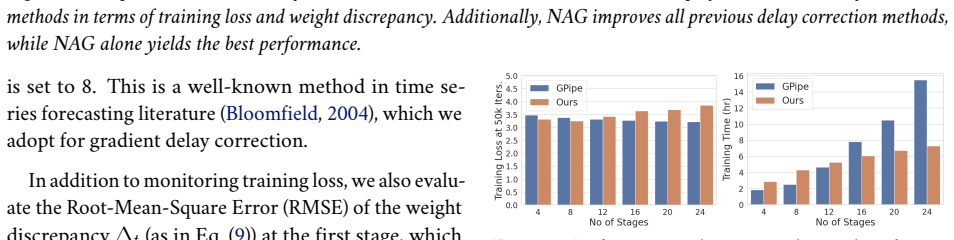
- [§5.5, Fig. 5] The text says that for GPipe 'the training time increase is exponentially larger,' but the reported numbers are 8.5× versus 2.5× for the proposed method. This is a large factor difference but not an exponential one; please rephrase as 'substantially larger' or provide evidence for superpolynomial growth.
- [Abstract and §6] The abstract says a 1B model is trained 'to convergence,' while the experiments run a fixed 50k iterations and report perplexity at that point. The phrase should be softened to avoid implying a separate convergence criterion was reached.
- [Appendix A.3, Eq. (29)] The schedule γ_t = (t−2)/t gives γ_1 = −1, which contradicts the earlier statement γ_1 = 0. Please specify that the formula applies for t ≥ 2 and state γ_1 separately.
- [§3.1 and §4] The claim that this is 'the first time a variant of the Nesterov method is shown to converge in the presence of delayed gradients' is too strong without a more careful positioning against existing delayed-momentum analyses such as Hakimi et al. (2019) and Stich and Karimireddy (2019). Please qualify the novelty claim.
Circularity Check
No circularity: the theoretical results are derived from explicit update equations and assumptions, and the empirical comparisons are observations rather than predictions forced by the derivation.
full rationale
The paper's theoretical claim is a convergence bound for the update in Eq. (10) under stated assumptions (convexity, smoothness, bounded gradients, fixed delay), and the proof follows standard NAG proof techniques; it does not fit any parameter to the result it then predicts. The 'look-ahead as delay correction' Proposition is a mathematical identity derived from the definition of d_t and the delayed update, not a fitted or externally assumed relation, so it is not circular. The empirical comparisons are controlled experiments, not derivations; the fact that the synchronous GPipe baseline uses AdamW while the proposed method uses NAdam with beta1=0.99 is an experimental confound and a fairness concern, but it is not a case where a fitted input is renamed as a prediction. The rate mismatch in the appendix (O(log t/t) from Eq. 33 versus the stated O(1/t) in Theorem 1) is a mathematical correctness issue, not circularity. No load-bearing self-citations or imported uniqueness theorems appear. Overall, the derivation chain is self-contained and no circular step is present.
Assumptions & free parameters
free parameters (4)
- beta_1 (momentum coefficient) =
0.99
- learning rate eta =
3e-4 base; 1e-4 for 1B and 20/24 stages
- T (learning-rate discounting horizon) =
6000 iterations
- Stage-dependent rho_t and gamma_i schedules =
rho_t = 1 - min(t/T,1); gamma_i = 0.9 + (P-i)/P * 0.09
assumptions (5)
- domain assumption f is convex, beta-smooth, and has bounded gradients
- domain assumption Gradient delay tau is fixed (and constant per stage)
- domain assumption Update directions change slowly over iterations
- ad hoc to paper Momentum coefficient increases to 1 (or is chosen close to 1)
- domain assumption Weight stashing stores the forward-pass weights and gives correct backpropagation
Cite this review
Pith. "Pith review of Nesterov Method for Asynchronous Pipeline Parallel Optimization." pith.science (2026). https://pith.science/paper/2N5EE55G
@misc{pith2026250501099,
  author       = {Pith},
  title        = {Pith review of: Nesterov Method for Asynchronous Pipeline Parallel Optimization},
  year         = {2026},
  howpublished = {\url{https://pith.science/paper/2N5EE55G}},
  note         = {Machine review of arXiv:2505.01099}
}
read the original abstract
Pipeline Parallelism (PP) enables large neural network training on small, interconnected devices by splitting the model into multiple stages. To maximize pipeline utilization, asynchronous optimization is appealing as it offers 100% pipeline utilization by construction. However, it is inherently challenging as the weights and gradients are no longer synchronized, leading to stale (or delayed) gradients. To alleviate this, we introduce a variant of Nesterov Accelerated Gradient (NAG) for asynchronous optimization in PP. Specifically, we modify the look-ahead step in NAG to effectively address the staleness in gradients. We theoretically prove that our approach converges at a sublinear rate in the presence of fixed delay in gradients. Our experiments on large-scale language modelling tasks using decoder-only architectures with up to 1B parameters, demonstrate that our approach significantly outperforms existing asynchronous methods, even surpassing the synchronous baseline.
Figures


Figures from the paper (9 more)



Reference graph
Works this paper leans on
-
[1]
2𝛽 ‖¯g𝑡‖2 + ¯g𝑡· (w𝑡 +𝜆𝑡d𝑡− w*), (26) = Ω𝑡− 𝜆𝑡(1 +𝛾𝑡)𝛽 2(1−𝛾𝑡) ¯h2 𝑡− 𝛽 1−𝛾𝑡 ¯h𝑡· (w𝑡 +𝜆𝑡d𝑡− w*), A ≤ Ω𝑡− 𝜆𝑡𝛽 2(1−𝛾𝑡) ¯h2 𝑡− 𝛽 1−𝛾𝑡 ¯h𝑡· (w𝑡 +𝜆𝑡d𝑡− w*), B = Ω𝑡− 𝛽 2𝜆𝑡(1−𝛾𝑡) (︀ ‖𝜆𝑡¯h𝑡 + w𝑡 +𝜆𝑡d𝑡− w*‖2−‖ w𝑡 +𝜆𝑡d𝑡− w*‖2)︀ , C where, A substitutes Ω𝑡 = 𝜆𝑡𝛽 2 ‖ ¯Δ𝑡‖2 +𝜆𝑡(𝛾𝑡− 1)¯g𝑡· ¯Δ𝑡, B is due to 0<𝛾 𝑡< 0,𝜆𝑡> 0,𝛽 >0, and C follows from𝑎2 + 2𝑎𝑏 = (𝑎 +𝑏)2−𝑏2. ...
work page 2023
-
[10]
Asynchronous sgd beats mini- batch sgd under arbitrary delays
Konstantin Mishchenko, Francis Bach, Mathieu Even, and Blake Woodworth. Asynchronous sgd beats mini- batch sgd under arbitrary delays. URL https://arxiv. org/abs/2206.07638, 2(6):7,
-
[11]
Asynchrony begets momentum, with an application to deep learning
Ioannis Mitliagkas, Ce Zhang, Stefan Hadjis, and Christopher Ré. Asynchrony begets momentum, with an application to deep learning. In 2016 54th Annual Allerton Conference on Communication, Con- trol, and Computing (Allerton), pages 997–1004. IEEE,
work page 2016
-
[13]
URL https: //proceedings.neurips.cc/paper/2020/ file/25ddc0f8c9d3e22e03d3076f98d83cb2- Paper.pdf. Max Ryabinin, Alexander Borzunov, Michael Diskin, Anton Gusev, Denis Mazur, Vsevolod Plokhot- nyuk, Alexey Bukhtiyarov, Pavel Samygin, Anton Sinitsin, and Artem Chumachenko. Hivemind: Decentralized Deep Learning in PyT orch, April
work page 2020
-
[2004]
Language models are few-shot learners
T om Brown, Benjamin Mann, Nick Ryder, Melanie Subbiah, Jared D Kaplan, Prafulla Dhariwal, Arvind Neelakantan, Pranav Shyam, Girish Sastry, Amanda Askell, et al. Language models are few-shot learners. Advances in neural information processing systems , 33: 1877–1901,
work page 1901
-
[2011]
Advances in asynchronous parallel and distributed optimization
Mahmoud Assran, Arda Aytekin, Hamid Reza Feyzmah- davian, Mikael Johansson, and Michael G Rabbat. Advances in asynchronous parallel and distributed optimization. Proceedings of the IEEE, 108(11):2013– 2031,
work page 2013
-
[2014]
Aixin Liu, Bei Feng, Bing Xue, Bingxuan Wang, Bochao Wu, Chengda Lu, Chenggang Zhao, Chengqi Deng, Chenyu Zhang, Chong Ruan, et al. Deepseek-v3 technical report. arXiv preprint arXiv:2412.19437 , 2024a. 10 Nesterov Method for Asynchronous Pipeline Parallel Optimization Bo Liu, Rachita Chhaparia, Arthur Douillard, Satyen Kale, Andrei A Rusu, Jiajun Shen, A...
-
[2015]
Efficient and robust parallel dnn training through model parallelism on multi-gpu platform
Chi-Chung Chen, Chia-Lin Yang, and Hsiang-Yun Cheng. Efficient and robust parallel dnn training through model parallelism on multi-gpu platform. arXiv preprint arXiv:1809.02839,
Show all 15 references
-
[2016]
The llama 3 herd of models
Abhimanyu Dubey, Abhinav Jauhri, Abhinav Pandey, Abhishek Kadian, Ahmad Al-Dahle, Aiesha Letman, Akhil Mathur, Alan Schelten, Amy Yang, Angela Fan, et al. The llama 3 herd of models. arXiv preprint arXiv:2407.21783,
-
[2019]
Xpipe: Efficient pipeline model parallelism for multi- gpu dnn training
Lei Guan, Wotao Yin, Dongsheng Li, and Xicheng Lu. Xpipe: Efficient pipeline model parallelism for multi- gpu dnn training. arXiv preprint arXiv:1911.04610 ,
1911 arXiv
-
[2020]
Gap aware mitigation of gradient staleness
Saar Barkai, Ido Hakimi, and Assaf Schuster. Gap aware mitigation of gradient staleness. arXiv preprint arXiv:1909.10802,
1909 arXiv
-
[2022]
Adam: A method for stochastic optimization
Diederik P Kingma. Adam: A method for stochastic optimization. arXiv preprint arXiv:1412.6980,
-
[2023]
The error-feedback framework: Better rates for sgd with delayed gradients and compressed communication
Sebastian U Stich and Sai Praneeth Karimireddy. The error-feedback framework: Better rates for sgd with delayed gradients and compressed communication. arXiv preprint arXiv:1909.05350,
1909 arXiv
-
[2024]
Taming momentum in a dis- tributed asynchronous environment
Ido Hakimi, Saar Barkai, Moshe Gabel, and As- saf Schuster. Taming momentum in a dis- tributed asynchronous environment. arXiv preprint arXiv:1907.11612,
1907 arXiv
-
[2025]
Penghui Qi, Xinyi Wan, Guangxing Huang, and Min Lin
Accessed: 2025-01-16. Penghui Qi, Xinyi Wan, Guangxing Huang, and Min Lin. Zero bubble pipeline parallelism. arXiv preprint arXiv:2401.10241,
2025 arXiv
Reviewed August 16, 2026 · model on record in the stance chip above.
Discussion (0). Continue with ORCID to comment.