REVIEW 3 major objections 5 minor 2 cited by
Unbinning global LHC analyses
T0 review · 3 major / 5 minor · reviewed 2026-08-05 · deepseek-v4-flash
Pith's one-line read Unbinned machine-learning inference beats binned histograms when four LHC diboson channels are combined to constrain six SMEFT Wilson coefficients.
desk verdict Competent first global SBI-vs-histogram SMEFT comparison; the factor-of-two headline is conditional on a deliberately coarse baseline, so the direction likely survives but the magnitude is the open question. read the letter →
The pith
A machine-rendered reading of the paper's core claim, the machinery that carries it, and where it could break.
The reading
What carries the argument
The central mechanism is 'derivative learning': because the SMEFT squared matrix element is a quadratic polynomial in the Wilson coefficients, the likelihood ratio can be expanded as a second-order polynomial whose coefficient functions R_i and R_ij depend only on event kinematics. Neural networks are trained to regress these coefficient functions from parton-level ratios, yielding an unbinned estimate of the reconstruction-level likelihood ratio. Backgrounds are incorporated through a signal–background classifier, and the per-process log-likelihood-ratio test statistics are then summed to form a combined test statistic for the global fit.
What would settle it
Repeat the same four-channel, six-operator combination with histogram observables optimized per operator, such as polarization-sensitive angular variables, and with correlated systematic uncertainties folded in. If the SBI limits are no longer roughly twice as strong as the histogram limits, the paper's central quantitative claim fails. A quicker check is whether the SBI advantage persists when the background classifier is replaced by a different background-modeling treatment.
Extended reading notes
Core claim
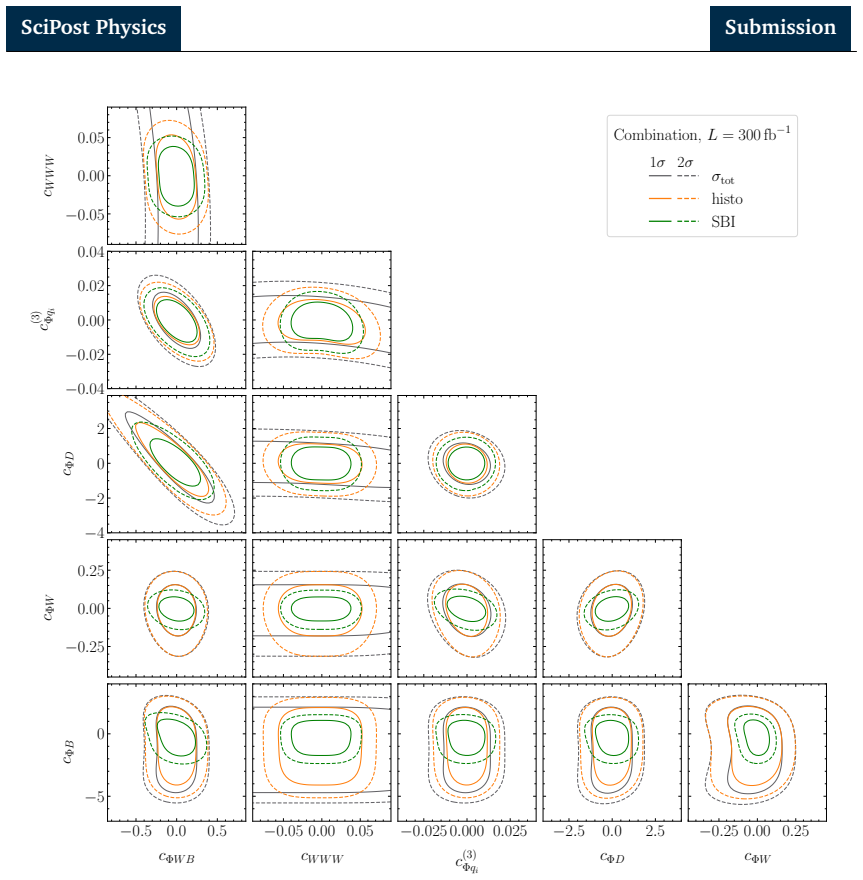
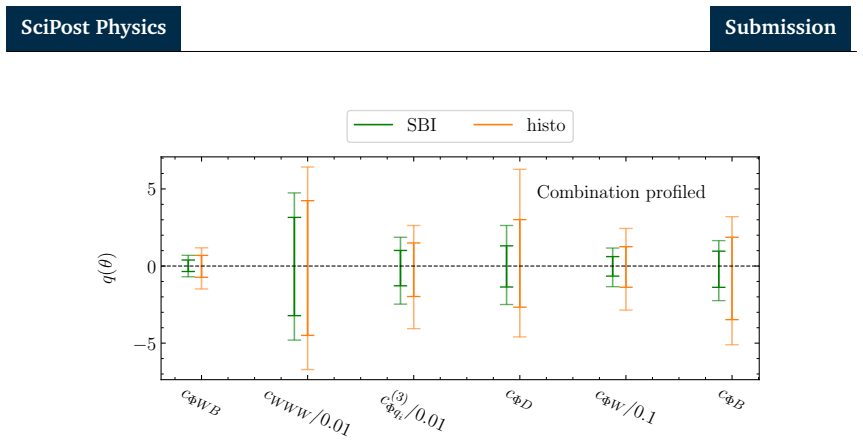
Working at 13.6 TeV with a simplified detector simulation, the paper derives expected exclusion limits on six Wilson coefficients from four diboson processes. It finds that SBI consistently outperforms histograms built from standard experimental observables and binnings: in profiled one-dimensional combined limits, the SBI constraints are roughly a factor of two stronger for coefficients to which the chosen histograms are only indirectly sensitive, and about 30% stronger even for coefficients that the histogram observables directly probe. The advantage is traced to SBI's use of the full phase space, in particular its sensitivity to Z-boson polarization, which breaks degeneracies that the tra
Load-bearing premise
The comparison assumes that the binnings taken from existing experiments and the neglect of systematic uncertainties are representative of real LHC analyses; if better binnings or realistic systematics are used, the reported factor-of-two gain may shrink.
Editorial extensions
If this is right
- A global SMEFT fit built on SBI would set stronger limits on electroweak and Higgs–gauge operators than the same fit built on rate or binned differential measurements.
- Operators that are degenerate in low-dimensional histograms—especially those distinguished by gauge-boson polarization—become individually constrainable once full event information is used.
- The expected gain corresponds to roughly a factor of four in integrated luminosity for the most degenerate coefficients, so unbinned inference can substitute for additional data in a histogram-based analysis.
- Combining channels does not erase the SBI advantage; the improvement persists after profiling over all other Wilson coefficients.
- The gain is not limited to one high-profile process: the method transfers to a multi-process, multi-parameter global analysis.
- The reported quantitative gains assume no systematic uncertainties and use unoptimized binnings, so they represent the kinematic-information gain under idealized conditions.
Reading between the lines
- Because the paper deliberately used standard, unoptimized binnings, a fair next test would compare SBI against histograms built from polarization-sensitive observables or per-operator optimized binnings; such a test would reveal how much of the factor-of-two gap is intrinsic to unbinned inference versus an artifact of binning choice.
- If realistic correlated systematic uncertainties were included, the ranking could shift: rate systematics affect both methods equally, but shape systematics and limited Monte Carlo statistics may degrade histograms more, potentially enlarging the SBI advantage—or, conversely, shrinking it if the learned likelihoods inherit simulation inaccuracies.
- The same derivative-learning combination strategy should extend to more processes, such as vector-boson fusion or gluon-fusion Higgs production, and to the full SMEFT operator set, where degeneracies are even more severe; the paper's architecture appears ready for that scaling.
- A concrete cross-check would be to reproduce the combined SBI limits with an independent unbinned method, such as the matrix-element method or a different likelihood-ratio estimator, to confirm that the reported limits are not sensitive to the specific neural-network training choices.
Signed reviews
Editorial analysis
A structured set of objections, weighed in public.
Referee Report
Summary. The paper compares simulation-based inference (SBI), implemented via the derivative-learning likelihood-ratio method, with traditional histogram-based inference for SMEFT constraints in a combined analysis of WW, WZ, WH, and ZH production at the LHC. Six dimension-six Wilson coefficients are considered. Expected limits at 300 fb^-1 are derived using parton-level reference limits, total-rate limits, one-dimensional histograms based on standard experimental/STXS binnings, and unbinned SBI. The central result is that SBI yields significantly stronger expected limits than the histogram approach, with factor-of-two improvements in several profiled directions (Fig. 11), corresponding to a claimed factor of roughly four in effective luminosity. The paper includes coverage checks of the learned likelihoods, uses fractional smearing to control high-weight events, and includes backgrounds for the Higgs-associated channels.
Significance. If the quantitative claim holds, the paper is a useful step toward global SMEFT interpretations with unbinned inference, and it demonstrates an interesting multi-process combination rather than a single-channel proof of principle. The strength is that the SBI likelihood ratios are derived from theory matrix elements and checked against parton-level ratios and coverage curves, so the comparison is not circular. The method is technically credible. However, the headline comparison is made against deliberately coarse histogram baselines and neglects systematic uncertainties and several backgrounds. These are acknowledged limitations, but they directly affect the magnitude of the claimed SBI advantage, so the significance as stated is somewhat narrower than the abstract/conclusion suggests.
major comments (3)
- [Sec. 3.2 (Histogram observables) and Sec. 4.2 (Fig. 11)] The central quantitative claim—SBI limits a factor ~2 stronger, equivalent to ~4x more luminosity—is measured against a deliberately unoptimized histogram baseline. The authors state that 'the choice of observables and binnings can be improved... we deliberately adopt the standard STXS binning.' The histograms are one-dimensional (pT^l1, mT^WZ, pT^V), while real diboson analyses use multiple observables, control regions, and optimized discriminants. Since the abstract and conclusion claim that 'SBI clearly outperforms histogram-based methods,' the factor-of-two statement is not established for a competitive histogram baseline. The paper should either benchmark against an optimized histogram approach (e.g., 2D binnings or a binned classifier discriminant) or qualify the claim to comparison with existing standard experimental binnings.
- [Sec. 3.2 (Event generation)] Systematic uncertainties are neglected, with the expectation that 'systematics to degrade the histogram limits more than the SBI limits,' but no demonstration is provided. All expected limits in Figs. 1–11 are pure-statistical. In realistic LHC diboson analyses, normalization and shape systematics are often comparable to statistical power, and they can reduce the advantage of unbinned methods, especially for operators where sensitivity is dominated by rate information. A stylized systematic model, or an explicit restriction of the conclusions to statistical-only limits, is needed to support the quantitative improvement claim.
- [Sec. 3.2 (Pre-selection cuts and backgrounds)] For WW and WZ, the dominant backgrounds (di-top for WW; Z+jets, Zgamma, ttbar for WZ, ~20–35% of the signal region) are omitted, with the justification that the two methods should be affected similarly. This is a plausibility argument rather than a demonstrated equivalence. Backgrounds enter both the Poisson rate term and the signal–background classifier, so omitting them could change the relative performance of SBI and histograms, particularly for rate-sensitive operators. Including these backgrounds or showing numerically that the ranking is unchanged would remove this uncertainty.
minor comments (5)
- [Title/Abstract] The term 'global LHC analyses' overstates the scope: the analysis combines four diboson processes and a subset of six operators, with no systematic uncertainties. Consider 'multi-process' or 'a global analysis of the electroweak/Higgs diboson sector' for precision.
- [Fig. 10 caption and Sec. 4.1] The caption states that parton-level limits are compared in the combined result, but Sec. 4.1 explicitly says parton-level bounds are not shown for WH (and none are shown for ZH). Clarify how the combined parton-level curve is obtained, or remove it from Fig. 10 to avoid an apparent inconsistency.
- [Fig. 7 caption] The phrase 'small central ellipsis' is confusing; 'ellipsis' should be 'ellipse.' Also clarify that the expected SM point is included in the 1-sigma region and what exactly the small ellipse represents.
- [Appendix B] Typos: 'emperical' should be 'empirical' and 'slighlty' should be 'slightly'.
- [Sec. 3.2 (Histogram observables)] For WW and WZ the histogram limits are shown without backgrounds, consistent with the SBI setup, but this should be stated in the table/caption so that the comparison is not misinterpreted as including full experimental backgrounds in either method.
Circularity Check
No significant circularity: SBI limits are derived from matrix-element-based likelihood ratios and compared against independent histograms; the few self-citations are method provenance, not load-bearing.
full rationale
The central derivation chain is self-contained. The likelihood ratio r(x|theta,theta0) is defined from the differential cross-section (Eqs. 1-7), and the network regresses the parton-level derivatives R_i and R_ij (Eq. 9) which are computed from SMEFT matrix elements, not from the reported limits. The expected limits in Sec. 4 are obtained by plugging these learned ratios into a full Poisson + kinematic likelihood (Eqs. 20-23) and a Wilks-based test statistic; no parameter is fitted to the quantity being predicted. The comparison in Fig. 11 uses the same simulated events and the same rate information for SBI and histograms, with histograms defined in Tab. 4. The paper's self-citations (Refs. [14] and [16]) supply the derivative-learning algorithm and fractional-smearing stabilization, but the physics conclusion ('SBI clearly outperforms histogram-based methods') is not inferred from those citations; it emerges from the independent limit-setting calculation, and the learned likelihoods are cross-checked with coverage curves (App. B) and parton-level references. The acknowledged choice of standard, non-optimized STXS binnings ('We deliberately adopt the standard STXS binning...') could make the histogram baseline weaker than a fully optimized one, but this is a baseline-choice/correctness concern, not circularity: the SBI result is not defined in terms of that histogram or vice versa. No step reduces by construction to its own input.
Assumptions & free parameters
assumptions (6)
- domain assumption SMEFT Lagrangian truncated at dimension six, neglecting CP and flavor violation
- domain assumption Interference between signal and background is negligible (different initial/final states or small Higgs width)
- domain assumption Backgrounds for WW and WZ are omitted because they are expected to affect SBI and histograms similarly
- domain assumption Systematic uncertainties are neglected
- domain assumption NLO corrections are approximated by flat K-factors
- domain assumption The four processes are treated as uncorrelated in the combined likelihood
Cite this review
Pith. "Pith review of Unbinning global LHC analyses." pith.science (2026). https://pith.science/paper/2NBDQERD
@misc{pith2026250905409,
  author       = {Pith},
  title        = {Pith review of: Unbinning global LHC analyses},
  year         = {2026},
  howpublished = {\url{https://pith.science/paper/2NBDQERD}},
  note         = {Machine review of arXiv:2509.05409}
}
read the original abstract
Neural simulation-based inference has been shown to outperform traditional, histogram-based inference in numerous phenomenological and experimental studies at the LHC. So far, these analyses have focused on individual processes. We study the combination of four different di-boson processes in terms of the Standard Model Effective Field Theory. Our results demonstrate how neural simulation-based inference also wins over traditional methods for more global LHC analyses.
Figures


Figures from the paper (13 more)




Forward citations
Cited by 2 Pith papers
-
Neural Control Variates at LO and NLO
Signed neural control variates from normalizing flows, combined with neural importance sampling, reduce weight ranges and negative weights for LO and NLO phase-space integration and event generation.
-
Agentic Re-Casting using Agentic Re-Simulations
An agentic AI system with a physicist in the loop re-casts an ATLAS ttZ measurement into a global top-quark SMEFT fit and recovers injected coloron Wilson coefficients in a repeatable benchmark.
Reviewed August 5, 2026 · model on record in the stance chip above.
Discussion (0). Continue with ORCID to comment.