REVIEW 1 major objections 5 minor 48 references
Decays $f_1 \to a_0 \pi,\pi \pi \pi(\eta)$ and $f_1 \to K K \pi$ in the chiral $U(3) \times U(3)$ quark NJL model
T0 review · 1 major / 5 minor · reviewed 2026-08-07 · deepseek-v4-flash
Pith's one-line read The paper claims that the standard U(3)×U(3) NJL quark model reproduces the f1(1285) decay branching fractions with no extra fitted parameters.
desk verdict Useful f1 decay predictions in NJL, but the KKπ branching fraction is miscounted. read the letter →
The pith
A machine-rendered reading of the paper's core claim, the machinery that carries it, and where it could break.
The reading
What carries the argument
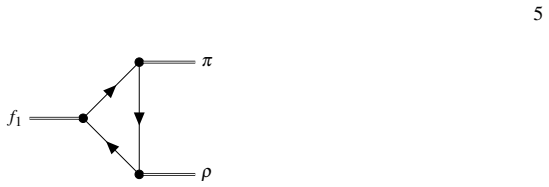
The machinery is the bosonized $U(3)\times U(3)$ NJL effective Lagrangian with quark-meson vertices whose coupling constants are fixed by one-loop quark integrals, the cutoff $\Lambda=1265$ MeV, and the constituent quark masses $m_u=270$ MeV and $m_s=420$ MeV. The calculation is carried by the assumption that scalar mesons are chiral partners of pseudoscalars, so scalar couplings inherit the pseudoscalar couplings, together with the mixing angles for the $f_1$--$f_1'$, $f_0$, and $\eta$ states. The $a_1$--$\pi$ and $\eta$--$f_1$ transition factors $A_\pi$ and $A_\eta$ encode axial-vector--pseudoscalar mixing, and Breit-Wigner propagators carry the intermediate $a_0^\pm$ and $f_0(500)$ states. Isospin breaking enters through the single mass difference $m_d-m_u=4$ MeV, previously fixed from $\omega\to\pi^+\pi^-$, which is what makes $f_1\to\rho\pi$ and $f_1\to\pi^+\pi^-\pi^0$ nonzero.
What would settle it
Resolve the $f_1(1285)\to\pi^+\pi^-\eta$ Dalitz plot with enough statistics to separate the $a_0^\pm\pi^\mp$ and $f_0\eta$ subchannels: the model requires approximately 15.6% from $a_0\pi$, 7.0% from $f_0\eta$, and positive interference between them to reach the total 27.5%. A measured negative interference or a visibly different subchannel pattern, or a lattice or unitarized calculation showing that $a_0(980)$ and $f_0(500)$ are not quark-antiquark states, would settle that the mechanism is wrong.
Extended reading notes
Core claim
On the paper's own terms, the discovery is that the $f_1(1285)$ decay pattern is not a collection of independent matrix elements but follows from one bosonized NJL Lagrangian in the one-loop quark approximation. With the scalar mesons $a_0(980)$ and $f_0(500)$ placed in the quark-antiquark chiral-partner representation, the model yields $\mathrm{Br}(f_1\to a_0\pi)=(39.4\pm5.91)\%$ against the PDG value $(38.0\pm4.0)\%$, and $\mathrm{Br}(f_1\to\pi^+\pi^-\eta)=(27.5\pm4.13)\%$ against $(35\pm15)\%$. The suppressed decays are claimed to be isospin-breaking effects: $\mathrm{Br}(f_1\to\rho\pi)=(1.9\pm0.3)\times10^{-3}$ against the experimental limit $<3.1\times10^{-3}$, and $\mathrm{Br}(f_1\to\pi^+\pi^-\pi^0)=(3.2\pm0.5)\times10^{-3}$ against $(3.0\pm0.9)\times10^{-3}$. For the strange channel the result is $\mathrm{Br}(f_1\to KK\pi)=(9.9\pm1.5)\%$ against $(9.0\pm0.4)\%$. The predicted ratio $\mathrm{Br}(f_1\to\pi^+\pi^-\pi^0)/\mathrm{Br}(f_1\to\pi^+\pi^-\eta)=1.16\%$ is also compared with the VES and BESIII values, and the $f_1\to KK\pi$ result is described as in qualitative agreement with PDG data.
Load-bearing premise
The load-bearing premise is that $a_0(980)$ and $f_0(500)$ really are ordinary quark-antiquark states, the chiral partners of the pseudoscalar mesons; if either scalar is instead a four-quark state or a meson-meson molecule, the computed amplitudes for $f_1\to a_0\pi$ and $f_1\to\pi\pi\eta$ would lose their foundation and the agreement with data would be coincidental.
Editorial extensions
If this is right
- If the central claim is correct, the five measured branching fractions become one consistency check on the NJL Lagrangian rather than five independent predictions.
- The $f_1\to\rho\pi$ and $f_1\to\pi^+\pi^-\pi^0$ rates are predicted from the $u$--$d$ quark mass difference, so a measurement that tightens the current upper limit on $\rho\pi$ would test this isospin-breaking mechanism directly.
- The $a_0\pi$ and $f_0\eta$ channels are required to interfere positively in $f_1\to\pi\pi\eta$; a Dalitz plot analysis that resolves the intermediate scalar channels would check the individual contributions of 15.6% and 7.0%.
- The same quark-antiquark scalar treatment is applied by the authors to strange scalar mesons and to tau lepton decays, so the $f_1$ results reinforce that broader set of predictions.
Reading between the lines
- A testable extension not pursued in the paper is the sign of the isospin-breaking amplitude: since $f_1\to\rho\pi$ is proportional to $m_d-m_u$, the model predicts a definite phase for this amplitude, which could be extracted from angular distributions rather than from rates alone.
- The paper's scalar mechanism could be cross-checked on $f_1'\to$ scalar-plus-pseudoscalar channels, where the strange quark content makes the chiral-partner assumption more restrictive than it is in the non-strange channels studied here.
- The ratio $\mathrm{Br}(f_1\to\rho\pi)/\mathrm{Br}(f_1\to\pi^+\pi^-\pi^0)$ is a pure isospin-violating observable in this model and could be compared across axial-vector mesons to see whether the $u$--$d$ mass difference is the universal source of such suppressed decays.
Editorial analysis
A structured set of objections, weighed in public.
Referee Report
Summary. The manuscript reports calculations of the branching fractions of f1(1285) decays into a0π, ππη, ρπ, πππ, and KKπ within the U(3)×U(3) quark NJL model. The model inputs (quark masses, cutoff, mixing angles) were fixed in earlier work, so the results are presented as parameter-free predictions. The reported values include Br(f1→a0π)=39.4±5.9%, Br(f1→πηπ)=27.5±4.1%, Br(f1→ρπ)=1.9×10^-3, Br(f1→3π)=3.2×10^-3, and Br(f1→KKπ)=9.9±1.5%, which are compared with PDG data. The a0(980) and f0(500) are treated as ordinary q-qbar chiral partners of the pseudoscalars.
Significance. The paper's main strength is that it makes genuinely parameter-free predictions within an established model: no parameter is fitted to the f1 data, and the agreement for a0π, ππη, ρπ, and 3π is broadly reasonable. The explicit treatment of isospin violation through md-mu is a nice feature. However, the KKπ result contains a charge-counting error that, once corrected, removes the claimed agreement with the PDG value. Because this error affects one of the five central branching-fraction claims, the paper needs revision before the results can be accepted as a set. If the KKπ issue is fixed, the paper would be a useful and compact NJL prediction for f1 decays.
major comments (1)
- [Section V, Eqs. (28)–(35)] The total branching fraction for f1→KKπ is quoted as 9.9±1.5%, obtained as 3×3.3%, where 3.3% is the single-mode result for f1→K+K0π−. The text explicitly states that the total includes four charge combinations: K+K0π−, K−K̄0π+, K+K−π0, and K0K̄0π0. Multiplying the single-mode rate by 3 is not justified: if the four amplitudes are equal one would obtain 4×3.3%=13.2%, and if they are not equal the total must be computed by summing the four individual widths rather than by a simple factor. The claimed agreement with PDG (9.0±0.4%) is therefore an arithmetic artifact. In addition, as written, two of the four final states (K+K0π− and K−K̄0π+) violate strangeness conservation; presumably the intended modes are K+K̄0π− and K−K0π+. The authors should correct the notation and recompute the total properly.
minor comments (5)
- [General] There are numerous typographical issues, including 'V olkov' in the author list and 'Chapter V'/'Chapter VI' instead of 'Section V'/'Section VI'; a careful proofread is needed.
- [Section III, Eqs. (13)–(17)] The derivation of the amplitudes for f1→ππη is extremely condensed; in particular, the definition of the coupling constants in Eq. (16) and the role of the strange-quark loops are not fully explained. Since the numerical results hinge on these expressions, a brief derivation or a reference to a prior derivation would improve the paper's transparency.
- [Section II, Eq. (1)] The notation for the mixing angles θσ, θη and their barred combinations is introduced only in passing; the definitions would be clearer if written explicitly as arθσ = θ0 − θσ and arθη = θ0 − θη in the text adjacent to Eq. (1).
- [Section III, Eq. (9)] The momentum subscript p_f0 in the amplitude (9) is confusing because f0 is an intermediate state in the f1→f0η decay; it should be clarified that p_f0 is the f0 momentum, not the pion momentum.
- [Section VI, Conclusion] The statement that the 15% uncertainty is 'based on a comparison of numerous calculations' is heuristic; the paper does not propagate the uncertainties of the model inputs. This is acceptable for an estimate but should be stated more cautiously.
Circularity Check
No significant circularity: the f1 decay widths are genuine NJL predictions with no parameters fitted to the target observables.
full rationale
The central quantities Br(f1→a0π), Br(f1→πηπ), Br(f1→ρπ), Br(f1→3π), and Br(f1→KKπ) are obtained by evaluating explicit one-loop quark amplitudes (Eqs. (5), (12), (22), (25), (28)) with coupling constants given in Eq. (2) and with parameters (mu=270 MeV, ms=420 MeV, Lambda=1265 MeV, md-mu=4 MeV, and the quoted mixing angles) that are fixed before the present calculation and are not adjusted to the f1 data. The PDG values are used only for comparison and for external masses and widths of intermediate mesons; no PDG branching fraction enters as an input. The self-citations to earlier NJL papers (e.g., [24, 28, 32, 40]) support the standard Lagrangian and parameter values, not the f1 branching fractions themselves, so they are not load-bearing circularity. The apparent factor-of-three issue in the KKπ total is not circularity either: with the four S=0 charge modes, isospin Clebsch-Gordan coefficients give equal rates for the two charged modes and half rates for the two neutral modes, so the total rate is three times the single-mode rate quoted from Eq. (28). In summary, the claimed agreement with experiment is a genuine, falsifiable prediction rather than a reduction to the inputs.
Assumptions & free parameters
free parameters (8)
- m_u =
270 MeV
- m_s =
420 MeV
- m_d - m_u =
4 MeV
- Lambda =
1265 MeV
- phi =
24 degrees
- theta_sigma =
24 degrees
- theta_eta =
-19 degrees
- alpha =
57 degrees
assumptions (4)
- domain assumption The U(3)xU(3) NJL Lagrangian with local four-quark interaction in the mean-field approximation correctly describes low-energy meson interactions.
- domain assumption Scalar mesons a0(980) and f0(500) are quark-antiquark states, chiral partners of pseudoscalars.
- domain assumption The one-loop quark approximation (leading order in 1/N_c) is sufficient for these decay amplitudes.
- domain assumption Breit-Wigner propagators with PDG masses and widths describe the intermediate scalar mesons.
Cite this review
Pith. "Pith review of Decays $f_1 \to a_0 \pi,\pi \pi \pi(\eta)$ and $f_1 \to K K \pi$ in the chiral $U(3) \times U(3)$ quark NJL model." pith.science (2026). https://pith.science/paper/2O2T56T2
@misc{pith2026250607065,
  author       = {Pith},
  title        = {Pith review of: Decays $f_1 \to a_0 \pi,\pi \pi \pi(\eta)$ and $f_1 \to K K \pi$ in the chiral $U(3) \times U(3)$ quark NJL model},
  year         = {2026},
  howpublished = {\url{https://pith.science/paper/2O2T56T2}},
  note         = {Machine review of arXiv:2506.07065}
}
abstract
The branching fractions of the axial vector meson decays $f_1 \to a_0 \pi,\pi\pi\eta$, $f_1 \to \rho \pi,\pi\pi\pi$ and $f_1 \to KK\pi$ are calculated in the standard $U(3) \times U(3)$ quark NJL model. The intermediate channels with the states $a_0(980)\pi$ and $f_0(500)\eta$ are taken into account in the decay $f_1 \to \pi\pi\eta$. In the case of the scalar mesons, the $\bar{q}q$ representation as a chiral symmetric partners of the pseudoscalar mesons is used. It is shown that the decays $f_1 \to \rho \pi$ and $f_1 \to3\pi$ occur due to the mass difference of the $u$ and $d$ quarks. All the results are obtained without using any additional arbitrary parameters and are in satisfactory agreement with the known experimental data.
Figures


Figures from the paper (1 more)

Reference graph
Works this paper leans on
-
[1]
M. K. V olkov and A. B. Arbuzov, Phys. Usp.60, no.7, 643-666 (2017) 8
work page 2017
-
[2]
Z. H. Guo, Phys. Rev. D78, 033004 (2008)
work page 2008
-
[3]
L. R. Dai, L. Roca and E. Oset, Eur. Phys. J. C80, no.7, 673 (2020)
work page 2020
-
[4]
M. K. V olkov, A. A. Pivovarov and K. Nurlan, Phys. Rev. D107, no.11, 116009 (2023)
work page 2023
-
[5]
M. K. V olkov, A. A. Pivovarov and K. Nurlan, Phys. Rev. D109, no.1, 016016 (2024)
work page 2024
-
[6]
G. Colangelo, M. Finkemeier and R. Urech, Phys. Rev. D54, 4403-4418 (1996)
work page 1996
- [7]
-
[8]
M. Mikhasenkoet al.[JPAC], Phys. Rev. D98, no.9, 096021 (2018)
work page 2018
Show all 48 references
-
[9]
D. G. Dumm, P. Roig, A. Pich and J. Portoles, Phys. Lett. B685, 158-164 (2010)
2010
-
[10]
I. M. Nugent, T. Przedzinski, P. Roig, O. Shekhovtsova and Z. Was, Phys. Rev. D88, 093012 (2013)
2013
-
[11]
Sadasivan, A
D. Sadasivan, A. Alexandru, H. Akdag, F. Amorim, R. Brett, C. Culver, M. Döring, F. X. Lee and M. Mai, Phys. Rev. D105, no.5, 054020 (2022)
2022
-
[12]
M. K. V olkov, A. A. Pivovarov and K. Nurlan, Eur. Phys. J. A61, no.3, 66 (2025)
2025
-
[13]
Navaset al.[Particle Data Group], Phys
S. Navaset al.[Particle Data Group], Phys. Rev. D110, no.3, 030001 (2024)
2024
-
[14]
Calderon, J
G. Calderon, J. H. Munoz and C. E. Vera, Phys. Rev. D87, no.11, 114011 (2013)
2013
-
[15]
M. K. V olkov, A. A. Pivovarov and A. A. Osipov, Eur. Phys. J. A54, no.4, 61 (2018)
2018
-
[16]
Oset and L
E. Oset and L. Roca, Phys. Lett. B782, 332-338 (2018)
2018
-
[17]
Dorofeev, A
V . Dorofeev, A. Ekimov, Y . Gouz, A. Ivashin, I. Kachaev, A. Karyukhin, Y . Khokhlov, V . Konstantinov, V . Matveev and V . Nikolaenko,et al.Eur. Phys. J. A47, 68 (2011)
2011
-
[18]
Aaijet al.[LHCb], Phys
R. Aaijet al.[LHCb], Phys. Rev. Lett.112, no.9, 091802 (2014)
2014
-
[19]
Acharyaet al.[ALICE], Phys
S. Acharyaet al.[ALICE], Phys. Lett. B866, 139562 (2025)
2025
-
[20]
Nambu and G
Y . Nambu and G. Jona-Lasinio, Phys. Rev.122(1961), 345-358
1961
-
[21]
Eguchi, Phys
T. Eguchi, Phys. Rev. D14, 2755 (1976)
1976
-
[22]
Ebert and M
D. Ebert and M. K. V olkov, Z. Phys. C16, 205 (1983)
1983
-
[23]
M. K. V olkov, Annals Phys.157, 282-303 (1984)
1984
-
[24]
M. K. V olkov, Sov. J. Part. Nucl.17, 186 (1986) [Fiz. Elem. Chast. Atom. Yadra17, 433 (1986)]
1986
-
[25]
Ebert and H
D. Ebert and H. Reinhardt, Nucl. Phys. B271, 188 (1986)
1986
-
[26]
V ogl and W
U. V ogl and W. Weise, Prog. Part. Nucl. Phys.27, 195 (1991)
1991
-
[27]
S. P. Klevansky, Rev. Mod. Phys.64, 649 (1992)
1992
-
[28]
M. K. V olkov, Phys. Part. Nucl.24, 35-58 (1993)
1993
-
[29]
Hatsuda and T
T. Hatsuda and T. Kunihiro, Phys. Rept.247(1994) 221
1994
-
[30]
Ebert, H
D. Ebert, H. Reinhardt and M. K. V olkov, Prog. Part. Nucl. Phys.33, 1 (1994)
1994
-
[31]
Buballa, Phys
M. Buballa, Phys. Rept.407, 205-376 (2005)
2005
-
[32]
M. K. V olkov and A. E. Radzhabov, Phys. Usp.49, 551 (2006)
2006
-
[33]
D. V . Amelin, E. B. Berdnikov, S. I. Bityukov, G. V . Borisov, V . A. Dorofeev, R. I. Dzhelyadin, Y . P. Gouz, Y . M. Ivanyushenkov, I. A. Kachaev and A. N. Karyukhin,et al.Z. Phys. C66, 71-76 (1995)
1995
-
[34]
M. F. M. Lutz and S. Leupold, Nucl. Phys. A813, 96-170 (2008)
2008
-
[35]
A. A. Osipov, A. A. Pivovarov and M. K. V olkov, Phys. Rev. D96, no.5, 054012 (2017)
2017
-
[36]
A. A. Osipov and M. K. V olkov, Phys. Rev. D97, no.7, 074020 (2018)
2018
-
[37]
A. A. Osipov, A. A. Pivovarov and M. K. V olkov, Phys. Rev. D98, no.1, 014037 (2018)
2018
-
[38]
J. J. Xie, G. Li and X. H. Liu, Chin. Phys. C44, no.11, 114104 (2020)
2020
-
[39]
Dicksonet al.[CLAS], Phys
R. Dicksonet al.[CLAS], Phys. Rev. C93, no.6, 065202 (2016)
2016
-
[40]
M. K. V olkov, M. Nagy and V . L. Yudichev, Nuovo Cim. A112, 225-232 (1999)
1999
-
[41]
Aceti, J
F. Aceti, J. M. Dias and E. Oset, Eur. Phys. J. A51(2015) no.4, 48
2015
-
[42]
D. M. Asneret al.[CLEO], Phys. Rev. D61, 012002 (2000)
2000
-
[43]
Ablikimet al.[BESIII], Phys
M. Ablikimet al.[BESIII], Phys. Rev. D92, no.1, 012007 (2015)
2015
-
[44]
Klempt and A
E. Klempt and A. Zaitsev, Phys. Rept.454, 1-202 (2007)
2007
-
[45]
J. R. Pelaez, Phys. Rept.658, 1 (2016)
2016
-
[46]
M. Mai, U. G. Meißner and C. Urbach, Phys. Rept.1001, 1-66 (2023)
2023
-
[47]
M. K. V olkov, K. Nurlan and A. A. Pivovarov, Eur. Phys. J. A59, no.4, 79 (2023)
2023
-
[48]
M. K. V olkov and K. Nurlan, JETP Lett.117, no.5, 321-327 (2023)
2023
Reviewed August 7, 2026 · model on record in the stance chip above.
Discussion (0). Continue with ORCID to comment.