Time crystals in cavity-BEC systems
Pith reviewed 2026-05-25 02:14 UTC · model grok-4.3
The pith
Cavity-BEC systems support three distinct time crystalline states that are distinguishable by cavity correlations and atomic momentum modes.
A machine-rendered reading of the paper's core claim, the machinery that carries it, and where it could break.
Core claim
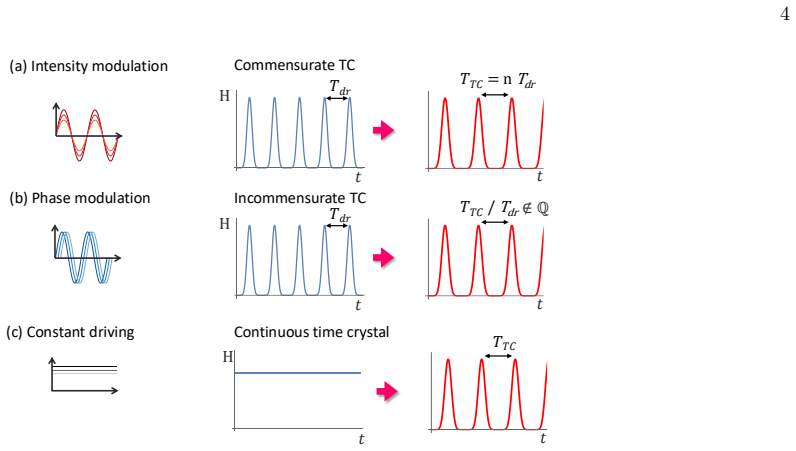
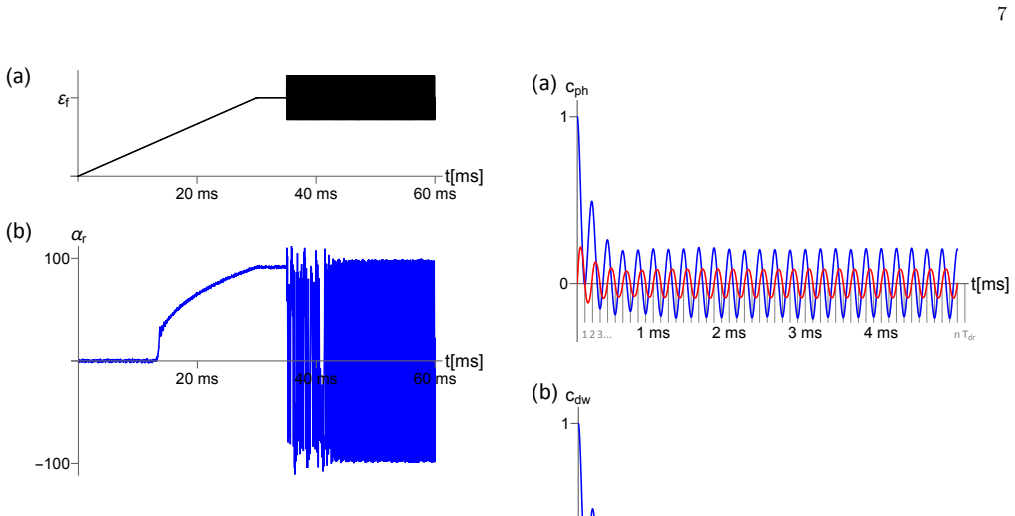
Three distinct time crystalline states are predicted and realized in a cavity-BEC system. Each is exemplified by a minimal few-mode model and characterized via correlation functions of the cavity mode and characteristic momentum modes of the condensate. This supports a clear distinction between these time crystals. The sequence of studies serves as a blueprint for setting up minimal models and their characterization for dynamical phenomena.
What carries the argument
Minimal few-mode models for each time crystal, together with cavity-mode correlation functions and condensate momentum modes used to distinguish the states.
If this is right
- The three states produce measurably different real-time signals in the cavity output light.
- Minimal models suffice to capture the features needed to identify which time crystal is present.
- The same modeling and characterization sequence applies to other light-induced dynamical states in ultracold gases.
Where Pith is reading between the lines
- The real-time cavity readout could be used to implement feedback that stabilizes or switches between time crystalline phases.
- Similar few-mode reductions may help classify dynamical states in other driven cavity-QED platforms.
- The distinction criteria could guide searches for transitions or coexistence between different time crystal types.
Load-bearing premise
The minimal few-mode models accurately represent the full many-body dynamics of the cavity-BEC system for distinguishing the time crystals.
What would settle it
Full many-body simulations or experiments that produce cavity correlation functions or atomic momentum distributions markedly different from those predicted by the corresponding few-mode model for any one of the three states.
Figures







read the original abstract
The understanding of light-induced dynamical states continues to be a challenging and fruitful pursuit of science. This pursuit is supported by quantum simulation of dynamical phenomena, e.g., in ultracold atom systems. Typically, ultracold atom dynamics are read out destructively, via time-of-flight imaging, limiting a detailed analysis. However, atom-cavity systems provide a real-time readout of the photonic state via photon emission from the cavity, making the system ideally suited for the simulation of dynamical phenomena. Here, we review three distinct time crystalline states, predicted and realized in a cavity-BEC system. We give an example for each of them, based on minimal few-mode models. We characterize the time crystalline states via correlation functions of the cavity mode, and characteristic momentum modes of the condensate. This supports a clear distinction between these time crystals. More generally, the sequence of studies reviewed here, serves as a blueprint for setting up minimal models and their characterization, for dynamical phenomena.
Editorial analysis
A structured set of objections, weighed in public.
Referee Report
Summary. The manuscript reviews three distinct time crystalline states predicted and realized in cavity-BEC systems. It constructs an example for each using minimal few-mode models and characterizes the states via correlation functions of the cavity mode together with characteristic momentum modes of the condensate, with the goal of providing a clear distinction among them and a blueprint for minimal-model studies of dynamical phenomena.
Significance. If the characterizations hold, the review is significant for curating existing cavity-BEC time-crystal results, highlighting the non-destructive photonic readout advantage, and supplying a structured methodological template. The explicit use of few-mode models and concrete correlation/momentum diagnostics strengthens the pedagogical value for quantum-simulation studies.
minor comments (3)
- [Abstract] Abstract: the three states are referred to only generically; naming them (e.g., by their dominant momentum or symmetry) would improve immediate readability.
- The manuscript states that the few-mode models 'accurately represent' the full dynamics for the purpose of distinction; a brief sentence recalling the validation range reported in the cited original works would strengthen this claim.
- Figure captions should explicitly state which correlation function (g^(1), g^(2), etc.) and which momentum component is plotted in each panel.
Simulated Author's Rebuttal
We thank the referee for the positive summary, significance assessment, and recommendation of minor revision. No specific major comments appear in the report.
Circularity Check
Review paper with no internal circular derivation chain
full rationale
This manuscript is explicitly a review summarizing three previously predicted and realized time-crystalline phases in cavity-BEC systems. It constructs illustrative examples from minimal few-mode models and characterizes them via cavity correlations and momentum distributions, but these constructions and characterizations are presented as curated presentations of existing results rather than new derivations. No load-bearing step within the paper reduces by definition, by fitting, or by self-citation chain to its own inputs; any reliance on few-mode accuracy is inherited from the cited original works. The paper is therefore self-contained against external benchmarks with no circularity.
Axiom & Free-Parameter Ledger
Reference graph
Works this paper leans on
-
[1]
Time-translation symmetry breaking
-
[2]
Interaction-induced or many-body nature
-
[3]
Time crystals in cavity-BEC systems
Robustness against perturbations Originally envisaged by Frank Wilczek [4], the exis- tence of time crystals in equilibrium scenarios is chal- lenged by a series of no-go theorems, which can be under- stood as energy conservation preventing a system from spontaneously oscillating in the absence of any external force [5–7]. To circumvent the no-go theorems...
work page internal anchor Pith review Pith/arXiv arXiv 2026
-
[4]
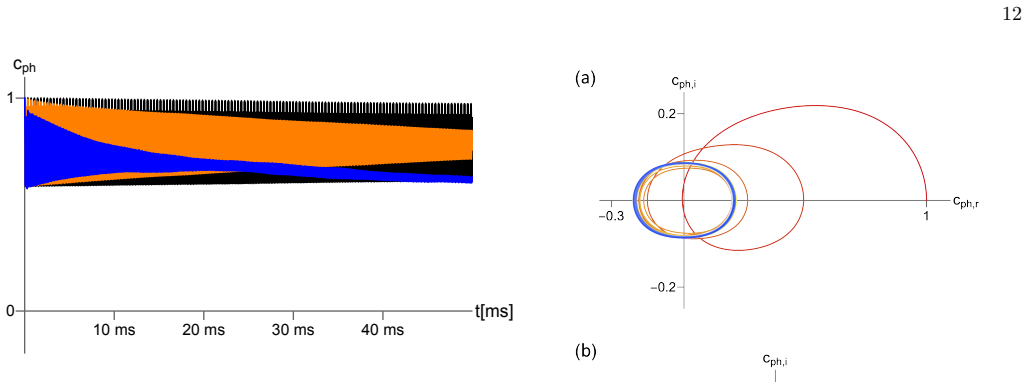
In all cases, we show the first 5 ms of the correlation function, as indicated in the color bar in Fig. 12. X. APPENDIX A. Large atom limit In Fig. 13, we display the real and imaginary part of the cavity correlation functionc ph(t), for the system pa- rameters described in Sect. VII. The system has been scaled up via the quantum-classical rescaling utili...
-
[5]
K. Sacha and J. Zakrzewski, Time crystals: a review, Reports on Progress in Physics81, 016401 (2018)
work page 2018
-
[6]
D. V. Else, C. Monroe, C. Nayak, and N. Y. Yao, Dis- crete Time Crystals, Annual Review of Condensed Mat- ter Physics11, 467 (2020)
work page 2020
-
[7]
M. P. Zaletel, M. Lukin, C. Monroe, C. Nayak, F. Wilczek, and N. Y. Yao, Colloquium: Quantum and classical discrete time crystals, Rev. Mod. Phys.95, 031001 (2023)
work page 2023
-
[8]
Wilczek, Quantum Time Crystals, Phys
F. Wilczek, Quantum Time Crystals, Phys. Rev. Lett. 109, 160401 (2012)
work page 2012
-
[9]
P. Nozi` eres, Time crystals: Can diamagnetic currents drive a charge density wave into rotation?, EPL (Euro- physics Letters)103, 57008 (2013)
work page 2013
-
[10]
Bruno, Impossibility of Spontaneously Rotating Time Crystals: A No-Go Theorem, Phys
P. Bruno, Impossibility of Spontaneously Rotating Time Crystals: A No-Go Theorem, Phys. Rev. Lett.111, 070402 (2013)
work page 2013
-
[11]
H. Watanabe and M. Oshikawa, Absence of quantum time crystals, Phys. Rev. Lett.114, 251603 (2015)
work page 2015
-
[12]
D. V. Else, B. Bauer, and C. Nayak, Floquet Time Crys- tals, Phys. Rev. Lett.117, 090402 (2016). 14
work page 2016
-
[13]
N. Y. Yao, A. C. Potter, I.-D. Potirniche, and A. Vish- wanath, Discrete Time Crystals: Rigidity, Criticality, and Realizations, Phys. Rev. Lett.118, 030401 (2017)
work page 2017
-
[14]
S. Choi, J. Choi, R. Landig, G. Kucsko, H. Zhou, J. Isoya, F. Jelezko, S. Onoda, H. Sumiya, V. Khemani, C. von Keyserlingk, N. Y. Yao, E. Demler, and M. D. Lukin, Ob- servation of discrete time-crystalline order in a disordered dipolar many-body system, Nature543, 221 (2017)
work page 2017
- [15]
-
[16]
D. V. Else, B. Bauer, and C. Nayak, Prethermal Phases of Matter Protected by Time-Translation Symmetry, Phys. Rev. X7, 011026 (2017)
work page 2017
-
[17]
Z. Gong, R. Hamazaki, and M. Ueda, Discrete Time- Crystalline Order in Cavity and Circuit QED Systems, Phys. Rev. Lett.120, 040404 (2018)
work page 2018
-
[18]
B. Zhu, J. Marino, N. Y. Yao, M. D. Lukin, and E. A. Demler, Dicke time crystals in driven-dissipative quantum many-body systems, New J. Phys.21, 073028 (2019)
work page 2019
-
[19]
S. B. J¨ ager, J. M. Giesen, I. Schneider, and S. Eggert, Dissipative Dicke time crystals: An atom’s point of view, Phys. Rev. A110, L010202 (2024)
work page 2024
- [20]
-
[21]
J. G. Cosme, J. Skulte, and L. Mathey, Time crystals in a shaken atom-cavity system, Phys. Rev. A100, 053615 (2019)
work page 2019
- [22]
- [23]
- [24]
-
[25]
P. Kongkhambut, H. Keßler, J. Skulte, L. Mathey, J. G. Cosme, and A. Hemmerich, Realization of a Periodically Driven Open Three-Level Dicke Model, Phys. Rev. Lett. 127, 253601 (2021)
work page 2021
-
[26]
P. Kongkhambut, J. Skulte, L. Mathey, J. G. Cosme, A. Hemmerich, and H. Keßler, Observation of a continu- ous time crystal, Science377, 670 (2022)
work page 2022
-
[27]
P. Kongkhambut, J. G. Cosme, J. Skulte, M. A. Moreno Armijos, L. Mathey, A. Hemmerich, and H. Keßler, Ob- servation of a phase transition from a continuous to a discrete time crystal, Rep. Prog. Phys.87, 080502 (2024)
work page 2024
- [28]
-
[29]
J. G. Cosme, P. Kongkhambut, A. B¨ olian, R. J. L. Tuquero, J. Skulte, L. Mathey, A. Hemmerich, and H. Keßler, Torus Bifurcation of a Dissipative Time Crys- tal, Phys. Rev. Lett.134, 223601 (2025)
work page 2025
-
[30]
K. Baumann, C. Guerlin, F. Brennecke, and T. Esslinger, Dicke quantum phase transition with a superfluid gas in an optical cavity, Nature464, 1301 (2010)
work page 2010
-
[31]
J. Klinder, H. Keßler, M. Wolke, L. Mathey, and A. Hem- merich, Dynamical phase transition in the open Dicke model, Proceedings of the National Academy of Sciences 112, 3290 (2015)
work page 2015
-
[32]
F. Mivehvar, F. Piazza, T. Donne, and H. Ritsch, Cavity qed with quantum gases: new paradigms in many-body physics, Advances in Physics70, 1 (2021)
work page 2021
- [33]
-
[34]
Universal quantum melting of quasiperiodic attractors in driven-dissipative cavities
C. Nowoczyn, L. Mathey, and K. Seibold, Universal quantum melting of quasiperiodic attractors in driven- dissipative cavities (2025), arXiv:2507.03764 [quant-ph]
work page internal anchor Pith review Pith/arXiv arXiv 2025
discussion (0)
Sign in with ORCID, Apple, or X to comment. Anyone can read and Pith papers without signing in.