REVIEW 4 major objections 4 minor 12 references
Surprising variants of Cauchy's formula for mean chord length
T0 review · 4 major / 4 minor · reviewed 2026-08-14 · deepseek-v4-flash
Pith's one-line read A random walk from boundary to boundary of an $N^d$ hypercubic lattice has mean length $N$ and a $n^{-3/2}$ power-law tail.
desk verdict A clean lattice version of Cauchy's mean chord formula with a heuristic—not proven—power-law tail in 2D/3D. read the letter →
The pith
A machine-rendered reading of the paper's core claim, the machinery that carries it, and where it could break.
The reading
What carries the argument
The mechanism is the projection of the lattice walk onto one coordinate axis, which is a one-dimensional random walk between two absorbing endpoints, the gambler's ruin problem. The exact solution gives the mean absorption time $m(N-m)$ from site $m$, hence $N$ for a boundary-to-boundary walk, and a hitting-time distribution decaying as $n^{-3/2}$. The paper's argument then treats the $d$-dimensional walk as a set of independent such components along each axis, so the linear mean and the qualitative power-law tail transfer from one dimension to two and three dimensions; the same one-dimensional formula explains the anisotropic cases, including the weight factors that collapse the mean-length data.
What would settle it
Compute the exact first-return-time distribution of the isotropic two-dimensional walk to the square boundary by transfer-matrix or eigenvalue methods, or by very high-statistics simulation at $N=10^4$, and measure the log-log slope in the window $N \ll n \ll N^2$; a slope clearly different from $-3/2$, or a slope that shifts with $N$, would refute the central claim. A direct check of the component-independence assumption is to measure whether the tail distribution depends on the exit coordinate along one axis: if it does, the reduction to independent components fails.
Extended reading notes
Core claim
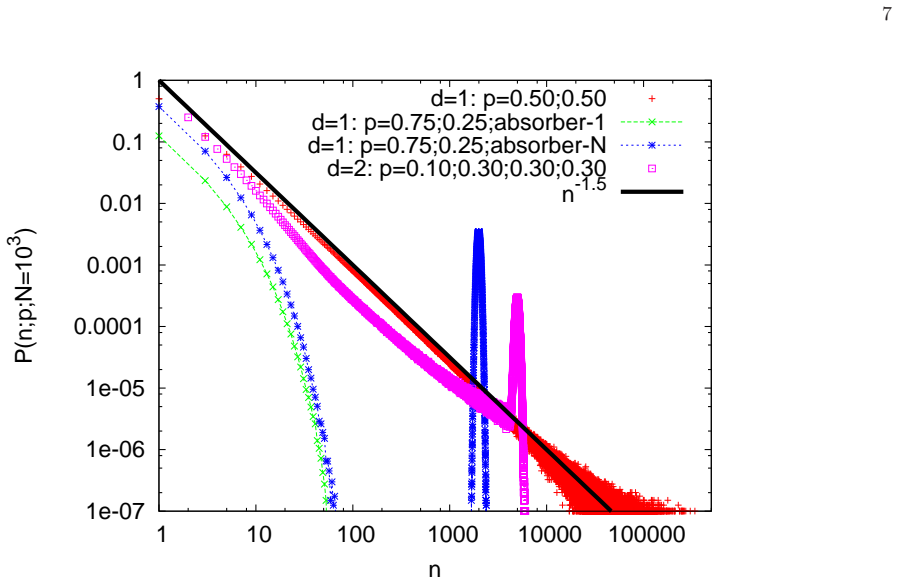
The central discovery is that Cauchy's formula survives when straight chords are replaced by restricted lattice random walks: an isotropic walk that enters an $N^d$ hypercubic lattice through a uniformly chosen surface site and leaves at the first surface hit has mean length equal to $N$, independently of $d$ in the dimensions studied. The distribution of walk lengths is qualitatively different from the continuum mean-field exponential: it decays as $C n^{-3/2}$ over many decades for a symmetric walk. For anisotropic walks the mean still scales linearly with $N$ after multiplying by fixed weight factors, and the power-law tail persists precisely when the walk is symmetric between each pair of opposite faces; breaking that symmetry replaces the tail with a finite-size peak. The paper argues that all of these features reduce to the one-dimensional two-absorber random walk.
Load-bearing premise
The load-bearing premise is that the components of the walk along the coordinate axes are independent, so the one-dimensional $n^{-3/2}$ tail transfers unchanged to two and three dimensions, and that 'large $n$' means the intermediate window $N \ll n \ll N^2$ before the one-dimensional finite-size exponential cutoff sets in.
Editorial extensions
If this is right
- If the main claim is correct, the mean first-return length on an $N^d$ hypercubic lattice is $N$ for every dimension studied, so the volume-to-surface ratio controls the mean even when a single step does not resemble a chord.
- The $n^{-3/2}$ tail implies that long walks are abundant: the probability of a walk lasting $n$ steps decays only polynomially, so fluctuations around the mean are much larger than an exponential model would allow.
- The lattice derivation ties Cauchy's formula to the gambler's ruin problem, giving a simple route to the chord-length formula that does not require the Boltzmann transport equation.
- When the walk is symmetric between opposite faces, the power-law tail holds; when that symmetry is broken, the same mean scaling survives but the power-law tail is replaced by a finite-size peak.
Reading between the lines
- Editorial inference: the component-independence assumption suggests a testable factorization of the $d$-dimensional first-return-time distribution into one-dimensional factors in the window $N \ll n \ll N^2$; measuring correlations between exit times and exit coordinates would confirm or refute it.
- Editorial inference: for rectangular or other non-cubic domains, the mean walk length should still scale with the volume-to-surface ratio, but the tail exponent and the location of the finite-size cutoff may depend on aspect ratio.
- Editorial inference: the loopy, localized structure of surface-to-surface walks resembles a bounded-domain model of anomalous diffusion, where the power-law tail could be observed as a slowly decaying return-time distribution in single-particle-tracking experiments.
Signed reviews
Editorial analysis
A structured set of objections, weighed in public.
Referee Report
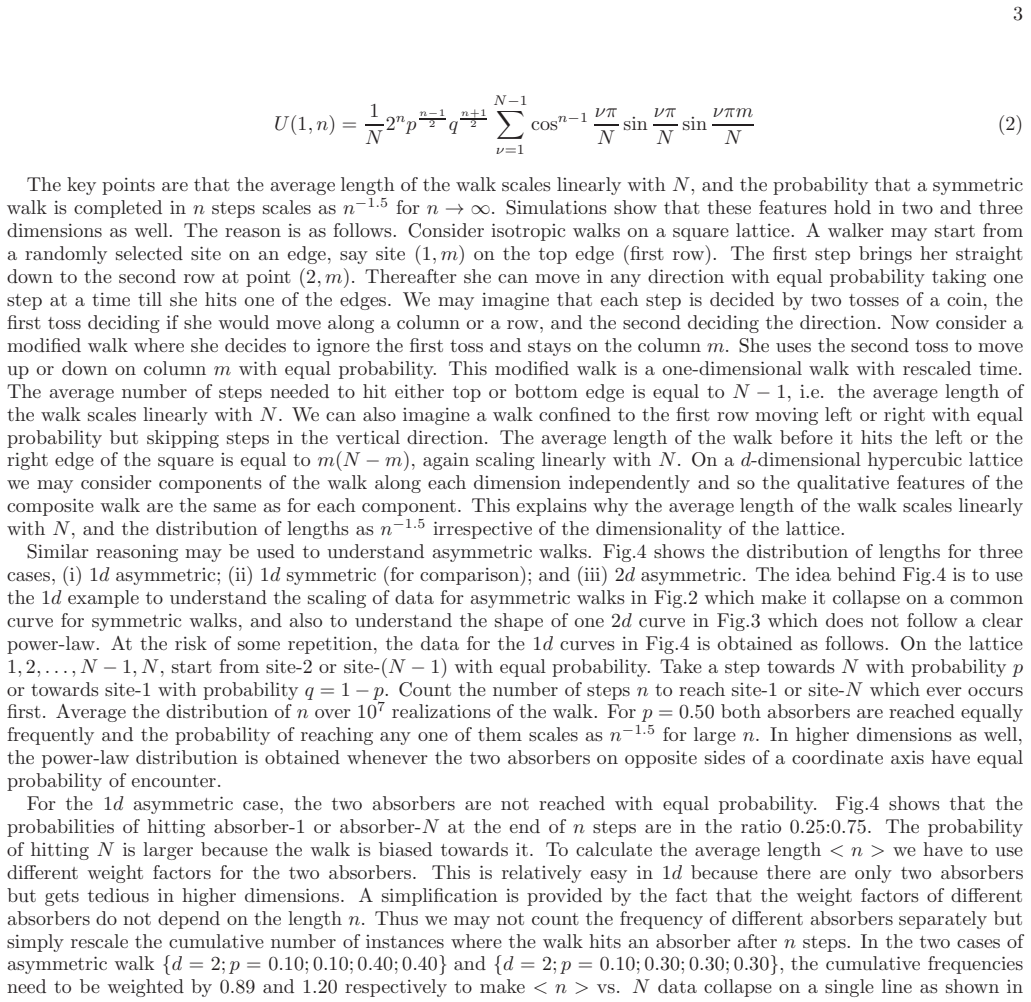
Summary. The paper studies nearest-neighbor random walks on d-dimensional hypercubic lattices (d = 1, 2, 3) that start on the boundary and terminate upon first return to the boundary. It reports two main claims: (i) the mean walk length <n> is proportional to N, with <n> = N for symmetric walks; and (ii) the length distribution P(n) decays as n^{-3/2} for large n for symmetric walks and for some asymmetric cases. These claims are presented as a lattice analogue of Cauchy's chord-length formula. The one-dimensional case is treated with classical gambler's-ruin formulas (Eqs. (1)-(2)); the higher-dimensional results are supported by simulations with N up to 10^3 and by a heuristic component-independence argument.
Significance. If the n^{-3/2} tail in d = 2, 3 were rigorously established, the paper would give a simple and appealing discrete counterpart of recent continuum results on Cauchy's formula, with potential applications in first-passage and transport problems. The simulations are extensive (more than 10^6 realizations for N = 10^3), and the one-dimensional exact formulas are a useful starting point. However, the higher-dimensional distributional claim is the principal novelty and is currently supported only by an unproved heuristic; the manuscript also overstates the mean-length claim. The significance is therefore conditional on a rigorous or clearly delimited version of the distributional result.
major comments (4)
- [Text following Eq. (2)] The step 'On a d-dimensional hypercubic lattice we may consider components of the walk along each dimension independently' is not a proof. In discrete time the coordinate processes are dependent, because each step changes exactly one coordinate, and the exit time is the minimum of the dependent coordinate hitting times. No error estimate or argument is given to show that this dependence preserves the one-dimensional n^{-3/2} tail in d = 2, 3. Since this tail is the paper's novel claim, the manuscript should either supply a rigorous intermediate-asymptotic derivation or explicitly present it as a conjecture supported by simulation.
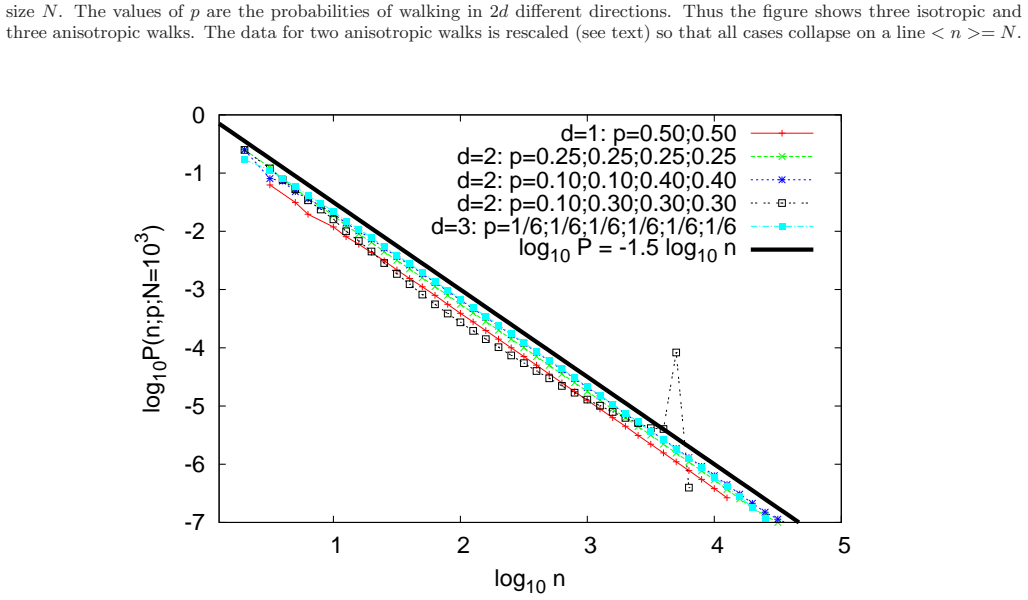
- [Abstract and Fig. 3 discussion] The statement that P(n) scales as n^{-1.5} 'for large n' is ambiguous and, as a fixed-N asymptotic statement, false. Equation (2) contains factors cos^{n-1}(nu pi / N), so for fixed N and n >> N^2 the distribution decays exponentially, not as a power law. The power law can hold only in the intermediate window 1 << n << N^2. The paper should state this window explicitly and verify that the data in Figs. 3 and 4 are collected within it; without that qualification, the claim is literally incorrect as a fixed-N asymptotic statement.
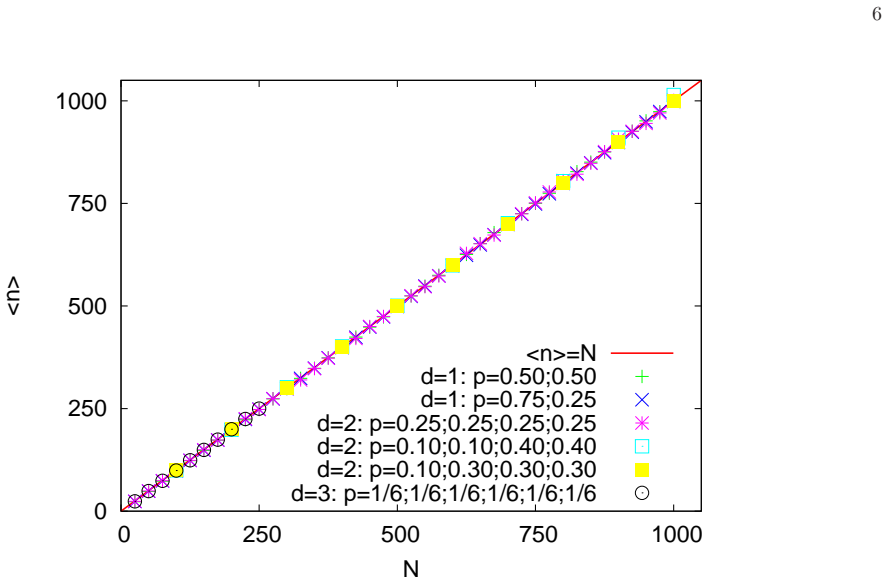
- [Abstract and conclusion] The abstract and the concluding paragraph claim without qualification that 'the mean length of walks is equal to N'. The body shows this is not true for the anisotropic cases: the two two-dimensional asymmetric datasets are multiplied by fitted factors 0.89 and 1.20 to collapse onto the <n> = N line, and in one dimension the asymmetric formula (1) gives proportionality constants that depend on the bias and the starting distribution. The abstract should carry the same caveat as the body: <n> is proportional to N, with <n> = N only for symmetric walks in the large-N limit and under the specified boundary-entry convention.
- [Eq. (1)] Equation (1) contains an off-by-one error. For a simple symmetric random walk on sites 1, ..., N with absorbing endpoints 1 and N, the expected duration from site m is (m-1)(N-m), not m(N-m); for N = 3 and m = 2, the formula gives S_2 = 2 while the true value is 1. This error propagates into the claimed proportionality constants and into the empirical 0.89 and 1.20 rescaling factors used in Fig. 2, so Eq. (1) and the statements depending on it must be corrected before the quantitative claims can be accepted.
minor comments (4)
- [Title and affiliations] There are several typographical errors: 'leng th' in the title, 'Shil long' for Shillong, and 'Euvres' should be 'Oeuvres' in the first reference.
- [Fig. 3 caption] The caption refers to 'open black squares', but the legend lists line styles and colors; please clarify which dataset corresponds to the non-power-law case.
- [Fig. 4 discussion] The text says 'The simulation data agrees with the analytic solution mentioned above but the peak is a finite size effect', yet earlier it says the analytic result applies to n <= N while the peak occurs at n about 2N. This needs clarification of which regimes are covered by the analytic formula.
- [Eq. (2)] The rendering of Eq. (2) is ambiguous: '2np' should presumably read '2^n p' or similar. Please correct the typography so the factors are unambiguous.
Circularity Check
No circularity: the 1D mean and tail are standard external results, and the higher-dimensional power law is an asserted extrapolation rather than a fitted or definitionally forced prediction.
full rationale
The paper's only analytical derivation is the one-dimensional gambler's ruin result quoted from Feller/Ellis (Eqs. 1-2); from this it extracts <n> linear in N and P(n) ~ n^-3/2 in 1D. The 2D and 3D claims are then made by the heuristic that coordinate components may be considered independently. This is an unproved independence assumption and a possible correctness gap, but it is not circular: the higher-dimensional distribution is not equal by construction to the 1D formula, nor is any fitted parameter substituted for the claimed exponent. The rescaling factors 0.89 and 1.20 used to collapse the asymmetric <n> data are empirical weights, but they are ancillary, are not asserted to be derived from step probabilities, and do not enter the symmetric mean or power-law claims. There are no self-citations used as load-bearing premises; the references to prior random-walk/Cauchy work ([7], [8]) are to continuum results used as motivation and boundary-condition analogies, not to the authors' own unverified results. Hence the derivation chain is not circular, even though the 2D/3D tail exponent is under-supported.
Assumptions & free parameters
free parameters (1)
- Asymmetric case weighting factors =
0.89 and 1.20
assumptions (3)
- standard math The 1D gambler's ruin formulas (Eqs. 1 and 2) for mean and distribution of absorption times are correct and applicable to the lattice walk along a coordinate.
- domain assumption Starting points uniformly distributed over the boundary with the first step directed inward is the lattice analogue of the uniform isotropic incident flux required by Cauchy's formula.
- ad hoc to paper In d dimensions the walk's exit statistics can be understood by considering its components along each coordinate independently (with rescaled time), and no proof or error bound is supplied.
Cite this review
Pith. "Pith review of Surprising variants of Cauchy's formula for mean chord length." pith.science (2026). https://pith.science/paper/2OBEB4ZZ
@misc{pith2026190806608,
  author       = {Pith},
  title        = {Pith review of: Surprising variants of Cauchy's formula for mean chord length},
  year         = {2026},
  howpublished = {\url{https://pith.science/paper/2OBEB4ZZ}},
  note         = {Machine review of arXiv:1908.06608}
}
abstract
We examine isotropic and anisotropic random walks which begin on the surface of linear ($N$), square ($N \times N$), or cubic ($N \times N \times N$) lattices and end upon encountering the surface again. The mean length of walks is equal to $N$ and the distribution of lengths $n$ generally scales as $n^{-1.5}$ for large $n$. Our results are interesting in the context of an old formula due to Cauchy that the mean length of a chord though a convex body of volume $V$ and surface $S$ is proportional to $V/S$. It has been realized in recent years that Cauchy's formula holds surprisingly even if chords are replaced by irregular insect paths or trajectories of colliding gas molecules. The random walk on a lattice offers a simple and transparent understanding of this result in comparison to other formulations based on Boltzmann's transport equation in continuum.
Figures
Figures from the paper (2 more)
Reference graph
Works this paper leans on
-
[1]
A. Cauchy, Euvres compl` etes: Series 1 (Cambridge Library Collection-Mathematics), Cam bridge University Press (2009). doi:10.1017/CB09780511702389
-
[2]
P. A. M. Dirac, K. Fuchs, R. Peierls, and P. D. Preston, Dec lassified British Report MS-D-5, Part II (1943)
work page 1943
-
[3]
Underwood, Quantitative Stereology (Addison-Wesle y, 1970)
E. Underwood, Quantitative Stereology (Addison-Wesle y, 1970)
work page 1970
-
[4]
Serra, Image Analysis and Mathematical Morphology (A cademic Press, London, 1982)
J. Serra, Image Analysis and Mathematical Morphology (A cademic Press, London, 1982)
work page 1982
-
[5]
S. Torquato, Random Heterogeneous Materials: microstr ucture and macroscopic properties (Springer-Verlag, New Y ork, 2001)
work page 2001
- [6]
-
[7]
A. Zoia, E. Dumonteil, A. Mazzolo, Phys. Rev. E 85, 011132 (2012); Phys. Rev. E 84, 061130 (2011)
work page 2012
-
[8]
A. Mazzolo, A. Zoia, and C de Mulatier, Journal of Mathema tical Physics, American Institute of Physics (AIP), 55, 083 308 (2014),and references therein
work page 2014
Show all 12 references
-
[9]
R. E. Ellis, Cambridge Mathematical Journal, vol 4 (1844 )
-
[10]
Feller An Introduction to Probability Theory and Its Implications , vol
W. Feller An Introduction to Probability Theory and Its Implications , vol. 1, 2nd ed.,John Wiley & Sons, New York (1959)
1959
-
[11]
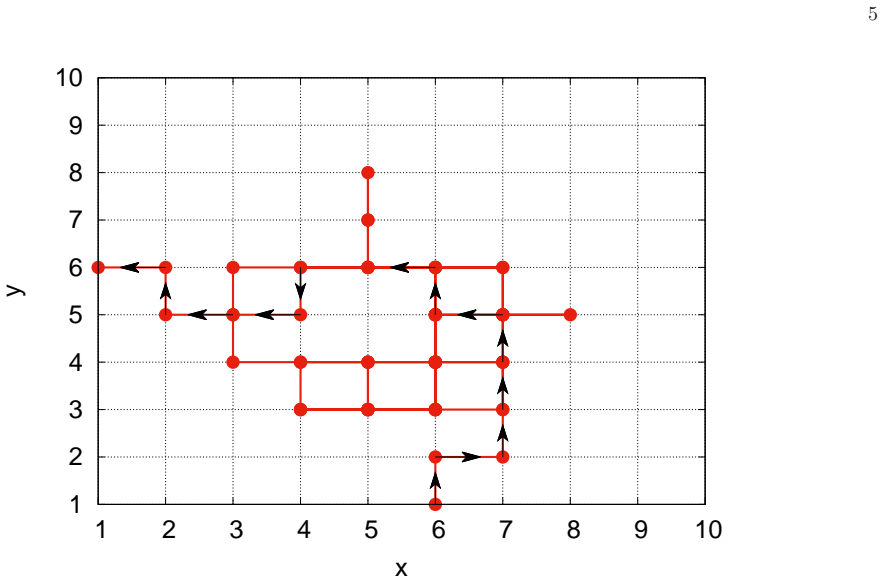
F. A. Oliveira, R. M. S. Ferreira, L. C. Lapas, and M. H. Va instein, Front. Phys. 7:18 (2019); doi: 10.3389/fphy.2019 .00018 5 1 2 3 4 5 6 7 8 9 10 1 2 3 4 5 6 7 8 9 10 y x FIG. 1: An isotropic random walk on a 10 × 10 lattice that starts and ends on the boundary
2019 doi
-
[12]
M. R. Evans and S. N. Majumdar, Phys. Rev. Lett. 106, 1606 01 (2011). 6 0 250 500 750 1000 0 250 500 750 1000 <n> N <n>=N d=1: p=0.50;0.50 d=1: p=0.75;0.25 d=2: p=0.25;0.25;0.25;0.25 d=2: p=0.10;0.10;0.40;0.40 d=2: p=0.10;0.30;0.30;0.30 d=3: p=1/6;1/6;1/6;1/6;1/6;1/6 FIG. 2: A...
2011
Reviewed August 14, 2026 · model on record in the stance chip above.
Discussion (0). Continue with ORCID to comment.