REVIEW 3 major objections 4 minor 37 references
Sparse Zero Correlation Zone Arrays for Training Design in Spatial Modulation Systems
T0 review · 3 major / 4 minor · reviewed 2026-08-12 · deepseek-v4-flash
Pith's one-line read This paper constructs sparse zero-correlation-zone arrays, directly usable as training matrices in spatial modulation, with ZCZ width twice that of existing CZCP-based designs.
desk verdict Solid construction paper with a genuine factor-two ZCZ improvement, but both main proofs have an unhandled v=2 case that the referee should ask to patch. read the letter →
The pith
A machine-rendered reading of the paper's core claim, the machinery that carries it, and where it could break.
The reading
What carries the argument
The machine is the 2D restricted generalized Boolean function: a Boolean function on $n+m$ binary variables whose array has entry $\xi^{f(g,i)}$ exactly when certain prescribed bits of the column index $i$ match the row index $g$, and $0$ otherwise. Restricting $x_{\pi_\alpha(m_\alpha)} = y_\alpha$ for each block $I_\alpha$ places one non-zero entry per column, and the chain of quadratic terms within each block, capped by the cross term $x_{\pi_\alpha(m_\alpha)} y_\alpha$, makes the phase differences cancel in pairs. The cancellation is driven by an involution that flips the bit at position $\pi_1(1)=m$: in the proof each non-zero correlation term $C_{g,j}C^*_{k,i}$ is paired with a twin term $C_{g,j'}C^*_{k,i'}$ whose phase differs by a factor of $-1$, so the contribution vanishes. The extra condition $\mu_m \in \{0,q/2\}$ keeps the paired phases opposite, and the width $Z = 2^{\pi_1(2)-1}$ is exactly the shift range for which the pairing argument holds.
What would settle it
Compute the periodic correlations $\theta(C_g,C_k;u)$ for the Theorem 3 construction in the boundary case $|I_1|=1$, for instance $m=3,n=2$ with $I_1=\{3\}$ and $I_2=\{2,1\}$. The formula $Z=2^{\pi_1(2)-1}$ is undefined there because $\pi_1(2)$ does not exist, so the theorem as stated makes no claim; the decisive test is whether such a matrix nevertheless has zero-correlation-zone width $2^{m-n-1}=2$, which would show the condition $|I_1|>1$ is not actually needed, or a smaller width, which would require amending the theorem.
Extended reading notes
Core claim
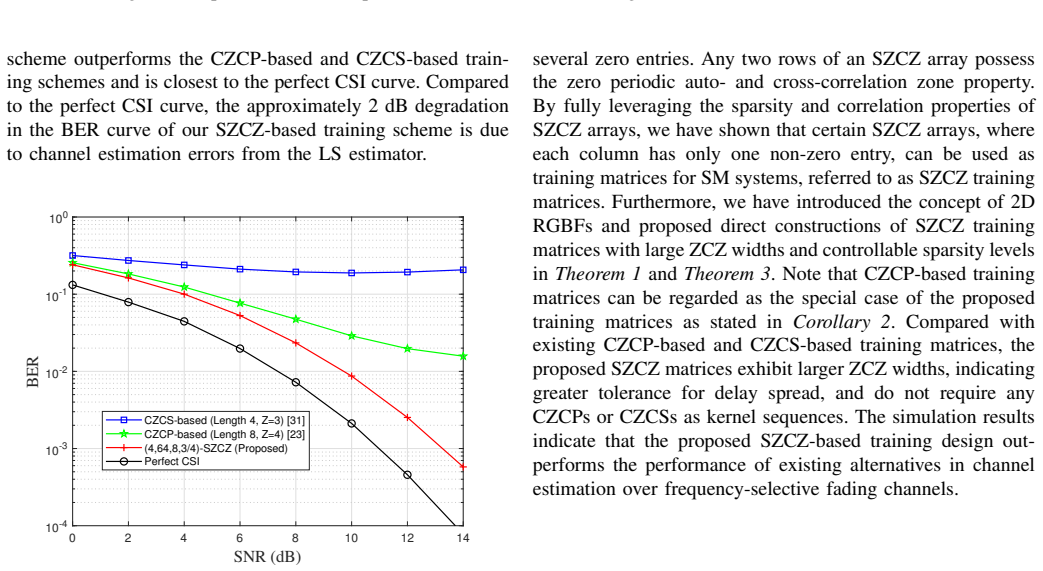
The discovery is that the SZCZ training matrix, unlike prior kernel-based designs, does not need any pre-existing cross Z-complementary pair or set as a building block. Theorem 3 constructs the matrix as a sparse array associated to a 2D RGBF $f|_{x=y}$, where variables $x_{\pi_\alpha(m_\alpha)}$ are equated with row-index bits $y_\alpha$; this restriction forces every column to contain exactly one non-zero entry, satisfying criterion (C1). The quadratic design $\frac{q}{2}\sum_{\alpha=1}^n\sum_{\beta=1}^{m_\alpha-1} x_{\pi_\alpha(\beta)}x_{\pi_\alpha(\beta+1)} + x_{\pi_\alpha(m_\alpha)}y_\alpha$ plus linear terms with $\mu_m \in \{0,q/2\}$ makes the periodic correlations vanish for shifts $1 \le u \le 2^{\pi_1(2)-1}$, satisfying criterion (C2). The paper shows that when the first block $I_1$ has at least two elements and $\pi_1(2)=m-n$, the ZCZ width reaches $2^{m-n-1}$, twice the width of the CZCP-based training matrix and larger than the CZCS-based one. Simulations for a $4\times64$ matrix with 9 multipaths show NMSE coinciding with the theoretical minimum and a BER close to the perfect-CSI curve, about 2 dB away.
Load-bearing premise
The correlation-cancellation proof requires the first block $I_1$ to contain at least two variables, because the zero-correlation-zone width is read from $\pi_1(2)$, the second entry of that block; the theorem statement allows $|I_1|=1$, where the claimed width is not defined.
Editorial extensions
If this is right
- An SZCZ training matrix with $Z \ge \lambda$ achieves the minimum NMSE $\sigma_v^2(\lambda+1)/M$ in least-squares channel estimation, so increasing $Z$ raises the number of multipaths the system tolerates without estimation loss.
- Theorem 3 yields $(2^n, 2^m, 2^{m-n-1}, (2^n-1)/2^n)$-SZCZ training matrices, doubling the largest ZCZ width of [23]'s CZCP-based framework and exceeding [31]'s CZCS-based width.
- The CZCP-based training matrices of [23] are a special case of the new construction, obtained by taking $\pi(2)=m-n-1$ in Theorem 1, as stated in Corollary 2.
- The sparsity of the training matrix is $S=(2^n-1)/2^n$, determined by the number of transmit antennas $2^n$, while the ZCZ width is controlled through $m-n$.
- The construction works for any even $q$, so the training entries can be polyphase rather than only binary.
Reading between the lines
- Beyond the paper, the partition of $\{1,\dots,m\}$ into blocks $I_1,\dots,I_n$ is a free parameter family: different partitions permute the arrangement of non-zero entries while preserving the ZCZ width, so one can search over partitions for training matrices with additional properties such as low peak-to-average power ratio or structured sparsity.
- The paper's analysis is for periodic correlations; the same RGBF construction may extend to aperiodic ZCZ training matrices for zero-padded single-carrier SM, connecting to the equalizer used in [37].
- Because the width formula is $2^{m-n-1}$, the doubling gain appears only when the training length exceeds the number of antennas by more than one order of magnitude; for $m$ close to $n$ the advantage shrinks to a single-shift zone.
Editorial analysis
A structured set of objections, weighed in public.
Referee Report
Summary. The paper introduces sparse zero correlation zone (SZCZ) arrays as training matrices for spatial modulation (SM) systems. It defines SZCZ arrays, derives the condition under which an SZCZ array yields minimum-NMSE channel estimation, and proposes two direct constructions based on 2D restricted generalized Boolean functions (RGBFs): Theorem 1 and Theorem 3. The authors claim that the constructions satisfy the SM-specific column-sparsity criterion (C1) and the zero-correlation criterion (C2), and that the best construction achieves a ZCZ width twice that of the existing CZCP/CZCS-based training matrices. Simulation results for a 4x64 training matrix show that the proposed SZCZ design attains the minimum NMSE for up to nine multipaths and improves BER relative to the compared schemes.
Significance. If the construction theorems are correct, the paper makes a useful contribution to SM training design: it provides a direct, kernel-free construction of sparse training matrices with controllable sparsity and larger ZCZ widths than existing CZCP/CZCS-based frameworks. The use of 2D RGBFs is a natural extension of prior Boolean-function-based sequence designs, and the paper honestly notes that the prior CZCP construction arises as a special case (Corollary 2). The worked examples and simulations support the claimed performance for the specific parameters shown. However, the proof of the main theorems contains an unhandled boundary case at the claimed maximal shift, and Theorem 3's statement omits a necessary condition on the partition block size; these issues need to be fixed before the central claims are fully established.
major comments (3)
- [Appendix A, Case 1, Eq. (34)] The proof of Theorem 1 uses the expression j_{π(v−2)} in Eq. (34), but when v=2 the index π(v−2)=π(0) does not exist. The case v=2 is not excluded: it occurs when i_{π(1)}=j_{π(1)} and i_{π(2)}≠j_{π(2)}, which happens at the boundary shift |u|=2^{π(2)−1}. Since the claimed ZCZ width is exactly 2^{π(2)−1}, the proof as written breaks precisely at the maximal promised shift. The cancellation can likely be recovered from the x_{π(1)}x_{π(2)} term alone (the missing j_{π(v−2)} term is absent for v=2), but the manuscript does not provide this argument. Please add a separate treatment of v=2 or define the term as zero in that case and show the cancellation still holds.
- [Appendix C, Case 1, Eq. (47)] The same undefined-index issue appears in the proof of Theorem 3. After establishing j_{πα(1)}=i_{πα(1)} for all α, the proof lets v be the smallest index with j_{π_ˆα(v)}≠i_{π_ˆα(v)} and flips the bit at position π_ˆα(v−1). If v=2, then π_ˆα(v−2) is undefined in the analog of Eq. (34). This case is not merely hypothetical: it can occur when the first differing unrestricted bit inside the block is the second one, which is compatible with the shift bound u≤2^{π1(2)−1}. Please add the v=2 boundary argument here as well.
- [Theorem 3 statement] Theorem 3 asserts that the constructed array is a (2^n, 2^m, 2^{π_1(2)−1}, S)-SZCZ matrix, but π_1(2) is undefined when m_1=|I_1|=1. The stated hypothesis m>n does not prevent m_1=1. Please add the condition m_1≥2 (or otherwise handle the m_1=1 case and give a valid ZCZ-width formula for it). This is a statement-level, not merely cosmetic, fix because the ZCZ width is the paper's central claimed improvement.
minor comments (4)
- [Section II.A] In the definition of the 2D GBF, the text says '1 ≤ m ≤ m' where the second 'm' should be a different index; this is a typo that should read, e.g., '1 ≤ i ≤ m'.
- [Theorem 1] The condition on π reads 'π(m − n + a) ∈ {m − n, m− n + 1, . . . , m− 1} for α = 1, 2, . . . , n'; the symbol 'a' should be 'α'.
- [Section IV, Figs. 5 and 6] The simulation figures do not include error bars or confidence intervals. Since the claimed NMSE saturation at the minimum value is central to the comparison, adding error bars or repeated-trial statistics would strengthen the evidence.
- [Example 4 and Table I] The CZCS-based scheme of [31] is listed with ZCZ width 3 for the 4×64 case, while Table I uses the parameter k; it would help the reader to spell out the exact values of k and n,m used in the comparison in the table caption or in Example 4.
Circularity Check
No significant circularity: the SZCZ constructions are direct, parameter-free Boolean-function derivations with stated assumptions, and the comparison against CZCP/CZCS benchmarks is external and explicitly shown as a special case.
full rationale
The paper's derivation chain is self-contained. The SZCZ array definition (Definition 2), the design criteria (C1) and (C2), and Lemma 1 are all established inside the paper from the correlation definitions and the LS channel-estimation equations (14)-(19). The constructions in Theorem 1 and Theorem 3 are direct assignments C = f|_{x=y} from explicitly stated 2D RGBFs, with no fitted parameters, no data-dependent values, and no hidden variables. The proof of criterion (C1) is a structural counting argument: each column has exactly one nonzero entry because exactly one row matches the restricted variables. The proof of criterion (C2) is a pairwise cancellation argument using the quadratic terms of the RGBF; although the manuscript has a possible boundary-index gap involving π(v−2) when v = 2, that is a correctness or proof-completeness concern, not circularity. The comparison with CZCP-based and CZCS-based training matrices is external: the paper cites [23] and [31] as benchmarks, and Corollary 2 explicitly reduces the proposed construction to the prior CZCP framework by choosing π(2) = m−n−1 and π(m−n+α) = m−n+α−1. This explicit reduction is honest and does not smuggle the prior result in as an assumption; instead it demonstrates that the proposed class generalizes the earlier one. The only self-citations are for background concepts such as 2D GBFs and CZCSs, and those are not load-bearing: the 2D GBF definition is stated in the paper, and the CZCS comparison is an external benchmark rather than a premise of the construction. No fitted value is renamed as a prediction, and no uniqueness theorem is invoked to force a choice. Accordingly, the paper is not circular.
Assumptions & free parameters
assumptions (4)
- standard math Properties of primitive q-th roots of unity and modular arithmetic, including cancellation of terms differing by q/2 in the exponent for even q.
- domain assumption The channel is quasi-static frequency-selective with (lambda+1) taps, each entry drawn from CN(0,1/(lambda+1)), and a cyclic prefix is used so the linear convolution becomes circulant.
- domain assumption Minimum NMSE for LS channel estimation requires XX^H = M I, as derived in [9] and restated in Section III-A.
- domain assumption The training matrix must have exactly one non-zero entry per column (criterion C1), a structural constraint of spatial modulation.
Cite this review
Pith. "Pith review of Sparse Zero Correlation Zone Arrays for Training Design in Spatial Modulation Systems." pith.science (2026). https://pith.science/paper/2P6EE4MK
@misc{pith2026241113878,
  author       = {Pith},
  title        = {Pith review of: Sparse Zero Correlation Zone Arrays for Training Design in Spatial Modulation Systems},
  year         = {2026},
  howpublished = {\url{https://pith.science/paper/2P6EE4MK}},
  note         = {Machine review of arXiv:2411.13878}
}
read the original abstract
This paper presents a novel training matrix design for spatial modulation (SM) systems, by introducing a new class of two-dimensional (2D) arrays called sparse zero correlation zone (SZCZ) arrays. An SZCZ array is characterized by a majority of zero entries and exhibits the zero periodic auto- and cross-correlation zone properties across any two rows. With these unique properties, we show that SZCZ arrays can be effectively used as training matrices for SM systems. Additionally, direct constructions of SZCZ arrays with large ZCZ widths and controllable sparsity levels based on 2D restricted generalized Boolean functions (RGBFs) are proposed. Compared with existing training schemes, the proposed SZCZ-based training matrices have larger ZCZ widths, thereby offering greater tolerance for delay spread in multipath channels. Simulation results demonstrate that the proposed SZCZ-based training design exhibits superior channel estimation performance over frequency-selective fading channels compared to existing alternatives.
Figures


Figures from the paper (3 more)


Reference graph
Works this paper leans on
-
[23]
Z. Liu, P. Yang, Y . L. Guan, and P. Xiao, “Cross Z-complementary pairs for optimal training in spatial modulation over frequency selective channels,” IEEE Trans. Signal Process. , vol. 68, pp. 1529–1543, Feb. 2020
work page 2020
-
[1]
Class of binary sequences with zero correlation zone,
P. Z. Fan, N. Suehiro, N. Kuroyanagi, and X. M. Deng, “Class of binary sequences with zero correlation zone,” Electron. Lett., vol. 35, no. 10, pp. 777–779, May 1999
work page 1999
-
[2]
A novel construction of zero correlation zone sequences based on boolean functions,
Y .-S. Tang, C.-Y . Chen, and C.-C. Chao, “A novel construction of zero correlation zone sequences based on boolean functions,” in Proc. IEEE Int. Symp. on Spread Spectrum Tech. and Applicat. , Taichung, Taiwan, Oct. 2010, pp. 198–203
work page 2010
-
[3]
A new class of zero-correlation zone sequences,
H. Torii, M. Nakamura, and N. Suehiro, “A new class of zero-correlation zone sequences,” IEEE Trans. Inf. Theory , vol. 50, pp. 559–565, Mar. 2004
work page 2004
-
[4]
A new class of sequences with zero or low correlation zone based on interleaving technique,
Z. Zhou, X. Tang, and G. Gong, “A new class of sequences with zero or low correlation zone based on interleaving technique,” IEEE Trans. Inf. Theory, vol. 54, pp. 4267–4273, Sep. 2008
work page 2008
-
[5]
A new construction of zero correlation zone sequences from generalized Reed-Muller codes,
Z. Liu, Y . L. Guan, and U. Parampalli, “A new construction of zero correlation zone sequences from generalized Reed-Muller codes,” in Proc. IEEE Inf. Theory Workshop , Hobart, Australia, Nov. 2014, pp. 591–595
work page 2014
-
[6]
Golay complementary sequence sets with large zero correlation zones,
C.-Y . Chen and S.-W. Wu, “Golay complementary sequence sets with large zero correlation zones,” IEEE Trans. Commun. , vol. 66, no. 11, pp. 5197–5204, Nov. 2018
work page 2018
-
[7]
Optimal and almost-optimal Golay-ZCZ sequence sets with bounded PAPRs,
C.-Y . Pai, Y .-J. Lin, and C.-Y . Chen, “Optimal and almost-optimal Golay-ZCZ sequence sets with bounded PAPRs,”IEEE Trans. Commun., vol. 71, no. 2, pp. 728–740, Feb. 2023
work page 2023
Show all 37 references
-
[8]
Performance of multi-path MIMO channel estimation based on ZCZ training sequences,
W. Yuan, P. Wang, and P. Fan, “Performance of multi-path MIMO channel estimation based on ZCZ training sequences,” in Proc. Int. Symp. on Microwave, Antenna, Propagation, and EMC Techno. for Wireless Commun., Beijing, China, Sep. 2005, pp. 1542–1545. 10
2005
-
[9]
Optimal binary training sequence design for multiple-antenna systems over dispersive fading channels,
S.-A. Yang and J. Wu, “Optimal binary training sequence design for multiple-antenna systems over dispersive fading channels,” IEEE Trans. Veh. Technol., vol. 51, no. 5, pp. 1271–1276, Sep. 2002
2002
-
[10]
Train- ing sequence design for efficient channel estimation in MIMO-FBMC systems,
S. Hu, Z. Liu, Y . L. Guan, C. Jin, Y . Huang, and J.-M. Wu, “Train- ing sequence design for efficient channel estimation in MIMO-FBMC systems,” IEEE Access, vol. 5, pp. 4747–4758, 2017
2017
-
[11]
A generalized QS-CDMA system and the design of new spreading codes,
B. Long, P. Zhang, and J. Hu, “A generalized QS-CDMA system and the design of new spreading codes,” IEEE Trans. Veh. Technol., vol. 47, pp. 1268–1275, Nov. 1998
1998
-
[12]
Improved mutually orthog- onal ZCZ polyphase sequence sets and their applications in OFDM frequency synchronization,
W. Zhang, F. Zeng, X. Long, and M. Xie, “Improved mutually orthog- onal ZCZ polyphase sequence sets and their applications in OFDM frequency synchronization,” in Proc. Int. Conf. on Wireless Commun. Netw. and Mobile Comput. , Chengdu, China, Sep. 2010, pp. 1–5
2010
-
[13]
Interference-avoidance pilot design using ZCZ sequences for multi-cell MIMO-OFDM systems,
R. Zhang, X. Cheng, M. Ma, and B. Jiao, “Interference-avoidance pilot design using ZCZ sequences for multi-cell MIMO-OFDM systems,” in Proc. IEEE Global Commun. Conf., Anaheim, CA, Dec. 2012, pp. 5056– 5061
2012
-
[14]
Spatial modulation,
R. Y . Mesleh, H. Haas, S. Sinanovic, C. W. Ahn, and S. Yun, “Spatial modulation,” IEEE Trans. Veh. Technol., vol. 57, no. 4, pp. 2228–2241, Jul. 2008
2008
-
[15]
Spatial modulation for multiple- antenna wireless systems: A survey,
M. Di Renzo, H. Haas, and P. Grant, “Spatial modulation for multiple- antenna wireless systems: A survey,” IEEE Commun. Mag. , vol. 49, no. 12, pp. 182–191, Dec. 2011
2011
-
[16]
Design guidelines for spatial modulation,
P. Yang, M. Di Renzo, Y . Xiao, S. Li, and L. Hanzo, “Design guidelines for spatial modulation,” IEEE Commun. Surv. Tut. , vol. 17, no. 1, pp. 6–26, May 1st Quart., 2015
2015
-
[17]
Single-carrier SM-MIMO: A promising design for broadband large-scale antenna systems,
P. Yang, Y . Xiao, Y . L. Guan, K. Hari, A. Chockalingam, S. Sugiura, H. Haas, M. D. Renzo, C. Masouros, Z. Liu, L. Xiao, S. Li, and L. Hanzo, “Single-carrier SM-MIMO: A promising design for broadband large-scale antenna systems,” IEEE Commun. Surv. Tut. , vol. 18, no. 3, pp. ...
2016
-
[18]
A survey on spatial modulation in emerging wireless systems: Research progresses and applications,
M. Wen, B. Zheng, K. J. Kim, M. Di Renzo, T. A. Tsiftsis, K. Chen, and N. Al-Dhahir, “A survey on spatial modulation in emerging wireless systems: Research progresses and applications,” IEEE J. Sel. Areas Commun., vol. 37, no. 9, pp. 1949–1972, Sep. 2019
1949
-
[19]
Space shift keying (SSK-) MIMO with practical channel estimates,
M. Di Renzo, D. D. Leonardis, F. Graziosi, and H. Haas, “Space shift keying (SSK-) MIMO with practical channel estimates,” IEEE Trans. Commun., vol. 60, no. 4, pp. 998–1012, Apr. 2012
2012
-
[20]
Effects of channel estimation on spatial modulation,
S. Sugiura and L. Hanzo, “Effects of channel estimation on spatial modulation,” IEEE Signal Process. Lett. , vol. 19, no. 12, pp. 805–808, Dec. 2012
2012
-
[21]
Channel estimation for spatial modulation,
X. Wu, H. Claussen, M. Di Renzo, and H. Haas, “Channel estimation for spatial modulation,” IEEE Trans. Commun. , vol. 62, no. 12, pp. 4362–4372, Dec. 2014
2014
-
[22]
Variable-block-length joint channel estimation and data detection for spatial modulation over time- varying channels,
Y . Akiba, T. Ishihara, and S. Sugiura, “Variable-block-length joint channel estimation and data detection for spatial modulation over time- varying channels,” IEEE Trans. Veh. Technol. , vol. 69, no. 11, pp. 13 964–13 969, Nov. 2020
2020
-
[24]
New sets of binary cross Z- complementary sequence pairs,
C. Fan, D. Zhang, and A. R. Adhikary, “New sets of binary cross Z- complementary sequence pairs,” IEEE Commun. Lett. , vol. 24, no. 8, pp. 1616–1620, Aug. 2020
2020
-
[25]
Constructions of cross Z-complementary pairs with new lengths,
A. R. Adhikary, Z. Zhou, Y . Yang, and P. Fan, “Constructions of cross Z-complementary pairs with new lengths,” IEEE Trans. Signal Process., vol. 68, pp. 4700–4712, 2020
2020
-
[26]
Binary cross Z-complementary pairs with flexible lengths from Boolean functions,
Z.-M. Huang, C.-Y . Pai, and C.-Y . Chen, “Binary cross Z-complementary pairs with flexible lengths from Boolean functions,” IEEE Commun. Lett., vol. 25, no. 4, pp. 1057–1061, Apr. 2021
2021
-
[27]
New sets of quadriphase cross Z-complementary pairs for preamble design in spatial modulation,
M. Yang, S. Tian, N. Li, and A. R. Adhikary, “New sets of quadriphase cross Z-complementary pairs for preamble design in spatial modulation,” IEEE Signal Process. Lett. , vol. 28, pp. 1240–1244, May 2021
2021
-
[28]
Quadriphase cross Z- complementary pairs for pilot sequence design in spatial modulation systems,
F. Zeng, X. He, Z. Zhang, and L. Yan, “Quadriphase cross Z- complementary pairs for pilot sequence design in spatial modulation systems,” IEEE Signal Process. Lett. , vol. 29, pp. 508–512, Jan. 2022
2022
-
[29]
New family of cross Z-complementary sequences with large ZCZ width,
S. Das, A. Banerjee, and Z. Liu, “New family of cross Z-complementary sequences with large ZCZ width,” in Proc. IEEE Int. Symp. Inf. Theory , Espoo, Finland, Jun. 2022, pp. 522–527
2022
-
[30]
New binary cross Z- complementary pairs with large CZC ratio,
H. Zhang, C. Fan, Y . Yang, and S. Mesnager, “New binary cross Z- complementary pairs with large CZC ratio,” IEEE Trans. Inf. Theory , vol. 69, no. 2, pp. 1328–1336, Feb. 2023
2023
-
[31]
Cross Z-complementary sets for training design in spatial modulation,
Z.-M. Huang, C.-Y . Pai, and C.-Y . Chen, “Cross Z-complementary sets for training design in spatial modulation,” IEEE Trans. Commun. , vol. 70, no. 8, pp. 5030–5045, Aug. 2022
2022
-
[32]
A novel construction of optimal cross Z-complementary sets based on generalized Boolean functions,
——, “A novel construction of optimal cross Z-complementary sets based on generalized Boolean functions,” in Proc. IEEE Int. Symp. Inf. Theory, Espoo, Finland, Jun. 2022, pp. 1725–1730
2022
-
[33]
Ternary sequence with zero correlation,
J. A. Chang, “Ternary sequence with zero correlation,” Proc. IEEE , vol. 55, no. 7, pp. 1211–1213, Jul. 1967
1967
-
[34]
Ternary complementary orthogonal sequences with zero correlation window,
S. Xu and D. Li, “Ternary complementary orthogonal sequences with zero correlation window,” inProc. IEEE Int. Symp. Personal, Indoor and Mobile Radio Commun. (PIMRC) , vol. 2, Beijing, China, Jan. 2003, pp. 1669–1672
2003
-
[35]
Adaptive rate QS-CDMA UWB systems using ternary OVSF codes with a zero-correlation zone,
D. Wu and P. Spasojevic, “Adaptive rate QS-CDMA UWB systems using ternary OVSF codes with a zero-correlation zone,” in Proc. IEEE Wireless Commun. and Netw. Conf., vol. 2, Nevada, Apr. 2006, pp. 1068– 1073
2006
-
[36]
Two-dimensional Golay complementary array pairs/sets with bounded row and column sequence PAPRs,
C.-Y . Pai and C.-Y . Chen, “Two-dimensional Golay complementary array pairs/sets with bounded row and column sequence PAPRs,” IEEE Trans. Commun., vol. 70, no. 6, pp. 3695–3707, Jun. 2022
2022
-
[37]
Spatial modulation aided zero-padded single carrier transmission for dispersive channels,
R. Rakshith, K. V .S. Hari, and L. Hanzo, “Spatial modulation aided zero-padded single carrier transmission for dispersive channels,” IEEE Trans. Commun., vol. 61, no. 6, pp. 2318–2329, Jun. 2013
2013
Reviewed August 12, 2026 · model on record in the stance chip above.
Discussion (0). Continue with ORCID to comment.