REVIEW 3 minor 31 references
Peculiarities in pseudo-transitions of a mixed spin-$(1/2,1)$ Ising-Heisenberg double-tetrahedral chain in an external magnetic field
T0 review · 0 major / 3 minor · reviewed 2026-08-14 · deepseek-v4-flash
Pith's one-line read This paper claims that a mixed spin-(1/2,1) Ising-Heisenberg double-tetrahedral chain, solved exactly in an external magnetic field, exhibits finite-temperature pseudo-transitions near all five unusual zero-temperature phase boundaries…
desk verdict Clean exact solution for a new mixed-spin chain with five pseudo-transition interfaces; the inherited residual-entropy criterion is the soft spot, but the FI2-FI3 case is backed by exact numerics. read the letter →
The pith
A machine-rendered reading of the paper's core claim, the machinery that carries it, and where it could break.
The reading
What carries the argument
The transfer matrix of Boltzmann factors $w_n$ ($n=\pm1,0$) built from the exact spectrum of the spin-1 Heisenberg triangle. The off-diagonal element $w_0$ becomes exponentially small at low temperature because intermediate configurations carry very high but finite energy, which keeps the free energy analytic while letting the competition between $w_1$ and $w_{-1}$ switch abruptly near $T_p$. The residual-entropy equality $S_c = \ln[\max(g_{1,0},g_{-1,0})]$ is the criterion that flags which ground-state interfaces will host a pseudo-transition.
What would settle it
Compute the full exact free energy from Eq. (24) at high precision along the FI2–FI3 interface (for example $J=-10$, $J_0=-10$, $h_z=h$, $J_z$ around $-17$): if the ratio $|w_1-w_{-1}|/w_0$ is not large near the predicted $T_p$, or if the specific heat and susceptibility do not develop narrow peaks at $T_p$, the claim that all five interfaces host pseudo-transitions fails. A simpler observation would be the absence of the predicted entropy step of size $\ln 2$ at a ferrimagnetic–frustrated interface.
Extended reading notes
Core claim
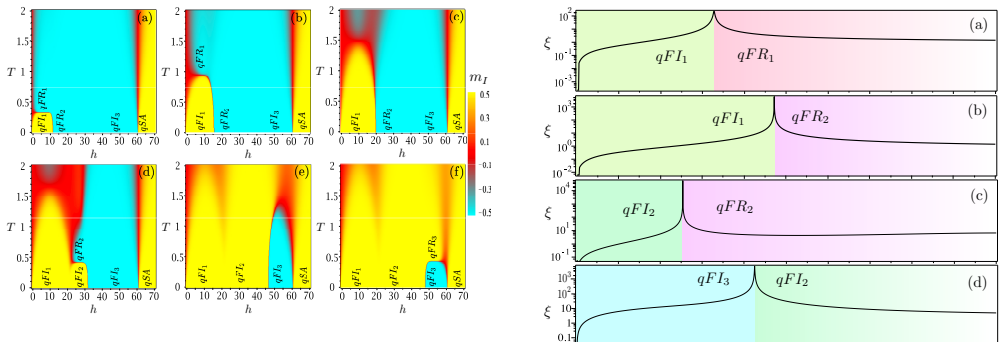
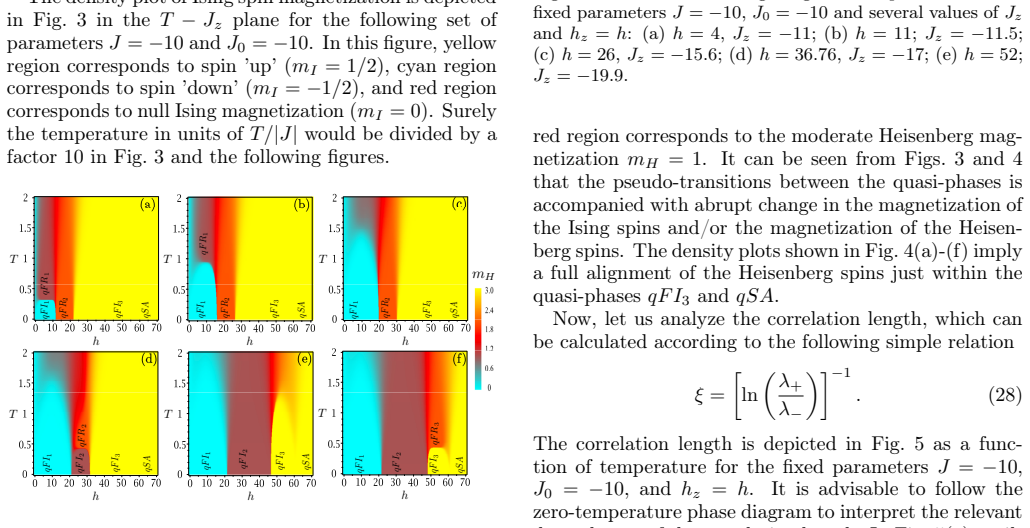
The central claim is that the mixed spin-(1/2,1) Ising-Heisenberg double-tetrahedral chain, solved exactly through a mapping to an effective spin-1/2 Ising chain with transfer matrix elements $w_1, w_0, w_{-1}$, exhibits pseudo-transitions in the vicinity of all five unusual ground-state interfaces. At low temperatures the free energy per site reduces to $f = -T\ln\max[w_1(T), w_{-1}(T)]$, and at a phase boundary the residual entropy per site is $S_c = \ln[\max(g_{1,0}, g_{-1,0})]$, which equals the larger entropy of the two coexisting phases. The pseudo-critical temperature $T_p$ solves $w_1(T_p)=w_{-1}(T_p)$, and near $T_p$ the entropy and magnetizations show a steep but smooth change while the specific heat and susceptibility show narrow peaks. Four of the interfaces separate a non-degenerate ferrimagnetic phase from a macroscopically degenerate frustrated phase, and one separates two non-degenerate ferrimagnetic phases; all five show the anomalous response. The paper therefore proposes that the equality of boundary residual entropy with the larger coexisting-phase entropy is a sufficient criterion for a pseudo-transition in one-dimensional short-range spin models.
Load-bearing premise
The argument assumes that equality between the boundary residual entropy and the larger entropy of the two coexisting phases is enough to guarantee a pseudo-transition, and that the low-temperature reduction $f = -T\ln\max[w_1,w_{-1}]$ remains valid near all five interfaces; the paper checks this numerically at selected parameter values, not in full generality.
Editorial extensions
If this is right
- The model provides an exact, fully analytic benchmark for pseudo-transition thermodynamics in one dimension, with explicit $T_p$ curves in the field-temperature plane.
- At the four ferrimagnetic–frustrated interfaces the entropy step at $T_p$ equals $\ln 2$, so the pseudo-transition is a direct finite-temperature imprint of the macroscopic degeneracy of the frustrated phase.
- At the FI2–FI3 interface, where both phases are non-degenerate, a pseudo-transition still occurs; this shows macroscopic degeneracy is not required for the phenomenon.
- The criterion lets one scan a ground-state phase diagram and predict pseudo-critical lines just from degeneracy data, without solving the full thermodynamics.
- The correlation length shows a sharp finite peak near $T_p$, so the pseudo-transition is also visible in correlation data, not only in thermal averages.
Reading between the lines
- The residual-entropy criterion may transfer directly to other one-dimensional decorated or coupled-spin chains when their transfer matrices have the same $w_1$-versus-$w_{-1}$ dominance; the double-tetrahedral chain with different Ising-Heisenberg couplings could be screened for additional pseudo-transitions.
- A natural testable extension is to sharpen the criterion into a quantitative relation: pseudo-transition strength should grow with the ratio $|w_1-w_{-1}|/w_0$ at $T_p$, which future work could verify numerically against the peak height of the specific heat.
- Because the FI2–FI3 interface has zero residual entropy on both sides, the pseudo-transition there is essentially a level-crossing of two low-energy bands; in a real material one might detect it as a sharp magnetocaloric signature.
Signed reviews
Editorial analysis
A structured set of objections, weighed in public.
Referee Report
Summary. The paper introduces and exactly solves a mixed spin-(1/2,1) Ising-Heisenberg double-tetrahedral chain in a magnetic field. The authors diagonalize the spin-1 Heisenberg triangles (Table I), express the full Boltzmann weights analytically (Eq. (20)), and map the model onto an effective spin-1/2 Ising chain with a 2x2 transfer matrix (Eqs. (18)-(24)). They obtain the ground-state phase diagram with three ferrimagnetic, three frustrated, and one saturated paramagnetic phase, and identify five ground-state interfaces where the residual entropy equals the larger of the two coexisting phase entropies (Eq. (27)). Using the pseudo-critical condition w1(Tp)=w-1(Tp) (Eq. (29)), they trace pseudo-critical lines and show, by exact numerical evaluation of the transfer-matrix free energy, that entropy and magnetization change steeply and specific heat and susceptibility display narrow peaks near all five interfaces (Figs. 7-11). The paper concludes that these interfaces are robust against thermal fluctuations.
Significance. If correct, the paper provides another exactly solvable one-dimensional model with pseudo-transitions, and it extends the authors' earlier criterion from Ref. [18] to a model with five distinct interfaces, including one between two non-degenerate ferrimagnetic phases. The main strengths are the explicit analytic diagonalization of the Heisenberg triangle, the closed-form Boltzmann factors and exact free energy (Eqs. (20) and (24)), and the absence of fitted parameters or ad hoc assumptions. The numerical demonstrations cover representative parameter values for each interface. The result is incremental relative to the existing pseudo-transition literature, but it is a useful benchmark and the five-interface structure is a genuine addition. The heuristic residual-entropy criterion should, however, be presented with more caution (see minor comments).
minor comments (3)
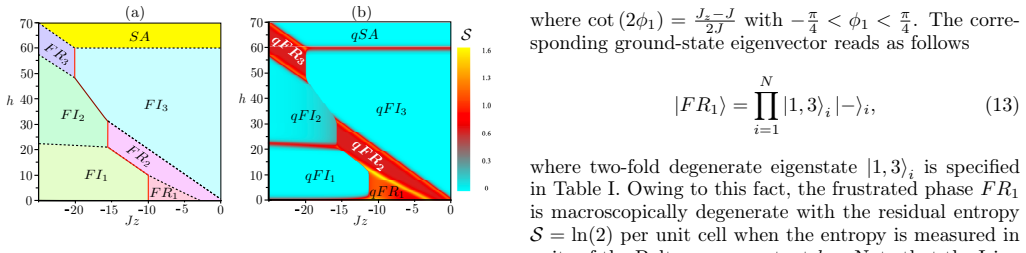
- [Sec. III, Eq. (27)] The statement that Eq. (27) is a sufficient criterion for a pseudo-transition is too strong: at the FI2-FI3 interface g_{1,0}=g_{-1,0}=1, so Eq. (27) reduces to the identity Sc=0 and cannot by itself select this interface as special. Please qualify Eq. (27) as a heuristic indicator and state explicitly that the pseudo-transition at FI2-FI3 is established by the exact numerical evaluation in Fig. 10, not by the criterion alone.
- [Sec. III, Eqs. (25) and (29)] Eq. (25) is derived under the condition |w1-w-1| >> w0, which is not satisfied at the pseudo-critical point where Eq. (29) holds, since the two weights cross there. I do not regard this as an error in the numerical results, which are based on the exact expression (24), but the text should clarify that Eq. (25) is used for the low-temperature asymptotic analysis and that the identification of Tp and all thermodynamic plots rely on Eq. (24). This would remove an apparent tension between Eqs. (25) and (29).
- [Sec. II and figure captions] There are several typographical errors: in Sec. II, 'the third frustrated phase FR 2' should be 'FR 3'; in Fig. 8 and the accompanying text, '(16.9, 13.6)' should be '(16.9, -13.6)'; in Fig. 10 and the accompanying text, '(42.55, 18.5)' should be '(42.55, -18.5)'; in Fig. 5, 'shark peak' should be 'sharp peak'; and in the discussion of Fig. 9, 'for 22 > h > 30' should be 'for 22 < h < 30'.
Circularity Check
Derivation is self-contained; no parameter is fitted and no claim reduces to its inputs.
full rationale
The paper begins with the Hamiltonian (Eq. 2), diagonalizes the Heisenberg triangle, constructs the exact transfer matrix, and obtains the free energy (Eq. 24). Pseudo-critical temperatures are located from the crossing condition w1(Tp)=w-1(Tp) (Eq. 29), which follows from the low-temperature approximation (Eq. 25) rather than being fitted to the displayed peaks. Figures 7-11 then show entropy, magnetization, specific heat, and susceptibility evaluated from the exact free energy, so the pseudo-transition fingerprints at the five interfaces are direct consequences of the transfer-matrix solution, not of the entropy criterion. The criterion Sc = ln[max(g1,0,g-1,0)] (Eq. 27) and the condition |w1-w-1| >> w0 are inherited from prior work by the same group (Refs. [17,18]), but the central claim is independently verified by exact calculations; nothing is fitted, renamed, or defined in terms of the target result. The possible limitations of the low-T approximation at the FI2-FI3 interface are a robustness/correctness issue, not circularity.
Assumptions & free parameters
assumptions (3)
- domain assumption The eigenvalues and eigenvectors of the spin-1 Heisenberg triangle listed in Table I are complete and correct.
- domain assumption The full Hamiltonian splits into commuting cell Hamiltonians, allowing the exact mapping to an effective spin-1/2 Ising chain with transfer matrix V.
- domain assumption The low-temperature reduction f = -T ln max[w1, w-1] (Eq. 25) and the residual-entropy criterion S_c = ln[max(g_{1,0}, g_{-1,0})] (Eq. 27) suffice to predict pseudo-transitions.
Cite this review
Pith. "Pith review of Peculiarities in pseudo-transitions of a mixed spin-$(1/2,1)$ Ising-Heisenberg double-tetrahedral chain in an external magnetic field." pith.science (2026). https://pith.science/paper/2PAZCWYF
@misc{pith2026190807286,
  author       = {Pith},
  title        = {Pith review of: Peculiarities in pseudo-transitions of a mixed spin-$(1/2,1)$ Ising-Heisenberg double-tetrahedral chain in an external magnetic field},
  year         = {2026},
  howpublished = {\url{https://pith.science/paper/2PAZCWYF}},
  note         = {Machine review of arXiv:1908.07286}
}
read the original abstract
Recently, it has been rigorously verified that several one-dimensional (1D) spin models may exhibit a peculiar pseudo-transition accompanied with anomalous response of thermodynamic quantities in a close vicinity of pseudo-critical temperature. In the present work we will introduce and exactly solve a mixed spin-(1/2,1) Ising-Heisenberg double-tetrahedral chain in an external magnetic field as another particular example of 1D lattice-statistical model with short-range interactions that displays a pseudo-transition of this type. The investigated model exhibits at zero temperature three ferrimagnetic phases, three frustrated phases, and one saturated paramagnetic phase. The ground-state phase diagram involves five unusual interfaces (phase boundaries), at which the residual entropy per site equals to a larger entropy of one of two coexisting phases. Four such interfaces are between a non-degenerate ferrimagnetic phase and a macroscopically degenerate frustrated phase, while one interface is between two non-degenerate ferrimagnetic phases. Though thermal excitations typically destroy all fingerprints of zero-temperature phase transitions of 1D lattice-statistical models with short-range forces, the mixed spin-(1/2,1) Ising-Heisenberg double-tetrahedral chain is quite robust with respect to thermal excitations and it displays peculiar pseudo-transitions close to all five aforementioned interfaces.
Figures

Figures from the paper (5 more)


Reference graph
Works this paper leans on
- [18]
-
[1]
J. F. Nagle, Am. J. Phys.36, 1114 (1968)
work page 1968
- [2]
-
[3]
S. T. Chui and J. D. Weeks, Phys. Rev. B 23, 2438 (1981)
work page 1981
-
[4]
The corre- sponding eigenvector reads |FI 2⟩ = N∏ i=1 |1, 1⟩i|+⟩i (9) with the eigenvector|1, 1⟩i defined in Table I. The Ising spin magnetizationin thesecondferrimagnetic phaseFI 2 becomes mI = 1 2, the Heisenberg spin magnetization is mH = 1, and the total magnetization ismt = 3 2. The ground-state energy for the third ferrimagnetic phase FI 3 is given b...
-
[5]
The corre- sponding ground-state eigenvector reads as follows |FR 1⟩ = N∏ i=1 |1, 3⟩i|−⟩i, (13) where two-fold degenerate eigenstate|1, 3⟩i is specified in Table I. Owing to this fact, the frustrated phaseFR 1 is macroscopically degenerate with the residual entropy S = ln(2) per unit cell when the entropy is measured in units of the Boltzmann constantkB. N...
- [6]
-
[7]
J. A. Cuesta and A. Sanchez, J. Stat. Phys.115, 869 (2003)
work page 2003
Show all 31 references
-
[8]
Dauxois and M
T. Dauxois and M. Peyrard, Phys. Rev. E 51, 4027 (1995)
1995
-
[9]
Sarkanych, Y
P. Sarkanych, Y. Holovatch, and R. Kenna, Phys. Lett. A 381, 3589 (2017)
2017
-
[10]
and pseudo-critical exponents [20]. The goal of the present study is to investigate a mixed spin-(1/2,1) Ising-Heisenberg tetrahedral chain in an ex- ternal magnetic field, which has a pretty rich ground- state phase diagram and exhibits a number of finite- temperature pseudo-tr...
-
[11]
Rojas, J
O. Rojas, J. Strečka, and S. M. de Souza, Solid State Commun. 246, 68 (2016)
2016
-
[12]
P. N. Timonin, J. Exp. Theor. Phys.113, 251 (2011)
2011
-
[13]
I. M. Carvalho, J. Torrico, S. M. de Souza, M. Rojas, and O. Rojas, J. Magn. Magn. Mater.465, 323 (2018)
2018
-
[14]
I. M. Carvalho, J. Torrico, S. M. de Souza, O. Rojas, and O. Derzhko, Ann. Phys.402, 45 (2019)
2019
-
[15]
Gálisová, Phys
L. Gálisová, Phys. Rev. E96, 052110 (2017)
2017
-
[16]
Strečka, R
J. Strečka, R. C. Alecio, M. Lyra, and O. Rojas, J. Magn. Magn. Mater. 409, 124 (2016)
2016
- [17]
-
[19]
Krokhmalskii, T
T. Krokhmalskii, T. Hutak, O. Rojas, S. M. de Souza, and O. Derzhko, Towards low-temperature peculiarities of thermodynamic quantities for decorated spin chains, arXiv:1908.06419
1908 arXiv
-
[20]
Gálisová and D
L. Gálisová and D. Knežo, Phys. Lett. A 382, 2839 (2018)
2018
-
[21]
S. M. de Souza and O. Rojas, Solid State Commun.269, 131 (2017)
2017
-
[22]
This article is organized as follows
of C•− 60 in (MDABCO+)(C•− 60 ) [MDABCO+ = N- methyldiazabicyclooctanium cation and C•− 60 radical an- ions], a stripe of this salt can be viewed also as a double- tetrahedral chain. This article is organized as follows. In Sec. II we consider and exactly solve the mixed spin-...
- [23]
-
[24]
Rojas, J
O. Rojas, J. Strečka, M. L. Lyra, and S. M. de Souza, Phys. Rev. E99, 042117 (2019)
2019
-
[25]
S.BuhrandtandL.Fritz, Phys.Rev.B 90, 094415(2014)
2014
-
[26]
Otsuka, D
A. Otsuka, D. V. Konarev, R. N. Lyubovskaya, S. S. Khasanov, M. Maesato, Y. Yoshida, and G. Saito, Crystals 8, 115 (2018)
2018
-
[27]
Mambrini, J
M. Mambrini, J. Trébosc, and F. Mila, Phys. Rev. B59, 13806 (1999)
1999
-
[28]
Rojas and F
O. Rojas and F. C. Alcaraz, Phys. Rev. B67, 174401 (2003)
2003
-
[29]
Maksymenko, O
M. Maksymenko, O. Derzhko, and J. Richter, Acta Physica Polonica A 119, 860 (2011); M. Maksymenko, O. Derzhko, and J. Richter, Eur. Phys. J. B 84, 397 (2011)
2011
-
[30]
Ohanyan, Physics of Atomic Nuclei73, 494 (2010)
V. Ohanyan, Physics of Atomic Nuclei73, 494 (2010). 10
2010
-
[31]
Antonosyan, S
D. Antonosyan, S. Bellucci, and V. Ohanyan, Phys. Rev. B 79, 014432 (2009). 11
2009
Reviewed August 14, 2026 · model on record in the stance chip above.
Discussion (0). Continue with ORCID to comment.