REVIEW 1 minor 83 references
Hard-Region Fermion Self-Energy and Fermion--Photon Vertex in Thermal QED through Two Loops
T0 review · 0 major / 1 minor · reviewed 2026-06-26 · grok-4.3
Pith's one-line read Hard-region self-energy corrections in thermal QED produce no finite contribution to the fermion damping rate.
desk verdict Two-loop hard-region self-energy in thermal QED yields no finite damping-rate contribution after renormalization. read the letter →
The pith
A machine-rendered reading of the paper's core claim, the machinery that carries it, and where it could break.
The reading
What carries the argument
Decomposition of amplitudes into independent statistical and gauge sectors at the integrand level, allowing sector-by-sector verification of the Ward-Takahashi identity and axial transversality.
What would settle it
An explicit integration of the two-loop hard self-energy that produces a nonzero imaginary part contributing to the damping rate at finite temperature would contradict the central result.
Extended reading notes
Core claim
In massless thermal QED in a general covariant gauge, the hard-region fermion self-energy at two-loop leading power and one-loop next-to-leading power, together with the corresponding off-shell vertex, are evaluated after renormalization. Symmetries force a selection rule that a contribution at power r is allowed only when r + N + 1 is even. The amplitudes factor into independent statistical and gauge sectors; the Ward-Takahashi identity holds sector by sector, and the fully longitudinal gauge sector vanishes at leading power while satisfying all constraints when it reappears at next-to-leading power. The resulting hard self-energy corrections yield no finite contribution to the fermion damp
Load-bearing premise
The decomposition of the amplitudes into independent statistical and gauge sectors at the integrand level, together with the claim that the fully longitudinal gauge sector vanishes at leading power while satisfying all symmetry constraints when it reappears at next-to-leading power.
Editorial extensions
If this is right
- The hard-region self-energy supplies input for thermal mass shifts without adding a finite damping-rate term.
- Inclusive rate calculations in thermal QED can incorporate these hard contributions directly.
- The sector decomposition and selection rules simplify construction of the next-to-leading-order fermionic effective Lagrangian.
- The vanishing of the fully longitudinal sector at leading power reduces the number of independent structures that must be computed at two loops.
Reading between the lines
- The same sector decomposition may reduce computational effort when extending the calculation to three loops or to thermal QCD.
- The selection rule on powers could be used to cross-check higher-order results in any theory with similar chiral and gauge symmetries.
- Matching these hard-region results to soft effective theories could yield a consistent two-loop thermal effective action for fermions.
Signed reviews
Editorial analysis
A structured set of objections, weighed in public.
Referee Report
Summary. The manuscript computes hard-region contributions to the fermion self-energy and off-shell fermion-photon vertex in massless thermal QED in a general covariant R_ξ gauge. It evaluates one-loop next-to-leading power and two-loop leading power terms in the soft-momentum expansion, includes zero-temperature counterterms for renormalization, and enforces chiral invariance, the Ward-Takahashi identity, axial transversality, and symmetry selection rules (r + N + 1 even) at the integrand level. Amplitudes are decomposed into independent statistical and gauge sectors (with further splitting into mixed metric-longitudinal and fully longitudinal sectors at two loops); the authors verify the identities sector by sector and conclude that the hard-region self-energy corrections yield no finite contribution to the fermion damping rate.
Significance. If the explicit two-loop results and integrand-level verifications hold, the work supplies necessary hard-region input for fermion mass shifts, inclusive rates, and the construction of the next-to-leading-order fermionic effective Lagrangian in thermal QED. The systematic enforcement of all listed symmetries and the demonstration that the fully longitudinal sector vanishes at leading power while reappearing consistently at NLO constitute a technical strength that increases the reliability of the damping-rate conclusion.
minor comments (1)
- The abstract refers to 'the paragraph on sector decomposition and WTI verification'; adding an explicit subsection label or equation numbers for the vanishing of the fully longitudinal sector would improve traceability.
Simulated Author's Rebuttal
We thank the referee for the positive assessment of our work and the recommendation to accept the manuscript.
Circularity Check
Direct perturbative calculation with no circular reductions
full rationale
The manuscript executes an explicit two-loop hard-region computation in thermal QED via standard Feynman rules and thermal propagators. All load-bearing steps—sector decomposition at the integrand level, enforcement of WTI and axial transversality, application of symmetry selection rules (r + N + 1 even), and the conclusion of vanishing finite damping-rate contribution—are obtained by direct integration and zero-temperature renormalization rather than by fitting parameters, self-defining quantities, or load-bearing self-citations. The derivation therefore remains self-contained against external benchmarks.
Assumptions & free parameters
assumptions (2)
- standard math Standard Feynman rules and thermal propagators for massless QED in R_xi gauge
- domain assumption Chiral invariance restricts the vertex to vector and axial-vector structures
Cite this review
Pith. "Pith review of Hard-Region Fermion Self-Energy and Fermion--Photon Vertex in Thermal QED through Two Loops." pith.science (2026). https://pith.science/paper/2Q7MOCDQ
@misc{pith2026260627137,
  author       = {Pith},
  title        = {Pith review of: Hard-Region Fermion Self-Energy and Fermion--Photon Vertex in Thermal QED through Two Loops},
  year         = {2026},
  howpublished = {\url{https://pith.science/paper/2Q7MOCDQ}},
  note         = {Machine review of arXiv:2606.27137}
}
abstract
In massless thermal QED in a general covariant $R_\xi$ gauge, we compute hard-region contributions to the fermion self-energy and the off-shell fermion--photon vertex at one-loop next-to-leading power and two-loop leading power in the soft-momentum expansion. The zero-temperature counterterms are also included to renormalize these hard amplitudes. Chiral invariance restricts the off-shell two-fermion--$N$-photon vertex to vector ($\gamma_\mu$) and axial-vector ($\gamma_\mu\gamma_5$) Dirac structures. The vector part is constrained by the Ward--Takahashi identity (WTI), while the axial part is transverse to the photon momentum. The symmetries and hermiticity of the theory impose definite constraints -- including reality, momentum reversal, and fermion-leg exchange properties -- which lead to selection rules in the soft expansion: a contribution at power $r$ can be nonzero only when $r+N+1$ is even, with $N=0$ for the self-energy. At the integrand level, we decompose the amplitudes into independent statistical and gauge sectors, and verify the WTI and axial transversality sector by sector. Notably, the gauge-dependent sectors split into mixed metric--longitudinal and fully longitudinal sectors at two loops. The latter vanishes at leading power and reappears at next-to-leading power while satisfying the constraints. We show that these hard-region self-energy corrections do not generate a finite contribution to the fermion damping rate. These results provide hard-region input for mass shifts and inclusive rates, as well as for the construction of the next-to-leading-order fermionic effective Lagrangian.
Figures

Figures from the paper (6 more)

Reference graph
Works this paper leans on
-
[1]
The relations forR 2 andR 4 are valid only up toO(ϵ 2)
Radial, Angular, and Collinear Integrals The relevant radial integrals used in this work are R1 ≡ Z p 1 p NB(p) = π2T 2 6 h 1 +ϵ 24 lnA−2−2γ E + 2ℓT i +O(ϵ 2), R2 ≡ − Z p 1 p NF (p) = 1 2 R1 − π2T 2 6 ln(2)ϵ+O(ϵ 2), R3 ≡ Z p 1 p3 NB(p) = 1 4ϵ + 1 2 ℓT + ϵ 8 π2 −4γ 2 E + 4ℓ2 T −8γ 1 +O(ϵ 2), R4 ≡ Z p 1 p3 NF (p) =R 3 + ln 2 h 1 +ϵ 2ℓT + ln 2 i +O(ϵ 2), R5 ...
-
[2]
19 The last line vanishes iff(p 0, p) is even inp 0
Difference-Propagator and KMS Identities The difference propagators satisfy the following relations 6 [29, 31] Z +∞ −∞ dp0 2π ∆(n) d (P)f(p 0, p) = (−i)n+1 (n−1)! Z +∞ −∞ dp0 2π ∆d(P) n 2p0 h −1 2p0 ∂ ∂p0 in−1h −f(p0, p) 2p0 io ,(A12a) Z P ∆d(P)f(p 0, ⃗ p) = Z ⃗ p f(p, ⃗ p)−f(−p, ⃗ p) 2p .(A12b) 6 The first line is obtained using the residue theorem [29, ...
-
[3]
Spectral Function and Fermion Self-Energy We start with the fermionic spectral function defined in position space byρ F (x, y) = {ψ(x), ¯ψ(y)} T , with Fourier transformρ F (Q). The most general Dirac decomposition gives ρF (Q) =S1+Pγ 5 +V µ γµ +A µ γµγ5 + 1 2 T µν σµν.(B9) 20 Chiral invariance impliesS=P=T µν = 0, yielding ρF (Q) =V µ(Q)γ µ +A µ(Q)γ µγ5....
-
[4]
, xN)ψ(z)A µ1(x1)· · ·A µN (xN),(B19) whereΓ µ1···µN (y, z;x 1,
Two-Fermion–N-Photon Vertices We consider the part of the 1PI effective action containing two fermion fields andNexternal photon insertions, Γ[ψ, ¯ψ, A]⊃ X N≥1 (−1)N N! Z d4y d4z d4x1 · · ·d4xN ¯ψ(y)Γ µ1···µN (y, z;x 1, . . . , xN)ψ(z)A µ1(x1)· · ·A µN (xN),(B19) whereΓ µ1···µN (y, z;x 1, . . . , xN) is the two-fermion–N-photon vertex function in position...
-
[5]
3, are drawn using the propagator conven- tions of Fig
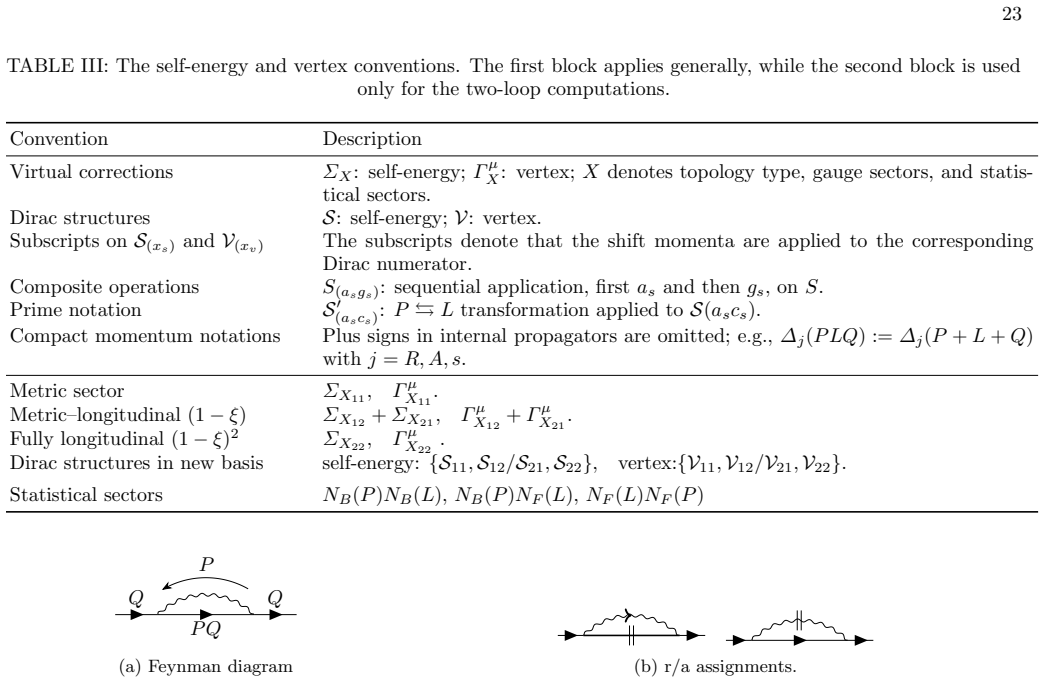
Self-Energy Corrections Ther/aassignments for the one-loop fermion self-energy, shown in Fig. 3, are drawn using the propagator conven- tions of Fig. 1. Together with Eq. (2) and the ordinary QED Feynman rules, they give −iΣ(1) m (Q) =e 2 Z P Sm h ∆s(P Q)∆A(P) + ˜∆s(P)∆ R(P Q) i , −iΣ(1) ξ (Q) =ie 2(1−ξ) Z P Sξ h ∆s(P Q)∆(2) A (P) + ˜∆(2) s (P)∆ R(P Q) i ...
-
[6]
4a), the corresponding r/a assignments illustrated in Fig
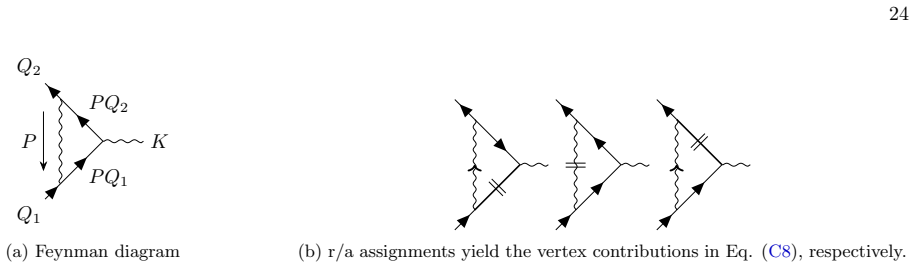
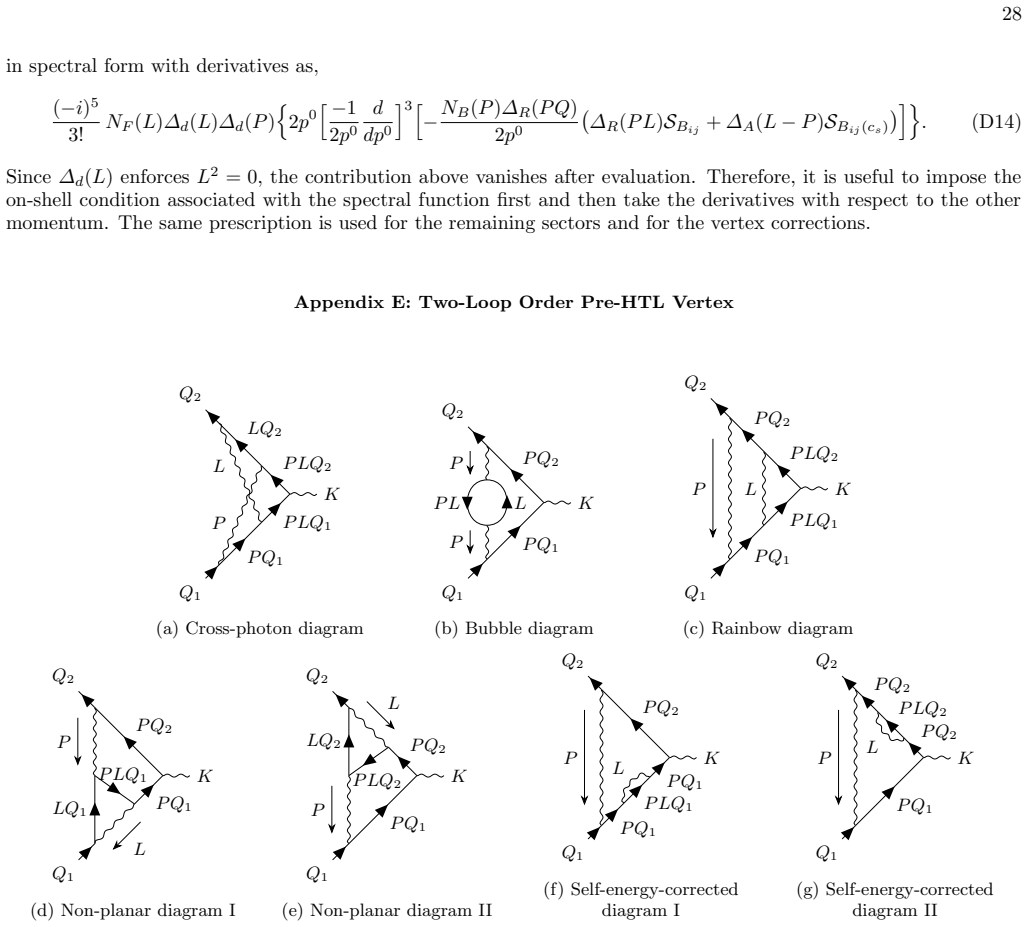
Vertex Corrections For the one-loop vertex (Fig. 4a), the corresponding r/a assignments illustrated in Fig. 4b yield the following contributions, respectively −ieΓ µ(1) m (Q2, Q1) =−ie 3 Z P Vm h ∆s(P Q1)∆A(P)∆ A(P Q2) + ˜∆s(P)∆ R(P Q1)∆R(P Q2) +∆ s(P Q2)∆R(P Q1)∆A(P) i −ieΓ µ(1) ξ (Q2, Q1) =e 3(1−ξ) Z P Vξ × h ∆s(P Q1)∆(2) A (P)∆ A(P Q2) + ˜∆(2) s (P)∆ R...
-
[7]
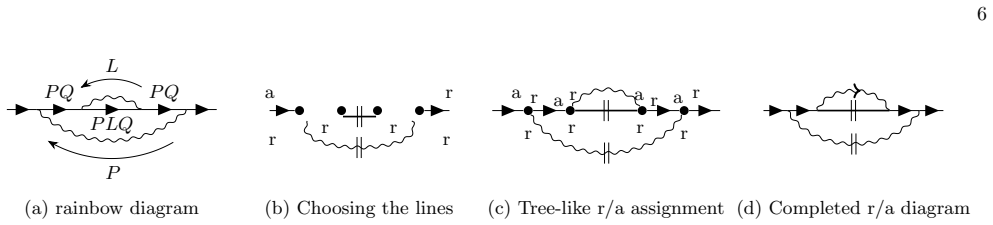
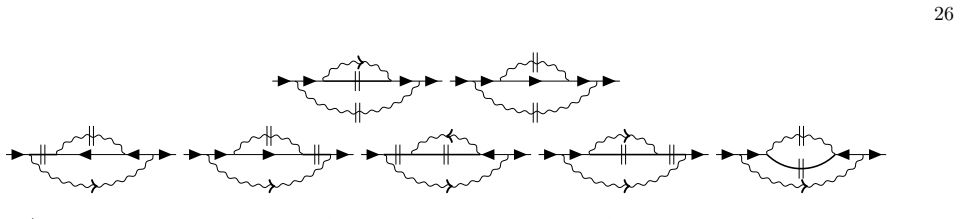
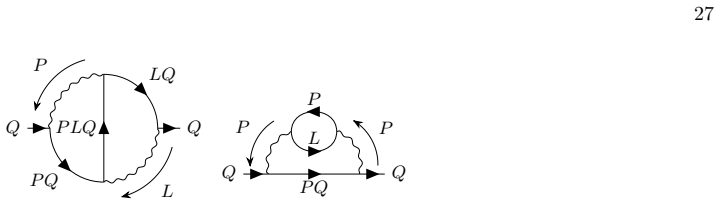
The Rainbow Self-Energy All allowedr/aassignments are shown in Fig. 5. Using the notation above, the sum ofr/aassignments gives −iΣ(2) Rij(Q) =e 4 Z P Z L ˆξij SRij n ˜∆(i) s (P)∆ (2) R (P Q) h ∆s(P LQ)∆(j) A (L) + ˜∆(j) s (L)∆R(P LQ) i +∆ s(P Q) ˜∆(j) s (L)∆(i) A (P) h ∆A(P LQ)∆A(P Q) +∆ R(P LQ)∆R(P Q) i +∆ s(P Q)∆s(P LQ)∆(i) A (P) h ∆(j) R (L)∆A(P Q) +∆...
-
[8]
The Cross-Photon and Bubble Topologies For the cross-photon and bubble topologies (see Fig. 6), we obtain the final results as −iΣ (2) Cij(Q) =e 4 Z P Z L ˆξij × ∆(j) d (L)∆(i) d (P)N B(L)NB(P)∆ R(P Q)∆R(P LQ)∆R(LQ)SCij +∆ d(L)∆d(P)N F (L)NF (P) n ∆(i) A (P−Q)∆ (j) A (L−Q)∆ A(P+L−Q)S Cij(asbs) +∆ R(L−P+Q) h ∆(i) A (P−Q)∆ (j) R (L−P)S Cij(ascs) +∆ (j) A (P...
Show all 83 references
-
[9]
Self-Energy The corresponding one-loop diagrams, containing the vertex counterterm and the counterterm insertions on the internal fermion and photon lines, are shown in Fig. 8. Using ther/arepresentations of the counterterm lines in Eq. (9), together with the freer/apropagator...
-
[10]
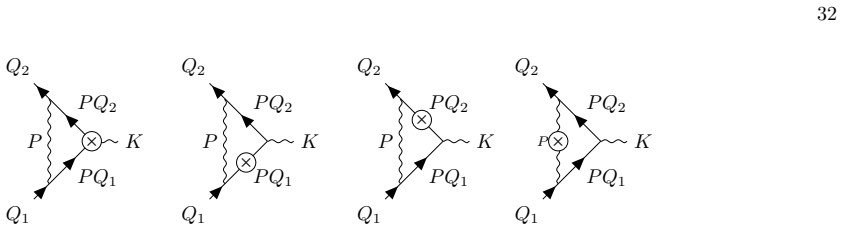
Vertex The one-loop diagrams containing the counterterm insertions are shown in Fig. 9, yielding the contributions −ieΓ µ(1) Vm,CT (Q2, Q1) =−3ie δ (1) 2 Γ µ(1) m (Q2, Q1),−ieΓ µ Vξ,CT (Q2, Q1) =−3ie δ (1) 2 Γ µ(1) ξ (Q2, Q1), −ieΓ µ(1) fIm ,CT (Q2, Q1) =e 3δ(1) 2 Z P n (P+Q 1...
-
[11]
Two-Loop Self-Energy Results −iΣ (2;LP) m =− ie4 4 Z P Z L ∆d(L)∆d(P) × n NB(L)NB(P) h D2 − /L L.P P.Q − Q2 /P (P.Q)3 + /Q (P.Q)2 + 2DQ 2 /L L.Q(P.Q)2 i +N F (L)N ′ F (P) h D2 /P p0P.Q i +N F (L)NF (P) h D2 − /L l02L.Q + γ0 l0L.Q − q0 /L l0(L.Q)2 − /P L.P L.Q + Q2 /L (L.Q)3 +D...
-
[12]
One-Loop NLP Vertex −ie h V µρ(1;NLP) m i γρ = ie3D 4 Z P ∆d(P) × NF (P) n /P h K 4P µ 2(K.P) 2P.Q1P.Q2 − K 2K µ 2(K.P) 2P.Q1 + K 2K µ 2(K.P) 2P.Q2 − K 2P µQ2 1 2(K.P) 2(P.Q1)2 − K 2P µQ2 2 2(K.P) 2(P.Q2)2 + K µQ2 1 2K.P(P.Q 1)2 + K µQ2 2 2K.P(P.Q 2)2 + P µQ4 1 2K.P(P.Q 1)3 − ...
-
[13]
Two-Loop LP Vertex −ie h V µρ(2;LP) m,NB NB i γρ =− ie5 4 Z P Z L ∆d(P)∆ d(L)NB(L)NB(P) × D2 /P h − P µQ12 (P.Q1)3P.Q2 − P µQ12 2(P.Q1)2(P.Q2)2 − P µQ22 2(P.Q1)2(P.Q2)2 − P µQ22 P.Q1(P.Q2)3 + Qµ 1 2(P.Q1)2P.Q2 + Qµ 1 2P.Q1(P.Q2)2 + Qµ 2 2(P.Q1)2P.Q2 + Qµ 2 2P.Q1(P.Q2)2 i − P µ...
-
[14]
V. V. Klimov, Sov. Phys. JETP55, 199 (1982)
1982
-
[15]
H. A. Weldon, Phys. Rev. D26, 2789 (1982)
1982
-
[16]
Braaten and R
E. Braaten and R. D. Pisarski, Phys. Rev. Lett.64, 1338 (1990)
1990
-
[17]
Arnold, G
P. Arnold, G. D. Moore, and L. G. Yaffe, Journal of High Energy Physics2002, 030–030 (2002)
2002
-
[18]
Arnold, G
P. Arnold, G. D. Moore, and L. G. Yaffe, Journal of High Energy Physics2001, 057 (2001)
2001
-
[19]
B¨ odeker, G
D. B¨ odeker, G. D. Moore, and K. Rummukainen, Phys. Rev. D61, 056003 (2000)
2000
-
[20]
Blaizot, E
J.-P. Blaizot, E. Iancu, and A. Rebhan, Physics Letters B470, 181–188 (1999)
1999
-
[21]
M. G. Mustafa, The European Physical Journal Special Topics232, 1369–1457 (2023)
2023
-
[22]
Haque and M
N. Haque and M. G. Mustafa, Prog. Part. Nucl. Phys.140, 104136 (2025), arXiv:2404.08734 [hep-ph]
2025
-
[23]
Graf and F
P. Graf and F. D. Steffen, Phys. Rev. D83, 075011 (2011)
2011
-
[24]
Braaten and R
E. Braaten and R. D. Pisarski, Nuclear Physics B337, 569 (1990)
1990
-
[25]
Frenkel and J
J. Frenkel and J. Taylor, Nuclear Physics B334, 199 (1990)
1990
-
[26]
Taylor and S
J. Taylor and S. Wong, Nuclear Physics B346, 115 (1990)
1990
-
[27]
Braaten and R
E. Braaten and R. D. Pisarski, Nuclear Physics B339, 310 (1990)
1990
-
[28]
Braaten and R
E. Braaten and R. D. Pisarski, Phys. Rev. D45, R1827 (1992)
1992
-
[29]
Blaizot and E
J.-P. Blaizot and E. Iancu, Physics Reports359, 355–528 (2002)
2002
-
[30]
Mottola and Z
E. Mottola and Z. Sz´ ep, Physical Review D81, 10.1103/physrevd.81.025014 (2010)
2010 doi
-
[31]
M. E. Carrington, Physical Review D75, 10.1103/physrevd.75.045019 (2007)
2007 doi
-
[32]
Mirza and M
A. Mirza and M. E. Carrington, Physical Review D87, 10.1103/physrevd.87.065008 (2013)
2013 doi
-
[33]
Kobes, G
R. Kobes, G. Kunstatter, and K. Mak, Phys. Rev. D45, 4632 (1992)
1992
-
[34]
Braaten and R
E. Braaten and R. D. Pisarski, Phys. Rev. D46, 1829 (1992)
1992
-
[35]
M. E. Carrington, A. Gynther, and D. Pickering, Phys. Rev. D78, 045018 (2008)
2008
-
[36]
Haque, and B
Sumit, N. Haque, and B. K. Patra, Journal of High Energy Physics2023, 10.1007/jhep05(2023)171 (2023)
2023 doi
-
[37]
Braaten and R
E. Braaten and R. D. Pisarski, Phys. Rev. D42, 2156 (1990)
1990
-
[38]
Schulz, Nuclear Physics B413, 353 (1994)
H. Schulz, Nuclear Physics B413, 353 (1994)
1994
-
[39]
M. L. Bellac,Thermal Field Theory, Cambridge Monographs on Mathematical Physics (Cambridge University Press, 2011)
2011
-
[40]
Carignano, C
S. Carignano, C. Manuel, and J. Soto, Physics Letters B780, 308–312 (2018)
2018
-
[41]
Manuel, J
C. Manuel, J. Soto, and S. Stetina, Phys. Rev. D94, 025017 (2016)
2016
-
[42]
Gorda, R
T. Gorda, R. Paatelainen, S. S¨ appi, and K. Sepp¨ anen, Journal of High Energy Physics2023, 10.1007/jhep08(2023)021 (2023)
2023 doi
-
[43]
Carignano, M
S. Carignano, M. E. Carrington, and J. Soto, Physics Letters B801, 135193 (2020)
2020
-
[44]
Gorda, A
T. Gorda, A. Kurkela, J. ¨Osterman, R. Paatelainen, S. S¨ appi, P. Schicho, K. Sepp¨ anen, and A. Vuorinen, Phys. Rev. D 107, 036012 (2023)
2023
-
[45]
Ekstedt, Journal of High Energy Physics2023, 10.1007/jhep06(2023)135 (2023)
A. Ekstedt, Journal of High Energy Physics2023, 10.1007/jhep06(2023)135 (2023)
2023 doi
- [46]
-
[47]
J. I. Kapusta and C. Gale,Finite-temperature field theory: Principles and applications, Cambridge Monographs on Math- ematical Physics (Cambridge University Press, 2011)
2011
-
[48]
J. S. Ball and T.-W. Chiu, Phys. Rev. D22, 2542 (1980)
1980
-
[49]
Kizilers¨ u, M
A. Kizilers¨ u, M. Reenders, and M. Pennington, Physical Review D52, 1242–1259 (1995)
1995
-
[50]
Kızılers¨ u and M
A. Kızılers¨ u and M. R. Pennington, Physical Review D79, 10.1103/physrevd.79.125020 (2009)
2009 doi
-
[51]
Fueki, H
Y. Fueki, H. Nakkagawa, H. Yokota, and K. Yoshida, Progress of Theoretical Physics107, 759–784 (2002)
2002
-
[52]
M. E. Carrington, H. Defu, and M. H. Thoma, Physical Review D58, 10.1103/physrevd.58.085025 (1998)
1998 doi
-
[53]
D. F. Hou and U. Heinz, Phys. Rev. D55, 4450 (1997)
1997
-
[54]
D. F. Hou, M. E. Carrington, R. Kobes, and U. Heinz, Phys. Rev. D61, 085013 (2000). 36
2000
-
[55]
Braaten and A
E. Braaten and A. Nieto, Physical Review D51, 6990–7006 (1995)
1995
-
[56]
Jantzen, Journal of High Energy Physics2011, 10.1007/jhep12(2011)076 (2011)
B. Jantzen, Journal of High Energy Physics2011, 10.1007/jhep12(2011)076 (2011)
2011 doi
-
[57]
Schulz, Nuclear Physics B413, 353–395 (1994)
H. Schulz, Nuclear Physics B413, 353–395 (1994)
1994
-
[58]
L. V. Keldysh, Sov. Phys. JETP20, 1018 (1965)
1965
-
[59]
Landsman and C
N. Landsman and C. van Weert, Physics Reports145, 141 (1987)
1987
-
[60]
M. A. van Eijck, R. Kobes, and C. G. van Weert, Physical Review D50, 4097–4109 (1994)
1994
-
[61]
Carrington, H
M. Carrington, H. Defu, and M. Thoma, The European Physical Journal C7, 347–354 (1999)
1999
-
[62]
Carrington, T
M. Carrington, T. Fugleberg, D. Irvine, and D. Pickering, The European Physical Journal C50, 711–727 (2007)
2007
-
[63]
Ghiglieri, A
J. Ghiglieri, A. Kurkela, M. Strickland, and A. Vuorinen, Physics Reports880, 1–73 (2020)
2020
-
[64]
Caron-Huot, JHEP2009(04), 004
S. Caron-Huot, JHEP2009(04), 004
-
[65]
’t Hooft and M
G. ’t Hooft and M. J. G. Veltman, Nucl. Phys. B44, 189 (1972)
1972
-
[66]
Breitenlohner and D
P. Breitenlohner and D. Maison, Commun. Math. Phys.52, 11 (1977)
1977
-
[67]
Shtabovenko, R
V. Shtabovenko, R. Mertig, and F. Orellana, Comput. Phys. Commun. , 109357 (2024), arXiv:2312.14089 [hep-ph]
2024
-
[68]
Shtabovenko, R
V. Shtabovenko, R. Mertig, and F. Orellana, Comput. Phys. Commun.256, 107478 (2020), arXiv:2001.04407 [hep-ph]
2020 arXiv
-
[69]
Shtabovenko, R
V. Shtabovenko, R. Mertig, and F. Orellana, Comput. Phys. Commun.207, 432 (2016), arXiv:1601.01167 [hep-ph]
2016 arXiv
-
[70]
Mertig, M
R. Mertig, M. B¨ ohm, and A. Denner, Comput. Phys. Commun.64, 345 (1991)
1991
-
[71]
M. E. Peskin and D. V. Schroeder,An Introduction to quantum field theory(Addison-Wesley, Reading, USA, 1995)
1995
-
[72]
Blaizot and U
J.-P. Blaizot and U. Reinosa, Nuclear Physics A764, 393–422 (2006)
2006
-
[73]
Espinosa, Physical Review D71, 10.1103/physrevd.71.065009 (2005)
O. Espinosa, Physical Review D71, 10.1103/physrevd.71.065009 (2005)
2005 doi
-
[74]
Weinberg,The Quantum theory of fields
S. Weinberg,The Quantum theory of fields. Vol. 1: Foundations(Cambridge University Press, 2005)
2005
-
[75]
J. F. Donoghue and B. R. Holstein, Phys. Rev. D28, 340 (1983)
1983
-
[76]
Ahmed and S
K. Ahmed and S. Saleem, Phys. Rev. D35, 4020 (1987)
1987
-
[77]
Ahmed and S
K. Ahmed and S. Saleem, Phys. Rev. D35, 1861 (1987)
1987
-
[78]
J. F. Donoghue, B. R. Holstein, and R. W. Robinett, Annals Phys.164, 233 (1985), [Erratum: Annals Phys. 172, 483 (1986)]
1985
-
[79]
Bonciani, P
R. Bonciani, P. Mastrolia, and E. Remiddi, Nuclear Physics B702, 359–363 (2004)
2004
-
[80]
Bonciani, P
R. Bonciani, P. Mastrolia, and E. Remiddi, Nuclear Physics B676, 399–452 (2004)
2004
-
[81]
Kinoshita, J
T. Kinoshita, J. Math. Phys.3, 650 (1962)
1962
-
[82]
T. D. Lee and M. Nauenberg, Phys. Rev.133, B1549 (1964)
1964
-
[83]
Weinberg,The quantum theory of fields
S. Weinberg,The quantum theory of fields. Vol. 2: Modern applications(Cambridge University Press, 2013)
2013
Reviewed June 26, 2026 · model on record in the stance chip above.
Discussion (0). Continue with ORCID to comment.