Parametrically amplified Josephson plasma waves in YBa₂Cu₃O_(6+x): evidence for local superconducting fluctuations up to the pseudogap temperature T^*
Pith reviewed 2026-05-22 17:17 UTC · model grok-4.3
The pith
Local pairing amplitude exists in the pseudogap phase of underdoped YBCO up to T*.
A machine-rendered reading of the paper's core claim, the machinery that carries it, and where it could break.
Core claim
The observed reflectivity edge and second-harmonic generation in pumped YBCO between Tc and T* arise from parametric amplification of the lower Josephson plasmon mode. This process occurs under the assumption of local pair amplitude and phase at equilibrium with correlations limited to a few lattice constants and without any pump-induced enhancement of coherence in-plane or between bilayers. Because the coupling between bilayers in the lower plasmon is primarily capacitive, the interlayer Josephson current can be set to zero without disrupting the amplification, allowing the data to be explained while preserving only short-range phase correlations.
What carries the argument
Parametric amplification of the lower Josephson plasmon mode within a Floquet framework, driven by the coherent terahertz field and relying on capacitive rather than Josephson interlayer coupling.
If this is right
- The pseudogap phase must contain local pairing amplitude at equilibrium up to T*.
- The pump does not create or reveal long-range in-plane or interlayer coherence.
- Models of the pseudogap are constrained to include short-range phase correlations of local pairs.
- The lower Josephson plasmon remains amplifiable even when the interlayer Josephson current is zero.
Where Pith is reading between the lines
- The pseudogap may be understood as a state of fluctuating local pairs whose phase coherence length is set by doping and temperature.
- Similar pump-probe experiments at varied doping levels could map how the correlation length evolves toward Tc.
- If local amplitude is confirmed, other pseudogap signatures such as the suppression of spectral weight may share the same microscopic origin.
Load-bearing premise
Local pair amplitude and phase exist at equilibrium for Tc < T < T* with phase correlations spanning only a few lattice constants, and the interlayer Josephson current can be neglected because coupling is mainly capacitive.
What would settle it
A calculation or measurement showing that capacitive coupling alone is insufficient to produce the observed amplification without a finite interlayer Josephson term, or a probe that directly demonstrates the absence of any local pairing amplitude above Tc.
Figures


read the original abstract
Experiments that subject underdoped $\rm{YBa_2Cu_3O_{6+x}}$ (YBCO) to intense terahertz pulses at temperatures between the transition temperature $T_c$ and the pseudogap scale $T^*$ have revealed a reflectivity edge that resembles that of the superconducting state, together with second harmonic generation of a probe pulse modulated at a similar frequency. These have been interpreted in terms of parametric amplification of the lower Josephson plasmon mode. Since this mode is often associated with coherent oscillations between bilayers in the YBCO structure, these experiments have led to the suggestion that the intense pump has created (or revealed) in-plane pair coherence up to $T^* \approx 400K$. In this paper we propose an alternative explanation by assuming the existence of local pair amplitude and phase at equilibrium for $T_c < T < T^*$. The phase correlation spans only a few lattice constants and we do not assume any pump-induced enhancement of this correlation, either in-plane or between bilayers. Instead, the coherent drive, via a parametric amplification process, induces coherence in the Josephson currents between members of bilayers. When combined with a Floquet framework, the reflectivity data can be explained. The key point is that in the lower Josephson plasmon, the coupling between bilayers is mainly capacitive; the Josephson current between bilayers can be set to zero without strongly affecting the parametric amplification process. Importantly, while superconducting coherence may not be created by the pump, the pseudogap phase must possess a local pairing amplitude at equilibrium. Consequently, these experiments have strong implications for the understanding of the pseudogap phase.
Editorial analysis
A structured set of objections, weighed in public.
Referee Report
Summary. The manuscript proposes an alternative explanation for the terahertz pump-induced reflectivity edge and second-harmonic generation observed in underdoped YBa2Cu3O6+x between Tc and T*. Rather than pump-induced long-range superconducting coherence, the authors attribute these features to parametric amplification of the lower Josephson plasmon within a Floquet framework. This relies on the assumption of equilibrium local pair amplitude and phase with short-range correlations (a few lattice constants), no pump-induced enhancement of coherence in-plane or between bilayers, and the assertion that interlayer coupling for the lower mode is mainly capacitive so that the inter-bilayer Josephson current can be set to zero without strongly affecting the amplification.
Significance. If the central modeling assumptions are validated, particularly the viability of the zero-J_inter limit, the result would indicate that the pseudogap phase hosts local pairing amplitude at equilibrium up to T*, with implications for cuprate physics. The work applies standard Floquet and parametric amplification concepts to reinterpret existing data without introducing new pump-induced order, and it is consistent with independent local-pair observations.
major comments (1)
- [model description and Floquet framework] The key assertion that 'the Josephson current between bilayers can be set to zero without strongly affecting the parametric amplification process' (stated in the abstract and model description) is load-bearing for the claim that equilibrium local pairing alone suffices. An explicit derivation or numerical demonstration is needed showing that the resonance condition, parametric instability threshold, and resulting reflectivity edge/SHG persist when the sin(ϕ) Josephson term is removed while retaining only capacitive coupling; without this, the lower-plasmon Floquet model remains unanchored.
minor comments (2)
- [results and comparison to experiment] Quantitative fits to the raw reflectivity data, including error analysis and explicit comparison of modeled vs. measured edge positions and SHG amplitudes, are not detailed; adding these would strengthen support for the chosen phase correlation length and other parameters.
- [abstract and introduction] The abstract and introduction would benefit from a clearer side-by-side contrast with prior interpretations that invoke pump-induced coherence, to highlight the novelty of the equilibrium-local-pair premise.
Simulated Author's Rebuttal
We thank the referee for their careful reading of the manuscript and for identifying the central modeling assumption that requires further clarification. We address the major comment below and will revise the manuscript to strengthen the presentation of the Floquet framework.
read point-by-point responses
-
Referee: [model description and Floquet framework] The key assertion that 'the Josephson current between bilayers can be set to zero without strongly affecting the parametric amplification process' (stated in the abstract and model description) is load-bearing for the claim that equilibrium local pairing alone suffices. An explicit derivation or numerical demonstration is needed showing that the resonance condition, parametric instability threshold, and resulting reflectivity edge/SHG persist when the sin(ϕ) Josephson term is removed while retaining only capacitive coupling; without this, the lower-plasmon Floquet model remains unanchored.
Authors: We agree that an explicit demonstration is needed to anchor the zero-J_inter limit. In the revised manuscript we will add an appendix containing (i) the analytic derivation of the Floquet equations for the lower plasmon when the interlayer Josephson (sin ϕ) term is removed while retaining only the capacitive inter-bilayer coupling, (ii) the resulting resonance condition and parametric instability threshold, and (iii) numerical time-domain simulations of the driven reflectivity edge and second-harmonic generation. These calculations confirm that the parametric amplification of the lower mode is preserved because the drive modulates the in-plane plasma frequency and the capacitive coupling is sufficient to sustain the collective mode dynamics. The main text will be updated to reference this appendix and to state the assumption more precisely. revision: yes
Circularity Check
No significant circularity; derivation relies on standard parametric amplification theory plus an explicit equilibrium assumption
full rationale
The paper assumes local pair amplitude and short-range phase correlations at equilibrium for Tc < T < T* and shows that, under the additional statement that interlayer coupling for the lower plasmon is mainly capacitive, a Floquet parametric-amplification calculation reproduces the observed reflectivity edge and SHG without requiring pump-induced coherence. This assumption is stated outright rather than derived from the data or from a self-citation chain; the parametric gain mechanism itself is imported from independent Floquet theory. No equation is shown to reduce to its own input by construction, no fitted parameter is relabeled as a prediction, and no uniqueness theorem is invoked from the authors' prior work. The central claim therefore retains independent content beyond the inputs.
Axiom & Free-Parameter Ledger
free parameters (1)
- phase correlation length
axioms (1)
- domain assumption Local pair amplitude and phase exist at equilibrium for Tc < T < T*
Reference graph
Works this paper leans on
-
[1]
We need to assume that at equilibrium, a local pair- ing amplitude exists so that a phase of the local pairing order parameter, ∆α,j(r) = | ∆α,j(r) | eiϕα,j (r), is defined. Here α = 1, 2 labels the top and bottom layer within a bi- layer labeled by j, and r is the in-plane coordinate. The phase ϕα,j has short range order with coherence length ξ which can...
-
[2]
We emphasize that no inter-bilayer coherence is needed for the existence of these modes
Under drive the phonons are parametrically coupled to two plasmon modes that are derived under condition 1 above. We emphasize that no inter-bilayer coherence is needed for the existence of these modes. To prove this point, we can set the Josephson coupling between bilay- ers to zero and still recover a low frequency mode which is very similar to the inte...
-
[3]
As long as ωp2 ≪ ωp1, its effect on the dispersion is minimal and limited to a region in momentum space where cq ≈ ωp2, as seen in Fig. 3b. To emphasize this point, we can simply set ωp2 = 0. This will decouple the phase correlation between bi-layers, leading to a phase distribution sketched in Fig. 1c. The reason the phase decoupling has little effect on...
-
[4]
However its velocity is given by c′ = q d2−d1 d2+d1 c, i.e
If we set ωp2 = 0, the lower plasmon is gapless with a linear dispersion. However its velocity is given by c′ = q d2−d1 d2+d1 c, i.e. it is different from propagation in free space and this modification of the velocity exists only be- cause ωp1 is nonzero. Therefore even the linear dispersion knows about the phase difference between members of a bilayer a...
-
[5]
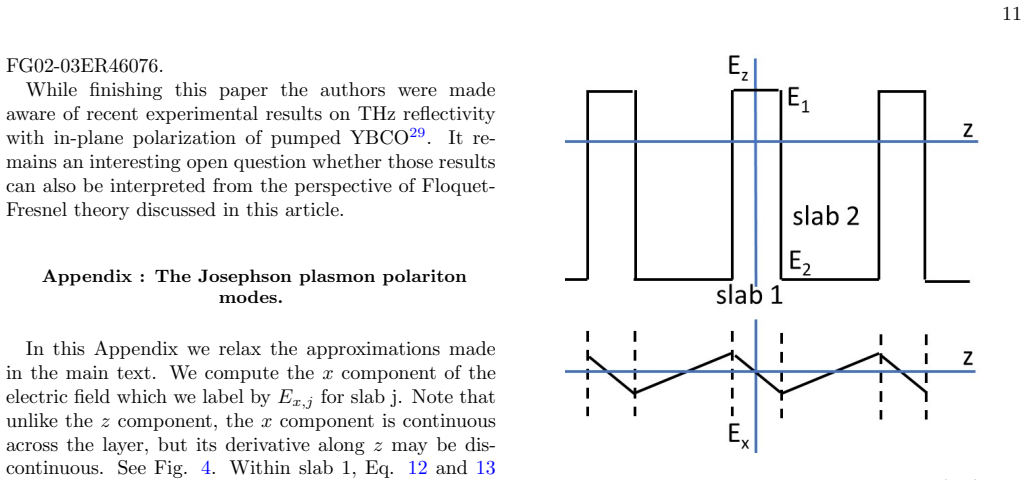
It is easy to see from Eq. 18 that the z compo- nent of the electric field is nonzero in both slabs, but is mainly in slab 1 for ωU and in slab 2 for ωL. In fact from this equation we can solve for the ratio at a given mode frequency ω. E1 E2 = ω2 p2 − ω2 ω2 p1 − ω2 ≈ − ω2 − ω2 p2 ω2 p1 (21) where in the second part we take ω ≪ ωp1 as is appropri- ate for...
-
[6]
From quantum matter to high-temperature superconductivity in copper oxides
Bernhard Keimer, Steven A Kivelson, Michael R Nor- man, Shinichi Uchida, and J Zaanen. From quantum matter to high-temperature superconductivity in copper oxides. Nature, 518(7538):179–186, 2015
work page 2015
-
[7]
Importance of phase fluctu- ations in superconductors with small superfluid density
VJ Emery and SA Kivelson. Importance of phase fluctu- ations in superconductors with small superfluid density. Nature, 374(6521):434–437, 1995
work page 1995
-
[8]
Coherence and pairing in a doped mott insulator: Application to the cuprates
T Senthil and Patrick A Lee. Coherence and pairing in a doped mott insulator: Application to the cuprates. Physical review letters, 103(7):076402, 2009
work page 2009
-
[9]
Amperean pairing and the pseudogap phase of cuprate superconductors
Patrick A Lee. Amperean pairing and the pseudogap phase of cuprate superconductors. Physical Review X , 4(3):031017, 2014
work page 2014
-
[10]
Pseudogap and fermi arcs in under- doped cuprates
Chandra M Varma. Pseudogap and fermi arcs in under- doped cuprates. Physical Review B, 99(22):224516, 2019
work page 2019
-
[11]
Pseudogap and fermi-surface topology in the two-dimensional hubbard model
Wei Wu, Mathias S Scheurer, Shubhayu Chatter- jee, Subir Sachdev, Antoine Georges, and Michel Fer- rero. Pseudogap and fermi-surface topology in the two-dimensional hubbard model. Physical Review X , 8(2):021048, 2018
work page 2018
- [12]
-
[13]
A. von Hoegen, M. Fechner, M. F¨ orst, N. Taherian, E. Rowe, A. Ribak, J. Porras, B. Keimer, M. Michael, E. Demler, and A. Cavalleri. Amplification of supercon- ducting fluctuations in driven yba 2cu3o6+x. Phys. Rev. X, 12:031008, Jul 2022
work page 2022
-
[14]
Marios H Michael, Alexander von Hoegen, Michael Fech- ner, Michael F¨ orst, Andrea Cavalleri, and Eugene Dem- ler. Parametric resonance of josephson plasma waves: A theory for optically amplified interlayer supercon- ductivity in yba 2 cu 3 o 6+ x. Physical Review B , 102(17):174505, 2020
work page 2020
-
[15]
S. Fava, G. De Vecchi, G. Jotzu, M. Buzzi, T. Gebert, Y. Liu, B. Keimer, and A. Cavalleri. Magnetic field expulsion in optically driven yba2cu3o6.48. Nature, 632(8023):75–80, 2024
work page 2024
-
[16]
Giant dynamical paramagnetism in the driven pseudogap phase of ybco
Marios H Michael, Duilio De Santis, Eugene A Dem- ler, and Patrick A Lee. Giant dynamical paramagnetism in the driven pseudogap phase of ybco. arXiv preprint arXiv:2410.12919, 2024
-
[17]
Marios H. Michael, Michael F¨ orst, Daniele Nicoletti, Sheikh Rubaiat Ul Haque, Yuan Zhang, Andrea Cav- alleri, Richard D. Averitt, Daniel Podolsky, and Eugene Demler. Generalized fresnel-floquet equations for driven quantum materials. Phys. Rev. B, 105:174301, May 2022
work page 2022
-
[18]
N. Taherian, M. F¨ orst, A. Liu, M. Fechner, D. Pavicevic, A. von Hoegen, E. Rowe, Y. Liu, S. Nakata, B. Keimer, E. Demler, M. H. Michael, and A. Cavalleri. Squeezed josephson plasmons in driven yba 2cu3o6+x, 2024
work page 2024
-
[19]
A. Dubroka, M. R¨ ossle, K. W. Kim, V. K. Malik, D. Mun- zar, D. N. Basov, A. A. Schafgans, S. J. Moon, C. T. Lin, D. Haug, V. Hinkov, B. Keimer, Th. Wolf, J. G. Storey, J. L. Tallon, and C. Bernhard. Evidence of a pre- cursor superconducting phase at temperatures as high as 180 k in rba2cu3o7−δ (r = Y, Gd, Eu) superconduct- ing crystals from infrared spe...
work page 2011
-
[20]
Lozano, Qiang Li, Genda D Gu, et al
Albert Liu, Danica Pavi´ cevi´ c, Marios H Michael, Alex G Salvador, Pavel E Dolgirev, Michael Fechner, Ankit S Disa, P M. Lozano, Qiang Li, Genda D Gu, et al. Prob- ing inhomogeneous cuprate superconductivity by ter- ahertz josephson echo spectroscopy. Nature Physics , 20(11):1751–1756, 2024
work page 2024
-
[21]
Alex G´ omez Salvador, Pavel E Dolgirev, Marios H Michael, Albert Liu, Danica Pavicevic, Michael Fechner, Andrea Cavalleri, and Eugene Demler. Principles of two- dimensional terahertz spectroscopy of collective excita- tions: The case of josephson plasmons in layered super- conductors. Physical Review B, 110(9):094514, 2024
work page 2024
-
[22]
Andr´ e Eckardt and Egidijus Anisimovas. High-frequency approximation for periodically driven quantum systems from a floquet-space perspective. New Journal of Physics, 17(9):093039, sep 2015
work page 2015
-
[23]
Nazaryan, Ivan Ridkokasha, Marios H
Khachatur G. Nazaryan, Ivan Ridkokasha, Marios H. Michael, and Eugene Demler. Terahertz amplification and lasing in pump-probe experiments with hyperbolic polaritons in h-bn, 2024
work page 2024
-
[24]
Deconfinement in the two-dimensional xy model
HA Fertig. Deconfinement in the two-dimensional xy model. Physical review letters, 89(3):035703, 2002
work page 2002
-
[25]
Egor Babaev. Vortex matter, effective magnetic charges, and generalizations of the dipolar superfluidity concept in layered systems. Phys. Rev. B , 77:054512, Feb 2008
work page 2008
-
[26]
Guido Homann, Marios H. Michael, Jayson G. Cosme, and Ludwig Mathey. Dissipationless counterflow currents above Tc in bilayer superconductors. Phys. Rev. Lett. , 13 132:096002, Feb 2024
work page 2024
-
[27]
Adaptive resonance and pumping a swing
Paul Glendinning. Adaptive resonance and pumping a swing. European Journal of Physics , 41(2):25006, 2020
work page 2020
-
[28]
Vanishing of phase coherence in underdoped bi2sr2cacu2o8+ δ
John Corson, R Mallozzi, J Orenstein, James N Eck- stein, and I Bozovic. Vanishing of phase coherence in underdoped bi2sr2cacu2o8+ δ. Nature, 398(6724):221– 223, 1999
work page 1999
-
[29]
Ece Uykur, Kiyohisa Tanaka, Takahiko Masui, Shigeki Miyasaka, and Setsuko Tajima. Persistence of the su- perconducting condensate far above the critical temper- ature of yba 2(Cu, Zn)3oy revealed by c-axis optical con- ductivity measurements for several zn concentrations and carrier doping levels. Phys. Rev. Lett. , 112:127003, Mar 2014
work page 2014
-
[30]
The physics of pair-density waves: cuprate superconductors and beyond
Daniel F Agterberg, JC S´ eamus Davis, Stephen D Ed- kins, Eduardo Fradkin, Dale J Van Harlingen, Steven A Kivelson, Patrick A Lee, Leo Radzihovsky, John M Tran- quada, and Yuxuan Wang. The physics of pair-density waves: cuprate superconductors and beyond. Annual Re- view of Condensed Matter Physics , 11(1):231–270, 2020
work page 2020
-
[31]
Superexchange mecha- nism and d-wave superconductivity
Gabriel Kotliar and Jialin Liu. Superexchange mecha- nism and d-wave superconductivity. Physical Review B , 38(7):5142, 1988
work page 1988
-
[32]
The physics behind high-temperature superconducting cuprates: the ‘plain vanilla’versionof rvb
Philip W Anderson, PA Lee, M Randeria, TM Rice, N Trivedi, and FC Zhang. The physics behind high-temperature superconducting cuprates: the ‘plain vanilla’versionof rvb. Journal of Physics: Condensed Matter, 16(24):R755, 2004
work page 2004
-
[33]
Equivalence of pseudogap and pairing energy in a cuprate high-temperature superconductor
Jiasen Niu, Maialen Ortego Larrazabal, Thomas Gozlin- ski, Yudai Sato, Koen M Bastiaans, Tjerk Benschop, Jian-Feng Ge, Yaroslav M Blanter, Genda Gu, Ingmar Swart, et al. Equivalence of pseudogap and pairing energy in a cuprate high-temperature superconductor. arXiv preprint arXiv:2409.15928 , 2024
-
[34]
M. Rosenberg, D. Nicoletti, M. Buzzi, A. Iudica, Y. Liu, B. Keimer, and A. Cavalleri. Signatures of three-dimensional photo-induced superconductivity in yba2cu3o6.48, 2025
work page 2025
discussion (0)
Sign in with ORCID, Apple, or X to comment. Anyone can read and Pith papers without signing in.