REVIEW 4 major objections 4 minor 18 references
LUST: A Multi-Modal Framework with Hierarchical LLM-based Scoring for Learned Thematic Significance Tracking in Multimedia Content
T0 review · 4 major / 4 minor · reviewed 2026-08-06 · deepseek-v4-flash
Pith's one-line read This paper claims that a video segment's thematic relevance should be scored twice: once from its own frame and speech, and again from the narrative history before it.
desk verdict A clear but unevaluated architecture paper: the two-stage LLM scoring idea is new, but every load-bearing claim about relevance quality is asserted rather than demonstrated. read the letter →
The pith
A machine-rendered reading of the paper's core claim, the machinery that carries it, and where it could break.
The reading
What carries the argument
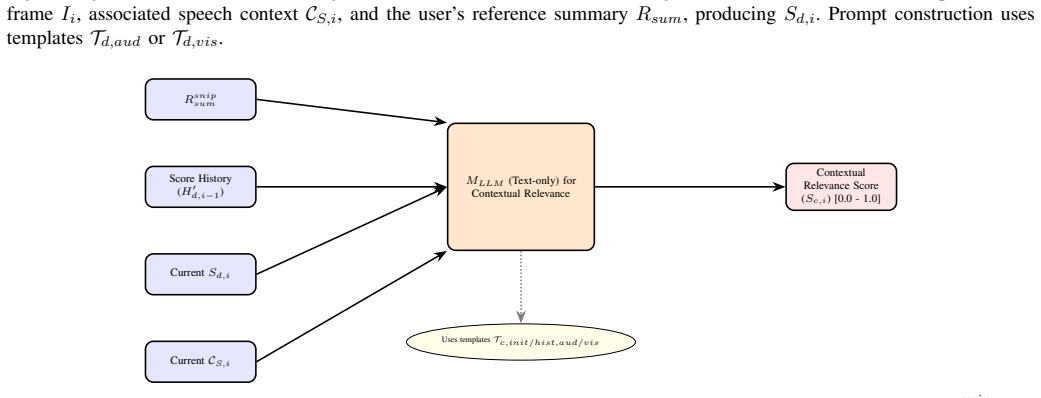
The load-bearing mechanism is the two-stage LLM scoring defined by Equations (3) and (4): $S_{d,i} = \operatorname{clamp}_{[0,1]}(\mathcal{M}_{LLM}(\text{user content} = [P_{d,i}, I_i], \text{system prompt} = \Pi_{sys}))$ and $S_{c,i} = \operatorname{clamp}_{[0,1]}(\mathcal{M}_{LLM}(\text{user content} = [\Pi_{c,i}], \text{system prompt} = \Pi_{sys}))$. The second prompt's distinguishing input is the history vector $H'_{d,i-1}$, the last $N_{hist}$ direct scores; that vector, together with the truncated reference snippet $R^{snip}_{sum}$, is what carries the temporal-narrative argument.
What would settle it
On a set of videos with human-annotated segment-level thematic relevance judgments, run LUST with the same theme: if the contextual scores $S_{c,i}$ do not agree with human judgments better than the direct scores $S_{d,i}$, or if the scores stay the same when the history order is reversed, the temporal-narrative claim fails.
Extended reading notes
Core claim
LUST's central claim is that relevance of a segment is best represented by two scores: a direct score $S_{d,i}$ based on the window's representative frame $I_i$, its ASR-derived speech context $C_{S,i}$, and the user's reference summary $R_{sum}$; and a contextual score $S_{c,i}$ obtained by prompting the same LLM, in text only, with a truncated version of $R_{sum}$, the current direct score, and the recent history of direct scores $H'_{d,i-1}$. The first score asks what the segment itself shows and says; the second asks how that content lands given the narrative that came before. The paper asserts that this hierarchy yields a temporally aware measure of user-defined significance and makes t
Load-bearing premise
The whole approach rests on the unverified premise that an LLM, given one frame and nearby transcribed speech, will assign scores matching a human's sense of thematic significance, and that feeding it earlier scores makes those assignments better.
Editorial extensions
If this is right
- A user can type an abstract theme and receive a continuous relevance curve over the video's timeline, with high-scoring moments visually marked on the frames.
- The contextual stage lets narrative buildup count: a visually quiet scene that follows escalating tension can score higher than it would in isolation.
- The approach is domain-agnostic because the query is free text, so lectures, films, and group discussions can all be scanned with the same pipeline.
- Per-window logs record the score, frame, time span, and speech snippet, making the output inspectable rather than a single opaque highlight.
- Temporal resolution is controlled by the window duration $\Delta t_w$ and history length $N_{hist}$, both explicit parameters of the method.
Reading between the lines
- A direct test the paper leaves implicit is to compare $S_{c,i}$ with $S_{d,i}$ against human-annotated segment relevance; if the history offers no gain, the contextual stage is an extra LLM call that adds cost without signal.
- Varying $N_{hist}$ and the speech radius $\delta_t$ could map where narrative context helps: long histories may suit films or documentaries, while short histories may suffice for topic-switching content such as news clips.
- The two-stage design suggests a cheaper architecture: model the history with a small temporal network over direct scores instead of a second LLM prompt, an option the paper's future-work discussion already gestures toward.
- Running the same prompts with the image or the speech context removed would yield a natural modality ablation, attributing each score's contribution to vision versus language.
Editorial analysis
A structured set of objections, weighed in public.
Referee Report
Summary. The paper proposes LUST, a framework for tracking user-defined thematic significance in video. The pipeline segments video into temporal windows, extracts a representative frame and ASR-transcribed speech context per window, and uses a multimodal LLM to compute a 'direct relevance' score S_d,i (Eq. 3) from the frame, speech, and a user-provided reference summary Rsum. A second, text-only LLM stage then computes a 'contextual relevance' score S_c,i (Eq. 4) from the current direct score, a snippet of Rsum, the current speech context, and a truncated history of previous direct scores. The system outputs an annotated video with a Bezier-curve overlay of S_c,i and extensive log files. The abstract and conclusion claim that this two-stage scoring yields 'a nuanced, temporally-aware measure of user-defined significance' and enables the model to 'understand evolving narratives.' The manuscript contains no experiments, no dataset, no human evaluation, no baseline comparison, no ablation, and no error analysis.
Significance. If the proposed scoring were shown to agree with human judgments of thematic relevance, the framework could be useful for theme-based video browsing, media production, educational content analysis, and similar tasks. The architecture is clearly described, the parameters are explicitly named, and the logging design is thoughtful for reproducibility. However, the central contribution is entirely unvalidated: the claimed ability to track evolving narrative significance rests on untested assumptions about LLM scoring behavior. The paper is currently an architecture description, not a demonstrated system, and the significance of the claimed contribution cannot be assessed from the evidence provided.
major comments (4)
- [§II-B, Eqs. (3)–(4)] The central claim—that the two-stage scoring mechanism 'allows the model to understand evolving narratives' and yields 'a nuanced, temporally-aware measure of user-defined significance'—is not supported by any experiment. No dataset, no human relevance judgments, no baselines, no metrics, and no error analysis are reported. S_c,i is simply another LLM output conditioned on a different prompt; whether it improves on S_d,i is an empirical question that the paper never tests. At minimum, the authors need a segment-level human-annotated relevance dataset, agreement/correlation metrics against human judgments, a non-temporal baseline, and a comparison of S_d,i with S_c,i.
- [§III, Discussion] The manuscript acknowledges that 'The LLM's interpretation of Rsum and its scoring consistency are critical,' but treats this as a passing caveat. This is load-bearing: the entire system output derives from LLM scores whose validity is never calibrated against human judgments. There is also no assessment of score consistency across repeated runs, across prompt template variations, or across different formulations of Rsum. As written, relevance is effectively defined as whatever the LLM returns, which makes the claimed 'tracking of user-defined significance' circular relative to the evaluation needed to support it.
- [§II-B, Stage 2] The assumption that adding the history H'_d,i-1 of previous direct scores improves contextual relevance is untested. Since S_c,i is computed from S_d,i via a text prompt, adding history could help, hurt, or be ignored by the LLM. No ablation or sensitivity analysis is provided. The free parameters N_hist, Δt_w, and δ_t are fixed to illustrative values (e.g., 1.0s, 2.5s) without any study of their effect. A comparison of S_c,i against S_d,i, and a sweep over N_hist, are necessary to substantiate the hierarchical contribution.
- [§II-C and Fig. 4] The only demonstration is a single frame of a math lecture with an overlay curve. This is not an evaluation: it shows that the software runs, but not that the scores correspond to human-perceived thematic relevance. The paper needs at least a qualitative analysis over multiple videos and a quantitative evaluation (e.g., correlation with human annotations, precision/recall at thresholded relevance levels) before the framework's usefulness can be judged.
minor comments (4)
- [§II-A4, Eq. (2)] The notation is inconsistent: the equation uses a large 'M' for concatenation, while the text says 'where L denotes concatenation.' This should be unified (e.g., a single concatenation operator or ellipsis).
- [§II-B3] The truncation function for R_snip^sum is not formally defined, and the subscript formatting ('Rsnipsum') is inconsistent. Also, the prompt templates T_d,aud, T_d,vis, T_c,init,aud, etc., are never shown, despite being central to the method; including them would improve reproducibility.
- [§II-A1] Calling Rsum 'the semantic ground truth' is misleading. Rsum is a user-provided query; ground truth would be human-judged relevance labels for each segment. This wording should be corrected and the distinction made explicit.
- [§II-A2] The text says 'The number of frames initially sampled within the window is a configurable parameter determining sampling density per second,' but only one representative frame is ever used. Clarify whether multiple frames are sampled and then discarded, or whether this parameter is vestigial.
Circularity Check
No circular derivation: LUST's two-stage LLM scoring is a defined pipeline, not a fit or a self-citation chain; lack of validation is an empirical gap, not circularity.
full rationale
The derivation chain is explicit and non-circular. Given V and Rsum, preprocessing produces representative frames Ii and speech context CS,i. Stage 1 defines Sd,i = clamp(MLLM(user content = [{Pd,i},{Ii}], system prompt = Πsys)) (Eq. 3). Stage 2 defines Sc,i as a separate text-only LLM call using Rsnip_sum, H′d,i−1, Sd,i, and CS,i (Eq. 4). Sc,i is not defined as Sd,i, nor as a fitted parameter, nor as a deterministic transformation of its inputs that would make a later 'prediction' equivalent to an earlier fit. No parameter is fitted to any subset of data and then reported as a prediction. No uniqueness theorem or prior result by the same authors is invoked to force a choice; all cited references are standard external tools (Whisper, FFmpeg, Pillow) or general surveys. The paper's central weakness is empirical: it asserts that the LLM outputs correspond to 'thematic relevance' and that the contextual stage improves on the direct stage, but it provides no human evaluation, baseline, or ablation. That is an unvalidated empirical claim, not a circular structural reduction. The paper itself flags the assumption in Section III: 'The LLM's interpretation of Rsum and its scoring consistency are critical.' This acknowledges that validity depends on an untested property of the model, but the framework's derivation remains self-consistent rather than circular. Therefore the appropriate circularity score is 0; concerns about missing validation belong in a correctness/evidence assessment, not a circularity finding.
Assumptions & free parameters
free parameters (8)
- visual window duration delta_tw =
1.0 s (configurable)
- speech context radius delta_t =
2.5 s (configurable)
- history length N_hist =
not specified
- reference summary snippet length L_snip =
70 characters (configurable)
- ASR model size =
e.g., medium English Whisper model
- LLM temperature =
0.1
- frame sampling density per second =
configurable, no default given
- LLM prompt templates =
hand-authored, not disclosed
assumptions (4)
- domain assumption A single representative frame per visual window adequately represents the window's visual content for relevance scoring.
- domain assumption ASR transcription preserves the spoken content relevant to the user theme with acceptable fidelity.
- domain assumption LLM numerical scores in [0,1] correspond to human-perceived thematic relevance.
- ad hoc to paper Adding the history of previous direct scores improves the contextual relevance estimate.
Cite this review
Pith. "Pith review of LUST: A Multi-Modal Framework with Hierarchical LLM-based Scoring for Learned Thematic Significance Tracking in Multimedia Content." pith.science (2026). https://pith.science/paper/2QE4BY6E
@misc{pith2026250804353,
  author       = {Pith},
  title        = {Pith review of: LUST: A Multi-Modal Framework with Hierarchical LLM-based Scoring for Learned Thematic Significance Tracking in Multimedia Content},
  year         = {2026},
  howpublished = {\url{https://pith.science/paper/2QE4BY6E}},
  note         = {Machine review of arXiv:2508.04353}
}
abstract
This paper introduces the Learned User Significance Tracker (LUST), a framework designed to analyze video content and quantify the thematic relevance of its segments in relation to a user-provided textual description of significance. LUST leverages a multi-modal analytical pipeline, integrating visual cues from video frames with textual information extracted via Automatic Speech Recognition (ASR) from the audio track. The core innovation lies in a hierarchical, two-stage relevance scoring mechanism employing Large Language Models (LLMs). An initial "direct relevance" score, $S_{d,i}$, assesses individual segments based on immediate visual and auditory content against the theme. This is followed by a "contextual relevance" score, $S_{c,i}$, that refines the assessment by incorporating the temporal progression of preceding thematic scores, allowing the model to understand evolving narratives. The LUST framework aims to provide a nuanced, temporally-aware measure of user-defined significance, outputting an annotated video with visualized relevance scores and comprehensive analytical logs.
Figures


Figures from the paper (1 more)

Reference graph
Works this paper leans on
-
[1]
A comprehensive review on video summarization techniques,
P. Ahluwalia and N. Varshney, “A comprehensive review on video summarization techniques,” Artificial Intelligence Review, vol. 55, no. 6, pp. 4455–4507, 2022
work page 2022
-
[2]
Content-based multimedia information retrieval: State of the art and challenges,
M. S. Lew, N. Sebe, C. Djeraba, and R. Jain, “Content-based multimedia information retrieval: State of the art and challenges,” ACM Transactions on Multimedia Computing, Communications, and Applications (TOMM), vol. 2, no. 1, pp. 1–19, 2006
work page 2006
-
[3]
Multimodal machine learning: A survey and taxonomy,
T. Baltru ˇsaitis, C. Ahuja, and L.-P. Morency, “Multimodal machine learning: A survey and taxonomy,” IEEE Transactions on Pattern Analysis and Machine Intelligence , vol. 41, no. 2, pp. 423–443, 2019
work page 2019
-
[4]
A survey of large language models,
W. X. Zhao, K. Zhou, J. Li, T. Tang, X. Wang, Y . Hou, Y . Min, B. Zhang, J. Zhang, Z. Dong, Y . Du, C. Yang, Y . Chen, Z. Chen, J. Jiang, R. Ren, Y . Li, Z. Liu, P. Liu, J.-Y . Nie, and J.-R. Wen, “A survey of large language models,” arXiv preprint arXiv:2303.18223 , 2023
arXiv 2023
-
[5]
Language models are few-shot learners,
T. B. Brown, B. Mann, N. Ryder, M. Subbiah, J. D. Kaplan, P. Dhariwal, A. Neelakantan, P. Shyam, G. Sastry, A. Askell, S. Agarwal, A. Herbert-V oss, G. Krueger, T. Henighan, R. Child, A. Ramesh, D. M. Ziegler, J. Wu, C. Winter, C. Hesse, M. Chen, E. Sigler, M. Litwin, S. Gray, B. Chess, J. Clark, C. Berner, S. McCandlish, A. Radford, I. Sutskever, and D. ...
work page 2020
-
[6]
A. Clark and Contributors, “Pillow (pil fork),” https://python-pillow.org/, 2024, accessed: 2024-06-04. Current version at access time: 10.3.0
work page 2024
- [7]
-
[8]
FFmpeg developers, “FFmpeg Multimedia Framework,” https://ffmpeg. org, 2024, accessed: 2024-06-04
work page 2024
Show all 18 references
-
[9]
Whisper model card,
OpenAI, “Whisper model card,” https://github.com/openai/whisper, 2022, accessed: 2024-06-04
2022
-
[10]
Robust speech recognition via large-scale weak super- vision,
A. Radford, J. W. Kim, T. Xu, G. Brockman, C. McLeavey, and I. Sutskever, “Robust speech recognition via large-scale weak super- vision,” arXiv preprint arXiv:2212.04356 , 2022
2022 arXiv
-
[11]
A statistical model-based voice activity detection,
J. Sohn, N. S. Kim, and W. Sung, “A statistical model-based voice activity detection,” IEEE Signal Processing Letters , vol. 6, no. 1, pp. 1–3, 1999
1999
-
[12]
Mixtral of experts,
Mistral AI Team, “Mixtral of experts,” arXiv preprint arXiv:2401.04088, 2024
2024 arXiv
-
[13]
G. E. Farin, Curves and Surfaces for CAGD: A Practical Guide , 5th ed. San Francisco, CA, USA: Morgan Kaufmann Publishers Inc., 2002
2002
-
[14]
Video abstraction: A systematic review and classification,
B. T. Truong and S. Venkatesh, “Video abstraction: A systematic review and classification,”ACM Transactions on Multimedia Computing, Communications, and Applications (TOMM) , vol. 3, no. 1, pp. 3–es, 2007
2007
-
[15]
Long-term recurrent convolutional networks for visual recognition and description,
J. Donahue, L. Anne Hendricks, S. Guadarrama, M. Rohrbach, S. Venu- gopalan, K. Saenko, and T. Darrell, “Long-term recurrent convolutional networks for visual recognition and description,” in Proceedings of the IEEE Conference on Computer Vision and Pattern Recognition (CVPR) ...
2015
-
[16]
Attention is all you need,
A. Vaswani, N. Shazeer, N. Parmar, J. Uszkoreit, L. Jones, A. N. Gomez, Ł. Kaiser, and I. Polosukhin, “Attention is all you need,” in Advances in Neural Information Processing Systems 30 (NIPS 2017), I. Guyon, U. V . Luxburg, S. Bengio, H. Wallach, R. Fergus, S. Vishwanathan, ...
2017
-
[17]
Is space-time attention all you need for video understanding?
G. Bertasius, H. Wang, and L. Torresani, “Is space-time attention all you need for video understanding?” in Proceedings of the 38th International Conference on Machine Learning (ICML) , ser. Proceedings of Machine Learning Research, M. Meila and T. Zhang, Eds., vol. 139. PMLR,...
2021
-
[18]
A survey of the state of explainable ai for natural language processing,
M. Danilevsky, K. Qian, R. Aharonov, Y . Katsis, B. Kawas, and P. Sen, “A survey of the state of explainable ai for natural language processing,” arXiv preprint arXiv:2010.00711 , 2020, presented at AACL-IJCNLP 2020
2010 arXiv
Reviewed August 6, 2026 · model on record in the stance chip above.
Discussion (0). Sign in to comment.