REVIEW 3 major objections 4 minor 26 references
High-Stakes Decisions with Language Models: Insights from Emergency Triage
T0 review · 3 major / 4 minor · reviewed 2026-08-06 · deepseek-v4-flash
Pith's one-line read Language-model triage failures are better explained by unstated cost preferences than by poor clinical knowledge, the paper argues, so evaluations and deployments should make utilities explicit.
desk verdict Strong steering results and a clean decision-theoretic decomposition, but the headline claim about ChatGPT Health's under-triage overstates what the data support given the tool sits below the ROC curve. read the letter →
The pith
A machine-rendered reading of the paper's core claim, the machinery that carries it, and where it could break.
The reading
What carries the argument
The central object is the cost ratio $\Gamma = c_{\mathrm{FN}}/c_{\mathrm{FP}}$: the relative cost of a missed emergency versus an unnecessary referral. Under a cost-minimizing decision rule it implies a break-even referral probability $p^* = c_{\mathrm{FP}}/(c_{\mathrm{FP}}+c_{\mathrm{FN}})$, so recovering the threshold that best explains a model's binary decisions from its own elicited probabilities reveals its implicit utility. The machinery is black-box: separate queries elicit the probability and the decision, and a discrete-choice logistic fit recovers the implied cost ratio. This decomposes triage errors into discrimination (AUROC) and decision policy (location on the ROC curve), and
What would settle it
Check the yardstick assumption directly: on a fixed case set, elicit probabilities and decisions in both orders (probability first vs. decision first) across repeated samples. If the recovered cost ratio shifts with query order, or if a model states a high emergency probability while withholding referral under a recovered safety-prioritized ratio whose implied threshold is much lower, then the separate probability estimate is not the belief driving the decision, and the utility attribution fails. For the deployed-tool claim, the decisive check is access to ChatGPT Health's internal probability
Extended reading notes
Core claim
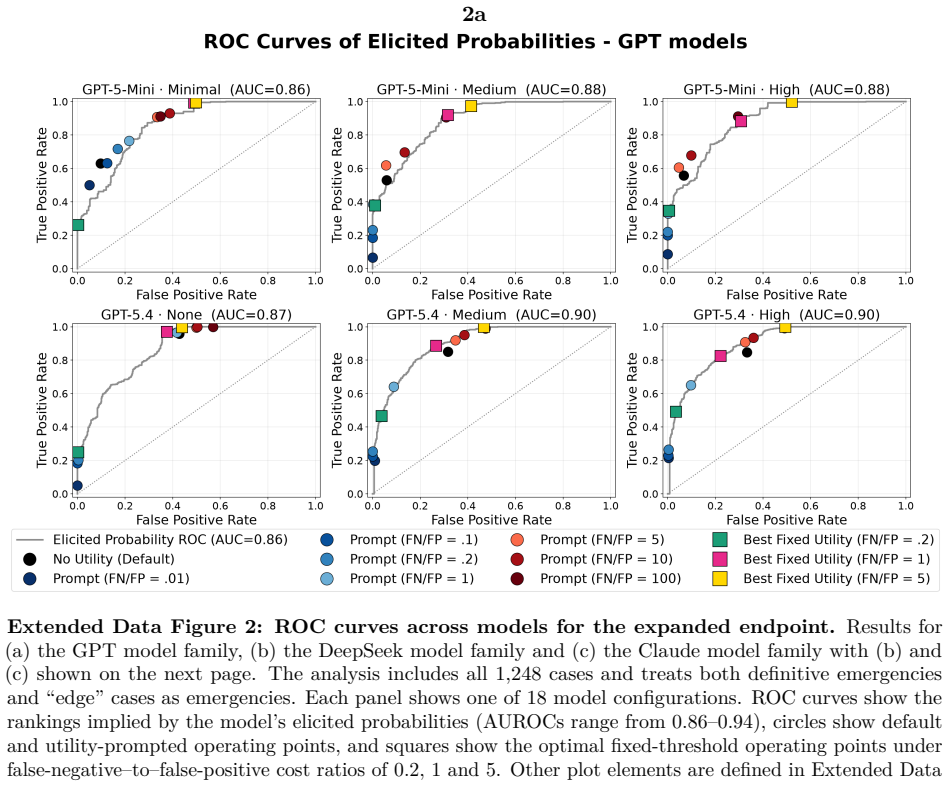
Much of ChatGPT Health's under-triage comes from an implicit preference against over-referral, not from limited discrimination. On the 576-case endpoint, elicited probabilities rank emergencies well (AUROC 0.95–0.99), yet the tool sits at the resource-conserving end of the curve, catching about 48% of emergencies at about 10% false alarms. Prompting the same model family with explicit 5:1 or 10:1 safety-prioritized cost ratios moves it up the curve, adding roughly 50% sensitivity with little added over-referral. Default utilities vary by model and reasoning level, and steering fidelity depends on capability. High-stakes LM systems should be treated as probabilistic decision systems governed
Load-bearing premise
The load-bearing premise is that the probability a model reports in a separate, cost-free question is the same probability it acts on when making the triage recommendation, and that the tested small model variant is a faithful stand-in for the deployed ChatGPT Health system.
Editorial extensions
If this is right
- Stating a cost ratio in plain language can move a capable model's operating point up the ROC curve to near-100% sensitivity without substantially increasing unnecessary referrals.
- Default LM behavior encodes an implicit, model-specific and reasoning-level-specific trade-off that should not be treated as clinically appropriate without explicit specification.
- Single-point evaluations can misclassify steerable models as unsafe or poorly controlled models as safe; reporting the full trade-off curve and prompted operating points corrects this.
- A target cost ratio can be deployed either by prompting the model or by applying an external threshold to its elicited probabilities, and the threshold approach offers some robustness to miscalibration.
- The distinction between probability and utility generalizes beyond triage to any high-stakes setting with asymmetric error costs.
Reading between the lines
- The paper leaves implicit that the same revealed-preference procedure could run prospectively as a pre-deployment safety check, producing a documented default cost ratio for any triage system.
- An unstated consequence of the reported variation across reasoning settings: changing inference-time reasoning effort could silently alter a model's triage policy, so safety reports should list operating points per reasoning configuration.
- A natural testable extension is to turn this into a benchmark: on decision tasks with known asymmetric error costs, compare a model's recovered cost ratio with the instructed ratio to measure steering fidelity domain by domain.
Editorial analysis
A structured set of objections, weighed in public.
Referee Report
Summary. This paper reanalyzes the ChatGPT Health emergency-triage failures reported by Ramaswamy et al. (2026). The authors elicit probability estimates and triage decisions separately from several frontier language models, fit a decision-theoretic model to recover the implicit cost ratio (false-negative cost relative to false-positive cost), and show that prompting models with explicit cost ratios moves their operating points along ROC curves derived from the elicited probabilities. They argue that the deployed tool's low sensitivity is largely attributable to an implicit resource-conserving utility rather than to poor discriminative ability, and they propose decision-analytic steering and evaluation as a general paradigm for high-stakes LM deployment.
Significance. The decision-analytic framing is valuable and timely: it separates probabilistic competence from utility-based decision policy in LM evaluation, a distinction that is often collapsed in safety evaluations. The paper is unusually transparent: it releases data and code, reports self-consistency checks (Extended Data Figure 3), validates the choice of GPT-5-mini as the reference model (Extended Data Figure 4), and explicitly states its caveats. If the central claim is sustained, the work has practical implications for how triage systems and other high-stakes LM applications should be prompted, evaluated, and deployed. However, the headline claim about the deployed tool is currently supported only qualitatively: the paper concedes that the tool lies below the GPT-5-mini ROC curve at its observed false-alarm rate, and it never quantifies how much of the under-triage is explained by utility versus residual inconsistency. That gap is the main barrier to accepting the paper's central conclusion.
major comments (3)
- [Decoding a model's decision priorities (caveats paragraph)] The central claim, 'Much of the reported under-triage can therefore be explained by an implicit preference against over-referral rather than by limited discriminatory performance alone,' is undercut by the paper's own first caveat and is never quantified. The text states that at the same false-alarm rate the ChatGPT Health tool identifies fewer emergencies than expected from GPT-5-mini's probability estimates; that is, the tool lies below the ROC curve. No cost-ratio threshold over the elicited probabilities can reproduce such behavior, so the threshold explanation cannot account for the full shortfall. The manuscript should report the GPT-5-mini TPR at FPR ≈ 0.10 (the tool's operating region), quantify the vertical residual gap, and state what fraction of the 48% sensitivity shortfall is attributable to threshold choice versus remaining inconsistency. The claim is also endpoint-dependen
- [Methods, 'Recovering the cost ratio implied by a model's behavior'] The recovery procedure is under-specified. The manuscript says a 'standard discrete-choice logistic model' is fit to decisions and probabilities and that the implied cost ratio is derived, but it does not give the model equation, the link function, the covariate (raw probability or logit), or the formula converting the fitted parameters into the reported cost ratio. This matters because Figures 3 and 4, and the recovered default thresholds throughout, depend directly on this mapping. The paper should specify, for example, P(refer) = σ(α + β·p) or P(refer) = σ(α + β·logit(p)), and state whether the threshold is α = −β·t or the equivalent. Without this, the quantitative recovered ratios are not reproducible.
- [Methods, 'Eliciting probabilities'; Abstract] The claim that 'the same underlying predictions can support markedly different decision policies' assumes that the probabilities elicited in the neutral, utility-free query are the probabilities the model uses when making decisions under utility prompts. This is not directly tested. If a safety-prioritized prompt also inflates the model's internal probability estimates, the recovered cost ratio would absorb that change and the steering result would conflate probability shift with utility shift. The self-consistency check (Extended Data Figure 3) shows that decisions are well described by a threshold on the elicited probabilities within each regime, but it does not establish cross-regime invariance. The authors should either re-elicit probabilities under the utility-prompt conditions in separate queries and demonstrate invariance, or temper the wording so that 'same underlying predictions
minor comments (4)
- [Discussion] Typo: 'and the we suggest improving the precision' should read 'and we suggest improving the precision.'
- [Decoding a model's decision priorities] The phrase 'increases by roughly 50% without increasing unnecessary referrals' should state whether the increase is in percentage points or relative, and should reconcile with the fact that along a single ROC curve a higher TPR at the same FPR is not achievable by a threshold shift. If FPR did increase slightly, report the exact change.
- [Figure 1 / Figure 2] The red star coordinates and the corresponding ROC TPR at the same FPR should be reported numerically in the text or caption. This would directly address the unquantified vertical gap and make the 'much' claim assessable.
- [General] Standardize the terminology: the text alternates between 'Extended Figure 1' and 'Extended Data Figure 1'; the supplementary section should be consistent.
Circularity Check
No circular derivation: probabilities and decisions are elicited separately, cost-ratio recovery is a descriptive fit, and the central steering result is a behavioral measurement; self-citations are supported by internal validation.
full rationale
The paper's central derivation is not circular. Probability estimates are elicited in isolated, utility-free queries and held fixed while triage decisions are collected under different prompting regimes; the recovered cost ratio is fit to the observed decision/probability pairs and used descriptively, not relabeled as a prediction. The ROC curves are constructed from the same elicited probabilities plus external gold-standard labels, and the prompted operating points are directly measured behaviors. The self-citations (refs. 18, 19, 23) provide methodological background for the elicitation and revealed-preference framework, but the paper includes internal validation: prompted ratios move recovered ratios (Figure 4), decision rules reproduce most choices (Extended Data Figure 3), and the choice of GPT-5-mini as the reference model is checked against the deployed tool's published decisions (Extended Data Figure 4). The caveat that ChatGPT Health falls below GPT-5-mini's ROC curve at the same false-alarm rate is a limitation on the strength of the headline claim, not a circularity: it means the threshold explanation is incomplete, but it does not make the analysis reduce to its own inputs. No fitted parameter is presented as an independent prediction, and no load-bearing conclusion rests solely on a self-citation.
Assumptions & free parameters
free parameters (2)
- Recovered cost ratio (per model configuration and prompt regime) =
ranges from strongly resource-prioritized to strongly safety-prioritized across models (e.g., defaults in Figure 3); exa
- Best fixed probability threshold (per model, endpoint, and target cost ratio) =
e.g., threshold for GPT-5-mini under 5:1 cost ratio shown as yellow square in Figure 1; values vary by model
assumptions (5)
- standard math A cost-minimizing decision maker should refer a patient when the estimated probability of a true emergency exceeds the break-even value c_FP/(c_FP + c_FN), where c_FN/c_FP is the false-negative-to-false-positive cost ratio.
- domain assumption The probability elicited in a separate, utility-free query reflects the model's genuine probabilistic belief used in subsequent decisions.
- domain assumption GPT-5-mini with reasoning was the backbone of the ChatGPT Health version studied by Ramaswamy et al. (2026).
- domain assumption The physician-adjudicated labels from Ramaswamy et al. (2026) are the gold standard for emergency status.
- domain assumption Each model's decisions under a given prompt can be represented by a single cost ratio (single decision threshold).
Cite this review
Pith. "Pith review of High-Stakes Decisions with Language Models: Insights from Emergency Triage." pith.science (2026). https://pith.science/paper/2QG5WSNF
@misc{pith2026260801361,
  author       = {Pith},
  title        = {Pith review of: High-Stakes Decisions with Language Models: Insights from Emergency Triage},
  year         = {2026},
  howpublished = {\url{https://pith.science/paper/2QG5WSNF}},
  note         = {Machine review of arXiv:2608.01361}
}
read the original abstract
High-stakes decisions under uncertainty, such as medical emergency triage, require more than accurate predictions. They depend on estimating the likelihood of alternative outcomes while explicitly weighing the consequences of different actions, principles that have long formed the foundation of medical diagnosis and decision making. Yet language models are increasingly used for high-stakes clinical recommendations without explicit specification of the utilities governing these decisions. Here we show that emergency triage with language models can be understood within a probabilistic decision framework, providing a case study of a broader decision-analytic paradigm for steering, evaluating, and deploying language models in high-stakes settings. Using clinical vignettes from a structured evaluation of a consumer triage system, we analyze recommendations for treatment under alternative utility functions that specify the relative costs of missed emergencies and unnecessary escalation. We find that capable language models adjust recommendations in response to stated utilities, revealing that the same underlying predictions can support markedly different decision policies. These findings show that effective deployment depends not only on improving predictions but also on making decision objectives explicit. More broadly, they suggest that language models for high-stakes applications should be understood and evaluated as probabilistic decision systems whose recommendations depend jointly on predictive performance and explicit utilities.
Figures


Figures from the paper (2 more)

Reference graph
Works this paper leans on
-
[1]
Yu Gu, Jingjing Fu, Xiaodong Liu, Jeya Maria Jose Valanarasu, Noel C. F. Codella, Reuben Tan, Qianchu Liu, Ying Jin, Sheng Zhang, Jinyu Wang, Rui Wang, Lei Song, Guanghui Qin, Naoto Usuyama, Cliff Wong, Hao Cheng, HoHin Lee, Praneeth Sanapathi, Sarah Hilado, Tristan Naumann, Javier Alvarez-Valle, Jiang Bian, Mu Wei, Khalil Malik, Lidong Zhou, Jianfeng Gao...
2026
-
[2]
Internal Representation, Not Clinical Knowledge: Where Apparent LLM Triage Failures Originate
David Fraile Navarro, Berardino Como, Jialei Sheng, Soundariya Ananthan, and Shlomo Berkovsky. Internal representation, not clinical knowledge: Where apparent llm triage failures originate, 2026. URLhttps://arxiv.org/abs/2605.29889
work page Pith review arXiv 2026
-
[3]
Jonathan Kim, Anna Podlasek, Kie Shidara, Feng Liu, Ahmed Alaa, and Danilo Bernardo. Limitations of large language models in clinical problem-solving arising from inflexible reasoning, Nov 2025. URLhttps://www.nature.com/articles/s41598-025-22940-0
work page 2025
-
[4]
Farieda Gaber, Maqsood Shaik, Fabio Allega, Agnes Julia Bilecz, Felix Busch, Kelsey Goon, Vedran Franke, and Altuna Akalin. Evaluating large language model workflows in clinical decision support for triage and referral and diagnosis, May 2025. URLhttps://www.nature. com/articles/s41746-025-01684-1
work page 2025
-
[5]
Christopher Y. K. Williams, Jaskaran Bains, Tianyu Tang, Kishan Patel, Alexa N. Lucas, Fiona Chen, Brenda Y. Miao, Atul J. Butte, and Aaron E. Kornblith. Evaluating large language models for drafting emergency department encounter summaries.PLOS Digital Health, 4(6): 1–14, 06 2025. doi: 10.1371/journal.pdig.0000899. URLhttps://doi.org/10.1371/journal. pdi...
-
[6]
Stephen D. Auger and Gregory Scott. Medical errors in large language models revealed using 1,000 synthetic clinical transcripts.medRxiv, 2026. doi: 10.64898/2026.03.23.26349082. URL https://www.medrxiv.org/content/early/2026/03/25/2026.03.23.26349082
-
[7]
Meuth, Lennert Böhm, and Marc Pawlitzki
Lars Masanneck, Linea Schmidt, Antonia Seifert, Tristan Kölsche, Niklas Huntemann, Robin Jansen, Mohammed Mehsin, Michael Bernhard, Sven G. Meuth, Lennert Böhm, and Marc Pawlitzki. Triage performance across large language models, chatgpt, and untrained doctors in emergency medicine: Comparative study.Journal of Medical Internet Research, 26:e53297, June 2...
doi:10.2196/53297 2024
-
[8]
Ashwin Ramaswamy, Alvira Tyagi, Hannah Hugo, Joy Jiang, Pushkala Jayaraman, Mateen Jangda, Alexis E. Te, Steven A. Kaplan, Joshua Lampert, Robert Freeman, Nicholas Gavin, Ashutosh K. Tewari, Ankit Sakhuja, Bilal Naved, Alexander W. Charney, Mahmud Omar, 15 Michael A. Gorin, Eyal Klang, and Girish N. Nadkarni. Chatgpt health performance in a structured tes...
Show all 26 references
-
[9]
Princeton University Press, Princeton, NJ, USA, 1944
John Von Neumann and Oskar Morgenstern.Theory of Games and Economic Behavior. Princeton University Press, Princeton, NJ, USA, 1944
1944
-
[10]
Courier Corporation, 1972
Leonard J Savage.The foundations of statistics. Courier Corporation, 1972
1972
-
[11]
Decision theory in expert systems and artificial intelligence.International journal of approximate reasoning, 2(3):247–302, 1988
Eric J Horvitz, John S Breese, and Max Henrion. Decision theory in expert systems and artificial intelligence.International journal of approximate reasoning, 2(3):247–302, 1988
1988
-
[12]
Mack, George Ruiz, Mark S
Mohsen Bayati, Mark Braverman, Michael Gillam, Karen M. Mack, George Ruiz, Mark S. Smith, and Eric Horvitz. Data-driven decisions for reducing readmissions for heart failure: General methodologyandcasestudy.PLOS ONE,9(10):1–9, 102014. doi: 10.1371/journal.pone.0109264. URLhttp...
-
[13]
Lee, Richard Ren, Long Phan, Norman Mu, Adam Khoja, Oliver Zhang, and Dan Hendrycks
Mantas Mazeika, Xuwang Yin, Rishub Tamirisa, Jaehyuk Lim, Bruce W. Lee, Richard Ren, Long Phan, Norman Mu, Adam Khoja, Oliver Zhang, and Dan Hendrycks. Utility engineering: Analyzing and controlling emergent value systems in ais, 2025. URLhttps://arxiv.org/ abs/2502.08640
2025 arXiv
-
[14]
When do llm preferences predict downstream behavior?, 2026
Katarina Slama, Alexandra Souly, Dishank Bansal, Henry Davidson, Christopher Summerfield, and Lennart Luettgau. When do llm preferences predict downstream behavior?, 2026. URL https://arxiv.org/abs/2602.18971
2026
-
[15]
Generative value conflicts reveal llm priorities, 2026
Andy Liu, Kshitish Ghate, Mona Diab, Daniel Fried, Atoosa Kasirzadeh, and Max Kleiman- Weiner. Generative value conflicts reveal llm priorities, 2026. URLhttps://arxiv.org/abs/ 2509.25369
2026
-
[16]
Griffiths
Jian-Qiao Zhu, Haijiang Yan, and Thomas L. Griffiths. Steering risk preferences in large language models by aligning behavioral and neural representations, 2025. URLhttps://arxiv. org/abs/2505.11615
2025 arXiv
-
[17]
Ai as decision-maker: Ethics and risk preferences of llms, 2025
Shumiao Ouyang, Hayong Yun, and Xingjian Zheng. Ai as decision-maker: Ethics and risk preferences of llms, 2025. URLhttps://arxiv.org/abs/2406.01168
2025 arXiv
-
[18]
When agents say one thing and do another: Validating elicited beliefs from llms,
Khurram Yamin, Jingjing Tang, Santiago Cortes-Gomez, Amit Sharma, Eric Horvitz, and Bryan Wilder. When agents say one thing and do another: Validating elicited beliefs from llms,
-
[19]
Can revealed preferences clarify llm alignment and steering?, 2026
Khurram Yamin, Jingjing Tang, Eric Horvitz, and Bryan Wilder. Can revealed preferences clarify llm alignment and steering?, 2026. URLhttps://arxiv.org/abs/2605.08556
2026 arXiv
-
[20]
Evaluating language models as risk scores.Advances in Neural Information Processing Systems, 37:97378–97407, 2024
André F Cruz, Moritz Hardt, and Celestine Mendler-Dünner. Evaluating language models as risk scores.Advances in Neural Information Processing Systems, 37:97378–97407, 2024. 16
2024
-
[21]
Rethink reporting of evaluation results in ai.Science (New York, N.Y.), 380:136–138, 04 2023
Ryan Burnell, Wout Schellaert, John Burden, Tomer Ullman, Fernando Plumed, Joshua Tenenbaum, Danaja Rutar, Lucy Cheke, Jascha Sohl-Dickstein, Melanie Mitchell, Douwe Kiela, Murray Shanahan, Ellen Voorhees, Anthony Cohn, Joel Leibo, and Jose Hernandez-Orallo. Rethink reporting ...
2023 doi
-
[22]
Mediq: Question-asking llms and a benchmark for reliable interactive clinical reasoning.Advances in Neural Information Processing Systems, 37:28858–28888, 2024
Stella Li, Vidhisha Balachandran, Shangbin Feng, Jonathan Ilgen, Emma Pierson, Pang Wei W Koh, and Yulia Tsvetkov. Mediq: Question-asking llms and a benchmark for reliable interactive clinical reasoning.Advances in Neural Information Processing Systems, 37:28858–28888, 2024
2024
-
[23]
What are the odds? language models are capable of probabilistic reasoning, 2024
Akshay Paruchuri, Jake Garrison, Shun Liao, John Hernandez, Jacob Sunshine, Tim Althoff, Xin Liu, and Daniel McDuff. What are the odds? language models are capable of probabilistic reasoning, 2024. URLhttps://arxiv.org/abs/2406.12830
2024 arXiv
-
[24]
Conditional logit analysis of qualitative choice behavior.Frontiers in Econometrics, pages 105–142, 1973
Daniel McFadden. Conditional logit analysis of qualitative choice behavior.Frontiers in Econometrics, pages 105–142, 1973
1973
-
[25]
refer to emergency care whenever the model’s elicited probability exceeds the corresponding decision threshold
Kenneth E Train.Discrete Choice Methods with Simulation. Cambridge University Press, 2nd edition, 2009. Supplementary Materials The supplementary materials include extended figures that present additional analyses of frontier model performance for the primary and expanded endp...
2009
-
[2026]
URLhttps://arxiv.org/abs/2602.06286
Reviewed August 6, 2026 · model on record in the stance chip above.
Discussion (0). Continue with ORCID to comment.