An Algorithm for Approximating the Metric Projection onto a Superelliptic Disk
Pith reviewed 2026-06-30 13:15 UTC · model grok-4.3
The pith
A new algorithm approximates the metric projection onto a superelliptic disk of order p>1 and is proven to converge.
A machine-rendered reading of the paper's core claim, the machinery that carries it, and where it could break.
Core claim
The authors introduce a dedicated algorithm for approximating the metric projection onto the superelliptic disk (the convex hull of the Lamé curve of order p>1) and prove that the iterates converge to the true projection point.
What carries the argument
An iterative approximation algorithm tailored to the superelliptic disk, whose convergence is established using the convexity of the set for p>1.
If this is right
- Repeated application of the algorithm yields projections to any desired accuracy.
- The method is valid for the entire family of superelliptic disks with p>1.
- It supplies a practical numerical tool inside optimization routines that enforce superelliptic constraints.
Where Pith is reading between the lines
- The algorithm could be benchmarked against standard projection methods for ellipses to quantify any gain in speed or accuracy.
- It might extend naturally to projection problems on convex bodies bounded by other algebraic curves.
- Applications in robotics or computer-aided design that model obstacles with superelliptic shapes could adopt the routine once implemented.
Load-bearing premise
The superelliptic disk remains convex for every p>1, which makes the metric projection unique and allows the convergence argument to apply.
What would settle it
A concrete counterexample in which the algorithm fails to converge or produces a point outside the claimed approximation error for some p>1 and some query point would refute the claim.
Figures
read the original abstract
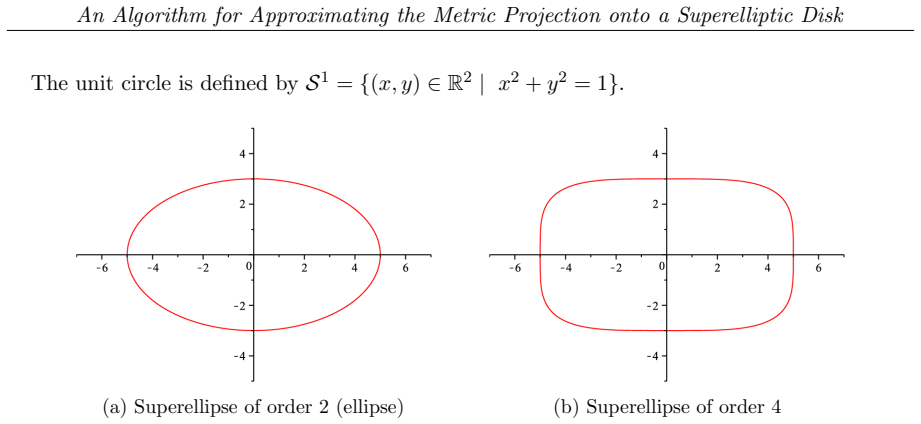
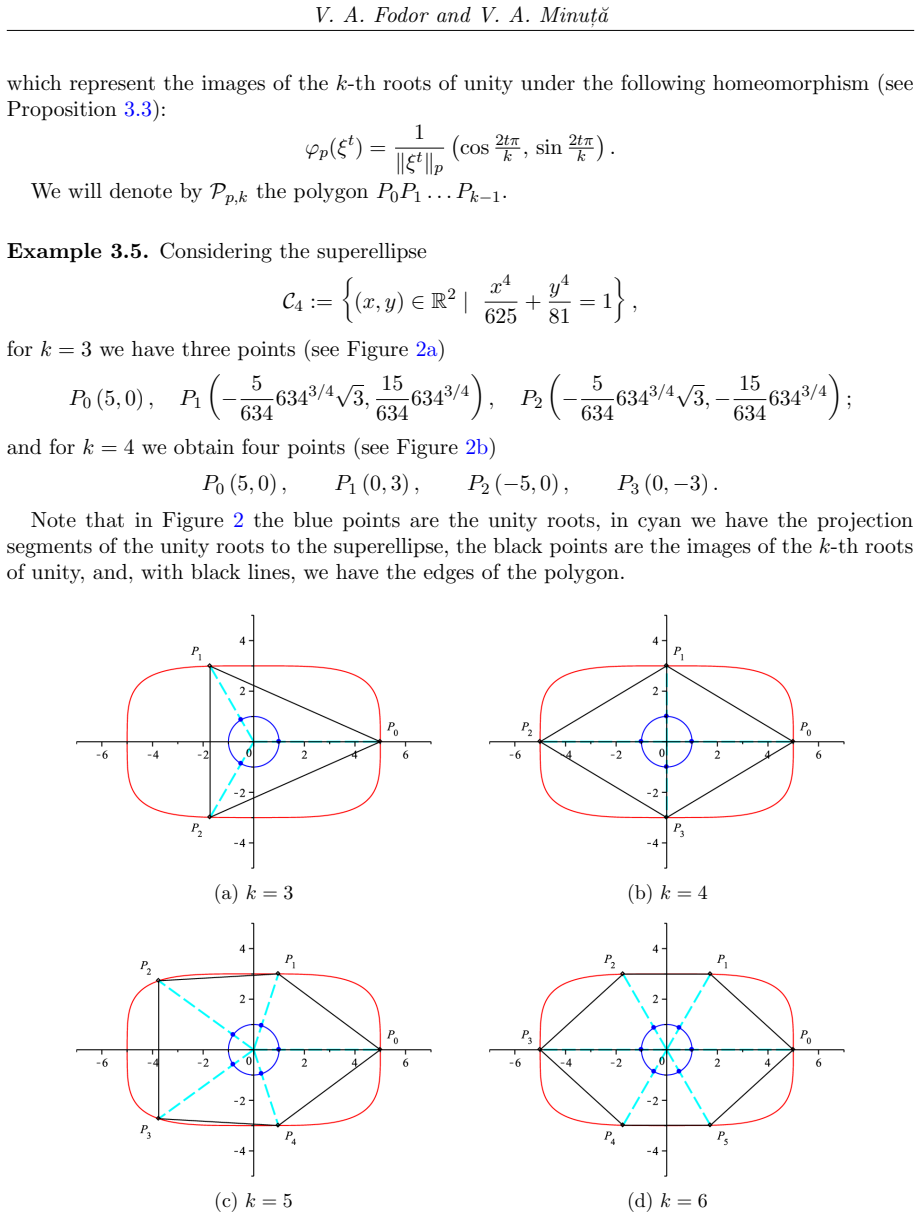
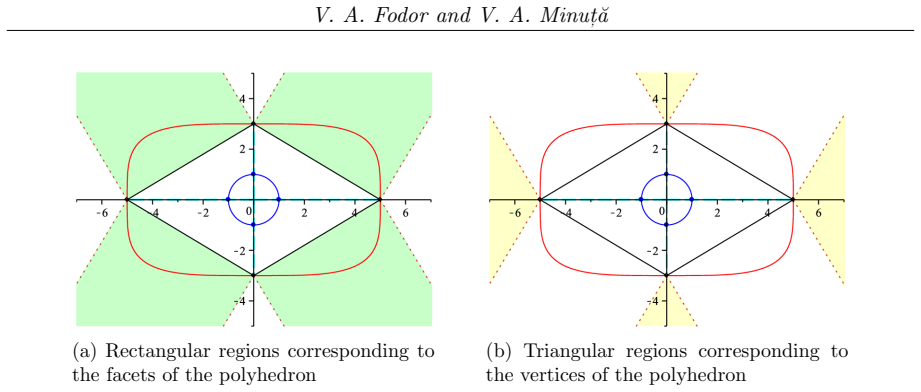
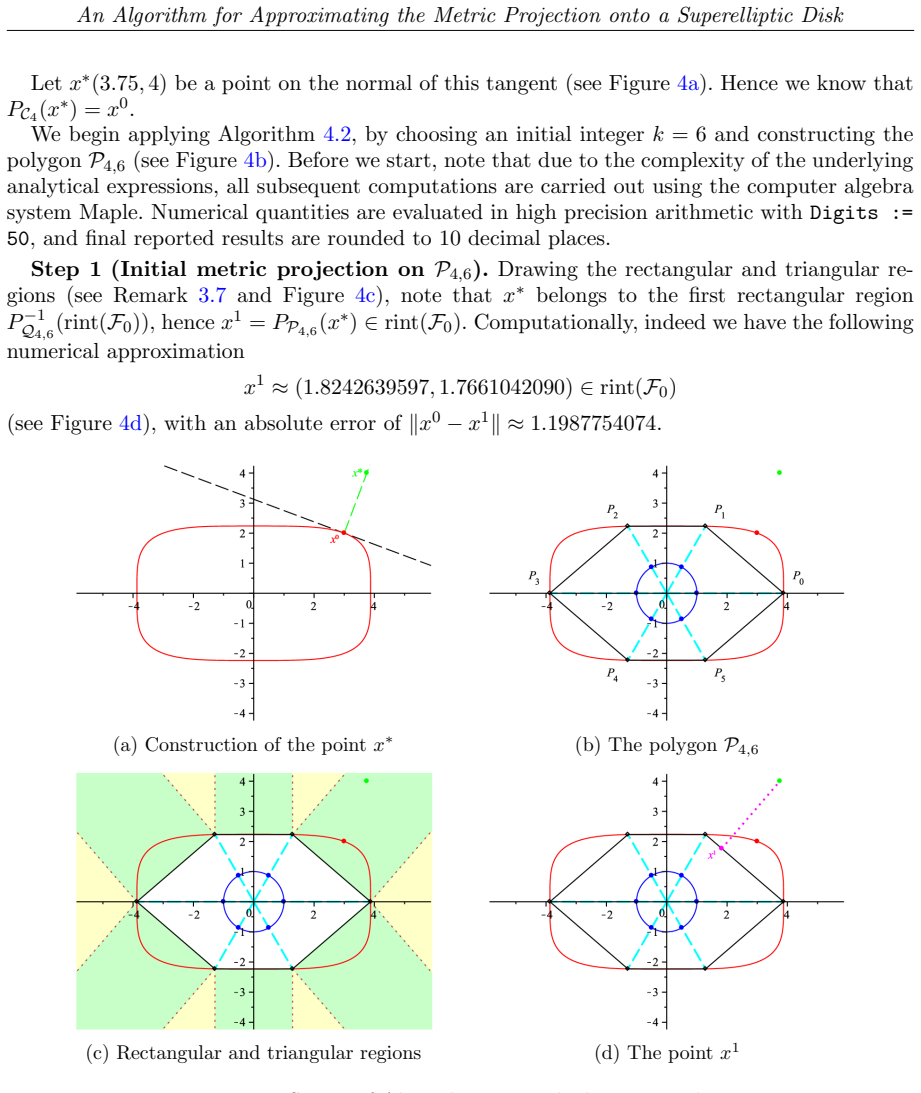
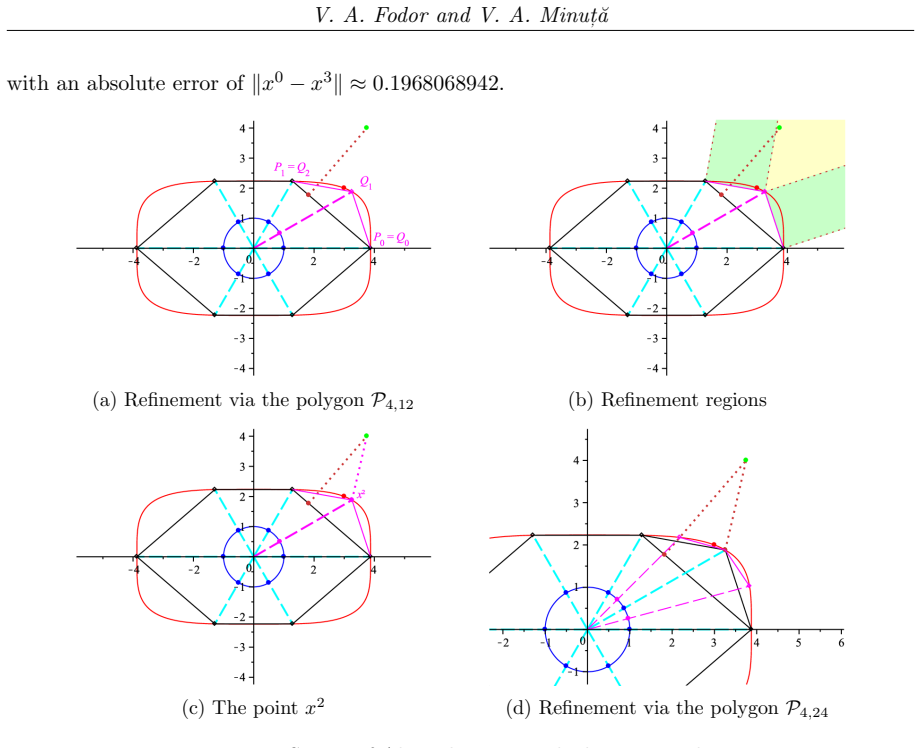
We propose a new algorithm for approximating the metric projection onto a superelliptic disk of order $p>1$, i.e., the convex hull of a superellipse (Lam\'e curve), and prove its convergence.
Editorial analysis
A structured set of objections, weighed in public.
Referee Report
Summary. The manuscript proposes a new algorithm for approximating the metric projection onto a superelliptic disk of order p>1 (the convex hull of a superellipse/Lamé curve) and states that it proves convergence of the algorithm.
Significance. If a correct algorithm and convergence proof were supplied, the work could be relevant to projection methods in convex optimization and computational geometry for non-Euclidean balls; however, the absence of any supporting material makes it impossible to evaluate potential significance or novelty.
major comments (1)
- [Abstract] The abstract asserts both the proposal of an algorithm and a proof of its convergence, but the manuscript supplies no algorithm description, no equations, no derivation steps, no error bounds, and no numerical validation. This absence renders the central claim unverifiable from the provided text. (Abstract)
Simulated Author's Rebuttal
We thank the referee for their report. We agree that the submitted manuscript does not contain the algorithm description, equations, proof, or validation referenced in the abstract, rendering the claims unverifiable in its current form. We will revise the manuscript to supply these elements in full.
read point-by-point responses
-
Referee: [Abstract] The abstract asserts both the proposal of an algorithm and a proof of its convergence, but the manuscript supplies no algorithm description, no equations, no derivation steps, no error bounds, and no numerical validation. This absence renders the central claim unverifiable from the provided text. (Abstract)
Authors: The referee correctly identifies that the manuscript text contains only the abstract claim without any supporting description of the algorithm, equations, derivations, bounds, or validation. This omission means the central claims cannot be evaluated from the provided document. In the revised version we will include a complete specification of the algorithm, all necessary equations and derivation steps, the convergence proof, error bounds, and numerical validation. revision: yes
Circularity Check
No significant circularity identified
full rationale
The provided abstract and context describe a standard algorithmic proposal for metric projection onto the convex superelliptic disk (p>1) together with a convergence proof. Convexity follows directly from the triangle inequality in the p-norm, an external fact independent of the paper. No equations, derivation steps, fitted parameters, self-citations, or ansatzes are visible that reduce any claimed result to its own inputs by construction. The work is self-contained as a new algorithm with an external convergence argument.
Axiom & Free-Parameter Ledger
Reference graph
Works this paper leans on
-
[1]
Barbu, V. and Precupanu, T. , Convexity and Optimization in Banach Spaces, 4th ed., Springer Monographs in Mathematics, Springer-Verlag, New York (NY), 2012,\\ https://doi.org/10.1007/978-94-007-2247-7
-
[2]
Balestro, V. , Martini, H. and Teixeira, R. , Convex Analysis in Normed Spaces and Metric Projections onto Convex Bodies, Journal of Convex Analysis, 28 (2021), 1223--1248,\\ https://zbmath.org/1490.52007
-
[3]
Deutsch, F. , Best Approximation in Inner Product Spaces, CMS Books in Mathematics 7, Springer-Verlag, New York (NY), 2001,\\ https://doi.org/10.1007/978-1-4684-9298-9
-
[4]
Fodor, V. A. and Pintea, C. , The metric projection over a polyhedral set through the relative interiors of its faces, Optim. Lett., 19 (2025), 1801–-1829,\\ https://doi.org/10.1007/s11590-025-02184-7
-
[5]
Pommerenke, Ch. , Boundary Behaviour of Conformal Maps, Grundlehren der mathematischen Wissenschaften 299, Springer-Verlag, Berlin, 1992,\\ https://doi.org/10.1007/978-3-662-02770-7
-
[6]
Rockafellar, R. T. , Convex Analysis, Princeton Mathematical Series 28, Princeton University Press, Princeton (NJ), 1970,\\ https://doi.org/10.1515/9781400873173
-
[7]
Rutkowski, K. E. , Closed-Form Expressions for Projectors onto Polyhedral Sets in Hilbert Spaces, SIAM J. Optim., 27 (2017) 1758--1771\\ https://doi.org/10.1137/16M1087540
-
[8]
Webster, R. , Convexity, Oxford Science Publications, Oxford University Press, Oxford, 1994,\\ https://zbmath.org/0835.52001
-
[9]
Yu, Y. and Wang, C. , Projections onto polyhedral sets: An improved finite step method and new distributed projection methods, Linear Algebra Appl., 719 (2025) 34--65\\ https://doi.org/10.1016/j.laa.2025.04.009
discussion (0)
Sign in with ORCID, Apple, or X to comment. Anyone can read and Pith papers without signing in.