REVIEW 2 major objections 9 minor 70 references
Life after death: Europa in the evolving Habitable Zone of a Red Sun
T0 review · 2 major / 9 minor · reviewed 2026-08-07 · deepseek-v4-flash
Pith's one-line read A Europa-like moon can hold surface water for at least 200 million years while its star is a red giant.
desk verdict Surface sublimation results are solid; the 0.2 Gyr survival bound needs a coupled photolysis-escape treatment before it carries the paper. read the letter →
The pith
A machine-rendered reading of the paper's core claim, the machinery that carries it, and where it could break.
The reading
What carries the argument
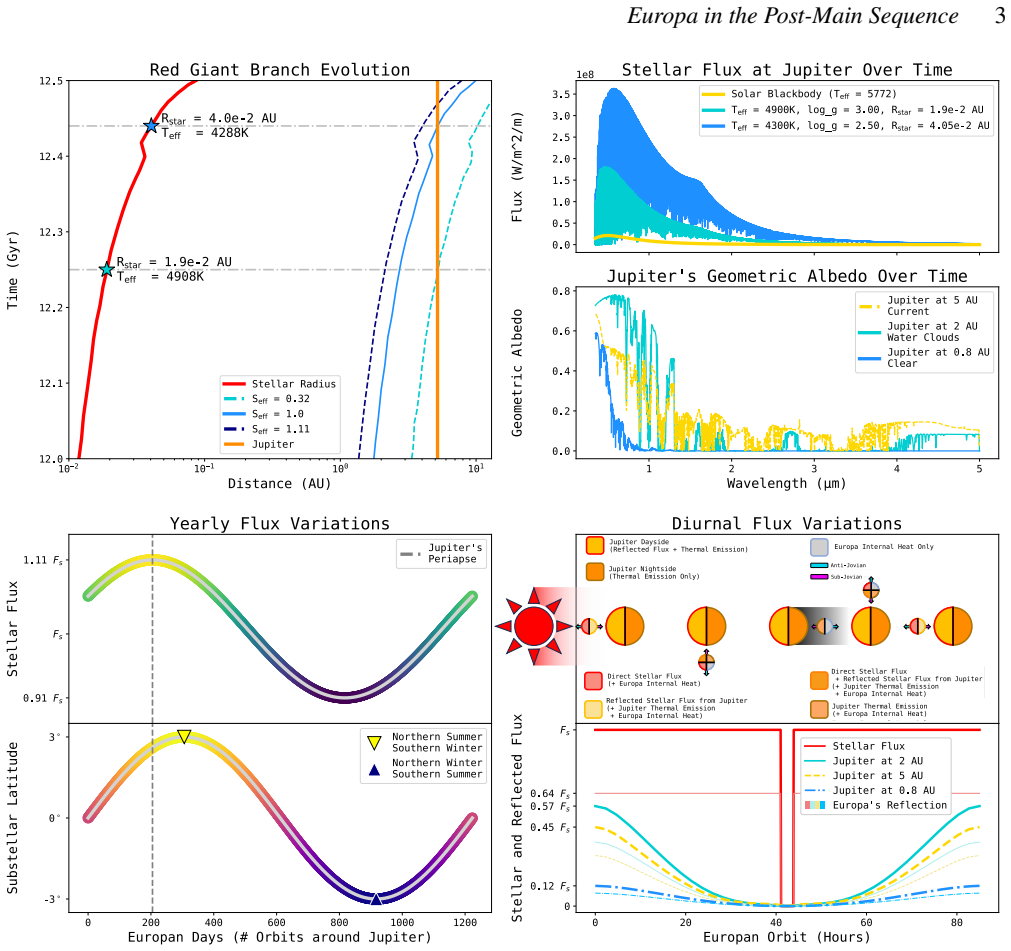
The carrying mechanism is the Clausius–Clapeyron ice–vapor interface: because a water-vapor atmosphere sits above an ice surface made of the same molecule, the surface pressure cannot exceed the saturation vapor pressure given by the Arden–Buck equation, so sublimation self-limits and the atmosphere stays thin. Around it the paper builds a 2D latitude–longitude Newtonian-cooling surface model that steps Europa's orbit every six minutes, combining absorbed stellar flux, Jupiter's phase-dependent reflected light, Jupiter's thermal emission, tidal heating, and a Jupiter eclipse, with ice–vapor phase changes at 170 K. Mass loss is then computed with Jeans escape and hydrodynamic escape formulas evaluated at the saturation-vapor-pressure-bounded surface density; a static 1D photochemical model adds the caveat that photolysis can split water into hydrogen, which is lost almost immediately, and spectral synthesis of the proposed atmospheres uses isochemical averages from that model.
What would settle it
A time-dependent photolysis–escape simulation that couples the paper's 1D photochemistry with Jeans and hydrodynamic escape across the full red giant branch habitable zone, integrated for 0.2 Gyr at $S_{\mathrm{eff}}$ between 0.32 and 1.0, would settle the claim: if the water column is depleted before 200 Myr under the red giant's ultraviolet spectrum, the lower bound fails. On the observational side, stacked transit spectra of a Europan analog around a white dwarf would look for the strong water bands the paper predicts.
Extended reading notes
Core claim
The paper's central claim is that a Europa-like moon orbiting a gas giant in the red giant branch habitable zone can retain surface water and a thin water-vapor atmosphere for at least 0.2 Gyr. A Newtonian-cooling surface model with ice–vapor phase changes shows that when the Jupiter–Europa system enters the habitable zone at about 12.25 Gyr (receiving 439 W/m², labeled $S_{\mathrm{eff}} = 0.32$), the equatorial band and the sub-Jovian mid-latitudes sublimate; at Earth-like instellation about 0.2 Gyr later (1373 W/m², $S_{\mathrm{eff}} = 1.0$), both hemispheres sublimate substantially, with Jupiter's reflected light and eclipse creating strong sub-Jovian versus anti-Jovian asymmetries. The mass-loss analysis then shows that the Clausius–Clapeyron ice–vapor interface bounds the surface pressure at the saturation vapor pressure, making hydrodynamic escape negligible and Jeans escape of the heavy water molecule slow: at the maximum modeled temperatures, complete water loss would take 0.45 to $1.6\times10^{5}$ Gyr. The paper therefore states, as a lower bound, that surface water persists for at least 0.2 Gyr in the red giant branch habitable zone, and it proposes three observing geometries—a secondary eclipse of a liberated exomoon around a white dwarf, a moon transit around a white dwarf, and a reflected-light transit across the host planet—through which such a sublimating exomoon could be detected.
Load-bearing premise
The 0.2 Gyr survival lower bound assumes photolysis does not strip the water reservoir faster than thermal escape; the paper's photochemistry model is static and preliminary, and any hydrogen produced by photolysis is lost near-instantaneously, so a coupled photolysis–escape calculation could erase the claimed stability.
Editorial extensions
If this is right
- If the lower bound holds, icy moons around giant planets become long-lived water reservoirs in the post-main-sequence habitable zone, extending the window for potentially habitable environments beyond the host star's main-sequence lifetime.
- The surface evolution is hemisphere-dependent: Jupiter's reflected light makes the sub-Jovian hemisphere sublimate first, while Jupiter's eclipse cools that same hemisphere and keeps it from reaching its peak temperature.
- At Earth-like instellation the model's peak temperatures exceed 250 K for part of each orbit, where the radiative timescale grows longer than Europa's orbital period; past $S_{\mathrm{eff}} = 1.11$ the paper expects a runaway greenhouse, so the 0.2 Gyr stability belongs to the earlier red giant branch phase.
- Three observing geometries could reveal a sublimating Europan-like exomoon: secondary-eclipse spectroscopy of a liberated moon around a white dwarf, a moon transit around a white dwarf, and a reflected-light transit across the host planet's bright disk.
- Predicted spectra show strong water bands and a weak ozone feature near 10 $\mu$m in clear atmospheres, while water clouds amplify a short-wavelength scattering slope and mute features out to about 1.4 $\mu$m.
Reading between the lines
- A coupled photolysis–escape model—the paper's own stated next step—could shorten the 0.2 Gyr bound if the red giant's ultraviolet environment photolyzes water faster than the static 1D run suggests, since the paper finds any resulting hydrogen is lost near-instantly.
- The same machinery should transfer to other icy moons and to sub-Neptune host planets; for smaller, more reflective planets the reflected-light 'optical mirror' transit method would produce a stronger exomoon signal than for a Jupiter analog.
- Because the surface and escape models sample only two snapshots, interpolating loss rates across the full ~0.37 Gyr in the habitable zone could tell observers when in that window a surviving moon would be easiest to detect.
- If liberated Europan exomoons around white dwarfs exist, emission spectroscopy may be out of reach for current infrared observatories but could become feasible with future high-contrast missions, making the transit geometry the most promising near-term test.
Editorial analysis
A structured set of objections, weighed in public.
Referee Report
Summary. This paper models the surface and atmospheric evolution of a Europa-like moon orbiting Jupiter during the Sun's red giant branch (RGB), focusing on two snapshots in the RGB habitable zone (Seff = 0.32 at 12.25 Gyr and Seff = 1.0 at 12.45 Gyr). A 2D latitude-longitude thermal model with diurnal, seasonal, eclipse, and Jupiter-reflected-light effects finds that the sub-Jovian hemisphere and equatorial bands sublimate, with a hemispheric asymmetry driven by Jupiter's albedo. The authors then compute thermal escape rates (Jeans and hydrodynamic) and, using the saturation vapor pressure of water as an upper bound, conclude that Europa can retain surface water for at least 0.2 Gyr in the RGB habitable zone. The paper also proposes three observational geometries for detecting such a sublimating exomoon and presents synthetic spectra generated with POSEIDON.
Significance. If the survival claim holds, this work identifies a previously underappreciated class of post-main-sequence habitats: icy moons around giant planets can maintain a water-vapor atmosphere and an ice-vapor interface for hundreds of millions of years during the RGB phase, providing a potential pathway for life beyond the main sequence. The 2D surface model is physically motivated and yields a falsifiable prediction of hemispheric asymmetry that future observations could test. The paper is commendably transparent about its assumptions and limitations, and the provision of a Zenodo reproduction repository is a strength. However, the central 0.2 Gyr claim currently rests on thermal escape alone and is not secured against photolysis, which the authors themselves identify as a potential dominant loss channel.
major comments (2)
- [Sec. 3.5-3.6, Sec. 6] The central assertion that surface water persists for at least 0.2 Gyr in the red giant branch habitable zone is a lower bound for thermal escape only. The manuscript's own VULCAN model (Sec. 3.5) shows H2O photolyzing into H2, O2, and O3, and Sec. 3.6 states that H2 is lost near-instantaneously, yet no photolysis timescale or coupled photolysis-escape model is provided for the two red giant snapshots. The VULCAN run is initialized with the Sun's current spectrum at 1 AU rather than the PHOENIX spectra (Teff = 4900 K and 4300 K) used elsewhere, and the Lorenz et al. (1997) statement that red giant UV flux decreases is not quantified. Without a demonstration that the photolysis timescale is longer than 0.2 Gyr, the survival claim—used to motivate the observability scenarios in Sec. 4—is not established.
- [Sec. 4] The synthetic spectra in Figure 5 are initialized with isochemical averages from the VULCAN model, which was run with the solar spectrum rather than the red giant spectra; the resulting O3 and O2 abundances, and hence the predicted 10 μm O3 feature, are not representative of the RGB environment. The paper should either recompute the photochemical output for the two PHOENIX spectra or explicitly label the spectra as purely illustrative and decoupled from the survival claim.
minor comments (9)
- [Sec. 3.3, Eq. (18)] The mean molecular weight of water is given as m = 2.989e26 kg; this should be 2.989e-26 kg (or equivalently 18 amu). As typeset, the equation is dimensionally inconsistent and would prevent reproduction.
- [Sec. 2.3, Eq. (7)] The equation for dT/dt appears garbled; it should presumably read dT/dt = (F_abs,tot - εσT^4)/c_h. Please fix the typesetting.
- [Sec. 4] The formula for the reflected-light signal is incomplete: 'is= 𝐹𝑠(𝜆) 𝐴𝑔(𝜆)( 𝑅𝑝/𝑎𝑝𝑑)2' lacks a clear denominator or parentheses; please correct.
- [Figure 4 caption] The caption refers to the 'Aden-Buck equation' while the text (Sec. 3.1) calls it the 'Arden-Buck equation'; unify the name.
- [Sec. 2.1] Change 'it’s atmospheric composition' to 'its atmospheric composition'.
- [Sec. 6] The typo 'chararactize' should be 'characterize'.
- [Sec. 3.6] The repeated misspelling 'Clausius-Claperyon' should be 'Clausius-Clapeyron'.
- [Figure A1 caption] The sentence 'Yearly and daily surface temperature variations after the simulation has reached steady state are shown in Figure 3' should refer to Figure A2, since Figure 3 is for the Seff = 0.32 case.
- [Sec. 2.2] The typo 'susbtellar' should be 'substellar'.
Circularity Check
No significant circularity: the 0.2 Gyr survival bound is computed from independent escape formalisms, and the self-citations are contextual inputs rather than load-bearing reductions.
full rationale
The paper's central claim is that Europa can retain surface water for at least 0.2 Gyr in the red giant branch habitable zone. The derivation chain is: (1) a 2D Newtonian-cooling surface model produces maximum surface temperatures of 220 K at Seff = 0.32 and 315 K at Seff = 1.0; (2) a Clausius-Clapeyron saturation vapor pressure bound limits the surface pressure; (3) hydrodynamic and Jeans escape rates are computed with standard literature formulas using planetary parameters, not fitted to the target survival time; and (4) the escape timescales at the maximum simulated temperatures are compared with the 0.2 Gyr interval between the two RGB snapshots. The 0.2 Gyr interval itself is taken from Ramirez and Kaltenegger (2016), which overlaps with a coauthor, but that paper is a published post-MS solar system evolution model and does not assume Europa retains water; the survival conclusion is an independent calculation layered on that temporal context. No equation reduces to a fitted value, and no prediction is equivalent to an input by construction. The VULCAN photolysis result is explicitly labeled preliminary and the coupled photolysis-escape model is stated to be beyond scope, so the associated photolysis caveat is a completeness and robustness concern rather than a circular step. The remaining self-citations, including Kaltenegger et al. (2020), Kozakis et al. (2018), and Mullens et al. (2024), support observability and spectral modeling but are not load-bearing for the core survival claim. Overall, the paper is self-contained against external benchmarks for its central result, with only minor contextual self-citation, so the circularity score is low.
Assumptions & free parameters
free parameters (7)
- Thermal depth H =
0.05 m
- Sublimation temperature T_sub =
170 K
- Bond albedo of Europa =
not stated explicitly
- Jupiter albedo model choice =
Cahoy 2 AU and 0.8 AU models
- Water mass fraction of Europa =
5% of bulk mass
- Mean molecular weight of water =
2.989e26 kg as printed; should be about 2.99e-26 kg
- Cloud particle size and mixing ratio in spectra =
log r_m = -1.5 µm; log VMR = -11
assumptions (7)
- domain assumption The Ramirez and Kaltenegger (2016) red giant HZ evolution defines the times (12.25 Gyr, 12.45 Gyr) and instellation values (Seff 0.32, 1.0).
- domain assumption Cahoy et al. (2010) Jupiter albedo spectra at 2 AU and 0.8 AU around a Sun-like star are representative of Jupiter's albedo during the RGB.
- domain assumption The surface pressure of a sublimated water atmosphere is bounded by the saturation vapor pressure through a Clausius-Clapeyron interface.
- domain assumption A 2D Newtonian cooling model with no lateral heat transport or global circulation adequately represents surface temperature and phase.
- domain assumption Europa's surface is entirely water ice; salts and carbon-bearing material do not control surface evolution.
- domain assumption Europa's orbit is circular and the eclipse occurs instantaneously.
- standard math Standard mass-loss formalisms for Jeans and hydrodynamic escape apply to a tenuous water-vapor atmosphere in equilibrium.
Cite this review
Pith. "Pith review of Life after death: Europa in the evolving Habitable Zone of a Red Sun." pith.science (2026). https://pith.science/paper/2QZC2DQK
@misc{pith2026250515495,
  author       = {Pith},
  title        = {Pith review of: Life after death: Europa in the evolving Habitable Zone of a Red Sun},
  year         = {2026},
  howpublished = {\url{https://pith.science/paper/2QZC2DQK}},
  note         = {Machine review of arXiv:2505.15495}
}
read the original abstract
Most stars end their main-sequence (MS) lives by evolving through the red-giant and asymptotic-giant branches before ending as a quiescent, stable white dwarf. Therefore, it is imperative to model the post-MS as it relates to long-term stability of environments potentially suitable for life. Recent work has shown that gas giants can exist in the habitable zone (HZ) during the red giant phase and around a white dwarf remnant. Icy moons represent large reservoirs of water and will evolve through sublimation and melting when exposed to higher instellation, where the relatively lower surface gravity could lead to the rapid loss of all surface water. We model the surface evolution of Europa when initially exposed to habitable zone instellation in the red giant branch. Modeling the diurnal and yearly flux variations on a 2D map we show that, due to Jupiter's increased albedo, the sub-Jovian hemisphere of Europa largely sublimates while only the anti-Jovian equatorial band sublimates. With the increasing instellation of the red giant branch, both hemispheres sublimate substantially. We then model the evolution of a tenuous water-vapor atmosphere and show it is stable against atmospheric loss for at least 0.2 Gyr in the red giant branch habitable zone. We then present three ways to observe a sublimating Europan-like exomoon and potential spectra. Extending the results of this work to different planets and moons could open up a new pathway by which life could persist beyond the death of a star.
Figures


Figures from the paper (2 more)


Reference graph
Works this paper leans on
-
[1]
Aguichine A., Mousis O., Deleuil M., Marcq E., 2021, @doi [ ] 10.3847/1538-4357/abfa99 , https://ui.adsabs.harvard.edu/abs/2021ApJ...914...84A 914, 84
-
[2]
Ashkenazy Y., 2016, @doi [arXiv e-prints] 10.48550/arXiv.1608.07372 , https://ui.adsabs.harvard.edu/abs/2016arXiv160807372A p. arXiv:1608.07372
-
[3]
Bagenal F., Dols V., 2020, @doi [Journal of Geophysical Research (Space Physics)] 10.1029/2019JA027485 , https://ui.adsabs.harvard.edu/abs/2020JGRA..12527485B 125, e27485
-
[4]
Batalha N. E., et al., 2017, @doi [ ] 10.1088/1538-3873/aa65b0 , https://ui.adsabs.harvard.edu/abs/2017PASP..129f4501B 129, 064501
-
[5]
Buck A. L., 1981, @doi [Journal of Applied Meteorology] 10.1175/1520-0450(1981)020<1527:NEFCVP>2.0.CO;2 , https://ui.adsabs.harvard.edu/abs/1981JApMe..20.1527B 20, 1527
-
[6]
Cahoy K. L., Marley M. S., Fortney J. J., 2010, @doi [ ] 10.1088/0004-637X/724/1/189 , https://ui.adsabs.harvard.edu/abs/2010ApJ...724..189C 724, 189
-
[7]
JWST Reveals Spectral Tracers of Recent Surface Modification on Europa
Cartwright R. J., et al., 2025, @doi [arXiv e-prints] 10.48550/arXiv.2504.05283 , https://ui.adsabs.harvard.edu/abs/2025arXiv250405283C p. arXiv:2504.05283
work page Pith review arXiv doi:10.48550/arxiv.2504.05283 2025
-
[8]
Chanover N., Bauer J., Gordon M., Huber L., Mace M., Neakrase L., Tiscareno M., Walker R., 2022, in AAS/Division for Planetary Sciences Meeting Abstracts. p. 415.01
work page 2022
Show all 70 references
-
[9]
B., 2025, @doi [Nature Astronomy] 10.1038/s41550-024-02414-5 , https://ui.adsabs.harvard.edu/abs/2025NatAs...9..189C 9, 189
Constantinou T., Shorttle O., Rimmer P. B., 2025, @doi [Nature Astronomy] 10.1038/s41550-024-02414-5 , https://ui.adsabs.harvard.edu/abs/2025NatAs...9..189C 9, 189
2025 doi
-
[10]
B., Agol E., 2011, @doi [ ] 10.1088/0004-637X/726/2/82 , https://ui.adsabs.harvard.edu/abs/2011ApJ...726...82C 726, 82
Cowan N. B., Agol E., 2011, @doi [ ] 10.1088/0004-637X/726/2/82 , https://ui.adsabs.harvard.edu/abs/2011ApJ...726...82C 726, 82
2011 doi
-
[11]
E., Desch S
Doyle A. E., Desch S. J., Young E. D., 2021, @doi [ ] 10.3847/2041-8213/abd9ba , https://ui.adsabs.harvard.edu/abs/2021ApJ...907L..35D 907, L35
2021 doi
-
[12]
T., Koester D., 2013, @doi [Science] 10.1126/science.1239447 , https://ui.adsabs.harvard.edu/abs/2013Sci...342..218F 342, 218
Farihi J., G \"a nsicke B. T., Koester D., 2013, @doi [Science] 10.1126/science.1239447 , https://ui.adsabs.harvard.edu/abs/2013Sci...342..218F 342, 218
2013 doi
-
[13]
Feistel R., Wagner W., 2007, @doi [ ] 10.1016/j.gca.2006.08.034 , https://ui.adsabs.harvard.edu/abs/2007GeCoA..71...36F 71, 36
2007 doi
- [14]
-
[15]
Grant D., et al., 2023, @doi [ ] 10.3847/2041-8213/acfc3b , https://ui.adsabs.harvard.edu/abs/2023ApJ...956L..29G 956, L29
2023 doi
-
[16]
K., et al., 2017, @doi [ ] 10.3847/1538-3881/aa932d , https://ui.adsabs.harvard.edu/abs/2017AJ....154..254G 154, 254
Grunblatt S. K., et al., 2017, @doi [ ] 10.3847/1538-3881/aa932d , https://ui.adsabs.harvard.edu/abs/2017AJ....154..254G 154, 254
2017 doi
-
[17]
M., Querry M
Hale G. M., Querry M. R., 1973, @doi [ ] 10.1364/AO.12.000555 , https://ui.adsabs.harvard.edu/abs/1973ApOpt..12..555H 12, 555
1973 doi
-
[18]
K., et al., 2023, @doi [ ] 10.3847/1538-3881/ad011c , https://ui.adsabs.harvard.edu/abs/2023AJ....166..208H 166, 208
Harada C. K., et al., 2023, @doi [ ] 10.3847/1538-3881/ad011c , https://ui.adsabs.harvard.edu/abs/2023AJ....166..208H 166, 208
2023 doi
-
[19]
Heller R., Barnes R., 2013, @doi [Astrobiology] 10.1089/ast.2012.0859 , https://ui.adsabs.harvard.edu/abs/2013AsBio..13...18H 13, 18
2013
-
[20]
Hobley D. E. J., Moore J. M., Howard A. D., Umurhan O. M., 2018, @doi [Nature Geoscience] 10.1038/s41561-018-0235-0 , https://ui.adsabs.harvard.edu/abs/2018NatGe..11..901H 11, 901
2018 doi
-
[21]
Howard S., M \"u ller S., Helled R., 2024, @doi [ ] 10.1051/0004-6361/202450629 , https://ui.adsabs.harvard.edu/abs/2024A&A...689A..15H 689, A15
2024 doi
-
[22]
pp EPSC2020--173, @doi 10.5194/epsc2020-173
Howell S., 2020, in European Planetary Science Congress. pp EPSC2020--173, @doi 10.5194/epsc2020-173
2020 doi
-
[23]
O., Wende-von Berg S., Dreizler S., Homeier D., Reiners A., Barman T., Hauschildt P
Husser T. O., Wende-von Berg S., Dreizler S., Homeier D., Reiners A., Barman T., Hauschildt P. H., 2013, @doi [ ] 10.1051/0004-6361/201219058 , https://ui.adsabs.harvard.edu/abs/2013A&A...553A...6H 553, A6
2013 doi
-
[24]
I., 2013a, Stellar Evolution Physics, Volume 1: Physical Processes in Stellar Interiors
Iben Jr. I., 2013a, Stellar Evolution Physics, Volume 1: Physical Processes in Stellar Interiors
-
[25]
I., 2013b, Stellar Evolution Physics, Volume 2: Advanced Evolution of Single Stars
Iben Jr. I., 2013b, Stellar Evolution Physics, Volume 2: Advanced Evolution of Single Stars
-
[26]
Jet Propulsion Laboratory N., 2021, Europa Orbital Data
2021
-
[27]
Juanola-Parramon R., et al., 2022, @doi [Journal of Astronomical Telescopes, Instruments, and Systems] 10.1117/1.JATIS.8.3.034001 , https://ui.adsabs.harvard.edu/abs/2022JATIS...8c4001J 8, 034001
2022 doi
- [28]
-
[29]
J., Kozakis T., Lewis N
Kaltenegger L., MacDonald R. J., Kozakis T., Lewis N. K., Mamajek E. E., McDowell J. C., Vanderburg A., 2020, @doi [ ] 10.3847/2041-8213/aba9d3 , https://ui.adsabs.harvard.edu/abs/2020ApJ...901L...1K 901, L1
2020 doi
-
[30]
J., et al., 2020, in Lystrup M., Perrin M
Kasdin N. J., et al., 2020, in Lystrup M., Perrin M. D., eds, Society of Photo-Optical Instrumentation Engineers (SPIE) Conference Series Vol. 11443, Space Telescopes and Instrumentation 2020: Optical, Infrared, and Millimeter Wave. p. 114431U ( @eprint arXiv 2103.01980 ), @do...
2020 arXiv
-
[31]
F., Pollack J
Kasting J. F., Pollack J. B., 1983, @doi [ ] 10.1016/0019-1035(83)90212-9 , https://ui.adsabs.harvard.edu/abs/1983Icar...53..479K 53, 479
1983 doi
-
[32]
Kempton E. M. R., et al., 2023, @doi [ ] 10.1038/s41586-023-06159-5 , https://ui.adsabs.harvard.edu/abs/2023Natur.620...67K 620, 67
2023 doi
-
[33]
N., Ligier N., 2022, @doi [Planetary Science Journal] 10.3847/PSJ/ac596d , https://ui.adsabs.harvard.edu/abs/2022PSJ.....3...72K 3, 72
King O., Fletcher L. N., Ligier N., 2022, @doi [Planetary Science Journal] 10.3847/PSJ/ac596d , https://ui.adsabs.harvard.edu/abs/2022PSJ.....3...72K 3, 72
2022 doi
-
[34]
Koester D., Chanmugam G., 1990, @doi [Reports on Progress in Physics] 10.1088/0034-4885/53/7/001 , https://ui.adsabs.harvard.edu/abs/1990RPPh...53..837K 53, 837
1990 doi
-
[35]
F., et al., 2017, USGS Spectral Library Version 7 , U.S
Kokaly R. F., et al., 2017, USGS Spectral Library Version 7 , U.S. Geological Survey, Crustal Geophysics and Geochemistry Science Center, USGS Data Series, Report: iv, 61 p.; Dataset; Data Release, @doi 10.3133/ds1035
2017 doi
-
[36]
W., 2018, @doi [ ] 10.3847/1538-4357/aacbc7 , https://ui.adsabs.harvard.edu/abs/2018ApJ...862...69K 862, 69
Kozakis T., Kaltenegger L., Hoard D. W., 2018, @doi [ ] 10.3847/1538-4357/aacbc7 , https://ui.adsabs.harvard.edu/abs/2018ApJ...862...69K 862, 69
2018 doi
-
[37]
R., Catling D
Lehmer O. R., Catling D. C., Zahnle K. J., 2017, @doi [ ] 10.3847/1538-4357/aa67ea , https://ui.adsabs.harvard.edu/abs/2017ApJ...839...32L 839, 32
2017 doi
-
[38]
D., Lunine J
Lorenz R. D., Lunine J. I., McKay C. P., 1997, @doi [ ] 10.1029/97GL52843 , https://ui.adsabs.harvard.edu/abs/1997GeoRL..24.2905L 24, 2905
1997 doi
-
[39]
J., 2023, @doi [The Journal of Open Source Software] 10.21105/joss.04873 , https://ui.adsabs.harvard.edu/abs/2023JOSS....8.4873M 8, 4873
MacDonald R. J., 2023, @doi [The Journal of Open Source Software] 10.21105/joss.04873 , https://ui.adsabs.harvard.edu/abs/2023JOSS....8.4873M 8, 4873
2023 doi
-
[40]
J., Madhusudhan N., 2017, @doi [ ] 10.1093/mnras/stx804 , https://ui.adsabs.harvard.edu/abs/2017MNRAS.469.1979M 469, 1979
MacDonald R. J., Madhusudhan N., 2017, @doi [ ] 10.1093/mnras/stx804 , https://ui.adsabs.harvard.edu/abs/2017MNRAS.469.1979M 469, 1979
2017 doi
-
[41]
Mortimer J., L \'e cuyer C., Fourel F., Carpenter J., 2018, @doi [ ] 10.1016/j.pss.2018.05.010 , https://ui.adsabs.harvard.edu/abs/2018P&SS..158...25M 158, 25
2018 doi
-
[42]
J., Petrovich C., 2020, @doi [ ] 10.3847/2041-8213/abc564 , https://ui.adsabs.harvard.edu/abs/2020ApJ...904L...3M 904, L3
Mu \ n oz D. J., Petrovich C., 2020, @doi [ ] 10.3847/2041-8213/abc564 , https://ui.adsabs.harvard.edu/abs/2020ApJ...904L...3M 904, L3
2020 doi
- [43]
-
[44]
D., Dermott S
Murray C. D., Dermott S. F., 1999, Solar System Dynamics . Cambridge University Press , @doi 10.1017/CBO9781139174817
1999 doi
-
[45]
E., Liu B., Lai D., 2021, @doi [ ] 10.1093/mnras/staa3723 , https://ui.adsabs.harvard.edu/abs/2021MNRAS.501..507O 501, 507
O'Connor C. E., Liu B., Lai D., 2021, @doi [ ] 10.1093/mnras/staa3723 , https://ui.adsabs.harvard.edu/abs/2021MNRAS.501..507O 501, 507
2021 doi
-
[46]
S., et al., 2023, @doi [Nature Astronomy] 10.1038/s41550-022-01839-0 , https://ui.adsabs.harvard.edu/abs/2023NatAs...7..190O 7, 190
Orton G. S., et al., 2023, @doi [Nature Astronomy] 10.1038/s41550-022-01839-0 , https://ui.adsabs.harvard.edu/abs/2023NatAs...7..190O 7, 190
2023 doi
-
[47]
J., Veras D., Holman M
Payne M. J., Veras D., Holman M. J., G \"a nsicke B. T., 2016, @doi [ ] 10.1093/mnras/stv2966 , https://ui.adsabs.harvard.edu/abs/2016MNRAS.457..217P 457, 217
2016 doi
-
[48]
M., Kaltenegger L., 2016, @doi [ ] 10.3847/0004-637X/823/1/6 , https://ui.adsabs.harvard.edu/abs/2016ApJ...823....6R 823, 6
Ramirez R. M., Kaltenegger L., 2016, @doi [ ] 10.3847/0004-637X/823/1/6 , https://ui.adsabs.harvard.edu/abs/2016ApJ...823....6R 823, 6
2016 doi
-
[49]
A., Rodriguez N
Rathbun J. A., Rodriguez N. J., Spencer J. R., 2010, @doi [ ] 10.1016/j.icarus.2010.07.017 , https://ui.adsabs.harvard.edu/abs/2010Icar..210..763R 210, 763
2010 doi
-
[50]
R., Denis C., 2001, @doi [ ] 10.1006/icar.2001.6591 , https://ui.adsabs.harvard.edu/abs/2001Icar..151..130R 151, 130
Rybicki K. R., Denis C., 2001, @doi [ ] 10.1006/icar.2001.6591 , https://ui.adsabs.harvard.edu/abs/2001Icar..151..130R 151, 130
2001
-
[51]
University of Arizona Press, pp 185--215
Schmidt B., 2020b, Planetary Astrobiology. University of Arizona Press, pp 185--215
-
[52]
E., 2020a, in Meadows V
Schmidt B. E., 2020a, in Meadows V. S., Arney G. N., Schmidt B. E., Des Marais D. J., eds, , Planetary Astrobiology. p. 185, @doi 10.2458/azu_uapress_9780816540068
-
[53]
Princeton University Press
Seager S., 2010, Exoplanet Atmospheres. Princeton University Press
2010
-
[54]
L., Wolf E
Shields A. L., Wolf E. T., Agol E., Tremblay P.-E., 2024, arXiv e-prints, https://ui.adsabs.harvard.edu/abs/2024arXiv241202694S p. arXiv:2412.02694
2024 arXiv
-
[55]
R., Tamppari L
Spencer J. R., Tamppari L. K., Martin T. Z., Travis L. D., 1999, @doi [Science] 10.1126/science.284.5419.1514 , https://ui.adsabs.harvard.edu/abs/1999Sci...284.1514S 284, 1514
1999
-
[56]
R., et al., 2024, @doi [Nature Astronomy] 10.1038/s41550-024-02206-x , https://ui.adsabs.harvard.edu/abs/2024NatAs...8..567S 8, 567
Szalay J. R., et al., 2024, @doi [Nature Astronomy] 10.1038/s41550-024-02206-x , https://ui.adsabs.harvard.edu/abs/2024NatAs...8..567S 8, 567
2024 doi
-
[57]
D., 2019, @doi [ ] 10.3847/1538-4357/ab4a76 , https://ui.adsabs.harvard.edu/abs/2019ApJ...886...26T 886, 26
Tan X., Komacek T. D., 2019, @doi [ ] 10.3847/1538-4357/ab4a76 , https://ui.adsabs.harvard.edu/abs/2019ApJ...886...26T 886, 26
2019 doi
-
[58]
R., Grosheintz L., Rimmer P
Tsai S.-M., Lyons J. R., Grosheintz L., Rimmer P. B., Kitzmann D., Heng K., 2017, @doi [ ] 10.3847/1538-4365/228/2/20 , https://ui.adsabs.harvard.edu/abs/2017ApJS..228...20T 228, 20
2017 doi
-
[59]
R., Fateev A., Lee E., Heng K., 2021, @doi [ ] 10.3847/1538-4357/ac29bc , https://ui.adsabs.harvard.edu/abs/2021ApJ...923..264T 923, 264
Tsai S.-M., Malik M., Kitzmann D., Lyons J. R., Fateev A., Lee E., Heng K., 2021, @doi [ ] 10.3847/1538-4357/ac29bc , https://ui.adsabs.harvard.edu/abs/2021ApJ...923..264T 923, 264
2021 doi
-
[60]
Vanderburg A., et al., 2020, @doi [ ] 10.1038/s41586-020-2713-y , https://ui.adsabs.harvard.edu/abs/2020Natur.585..363V 585, 363
2020 doi
-
[61]
Veras D., 2016, @doi [Royal Society Open Science] 10.1098/rsos.150571 , https://ui.adsabs.harvard.edu/abs/2016RSOS....350571V 3, 150571
2016 doi
-
[62]
A., 2021, @doi [ ] 10.1093/mnras/stab1772 , https://ui.adsabs.harvard.edu/abs/2021MNRAS.506.1697V 506, 1697
Veras D., Vidotto A. A., 2021, @doi [ ] 10.1093/mnras/stab1772 , https://ui.adsabs.harvard.edu/abs/2021MNRAS.506.1697V 506, 1697
2021 doi
-
[63]
J., Siess L., 2014, @doi [ ] 10.1088/0004-637X/794/1/3 , https://ui.adsabs.harvard.edu/abs/2014ApJ...794....3V 794, 3
Villaver E., Livio M., Mustill A. J., Siess L., 2014, @doi [ ] 10.1088/0004-637X/794/1/3 , https://ui.adsabs.harvard.edu/abs/2014ApJ...794....3V 794, 3
2014 doi
-
[64]
G., 1984, @doi [ ] 10.1364/AO.23.001206 , https://ui.adsabs.harvard.edu/abs/1984ApOpt..23.1206W 23, 1206
Warren S. G., 1984, @doi [ ] 10.1364/AO.23.001206 , https://ui.adsabs.harvard.edu/abs/1984ApOpt..23.1206W 23, 1206
1984 doi
-
[65]
A., 1992, @doi [ ] 10.1038/355145a0 , https://ui.adsabs.harvard.edu/abs/1992Natur.355..145W 355, 145
Wolszczan A., Frail D. A., 1992, @doi [ ] 10.1038/355145a0 , https://ui.adsabs.harvard.edu/abs/1992Natur.355..145W 355, 145
1992 doi
-
[66]
Yue Y., Liu J., Wang X., 2023, @doi [Journal of Geophysical Research (Planets)] 10.1029/2022JE007329 , https://ui.adsabs.harvard.edu/abs/2023JGRE..12807329Y 128, e2022JE007329
2023 doi
-
[67]
J., Catling D
Zahnle K. J., Catling D. C., 2017, @doi [ ] 10.3847/1538-4357/aa7846 , https://ui.adsabs.harvard.edu/abs/2017ApJ...843..122Z 843, 122
2017 doi
- [68]
-
[69]
R., Armstrong J
Zollinger R. R., Armstrong J. C., Heller R., 2017, @doi [ ] 10.1093/mnras/stx1861 , https://ui.adsabs.harvard.edu/abs/2017MNRAS.472....8Z 472, 8
2017 doi
-
[70]
van Maanen A., 1917, @doi [ ] 10.1086/122654 , https://ui.adsabs.harvard.edu/abs/1917PASP...29..258V 29, 258
1917 doi
Reviewed August 7, 2026 · model on record in the stance chip above.
Discussion (0). Continue with ORCID to comment.