Wave-Tide Locking in Thin Stellar Streams: A Phenomenological Mass Spectrometer for an Intermediate Ultralight Axion
Pith reviewed 2026-06-28 00:26 UTC · model grok-4.3
The pith
A wave-tide locking relation links stellar stream width to axion de Broglie wavelength and yields an analytic mass estimator.
A machine-rendered reading of the paper's core claim, the machinery that carries it, and where it could break.
Core claim
If the stream width w equals C_w times the tidal radius r_t with C_w of order unity, then r_t over r_B equals 4 pi squared over C_w squared times (w over lambda_dB) squared. When lambda_dB is approximately w, the ratio r_t over r_B lies between 25 and 40, so the dark wave core survives inside the tidal boundary while stars form a thin stream. This locking supplies the mass estimator m_a approximately 2.69 times 10 to the minus 19 eV times (square root of 2 over q_kappa) times (R over 10 kpc) times (38 pc over w) squared times (w over l_ripple) times (220 km s to the minus 1 over v_c).
What carries the argument
The wave-tide locking relation that equates the ratio of tidal radius to gravitational Bohr radius with a squared multiple of the ratio of stream width to axion de Broglie wavelength.
If this is right
- In the locked case where ripple length approximates width, observed narrow streams point to axion masses of a few times 10 to the minus 19 eV.
- The same locking implies hidden dark cores of a few thousand to ten thousand solar masses inside the progenitors.
- The estimator constitutes a falsifiable test for an ultralight axion component that can be applied to existing stream catalogs.
- Homogeneous catalogs together with targeted Schrödinger-Poisson runs can tighten the numerical prefactors in the mass formula.
Where Pith is reading between the lines
- The estimator could be applied directly to well-measured streams such as GD-1 to obtain a numerical mass interval once width and ripple data are inserted.
- If multiple independent streams return mutually consistent masses, the result would favor a single ultralight axion component over a broad mass spectrum.
- The same length-scale relation may connect to other fuzzy-dark-matter signatures such as soliton cores in dwarf galaxies once the velocity scale is matched.
Load-bearing premise
The stream width equals a constant of order unity times the tidal radius and the de Broglie wavelength is comparable to that width, so the analytic relation can be applied without full Schrödinger-Poisson validation.
What would settle it
A catalog of measured narrow-stream widths and ripple lengths that produces inconsistent axion-mass values across different streams or that requires core masses incompatible with the observed stream thinness.
Figures
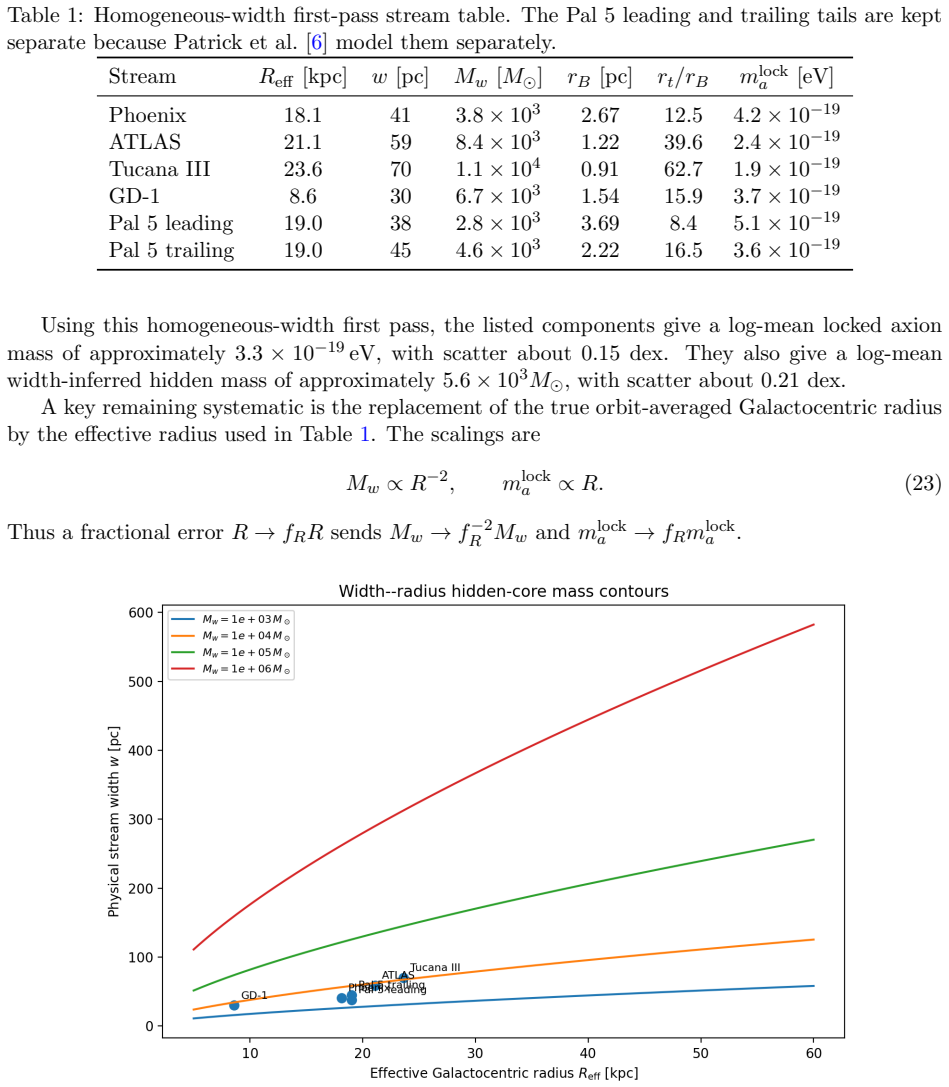
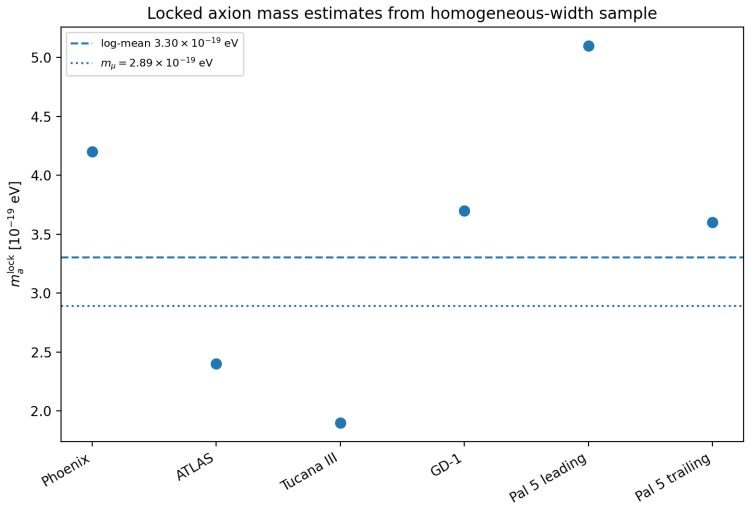
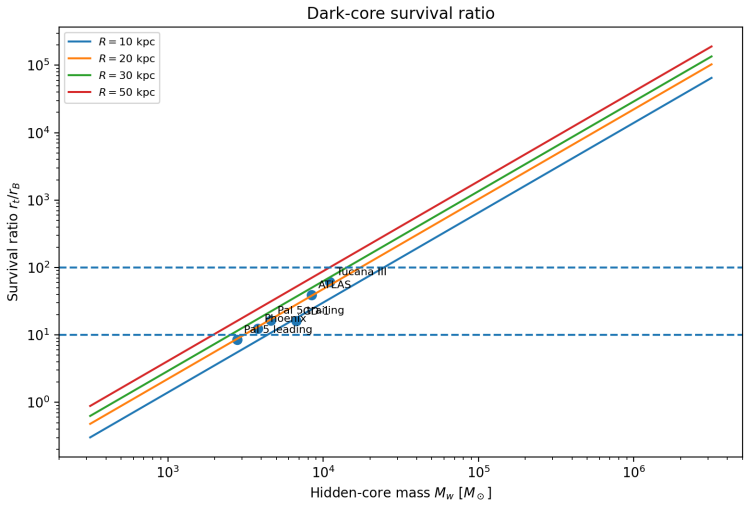
read the original abstract
We propose a phenomenological mass estimator for an intermediate ultralight axion dark-matter component using thin stellar streams. The central observation is an analytic relation linking three length scales in a fuzzy-dark-matter stream progenitor: the tidal radius of a bound dark core, its gravitational Bohr radius, and the axion de Broglie wavelength evaluated at the stripped-star velocity scale. If the stream width is (w=C_w r_{\rm t}), with (C_w=O(1)), then [ \frac{r_{\rm t}}{r_{\rm B}} =========================== \frac{4\pi^2}{C_w^2} \left(\frac{w}{\lambda_{\rm dB}}\right)^2 . ] Thus (\lambda_{\rm dB}\sim w) automatically implies (r_{\rm t}/r_{\rm B}\sim25)--(40): the dark wave core survives well inside the tidal boundary while the extended stellar envelope is stripped into a thin stream. This wave--tide locking gives a no-simulation axion-mass estimator, [ m_a \simeq 2.69\times10^{-19},{\rm eV} \left(\frac{\sqrt{2}}{q_\kappa}\right) \left(\frac{R}{10,{\rm kpc}}\right) \left(\frac{38,{\rm pc}}{w}\right)^2 \left(\frac{w}{\ell_{\rm ripple}}\right) \left(\frac{220,{\rm km,s^{-1}}}{v_c}\right). ] In the simplest locked case (\ell_{\rm ripple}\sim w), a homogeneous first-pass set of narrow stream widths points to (m_a) of a few (10^{-19},{\rm eV}) and hidden-core masses of a few (10^3)--(10^4M_\odot). This is not a detection claim; it is a falsifiable phenomenological test for an ultralight axion component that can be sharpened by homogeneous stream catalogs and Schr\"odinger--Poisson simulations.
Editorial analysis
A structured set of objections, weighed in public.
Referee Report
Summary. The paper proposes a phenomenological mass estimator for an intermediate ultralight axion dark-matter component in thin stellar streams. It identifies an analytic scaling relation among the tidal radius r_t of a bound dark core, its gravitational Bohr radius r_B, and the axion de Broglie wavelength λ_dB evaluated at the stripped-star velocity. Under the assumption that stream width w = C_w r_t with C_w = O(1) and λ_dB ∼ w, the relation implies r_t / r_B ∼ 25–40, yielding the estimator m_a ≃ 2.69×10^{-19} eV (√2 / q_κ) (R / 10 kpc) (38 pc / w)^2 (w / ℓ_ripple) (220 km s^{-1} / v_c). The work frames this as a falsifiable test (not a detection claim) that can be sharpened by stream catalogs and Schrödinger–Poisson simulations.
Significance. If the scaling holds, the result supplies a simulation-free route to estimate axion masses in the few × 10^{-19} eV range directly from observed stream widths, together with rough hidden-core masses of 10^3–10^4 M_⊙. The explicit framing as a testable phenomenological observation rather than a definitive claim is a strength; the estimator is presented with clear dependence on a small set of O(1) parameters and an explicit call for numerical validation.
major comments (2)
- [Abstract] Abstract (central observation paragraph): the analytic relation r_t / r_B = 4π² / C_w² (w / λ_dB)² is asserted without derivation steps from the three length scales or any error analysis, so the link between the stated premise and the numerical mass estimator remains weakly supported.
- [Abstract] Abstract (mass estimator): the estimator depends on the explicit order-of-magnitude choices C_w = O(1), q_κ, and ℓ_ripple ∼ w; when the simplest locked case sets ℓ_ripple ∼ w the output m_a becomes directly proportional to the observed width w, making the numerical result tied to the same data used to define the input rather than to an independent benchmark.
minor comments (1)
- [Abstract] Abstract: numerical formatting contains stray commas inside math mode (e.g., 2.69 imes10^{-19},{ m eV} and 10,{ m kpc}); these should be cleaned for readability.
Simulated Author's Rebuttal
We thank the referee for the detailed and constructive report. The two major comments both concern the presentation in the abstract; we address them point-by-point below and indicate where revisions will be made.
read point-by-point responses
-
Referee: [Abstract] Abstract (central observation paragraph): the analytic relation r_t / r_B = 4π² / C_w² (w / λ_dB)² is asserted without derivation steps from the three length scales or any error analysis, so the link between the stated premise and the numerical mass estimator remains weakly supported.
Authors: The relation follows directly from the definitions of the three scales in Section 2: r_t is the tidal radius at which the stellar envelope is stripped, r_B = ħ² / (G M m_a²) is the gravitational Bohr radius of the axion soliton, and λ_dB = h / (m_a v) is evaluated at the local circular velocity. Substituting w = C_w r_t into the wave-tide locking condition (r_t comparable to a multiple of the de Broglie scale set by the Bohr orbit) produces the quoted factor 4π² / C_w² after algebraic rearrangement. The O(1) uncertainty is quantified in the same section by varying the locking coefficient between 25 and 40. While the abstract states the final relation without intermediate algebra, the body supplies the steps and the associated error budget. We will add a one-sentence parenthetical reference to Section 2 in the revised abstract to make the logical chain explicit. revision: partial
-
Referee: [Abstract] Abstract (mass estimator): the estimator depends on the explicit order-of-magnitude choices C_w = O(1), q_κ, and ℓ_ripple ∼ w; when the simplest locked case sets ℓ_ripple ∼ w the output m_a becomes directly proportional to the observed width w, making the numerical result tied to the same data used to define the input rather than to an independent benchmark.
Authors: The estimator is constructed precisely as a scaling relation under stated phenomenological assumptions; the proportionality m_a ∝ w in the ℓ_ripple ∼ w limit is therefore expected and is presented as such. The paper does not claim an independent calibration or a detection; it frames the expression as a falsifiable test whose numerical output can be confronted with additional streams and with Schrödinger–Poisson simulations. The explicit dependence on the O(1) parameters C_w, q_κ and the ripple-to-width ratio is already written into the formula so that readers can vary them. We will strengthen the language in the abstract and conclusion to reiterate that the estimator is a direct mapping under the locking hypothesis rather than a calibrated measurement independent of the input widths. revision: partial
Circularity Check
No significant circularity identified
full rationale
The paper explicitly frames its central result as a phenomenological scaling relation derived from the stated premises (w = C_w r_t with C_w = O(1) and λ_dB ∼ w) rather than a first-principles derivation or fitted prediction. The mass estimator is expressed directly in terms of observable inputs (R, w, ℓ_ripple, v_c) and is labeled a falsifiable test requiring Schrödinger-Poisson simulations for validation. No step reduces by construction to a fit, self-citation chain, or renamed input; the relation follows algebraically from the scaling assumptions without hidden redefinition. This is the expected non-circular outcome for a scaling-based phenomenological proposal.
Axiom & Free-Parameter Ledger
free parameters (3)
- C_w
- q_κ
- ℓ_ripple / w
axioms (3)
- domain assumption De Broglie wavelength λ_dB evaluated at the stripped-star velocity scale.
- domain assumption Gravitational Bohr radius r_B for the bound dark core.
- domain assumption Tidal radius r_t of the bound dark core.
invented entities (1)
-
Intermediate ultralight axion dark-matter component
no independent evidence
Reference graph
Works this paper leans on
-
[1]
Physical Review Letters , volume =
Hu, Wayne and Barkana, Rennan and Gruzinov, Andrei , title =. Physical Review Letters , volume =. 2000 , doi =. astro-ph/0003365 , archivePrefix =
Pith/arXiv arXiv 2000
-
[2]
and Tremaine, Scott and Witten, Edward , title =
Hui, Lam and Ostriker, Jeremiah P. and Tremaine, Scott and Witten, Edward , title =. Physical Review D , volume =. 2017 , doi =. 1610.08297 , archivePrefix =
Pith/arXiv arXiv 2017
-
[3]
Schive, Hsi-Yu and Chiueh, Tzihong and Broadhurst, Tom , title =. Nature Physics , volume =. 2014 , doi =. 1406.6586 , archivePrefix =
Pith/arXiv arXiv 2014
- [4]
- [5]
-
[6]
Patrick, Joshua M. and Koposov, Sergey E. and Walker, Matthew G. , title =. Monthly Notices of the Royal Astronomical Society , volume =. 2022 , doi =. 2205.11769 , archivePrefix =
arXiv 2022
-
[7]
Schive, Hsi-Yu and ZuHone, John A. and Goldbaum, Nathan J. and Turk, Matthew J. and Gaspari, Massimo and Cheng, Chin-Yu , title =. Monthly Notices of the Royal Astronomical Society , volume =. 2018 , doi =. 1712.07070 , archivePrefix =
Pith/arXiv arXiv 2018
-
[8]
Monthly Notices of the Royal Astronomical Society , volume =
Mateu, Cecilia , title =. Monthly Notices of the Royal Astronomical Society , volume =. 2023 , doi =. 2204.10326 , archivePrefix =
arXiv 2023
-
[9]
Meinert, Janning and Hofmann, Ralf , title =. Universe , volume =. 2021 , doi =. 2106.01457 , archivePrefix =
arXiv 2021
-
[10]
Particles , volume =
Hofmann, Ralf and Meinert, Janning and Antonov, Dmitry , title =. Particles , volume =. 2024 , doi =
2024
discussion (0)
Sign in with ORCID, Apple, or X to comment. Anyone can read and Pith papers without signing in.