Motion planning for hundreds of floating robots
Pith reviewed 2026-06-27 16:43 UTC · model grok-4.3
The pith
A pipeline that decomposes a collision graph into interaction clusters enables collision-free motion planning for hundreds of floating robots.
A machine-rendered reading of the paper's core claim, the machinery that carries it, and where it could break.
Core claim
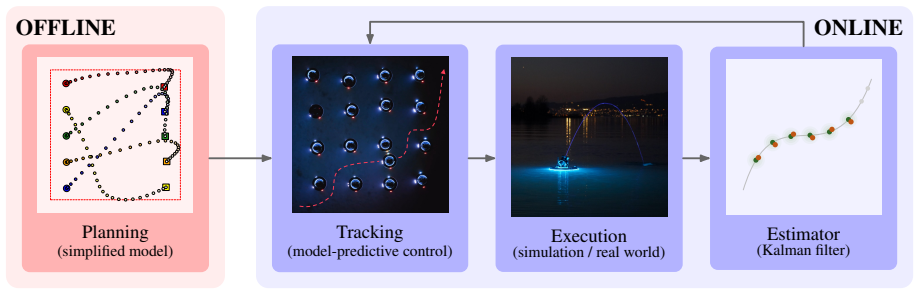
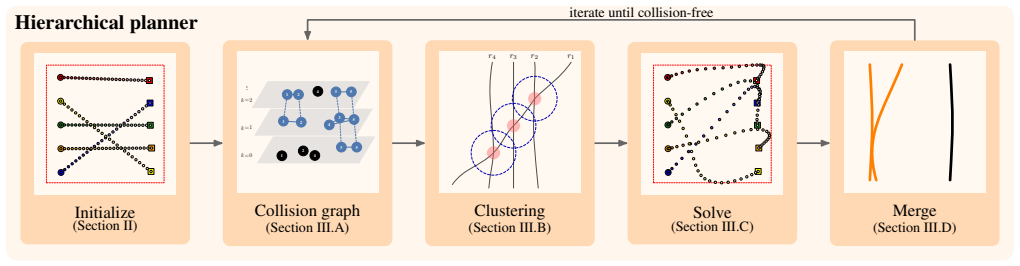
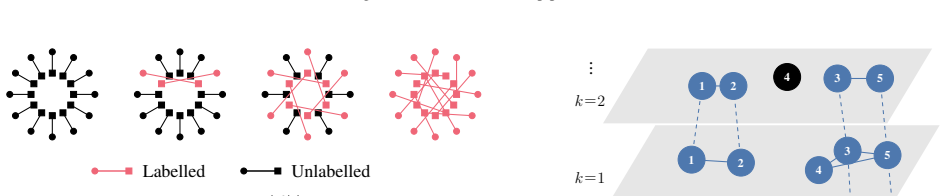
The authors claim that the coupled multi-robot planning problem can be solved scalably by constructing a collision graph from an initialization, decomposing the graph into interaction clusters, and optimizing the clusters independently and in parallel, while adding robustness checks that repair common failures such as infeasible subproblems or timing violations across the sparse keyframes.
What carries the argument
Interaction-cluster decomposition of the collision graph, which isolates locally coupled subgroups so they can be solved separately without a single global optimization.
If this is right
- Planning time stays low enough for interactive use even when transitions span minutes.
- Fleets of 500 robots become feasible in simulation without solving the full coupled problem.
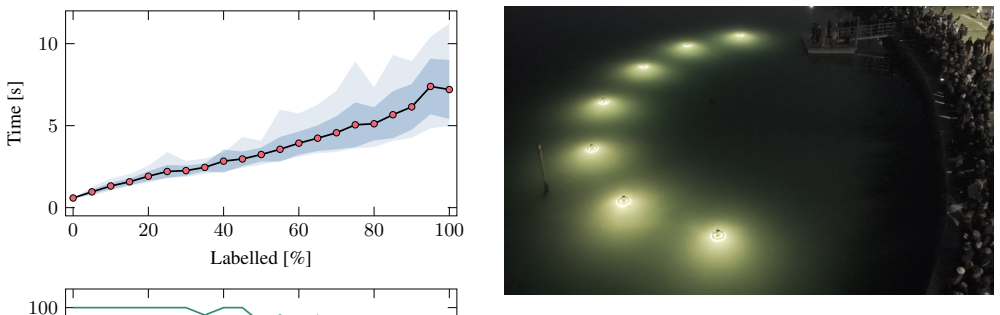
- Physical deployment on water succeeds for at least 24 robots using the same decomposed trajectories.
- Parallel cluster solves reduce computation while the robustness mechanisms handle most decomposition errors.
Where Pith is reading between the lines
- The method implicitly assumes that most interactions remain local after the initial graph is built, so distant robots rarely need joint re-planning.
- If the initial graph misses some collisions, the downstream cluster solves may still succeed provided the robustness layer can recover.
- The same decomposition pattern could be tested on other sparse-interaction systems such as ground vehicle fleets where global coupling is also weak.
Load-bearing premise
An initial collision graph plus cluster decomposition will produce feasible collision-free trajectories for the whole fleet without global re-optimization or violation of keyframe timing constraints even across thousands of time steps.
What would settle it
A 200-robot simulation in which the independently solved clusters produce collisions between robots from different clusters or miss the required keyframe times.
Figures
read the original abstract
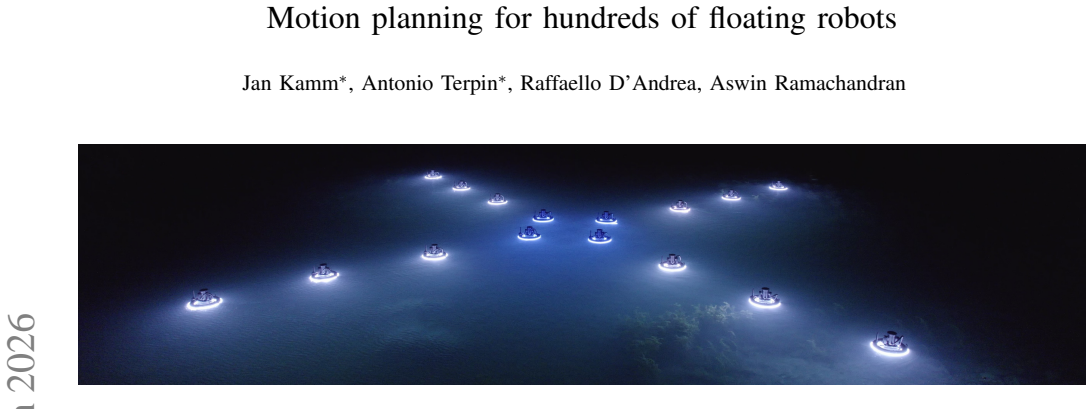
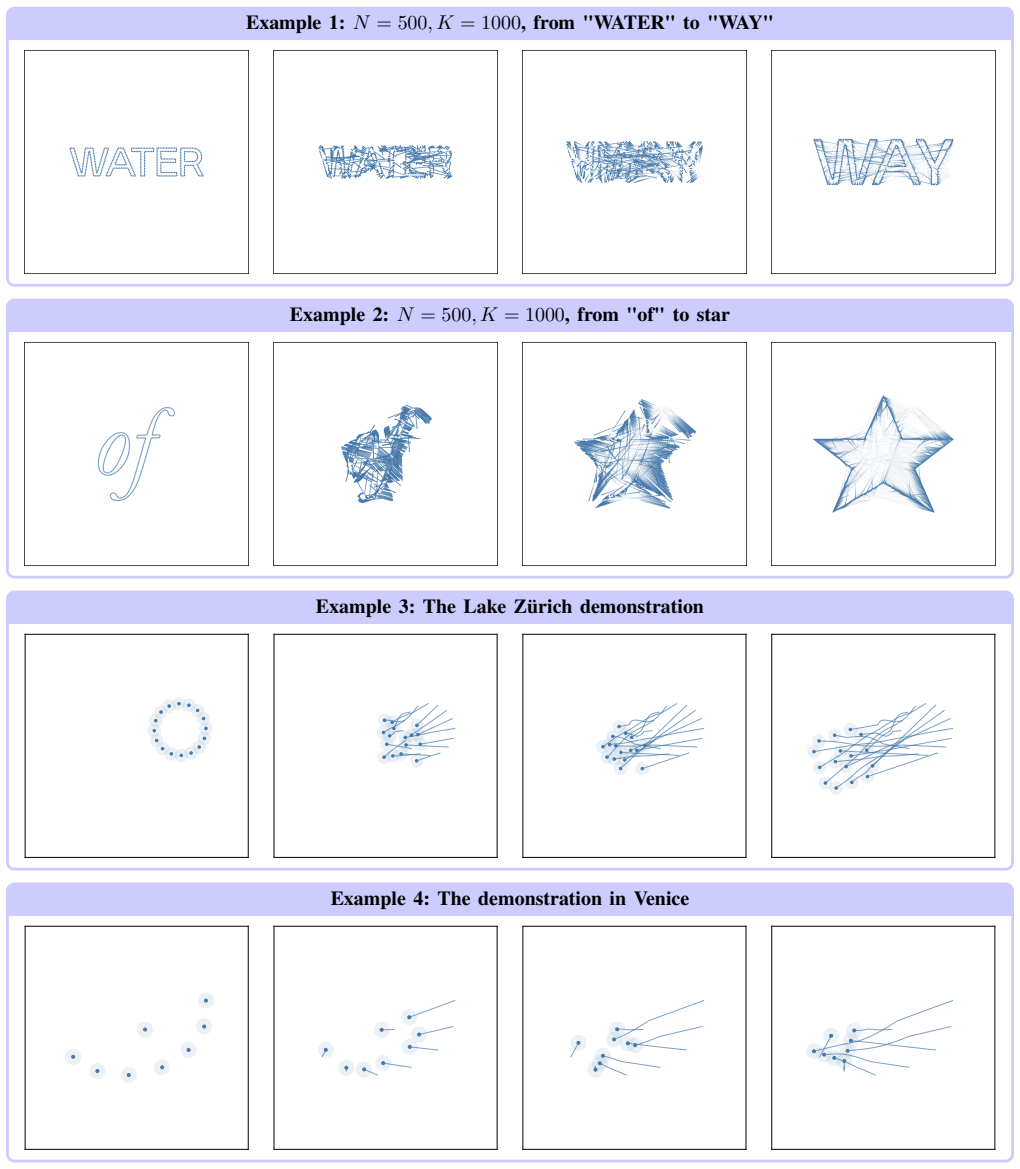
Planning collision-free motion for large robot fleets is difficult because collision avoidance induces strong inter-agent coupling that grows rapidly with team size. We consider omnidirectional floating robots on water, where choreographies are specified by sparse keyframes and an interactive tool must generate trajectories within seconds, even when transitions span minutes and thousands of time steps. We propose a scalable pipeline that builds a collision graph from an initialization, decomposes the coupled problem into interaction clusters, and solves clusters independently (and in parallel) with robustness mechanisms for common decomposition pathologies. We validate the approach in simulations up to 500 robots. The synthesized trajectories have also been deployed in two real-world demonstrations, on Lake Z\"urich with a fleet of 24 Way of Water crafts and at the Time Space Existence 2025 Venice Biennale.
Editorial analysis
A structured set of objections, weighed in public.
Referee Report
Summary. The manuscript proposes a scalable pipeline for collision-free motion planning of large fleets of omnidirectional floating robots specified via sparse keyframes. The approach constructs a collision graph from an initialization, decomposes the coupled multi-agent problem into interaction clusters, solves the clusters independently and in parallel, and incorporates robustness mechanisms for common decomposition pathologies. Validation consists of simulations with up to 500 robots plus two real-world deployments (24 robots on Lake Zürich and at the 2025 Venice Biennale).
Significance. If the pipeline reliably yields globally feasible, collision-free trajectories without requiring global re-optimization, the work would represent a practical advance for interactive planning of large aquatic robot teams over long time horizons. The parallel cluster solving and real-world hardware validation are concrete strengths that could support applications in performance robotics and environmental monitoring.
major comments (2)
- [Pipeline description (decomposition and robustness mechanisms)] The central claim that independent cluster solves plus robustness mechanisms produce globally collision-free fleet trajectories rests on the assumption that an initial collision graph captures all relevant interactions. The manuscript should demonstrate (via analysis or counter-example experiments) that optimized trajectories over thousands of time steps do not induce new inter-cluster collisions or timing violations that the robustness mechanisms cannot resolve without re-optimization.
- [Experimental validation and real-world demonstrations] Validation sections report success up to 500 robots but do not provide quantitative metrics (e.g., fraction of runs with residual inter-cluster collisions, timing-constraint violations, or failure rate of the robustness mechanisms) that would confirm the end-to-end guarantee of feasibility for the full fleet.
minor comments (2)
- [Method overview] Notation for the collision graph and cluster boundaries should be defined more explicitly (e.g., with a small example) to clarify how the initial graph is constructed from the initialization.
- [Abstract and introduction] The abstract and introduction could include a brief statement of the maximum time horizon (in steps) used in the 500-robot simulations to contextualize the long-horizon claim.
Simulated Author's Rebuttal
We thank the referee for the constructive feedback on our manuscript. We address each major comment below with clarifications from the paper's approach and commit to revisions that strengthen the presentation without overstating the guarantees.
read point-by-point responses
-
Referee: [Pipeline description (decomposition and robustness mechanisms)] The central claim that independent cluster solves plus robustness mechanisms produce globally collision-free fleet trajectories rests on the assumption that an initial collision graph captures all relevant interactions. The manuscript should demonstrate (via analysis or counter-example experiments) that optimized trajectories over thousands of time steps do not induce new inter-cluster collisions or timing violations that the robustness mechanisms cannot resolve without re-optimization.
Authors: The collision graph is constructed from an initialization that spans the full time horizon of the keyframes, with edges added for any pair of robots whose swept volumes intersect at any discrete time step. Clusters are formed from connected components of this graph, and the robustness mechanisms include conservative buffer distances plus a post-solve verification pass that re-checks all original inter-cluster pairs. We will add a dedicated subsection with counter-example experiments (e.g., deliberately sparse initial graphs and long-horizon runs) that quantify any newly induced collisions after independent solves; in our existing 500-robot simulations these checks returned zero residual violations, but the new experiments will make this explicit. revision: partial
-
Referee: [Experimental validation and real-world demonstrations] Validation sections report success up to 500 robots but do not provide quantitative metrics (e.g., fraction of runs with residual inter-cluster collisions, timing-constraint violations, or failure rate of the robustness mechanisms) that would confirm the end-to-end guarantee of feasibility for the full fleet.
Authors: We agree that aggregate success statistics would improve the validation. The revised manuscript will include tables reporting, over 50 independent random initializations per fleet size: (i) fraction of runs with zero residual inter-cluster collisions after the final verification pass, (ii) frequency and type of robustness-mechanism triggers, and (iii) any timing-constraint violations that required fallback re-optimization. These metrics will be computed from the same simulation data already presented. revision: yes
Circularity Check
No significant circularity detected in derivation chain
full rationale
The paper presents an algorithmic pipeline: collision graph from initialization, decomposition into interaction clusters, independent parallel solves with robustness mechanisms. No equations, fitted parameters, or predictions are described that reduce by construction to inputs (no self-definitional relations, no fitted-input-called-prediction, no ansatz smuggled via citation). Validation relies on external simulation (up to 500 robots) and real-world deployment, which are independent benchmarks. No load-bearing self-citations or uniqueness theorems from prior author work are invoked in the abstract or described text. The skeptic concern identifies a possible empirical limitation in the initial-graph assumption but does not constitute circularity under the enumerated patterns.
Axiom & Free-Parameter Ledger
Reference graph
Works this paper leans on
-
[1]
Choreographing the Way of Water: A computational framework for aquatic robotic art,
A. K. Ramachandran Venkatapathy, C. Golling, S. Burmester, N. Sendlhofer, R. Jiang, J. Kamm, and R. D’Andrea, “Choreographing the Way of Water: A computational framework for aquatic robotic art,” inProceedings of the International Conference on New Interfaces for Musical Expression (NIME ’26), 2026
2026
-
[2]
Multi-robot navigation in formation via sequential convex programming,
J. Alonso-Mora, S. Baker, and D. Rus, “Multi-robot navigation in formation via sequential convex programming,” in2015 IEEE/RSJ International Conference on Intelligent Robots and Systems (IROS). Hamburg, Germany: IEEE, 2015, pp. 4634–4641
2015
-
[3]
Airways: Optimization-based planning of quadrotor trajectories according to high-level user goals,
C. Gebhardt, B. Hepp, T. Nägeli, S. Stevši ´c, and O. Hilliges, “Airways: Optimization-based planning of quadrotor trajectories according to high-level user goals,” inProceedings of the 2016 CHI Conference on Human Factors in Computing Systems. New York, NY , USA: Association for Computing Machinery, 2016, p. 2508–2519
2016
-
[4]
Technical Note—A General Inner Approximation Algorithm for Nonconvex Mathematical Programs,
B. R. Marks and G. P. Wright, “Technical Note—A General Inner Approximation Algorithm for Nonconvex Mathematical Programs,” Operations Research, vol. 26, no. 4, pp. 681–683, 1978
1978
-
[5]
An application of sequential convex programming to time optimal trajectory planning for a car motion,
Q. Tran Dinh and M. Diehl, “An application of sequential convex programming to time optimal trajectory planning for a car motion,” inProceedings of the 48th IEEE Conference on Decision and Control (CDC) held jointly with the 2009 28th Chinese Control Conference. Shanghai, China: IEEE, 2009, pp. 4366–4371
2009
-
[6]
Generation of collision-free trajectories for a quadrocopter fleet: A sequential convex programming approach,
F. Augugliaro, A. P. Schoellig, and R. D’Andrea, “Generation of collision-free trajectories for a quadrocopter fleet: A sequential convex programming approach,” in2012 IEEE/RSJ International Conference on Intelligent Robots and Systems. Vilamoura-Algarve, Portugal: IEEE, 2012, pp. 1917–1922
2012
-
[7]
Finding Locally Optimal, Collision-Free Trajectories with Sequen- tial Convex Optimization,
J. Schulman, J. Ho, A. Lee, I. Awwal, H. Bradlow, and P. Abbeel, “Finding Locally Optimal, Collision-Free Trajectories with Sequen- tial Convex Optimization,” inRobotics: Science and Systems IX. Robotics: Science and Systems Foundation, 2013
2013
-
[8]
Motion planning with sequential convex optimization and convex collision checking,
J. Schulman, Y . Duan, J. Ho, A. Lee, I. Awwal, H. Bradlow, J. Pan, S. Patil, K. Goldberg, and P. Abbeel, “Motion planning with sequential convex optimization and convex collision checking,”The International Journal of Robotics Research, vol. 33, no. 9, pp. 1251–1270, 2014
2014
-
[9]
Reciprocal n- body collision avoidance,
J. Van Den Berg, S. J. Guy, M. Lin, and D. Manocha, “Reciprocal n- body collision avoidance,” inRobotics Research, ser. Springer Tracts in Advanced Robotics, C. Pradalier, R. Siegwart, and G. Hirzinger, Eds. Springer, 2011, vol. 70, pp. 3–19
2011
-
[10]
Conflict-based search for optimal multi-agent pathfinding,
G. Sharon, R. Stern, A. Felner, and N. R. Sturtevant, “Conflict-based search for optimal multi-agent pathfinding,”Artificial Intelligence, vol. 219, pp. 40–66, 2015
2015
-
[11]
CHOMP: Gradient optimization techniques for efficient motion planning,
N. Ratliff, M. Zucker, J. A. Bagnell, and S. Srinivasa, “CHOMP: Gradient optimization techniques for efficient motion planning,” in 2009 IEEE International Conference on Robotics and Automation. Kobe: IEEE, 2009, pp. 489–494
2009
-
[12]
STOMP: Stochastic trajectory optimization for motion planning,
M. Kalakrishnan, S. Chitta, E. Theodorou, P. Pastor, and S. Schaal, “STOMP: Stochastic trajectory optimization for motion planning,” in 2011 IEEE International Conference on Robotics and Automation. Shanghai, China: IEEE, 2011, pp. 4569–4574
2011
-
[13]
Distributed feedback optimisation for robotic coordination,
A. Terpin, S. Fricker, M. Perez, M. H. de Badyn, and F. Dörfler, “Distributed feedback optimisation for robotic coordination,” in2022 American Control Conference (ACC). IEEE, 2022, pp. 3710–3715
2022
-
[14]
Decentralized non- communicating multiagent collision avoidance with deep reinforce- ment learning,
Y . F. Chen, M. Liu, M. Everett, and J. P. How, “Decentralized non- communicating multiagent collision avoidance with deep reinforce- ment learning,” in2017 IEEE International Conference on Robotics and Automation (ICRA). Singapore: IEEE, 2017, pp. 285–292
2017
-
[15]
Neural graph control barrier functions guided distributed collision-avoidance multi-agent control,
S. Zhang, K. Garg, and C. Fan, “Neural graph control barrier functions guided distributed collision-avoidance multi-agent control,” inProceedings of The 7th Conference on Robot Learning, ser. Proceedings of Machine Learning Research, vol. 229, 2023, pp. 2373–2392. [Online]. Available: https://proceedings.mlr.press/v229/ zhang23h.html
2023
-
[16]
doi:10.1007/s12532-020-00179-2 , urldate =
B. Stellato, G. Banjac, P. Goulart, A. Bemporad, and S. Boyd, “OSQP: an operator splitting solver for quadratic programs,”Mathematical Programming Computation, vol. 12, no. 4, pp. 637–672, Dec. 2020. [Online]. Available: https://doi.org/10.1007/s12532-020-00179-2
-
[17]
Results and problems in the theory of doubly-stochastic matrices,
L. Mirsky, “Results and problems in the theory of doubly-stochastic matrices,”Zeitschrift für Wahrscheinlichkeitstheorie und verwandte Gebiete, vol. 1, no. 4, pp. 319–334, 1963
1963
-
[18]
Dynamic Programming in Probability Spaces via Optimal Transport,
A. Terpin, N. Lanzetti, and F. Dörfler, “Dynamic Programming in Probability Spaces via Optimal Transport,”SIAM Journal on Control and Optimization, vol. 62, no. 2, pp. 1183–1206, 2024
2024
-
[19]
The hungarian method for the assignment problem,
H. W. Kuhn, “The hungarian method for the assignment problem,” Naval research logistics quarterly, vol. 2, no. 1-2, pp. 83–97, 1955
1955
-
[20]
Multidimensional binary search trees used for asso- ciative searching,
J. L. Bentley, “Multidimensional binary search trees used for asso- ciative searching,”Communications of the ACM, vol. 18, no. 9, pp. 509–517, 1975
1975
-
[21]
T. H. Cormen, C. E. Leiserson, R. L. Rivest, and C. Stein,Introduction to algorithms. MIT press, 2022
2022
-
[22]
Convex optimization for trajectory generation: A tutorial on generating dynamically feasible trajectories reliably and efficiently,
D. Malyuta, T. P. Reynolds, M. Szmuk, T. Lew, R. Bonalli, M. Pavone, and B. Açıkme¸ se, “Convex optimization for trajectory generation: A tutorial on generating dynamically feasible trajectories reliably and efficiently,”IEEE Control Systems Magazine, vol. 42, no. 5, pp. 40– 113, 2022
2022
-
[23]
PiNet: Optimizing hard-constrained neural networks with orthogonal projection layers,
P. D. Grontas, A. Terpin, E. C. Balta, R. D’Andrea, and J. Lygeros, “PiNet: Optimizing hard-constrained neural networks with orthogonal projection layers,”arXiv preprint arXiv:2508.10480, 2025
arXiv 2025
-
[24]
Variational analysis in the wasserstein space,
N. Lanzetti, A. Terpin, and F. Dörfler, “Variational analysis in the wasserstein space,”arXiv preprint arXiv:2406.10676, 2024
arXiv 2024
-
[25]
Deep reinforcement learning from human preferences,
P. F. Christiano, J. Leike, T. Brown, M. Martic, S. Legg, and D. Amodei, “Deep reinforcement learning from human preferences,” Advances in neural information processing systems, vol. 30, 2017. Example 1:N= 500, K= 1000, from "W ATER" to "W AY" Example 2:N= 500, K= 1000, from "of" to star Example 3: The Lake Zürich demonstration Example 4: The demonstratio...
2017
discussion (0)
Sign in with ORCID, Apple, or X to comment. Anyone can read and Pith papers without signing in.