REVIEW 2 major objections 4 minor 8 references
Deformation Theories Controlled by Hochschild Cohomologies
T0 review · 2 major / 4 minor · reviewed 2026-08-14 · deepseek-v4-flash
Pith's one-line read This paper shows that a d-sphere version and a tertiary version of Hochschild cohomology determine when formal deformations of an algebra remain associative.
desk verdict The S^3 and tertiary deformation results are solid, but the general d-sphere theorem is asserted rather than proven and needs a real proof before the paper can be trusted. read the letter →
The pith
A machine-rendered reading of the paper's core claim, the machinery that carries it, and where it could break.
The reading
What carries the argument
The load-bearing structure is the pairing between an associativity-type equation and a cochain complex. On the sphere side, the complex is $C^\bullet_{S^d}(A,A)$ with the coboundary $\delta_d$ written in (2.2); the composition operations $f_1\circ\cdots\circ f_m$, written out for $d=3$ as the two-factor map $\circ$ and the three-factor map $\star$, convert the coefficient of $t^{n+1}$ in (3.7) into an equation of the form $\delta_d(u_{n+1})=\text{obstruction}$. On the tertiary side, the complex is associated to the quintuple $Q$; the two-factor composition $f\circ g$ rearranges the generalized associativity condition (4.3) into the coboundary equation for $c_{n+1}$ with the sum $\sum_{i+j=n+1}c_i\circ c_j$ as obstruction. The cohomology class of the obstruction is what decides whether the deformation continues.
What would settle it
Take $d=4$ and a commutative algebra with a nonzero linear map $u_1$; write out both sides of (3.7) through $t^4$ and compare the coefficient pattern with the sum claimed in Theorem 3.2. If the signs or the number of factors in the natural composition differ from the $d=3$ pattern, the obstruction will not land in $H^5_{S^4}(A,A)$.
Extended reading notes
Core claim
At the center are two assertions. Theorem 3.2 fixes $d\ge1$ and considers a formal map $u(a)=a+u_1(a)t+u_2(a)t^2+\cdots$ from $A[[t]]$ to itself. If $u$ satisfies the generalized associativity condition (3.7) modulo $t^2$, then $u_1$ lies in $Z^d_{S^d}(A,A)$; if the condition holds modulo $t^{n+1}$, extension to order $n+2$ is possible exactly when the sum $\sum_{m=2}^{\lceil(d+2)/2\rceil}\sum_{i_1+\cdots+i_m=n+1}u_{i_1}\circ\cdots\circ u_{i_m}$ vanishes in $H^{d+1}_{S^d}(A,A)$. Theorem 4.3 is the analogous statement for a quintuple $Q=(A,B,C,\varepsilon,\theta)$: the first-order term $c_1$ of a compatible family of deformed products is a 2-cocycle, and extension beyond order $n+1$ is blocked precisely when $\sum_{i+j=n+1}c_i\circ c_j$ is nonzero in $H^3(Q;A)$. The explicit computations for $d=3$ are what make the general pattern visible.
Load-bearing premise
The general $d$-sphere theorem assumes that the composition operations $f_1\circ\cdots\circ f_m$ behave for every $d$ exactly as they do for $d=3$, with the same signs and the same upper bound on the number of factors; the proof only verifies this pattern in the $d=3$ case.
Editorial extensions
If this is right
- For $d=1$, condition (3.7) becomes $u(ab)=u(a)u(b)$; Theorem 3.2 then says $u_1$ is a cocycle in ordinary Hochschild cohomology and the obstruction to extending sits in the next degree.
- For $d=2$, the theorem recovers the previously studied $S^2$ deformation theory.
- For $d=3$, the first obstruction is $u_1\circ u_2+u_2\circ u_1+u_1\star u_1\star u_1$, and it must vanish in $H^4_{S^3}(A,A)$.
- For a quintuple $Q$, Theorem 4.3 gives the tertiary analogue: $c_1$ is a 2-cocycle and $\sum_{i+j=n+1}c_i\circ c_j$ is the obstruction in $H^3(Q;A)$.
- When $C=\mathbb{k}$ the tertiary statements reduce to the secondary theory, and when $C=B=\mathbb{k}$ they reduce to the classical one; the isomorphism-class corollaries (3.6, 4.5) also hold.
Reading between the lines
- If the parity pattern in (3.7) is the essential feature, analogous deformation theories should exist for finite simplicial sets other than spheres with the same gluing shape; the paper does not develop this.
- The two-layer structure visible here—cocycle condition at order one, class-valued obstruction at order two—should reappear for any finite number of auxiliary algebra structures, since the final remarks point toward quaternary and higher versions.
- A concrete example with a nonzero obstruction class would test whether the cohomological condition is sharp; the paper provides no such example.
Signed reviews
Editorial analysis
A structured set of objections, weighed in public.
Referee Report
Summary. The paper develops two deformation theories. In Section 3, for a commutative algebra A and a formal map u(a)=a+u1(a)t+..., it studies the condition (3.7) and claims that the first-order term u1 is a d-cocycle in higher-order Hochschild cohomology over the d-sphere, and that the obstruction to extending from order n+1 to order n+2 is a sum of compositions of the ui in H^{d+1}_{Sd}(A,A). Section 4 introduces a family of products m^x_{α,t} on A[[t]] and claims that the associativity condition (4.3) is controlled by tertiary Hochschild cohomology of the quintuple Q, with c1 a 2-cocycle and the obstruction a sum ci∘cj in H^3(Q;A). The paper also contains corollaries on the isomorphism-invariance of the first-order class and remarks on quaternary and higher extensions.
Significance. The explicit computations in Proposition 3.1 and in the first-order part of Theorem 4.3 are correct and demonstrate that the proposed statements are plausible. The paper's framework, if completed, would unify Gerstenhaber's classical deformation theory, Staic's secondary theory, and the S^2 result of [3] as special cases. However, the advertised d-sphere generalization and the higher-order extension statements are not fully proven in the manuscript, so the significance depends on supplying the missing arguments.
major comments (2)
- [§3.2, Theorem 3.2] The general-d statement is not proven in the text. The maps f1∘⋯∘fm are defined only as 'in the natural way' immediately before (3.7), and the proof is a single sentence citing Definition 2.1 and (2.2). Neither (2.2) nor the surrounding text specifies the placement of the m functions in A^{⊗(d+1)}, the sign conventions, or why m is bounded by ceil((d+2)/2). Since the obstruction class is exactly this sum, the theorem cannot be verified as written; please supply an explicit definition of the multi-factor composition and a proof of (i) and (ii) for arbitrary d.
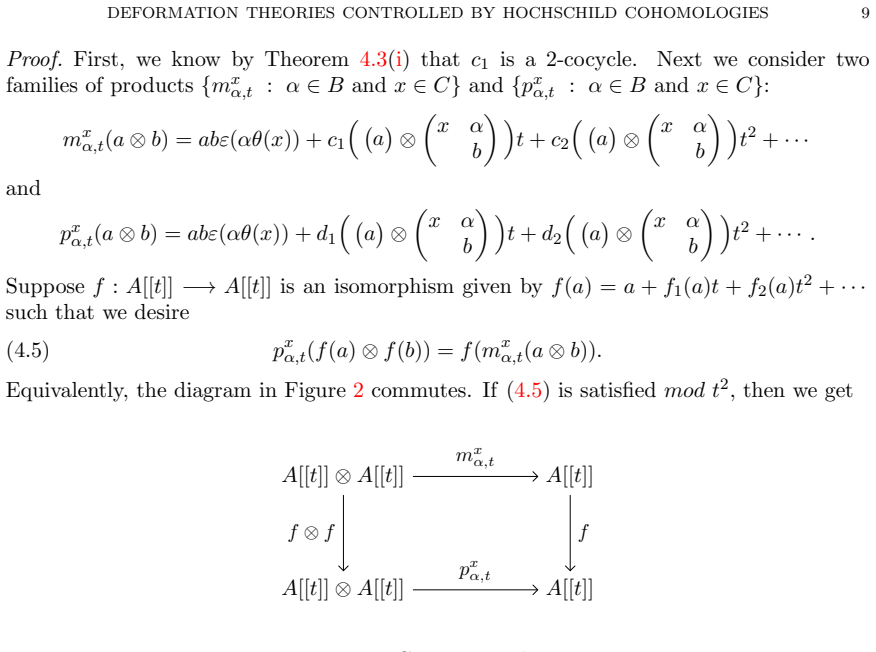
- [§4.1, Theorem 4.3(ii)] The extension statement for all n is asserted after verifying only the n=1 case. To justify the 'if and only if' for arbitrary n, the authors need to show that the t^{n+1}-coefficient of (4.3) is, up to a coboundary term, exactly ∑_{i+j=n+1} ci∘cj, and that the class of this sum is independent of the chosen c_{n+1}. The current sentence 'one can do this for any n' is a sketch rather than a proof.
minor comments (4)
- [§3.2, before Proposition 3.7] The sentence 'Notice that all of the equalities contained in (3.7) are independent' is contradicted by the immediately following observation that the d=1 equality implies the others and by Proposition 3.7 itself; please rephrase to describe the actual logical relations.
- [§4, before Proposition 4.1] Proposition 4.1 says 'θ : B → C', but the quintuple definition and the surrounding discussion use θ : C → B; otherwise εMQ∘θ is not defined. Please correct the direction.
- [§4.2] The discussion of quaternary and higher-order analogues is only a remark; if it is intended as a theorem, the relevant cohomology theories and deformation conditions need to be defined.
- [References] References [2] and [3] are arXiv preprints by the same authors; please update to published versions if available.
Circularity Check
No circularity in the core deformation computations; minor self-citations and an unverified 'natural' composition prevent a clean bill, but no result reduces to its inputs.
full rationale
Walking the derivation chain, the S3 results in Proposition 3.1 are computed directly from the explicit δ3 formula and the t-expansion of (3.2): the t2 term rearranges to δ3(u2) = u1 ∘ u1 and the t3 term to δ3(u3) = u1 ∘ u2 + u2 ∘ u1 + u1 ⋆ u1 ⋆ u1, so the cohomology class is the actual obstruction rather than an assumed one. Theorem 4.3 is likewise explicit: mod t2 gives γ2(c1) = 0 and the t3 computation gives γ2(c2) = c1 ∘ c1; the reductions to secondary and ordinary Hochschild deformations in Remark 4.4 are consistency checks against [8] and [4], not inputs. The self-citations [2] and [3] supply the simplicial/framework language and the d = 2 special case, but the new d = 3 and tertiary computations are carried out in the text, so the self-citation is not load-bearing. The genuine weaknesses are rigor gaps rather than circularity: Theorem 3.2's proof is a single sentence and f1 ∘ ⋯ ∘ fm is only described as 'natural,' so the asserted d-sphere generalization is not independently verified in the paper; also the remark before Proposition 3.7 first says the equalities in (3.7) are independent and then says the d = 1 equality implies the others. These concerns affect verifiability, not the circularity score.
Assumptions & free parameters
assumptions (4)
- standard math The higher order Hochschild cohomology complex C^•_{Sd}(A,M) of [1],[7] is a cochain complex with coboundary (2.2) for all d≥1.
- domain assumption The simplicial structure for Sd described in [2] gives the chain complex in (2.1), including the low-dimensional maps in (2.3).
- standard math The tertiary Hochschild cohomology complex C^•(Q;M) from [2] is a well-defined cochain complex with low-dimensional maps gamma0, gamma1, gamma2 as stated.
- domain assumption The family of products MQ in Section 4 is fully described by a single sequence of cochains c_i on A^{⊗2}⊗B⊗C.
Cite this review
Pith. "Pith review of Deformation Theories Controlled by Hochschild Cohomologies." pith.science (2026). https://pith.science/paper/2RVH6M5O
@misc{pith2026190801846,
  author       = {Pith},
  title        = {Pith review of: Deformation Theories Controlled by Hochschild Cohomologies},
  year         = {2026},
  howpublished = {\url{https://pith.science/paper/2RVH6M5O}},
  note         = {Machine review of arXiv:1908.01846}
}
abstract
We explore how the higher order Hochschild cohomology controls a deformation theory when the simplicial set models the 3-sphere. Besides generalizing to the $d$-sphere for any $d\geq1$, we also investigate a deformation theory corresponding to the tertiary Hochschild cohomology, which naturally reduces to those studied for the secondary and usual Hochschild cohomologies under certain conditions.
Figures

Reference graph
Works this paper leans on
-
[3]
Samuel Carolus and Mihai D. Staic. G-algebra structure on the higher order Hochschild cohomolo gy H ∗ S2 (A, A). arXiv:1804.05096, 2018
work page Pith review arXiv 2018
-
[1]
D. W. Anderson. Chain functors and homology theories. Symposium on Algebraic Topology (Battelle Seattle Res. Center, Seattle, Wash., 1971) , pages 1–12. Lecture notes in Math., Vol. 249, 1971
work page 1971
-
[2]
Simplicial Structures Over the 3-Sphere and Generalized Higher Order Hochschild Homology
Samuel Carolus and Jacob Laubacher. Simplicial structu res over the 3-sphere and generalized higher order Hochschild homology. arXiv:1707.03863, 2017
work page Pith review arXiv 2017
-
[4]
On the deformation of rings and alg ebras
Murray Gerstenhaber. On the deformation of rings and alg ebras. Ann. of Math. (2) , 79:59–103, 1964
work page 1964
-
[5]
Higher order Hochschild cohomology
Gr´ egory Ginot. Higher order Hochschild cohomology. C. R. Math. Acad. Sci. Paris , 346(1-2):5–10, 2008
work page 2008
-
[6]
On the cohomology groups of an assoc iative algebra
Gerhard Hochschild. On the cohomology groups of an assoc iative algebra. Ann. of Math. (2) , 46:58–67, 1945
work page 1945
-
[7]
Hodge decomposition for higher or der Hochschild homology
Teimuraz Pirashvili. Hodge decomposition for higher or der Hochschild homology. Ann. Sci. ´Ecole Norm. Sup. (4) , 33(2):151–179, 2000
work page 2000
-
[8]
Mihai D. Staic. Secondary Hochschild cohomology. Algebr. Represent. Theory , 19(1):47–56, 2016. Department of Mathematics and Statistics, Ohio Northern Un iversity, Ada, Ohio 45810 E-mail address : s-carolus@onu.edu Department of Mathematics, St. Norbert College, De Pere, Wi sconsin 54115 E-mail address : samuel.hokamp@snc.edu Department of Mathematics, S...
work page 2016
Reviewed August 14, 2026 · model on record in the stance chip above.
Discussion (0). Continue with ORCID to comment.