Direct Nanoscale Pyroelectric Characterization of a CuInP{}₂S{}₆ van der Waals Nanogenerator
Pith reviewed 2026-06-27 03:15 UTC · model grok-4.3
The pith
Scanning thermal microscopy with finite-element modeling directly yields the local pyroelectric coefficient in a CuInP2S6 nanogenerator.
A machine-rendered reading of the paper's core claim, the machinery that carries it, and where it could break.
Core claim
Finite-element thermal modeling combined with probe calibration enables direct determination of the local pyroelectric coefficient from the measured electrical response.
What carries the argument
Scanning thermal microscopy probe as a localized nanoscale heat source, paired with harmonic detection and finite-element thermal modeling to extract the coefficient.
If this is right
- Local pyroelectric coefficients can be obtained without spatial averaging over the entire device.
- Regions of zero response caused by defects become directly visible during operation.
- The method supplies a platform for quantitative optimization of van der Waals pyroelectric devices.
Where Pith is reading between the lines
- The same probe-plus-modeling workflow could be applied to other two-dimensional ferroelectrics to map their local coefficients.
- Spatially resolved data may allow direct links between specific microscopic defects and reduced energy-conversion efficiency.
- Combining the technique with additional scanning-probe modes could enable simultaneous mapping of pyroelectric and other properties.
Load-bearing premise
The finite-element model accurately captures the probe-sample thermal transport without significant unaccounted parasitic effects.
What would settle it
An independent macroscopic measurement of the pyroelectric coefficient on the identical sample that differs substantially from the locally extracted values would indicate the modeling assumptions are incomplete.
Figures
read the original abstract
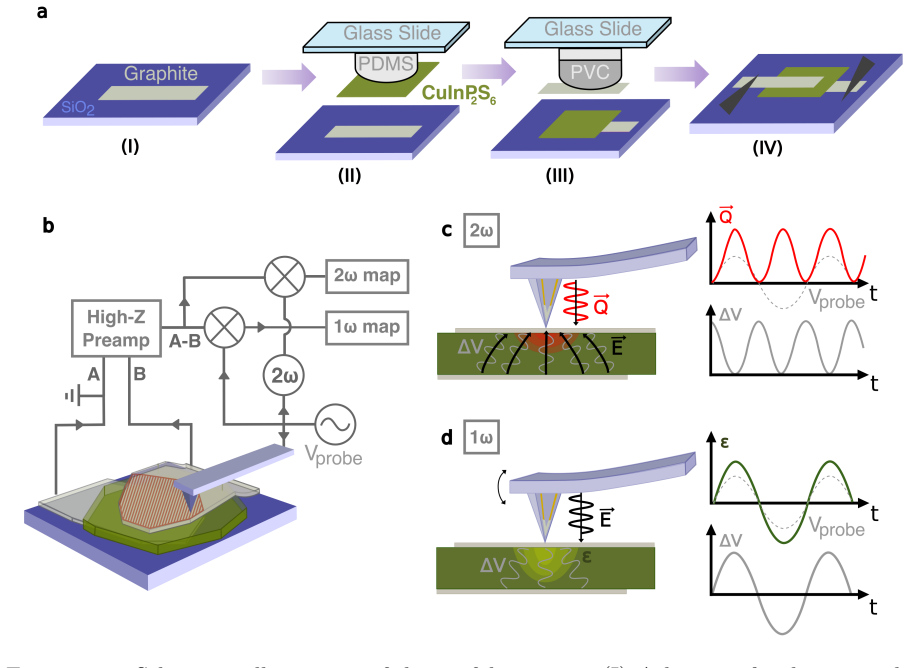
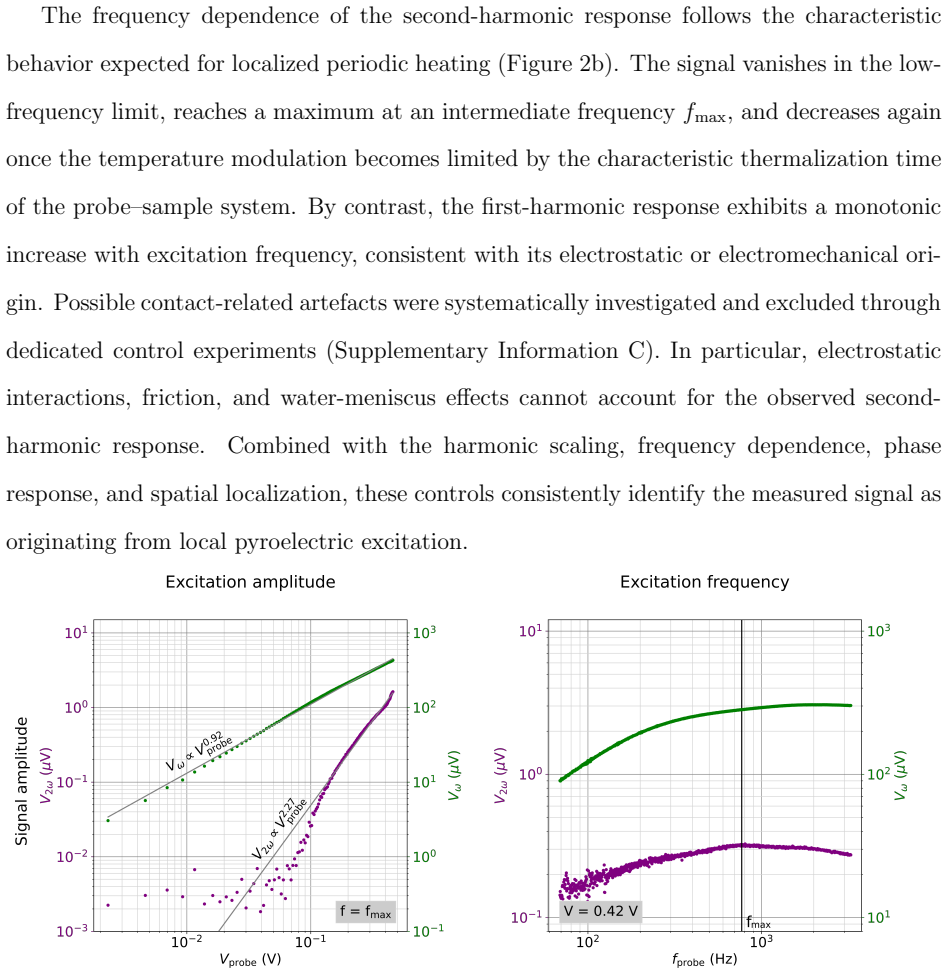
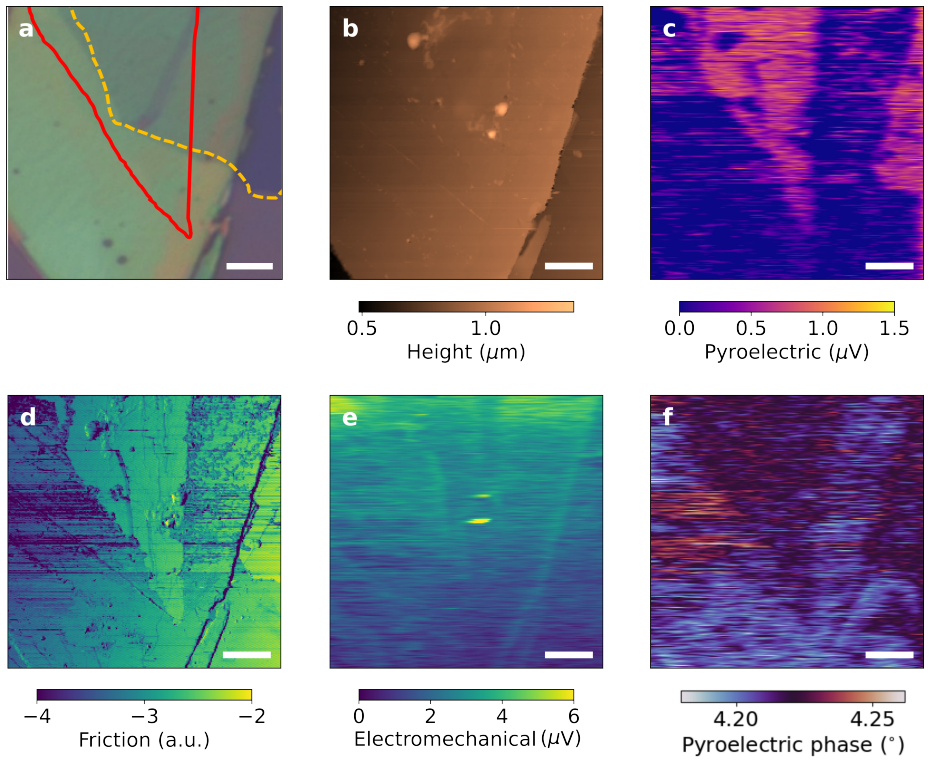
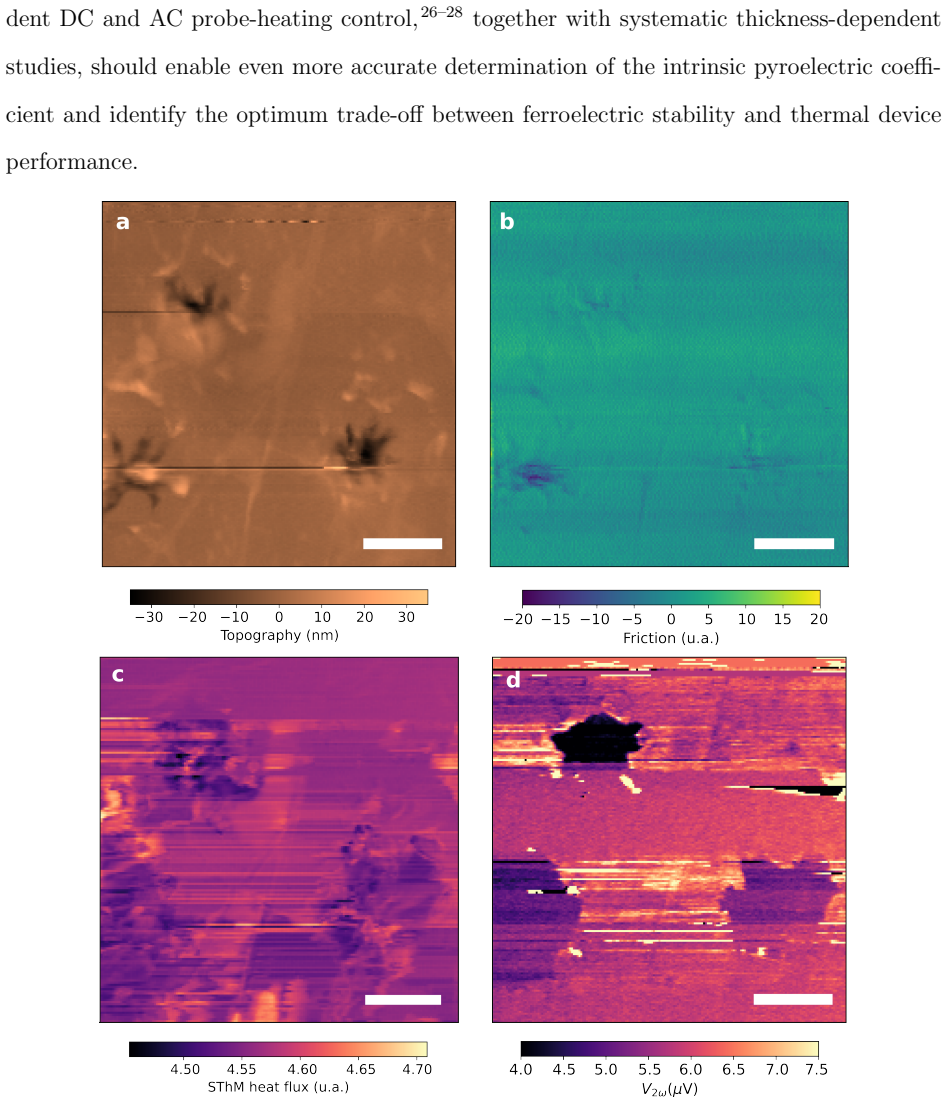
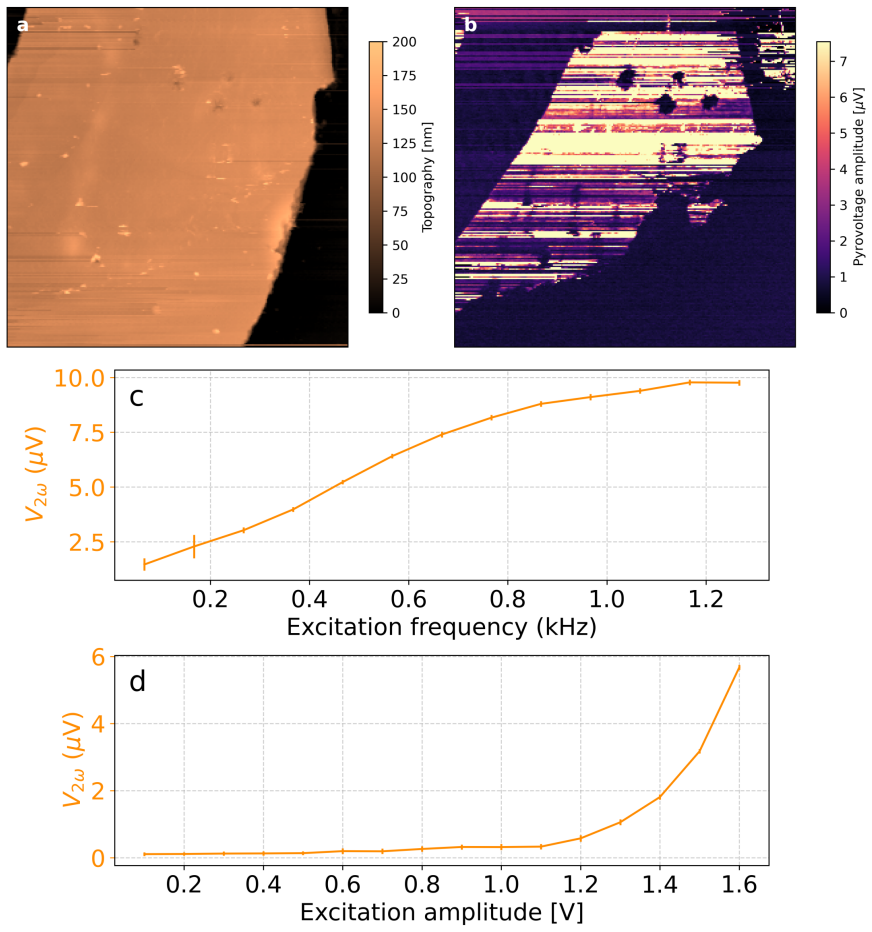
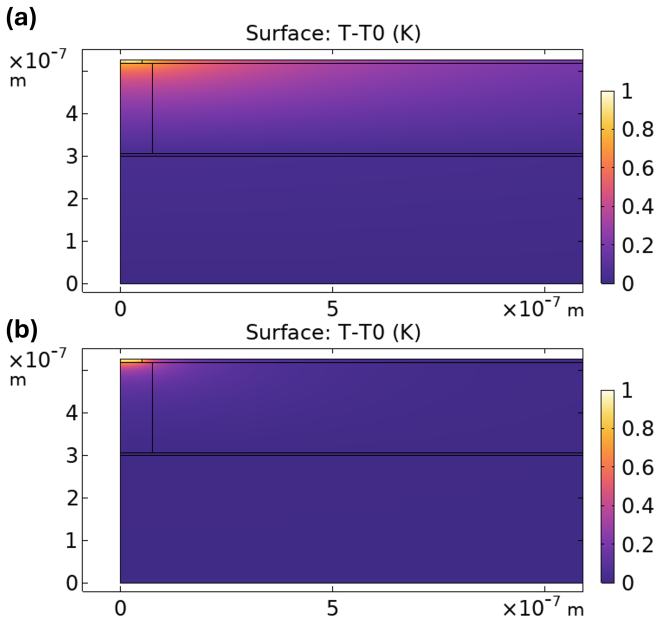
Pyroelectric energy conversion offers a route for harvesting time-dependent thermalfluctuations that are abundant in natural and technological environments. Twodimensional ferroelectrics are particularly attractive for this purpose because reduced dimensionality enables ultrathin, mechanically compliant device architectures. Here, we demonstrate direct nanoscale pyroelectric characterization of an out-of-plane van der Waals nanogenerator based on CuInP2S6 (CIPS) encapsulated between few-layer graphene electrodes. A scanning thermal microscopy (SThM) probe is employed as a localized nanoscale heat source while the electrically generated response is measured in situ through the device electrodes. Harmonic detection isolates the pyroelectric signal from parasitic first-harmonic electromechanical contributions, while finite-element thermal modeling combined with probe calibration enables direct determination of the local pyroelectric coefficient from the measured electrical response. Beyond quantitative characterization, the spatially resolved measurements directly identify electrically inactive regions associated with device defects, revealing local performance-limiting features that remain hidden in conventional spatially averaged pyroelectric measurements. The presented approach establishes a versatile platform for quantitative nanoscale pyroelectric characterization and the optimization of van der Waals pyroelectric devices.
Editorial analysis
A structured set of objections, weighed in public.
Referee Report
Summary. The manuscript demonstrates a nanoscale pyroelectric characterization technique for an out-of-plane CuInP2S6 (CIPS) van der Waals nanogenerator encapsulated in few-layer graphene. A scanning thermal microscopy (SThM) probe serves as a localized heat source; harmonic detection isolates the pyroelectric response from electromechanical artifacts, and finite-element thermal modeling combined with probe calibration converts the measured electrical signal into a local pyroelectric coefficient. Spatially resolved maps also reveal electrically inactive regions linked to device defects.
Significance. If the finite-element model is shown to accurately capture heat flux without unaccounted parasitics, the method would enable quantitative local pyroelectric measurements in ultrathin 2D ferroelectrics that are inaccessible to conventional averaged techniques. This would be useful for defect identification and device optimization in pyroelectric energy harvesters. The work is an experimental demonstration with no free parameters or circular derivations noted.
major comments (2)
- [Abstract] Abstract: the central claim that finite-element thermal modeling 'enables direct determination' of the local pyroelectric coefficient is load-bearing for the entire contribution. The abstract supplies no measured data, error bars, calibration curves, or validation against independent heat-flow standards (e.g., known pyroelectric crystals or IR thermography), so it is impossible to assess whether contact resistance, tip-geometry variation, or stray conduction paths are absorbed into the extracted coefficient rather than being explicitly bounded.
- [Abstract] The weakest assumption identified in the approach—that the SThM probe constitutes a well-characterized heat source whose transport is fully captured by the FEM model without residual parasitics—directly determines whether the extracted coefficient is truly 'direct.' A concrete test (comparison of modeled vs. measured heat flux on a reference sample) is required to support this.
minor comments (1)
- [Abstract] Abstract: 'time-dependent thermalfluctuations' is missing a space.
Simulated Author's Rebuttal
We thank the referee for their careful reading and constructive comments, which help clarify the presentation of our results. We address the major comments point by point below.
read point-by-point responses
-
Referee: [Abstract] Abstract: the central claim that finite-element thermal modeling 'enables direct determination' of the local pyroelectric coefficient is load-bearing for the entire contribution. The abstract supplies no measured data, error bars, calibration curves, or validation against independent heat-flow standards (e.g., known pyroelectric crystals or IR thermography), so it is impossible to assess whether contact resistance, tip-geometry variation, or stray conduction paths are absorbed into the extracted coefficient rather than being explicitly bounded.
Authors: We agree that the abstract is highly condensed and does not reference the supporting data and analysis contained in the main text. The manuscript details the probe calibration procedure, FEM implementation, and quantitative error bounds arising from contact resistance and tip geometry (see Methods and Supplementary Note 2). We will revise the abstract to explicitly note the calibration step and the resulting uncertainty estimate, thereby better supporting the claim of direct determination. revision: yes
-
Referee: [Abstract] The weakest assumption identified in the approach—that the SThM probe constitutes a well-characterized heat source whose transport is fully captured by the FEM model without residual parasitics—directly determines whether the extracted coefficient is truly 'direct.' A concrete test (comparison of modeled vs. measured heat flux on a reference sample) is required to support this.
Authors: The SThM probe is calibrated on reference thermal standards, with contact resistance and tip geometry parameters extracted from independent measurements and incorporated into the FEM model. Validation is performed by comparing modeled and measured temperature distributions on the CIPS device itself. While a dedicated cross-check against an independent pyroelectric reference crystal using IR thermography is not included, we will add an explicit discussion of residual parasitics together with sensitivity-analysis bounds in the revised manuscript. revision: partial
Circularity Check
No circularity: experimental extraction via calibrated FEM modeling
full rationale
The paper presents an experimental method using SThM probe heating and in-situ electrical readout, with finite-element thermal modeling employed solely for calibration to convert measured voltage to pyroelectric coefficient. No derivation chain reduces a claimed prediction or uniqueness result to its own fitted inputs or self-citations. The central claim is a direct measurement protocol whose validity rests on independent physical modeling and probe characterization, not on self-referential definitions or renamings. This matches the default expectation for non-circular experimental work.
Axiom & Free-Parameter Ledger
Reference graph
Works this paper leans on
-
[1]
Reviews of Modern Physics , author =
On the. Reviews of Modern Physics , author =. 1945 , pages =. doi:10.1103/RevModPhys.17.245 , number =
-
[2]
Physical Review Letters , author =
Temperature. Physical Review Letters , author =. 1975 , pages =. doi:10.1103/PhysRevLett.35.1532 , number =
-
[3]
Advanced Energy Materials , author =. 2024 , keywords =. doi:10.1002/aenm.202403319 , language =
-
[4]
Physical Review Letters , author =
Mechanisms of. Physical Review Letters , author =. doi:10.1103/PhysRevLett.120.207602 , number =
-
[5]
Giant pyroelectricity in nanomembranes , volume =. Nature , author =. 2022 , keywords =. doi:10.1038/s41586-022-04850-7 , language =
-
[6]
Nature Communications , author =
Room-temperature pyro-catalytic hydrogen generation of. Nature Communications , author =. 2018 , note =. doi:10.1038/s41467-018-05343-w , language =
-
[7]
Controlled synthesis and room-temperature pyroelectricity of. Nano Energy , author =. 2019 , keywords =. doi:10.1016/j.nanoen.2019.01.085 , abstract =
-
[8]
ACS Nano , author =
Giant. ACS Nano , author =. 2025 , pages =
2025
-
[9]
Ultrahigh pyroelectricity in monoelemental two-dimensional tellurium , volume =. Physical Review B , author =. 2025 , pages =. doi:10.1103/PhysRevB.111.155436 , number =
-
[10]
Versatile polymer method to dry-flip two-dimensional moir
Mech, Roop K and Spi. Versatile polymer method to dry-flip two-dimensional moir. Physical Review B , volume=. 2025 , publisher=
2025
-
[11]
Journal of Applied Physics , author =
Nanoscale spatial resolution probes for scanning thermal microscopy of solid state materials , volume =. Journal of Applied Physics , author =. 2012 , pages =. doi:10.1063/1.4767923 , abstract =
-
[12]
Nature Communications , author =
Self-powered photo-pyroelectric sensing in antiferroelectric. Nature Communications , author =. 2025 , keywords =. doi:10.1038/s41467-025-67575-x , abstract =
-
[13]
Direct. Small Methods , author =. 2025 , keywords =. doi:10.1002/smtd.202401715 , abstract =
-
[14]
Van der. Nature , author =. 2013 , note =. doi:10.1038/nature12385 , abstract =
-
[15]
Frontiers of Physics , author =
Van der. Frontiers of Physics , author =. 2020 , keywords =. doi:10.1007/s11467-020-0986-0 , abstract =
-
[16]
Pyroelectric scanning probe microscopy:. Physical Review B , author =. 2010 , note =. doi:10.1103/PhysRevB.82.054112 , abstract =
-
[17]
Physical Review Applied , author =
Ferri-ionic coupling in \ \. Physical Review Applied , author =. 2024 , note =. doi:10.1103/PhysRevApplied.22.034059 , abstract =
-
[18]
Dynamic. Nanoscale , author =. doi:10.1039/C8NR03586E , abstract =
-
[19]
Ultra-. ACS Nano , author =. 2012 , note =. doi:10.1021/nn300774n , abstract =
-
[20]
Signal size and resolution of scanning thermal microscopy in air and vacuum , volume =. Scientific Reports , author =. 2025 , note =. doi:10.1038/s41598-025-95648-w , abstract =
-
[21]
Journal of Applied Physics , author =
Improving accuracy of nanothermal measurements via spatially distributed scanning thermal microscope probes , volume =. Journal of Applied Physics , author =. 2018 , pages =. doi:10.1063/1.5031085 , abstract =
-
[22]
Nano Letters , author =. 2015 , note =. doi:10.1021/acs.nanolett.5b00491 , abstract =
-
[23]
Applied Physics Reviews , author =
How to measure the pyroelectric coefficient? , volume =. Applied Physics Reviews , author =. 2017 , pages =. doi:10.1063/1.4983118 , abstract =
-
[24]
Physical Review Applied , author =
Impact of. Physical Review Applied , author =. 2020 , note =. doi:10.1103/PhysRevApplied.14.064079 , abstract =
-
[25]
Plasmon-enhanced photoresponse of single silver nanowires and their network devices , volume =. Nanoscale Horizons , author =. 2022 , note =. doi:10.1039/D1NH00629K , language =
-
[26]
npj 2D Materials and Applications , author =
Single-material. npj 2D Materials and Applications , author =. 2023 , note =. doi:10.1038/s41699-023-00406-z , abstract =
-
[27]
IEEE Transactions on Instrumentation and Measurement , author =
Characterization of. IEEE Transactions on Instrumentation and Measurement , author =. 2026 , keywords =. doi:10.1109/TIM.2026.3674275 , abstract =
-
[28]
Review of Scientific Instruments , author =
Nanoscale thermometry by scanning thermal microscopy , volume =. Review of Scientific Instruments , author =. 2016 , pages =. doi:10.1063/1.4955449 , abstract =
-
[29]
Scanning. ACS Nano , author =. 2025 , note =. doi:10.1021/acsnano.4c12784 , abstract =
-
[30]
The strain-induced transitions of the piezoelectric, pyroelectric, and electrocaloric properties of the. AIP Advances , author =. 2023 , pages =. doi:10.1063/5.0178854 , abstract =
-
[31]
Applied Physics Letters , author =
Three-dimensional mapping of polarization profiles with thermal pulses , volume =. Applied Physics Letters , author =. 2005 , note =. doi:10.1063/1.1870124 , abstract =
-
[32]
Polarization distribution of thermally poled. Ferroelectrics , author =. 1991 , note =. doi:10.1080/00150199108014772 , abstract =
-
[33]
Journal of Physics: Conference Series , author =
Use of scanning. Journal of Physics: Conference Series , author =. 2009 , pages =. doi:10.1088/1742-6596/183/1/012001 , abstract =
-
[34]
Journal of Applied Physics , author =
Laser‐intensity‐modulation method:. Journal of Applied Physics , author =. 1986 , pages =. doi:10.1063/1.336352 , abstract =
-
[35]
Journal of Physics D: Applied Physics , author =
Space charge cartography by. Journal of Physics D: Applied Physics , author =. 2002 , pages =. doi:10.1088/0022-3727/35/24/316 , abstract =
-
[36]
Chromophore–zeolite composites:. Advanced Materials , author =. 1994 , note =. doi:10.1002/adma.19940060517 , abstract =
-
[37]
Pyroelectric. Advanced Materials , author =. 2004 , pages =. doi:10.1021/j100098a029 , abstract =
-
[38]
The Journal of Physical Chemistry B , author =
Analysis of the. The Journal of Physical Chemistry B , author =. 1998 , pages =. doi:10.1021/jp973350p , abstract =
-
[39]
Dobson, Phillip S. and Weaver, John M. R. and Mills, Gordon , month = oct, year =. New. 2007. doi:10.1109/ICSENS.2007.4388498 , abstract =
-
[40]
Harzheim, Achim and Spiece, Jean and Evangeli, Charalambos and McCann, Edward and Falko, Vladimir and Sheng, Yuewen and Warner, Jamie H. and Briggs, G. Andrew D. and Mol, Jan A. and Gehring, Pascal and Kolosov, Oleg V. , month = dec, year =. Geometrically. Nano Letters , publisher =. doi:10.1021/acs.nanolett.8b03406 , abstract =
discussion (0)
Sign in with ORCID, Apple, or X to comment. Anyone can read and Pith papers without signing in.