Imitation learning for clinical decision support in pediatric ECMO
Pith reviewed 2026-05-20 20:46 UTC · model grok-4.3
The pith
TabPFN learns to imitate unobserved clinician actions in pediatric ECMO better than XGBoost or MLPs.
A machine-rendered reading of the paper's core claim, the machinery that carries it, and where it could break.
Core claim
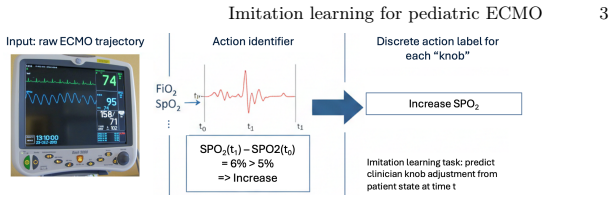
We frame clinical decision-making as learning to act from trajectories, i.e., imitation learning that learns action models from observational data, with a key feature that actions are not directly observed. We consider TabPFN, a recent transformer-based approach for tabular data, and traditional baselines including XGBoost and Multi-Layer Perceptrons on real-world pediatric ECMO data to learn the action models. We find that the TabPFN-based approach consistently outperforms these classical baselines, supporting its use as a strong clinician-behavior baseline for pediatric ECMO decision support.
What carries the argument
TabPFN, a transformer-based model for tabular data that learns action models from observational trajectories in an imitation-learning setup with unobserved actions.
If this is right
- Decision-support systems for ECMO could be built by training on historical trajectories to suggest actions that match observed expert patterns.
- The same imitation-learning framing applies to other pediatric critical-care therapies where interventions are recorded only indirectly through patient state changes.
- TabPFN can serve as a reproducible clinician-behavior reference against which new decision-support algorithms are compared.
Where Pith is reading between the lines
- If the model generalizes to new hospitals, it could reduce variation in ECMO management by surfacing patterns from high-volume centers.
- Integrating the learned action model with real-time sensor streams would allow prospective testing of whether following its suggestions improves patient outcomes.
- The approach highlights a route to decision support that stays close to existing practice rather than optimizing directly for clinical endpoints.
Load-bearing premise
The recorded patient trajectories accurately reflect the true decision process of clinicians without important unobserved factors that shape their choices.
What would settle it
Collect a new set of pediatric ECMO cases and measure whether the TabPFN action model predicts the actual interventions chosen by clinicians at each time step more accurately than the XGBoost or MLP models.
Figures


read the original abstract
Pediatric critical care is a dynamic, high-stakes process involving constant monitoring and adjustments in life-saving treatments. Modeling these interventions is crucial for effective decision support. To address the challenges of high complexity and data scarcity in pediatric Extracorporeal Membrane Oxygenation (ECMO), we frame clinical decision-making as learning to act from trajectories, i.e., imitation learning that learns action models from observational data, with a key feature that actions are not directly observed. We consider TabPFN, a recent transformer-based approach for tabular data, and traditional baselines including XGBoost and Multi-Layer Perceptrons(MLPs) on real-world pediatric ECMO data to learn the action models. We find that the TabPFN-based approach consistently outperforms these classical baselines, supporting its use as a strong clinician-behavior baseline for pediatric ECMO decision support.
Editorial analysis
A structured set of objections, weighed in public.
Referee Report
Summary. The manuscript frames clinical decision-making in pediatric ECMO as an imitation learning task from observational trajectories in which actions are not directly observed. It evaluates TabPFN (a transformer-based tabular model) against XGBoost and MLP baselines on real-world pediatric ECMO data and reports that TabPFN consistently outperforms the baselines, positioning the approach as a strong clinician-behavior baseline for decision support.
Significance. If the empirical comparison is robust, the work would demonstrate the utility of recent tabular foundation models like TabPFN for imitation learning in data-scarce, high-stakes clinical domains. It could strengthen the use of learned clinician-behavior models as baselines for future decision-support systems in pediatric critical care.
major comments (2)
- [Abstract] Abstract: The central claim that TabPFN 'consistently outperforms' the baselines and supports its use as a clinician-behavior baseline rests on an empirical comparison whose details (dataset size, action-inference procedure from trajectories, feature construction, cross-validation scheme, and statistical tests) are not described. Without these, the performance gap cannot be evaluated for reliability or sensitivity to unobserved confounding.
- [Methods] Methods (action modeling): The assumption that observational trajectories yield faithful action models is load-bearing for the claim, yet no description is given of how actions are inferred when not directly observed, nor of any checks for selection bias or unrecorded physiologic trends/team judgment that commonly confound ECMO decisions. This leaves open the possibility that reported gains reflect data artifacts rather than improved clinician-behavior modeling.
Simulated Author's Rebuttal
We thank the referee for the constructive comments, which highlight important areas for improving the clarity and transparency of our methods. We address each major comment below and will revise the manuscript to incorporate additional details on the experimental setup and action modeling process.
read point-by-point responses
-
Referee: [Abstract] Abstract: The central claim that TabPFN 'consistently outperforms' the baselines and supports its use as a clinician-behavior baseline rests on an empirical comparison whose details (dataset size, action-inference procedure from trajectories, feature construction, cross-validation scheme, and statistical tests) are not described. Without these, the performance gap cannot be evaluated for reliability or sensitivity to unobserved confounding.
Authors: We agree that the abstract would benefit from greater specificity to allow evaluation of the results. In the revised version, we will expand the abstract to include the dataset size (number of patients and total time steps from the pediatric ECMO cohort), a high-level description of the action-inference procedure (extracting discrete clinician actions from changes in recorded interventions such as ECMO settings and medications), feature construction details, the patient-level cross-validation scheme used to prevent leakage, and mention of statistical testing (e.g., significance of performance differences). These additions will be concise yet sufficient to support the claim of consistent outperformance while preserving the abstract's length. revision: yes
-
Referee: [Methods] Methods (action modeling): The assumption that observational trajectories yield faithful action models is load-bearing for the claim, yet no description is given of how actions are inferred when not directly observed, nor of any checks for selection bias or unrecorded physiologic trends/team judgment that commonly confound ECMO decisions. This leaves open the possibility that reported gains reflect data artifacts rather than improved clinician-behavior modeling.
Authors: We acknowledge that explicit description of action inference and potential confounders is necessary. The current methods section frames the problem as imitation learning from trajectories where actions are latent, but we will revise it to detail the inference procedure (mapping observed treatment adjustments between time points to action labels) and add discussion of selection bias, unrecorded physiologic trends, and team judgment. We will note that the approach models observed clinician behavior rather than causal optimality and include caveats plus any feasible sensitivity checks using the available features. This strengthens the manuscript without changing the core empirical findings on TabPFN. revision: yes
Circularity Check
No significant circularity in empirical benchmarking study
full rationale
The paper frames the task as imitation learning from observational trajectories and reports an empirical comparison of TabPFN versus XGBoost and MLP baselines on held-out pediatric ECMO data. No derivations, uniqueness theorems, or first-principles results are presented that reduce to fitted parameters or self-citations by construction. Performance claims rest on standard train-test evaluation against external data splits, satisfying the self-contained benchmark criterion. No load-bearing steps match any of the enumerated circularity patterns.
Axiom & Free-Parameter Ledger
free parameters (1)
- TabPFN hyperparameters
axioms (1)
- domain assumption Observational trajectories reflect the true clinician policy without major unobserved confounders
Reference graph
Works this paper leans on
-
[1]
Chen, T., Guestrin, C.: Xgboost: A scalable tree boosting system. In: KDD (2016)
work page 2016
-
[2]
Goodfellow, I., Bengio, Y., Courville, A., Bengio, Y.: Deep learning, vol. 1. MIT press Cambridge (2016)
work page 2016
-
[3]
Grinsztajn, L., Flöge, K., Key, O., Birkel, F., Jund, P., Roof, B., Jäger, B., Safaric, D., Alessi, S., Hayler, A., Manium, M., Yu, R., Jablonski, F., Hoo, S.B., Garg, A., Robertson, J., Bühler, M., Moroshan, V., Purucker, L., Cornu, C., Wehrhahn, L.C., Bonetto, A., Schölkopf, B., Gambhir, S., Hollmann, N., Hutter, F.: Tabpfn- 2.5: Advancing the state of ...
work page internal anchor Pith review Pith/arXiv arXiv 2025
-
[4]
Hollmann, N., Müller, S., Eggensperger, K., Hutter, F.: Tabpfn: A transformer that solves small tabular classification problems in a second. In: ICLR (2023)
work page 2023
-
[5]
Nature637(8045), 319–326 (2025)
Hollmann, N., Müller, S., Purucker, L., Krishnakumar, A., Körfer, M., Hoo, S.B., Schirrmeister, R.T., Hutter, F.: Accurate predictions on small data with a tabular foundation model. Nature637(8045), 319–326 (2025)
work page 2025
-
[6]
ACM Computing Surveys (CSUR)50(2), 1–35 (2017)
Hussein, A., Gaber, M.M., Elyan, E., Jayne, C.: Imitation learning: A survey of learning methods. ACM Computing Surveys (CSUR)50(2), 1–35 (2017)
work page 2017
-
[7]
Respiratory care62(6), 732–750 (2017)
Lin, J.C.: Extracorporeal membrane oxygenation for severe pediatric respiratory failure. Respiratory care62(6), 732–750 (2017)
work page 2017
- [8]
-
[9]
Natarajan, S., Joshi, S., Tadepalli, P., Kersting, K., Shavlik, J.: Imitation learning in relational domains: A functional-gradient boosting approach. In: IJCAI (2011)
work page 2011
-
[10]
Puterman, M.L.: Markov decision processes: discrete stochastic dynamic program- ming. John Wiley & Sons (2014)
work page 2014
- [11]
-
[12]
Sutton, R.S., Barto, A.G.: Reinforcement Learning: An Introduction. MIT (2018)
work page 2018
-
[13]
Vaswani,A.,Shazeer,N.,Parmar,N.,Uszkoreit,J.,Jones,L.,Gomez,A.N.,Kaiser, Ł., Polosukhin, I.: Attention is all you need. In: NeurIPS (2017)
work page 2017
discussion (0)
Sign in with ORCID, Apple, or X to comment. Anyone can read and Pith papers without signing in.