REVIEW 4 major objections 4 minor 50 references
Large-Scale Quantum Device Benchmarking via LXEB with Particle-Number-Conserving Random Quantum Circuits
T0 review · 4 major / 4 minor · reviewed 2026-08-15 · deepseek-v4-flash
Pith's one-line read The paper claims that fidelity benchmarking based on linear cross-entropy can be extended beyond 100 qubits by conserving particle number, with a modified estimator that tracks circuit fidelity under low noise.
desk verdict MLXEB is a plausible, well-tested extension of LXEB to particle-number-conserving circuits, but the fixed-angle Porter-Thomas premise for >100 qubits is an extrapolation, not a proven fact. read the letter →
The pith
A machine-rendered reading of the paper's core claim, the machinery that carries it, and where it could break.
The reading
What carries the argument
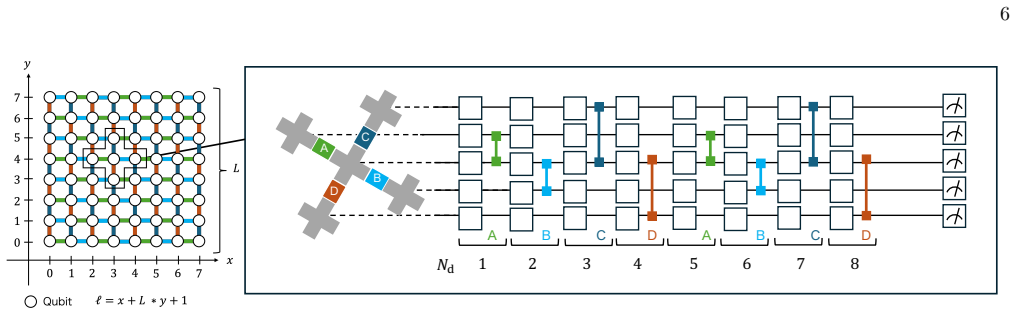
The load-bearing object is the particle-number-n subspace of dimension Dn = C(N,n), together with the rescaled Porter-Thomas formula Pn(pn)=Dn $e^{{-Dn pn}}$ that is assumed to describe the ideal output probabilities inside that subspace. The circuits are layers of U(1)-symmetric XXZ gates w(alpha1,alpha2)=exp(i[alpha1(X X+Y Y)+alpha2 Z Z]) on a square lattice, with either random angles or fixed angles alpha1=pi/8, alpha2=0; fixing the angles and placing the initial particle near the lattice center accelerates convergence to Porter-Thomas. The estimator FMLXEB,n in Eq. (11) renormalizes the standard LXEB formula by ns/Ns and Dn/ns, so that noiseless sampling gives 1 and fully depolarized sampling gives 0. The authors also introduce a finite-size scaling f(Nd)=((FMLXEB,n-1)/(Dn-2))^{1/(n+a)} with a=0.3, whose stretched-exponential fit predicts the circuit depth needed for reliable benchmarking at larger system sizes.
What would settle it
A direct way to test the central claim is to simulate the fixed-angle ensemble at N=144 or 196, n=3, at depths Nd near the fitted scaling value, and compare the sorted probability histogram to Dn $e^{{-Dn p}}$; if the distribution's deviation from Porter-Thomas remains visible (for example, a KL divergence that does not decrease with N) or if FMLXEB,n at p_noise=1e-3 disagrees with an independently computed gate-level fidelity beyond the sampling error, the normalization behind MLXEB fails.
Extended reading notes
Core claim
The paper's central claim is that fidelity estimation by cross entropy survives a symmetry restriction that makes the ideal distribution classically computable. Defining FMLXEB,n in Eq. (11) as (ns/Ns)[(Dn/ns) Σ pn(x'_j) - 1], with ns the measurement outcomes in the n-particle subspace and pn the noiseless probabilities there, the authors maintain that FMLXEB,n coincides with the circuit fidelity F when the output distribution approaches the rescaled Porter-Thomas distribution Pn(p)=Dn $e^{{-Dn p}}$ and the depolarizing noise rate is low. They demonstrate numerically that square-lattice circuits of U(1)-symmetric XXZ gates, with either random or fixed gate angles, produce this distribution for N=36 to 196 qubits, and that FMLXEB,n converges to 1 noiselessly and matches the true fidelity at p_noise around 1e-3. The method thereby claims access to benchmark regimes beyond the roughly 50-qubit classical simulation wall of ordinary LXEB while remaining compatible with non-Clifford random circuits.
Load-bearing premise
The fragile premise is that the fixed-angle XXZ circuits (alpha1=pi/8, alpha2=0) on a square lattice produce the rescaled Porter-Thomas distribution over the whole n-particle subspace at the depths used; the paper verifies this numerically only up to N=100 for fixed angles (and N=196 for random angles), and it leaves open which t-design property the fixed-angle ensemble satisfies.
Editorial extensions
If this is right
- MLXEB should benchmark the fidelity of U(1)-symmetric circuits on devices with more than 100 qubits whenever n=O(1), a scale beyond ordinary LXEB's exact-simulation reach.
- For 64-qubit circuits run at gate noise around 1e-3, MLXEB with n=1 estimates the overall fidelity at depth Nd approximately 30 within statistical uncertainty.
- In the random-angle ensemble, the depth dependence obeys a single scaling curve, so the required depth for a target fidelity can be predicted for larger devices before running them.
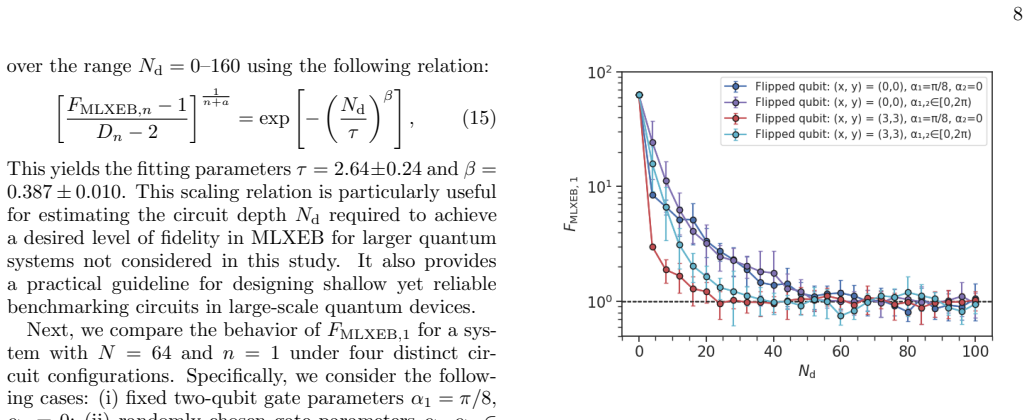
- Fixed-angle circuits converge to the rescaled Porter-Thomas distribution with less depth, which is useful on hardware with a limited coherent gate budget; however, no scaling relation is yet known for that ensemble.
- Because the circuits use non-Clifford XXZ gates, the method covers benchmarking scenarios that Clifford-based benchmarking methods cannot address.
Reading between the lines
- If the fixed-angle U(1)-symmetric ensemble is later proven to be a unitary t-design (meaning its statistical moments match Haar-random unitaries), the numerical convergence seen here would become a theorem, and the method would need no per-circuit random angle sampling at all.
- The same subspace-truncation idea used for noisy simulation, retaining particle sectors above n, could be adapted to extract noise rates or to benchmark hardware with U(1) charge conservation, such as fermionic simulators.
- A natural next test is to apply MLXEB to N>200 at n=2 or 3 with the fixed-angle circuits; if the random-angle scaling relation does not reappear, depth planning for those circuits will need a separate heuristic.
- If per-gate error rates continue to drop toward 1e-4, the usable depth and system size for accurate MLXEB estimates would grow roughly logarithmically with inverse noise, potentially reaching the 1000-qubit simulation capability the authors report.
Signed reviews
Editorial analysis
A structured set of objections, weighed in public.
Referee Report
Summary. This paper proposes MLXEB, a modified linear cross-entropy benchmark for particle-number-conserving (U(1)-symmetric) random quantum circuits. By restricting the Hilbert space to a fixed particle-number sector of dimension D_n = C(N,n), the authors argue that the ideal output distribution can be simulated classically for N>100 when n=O(1). The estimator F_MLXEB,n in Eq. (11) is constructed so that, when the ideal distribution in the n-particle sector is the rescaled Porter-Thomas distribution, it should equal the circuit fidelity F. Numerical tests are reported for noiseless circuits up to N=196, for two gate-angle settings (random and fixed α1=π/8, α2=0), showing convergence of F_MLXEB to 1 with depth and a data collapse based on Eq. (13). Under depolarizing noise, a single N=64, n=1 fixed-angle configuration is reported to match the true fidelity for p_noise ≤ 2×10^-3. The paper is candid about open questions, including the t-design class of the fixed-angle ensemble and the absence of a consistent scaling relation for fixed angles.
Significance. If the claims hold, MLXEB would be a useful extension of LXEB to non-Clifford circuits on devices beyond 50 qubits, a gap the paper identifies correctly. The strengths include: the fidelity estimator is benchmarked against an independently computed true fidelity rather than against itself; the noiseless random-angle results show a scaling collapse over system sizes and particle numbers; and the use of particle-number conservation to enable classical simulation is sound. The paper also explicitly flags the main caveats, which is helpful. However, the practical fixed-angle variant—the one recommended for shallow noisy circuits—is validated for Porter-Thomas behavior only up to N=100 and for fidelity tracking only at N=64, so the headline scalability claim is only partially supported.
major comments (4)
- [§IV B, §V] The fixed-angle circuit ensemble (α1=π/8, α2=0) is the variant used in the noisy benchmark and recommended for hardware, but its convergence to the rescaled Porter-Thomas distribution is verified only for N=36, 64, and 100 at depth Nd=160 (Fig. 2), and Section V explicitly states that the scaling relation in Eq. (13) does not hold consistently for this ensemble and that its t-design class is open. Since Eq. (11) is normalized by D_n and is valid only if the ideal n-particle distribution is the rescaled Porter-Thomas distribution, the extrapolation of the fixed-angle protocol to devices with more than 100 qubits—which appears in the abstract and conclusion—is unsupported. I request either a numerical test of fixed-angle Porter-Thomas convergence for N>100 (at least for n=1) or a revision that restricts the practical scalability claim to the random-angle protocol and states the fixed-angle protocol's validity as demonstrated only up to N=100.
- [§IV D, Fig. 8] The central noisy validation claims that F_MLXEB,1 agrees with the true circuit fidelity for 1.0×10^-3 ≤ p_noise ≤ 2.0×10^-3, and that the deviation at p_noise ≥ 3.0×10^-3 is due to sampling error scaling as O(1/sqrt(N_s N_c)). No error bars or confidence intervals are described, and the text does not quantify the variance of F_MLXEB under the Porter-Thomas model. Given that the asymptotic standard deviation of an LXEB-type estimator can be estimated as sqrt(2/n_s) (roughly 1.4×10^-3 for the total samples used here), the claimed sampling-error explanation for discrepancies at p_noise = 3×10^-3 needs a quantitative check rather than a qualitative statement. Please add error bars (for example, bootstrap over the N_c=10 circuit instances) and, if the discrepancy persists, discuss possible bias from the n_max=3 truncation.
- [§IV C, Eq. (13)] The finite-size scaling relation in Eq. (13) is introduced with an exponent 1/(n+a) whose form is motivated heuristically, with a=0.3 chosen to achieve a collapse, and the stretched-exponential parameters in Eq. (15) are fit to the same data that are then shown as collapsed. The relation is used in the conclusion to predict the circuit depth required for devices larger than those simulated, but no held-out predictive test is reported. If the scaling relation is meant to guide experimental design for N>196, please validate it by fitting on a subset of (N,n) pairs and predicting held-out data, or clearly label it as an empirical observation for the studied sizes.
- [§IV D, Fig. 6] The truncation strategy n_max=3, used for the principal N=64, n=1 noisy simulation, is validated in Fig. 6 only for N=16, n=3 by comparison with the full Hilbert space. The theoretical argument that leakage to sectors with |δn|>2 is O(p_noise^3) is reasonable, but since this truncation underlies the only fidelity-tracking demonstration, it would strengthen the paper to verify at a larger system size where full simulation is still possible (e.g., N=20 or 24 with n=1) that the observable F_MLXEB is insensitive to the truncation cutoff, or to provide an explicit bound on the induced error.
minor comments (4)
- [§V] The word 'consistenty' in the first paragraph of Section V should be 'consistently'.
- [§IV B, §IV C] The text says Porter-Thomas convergence is confirmed for N=36 to 100, but the abstract and conclusion later refer to validation up to N=196; it should be stated explicitly that the N=196 validation is for noiseless F_MLXEB convergence (Fig. 3) and not for a direct Porter-Thomas histogram comparison.
- [§IV D] The sentence 'validating the analytical expression used in Eq. (6)' appears to be a typo for Eq. (16), since Eq. (6) defines the particle-number sector G_n rather than the predicted-fidelity formula.
- [§IV A] The noise model applies a two-qubit Pauli selected uniformly from the 15 non-identity Paulis with probability p_noise; this is a valid depolarizing channel but should be stated explicitly as the convention used, to avoid confusion with the more common convention where each non-identity Pauli occurs with probability p_noise/15.
Circularity Check
No circularity: MLXEB is benchmarked against an independently computed state fidelity and its Porter-Thomas premise is cited from independent prior work.
full rationale
The paper's derivation chain is self-contained and no load-bearing step reduces to its own inputs. The estimator FMLXEB,n in Eq. (11) is the standard LXEB expression restricted to the fixed-particle-number subspace, and its identification with circuit fidelity rests on the rescaled Porter-Thomas property (Eq. (10)), which is imported from Refs. [38,39] — independent work not authored by the present authors. The numerical validation compares FMLXEB,1 against a separately evaluated state fidelity from the same depolarizing noise model (via overlap averaging of |ψ_noise⟩ with |ψ_n⟩), so the match is not a tautology of the estimator's definition. The noiseless limit FMLXEB,n → 1 is a built-in consistency property rather than a claimed prediction, and the high-noise limit → 0 is likewise an immediate consequence of the estimator form and uniform noise. The only fitted parameters (a = 0.3, τ, β) appear in the auxiliary finite-size scaling relation Eq. (13)/(15), which the paper explicitly presents as empirical and even notes does not hold for fixed-angle circuits in Section V; this relation is not used to define or justify the fidelity estimate. The citation of the author's own QS^3 software (Refs. [46,47]) is merely for the simulation tool, not for a scientific premise. Therefore, the central claims are supported by external statistical assumptions and independent numerical benchmarks, and no circular step meets the evidentiary bar of this review.
Assumptions & free parameters
free parameters (3)
- a (scaling exponent offset) =
0.3
- tau (stretched exponential time constant) =
2.64 +/- 0.24
- beta (stretched exponential exponent) =
0.387 +/- 0.010
assumptions (5)
- standard math Porter-Thomas distribution for Haar-random unitaries, with P(p)=D e^{-Dp}.
- domain assumption The U(1)-symmetric random circuit ensemble converges to a unitary t-design or at least produces Porter-Thomas output in the fixed-particle-number subspace.
- domain assumption Depolarizing noise applied independently after each gate and before measurement is an adequate model for device noise in the benchmarking regime.
- standard math Monte Carlo wavefunction sampling with Pauli errors reproduces the full density-matrix evolution in the limits used.
- ad hoc to paper The subspace truncation nmax=3 captures all relevant noise leakage for n=1, N=64.
Cite this review
Pith. "Pith review of Large-Scale Quantum Device Benchmarking via LXEB with Particle-Number-Conserving Random Quantum Circuits." pith.science (2026). https://pith.science/paper/2TFCLBKH
@misc{pith2026250510820,
  author       = {Pith},
  title        = {Pith review of: Large-Scale Quantum Device Benchmarking via LXEB with Particle-Number-Conserving Random Quantum Circuits},
  year         = {2026},
  howpublished = {\url{https://pith.science/paper/2TFCLBKH}},
  note         = {Machine review of arXiv:2505.10820}
}
abstract
Linear cross-entropy benchmarking (LXEB) with random quantum circuits is a standard method for evaluating quantum computers. However, LXEB requires classically simulating the ideal output distribution of a given quantum circuit with high numerical precision, which becomes infeasible beyond approximately 50 qubits, even on state-of-the-art supercomputers. As a result, LXEB cannot be directly applied to evaluate large-scale quantum devices, which now exceed 100 qubits and continue to grow rapidly in size. To address this limitation, we introduce a constraint known as particle-number conservation into the random quantum circuits used for benchmarking. This restriction significantly reduces the size of the Hilbert space for a fixed particle number, enabling classical simulations of circuits with over 100 qubits when the particle number is $O(1)$. Furthermore, we propose a modified version of LXEB, called MLXEB, which enables fidelity estimation under particle-number-conserving dynamics. Through numerical simulations, we investigate the conditions under which MLXEB provides accurate fidelity estimates.
Figures


Figures from the paper (3 more)


Reference graph
Works this paper leans on
-
[1]
Subtract the trivial asymptotic value 1 from FMLXEB,n, to which it converges as Nd→∞ . 7 (a) (b) (c) FIG. 3. Circuit depth dependence of (a) FMLXEB,1, (b) FMLXEB,2, and (c) FMLXEB,3 under noiseless conditions (pnoise = 0). The initial state is prepared by applying X gates to qubits at positions (0, 0),..., (n−1, 0) of the vacuum state |ψ0⟩. The rotation a...
-
[2]
Normalize FMLXEB,n− 1 by dividing by Dn− 2, so that the result becomes 1 at Nd = 0, regardless of N and n
-
[3]
Under the condition n≪ N, the quantum state in the basis {|x⟩∈ Gn} expands to approximately O(2n) states under the action of a single layer (A, B, C, or D) of the quantum circuit. To elimi- nate the n-dependence of the convergence rate of FMLXEB,n towards 1, the exponent is divided by a linear function of n, specifically n +a, where a is a fitting paramet...
-
[4]
A. M. Dalzell, S. McArdle, M. Berta, P. Bienias, C.- F. Chen, A. Gily´ en, C. T. Hann, M. J. Kastoryano, E. T. Khabiboulline, A. Kubica, et al. , arXiv preprint arXiv:2310.03011 (2023)
arXiv 2023
-
[5]
Arute, K
F. Arute, K. Arya, R. Babbush, D. Bacon, J. C. Bardin, R. Barends, R. Biswas, S. Boixo, F. G. Brandao, D. A. Buell, et al. , Nature 574, 505 (2019)
2019
- [6]
-
[7]
D. Gao, D. Fan, C. Zha, J. Bei, G. Cai, J. Cai, S. Cao, F. Chen, J. Chen, K. Chen, et al. , Physical Review Let- ters 134, 090601 (2025)
work page 2025
-
[8]
M. DeCross, R. Haghshenas, M. Liu, E. Rinaldi, J. Gray, Y. Alexeev, C. H. Baldwin, J. P. Bartolotta, M. Bohn, E. Chertkov, et al. , arXiv preprint arXiv:2406.02501 (2024)
arXiv 2024
Show all 50 references
-
[9]
Acharya, D
R. Acharya, D. A. Abanin, L. Aghababaie-Beni, I. Aleiner, T. I. Andersen, M. Ansmann, F. Arute, K. Arya, A. Asfaw, N. Astrakhantsev, et al. , Nature (2024)
2024
-
[10]
Katabarwa, K
A. Katabarwa, K. Gratsea, A. Caesura, and P. D. John- son, PRX Quantum 5, 020101 (2024)
2024
-
[11]
AbuGhanem, The Journal of Supercomputing 81, 687 (2025)
M. AbuGhanem, The Journal of Supercomputing 81, 687 (2025)
2025
-
[12]
Preskill, Quantum 2, 79 (2018)
J. Preskill, Quantum 2, 79 (2018)
2018
-
[13]
Eisert, D
J. Eisert, D. Hangleiter, N. Walk, I. Roth, D. Markham, R. Parekh, U. Chabaud, and E. Kashefi, Nature Reviews Physics 2, 382 (2020)
2020
-
[14]
A. G. Fowler, M. Mariantoni, J. M. Martinis, and A. N. Cleland, Physical Review A—Atomic, Molecular, and Optical Physics 86, 032324 (2012)
2012
-
[15]
Dennis, A
E. Dennis, A. Kitaev, A. Landahl, and J. Preskill, Jour- nal of Mathematical Physics 43, 4452 (2002)
2002
-
[16]
Z. Zhou, A. Ji, and Y. Ding, arXiv preprint arXiv:2503.04642 (2025)
2025 arXiv
-
[17]
J. F. Kam, S. Gicev, K. Modi, A. Southwell, and M. Us- man, arXiv preprint arXiv:2410.23779 (2024)
2024 arXiv
-
[18]
Proctor, K
T. Proctor, K. Young, A. D. Baczewski, and R. Blume- Kohout, Nature Reviews Physics , 1 (2025)
2025
-
[19]
Erhard, J
A. Erhard, J. J. Wallman, L. Postler, M. Meth, R. Stricker, E. A. Martinez, P. Schindler, T. Monz, 11 J. Emerson, and R. Blatt, Nature communications 10, 5347 (2019)
2019
-
[20]
Harper, S
R. Harper, S. T. Flammia, and J. J. Wallman, Nature Physics 16, 1184 (2020)
2020
-
[21]
Magesan, J
E. Magesan, J. M. Gambetta, and J. Emerson, Physical Review A—Atomic, Molecular, and Optical Physics 85, 042311 (2012)
2012
-
[22]
Knill, D
E. Knill, D. Leibfried, R. Reichle, J. Britton, R. B. Blakestad, J. D. Jost, C. Langer, R. Ozeri, S. Seidelin, and D. J. Wineland, Physical Review A—Atomic, Molec- ular, and Optical Physics 77, 012307 (2008)
2008
-
[23]
Dankert, R
C. Dankert, R. Cleve, J. Emerson, and E. Livine, Physical Review A—Atomic, Molecular, and Optical Physics 80, 012304 (2009)
2009
-
[24]
Magesan, J
E. Magesan, J. M. Gambetta, and J. Emerson, Physical review letters 106, 180504 (2011)
2011
-
[25]
S. T. Flammia and J. J. Wallman, ACM Transactions on Quantum Computing 1, 1 (2020)
2020
-
[26]
Harper, W
R. Harper, W. Yu, and S. T. Flammia, PRX Quantum 2, 010322 (2021)
2021
-
[27]
S. T. Flammia and R. O’Donnell, Quantum5, 549 (2021)
2021
-
[28]
S. T. Flammia, arXiv preprint arXiv:2108.05803 (2021)
2021 arXiv
-
[29]
Boixo, S
S. Boixo, S. V. Isakov, V. N. Smelyanskiy, R. Babbush, N. Ding, Z. Jiang, M. J. Bremner, J. M. Martinis, and H. Neven, Nature Physics 14, 595 (2018)
2018
-
[30]
Mullane, arXiv preprint arXiv:2007.07872 (2020)
S. Mullane, arXiv preprint arXiv:2007.07872 (2020)
2020 arXiv
-
[31]
Y. Liu, M. Otten, R. Bassirianjahromi, L. Jiang, and B. Fefferman, arXiv preprint arXiv:2105.05232 (2021)
2021 arXiv
-
[32]
J. Chen, D. Ding, C. Huang, and L. Kong, Physical Re- view A 108, 052613 (2023)
2023
-
[33]
Cheng, F
B. Cheng, F. Meng, Z.-J. Zhang, and M.-H. Yung, Chip , 100127 (2025)
2025
-
[34]
Lacroix, E
D. Lacroix, E. A. Ruiz Guzman, and P. Siwach, The Eu- ropean Physical Journal A 59, 3 (2023)
2023
-
[35]
P. K. Barkoutsos, J. F. Gonthier, I. Sokolov, N. Moll, G. Salis, A. Fuhrer, M. Ganzhorn, D. J. Egger, M. Troyer, A. Mezzacapo, et al. , Physical Review A 98, 022322 (2018)
2018
-
[36]
J. J. Meyer, M. Mularski, E. Gil-Fuster, A. A. Mele, F. Arzani, A. Wilms, and J. Eisert, PRX quantum 4, 010328 (2023)
2023
-
[37]
J. M. Arrazola, O. Di Matteo, N. Quesada, S. Jahangiri, A. Delgado, and N. Killoran, Quantum 6, 742 (2022)
2022
-
[38]
B. M. Ayeni, arXiv preprint arXiv:2308.08912 (2023)
2023 arXiv
-
[39]
B. T. Gard, L. Zhu, G. S. Barron, N. J. Mayhall, S. E. Economou, and E. Barnes, npj Quantum Information 6, 10 (2020)
2020
-
[40]
Summer, A
A. Summer, A. Nico-Katz, S. Dooley, and J. Goold, arXiv preprint arXiv:2411.14357 (2024)
2024 arXiv
-
[41]
H. Liu, A. Hulse, and I. Marvian, arXiv preprint arXiv:2408.14463 (2024)
2024 arXiv
-
[42]
Mitsuhashi, R
Y. Mitsuhashi, R. Suzuki, T. Soejima, and N. Yoshioka, Physical Review Letters 134, 180404 (2025)
2025
-
[43]
Khaneja, R
N. Khaneja, R. Brockett, and S. J. Glaser, Phys. Rev. A 63, 032308 (2001)
2001
-
[44]
Kraus and J
B. Kraus and J. I. Cirac, Phys. Rev. A 63, 062309 (2001)
2001
-
[45]
Suzuki, H
R. Suzuki, H. Katsura, Y. Mitsuhashi, T. Soejima, J. Eis- ert, and N. Yoshioka, More global randomness from less random local gates (2024), arXiv:2410.24127 [quant-ph]
2024 arXiv
-
[46]
A. W. Harrow and R. A. Low, Communications in Math- ematical Physics 291, 257 (2009)
2009
-
[47]
Nielsen and I
M. Nielsen and I. Chuang, Quantum Computation and Quantum Information: 10th Anniversary Edition (Cam- bridge University Press, 2010)
2010
-
[48]
Mølmer, Y
K. Mølmer, Y. Castin, and J. Dalibard, J. Opt. Soc. Am. B 10, 524 (1993)
1993
-
[49]
H. Ueda, S. Yunoki, and T. Shimokawa, Computer Physics Communications 277, 108369 (2022)
2022
-
[50]
H. Ueda, D. Yamamoto, and T. Shimokawa, Qs 3 for var- ious quantum spin systems (2023)
2023
Reviewed August 15, 2026 · model on record in the stance chip above.
Discussion (0). Continue with ORCID to comment.