REVIEW 2 major objections 5 minor 99 references
Impact of numerical stability in Bayesian noise wave calibration on global 21-cm experiments
T0 review · 2 major / 5 minor · reviewed 2026-07-30 · grok-4.5
Pith's one-line read A hidden degeneracy in noise-wave calibration makes global 21-cm solutions non-reproducible across computers, and fixing the noise-source temperature restores stability.
desk verdict Solid diagnosis of a real X_NS–X_L ill-conditioning problem in noise-wave calibration, with a clean 4-NWP fix; the hot-load T_NS(ν) half is only half-validated on mocks. read the letter →
The pith
A machine-rendered reading of the paper's core claim, the machinery that carries it, and where it could break.
The reading
What carries the argument
The X_NS–X_L degeneracy in the noise-wave design matrix (X_NS = X_L × (P_cal−P_L)/(P_NS−P_L)), diagnosed by SVD and condition number of the posterior covariance V*, and removed by a Chebyshev 4-NWP fit with T_NS held fixed (scalar or hot-load-recovered).
What would settle it
Run the same mock calibrator suite through the Chebyshev 4-NWP and original monomial 5-NWP pipelines under two different BLAS backends: if κ(V*) stays near 10^10 and residuals still differ by tenths of a kelvin after the 4-NWP fix, or if real lab S-parameter data reverse the mock residual improvement, the claim fails.
Extended reading notes
Core claim
The REACH Bayesian noise-wave posterior is driven to condition numbers κ(V*) ~ 10^9–10^11 by near-collinearity of the X_NS and X_L design-matrix columns. Fixing T_NS—either to a manufacturer scalar or to a smooth curve recovered iteratively from the hot-load residual—in a Chebyshev four-parameter fit reduces κ(V*) to ~60, restores cross-backend reproducibility, and on mock data yields calibration residuals comparable to the unstable five-parameter pipeline; masking narrow cable standing-wave channels further removes local design-matrix artefacts.
Load-bearing premise
That results from one family of REACH-like mock datasets transfer to real on-sky receiver data, including that hot-load recovery of T_NS stays unbiased when the hot-load noise-source weight is small or edge channels are masked.
Editorial extensions
If this is right
- Global 21-cm pipelines that use noise-wave calibration should treat condition number of V* as a standard diagnostic alongside residual RMSE.
- A four-parameter fit with T_NS fixed (scalar ENR or hot-load-recovered) can replace the five-parameter joint fit without sacrificing mock accuracy while making solutions environment-independent.
- Cable-connected calibrator suites need automated spike detection and narrow-channel masking where standing waves make X-matrix columns locally collinear.
- Other experiments using the same noise-wave formalism (not only REACH) inherit the X_NS–X_L degeneracy and can adopt the same reduction.
- Bayesian evidence used for polynomial-order selection becomes trustworthy only after the posterior is well-conditioned.
Reading between the lines
- If unaddressed, environment-dependent millikelvin residuals could be absorbed into claimed 21-cm absorption features or into foreground model choices, mimicking the kinds of systematics already debated in existing global-signal claims.
- The hot-load iteration is essentially a constrained scale/offset self-calibration; experiments without a well-characterized hot load may need an external ENR standard or a different absolute temperature anchor.
- Sub-band calibration plus edge-aware masking may become necessary whenever high-order global polynomials are fit across cable-induced spikes.
- Publishing κ(V*) and cross-backend residual differences could become a minimal reproducibility checklist for precision radio calibration papers.
Signed reviews
Editorial analysis
A structured set of objections, weighed in public.
Referee Report
Summary. The paper diagnoses a numerical instability in the REACH Bayesian noise-wave calibration pipeline: the posterior covariance reaches κ(V*)∼10^9–10^11, so identical code and mock data yield environment-dependent solutions (NumPy 1.x vs 2.x). SVD and a controlled synthetic experiment attribute the ill-conditioning to monomial collinearity and, more critically, near-collinearity of the design-matrix columns X_NS and X_L (Eqs. 7, 10). Mitigations are a stacked Chebyshev basis, a 4-NWP model that fixes T_NS (scalar ENR or iterative hot-load recovery of T_NS(ν)), and masking of cable standing-wave spikes in κ(X). On REACH-like mock data these steps reduce κ(V*) to ∼60, restore cross-backend reproducibility, and (for the full-band hot-load route) bring antenna residuals to a level comparable to the unstable 5-NWP fit.
Significance. If the diagnosis and mitigations hold on real receiver data, the work identifies a previously under-appreciated reproducibility failure that is inherent to the noise-wave formalism whenever (P_cal−P_L)/(P_NS−P_L)≈1, and supplies a practical, physically motivated fix (4-NWP + optional hot-load T_NS(ν) + spike masking) that other global 21-cm experiments can adopt. Strengths include clear ablations (Table 1), SVD/condition-number diagnostics, a controlled synthetic isolation of the X_NS–X_L driver (Fig. 7), and an explicit cross-backend reproducibility test (Figs. 2, 16). The paper correctly elevates numerical stability to a first-class calibration requirement alongside accuracy.
major comments (2)
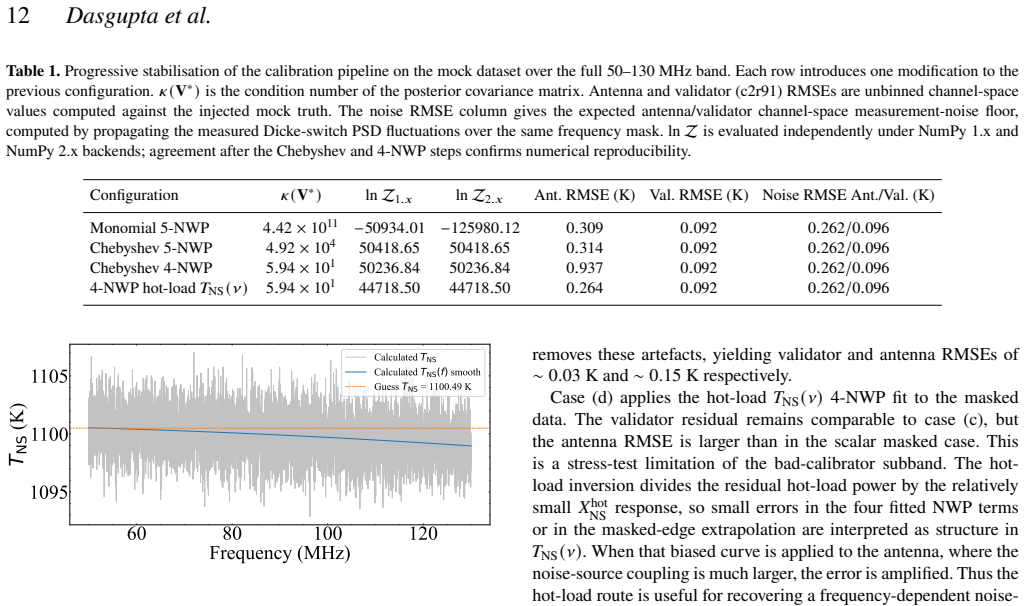
- [§4, Table 1, Abstract] All quantitative accuracy claims (Table 1; Figs. 13–15) and the packaged “stable, data-driven” procedure rest on one REACH-like mock family (lab S-parameters, simulated noise parameters, power-law antenna, no antenna cable). The central conditioning diagnosis is tightly supported on these mocks, but transfer of the iterative hot-load T_NS(ν) route to real data is not demonstrated. A real-receiver or multi-mock validation (or an explicit limitation statement that accuracy claims are mock-only) is needed before the abstract’s broader claim is warranted.
- [§3.4.3, §3.5, §4, Fig. 17, Abstract] The paper’s own bad-calibrator subband test already shows that hot-load recovery can bias the antenna: with masking, antenna RMSE rises from 0.140 K (scalar 4-NWP) to 0.284 K (hot-load T_NS(ν); Fig. 17 case d). Recovery divides the hot-load residual by X_NS^hot (Eq. 24); when that weight is small or high-leverage edge channels are masked (§3.5), residual NWP/edge errors are absorbed into T_NS(ν) and amplified on the antenna. The abstract and §5 still present hot-load recovery as achieving “comparable calibration accuracy” without stating the regime of validity or a decision rule (when to prefer scalar ENR vs hot-load). That caveat should be quantitative and prominent.
minor comments (5)
- [§2.2–3.4] Inconsistent notation for the design-matrix columns (X_NS vs XNS, bold/unbold V*) and occasional missing spaces in compound words (e.g. “design-matrixcolumns”) should be cleaned for production.
- [Fig. 10, §3.4.2] Figure 10 caption reports κ≈5.94×10^1 while the text sometimes rounds to ∼60; keep a single reported value.
- [§2.3, Table 1] The conjugate-prior hyperparameters (μ0, V0, a0, b0) and the precise Chebyshev degree choices used for the main Table 1 runs should be stated explicitly so the reproducibility test can be repeated.
- [§3.2, Fig. 11] Typos: “Decompostition” (Fig. 4 discussion), “interation” (Fig. 11 caption), and “afactor” / similar run-ons in §3.4.
- [§3.4.3] Related EDGES iterative calibration (Monsalve et al. 2017) is cited; a slightly sharper statement of what is identical vs analogous (C1/C2 vs T_NS/T_L) would help readers already familiar with that pipeline.
Circularity Check
No significant circularity: numerical diagnosis and 4-NWP mitigation are checked against linear-algebra structure and held-out mock truth, not against quantities defined to equal the fit.
full rationale
The paper’s load-bearing chain is diagnostic and methodological, not a first-principles prediction that collapses into its inputs. Ill-conditioning is exhibited by computing κ(V*) and the SVD of the posterior under two LAPACK backends on identical mock data (Figs. 2–4); the X_NS–X_L near-collinearity follows directly from the standard noise-wave design-matrix definitions (Eqs. 7, 10) when the Dicke power ratio is near unity, which is a structural fact of the formalism rather than a fitted quantity renamed as a result. Mitigation—Chebyshev basis, stacked update, fixing T_NS (scalar ENR or iterative hot-load recovery), and optional spike masking—is validated by re-measuring κ(V*), cross-backend log-evidence identity, and residuals against injected mock truth plus a held-out validator (c2r91) never used in the fit (Table 1; Figs. 13–16). Hot-load T_NS(ν) recovery is iterative self-consistency within the same linear model (analogous to Monsalve et al. 2017), but the accuracy claim is scored on independent channels/sources, not on the hot-load residual that supplied T_NS. Self-citations (Roque et al. 2021; Dash et al. 2026; Kirkham et al.) supply the REACH pipeline and the condition-number diagnostic; they are not uniqueness theorems that force the central numerical claim. Weaknesses (mock-only transfer; bad-calibrator antenna RMSE rise under hot-load+mask) are external-validity / correctness issues, not circular reductions. Score 0 is therefore appropriate.
Assumptions & free parameters
free parameters (5)
- NWP polynomial orders (e.g. 9/9/9/2/2 or Chebyshev n=[10,10,10,1,1]) =
diagnostic runs use up to order 9–10 for T_unc/cos/sin; T_NS/T_L low order
- Scalar T_NS / ENR anchor =
~1100 K (datasheet); guess 1100.49 K in Fig. 13
- T_NS(ν) smoother order =
2
- Cable-spike mask half-width =
±1.5 MHz
- Conjugate-prior hyperparameters (μ0, V0, a0, b0)
assumptions (5)
- domain assumption Noise-wave linear model T_cal = X_unc T_unc + X_cos T_cos + X_sin T_sin + X_NS T_NS + X_L T_L + σ with X_NS = X_L (P_cal−P_L)/(P_NS−P_L) (Meys; Rogers & Bowman; Roque et al.)
- domain assumption Normal-inverse-gamma conjugate prior yields closed-form V* = (V0^{-1} + X^T X)^{-1} whose condition number diagnoses stability
- ad hoc to paper Mock dataset from lab S-parameters and simulated noise parameters is sufficiently faithful that κ, residuals, and backend divergence diagnose the real REACH pipeline
- standard math Ill-conditioned inversion amplifies backend floating-point summation order differences by ~κ (standard numerical analysis)
- standard math Chebyshev polynomials of the first kind are sufficiently orthogonal on the mapped band to reduce basis collinearity versus monomials
Cite this review
Pith. "Pith review of Impact of numerical stability in Bayesian noise wave calibration on global 21-cm experiments." pith.science (2026). https://pith.science/paper/2TGCHVUV
@misc{pith2026260726911,
  author       = {Pith},
  title        = {Pith review of: Impact of numerical stability in Bayesian noise wave calibration on global 21-cm experiments},
  year         = {2026},
  howpublished = {\url{https://pith.science/paper/2TGCHVUV}},
  note         = {Machine review of arXiv:2607.26911}
}
abstract
Detecting the global 21-cm signal from the Cosmic Dawn and Epoch of Reionization requires calibration accuracy far below the level of astrophysical foregrounds. REACH models its receiver using the noise wave formalism, with five frequency-dependent low-noise amplifier parameters fitted jointly to multiple calibration sources. We identify a numerical instability in this Bayesian calibration pipeline: the condition number of the posterior covariance matrix reaches $\kappa(\mathbf{V}^*) \sim 10^{9}$--$10^{11}$, making solutions non-reproducible across computing environments. Singular value decomposition shows that the instability is driven by near-collinearity between the design-matrix columns associated with the excess noise source temperature, $X_\mathrm{NS}$, and the load temperature, $X_\mathrm{L}$. Using a Chebyshev basis, we develop a two-step mitigation. First, fixing $T_\mathrm{NS}$ to a scalar removes the degeneracy and reduces $\kappa(\mathbf{V}^*)$ to $\sim 60$. Second, to retain frequency dependence, we recover $T_\mathrm{NS}(\nu)$ directly from the hot-load calibration measurement. On mock data, this method preserves the stability of the reduced model while achieving comparable calibration accuracy. Masking narrow channels around cable standing-wave degeneracies further removes local artefacts in the design matrix. These steps provide a stable, reproducible, and data-driven calibration procedure. Because the $X_\mathrm{NS}$--$X_\mathrm{L}$ degeneracy is inherent to the noise wave formalism, the method is relevant to other global 21-cm experiments.
Figures
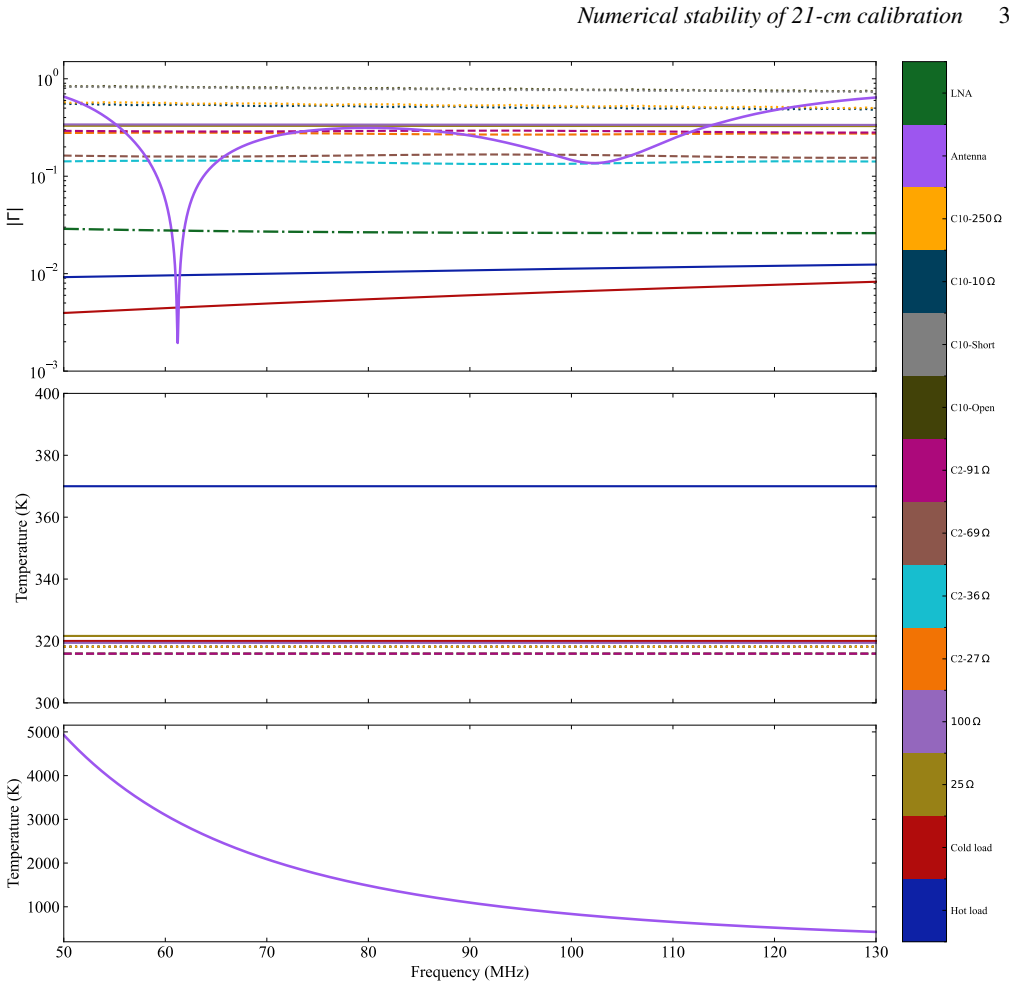


Figures from the paper (11 more)




Reference graph
Works this paper leans on
-
[1]
Cosmology at low frequencies: The 21 cm transition and the high-redshift Universe. Physics Reports , keywords =. doi:10.1016/j.physrep.2006.08.002 , adsurl =
-
[2]
Results from EDGES High-band. II. Constraints on Parameters of Early Galaxies. , keywords =. doi:10.3847/1538-4357/aace54 , archivePrefix =. 1806.07774 , primaryClass =
-
[3]
Astrophysical constraints from the SARAS 3 non-detection of the cosmic dawn sky-averaged 21-cm signal. Nature Astronomy , keywords =. doi:10.1038/s41550-022-01825-6 , archivePrefix =. 2212.00464 , primaryClass =
-
[4]
Calibration Error in 21-Centimeter Global Spectrum Experiment. Universe , keywords =. doi:10.3390/universe10060236 , archivePrefix =. 2405.17742 , primaryClass =
-
[5]
Mapper of the IGM spin temperature: instrument overview. , keywords =. doi:10.1093/mnras/stae1138 , archivePrefix =. 2309.02996 , primaryClass =
-
[6]
Journal of Astronomical Instrumentation , keywords =
Radio Antenna Design for Sky-Averaged 21cm Cosmology Experiments: The REACH Case. Journal of Astronomical Instrumentation , keywords =. doi:10.1142/S2251171722500015 , archivePrefix =. 2109.10098 , primaryClass =
-
[7]
Journal of Astronomical Instrumentation , keywords =
Probing Radio Intensity at High-Z from Marion: 2017 Instrument. Journal of Astronomical Instrumentation , keywords =. doi:10.1142/S2251171719500041 , archivePrefix =. 1806.09531 , primaryClass =
arXiv 2017
-
[8]
Experimental Astronomy , keywords =
Receiver design for the REACH global 21-cm signal experiment. Experimental Astronomy , keywords =. doi:10.1007/s10686-024-09975-3 , archivePrefix =. 2307.00099 , primaryClass =
Show all 99 references
-
[9]
arXiv e-prints , keywords =
RHINO: A large horn antenna for detecting the 21cm global signal. arXiv e-prints , keywords =. doi:10.48550/arXiv.2410.00076 , archivePrefix =. 2410.00076 , primaryClass =
-
[10]
arXiv e-prints , keywords =
The Electromagnetically Isolated Global Signal Estimation Platform (EIGSEP). arXiv e-prints , keywords =. doi:10.48550/arXiv.2602.02661 , archivePrefix =. 2602.02661 , primaryClass =
-
[11]
Experimental Astronomy , keywords =
SARAS: a precision system for measurement of the cosmic radio background and signatures from the epoch of reionization. Experimental Astronomy , keywords =. doi:10.1007/s10686-013-9336-3 , archivePrefix =. 1211.3800 , primaryClass =
-
[12]
Nature Astronomy , keywords =
On the detection of a cosmic dawn signal in the radio background. Nature Astronomy , keywords =. doi:10.1038/s41550-022-01610-5 , archivePrefix =. 2112.06778 , primaryClass =
-
[13]
, keywords =
Calibration of the EDGES High-band Receiver to Observe the Global 21 cm Signature from the Epoch of Reionization. , keywords =. doi:10.3847/1538-4357/835/1/49 , archivePrefix =. 1602.08065 , primaryClass =
-
[14]
, keywords =
An absorption profile centred at 78 megahertz in the sky-averaged spectrum. , keywords =. doi:10.1038/nature25792 , archivePrefix =. 1810.05912 , primaryClass =
-
[15]
, keywords =
Signature of excess radio background in the 21-cm global signal and power spectrum. , keywords =. doi:10.1093/mnras/stz873 , archivePrefix =. 1902.02438 , primaryClass =
1902 arXiv
-
[16]
, keywords =
Modeling the Radio Background from the First Black Holes at Cosmic Dawn: Implications for the 21 cm Absorption Amplitude. , keywords =. doi:10.3847/1538-4357/aae51d , archivePrefix =. 1803.01815 , primaryClass =
-
[17]
, keywords =
Concerns about modelling of the EDGES data. , keywords =. doi:10.1038/s41586-018-0796-5 , archivePrefix =. 1805.01421 , primaryClass =
-
[18]
, keywords =
The Redshifted 21 cm Signal in the EDGES Low-band Spectrum. , keywords =. doi:10.3847/1538-4357/ab2879 , archivePrefix =. 1903.04540 , primaryClass =
1903 arXiv
-
[19]
, keywords =
A Ground Plane Artifact that Induces an Absorption Profile in Averaged Spectra from Global 21 cm Measurements, with Possible Application to EDGES. , keywords =. doi:10.3847/1538-4357/ab0d8b , archivePrefix =. 1810.09015 , primaryClass =
-
[20]
, keywords =
A small amount of mini-charged dark matter could cool the baryons in the early Universe. , keywords =. doi:10.1038/s41586-018-0151-x , archivePrefix =. 1802.10094 , primaryClass =
-
[21]
, keywords =
Severely Constraining Dark-Matter Interpretations of the 21-cm Anomaly. , keywords =. doi:10.1103/PhysRevLett.121.011102 , archivePrefix =. 1803.02804 , primaryClass =
-
[22]
, year = 2018, month = jul, volume =
Implications of a 21-cm signal for dark matter annihilation and decay. , year = 2018, month = jul, volume =. doi:10.1103/PhysRevD.98.023501 , adsurl =
2018 doi
-
[23]
, keywords =
Can early dark energy explain EDGES?. , keywords =. doi:10.1088/1475-7516/2018/08/037 , archivePrefix =. 1803.07555 , primaryClass =
2018 arXiv
-
[24]
, keywords =
Constraints on superconducting cosmic strings from the global 21-cm signal before reionization. , keywords =. doi:10.1088/1475-7516/2019/09/009 , archivePrefix =. 1902.08282 , primaryClass =
2019 arXiv
-
[25]
, keywords =
High-redshift radio galaxies: a potential new source of 21-cm fluctuations. , keywords =. doi:10.1093/mnras/staa3091 , archivePrefix =. 2008.04315 , primaryClass =
2008 arXiv
-
[26]
, keywords =
Constraints on primordial black hole dark matter from Galactic center X-ray observations. , keywords =. doi:10.1051/0004-6361/201833483 , archivePrefix =. 1805.06513 , primaryClass =
-
[27]
, keywords =
21 cm limits on decaying dark matter and primordial black holes. , keywords =. doi:10.1103/PhysRevD.98.043006 , archivePrefix =. 1803.09390 , primaryClass =
-
[28]
, keywords =
Constraining primordial black holes as dark matter using the global 21-cm signal with X-ray heating and excess radio background. , keywords =. doi:10.1088/1475-7516/2022/03/030 , archivePrefix =. 2107.02190 , primaryClass =
2022 arXiv
-
[29]
, keywords =
BIGHORNS - Broadband Instrument for Global HydrOgen ReioNisation Signal. , keywords =. doi:10.1017/pasa.2015.3 , archivePrefix =. 1501.02922 , primaryClass =
2015 arXiv
-
[30]
Radio Science , keywords =
Absolute calibration of a wideband antenna and spectrometer for accurate sky noise temperature measurements. Radio Science , keywords =. doi:10.1029/2011RS004962 , archivePrefix =. 1209.1106 , primaryClass =
-
[31]
, journal=
Meys, R.P. , journal=. A Wave Approach to the Noise Properties of Linear Microwave Devices , year=
-
[32]
Bayesian Linear Model : Gory Details , booktitle=
Sudipto Banerjee , year=. Bayesian Linear Model : Gory Details , booktitle=
-
[33]
Nature Astronomy , keywords =
The REACH radiometer for detecting the 21-cm hydrogen signal from redshift z 7.5-28. Nature Astronomy , keywords =. doi:10.1038/s41550-022-01709-9 , archivePrefix =. 2210.07409 , primaryClass =
- [34]
-
[35]
Contemporary Physics , keywords =
Bayes in the sky: Bayesian inference and model selection in cosmology. Contemporary Physics , keywords =. doi:10.1080/00107510802066753 , archivePrefix =. 0803.4089 , primaryClass =
-
[36]
Proceedings of the IRE , keywords =
Representation of Noise in Linear Twoports. Proceedings of the IRE , keywords =. doi:10.1109/JRPROC.1960.287381 , adsurl =
1960
-
[37]
, keywords =
Bayesian noise wave calibration for 21-cm global experiments. , keywords =. doi:10.1093/mnras/stab1453 , archivePrefix =. 2011.14052 , primaryClass =
2011 arXiv
- [38]
-
[39]
2005 , publisher=
Regression diagnostics: Identifying influential data and sources of collinearity , author=. 2005 , publisher=
2005
-
[40]
2013 , publisher=
Approximation Theory and Approximation Practice , author=. 2013 , publisher=
2013
-
[41]
American Astronomical Society Meeting Abstracts \#225 , year = 2015, series =
Hydrogen Epoch of Reionization Array (HERA). American Astronomical Society Meeting Abstracts \#225 , year = 2015, series =
2015
-
[42]
, keywords =
HERA Phase I Limits on the Cosmic 21 cm Signal: Constraints on Astrophysics and Cosmology during the Epoch of Reionization. , keywords =. doi:10.3847/1538-4357/ac2ffc , archivePrefix =. 2108.07282 , primaryClass =
-
[43]
, keywords =
LOFAR: The LOw-Frequency ARray. , keywords =. doi:10.1051/0004-6361/201220873 , archivePrefix =. 1305.3550 , primaryClass =
-
[44]
SF2A-2021: Proceedings of the Annual meeting of the French Society of Astronomy and Astrophysics , year = 2021, editor =
Exploring the Cosmic Dawn with NenuFAR. SF2A-2021: Proceedings of the Annual meeting of the French Society of Astronomy and Astrophysics , year = 2021, editor =. doi:10.48550/arXiv.2109.10055 , archivePrefix =. 2109.10055 , primaryClass =
-
[45]
, keywords =
The Impact of Realistic Foreground and Instrument Models on 21 cm Epoch of Reionization Experiments. , keywords =. doi:10.3847/1538-4357/ab8003 , archivePrefix =. 2003.08552 , primaryClass =
2003 arXiv
-
[46]
, keywords =
Understanding spectral artefacts in SKA-Low 21-cm cosmology experiments: the impact of cable reflections. , keywords =. doi:10.1093/mnras/stae1952 , archivePrefix =. 2402.04008 , primaryClass =
-
[47]
, keywords =
21-cm foregrounds and polarization leakage: cleaning and mitigation strategies. , keywords =. doi:10.1093/mnras/stab856 , archivePrefix =. 2010.02907 , primaryClass =
2010 arXiv
-
[48]
, keywords =
Recovery of 21-cm intensity maps with sparse component separation. , keywords =. doi:10.1093/mnras/staa2854 , archivePrefix =. 2006.05996 , primaryClass =
2006 arXiv
-
[49]
, keywords =
Investigating mutual coupling in the hydrogen epoch of reionization array and mitigating its effects on the 21-cm power spectrum. , keywords =. doi:10.1093/mnras/staf1012 , archivePrefix =. 2406.08549 , primaryClass =
-
[50]
, keywords =
Uncovering the effects of array mutual coupling in 21-cm experiments with the SKA-Low radio telescope. , keywords =. doi:10.1093/mnras/staf264 , archivePrefix =. 2412.01699 , primaryClass =
-
[51]
, keywords =
The Effects of the Ionosphere on Ground-based Detection of the Global 21 cm Signal from the Cosmic Dawn and the Dark Ages. , keywords =. doi:10.3847/0004-637X/831/1/6 , adsurl =
-
[52]
, keywords =
Quantifying ionospheric effects on global 21-cm observations. , keywords =. doi:10.1093/mnras/stab429 , archivePrefix =. 2011.10517 , primaryClass =
2011 arXiv
-
[53]
, keywords =
Modelling a hot horizon in global 21-cm experimental foregrounds. , keywords =. doi:10.1093/mnras/stad3378 , archivePrefix =. 2307.02908 , primaryClass =
-
[54]
The Impact of Beam Variations on Power Spectrum Estimation for 21 cm Cosmology. I. Simulations of Foreground Contamination for HERA. , keywords =. doi:10.3847/1538-4357/ac9eaf , archivePrefix =. 2210.16421 , primaryClass =
-
[55]
, keywords =
Improved upper limits on the 21-cm signal power spectrum at z = 17.0 and z = 20.3 from an optimal field observed with NenuFAR. , keywords =. doi:10.1093/mnras/staf1386 , archivePrefix =. 2507.10533 , primaryClass =
-
[56]
, keywords =
The Murchison Widefield Array: The Square Kilometre Array Precursor at Low Radio Frequencies. , keywords =. doi:10.1017/pasa.2012.007 , archivePrefix =. 1206.6945 , primaryClass =
2012 arXiv
-
[57]
Indian Journal of Radio and Space Physics , keywords =
Giant metrewave radio telescope (GMRT) - Scientific objectives and design aspects. Indian Journal of Radio and Space Physics , keywords =
-
[58]
IEEE Proceedings , year = 2009, month = aug, volume =
The Square Kilometre Array. IEEE Proceedings , year = 2009, month = aug, volume =. doi:10.1109/JPROC.2009.2021005 , adsurl =
2009
- [59]
-
[60]
Formalism and the expected signal
On using visibility correlations to probe the HI distribution from the dark ages to the present epoch - I. Formalism and the expected signal. , keywords =. doi:10.1111/j.1365-2966.2004.08604.x , archivePrefix =. astro-ph/0406676 , primaryClass =
2004
-
[61]
, keywords =
Foreground simulations for the LOFAR-epoch of reionization experiment. , keywords =. doi:10.1111/j.1365-2966.2008.13634.x , archivePrefix =. 0804.1130 , primaryClass =
2008
-
[62]
, keywords =
Realistic simulations of the Galactic polarized foreground: consequences for 21-cm reionization detection experiments. , keywords =. doi:10.1111/j.1365-2966.2010.17407.x , archivePrefix =. 1007.4135 , primaryClass =
2010
-
[63]
, keywords =
Bright Source Subtraction Requirements for Redshifted 21 cm Measurements. , keywords =. doi:10.1088/0004-637X/724/1/526 , archivePrefix =. 1005.4071 , primaryClass =
-
[64]
Advancing Astrophysics with the Square Kilometre Array (AASKA14) , year = 2015, month = apr, eid =
The Cosmic Dawn and Epoch of Reionisation with SKA. Advancing Astrophysics with the Square Kilometre Array (AASKA14) , year = 2015, month = apr, eid =. doi:10.22323/1.215.0001 , archivePrefix =. 1505.07568 , primaryClass =
2015 arXiv
-
[65]
Experimental Astronomy , keywords =
Peering into the dark (ages) with low-frequency space interferometers. Experimental Astronomy , keywords =. doi:10.1007/s10686-021-09743-7 , archivePrefix =. 1908.04296 , primaryClass =
1908
-
[66]
American Astronomical Society Meeting \#240 , year = 2022, series =
In Search of New Physics in the Dark Ages using Low Radio Frequency Arrays on the Moon's Far Side. American Astronomical Society Meeting \#240 , year = 2022, series =
2022
-
[67]
, keywords =
Science with a lunar low-frequency array: From the dark ages of the Universe to nearby exoplanets. , keywords =. doi:10.1016/j.newar.2009.02.001 , archivePrefix =. 0902.0493 , primaryClass =
2009 arXiv
-
[68]
Advances in Space Research , keywords =
A roadmap towards a space-based radio telescope for ultra-low frequency radio astronomy. Advances in Space Research , keywords =. doi:10.1016/j.asr.2019.09.007 , archivePrefix =. 1909.08951 , primaryClass =
2019 arXiv
-
[69]
American Astronomical Society Meeting Abstracts \#234 , year = 2019, series =
Dark Cosmology: Investigating Dark Matter and Exotic Physics using the Redshifted 21-cm Global Signal with the Dark Ages Polarimeter Pathfinder (DAPPER). American Astronomical Society Meeting Abstracts \#234 , year = 2019, series =
2019
-
[70]
American Astronomical Society Meeting Abstracts \#235 , year = 2020, series =
FARSIDE: Farside Array for Radio Science Investigations of the Dark ages and Exoplanets. American Astronomical Society Meeting Abstracts \#235 , year = 2020, series =
2020
-
[71]
Experimental Astronomy , keywords =
PRATUSH experiment concept and design overview. Experimental Astronomy , keywords =. doi:10.1007/s10686-023-09909-5 , adsurl =
-
[72]
arXiv e-prints , keywords =
Results from NASA's First Radio Telescope on the Moon: Terrestrial Technosignatures and the Low-Frequency Galactic Background Observed by ROLSES-1 Onboard the Odysseus Lander. arXiv e-prints , keywords =. doi:10.48550/arXiv.2503.09842 , archivePrefix =. 2503.09842 , primaryClass =
-
[73]
Advances in Space Research , keywords =
FarView: An in-situ manufactured lunar far side radio array concept for 21-cm Dark Ages cosmology. Advances in Space Research , keywords =. doi:10.1016/j.asr.2024.04.008 , archivePrefix =. 2404.03840 , primaryClass =
2024 arXiv
- [74]
- [75]
-
[76]
Philosophical Transactions of the Royal Society of London Series A , keywords =
Cosmic mysteries and the hydrogen 21-cm line: bridging the gap with lunar observations. Philosophical Transactions of the Royal Society of London Series A , keywords =. doi:10.1098/rsta.2023.0068 , archivePrefix =. 2311.05366 , primaryClass =
2023
- [77]
-
[78]
, keywords =
Low Radio Frequency Observations from the Moon Enabled by NASA Landed Payload Missions. , keywords =. doi:10.3847/PSJ/abdfc3 , archivePrefix =. 2102.02331 , primaryClass =
-
[79]
American Astronomical Society Meeting \#240 , year = 2022, series =
Ultra-Long Wavelength Radio Astronomy Using the Lunar Crater Radio Telescope (LCRT) on the Farside of the Moon. American Astronomical Society Meeting \#240 , year = 2022, series =
2022
-
[80]
American Astronomical Society Meeting Abstracts , year = 2025, series =
The FarView Low Frequency Radio Array on the Moon: Mission Architecture. American Astronomical Society Meeting Abstracts , year = 2025, series =
2025
-
[81]
American Astronomical Society Meeting Abstracts , year = 2024, series =
The Astronomical Lunar Observatory (ALO) - Probing the cosmological Dark Ages and Cosmic Dawn with a distributed low-frequency radio array on the Lunar Far Side. American Astronomical Society Meeting Abstracts , year = 2024, series =
2024
-
[82]
Bulletin of the American Astronomical Society , year = 2019, volume =
FARSIDE: A Low Radio Frequency Interferometric Array on the Lunar Farside. Bulletin of the American Astronomical Society , year = 2019, volume =. doi:10.48550/arXiv.1907.05407 , archivePrefix =. 1907.05407 , primaryClass =
-
[83]
Philosophical Transactions of the Royal Society of London Series A , keywords =
Large-scale array for radio astronomy on the farside (LARAF). Philosophical Transactions of the Royal Society of London Series A , keywords =. doi:10.1098/rsta.2023.0094 , archivePrefix =. 2403.16409 , primaryClass =
2023
-
[84]
Philosophical Transactions of the Royal Society of London Series A , keywords =
Discovering the sky at the longest wavelengths with a lunar orbit array. Philosophical Transactions of the Royal Society of London Series A , keywords =. doi:10.1098/rsta.2019.0566 , archivePrefix =. 2007.15794 , primaryClass =
2019
-
[85]
, keywords =
Possible interaction between baryons and dark-matter particles revealed by the first stars. , keywords =. doi:10.1038/nature25791 , archivePrefix =. 1803.06698 , primaryClass =
-
[86]
, keywords =
Enhanced Global Signal of Neutral Hydrogen Due to Excess Radiation at Cosmic Dawn. , keywords =. doi:10.3847/2041-8213/aac0fe , archivePrefix =. 1802.07432 , primaryClass =
-
[87]
, keywords =
Testing for calibration systematics in the EDGES low-band data using Bayesian model selection. , keywords =. doi:10.1093/mnras/stz3388 , archivePrefix =. 1910.03165 , primaryClass =
1910 arXiv
-
[88]
arXiv e-prints , keywords =
Narrowing the discovery space of the cosmological 21-cm signal using multi-wavelength constraints. arXiv e-prints , keywords =. doi:10.48550/arXiv.2508.13761 , archivePrefix =. 2508.13761 , primaryClass =
-
[89]
Review of Scientific Instruments , year = 1946, month = jul, volume =
The Measurement of Thermal Radiation at Microwave Frequencies. Review of Scientific Instruments , year = 1946, month = jul, volume =. doi:10.1063/1.1770483 , adsurl =
1946 doi
-
[90]
, keywords =
Accounting for noise and singularities in Bayesian calibration methods for global 21-cm cosmology experiments. , keywords =. doi:10.1093/mnras/staf1715 , archivePrefix =. 2412.14023 , primaryClass =
-
[91]
, keywords =
Capturing system drift with time series calibration for Global 21-cm cosmology experiments. , keywords =. doi:10.1093/mnras/stag232 , archivePrefix =. 2509.13010 , primaryClass =
-
[92]
arXiv e-prints , keywords =
Optimisation of calibration sources for global 21-cm experiments: the REACH case. arXiv e-prints , keywords =. doi:10.48550/arXiv.2604.00105 , archivePrefix =. 2604.00105 , primaryClass =
-
[93]
NC346 Coaxial Series Noise Source --- Data Sheet
-
[94]
Nature , year = 2020, month = sep, volume =
Array programming with NumPy. Nature , year = 2020, month = sep, volume =
2020
-
[95]
IEEE Standard for Floating-Point Arithmetic
-
[96]
ACM Computing Surveys , year = 1991, volume =
What every computer scientist should know about floating-point arithmetic. ACM Computing Surveys , year = 1991, volume =
1991
-
[97]
Accuracy and Stability of Numerical Algorithms
-
[98]
Proceedings of the International Conference on High Performance Computing, Networking, Storage and Analysis (SC '13) , year = 2013, pages =
AUGEM: automatically generate high performance dense linear algebra kernels on x86 CPUs. Proceedings of the International Conference on High Performance Computing, Networking, Storage and Analysis (SC '13) , year = 2013, pages =
2013
-
[99]
Introduction to the Conditional Numerical Reproducibility (CNR) feature in Intel Math Kernel Library
Reviewed July 30, 2026 · model on record in the stance chip above.
Discussion (0). Continue with ORCID to comment.