REVIEW 2 major objections 5 minor 43 references
Topology-Preserving Coupling of Compressible Fluids and Thin Deformables
T0 review · 2 major / 5 minor · reviewed 2026-08-07 · deepseek-v4-flash
Pith's one-line read This paper claims that clipping a Voronoi fluid partition along solid surfaces and stitching orphaned cells back to their largest-area neighbor makes the discrete fluid domain leakproof exactly when the continuous fluid domain is…
desk verdict A genuinely useful stitching construction for leakproof compressible FSI, but the central topology claim needs a coverage condition that is currently unstated and unproven. read the letter →
The pith
A machine-rendered reading of the paper's core claim, the machinery that carries it, and where it could break.
The reading
What carries the argument
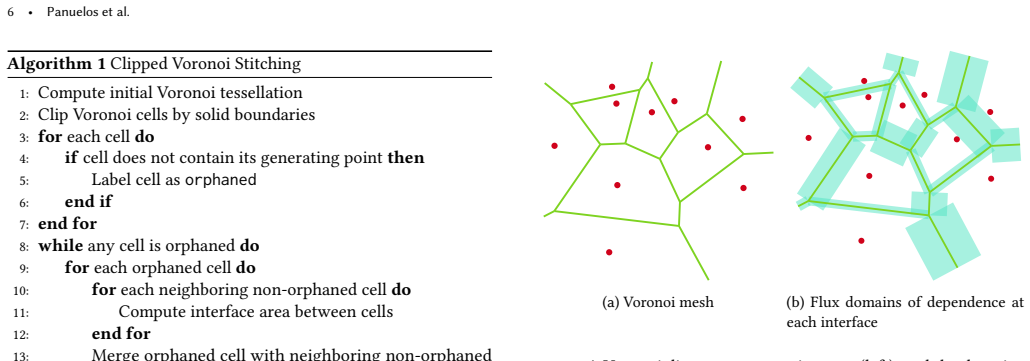
The carrying mechanism is the clipped Voronoi stitching algorithm (Algorithm 1). It starts from the ordinary Voronoi diagram of the Lagrangian fluid particles, clips every cell by the solid boundary, removes Voronoi faces that lie inside volumetric solids, adds solid faces as new mesh faces, flags cells that no longer contain their generating particle as orphaned, then iteratively merges each orphaned cell into the neighboring non-orphaned cell with the largest interface area. This reconnection keeps every remaining fluid face attached to a source through fluid-only paths, which is what enforces path-connectivity-preserving leakproofness. Boundary conditions are then handled locally by reflected particles, which exist only for the flux computation at each solid face and carry mirrored velocity in the solid frame.
What would settle it
A concrete check: place a thin closed solid around a cavity that contains no fluid particle, run Algorithm 1 on a finite set of exterior particles, and see whether the loop terminates with the cavity represented; if it cannot terminate or the cavity is absent from the partition, the leakproofness claim fails. Alternatively, compare the stitched partition's fluid-face graph to an exact visibility-constrained Voronoi diagram for the same sources and barriers in 2D with rectilinear barriers; any connection in one graph that is absent from the other refutes the claimed necessary and sufficient connectivity preservation.
Extended reading notes
Core claim
On the paper's own terms, the central discovery is that necessary and sufficient leakproofness reduces to a combinatorial property of the fluid partition: after inserting solid faces into the Voronoi diagram, every orphaned cell is stitched to a non-orphaned neighbor through a chain of shared fluid faces, so the partition's face graph exactly matches the path connectedness of the fluid domain constrained by solids. Fluid is allowed to flow only where that graph has a path, and is blocked exactly where a solid face separates cells. The solid boundary is resolved as a face of the partition, and the no-penetration condition is enforced by reflecting each fluid particle across the solid face into the solid velocity frame, yielding direct pressure forces on the solid. The paper further claims this holds for arbitrarily thin and closed solids, including subgrid features, and demonstrates bidirectional energy transfer in the examples.
Load-bearing premise
The load-bearing assumption is that every separate pocket of fluid that must be simulated contains at least one fluid particle; if a solid fully encloses a particle-free region, the stitching loop has no root to attach orphaned cells to, and Section 6 concedes that the stitched partition sidesteps the true visibility-constrained Voronoi structure, so exact path connectivity is approximate rather than exact.
Editorial extensions
If this is right
- A thin solid no longer needs to be volumetrically thickened, so pressure artifacts at an immersed sheet's leading and trailing edges disappear and narrow orifices such as balloon nozzles remain open at arbitrary resolution.
- Because solid faces carry the flux, boundary conditions are enforced sharply by reflected particles and the pressure force transfers directly to the solid, allowing a balloon to convert elastic energy into air pressure and then into kinetic energy.
- The method is agnostic to the Riemann solver and can be extended to viscous fluxes, as shown by the air-spring example, and it handles topology changes when an enclosed chamber opens, as in the champagne cork.
- The dominant cost is the Voronoi diagram recomputation, taking 85% of runtime, so exploiting temporal coherence or approximating face areas while preserving connectivity is the main avenue to speedup.
- Underresolved supersonic wakes remain a limitation; the paper suggests particle splitting, and notes that connectivity persists even at low resolution.
Reading between the lines
- If the face graph really is the right notion of connectivity, the stitching pass is independent of the Euler equations and could be dropped into any moving-mesh finite-volume scheme for other hyperbolic conservation laws.
- The largest-interface-area attachment rule is a numerical choice rather than a topological necessity; a pure topology-preserving variant could use any rule that eventually links each orphan through fluid faces, suggesting the algorithm's guarantees are insensitive to that rule.
- An exact test against the 2D rectilinear visibility-constrained Voronoi construction would show whether the claimed necessary and sufficient connectivity holds exactly or only approximately; the paper's Section 6 concession suggests the latter.
- The sealed-bunny single-particle interior test hints at a stronger scalability property: an enclosed region can be represented by arbitrarily few particles, which would make enclosed cavities cheap but would also limit how well one particle can resolve internal pressure gradients.
Editorial analysis
A structured set of objections, weighed in public.
Referee Report
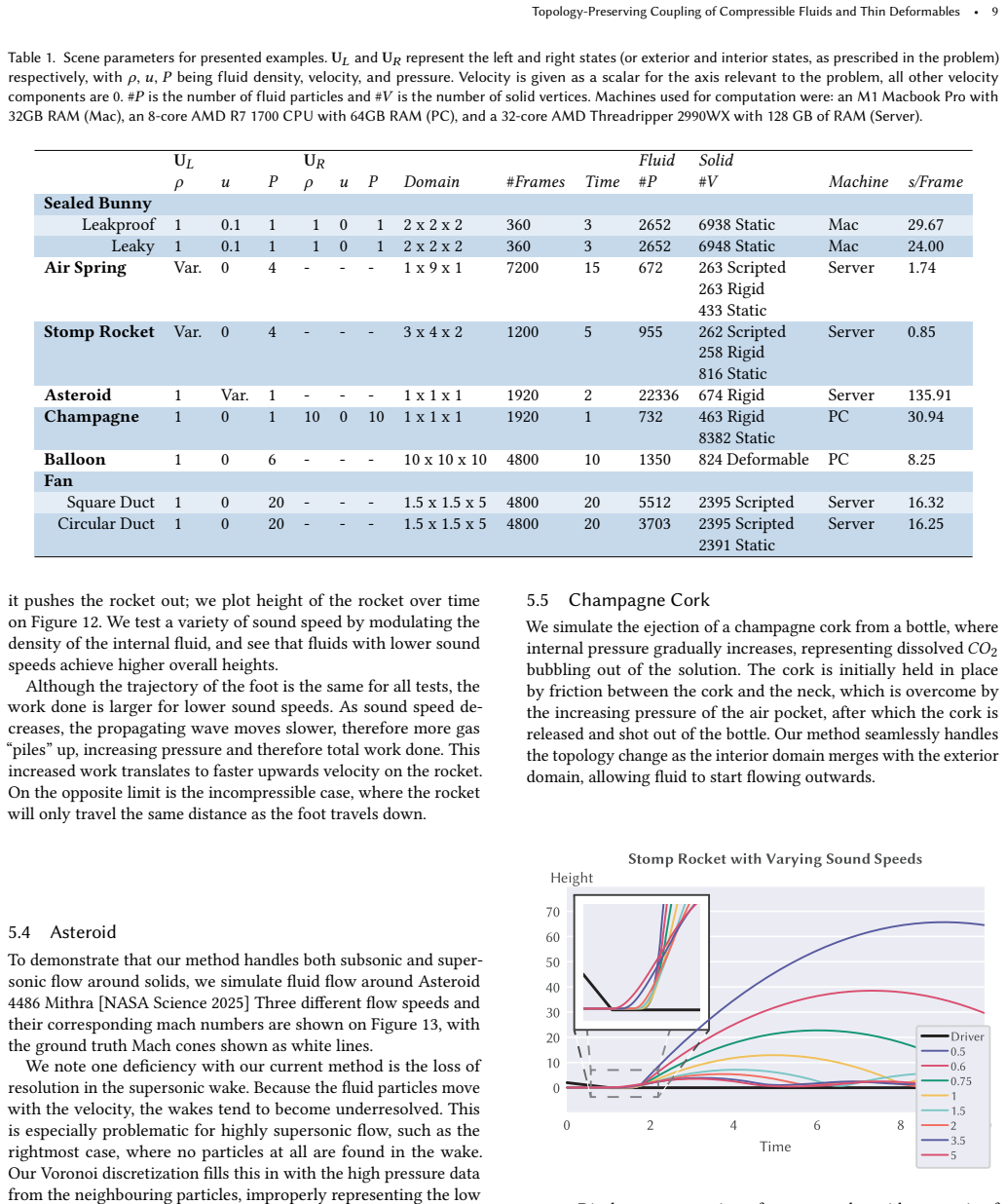
Summary. The paper proposes a finite-volume discretization for the compressible Euler equations coupled to thin deformable solids. Starting from a Voronoi tessellation induced by Lagrangian fluid particles, the method clips all cells against the solid boundary geometry and then runs a stitching pass (Algorithm 1) that merges each orphaned cell -- one that no longer contains its generating particle after clipping -- into the neighboring non-orphaned cell with the largest shared interface area. Solid boundary conditions are enforced by reflected particles, and the fluid is integrated with a Godunov-type central scheme. The authors claim that the resulting partition is 'sufficiently and necessarily leakproof': fluid cannot cross solid boundaries, and fluid flows wherever a continuous path exists in the continuous fluid domain. The method is demonstrated on a sealed bunny in a wind tunnel, an air spring, a stomp rocket, a supersonic asteroid, a champagne cork, a self-propelled balloon, and fan-in-duct scenarios.
Significance. Thin and codimensional solid-fluid coupling is a genuine gap in Voronoi-based compressible flow solvers: representing solids by volumetric Voronoi sites, as in Springel's moving-mesh approach, thickens interfaces and can seal narrow passages. The paper's clipping-and-stitching construction is a natural and promising remedy. The sealed-bunny stress test with a single interior particle is a strong sanity check, and the reported machine-precision quiescence of the interior is a falsifiable, reproducible-style check of the method's core mechanism. The method has no fitted parameters; the leakproof property is a designed consequence of the discretization rather than a curve fit. If the topological guarantee can be rigorously established, the method would be a solid contribution to physics-based simulation of compressible flow around thin structures. Currently the central theorem is not fully proved, and the significance of the contribution is therefore conditional on closing that gap.
major comments (2)
- [§4.3 and Algorithm 1] The proof of necessary and sufficient leakproofness relies on the assertion that every orphaned cell 'will be connected to a valid cell through a series of shared fluid faces.' This is not established and is false in a configuration where a connected component of the fluid domain contains no Lagrangian source point. In that case every cell in the component is orphaned and none has a non-orphaned neighbor, so the while loop in Algorithm 1 (lines 8-16) cannot terminate; if such cells are silently dropped instead, the component is absent from the discretized fluid domain and the claimed topology is not preserved. The sealed-bunny stress test in §5.1 seeds a single interior particle and therefore exercises exactly the favorable case, but it does not prove that every component always contains a source point. The manuscript must either state and guarantee this coverage condition (including under dynamic solid motion that can seal off new regions), prove that the invariant is maintained, or modify the algorithm to handle source-free components, before the central claim can be accepted.
- [§4.3 and §6] The central claim is phrased as 'sufficient and necessary leakproofness' and 'preserving the path connectedness of the fluid domain,' but no formal statement of the discrete connectivity guarantee is given. The authors should define the graph whose nodes are stitched cells and whose edges are fluid faces after clipping and stitching, and state a theorem that its connected components correspond exactly to the connected components of the continuous fluid domain. The argument in §4.3 is a local, informal proof sketch and does not supply such a theorem. The concession in §6 that the stitched partition 'sidesteps the true intended structure, which is a visibility-constrained Voronoi' does not by itself invalidate a purely topological claim, but it underscores that the paper should state precisely which property is guaranteed and prove it; as written, the terminology conflates a physical leakage property with a geometric construction.
minor comments (5)
- [§4.5, Eq. (8)] The reflected velocity update is written as u_f = u_f - 2((u_p - u_s)·n)n, with the same symbol on both sides; the left-hand side should be a newly defined reflected velocity, otherwise the equation is formally a tautology.
- [§3, Eq. (2)] The momentum density vector is written as (rho u_x, rho u_y, rho u_yz); the third component should be rho u_z.
- [Figure 9] The y-axis label reads 'Height' while the caption describes average speed over time; the label and caption should be made consistent.
- [§6] In the final paragraph, the sentence about coupling says the solid 'imposes a boundary condition onto the liquid'; since the method targets compressible fluids generally, this should read 'onto the fluid.'
- [§2.2.3] The phrase 'fluid sidedness tracking' is unclear; consider rephrasing as 'side-of-interface tracking' or similar.
Circularity Check
No fitted-parameter or self-citation circularity, but the Section 4.3 leakproofness proof assumes the per-component source-point coverage it needs to establish.
-
other
[Section 4.3, Necessary and Sufficient Leakproofing, third bullet]
"In the latter case, we know that the orphaned cell will be connected to a valid cell through a series of shared fluid faces. Therefore, any flux this face experiences represents some fluid that is able to make its way to the valid cell’s particle via a path entirely within the fluid."
The clause 'we know that the orphaned cell will be connected to a valid cell through a series of shared fluid faces' is exactly the path-connectivity conclusion the section is trying to prove. The stitching algorithm only creates such a connection when every connected component of the clipped fluid domain contains at least one source point; if a sealed fluid component has no source point, every cell in it is orphaned and has no non-orphaned neighbor, so Algorithm 1's while loop cannot terminate. The paper never states or proves this per-component source-point condition. Indeed, Section 5.1's bunny stress test seeds a single interior particle, which is precisely the missing coverage assumption.
full rationale
The paper contains no fitted parameters renamed as predictions, no load-bearing self-citation chain, and no uniqueness theorem imported from the authors' prior work. The core method is a constructive discretization: Voronoi cells are clipped by solid faces and orphaned cells are stitched to valid neighbors, and the validation scenarios (sealed bunny, air spring, stomp rocket, asteroid Mach cones, balloon, fan) are external demonstrations of the implementation rather than quantities fitted to the method's own inputs. The one significant issue is in Section 4.3, where the proof of path-connectivity preservation asserts, rather than derives, that every orphaned cell has a fluid-only path to a valid cell. This is a real logical gap and a mild form of circularity in the proof of the central claim, because the missing condition is exactly that every connected fluid component contains a source point. However, this is not a statistical or empirical circularity: the method does genuinely preserve connectivity when that coverage condition holds, and the paper's bunny stress test verifies the favorable case. The Section 6 concession that stitching sidesteps a true visibility-constrained Voronoi is a separate approximation and does not by itself undermine the connectivity argument. Overall circularity is therefore low, scored 2 rather than 0 because the main theorem's proof leans on an unstated assumption that is itself the desired connectivity property.
Assumptions & free parameters
assumptions (4)
- standard math Fluid obeys the compressible Euler equations closed by the ideal gas law P=(gamma-1)*rho*e with gamma=1.4.
- domain assumption Solid surfaces are given as triangle meshes that can be robustly intersected with Voronoi cells at every timestep.
- ad hoc to paper Every connected component of the fluid domain contains at least one Lagrangian source particle.
- domain assumption Reflecting particles across a solid face with mirrored velocity in the solid frame enforces the no-penetration boundary condition.
Cite this review
Pith. "Pith review of Topology-Preserving Coupling of Compressible Fluids and Thin Deformables." pith.science (2026). https://pith.science/paper/2TMZQJVV
@misc{pith2026250718460,
  author       = {Pith},
  title        = {Pith review of: Topology-Preserving Coupling of Compressible Fluids and Thin Deformables},
  year         = {2026},
  howpublished = {\url{https://pith.science/paper/2TMZQJVV}},
  note         = {Machine review of arXiv:2507.18460}
}
read the original abstract
We present a novel discretization of coupled compressible fluid and thin deformable structures that provides sufficient and necessary leakproofness by preserving the path connectedness of the fluid domain. Our method employs a constrained Voronoi-based spatial partitioning combined with Godunov-style finite-volume time integration. The fluid domain is discretized into cells that conform exactly to the fluid-solid interface, allowing boundary conditions to be sharply resolved exactly at the interface. This enables direct force exchange between the fluid and solid while ensuring that no fluid leaks through the solid, even when arbitrarily thin. We validate our approach on a series of challenging scenarios -- including a balloon propelled by internal compressed air, a champagne cork ejecting after overcoming friction, and a supersonic asteroid -- demonstrating bidirectional energy transfer between fluid and solid.
Figures


Figures from the paper (11 more)






Reference graph
Works this paper leans on
-
[14]
A sharp interface immersed boundary method for compressible viscous flows. J. Comput. Phys. 225, 1 (2007), 528–553. Robert A Gingold and Joseph J Monaghan
work page 2007
-
[24]
A numerical approach to the testing of the fission hypothesis. Astronomical Journal, vol. 82, Dec. 1977, p. 1013-1024. 82 (1977), 1013–1024. DJ Mavriplis and V Venkatakrishnan
work page 1977
-
[26]
Journal of computational physics 227, 10 (2008), 4825–4852
A versatile sharp interface immersed boundary method for incompressible flows with complex boundaries. Journal of computational physics 227, 10 (2008), 4825–4852. NASA Science
work page 2008
-
[29]
Acta numerica 11 (2002), 479–517
The immersed boundary method. Acta numerica 11 (2002), 479–517. Ziyin Qu, Minchen Li, Yin Yang, Chenfanfu Jiang, and Fernando De Goes
work page 2002
-
[31]
Computer methods in applied mechanics and engineering 139, 1-4 (1996), 375–408
Smoothed particle hydrodynamics: some recent improvements and applications. Computer methods in applied mechanics and engineering 139, 1-4 (1996), 375–408. Philip L Roe
work page 1996
-
[34]
ACM Transactions on Graphics (TOG) 31, 4 (2012), 1–8
Ghost SPH for animating water. ACM Transactions on Graphics (TOG) 31, 4 (2012), 1–8. Mar Serrano, Pep Español, and Ignacio Zúñiga
work page 2012
-
[37]
Monthly Notices of the Royal Astronomical Society 401, 2 (2010), 791–851
E pur si muove: Galilean-invariant cosmological hydrodynamical simulations on a moving mesh. Monthly Notices of the Royal Astronomical Society 401, 2 (2010), 791–851. James M Stone and Michael L Norman
work page 2010
-
[40]
Restoration of the contact surface in the HLL-Riemann solver. Shock waves 4 (1994), 25–34. Yung H. Tsin and Cao An Wang
work page 1994
Show all 43 references
-
[41]
Geodesic Voronoi diagrams in the presence of rectilinear barriers. Nord. J. Comput. 3, 1 (1996), 1–26. 12 • Panuelos et al. Vuko Vukčević, Hrvoje Jasak, and Inno Gatin
1996
-
[43]
Journal of computational physics 156, 2 (1999), 209–240
An accurate Cartesian grid method for viscous incompressible flows with complex immersed boundaries. Journal of computational physics 156, 2 (1999), 209–240
1999
-
[1954]
Communications on Pure and Applied Mathematics 7, 1 (1954), 159–193
Weak solutions of nonlinear hyperbolic equations and their nu- merical computation. Communications on Pure and Applied Mathematics 7, 1 (1954), 159–193. Leon B Lucy
1954
-
[1972]
Charles S Peskin
Flow patterns around heart valves: a numerical method.Journal of computational physics 10, 2 (1972), 252–271. Charles S Peskin
1972
-
[1974]
Journal of computational physics 14, 3 (1974), 227–253
An arbitrary Lagrangian- Eulerian computing method for all flow speeds. Journal of computational physics 14, 3 (1974), 227–253. Philip F Hopkins
1974
-
[1977]
Monthly notices of the royal astronomical society 181, 3 (1977), 375–389
Smoothed particle hydrodynamics: the- ory and application to non-spherical stars. Monthly notices of the royal astronomical society 181, 3 (1977), 375–389. Jón Tómas Grétarsson and Ron Fedkiw
1977
-
[1981]
Journal of computational physics 43, 2 (1981), 357–372
Approximate Riemann solvers, parameter vectors, and difference schemes. Journal of computational physics 43, 2 (1981), 357–372. Robert I Saye and James A Sethian
1981
-
[1982]
Computer methods in applied mechanics and engineering 33, 1-3 (1982), 689–723
An arbitrary Lagrangian- Eulerian finite element method for transient dynamic fluid-structure interactions. Computer methods in applied mechanics and engineering 33, 1-3 (1982), 689–723. Bernd Einfeldt
1982
-
[1983]
SIAM review 25, 1 (1983), 35–61
On upstream differencing and Godunov-type schemes for hyperbolic conservation laws. SIAM review 25, 1 (1983), 35–61. Xiaowei He, Shusen Liu, Yuzhong Guo, Jian Shi, and Ying Qiao
1983
-
[1988]
SIAM Journal on numerical analysis 25, 2 (1988), 294–318
On Godunov-type methods for gas dynamics. SIAM Journal on numerical analysis 25, 2 (1988), 294–318. Ronald P Fedkiw
1988
-
[1989]
Journal of computational Physics 82, 1 (1989), 64–84
Local adaptive mesh refinement for shock hydrodynamics. Journal of computational Physics 82, 1 (1989), 64–84. Christoph Börgers and Charles S Peskin
1989
-
[1992]
I-The hydrodynamic algorithms and tests
ZEUS-2D: a radiation magnetohydrody- namics code for astrophysical flows in two space dimensions. I-The hydrodynamic algorithms and tests. Astrophysical Journal Supplement Series (ISSN 0067-0049), vol. 80, no. 2, June 1992, p. 753-790. Research supported by University of Illin...
1992
-
[1994]
Progress of theoretical physics 92, 5 (1994), 939–960
Numerical simulation of viscous flow by smoothed particle hydrodynamics. Progress of theoretical physics 92, 5 (1994), 939–960. Eleuterio F Toro
1994
-
[1996]
Computer Animation and Simulation/Springer Vienna (1996)
Smoothed particles: A new paradigm for animating highly deformable bodies. Computer Animation and Simulation/Springer Vienna (1996). Jean Donea, SHJP Giuliani, and Jean-Pierre Halleux
1996
-
[1997]
International Journal of Computational Fluid Dynamics 8, 4 (1997), 247–263
A unified multigrid solver for the Navier- Stokes equations on mixed element meshes. International Journal of Computational Fluid Dynamics 8, 4 (1997), 247–263. Rajat Mittal, Haibo Dong, Meliha Bozkurttas, FM Najjar, Abel Vargas, and Alfred Von Loebbecke
1997
-
[1999]
Journal of computational physics 152, 2 (1999), 457–492
A non- oscillatory Eulerian approach to interfaces in multimaterial flows (the ghost fluid method). Journal of computational physics 152, 2 (1999), 457–492. Jeferson Wilian Dossa Fernandes, Humberto Breves Coda, and Rodolfo André Kuche Sanches
1999
-
[2000]
Journal of computational physics 160, 1 (2000), 241–282
New high-resolution central schemes for nonlinear conservation laws and convection–diffusion equations. Journal of computational physics 160, 1 (2000), 241–282. Nathalie Lanson and Jean-Paul Vila
2000
-
[2002]
Coupling an Eulerian fluid calculation to a Lagrangian solid calculation with the ghost fluid method. J. Comput. Phys. 175, 1 (2002), 200–224. Ronald P Fedkiw, Tariq Aslam, Barry Merriman, and Stanley Osher
2002
-
[2005]
Journal of statistical physics 121 (2005), 133–147
Voronoi fluid particle model for Euler equations. Journal of statistical physics 121 (2005), 133–147. Side Effects Software Inc
2005
-
[2007]
In Proceedings of the 2007 ACM SIGGRAPH/Eurographics symposium on Computer animation
Weakly compressible SPH for free sur- face flows. In Proceedings of the 2007 ACM SIGGRAPH/Eurographics symposium on Computer animation. 209–217. Jan Bender and Dan Koschier
2007
-
[2008]
Renormalized meshfree schemes I: consis- tency, stability, and hybrid methods for conservation laws. SIAM J. Numer. Anal. 46, 4 (2008), 1912–1934. Peter D. Lax
2008
-
[2009]
In Proceedings of the 2009 ACM SIG- GRAPH/Eurographics symposium on computer animation
A point-based method for animating incompressible flow. In Proceedings of the 2009 ACM SIG- GRAPH/Eurographics symposium on computer animation . 247–255. Volker Springel
2009
-
[2010]
In ACM SIGGRAPH 2010 papers
Matching fluid simulation elements to surface geometry and topology. In ACM SIGGRAPH 2010 papers. 1–9. Oleksiy Busaryev, Tamal K Dey, Huamin Wang, and Zhong Ren
2010
-
[2011]
Proceedings of the National Academy of Sciences 108, 49 (2011), 19498–19503
The Voronoi implicit interface method for computing multiphase physics. Proceedings of the National Academy of Sciences 108, 49 (2011), 19498–19503. Hagit Schechter and Robert Bridson
2011
-
[2012]
ACM Transactions on Graphics (TOG) 31, 4 (2012), 1–8
Animating bubble interactions in a liquid foam. ACM Transactions on Graphics (TOG) 31, 4 (2012), 1–8. Yadi Cao, Yunuo Chen, Minchen Li, Yin Yang, Xinxin Zhang, Mridul Aanjaneya, and Chenfanfu Jiang
2012
-
[2013]
Fully conservative leak-proof treatment of thin solid structures immersed in compressible fluids. J. Comput. Phys. 245 (2013), 160–204. Leonidas Guibas
2013
-
[2014]
A note on visibility-constrained Voronoi diagrams. Inform. Process. Lett. 114, 7 (2014), 357–361. https://doi.org/10.1016/j.ipl.2014.01.014 Markus Becker and Matthias Teschner
2014 doi
-
[2015]
Monthly Notices of the Royal Astronomical Society 450, 1 (2015), 53–110
A new class of accurate, mesh-free hydrodynamic simulation methods. Monthly Notices of the Royal Astronomical Society 450, 1 (2015), 53–110. Young Kwang Hwang, John E Bolander, Yun Mook Lim, and Jung-Wuk Hong
2015
-
[2016]
IEEE Transactions on Visualization and Computer Graphics 23, 3 (2016), 1193–1206
Divergence-free SPH for incompressible and viscous fluids. IEEE Transactions on Visualization and Computer Graphics 23, 3 (2016), 1193–1206. Marsha J Berger and Phillip Colella
2016
-
[2017]
Computers & fluids 153 (2017), 1–19
Implementation of the ghost fluid method for free surface flows in polyhedral finite volume framework. Computers & fluids 153 (2017), 1–19. Tao Ye, Rajat Mittal, HS Udaykumar, and Wei Shyy
2017
-
[2019]
Computational Mechanics 63 (2019), 555–569
ALE incompressible fluid–shell coupling based on a higher-order auxiliary mesh and positional shell finite element. Computational Mechanics 63 (2019), 555–569. Reza Ghias, Rajat Mittal, and Haibo Dong
2019
-
[2021]
Computational Particle Mechanics 8, 4 (2021), 813–823
Coupling of SPH and Voronoi-cell lattice models for simulating fluid–structure interaction. Computational Particle Mechanics 8, 4 (2021), 813–823. Alexander Kurganov and Eitan Tadmor
2021
-
[2022]
ACM Transactions on Graphics (TOG) 41, 5 (2022), 1–13
An efficient b-spline lagrangian/eulerian method for com- pressible flow, shock waves, and fracturing solids. ACM Transactions on Graphics (TOG) 41, 5 (2022), 1–13. M Desbrun
2022
-
[2023]
ACM Transactions on Graphics (TOG) 42, 6 (2023), 1–11
Power Plastics: A Hybrid Lagrangian/Eulerian Solver for Mesoscale Inelastic Flows. ACM Transactions on Graphics (TOG) 42, 6 (2023), 1–11. Phil W Randles and Larry D Libersky
2023
-
[2025]
https://science.nasa.gov/3d- resources/asteroid-4486-mithra/ Accessed: 2025-05-20
Asteroid 4486 Mithra 3D Model. https://science.nasa.gov/3d- resources/asteroid-4486-mithra/ Accessed: 2025-05-20. Atsuyuki Okabe, Barry Boots, Kokichi Sugihara, and Sung Nok Chiu
2025
Reviewed August 7, 2026 · model on record in the stance chip above.
Discussion (0). Sign in to comment.