REVIEW 3 major objections 4 minor 61 references
A Reduced Cost Two-component Relativistic Equation-of-Motion Coupled Cluster Method for Ionization Potential
T0 review · 3 major / 4 minor · reviewed 2026-08-07 · deepseek-v4-flash
Pith's one-line read A two-component relativistic equation-of-motion coupled-cluster method reproduces four-component ionization potentials to within 0.001 eV and becomes feasible for medium-sized heavy-element molecules.
desk verdict Solid implementation paper; the load-bearing four-component equivalence claim is supported only by five hydrogen halides, so the authors should soften it or test more. read the letter →
The pith
A machine-rendered reading of the paper's core claim, the machinery that carries it, and where it could break.
The reading
What carries the argument
The load-bearing object is the X2CAMF Hamiltonian, a two-component relativistic Hamiltonian in which the spin-dependent two-electron interaction is absorbed into an atomic mean-field one-electron operator and spin-free two-electron integrals are kept at the nonrelativistic level, so no molecular relativistic two-electron integrals need to be built. The implementation places Cholesky decomposition on top, storing only integrals with two or fewer virtual indices and constructing the rest on the fly, and then applies frozen natural spinors, obtained by diagonalizing an MP2 virtual-virtual density matrix and truncating by occupation number, to shrink the virtual space and cut floating-point work. The argument works because these two approximations attack the dominant costs of relativistic IP-EOM-CCSD, memory and operation count, while the X2CAMF Hamiltonian preserves the four-component accuracy that the paper benchmarks against the hydrogen halides.
What would settle it
Compute the first three ionization potentials of a heavy-atom molecule with strong ligand-field spin-orbit coupling, for example a bismuth or thallium complex, using both the two-component FNS-CD-X2CAMF-IP-EOM-CCSD method and a four-component FNS-IP-EOM-CCSD method with the same basis and truncation thresholds. If the state-resolved IP differences exceed the roughly 0.001 eV seen for the hydrogen halides, the X2CAMF approximations do not transfer to that regime.
Extended reading notes
Core claim
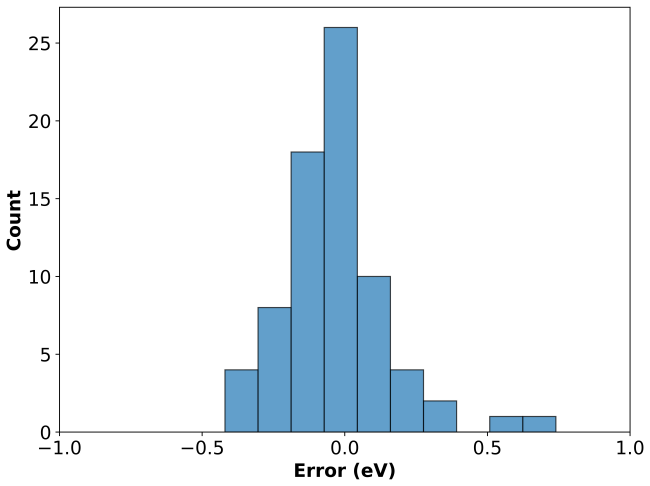
The central result is that the FNS-CD-X2CAMF-IP-EOM-CCSD method gives ionization potentials essentially identical to those of four-component FNS-IP-EOM-CCSD for the HX series (HF, HCl, HBr, HI, HAt), with differences of at most 0.001 eV, while also capturing the spin-orbit splittings that a spin-free treatment misses. Against experiment, the method attains a mean absolute error of 0.13 eV over 74 heavy-element molecules from the SOC-81 set, and it reproduces the photoelectron band patterns of CdCl2, CdBr2, and CdI2, including the spin-orbit-induced reordering in CdI2. The system [I(H2O)12]-, with 1,698 virtual spinors before truncation, yields a first vertical ionization energy of 4.30 eV and a solvation blue shift of 1.23 eV relative to atomic iodide, showing that the cost reductions make such medium-sized systems tractable.
Load-bearing premise
Validation against four-component theory covers only the five hydrogen halides; the paper assumes the atomic mean-field treatment of spin-orbit and the neglect of scalar two-electron picture-change effects transfer unchanged to all 74 benchmark molecules and to the iodide-water cluster.
Editorial extensions
If this is right
- Ionization energies and photoelectron spectra of heavy-element molecules can be obtained at four-component-level accuracy without four-component cost, making such calculations routine for systems with hundreds of virtual spinors.
- Spin-orbit effects, including the reordering of ionized states in heavy halides such as CdI2, are captured by the two-component treatment with errors within 0.001 eV of four-component results for the tested HX series.
- A loose Cholesky and frozen-natural-spinor threshold is enough for vertical ionization potentials: the mean error changes by less than 0.005 eV between the loosest and tightest thresholds, so users can trade accuracy for speed with little risk.
- The method's storage pattern, with only integrals containing two or fewer virtual indices, extends the size limit of relativistic IP-EOM-CCSD to molecules like [I(H2O)12]-, completing a four-root EOM calculation in under five days on one workstation.
Reading between the lines
- Beyond the paper's benchmarks, the approximations are likely to face their hardest test in molecules where spin-orbit coupling is delocalized or strongly altered by the chemical environment, such as heavy transition-metal complexes; a two- versus four-component comparison there would map the method's true domain of validity.
- The same combination of Cholesky decomposition, frozen natural spinors, and the X2CAMF Hamiltonian could plausibly be carried into electron-attachment and excited-state EOM-CC variants, extending the cost reduction to other charged and neutral excitations.
- Because the loose threshold barely changes ionization energies, the practical bottleneck is the ground-state CCSD step's formal $O(N^6)$ scaling; combining frozen natural spinors with local or pair-natural-orbital truncations could push calculations toward larger molecular sizes than the iodide-water cluster.
- The hydration blue shift of 1.23 eV in the paper agrees with prior embedded EOM-CC results, suggesting the method is accurate enough to map solvent effects on heavy-element ionization energies, a direction the paper does not develop beyond a single cluster.
Editorial analysis
A structured set of objections, weighed in public.
Referee Report
Summary. The manuscript presents an implementation of the ionization-potential variant of equation-of-motion coupled-cluster singles and doubles (IP-EOM-CCSD) within the exact two-component atomic mean-field (X2CAMF) relativistic framework, using Cholesky decomposition (CD) and frozen natural spinors (FNS) to reduce storage and floating-point cost. The method is benchmarked on 18 iodine-containing molecules, on 74 heavy-element molecules from the SOC-81 set against experimental vertical IPs, on the hydrogen halide series against four-component FNS-IP-EOM-CCSD, and on the photoelectron spectra of CdX2. The paper also reports an application to [I(H2O)12]- with 1698 virtual spinors. The central claim is that FNS-CD-X2CAMF-IP-EOM-CCSD produces ionization potentials that are 'almost identical' to four-component IP-EOM-CCSD while being substantially cheaper.
Significance. If the central claim is fully substantiated, this is a practically valuable method for relativistic IP calculations on medium-sized heavy-element systems. The work has clear strengths: the integration of CD and FNS into an already established X2CAMF-CC framework is technically non-trivial; the 74-molecule experimental benchmark with MAE 0.13 eV is useful and independent; the sub-milli-eV agreement with four-component results for the five hydrogen halides is an impressive consistency check; and the [I(H2O)12]- calculation demonstrates real applicability. The main gap is that the headline equivalence to four-component theory is established only for a narrow set of closed-shell diatomics, and the threshold convergence evidence is indirect. These issues are addressable and do not invalidate the method, but they need to be closed or the claims tempered before the paper can be accepted.
major comments (3)
- [4.4, Table 3; Abstract; Conclusions] The claim that the X2CAMF IP values are 'almost identical' to four-component results is supported only by the five hydrogen halides HX (X=F, Cl, Br, I, At). These are closed-shell diatomics in which the ionized hole is localized on a single heavy atom, which is the least demanding case for the two key approximations: the atomic mean-field replacement of the spin-dependent two-electron interaction in Eq. (4) and the neglect of scalar two-electron picture-change effects in Eq. (8). The abstract and conclusions state the equivalence without this scope limitation. To make the claim load-bearing for the 74-molecule benchmark and the [I(H2O)12]- application, the authors should either add four-component FNS-IP-EOM-CCSD comparisons for at least a few representative SOC-81 molecules with open d/f shells, multiple heavy centers, or delocalized valence holes, or explicitly restrict the equivalence claim to the systems tested.
- [4.1, Table 1; 4.5] The choice of LOOSEFNS as the default threshold is justified in §4.1 by comparing experimental MAEs at three threshold settings. This is not a direct test of the FNS/CD truncation error, because the experimental MAE also contains basis-set, correlation, and Hamiltonian errors. The three MAE values (0.068, 0.066, and 0.065 eV) could be nearly identical even if LOOSEFNS deviates from TIGHTFNS by more than the quoted precision. The authors should report the mean and maximum absolute IP differences between LOOSEFNS and TIGHTFNS (or between LOOSEFNS and an untruncated reference) for the 18-molecule set, and for at least a subset of the SOC-81 molecules, before using LOOSEFNS for the headline benchmarks and for [I(H2O)12]-.
- [4.4, Table 3; 4.2, Table 2] The direct four-component comparison in Table 3 is performed at the TIGHTFNS setting (FNS threshold 10^-5, CD threshold 10^-5), while the 74-molecule benchmark in Table 2 and the [I(H2O)12]- application use LOOSEFNS. The sub-meV agreement with four-component theory therefore does not directly validate the threshold setting used for the main results. The paper should either provide a four-component comparison at LOOSEFNS for a few molecules or explain why the equivalence established at TIGHTFNS transfers to LOOSEFNS; as written, the abstract's 'almost identical' claim is not directly supported at the default threshold.
minor comments (4)
- [4.3, Figure 2] The text says the computed spectra are compared 'directly' with experiment, but a uniform energy shift is applied per molecule to align the lowest-energy peaks. The authors should state explicitly that Figure 2 validates relative peak positions and splittings, not absolute ionization energies, and that the applied shifts are for visual alignment only.
- [Abstract; title] There is a typo in the title and abstract: 'T wo-component' should read 'Two-component'.
- [4.2, Table 2] The comparison with the GW results of Ref. 49 should state the basis sets, geometries, and frozen-core settings used in those calculations, so that the comparison in Table 2 is not compromised by protocol differences.
- [4.4, Table 3] The notation for the ionization states (e.g., '5Π1', '4Π1', '3Σ2') is not defined; the authors should specify whether these are term symbols or state ordering labels and how they are assigned.
Circularity Check
No significant circularity: absolute IPs and spectral shapes are benchmarked against independent four-component and experimental references; the only fitted element is a disclosed spectral shift.
full rationale
The paper's central claim is that FNS-CD-X2CAMF-IP-EOM-CCSD reproduces four-component IP-EOM-CCSD results and experimental ionization energies at low cost. The X2CAMF Hamiltonian in Eq. (10) is adopted from prior work (Refs 15–17) and is not defined in terms of the target IPs; the IPs are obtained by solving the EOM-CCSD eigenproblem, not by fitting. The four-component comparison in Table 3 uses values from the authors' earlier study (Ref 31), but those are parameter-free results with stated basis sets, frozen-core settings, and FNS thresholds; they are also checked against experiment within Table 3, so they constitute independent support rather than a self-referential reduction. The threshold selection on 18 iodine molecules (Sec 4.1) is a hyperparameter choice, not a fit of ionization energies, and the subsequent 74-molecule benchmark (Table 2) is an external experimental test. The only fitted element is the uniform energy shift applied to the simulated CdX2 photoelectron spectra in Sec 4.3; this is explicitly disclosed, does not enter the tabulated IP values, and is used only to align spectral patterns, so it does not make the spectral-shape prediction circular. No equation or predicted quantity reduces by construction to its inputs, and no uniqueness theorem or load-bearing self-citation chain is invoked. The self-citations to Refs 31 and 32 are methodological and benchmark-related, not argumentative dependencies.
Assumptions & free parameters
free parameters (3)
- Cholesky decomposition threshold =
LOOSEFNS: 1e-3; NORMAL: 1e-4; TIGHT: 1e-5
- Frozen natural spinor occupation cutoff =
LOOSEFNS: 1e-4; NORMAL: 10^-4.5; TIGHT: 1e-5
- PES alignment shift per CdX2 molecule =
-0.02 eV (CdCl2), +0.2 eV (CdBr2), -0.12 eV (CdI2)
assumptions (5)
- domain assumption No-pair approximation: only positive-energy four-component spinors are included in the Hamiltonian
- domain assumption Scalar two-electron picture-change effects are negligible for the X2CAMF Hamiltonian
- domain assumption Atomic mean-field approximation captures spin-dependent two-electron interactions
- ad hoc to paper LOOSEFNS truncation introduces negligible error for valence IPs across heavy-element systems
- domain assumption Experimental geometries from SOC-81 and NIST vertical IPs are reliable references
Cite this review
Pith. "Pith review of A Reduced Cost Two-component Relativistic Equation-of-Motion Coupled Cluster Method for Ionization Potential." pith.science (2026). https://pith.science/paper/2TQ36XFM
@misc{pith2026250606805,
  author       = {Pith},
  title        = {Pith review of: A Reduced Cost Two-component Relativistic Equation-of-Motion Coupled Cluster Method for Ionization Potential},
  year         = {2026},
  howpublished = {\url{https://pith.science/paper/2TQ36XFM}},
  note         = {Machine review of arXiv:2506.06805}
}
abstract
We report an efficient implementation of the ionization potential (IP) variant of the equation-of-motion coupled cluster (IP-EOM-CC) method based on the exact two-component atomic mean field (X2CAMF) framework, utilizing Cholesky decomposition (CD) and frozen natural spinors (FNS). The CD approximation significantly reduces memory demands, whereas the FNS approximation lowers the number of floating-point operations. Together, these techniques make the method computationally efficient for accurate relativistic IP-EOM-CC calculations of molecules containing heavy elements. The calculated IP values are almost identical to those obtained by the four-component relativistic IP-EOM-CC method. Benchmark studies show good agreement with experimental ionization energies and photoelectron spectra, demonstrating the method's reliability. The practical applicability of the approach is demonstrated by IP calculations on the medium-sized [I(H$_{2}$O)$_{12}$]$^{-}$ complex, with 1698 virtual spinors.
Figures


Reference graph
Works this paper leans on
-
[1]
ROWE, D. J. Equations-of-Motion Method and the Extended Shell Model. Rev. Mod. Phys. 1968, 40, 153--166
1968
-
[2]
Stanton, J. F.; Bartlett, R. J. The equation of motion coupled-cluster method. A systematic biorthogonal approach to molecular excitation energies, transition probabilities, and excited state properties. J. Chem. Phys. 1993, 98, 7029--7039
work page 1993
-
[3]
Nooijen, M.; Bartlett, R. J. Equation of motion coupled cluster method for electron attachment. J. Chem. Phys. 1995, 102, 3629--3647
work page 1995
-
[4]
Hess, B. A. Relativistic electronic-structure calculations employing a two-component no-pair formalism with external-field projection operators. Phys. Rev. A 1986, 33, 3742--3748
1986
-
[5]
van Lenthe, E.; van Leeuwen, R.; Baerends, E. J.; Snijders, J. G. Relativistic regular two-component Hamiltonians. Int. J. Quantum Chem. 1996, 57, 281--293
work page 1996
-
[6]
Dyall, K. G. Interfacing relativistic and nonrelativistic methods. I. Normalized elimination of the small component in the modified Dirac equation . J. Chem. Phys. 1997, 106, 9618--9626
work page 1997
-
[7]
A new relativistic theory: a relativistic scheme by eliminating small components (RESC)
Nakajima, T.; Hirao, K. A new relativistic theory: a relativistic scheme by eliminating small components (RESC). Chem. Phys. Lett. 1999, 302, 383--391
work page 1999
-
[8]
Barysz, M.; Sadlej, A. J. Two-component methods of relativistic quantum chemistry: from the Douglas-Kroll approximation to the exact two-component formalism. J. Mol. Struct.: THEOCHEM 2001, 573, 181--200
work page 2001
Show all 61 references
-
[9]
Exact two-component Hamiltonians revisited
Liu, W.; Peng, D. Exact two-component Hamiltonians revisited . J. Chem. Phys. 2009, 131, 031104
2009
-
[10]
Relativistic Hamiltonians for Chemistry : A Primer
Saue, T. Relativistic Hamiltonians for Chemistry : A Primer . ChemPhysChem 2011, 12, 3077--3094
2011
-
[11]
Quasirelativistic theory equivalent to fully relativistic theory
Kutzelnigg, W.; Liu, W. Quasirelativistic theory equivalent to fully relativistic theory . J. Chem. Phys. 2005, 123, 241102
2005
-
[12]
An infinite-order two-component relativistic Hamiltonian by a simple one-step transformation
Ilia s , M.; Saue, T. An infinite-order two-component relativistic Hamiltonian by a simple one-step transformation . J. Chem. Phys. 2007, 126, 064102
2007
-
[13]
G.; Faegri, K
Dyall, K. G.; Faegri, K. Introduction to Relativistic Quantum Chemistry; Oxford University Press, 2007
2007
-
[14]
A.; Marian, C
He , B. A.; Marian, C. M.; Wahlgren, U.; Gropen, O. A mean-field spin-orbit method applicable to correlated wavefunctions. Chem. Phys. Lett. 1996, 251, 365--371
1996
-
[15]
An atomic mean-field spin-orbit approach within exact two-component theory for a non-perturbative treatment of spin-orbit coupling
Liu, J.; Cheng, L. An atomic mean-field spin-orbit approach within exact two-component theory for a non-perturbative treatment of spin-orbit coupling . J. Chem. Phys. 2018, 148, 144108
2018
-
[16]
Atomic Mean-Field Approach within Exact Two-Component Theory Based on the Dirac-Coulomb-Breit Hamiltonian
Zhang, C.; Cheng, L. Atomic Mean-Field Approach within Exact Two-Component Theory Based on the Dirac-Coulomb-Breit Hamiltonian. J. Phys. Chem. A 2022, 126, 4537--4553, PMID: 35763592
2022
-
[17]
Knecht, S.; Repisky, M.; Jensen, H. J. A.; Saue, T. Exact two-component Hamiltonians for relativistic quantum chemistry: Two-electron picture-change corrections made simple . J. Chem. Phys. 2022, 157, 114106
2022
-
[18]
Exact two-component equation-of-motion coupled-cluster singles and doubles method using atomic mean-field spin-orbit integrals
Asthana, A.; Liu, J.; Cheng, L. Exact two-component equation-of-motion coupled-cluster singles and doubles method using atomic mean-field spin-orbit integrals. J. Chem. Phys. 2019, 150, 074102
2019
-
[19]
Analytic gradients for relativistic exact-two-component equation-of-motion coupled-cluster singles and doubles method
Zhang, C.; Zheng, X.; Liu, J.; Asthana, A.; Cheng, L. Analytic gradients for relativistic exact-two-component equation-of-motion coupled-cluster singles and doubles method. J. Chem. Phys. 2023, 159, 244113
2023
-
[20]
Relativistic Cholesky-decomposed density matrix MP2
Helmich-Paris, B.; Repisky, M.; Visscher, L. Relativistic Cholesky-decomposed density matrix MP2. Chem. Phys. 2019, 518, 38--46
2019
-
[21]
G.; Li, X
Banerjee, S.; Zhang, T.; Dyall, K. G.; Li, X. Relativistic resolution-of-the-identity with Cholesky integral decomposition . J. Chem. Phys. 2023, 159, 114119
2023
-
[22]
Cholesky Decomposition in Spin-Free Dirac-Coulomb Coupled-Cluster Calculations
Uhl\' r ov\'a, T.; Cianchino, D.; Nottoli, T.; Lipparini, F.; Gauss, J. Cholesky Decomposition in Spin-Free Dirac-Coulomb Coupled-Cluster Calculations. J. Phys. Chem. A 2024, 128, 8292--8303, PMID: 39268870
2024
-
[23]
S.; Shiozaki, T
Kelley, M. S.; Shiozaki, T. Large-scale Dirac-Fock-Breit method using density fitting and 2-spinor basis functions . J. Chem. Phys. 2013, 138, 204113
2013
-
[24]
E.; Shiozaki, T
Bates, J. E.; Shiozaki, T. Fully relativistic complete active space self-consistent field for large molecules: Quasi-second-order minimax optimization . J. Chem. Phys. 2015, 142, 044112
2015
-
[25]
Cholesky Decomposition-Based Implementation of Relativistic Two-Component Coupled-Cluster Methods for Medium-Sized Molecules
Zhang, C.; Lipparini, F.; Stopkowicz, S.; Gauss, J.; Cheng, L. Cholesky Decomposition-Based Implementation of Relativistic Two-Component Coupled-Cluster Methods for Medium-Sized Molecules. J. Chem. Theory Comput. 2024, 20, 787--798, PMID: 38198515
2024
-
[26]
K.; Vaval, N.; Pal, S
Pathak, H.; Sasmal, S.; Nayak, M. K.; Vaval, N.; Pal, S. Relativistic equation-of-motion coupled-cluster method for the ionization problem: Application to molecules. Phys. Rev. A 2014, 90, 062501
2014
-
[27]
Spin-orbit coupling with approximate equation-of-motion coupled-cluster method for ionization potential and electron attachment
Cao, Z.; Wang, F.; Yang, M. Spin-orbit coupling with approximate equation-of-motion coupled-cluster method for ionization potential and electron attachment. J. Chem. Phys. 2016, 145, 154110
2016
-
[28]
K.; Dutta, A
Chamoli, S.; Surjuse, K.; Jangid, B.; Nayak, M. K.; Dutta, A. K. A reduced cost four-component relativistic coupled cluster method based on natural spinors . J. Chem. Phys. 2022, 156, 204120
2022
-
[29]
Yuan, X.; Visscher, L.; Gomes, A. S. P. Assessing MP2 frozen natural orbitals in relativistic correlated electronic structure calculations . J. Chem. Phys. 2022, 156, 224108
2022
-
[30]
K.; Dutta, A
Chamoli, S.; Nayak, M. K.; Dutta, A. K. Electron Density; John Wiley & Sons, Ltd, 2024; Chapter 5, pp 83--96
2024
-
[31]
K.; Dutta, A
Surjuse, K.; Chamoli, S.; Nayak, M. K.; Dutta, A. K. A low-cost four-component relativistic equation of motion coupled cluster method based on frozen natural spinors: Theory, implementation, and benchmark . J. Chem. Phys. 2022, 157, 204106
2022
-
[32]
K.; Dutta, A
Chamoli, S.; Wang, X.; Zhang, C.; Nayak, M. K.; Dutta, A. K. Frozen Natural Spinors for Cholesky Decomposition-Based Two-Component Relativistic Coupled Cluster Method. J. Chem. Theory Comput. 2025, 21, 4532--4542, PMID: 40265900
2025
-
[33]
Foundations of the relativistic theory of many-electron atoms
Sucher, J. Foundations of the relativistic theory of many-electron atoms. Phys. Rev. A 1980, 22, 348--362
1980
-
[34]
Dyall, K. G. An exact separation of the spin-free and spin-dependent terms of the Dirac-Coulomb-Breit Hamiltonian . J. Chem. Phys. 1994, 100, 2118--2127
1994
-
[35]
E.; Havriliak, S
Stanton, R. E.; Havriliak, S. Kinetic balance: A partial solution to the problem of variational safety in Dirac calculations. J. Chem. Phys. 1984, 81, 1910--1918
1984
-
[36]
Shavitt, I.; Bartlett, R. J. Many-Body Methods in Chemistry and Physics: MBPT and Coupled-Cluster Theory; Cambridge Molecular Science; Cambridge University Press, 2009
2009
-
[37]
A generalization of the Davidson's method to large nonsymmetric eigenvalue problems
Hirao, K.; Nakatsuji, H. A generalization of the Davidson's method to large nonsymmetric eigenvalue problems. J. Comput. Phys. 1982, 45, 246--254
1982
-
[38]
Beebe, N. H. F.; Linderberg, J. Simplifications in the generation and transformation of two-electron integrals in molecular calculations. Int. J. Quantum Chem. 1977, 12, 683--705
1977
-
[39]
Koch, H.; S\'anchez de Mer\'as, A.; Pedersen, T. B. Reduced scaling in electronic structure calculations using Cholesky decompositions. J. Chem. Phys. 2003, 118, 9481--9484
2003
-
[40]
Aquilante, F.; Pedersen, T. B. Quartic scaling evaluation of canonical scaled opposite spin second-order M ller-Plesset correlation energy using Cholesky decompositions. Chem. Phys. Lett. 2007, 449, 354--357
2007
-
[41]
B.; Aquilante, F.; Lindh, R
Pedersen, T. B.; Aquilante, F.; Lindh, R. Density fitting with auxiliary basis sets from Cholesky decompositions. Theor. Chem. Acc. 2009, 124, 1--10
2009
-
[42]
S.; Pedersen, T
Aquilante, F.; Boman, L.; Bostr \"o m, J.; Koch, H.; Lindh, R.; de Mer \'a s, A. S.; Pedersen, T. B. In Linear-Scaling Techniques in Computational Chemistry and Physics: Methods and Applications; Zalesny, R., Papadopoulos, M. G., Mezey, P. G., Leszczynski, J., Eds.; Springer N...
2011
-
[43]
D.; Kj nstad, E
Folkestad, S. D.; Kj nstad, E. F.; Koch, H. An efficient algorithm for Cholesky decomposition of electron repulsion integrals. J. Chem. Phys. 2019, 150, 194112
2019
-
[44]
F.; Li, X
Zhang, T.; Liu, X.; Valeev, E. F.; Li, X. Toward the Minimal Floating Operation Count Cholesky Decomposition of Electron Repulsion Integrals. J. Phys. Chem. A 2021, 125, 4258--4265, PMID: 33970626
2021
-
[45]
Quantum Theory of Many-Particle Systems
L\"owdin, P.-O. Quantum Theory of Many-Particle Systems. I. Physical Interpretations by Means of Density Matrices, Natural Spin-Orbitals, and Convergence Problems in the Method of Configurational Interaction. Phys. Rev. 1955, 97, 1474--1489
1955
-
[46]
K.; Manna, A.; Jangid, B.; Majee, K.; Surjuse, K.; Mukherjee, M.; Thapa, M.; Arora, S.; Chamoli, S.; Haldar, S.; Chakraborty, S.; Mukhopadhyay, T
Dutta, A. K.; Manna, A.; Jangid, B.; Majee, K.; Surjuse, K.; Mukherjee, M.; Thapa, M.; Arora, S.; Chamoli, S.; Haldar, S.; Chakraborty, S.; Mukhopadhyay, T. BAGH: A Quantum Chemistry Software Package . 2023; https://sites.google.com/iitb.ac.in/bagh, Accessed: 2023-09-19
2023
-
[47]
2024; https://github.com/xubwa/socutils, Accessed: 2024-12-24
Xubwa socutils. 2024; https://github.com/xubwa/socutils, Accessed: 2024-12-24
2024
-
[48]
Implementation and Validation of Fully Relativistic GW Calculations: Spin-Orbit Coupling in Molecules, Nanocrystals, and Solids
Scherpelz, P.; Govoni, M.; Hamada, I.; Galli, G. Implementation and Validation of Fully Relativistic GW Calculations: Spin-Orbit Coupling in Molecules, Nanocrystals, and Solids. J. Chem. Theory Comput. 2016, 12, 3523--3544, PMID: 27331614
2016
-
[49]
Relativistic Fully Self-Consistent GW for Molecules: Total Energies and Ionization Potentials
Abraham, V.; Harsha, G.; Zgid, D. Relativistic Fully Self-Consistent GW for Molecules: Total Energies and Ionization Potentials. J. Chem. Theory Comput. 2024, 20, 4579--4590, PMID: 38778459
2024
-
[50]
W.; Allen, J
Boggess, G. W.; Allen, J. D.; Schweitzer, G. K. The photoelectron spectra of gaseous zinc(II) and cadmium(II) chlorides, bromides, and iodides. J. Electron Spectrosc. Relat. Phenom. 1973, 2, 467--473
1973
-
[51]
WebPlotDigitizer
Rohatgi, A. WebPlotDigitizer. https://automeris.io
-
[52]
NIST Chemistry WebBook
Linstrom, P.; Mallard, W. NIST Chemistry WebBook. NIST Standard Reference Database Number 69, National Institute of Standards and Technology, Gaithersburg MD, 20899, 2025; https://doi.org/10.18434/T4D303, (retrieved April 25, 2025)
2025 doi
-
[53]
Majumder, R.; Sokolov, A. Y. Algebraic Diagrammatic Construction Theory of Charged Excitations with Consistent Treatment of Spin-Orbit Coupling and Dynamic Correlation. J. Chem. Theory Comput. 2025, 21, 2414--2431, PMID: 39979128
2025
-
[54]
S.; Shirley, D
Banna, M. S.; Shirley, D. A. Molecular photoelectron spectroscopy at 132.3 eV. The second-row hydrides. J. Chem. Phys. 1975, 63, 4759--4766
1975
-
[55]
Threshold photoelectron spectroscopy of HCl and DCl
Yencha, A.; Cormack, A.; Donovan, R.; Hopkirk, A.; King, G. Threshold photoelectron spectroscopy of HCl and DCl. Chem. Phys. 1998, 238, 109--131
1998
-
[56]
High resolution X-ray excited inner valence photoelectron spectra of HBr and DBr
Adam, M.; Keane, M.; Naves de Brito , A.; Correia, N.; Baltzer, P.; Wannberg, B.; Karlsson, L.; Svensson, S. High resolution X-ray excited inner valence photoelectron spectra of HBr and DBr. J. Electron Spectrosc. Relat. Phenom. 1992, 58, 185--197
1992
-
[57]
High-resolution threshold photoelectron spectroscopy of hydrogen iodide
Cormack, A.; Yencha, A.; Donovan, R.; Lawley, K.; Hopkirk, A.; King, G. High-resolution threshold photoelectron spectroscopy of hydrogen iodide. Chem. Phys. 1997, 221, 175--188
1997
-
[58]
The ORCA program system
Neese, F. The ORCA program system. WIRES Comput. Molec. Sci. 2012, 2, 73--78
2012
-
[59]
R.; McDermid, I
Webster, C. R.; McDermid, I. S.; Rettner, C. T. Laser optogalvanic photodetachment spectroscopy: A new technique for studying photodetachment thresholds with application to I-. J. Chem. Phys. 1983, 78, 646--651
1983
-
[60]
Photoelectron spectroscopy of iodine anion solvated in water clusters
Markovich, G.; Giniger, R.; Levin, M.; Cheshnovsky, O. Photoelectron spectroscopy of iodine anion solvated in water clusters. J. Chem. Phys. 1991, 95, 9416--9419
1991
-
[61]
Interfacing relativistic and nonrelativistic methods. I. Normalized elimination of the small component in the modified Dirac equation
Bouchafra, Y.; Shee, A.; R\'eal, F.; Vallet, V.; Severo Pereira Gomes, A. Predictive Simulations of Ionization Energies of Solvated Halide Ions with Relativistic Embedded Equation of Motion Coupled Cluster Theory. Phys. Rev. Lett. 2018, 121, 266001 mcitethebibliography main.bi...
2016
Reviewed August 7, 2026 · model on record in the stance chip above.
Discussion (0). Sign in to comment.