REVIEW 5 major objections 6 minor 39 references
WisWheat: A Three-Tiered Vision-Language Dataset for Wheat Management
T0 review · 5 major / 6 minor · reviewed 2026-08-07 · deepseek-v4-flash
Pith's one-line read A wheat-specific dataset lets a 7B open VLM beat GPT-4o on wheat management by large margins.
desk verdict A genuinely useful wheat-specific dataset, but the headline conversation gains over GPT-4o are inflated by a self-referential judge and should not be taken at face value. read the letter →
The pith
A machine-rendered reading of the paper's core claim, the machinery that carries it, and where it could break.
The reading
What carries the argument
The load-bearing mechanism is the three-tier dataset design itself: (1) a pretraining tier that adapts general VLMs to wheat morphology via image-caption pairs, (2) a quantification tier of VQA-style questions with numeric answers for traits like spike count, organ proportion, and rust coverage, and (3) an instruction fine-tuning tier of expert-curated question-response pairs covering biotic and abiotic stress, growth stages, and management plans. Each tier progressively specializes the model, first grounding visual features in wheat, then teaching quantitative reasoning, then instilling agronomic decision-making. The fine-tuning procedure freezes the vision encoder while updating the projection layer and language model, and for the quantitative tasks a GRPO reinforcement step with task-specific reward functions further sharpens numeric predictions.
What would settle it
Create a human-annotated test set of wheat stress and growth-stage images where expert agronomists, blind to model identity, judge the correctness of responses from GPT-4o and the WisWheat-fine-tuned Qwen2.5 VL 7B; if human-expert agreement with the fine-tuned model vanishes once GPT-4o is not the judge, the claimed margin collapses.
Extended reading notes
Core claim
The central claim is that a three-layered wheat-specific vision-language dataset, WisWheat, substantially improves VLM performance on wheat management tasks. The dataset has a pretraining layer (47,871 image-caption pairs), a quantitative layer (7,263 VQA triplets for trait measurement), and an instruction fine-tuning layer (4,888 expert-curated triplets for stress diagnosis and management planning). Fine-tuning Qwen2.5 VL 7B on the instruction layer yields 79.2% accuracy on wheat stress conversations and 84.6% on growth-stage conversations, surpassing GPT-4o (67.3% and 50.0%) by 11.9% and 34.6% respectively. The paper also reports that reinforcement learning with GRPO on the quantitative layer reduces MAE on spike counting from 33.1 to 15.9 and on organ ratio from 35.9 to 5.5 for the 7B model, showing the dataset improves quantitative phenotyping as well.
Load-bearing premise
The evaluation assumes GPT-4o is an unbiased judge of answer quality even though the reference answers were partly written with GPT-4o's help, so the fine-tuned model's scores could reflect format similarity rather than true agronomic expertise.
Editorial extensions
If this is right
- Open-source VLMs fine-tuned on WisWheat can provide actionable wheat management advice that is competitive with or better than the best commercial closed models, at far lower inference cost.
- The same three-tier recipe (pretrain on domain captions, then quantitative VQA, then expert-curated instruction tuning) could transfer to other crops and even to other fine-grained domains like plant pathology or precision agriculture.
- If the benchmark numbers hold, the dataset gives researchers a ready-made evaluation suite that can serve as a standard testbed for agricultural vision-language research.
- The paper's RL fine-tuning results suggest that combining domain-specific data with verifiable reward signals is a promising path for making VLMs reliably quantitative in applied settings.
Reading between the lines
- The reported margins likely understate the practical gap in field use: the fine-tuned model is trained on Australian wheat conditions, so its real-world advantage would shrink when applied to other agro-ecological zones, a limitation the authors acknowledge.
- A direct test of the paper's claim would be to have agronomists blindly rank GPT-4o versus the fine-tuned model's responses; if human expert agreement with the fine-tuned model exceeds agreement with GPT-4o, the GPT-4o-as-judge concern is mitigated.
- The three-tier architecture suggests a general recipe for domain-specializing VLMs: start with cheap caption data for broad grounding, add structured quantitative tasks, and finish with expert dialogue; this ordering might be as important as the data volume itself.
- Because the reference solutions were partly generated with GPT-4o assistance, the evaluation may systematically favor answers that resemble GPT-4o's own style; an independent human-annotated test set would be a cleaner falsifier.
Editorial analysis
A structured set of objections, weighed in public.
Referee Report
Summary. The paper introduces WisWheat, a three-tier vision-language dataset for wheat management, comprising a pretraining layer of 47,871 image-caption pairs, a quantitative layer of 7,263 VQA triplets (spike counting, organ proportions, leaf rust coverage, growth stage classification), and an instruction fine-tuning layer of 4,888 expert-curated image-question-response triplets covering biotic/abiotic stress diagnosis and growth-stage-specific management. The authors fine-tune open-source VLMs (Qwen2.5 VL series, LLaVA series) on these data and report substantial gains, with the headline result that Qwen2.5 VL 7B fine-tuned on the instruction dataset reaches 79.2% and 84.6% accuracy on wheat stress and growth stage conversation tasks, surpassing GPT-4o by 11.9 and 34.6 percentage points. The paper also applies GRPO reinforcement learning to the quantitative VQA tasks, reporting lower MAEs than base and closed-source models. The conclusion acknowledges that the domain knowledge is primarily Australian in scope.
Significance. If the reported results are credible, WisWheat would be a valuable resource for the agricultural vision-language community: it is the first wheat-specific, three-tier dataset covering both quantitative phenotyping and management-oriented reasoning, and the objective MAE results on spike counting, organ ratio, and rust coverage (Table 3) provide concrete evidence that domain-specific fine-tuning improves measurable regression performance. The paper makes the dataset and fine-tuned model availability claims, which would support reproducibility and downstream research. However, the headline conversation benchmark claim rests on an evaluation protocol in which GPT-4o is both a generator of reference solutions and the automated judge of model responses, so the reported margins over GPT-4o are not yet established as genuine domain-knowledge advantages. The significance of the work is therefore conditional on either replacing or supplementing the judge-based evaluation with an objective or human-verified protocol, and on clarifying the train/test split to rule out leakage.
major comments (5)
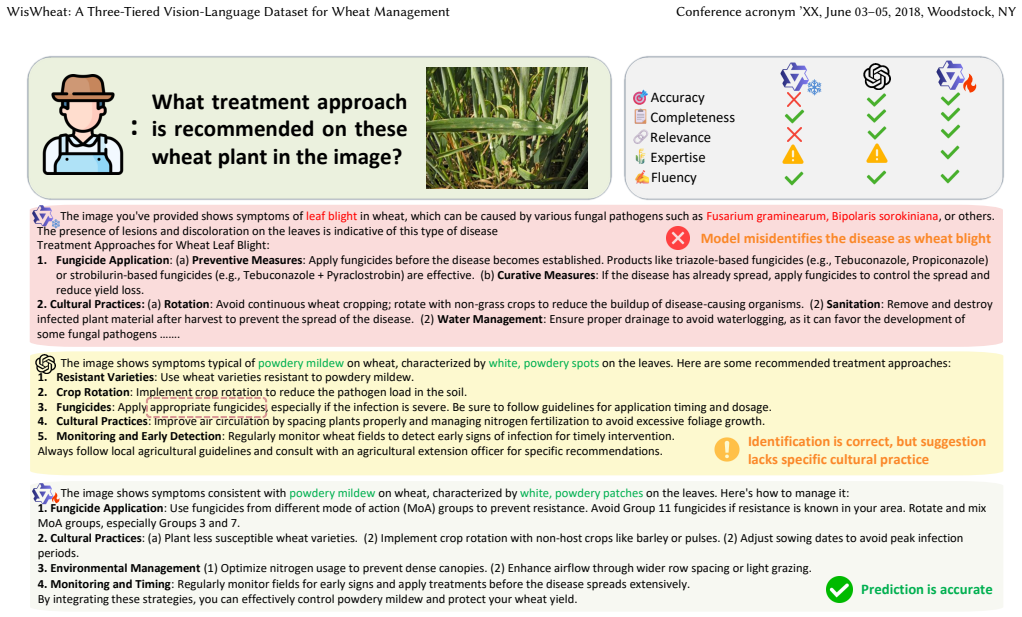
- [§3.2, §5.2.1, Table 2] The conversation evaluation is circular in a load-bearing way. Section 3.2 states that responses were generated with ChatGPT-4o assistance followed by expert verification, and Section 5.2.1 states that GPT-4o is used as the automated judge, with reference solutions provided during scoring. The fine-tuned models are trained to imitate these references, so their outputs are likely to resemble GPT-4o's own answer style and content. Since LLM-as-a-judge is known to favor responses similar to its own outputs, the Accuracy and Domain Expertise margins in Table 2 (e.g., Qwen2.5 VL 7B 79.2% vs GPT-4o 67.3% on stress; 84.6% vs 50.0% on growth stage) may substantially reflect judge self-preference rather than verified domain superiority. I recommend reporting an objective answer-verification baseline (e.g., exact or semantic matching against ground-truth labels) and/or a human-evaluation study on a held-out sample, with inter-annotator agreement, to support the headline comparison.
- [§5.1] The train/test split is not described. The text refers to 'the training split of our dataset' and 'the test split of WisWheat' but does not specify how images or samples were partitioned: random by sample, by image, by source dataset, or by field/experimental unit. If images from the same source dataset (e.g., WFD, GWFSS, Cobbity Wheat) appear in both training and test sets, the reported accuracy and MAE numbers in Tables 2 and 3 could be inflated by image-level leakage. Please describe the split protocol precisely, report the number of samples per split, and, ideally, report results with a split that ensures no source-dataset overlap between training and testing.
- [§5.2.2, §5.3.2, Tables 2 and 3] No error bars, confidence intervals, or multiple runs are reported. Fine-tuning of VLMs and GPT-4o-based judging are both stochastic, and the claimed improvements (e.g., growth stage accuracy 84.6% vs 50.0%; organ ratio MAE 5.5 vs 21.9–36.0) could be partly attributable to run-to-run variability. I ask the authors to report mean and standard deviation over at least three independent training runs and, for the conversation benchmark, over judge calls, or to provide a statistical significance test. This is necessary to establish that the margins in the central tables are robust.
- [§4.4, Eq. (5), Table 3] The numerical reward in Eq. (5) depends on a scaling parameter λ, but its value is not reported anywhere in the paper, and the format reward's relative weighting is also unspecified. Since the GRPO results in Table 3 are central to the quantitative claim, the paper should report the exact λ used, the reward weights, and ideally a small sensitivity analysis (e.g., λ ∈ {0.1, 0.5, 1.0}) to show that the reported MAE improvements are not artifacts of a particular reward scaling.
- [§5.2.1, 'Accuracy' criterion] Even setting aside the judge circularity, the 'Accuracy' dimension in the conversation benchmark is scored by GPT-4o as a holistic quality judgment, not by matching against a verified ground-truth fact. The paper should clarify how 'accuracy' is operationalized in the scoring rubric (e.g., does a response with one correct and one incorrect management recommendation receive partial credit?) and provide at least one worked example of a scored response to make the criterion interpretable and reproducible.
minor comments (6)
- [§3.2] Typo: 'pertaining layer' should be 'pretraining layer'; also 'assistantce' in §5.2.1 should be 'assistance'.
- [§4.4] Typo: 'rely on human-annotated reward signals' should be 'rely on'; also 'replay' appears in the same sentence and should be 'reply'.
- [Table 2] The name 'Claude Sonnect 3.7' should be 'Claude Sonnet 3.7'; also the model naming is inconsistent between 'ChatGPT-4o' and 'GPT-4o' in the text and table.
- [§3.1, Table 1] For the Pretraining Layer, it is unclear how unlabeled GWFSS images are converted into 'image-caption pairs'; please describe the caption generation process for these 47,871 pairs and whether automated captioning was used.
- [§3.2] The paper refers readers to a 'data repository' for the full question list, but no URL or repository identifier is provided in the manuscript; including the link (or a placeholder such as an anonymous repository) would improve reproducibility.
- [Throughout] Several references are incomplete or informal (e.g., reference [2] is just a URL; [23] is a blog post without version/date; [30] is a preprint without journal/venue). The bibliography should be brought to a consistent, complete format before publication.
Circularity Check
Conversation benchmark is partially circular: GPT-4o helped generate the reference solutions and also serves as the judge, so the headline margins over GPT-4o may reflect judge self-preference rather than objective domain expertise.
-
fitted input called prediction
[Sec. 5.2.1 (with Sec. 3.2/Fig. 1 and Sec. 4.3)]
"As discussed in Sec. 3, the reference solutions are derived from expert wheat-specific knowledge curated with GPT-4o assistantce. During the evaluation process, we provide GPT-4o with reference solutions alongside detailed score criteria for test samples."
The instruction-tuning references were generated with ChatGPT-4o assistance and then expert-verified (Sec. 3.2, Fig. 1). The fine-tuned Qwen2.5 VL 7B is trained on these references via cross-entropy loss (Sec. 4.3), so it learns to imitate GPT-4o's answer style and content. The same GPT-4o model is then used as the automated judge, with the reference solutions supplied during scoring (Sec. 5.2.1). Consequently, the reported Accuracy and Domain Expertise scores measure how closely a model reproduces GPT-4o-generated answers, judged by GPT-4o itself. The headline margins over GPT-4o (79.2% vs 67.3% for stress; 84.6% vs 50.0% for growth stage) are therefore inflated by judge self-preference and do not constitute an objective measure of domain expertise.
full rationale
The conversation benchmark in Sec. 5.2.2 is partially circular. The reference solutions used for both training and evaluation were initially produced with ChatGPT-4o assistance and then expert-verified (Sec. 3.2, Fig. 1); the evaluation then uses GPT-4o as the automated judge and provides those same reference solutions (Sec. 5.2.1). Because the fine-tuned Qwen2.5 VL 7B is trained to imitate these GPT-4o-derived references (Sec. 4.3), its responses are likely to match the judge's own stylistic and content preferences, inflating the reported accuracy. The quantitative VQA results (Table 3) rely on objective metrics such as MAE for spike counts, organ ratios, and rust ratios, so they are independent of this circularity and provide genuine evidence of dataset value. No load-bearing self-citation was found; the citation to GWFSS [33] is a normal dataset reference and does not smuggle in an unverified uniqueness claim. The paper also does not describe how the test split was created, which is a potential contamination risk, but no quoted evidence establishes overlap, so it is not scored as a circular step. Overall, the central dataset contribution has independent support from the quantitative experiments, but the headline conversational claim is partially compromised by the judge/reference-generator overlap, giving a partial-circularity score of 6.
Assumptions & free parameters
free parameters (1)
- Lambda in numerical reward =
not specified
assumptions (3)
- domain assumption GPT-4o can serve as an unbiased judge for wheat-domain response quality.
- domain assumption Reference solutions generated with GPT-4o assistance and expert verification are gold-standard.
- domain assumption Public source datasets provide correct labels for generating QA pairs.
Cite this review
Pith. "Pith review of WisWheat: A Three-Tiered Vision-Language Dataset for Wheat Management." pith.science (2026). https://pith.science/paper/2TWLOZB6
@misc{pith2026250606084,
  author       = {Pith},
  title        = {Pith review of: WisWheat: A Three-Tiered Vision-Language Dataset for Wheat Management},
  year         = {2026},
  howpublished = {\url{https://pith.science/paper/2TWLOZB6}},
  note         = {Machine review of arXiv:2506.06084}
}
read the original abstract
Wheat management strategies play a critical role in determining yield. Traditional management decisions often rely on labour-intensive expert inspections, which are expensive, subjective and difficult to scale. Recently, Vision-Language Models (VLMs) have emerged as a promising solution to enable scalable, data-driven management support. However, due to a lack of domain-specific knowledge, directly applying VLMs to wheat management tasks results in poor quantification and reasoning capabilities, ultimately producing vague or even misleading management recommendations. In response, we propose WisWheat, a wheat-specific dataset with a three-layered design to enhance VLM performance on wheat management tasks: (1) a foundational pretraining dataset of 47,871 image-caption pairs for coarsely adapting VLMs to wheat morphology; (2) a quantitative dataset comprising 7,263 VQA-style image-question-answer triplets for quantitative trait measuring tasks; and (3) an Instruction Fine-tuning dataset with 4,888 samples targeting biotic and abiotic stress diagnosis and management plan for different phenological stages. Extensive experimental results demonstrate that fine-tuning open-source VLMs (e.g., Qwen2.5 7B) on our dataset leads to significant performance improvements. Specifically, the Qwen2.5 VL 7B fine-tuned on our wheat instruction dataset achieves accuracy scores of 79.2% and 84.6% on wheat stress and growth stage conversation tasks respectively, surpassing even general-purpose commercial models such as GPT-4o by a margin of 11.9% and 34.6%.
Figures

Reference graph
Works this paper leans on
-
[1]
Rohan Anil, Sebastian Borgeaud, Yonghui Wu, Jean-Baptiste Alayrac, Jiahui Yu, Radu Soricut, Johan Schalkwyk, Andrew M. Dai, Anja Hauth, Katie Millican, David Silver, Slav Petrov, Melvin Johnson, Ioannis Antonoglou, Julian Schrit- twieser, Amelia Glaese, Jilin Chen, Emily Pitler, Timothy P. Lillicrap, Angeliki Lazaridou, Orhan Firat, James Molloy, Michael ...
-
[2]
Anthropic. 2024. Claude. https://claude.ai AI Assistant
work page 2024
-
[3]
Muhammad Arbab Arshad, Talukder Zaki Jubery, Tirtho Roy, Rim Nassiri, Asheesh K. Singh, Arti Singh, Chinmay Hegde, Baskar Ganapathysubramanian, Aditya Balu, Adarsh Krishnamurthy, and Soumik Sarkar. 2025. Leveraging Vision Language Models for Specialized Agricultural Tasks. In W ACV. IEEE
work page 2025
-
[4]
Muhammad Awais, Ali Husain Salem Abdulla Alharthi, Amandeep Kumar, Hisham Cholakkal, and Rao Muhammad Anwer. 2025. Agrogpt: Efficient agricul- tural vision-language model with expert tuning. In W ACV. IEEE, 5687–5696
work page 2025
-
[5]
Shuai Bai, Keqin Chen, Xuejing Liu, Jialin Wang, Wenbin Ge, Sibo Song, Kai Dang, Peng Wang, Shijie Wang, Jun Tang, Humen Zhong, Yuanzhi Zhu, Ming-Hsuan Yang, Zhaohai Li, Jianqiang Wan, Pengfei Wang, Wei Ding, Zheren Fu, Yiheng Xu, Jiabo Ye, Xi Zhang, Tianbao Xie, Zesen Cheng, Hang Zhang, Zhibo Yang, Haiyang Xu, and Junyang Lin. 2025. Qwen2.5-VL Technical ...
-
[6]
Asma Ben Abacha, Sadid A Hasan, Vivek V Datla, Dina Demner-Fushman, and Henning Müller. 2019. Vqa-med: Overview of the medical visual question an- swering task at imageclef 2019. In Proceedings of CLEF (Conference and Labs of the Evaluation Forum) 2019 Working Notes . 9-12 September 2019
2019
-
[7]
Lucas Beyer, Andreas Steiner, André Susano Pinto, Alexander Kolesnikov, Xiao Wang, Daniel Salz, Maxim Neumann, Ibrahim Alabdulmohsin, Michael Tschan- nen, Emanuele Bugliarello, Thomas Unterthiner, Daniel Keysers, Skanda Kop- pula, Fangyu Liu, Adam Grycner, Alexey Gritsenko, Neil Houlsby, Manoj Kumar, Keran Rong, Julian Eisenschlos, Rishabh Kabra, Matthias...
arXiv 2024
-
[8]
Xi Chen, Xiao Wang, Soravit Changpinyo, A. J. Piergiovanni, Piotr Padlewski, Daniel Salz, Sebastian Goodman, Adam Grycner, Basil Mustafa, Lucas Beyer, Alexander Kolesnikov, Joan Puigcerver, Nan Ding, Keran Rong, Hassan Akbari, Gaurav Mishra, Linting Xue, Ashish V. Thapliyal, James Bradbury, and Weicheng Kuo. 2023. PaLI: A Jointly-Scaled Multilingual Langu...
work page 2023
Show all 39 references
-
[9]
Guy Coleman. 2021. 20200827 - Cobbity Wheat BFLY. https://weed-ai.sydney. edu.au/datasets/3c363da3-6274-45e4-a0ce-b307cb0f89cc
2021
-
[10]
Guy Coleman. 2021. 20201014 - Cobbity Wheat BFLY. https://weed-ai.sydney. edu.au/datasets/73468c19-b098-406a-86fa-df172caaec16
2021
-
[11]
Mark Cooper, Carlos D Messina, Tom Tang, Carla Gho, Owen M Powell, Dean W Podlich, Frank Technow, and Graeme L Hammer. 2022. Predicting Genotype× Environment× Management (G× E× M) interactions for the design of crop improvement strategies: integrating breeder, agronomist, and ...
2022
-
[12]
Wenliang Dai, Junnan Li, Dongxu Li, Anthony Meng Huat Tiong, Junqi Zhao, Weisheng Wang, Boyang Li, Pascale Fung, and Steven Hoi. 2023. InstructBLIP: Towards General-purpose Vision-Language Models with Instruction Tuning. arXiv:2305.06500 https://arxiv.org/abs/2305.06500
2023 arXiv
-
[13]
Etienne David, Mario Serouart, Daniel Smith, Simon Madec, Kaaviya Velumani, Shouyang Liu, Xu Wang, Francisco Pinto, Shahameh Shafiee, Izzat S.A. Tahir, Hisashi Tsujimoto, Shuhei Nasuda, Bangyou Zheng, Norbert Kirchgessner, Helge Aasen, Andreas Hund, Pouria Sadhegi-Tehran, Koic...
2021
-
[14]
Ani A Elias, Kelly R Robbins, RW Doerge, and Mitchell R Tuinstra. 2016. Half a century of studying genotype× environment interactions in plant breeding experiments. Crop Science 56, 5 (2016), 2090–2105
2016
-
[15]
Olaf Erenstein, Moti Jaleta, Khondoker Abdul Mottaleb, Kai Sonder, Jason Dono- van, and Hans-Joachim Braun. 2022. Global trends in wheat production, con- sumption and trade. In Wheat improvement: food security in a changing climate . Springer International Publishing Cham, 47–66
2022
-
[16]
Mikhail Genaev, Ekaterina Skolotneva, Ekaterina Gultyaeva, Elena Orlova, Nico- las Bechtold, and Dmitry Afonnikov. 2021. Image-Based Wheat Fungi Dis- eases Identification by Deep Learning. Plants 10, 8 (2021), 1500. doi:10.3390/ plants10081500
2021
-
[17]
Ho, Christopher Ré, Adam Chilton, Aditya Narayana, Alex Chohlas-Wood, Austin Peters, Brandon Waldon, Daniel N
Neel Guha, Julian Nyarko, Daniel E. Ho, Christopher Ré, Adam Chilton, Aditya Narayana, Alex Chohlas-Wood, Austin Peters, Brandon Waldon, Daniel N. Rock- more, Diego Zambrano, Dmitry Talisman, Enam Hoque, Faiz Surani, Frank Fagan, Galit Sarfaty, Gregory M. Dickinson, Haggai Por...
2023 arXiv
- [18]
-
[19]
Le, Yunhsuan Sung, Zhen Li, and Tom Duerig
Chao Jia, Yinfei Yang, Ye Xia, Yi-Ting Chen, Zarana Parekh, Hieu Pham, Quoc V. Le, Yunhsuan Sung, Zhen Li, and Tom Duerig. 2021. Scaling Up Visual and Vision-Language Representation Learning With Noisy Text Supervision. arXiv:2102.05918 https://arxiv.org/abs/2102.05918
2021 arXiv
-
[20]
Alistair EW Johnson, Tom J Pollard, Seth J Berkowitz, Nathaniel R Greenbaum, Matthew P Lungren, Chih-ying Deng, Roger G Mark, and Steven Horng. 2019. MIMIC-CXR, a de-identified publicly available database of chest radiographs with free-text reports. Scientific data 6, 1 (2019), 317
2019
-
[21]
Jason J Lau, Soumya Gayen, Asma Ben Abacha, and Dina Demner-Fushman. 2018. A dataset of clinically generated visual questions and answers about radiology images. Scientific data 5, 1 (2018), 1–10
2018
-
[22]
Junnan Li, Dongxu Li, Caiming Xiong, and Steven C. H. Hoi. 2022. BLIP: Bootstrap- ping Language-Image Pre-training for Unified Vision-Language Understanding and Generation. In ICML, Vol. 162. PMLR, 12888–12900
2022
-
[23]
Haotian Liu, Chunyuan Li, Yuheng Li, Bo Li, Yuanhan Zhang, Sheng Shen, and Yong Jae Lee. 2024. LLaVA-NeXT: Improved reasoning, OCR, and world knowl- edge. https://llava-vl.github.io/blog/2024-01-30-llava-next/
2024
-
[24]
Haotian Liu, Chunyuan Li, Qingyang Wu, and Yong Jae Lee. 2023. Visual Instruc- tion Tuning. In NeurIPS
2023
- [25]
-
[26]
Joel Niklaus, Veton Matoshi, Matthias Stürmer, Ilias Chalkidis, and Daniel E Ho. 2023. Multilegalpile: A 689gb multilingual legal corpus. arXiv preprint arXiv:2306.02069 (2023)
2023 arXiv
-
[27]
Long Ouyang, Jeff Wu, Xu Jiang, Diogo Almeida, Carroll L. Wainwright, Pamela Mishkin, Chong Zhang, Sandhini Agarwal, Katarina Slama, Alex Ray, John Schul- man, Jacob Hilton, Fraser Kelton, Luke Miller, Maddie Simens, Amanda Askell, Peter Welinder, Paul Christiano, Jan Leike, a...
2022 arXiv
-
[28]
Alec Radford, Jong Wook Kim, Chris Hallacy, Aditya Ramesh, Gabriel Goh, Sandhini Agarwal, Girish Sastry, Amanda Askell, Pamela Mishkin, Jack Clark, Gretchen Krueger, and Ilya Sutskever. 2021. Learning Transferable Visual Models From Natural Language Supervision, Vol. 139. PMLR...
2021
-
[29]
Gilbert Rayner. 2022. RadishWheatDataset. https://weed-ai.sydney.edu.au/ datasets/8b8f134f-ede4-4792-b1f7-d38fc05d8127
2022
- [30]
-
[31]
Haozhan Shen, Peng Liu, Jingcheng Li, Chunxin Fang, Yibo Ma, Jiajia Liao, Qiaoli Shen, Zilun Zhang, Kangjia Zhao, Qianqian Zhang, Ruochen Xu, and Tiancheng Zhao. 2025. VLM-R1: A Stable and Generalizable R1-style Large Vision-Language Model. Conference acronym ’XX, June 03–05, ...
2025
-
[32]
Liqiong Wang, Teng Jin, Jinyu Yang, Ales Leonardis, Fangyi Wang, and Feng Zheng. 2024. Agri-LLaVA: Knowledge-Infused Large Multimodal Assistant on Agricultural Pests and Diseases. CoRR (2024)
2024
-
[33]
Zijian Wang, Radek Zenkl, Latifa Greche, Benoit De Solan, Lucas Bernigaud Samatan, Safaa Ouahid, Andrea Visioni, Carlos A Robles-Zazueta, Francisco Pinto, Ivan Perez-Olivera, et al. 2025. The Global Wheat Full Semantic Organ Segmentation (GWFSS) Dataset. bioRxiv (2025), 2025–03
2025
-
[34]
RM Williams, Louise O’Brien, Howard A Eagles, Vicky A Solah, and Vijay Jayasena. 2008. The influences of genotype, environment, and genotype× envi- ronment interaction on wheat quality. Australian journal of agricultural research 59, 2 (2008), 95–111
2008
-
[35]
Chaoyi Wu, Weixiong Lin, Xiaoman Zhang, Ya Zhang, Yanfeng Wang, and Weidi Xie. 2023. PMC-LLaMA: Towards Building Open-source Language Models for Medicine. arXiv:2304.14454 [cs.CL] https://arxiv.org/abs/2304.14454
2023 arXiv
-
[36]
Haoning Wu, Zicheng Zhang, Weixia Zhang, Chaofeng Chen, Liang Liao, Chunyi Li, Yixuan Gao, Annan Wang, Erli Zhang, Wenxiu Sun, Qiong Yan, Xiongkuo Min, Guangtao Zhai, and Weisi Lin. 2024. Q-Align: Teaching LMMs for Visual Scoring via Discrete Text-Defined Levels. In ICML
2024
-
[37]
Jianbin Yao, Yushu Wu, Jianhua Liu, and Hansheng Wang. 2024. Multimodal deep learning-based drought monitoring research for winter wheat during critical growth stages. PLOS ONE 19, 5 (2024), e0300746. doi:10.1371/journal.pone.0300746
2024 doi
-
[38]
McDonald, Achim Walter, and Jonas Anderegg
Radek Zenkl, Bruce A. McDonald, Achim Walter, and Jonas Anderegg. 2025. Towards high throughput in-field detection and quantification of wheat foliar diseases using deep learning. Computers and Electronics in Agriculture 232 (2025), 109854. doi:10.1016/j.compag.2024.109854
2025
-
[39]
Xing, Hao Zhang, Joseph E
Lianmin Zheng, Wei-Lin Chiang, Ying Sheng, Siyuan Zhuang, Zhanghao Wu, Yonghao Zhuang, Zi Lin, Zhuohan Li, Dacheng Li, Eric P. Xing, Hao Zhang, Joseph E. Gonzalez, and Ion Stoica. 2023. Judging LLM-as-a-Judge with MT- Bench and Chatbot Arena. In NeurIPS
2023
Reviewed August 7, 2026 · model on record in the stance chip above.
Discussion (0). Sign in to comment.