REVIEW 3 major objections 5 minor 44 references
StyleComposer: Training-Free Multi-Reference Style Composition
T0 review · 3 major / 5 minor · reviewed 2026-08-08 · deepseek-v4-flash
Pith's one-line read No training: compose color, texture, and structure from three reference images at once.
desk verdict Well-ablated, clearly written method for training-free per-attribute style composition; the central claim holds up, with addressable concerns about benchmark input mapping and the generality of the K/V decomposition. read the letter →
The pith
A machine-rendered reading of the paper's core claim, the machinery that carries it, and where it could break.
The reading
What carries the argument
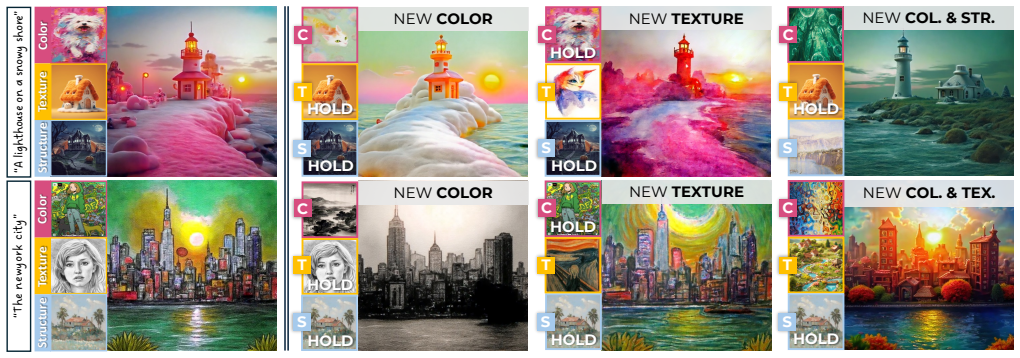
The load-bearing mechanism is a route-and-stage decomposition: each style attribute is assigned to the internal representation in which the paper's probes find it most separable, and each route is active only during the denoising stage where it does its work. Color rides the three-dimensional chromatic subspace of the FLUX VAE latent, found by PCA on solid-color latents, and is transferred by sliced optimal transport of the empirical coordinate distribution, with a reference-free prediction providing the αc=0 endpoint so the slider removes palette leaked by other routes. Texture rides the attention K/V pathway, but only the low-frequency components of the texture reference's RoPE-encoded keys are kept and only generation-key statistics are AdaIN-aligned, so coarse brushwork transfers while object positions and reference palette do not. Structure rides the query pathway as a fixed anchor recorded once from the structure reference, blended into the last 25 single-stream blocks during the first Ts steps with cosine decay, so layout is guided early and released before detail formation. A step-dependent cap on attention mass to texture tokens prevents the reference from overwhelming prompt content early in sampling. Together these three interventions define StyleComposer's claim: coordination by representation, attention component, and time replaces learned fusion.
What would settle it
Run the paper's two controlled probes on a larger, more diverse reference pool: if shuffling the texture reference's key tokens leaves texture transfer well above the reported 0.03, or if neutralizing the channel statistics of V leaves color transfer well above the reported −0.05, then the K–V/global-V decomposition is not the general mechanism and the texture route's premise collapses. A second decisive check: disable the latent color route only and ask whether raising the texture slider raises color distance to the color reference; if MS-SWD moves substantially, color is riding the texture path despite the design.
Extended reading notes
Core claim
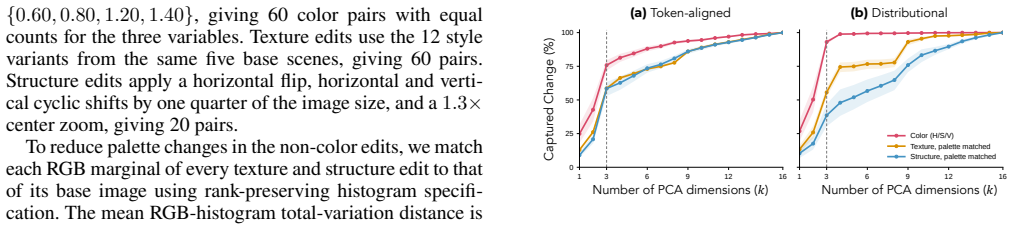
The central discovery is an asymmetry in where style attributes live inside a frozen text-to-image diffusion model. In the CLIP image embedding, color and texture edits move along content-specific directions (pairwise cosine similarity 0.24 for color, 0.37 for texture), so embedding arithmetic cannot serve as a reusable attribute axis. In the joint attention layers, texture transfer follows token-wise key–value correspondence while color follows the global channel statistics of the value features, so selecting K or V alone does not isolate either. In the VAE latent, a three-dimensional chromatic basis captures 93% of color edits but only 56% of texture and 39% of structure edits. The paper builds on this asymmetry: after projecting the clean latent estimate onto the chromatic basis, it transports the color-coordinate distribution toward the color reference with sliced optimal transport; it appends texture-reference K/V tokens but keeps only low-frequency keys and aligns only key statistics with AdaIN, so texture comes across without the reference's objects or palette; and it blends a fixed structure-reference query anchor into early denoising steps with a cosine decay, holding layout while detail formation is released to the prompt. The result is a training-free pipeline in which each attribute has an independent strength parameter and the three references plus the prompt are satisfied jointly, measured by new Composition and Selectivity scores (0.621 and 0.745, versus 0.432 and 0.446 for the closest prior method).
Load-bearing premise
The entire design rests on the probe result that, in FLUX's attention, texture is carried by token-wise key–value correspondence while color is carried by the global statistics of the value features; if that split fails for references or prompts beyond the nine references, five prompts, and two seeds tested, the texture route will leak color or content.
Editorial extensions
If this is right
- A user can set three independent sliders — αc for color, s_lf for texture, T_s for structure — and generate a new composition from the same references and prompt in one pass, with no re-optimization.
- Because no training or inversion is involved, any image can serve as a reference; the only per-reference cost is one forward pass for the structure anchor and per-step texture feature extraction.
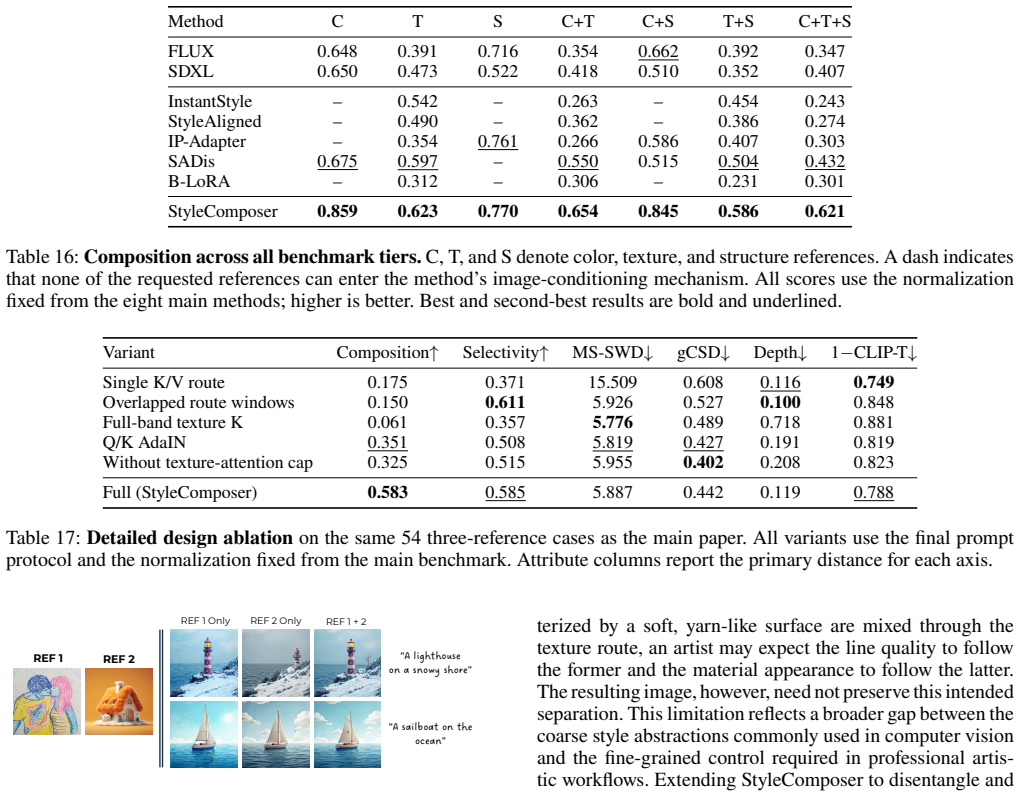
- The paper's cross-tier results (Composition 0.859 for color-only, 0.623 texture-only, 0.770 structure-only, up to 0.621 for all three) imply the routing gains are not specific to the triple-reference setting.
- The ablation results imply each route is the sole carrier of its attribute: removing a route degrades that attribute's metric sharply (MS-SWD 5.89→15.57 for color, gCSD 0.442→0.608 for texture, depth 0.119→0.139 for structure) and no other route compensates.
Reading between the lines
- If the representation-asymmetry principle generalizes, finer art-theoretic attributes such as line quality or value could be routed through other latent coordinates or frequency bands, once a probe locates where they separate; the paper leaves this untested.
- The low-frequency key filter suggests a quantitative trade-off curve: sweeping the frequency exponent β or the high-frequency floor s_hf should trace a frontier between texture fidelity (gCSD) and content copying (CLIP-I or object-level similarity); the paper reports only the chosen operating point.
- The reliance on FLUX-specific probes (three-dimensional chromatic basis, RoPE axes, joint-attention layout) means the recipe is not portable without re-derivation; a natural test is whether an autoregressive image generator with continuous tokens shows the same K–V/global-V split.
- Since a texture-medium prompt descriptor added 0.059 Composition over the image-only routes, the image routes may be carrying category-level texture cues rather than pixel-identical brushwork; a stricter test would measure whether two different texture references in the same medium produce distinguishable outputs at equal slider settings.
Editorial analysis
A structured set of objections, weighed in public.
Referee Report
Summary. This paper proposes StyleComposer, a training-free method for composing color, texture, and spatial structure from three different reference images during FLUX sampling. The paper first argues, via CLIP-embedding edit directions, attention K/V/Q probes, and a VAE latent chromatic-subspace analysis, that no single representation isolates all three attributes. It then routes color through sliced optimal transport on a 3-D chromatic subspace of the VAE latent, texture through low-frequency K/V token injection with K-only AdaIN, and structure through early query blending with cosine decay. The method is evaluated on 610 benchmark combinations with a new Composition/Selectivity pair of metrics, route and design ablations, a user study, and qualitative slider demonstrations.
Significance. Within the paper's scope, the contribution is meaningful: if the route decomposition holds, StyleComposer would be the first training-free method to let a user choose the source and strength of color, texture, and structure independently. The method is specified in unusual detail (Algorithm 1 and Table 9), the route-removal ablations in Table 3 and the design ablations in Table 4 support the claim that each route is the primary carrier of its attribute, and the independent user study favors the method. The within-method comparison of image routes versus textual substitutes (Table 13) also helps isolate the value of the image-based routes. However, the headline comparison is not fully matched across methods, and the central K/V decomposition rests on a small and not fully controlled probe set; both need to be strengthened before the central claim is established.
major comments (3)
- [Section 3, Table 7, Eqs. (4)-(5)] The texture route is load-bearing and rests on the probe conclusion that texture is carried by token-wise K-V correspondence while color is carried by the global statistics of V. The evidence is thin (9 references, 5 prompts, 2 seeds) and the two key interventions are not controlled for total injection strength: shuffling K also randomizes, for each query, which reference V token receives the attention weight, thereby reducing effective reference injection; V neutralization changes the scale and offset of the injected V. The observed dissociation in Table 7 could therefore reflect a reduction in the overall reference signal rather than an attribute-specific carrier. This matters because Eq. (5) appends unmodified V_t and Eqs. (2)-(3) correct only the chromatic coordinates after attention; if the decomposition fails on a broader distribution of references, texture routing would leak color or content that the latent correction cannot absorb. Please add matched-fluence controls (e.g., a scrambled K with attention re-normalized to the original total mass, and V neutralization followed by rescaling to the original statistics) and validate the decomposition on a larger and more diverse probe set.
- [Table 2, Table 11] The headline quantitative claim in Table 2 is confounded by the reference mapping. In the three-reference tier, StyleComposer receives image routes for all three attributes, while SADis receives color and texture images plus a text layout description, IP-Adapter receives a texture image plus depth control and a text palette description, and InstantStyle, StyleAligned, and B-LoRA receive only a texture image with text descriptions for color and structure. The manual descriptors in Table 12 are informative but are not equivalent to image references. To support the abstract's claim that the method 'satisfies three references and the prompt jointly more closely than prior methods,' please provide a fully matched comparison in which every method receives the same three reference images through its available image interfaces (for example, a composite reference image for single-image methods), or at minimum compare against a StyleComposer variant that receives text descriptors for color and structure, under the same information budget as each baseline.
- [Table 2, Table 16] The aggregate Composition and Selectivity scores in Table 2 are averaged over each method's supported case set, which differs across methods: 610 cases for StyleComposer and FLUX/SDXL, 590 for SADis and IP-Adapter, and 470 for InstantStyle, StyleAligned, and B-LoRA. Because the difficulty of satisfying requests varies across tiers, a global average over different subsets is not a head-to-head comparison. Table 16 is more informative, but the headline numbers should be recomputed on a common case set (the 470-case intersection is natural) and reported with bootstrap confidence intervals for Composition and Selectivity.
minor comments (5)
- [Table 4] The 'Full (ours)' row in Table 4 reports Composition 0.583 and Selectivity 0.585, while Table 2 reports 0.621 and 0.745; the caption should state explicitly that Table 4 uses the 54-case ablation subset to avoid an apparent inconsistency.
- [Eq. (26)] The notation LSE in Eq. (26) is used without definition; please define it as log-sum-exp and clarify the exact dimensions over which it is computed (e.g., over the appended reference key tokens and the generation key tokens, respectively).
- [Figure 2] The caption of Figure 2 contains a repeated or malformed axis label ('PC 1 PC 1 PC 2 PC 1'); this typo should be corrected.
- [Algorithm 1] In Algorithm 1, line 2 says 'Sample initial latent x0,' but FLUX sampling starts from a fully noisy latent; please clarify whether x0 denotes the initial noise latent or an intermediate state and make the initialization of the noise schedule explicit.
- [Table 9] Table 9 fixes many hyperparameters, including the SOT expansion factor rho=1.5, the frequency scaling exponents beta=2, the attention-cap schedule, and the route intervals; since the paper emphasizes the absence of per-case tuning, a small sensitivity analysis over these fixed values would strengthen that claim.
Circularity Check
No significant circularity: the attribute-route design is grounded in separate probe experiments, and the headline benchmark compares fixed configurations; no load-bearing result reduces to its own inputs by construction.
full rationale
The derivation chain is not circular in the sense targeted here. The decisions to route color through the VAE latent chromatic subspace, texture through low-frequency K/V with K-only AdaIN, and structure through early Q blending are justified by separate probe experiments: CLIP edit-direction consistency (0.24 for color, 0.37 for texture), attention K/V interventions (K-shuffle and V-neutralization), and latent chromatic capture (93% for color versus 56% and 39% for texture and structure). These probes are distinct from the final 610-case composition benchmark and are not fitted to it. The strength sliders alpha_c, s_lf, and T_s are constructional controls by Equations 2, 4, and 6, but the paper's central claim is not merely that a slider exists; it is that the three routes jointly satisfy three references and a prompt better than prior methods, which is evaluated with fixed configurations on a shared benchmark. No equation in the paper is equivalent to the evaluation metric by construction: the color route's sliced optimal transport operates in a 3-D latent coordinate system, while the benchmark color metrics are external image-level distances; texture and structure scores are likewise not minimized directly by the K/V and Q interventions. The paper contains no load-bearing self-citations: the cited foundations (Pach et al. 2026; Yin et al. 2025; Mikaeili et al. 2026) are by other groups and are used as starting points rather than as proof of the final claim. The remaining concerns in the manuscript are empirical robustness issues, not circularity: the K/V decomposition rests on nine references, five prompts, and two seeds, and the paper does not document whether the final hyperparameter set (alpha_c=1, s_lf=2, cap schedule, T_s=12) was selected on a validation split rather than the test benchmark. If the latter were true, it would be a statistical-validation problem, but the paper provides no quote or equation showing that any reported prediction is forced by a fit or by definition. Accordingly the circularity score is 0.
Assumptions & free parameters
free parameters (6)
- alpha_c (global color strength) =
1.0 default (slider 0 to 1)
- SOT expansion factor rho =
1.5
- Texture key frequency scaling (s_hf, s_lf, beta) =
s_hf=0, s_lf=2, beta=2
- Texture-attention cap schedule tau_i =
0.25 (steps 3 to 11), 0.50 (steps 12 to 19), none (steps 20 to 27)
- Route intervals =
color 16 to 27, texture 3 to 27, structure 0 to 11
- Structure route duration and anchor =
Ts=12, anchor at scheduler index 20, last 25 single-stream blocks (indices 13 to 37)
assumptions (4)
- domain assumption The 3-D chromatic PCA basis of the FLUX VAE latent, estimated from solid-color images, captures color changes with little intrusion from texture or structure.
- domain assumption Attention Q/K/V roles observed in probes remain valid when features are filtered and mixed as in Eqs. 4 to 6.
- domain assumption MS-SWD, grayscale CSD, and depth-layout distance are adequate proxies for color, texture, and structure fidelity as humans perceive them.
- domain assumption Hand-coordinated training-free routing on a frozen FLUX model is sufficient for simultaneous multi-attribute composition.
Cite this review
Pith. "Pith review of StyleComposer: Training-Free Multi-Reference Style Composition." pith.science (2026). https://pith.science/paper/2TZ2UEQE
@misc{pith2026260805213,
  author       = {Pith},
  title        = {Pith review of: StyleComposer: Training-Free Multi-Reference Style Composition},
  year         = {2026},
  howpublished = {\url{https://pith.science/paper/2TZ2UEQE}},
  note         = {Machine review of arXiv:2608.05213}
}
read the original abstract
The style of a painting is not monolithic: color, texture, and structure may come from different sources. Existing reference-guided methods transfer them as one style signal, leaving each attribute's source and strength outside the user's control. We ask where in a diffusion model one attribute can change while the others hold, and find that no single representation isolates all three. The proposed StyleComposer therefore routes each style attribute through the representation where it separates best and coordinates the routes over denoising time. Without training or inversion, it satisfies three references and the prompt jointly more closely than prior methods, and exposes one strength slider per attribute. Project page: https://lexxsh.github.io/StyleComposer
Figures


Figures from the paper (14 more)






Reference graph
Works this paper leans on
-
[1]
Communication, Simulation, and Intelligent Agents: Implications of Personal Intelligent Machines for Medical Education
Clancey, William J. Communication, Simulation, and Intelligent Agents: Implications of Personal Intelligent Machines for Medical Education. Proceedings of the Eighth International Joint Conference on Artificial Intelligence (IJCAI-83)
-
[2]
Classification Problem Solving
Clancey, William J. Classification Problem Solving. Proceedings of the Fourth National Conference on Artificial Intelligence
-
[3]
, title =
Robinson, Arthur L. , title =. 1980 , doi =. https://science.sciencemag.org/content/208/4447/1019.full.pdf , journal =
1980
-
[4]
New Ways to Make Microcircuits Smaller---Duplicate Entry
Robinson, Arthur L. New Ways to Make Microcircuits Smaller---Duplicate Entry. Science
-
[5]
Clancey and Glenn Rennels , abstract =
Diane Warner Hasling and William J. Clancey and Glenn Rennels , abstract =. Strategic explanations for a diagnostic consultation system , journal =. 1984 , issn =. doi:https://doi.org/10.1016/S0020-7373(84)80003-6 , url =
-
[6]
and Rennels, Glenn R
Hasling, Diane Warner and Clancey, William J. and Rennels, Glenn R. and Test, Thomas. Strategic Explanations in Consultation---Duplicate. The International Journal of Man-Machine Studies
-
[7]
Poligon: A System for Parallel Problem Solving
Rice, James. Poligon: A System for Parallel Problem Solving
-
[8]
Transfer of Rule-Based Expertise through a Tutorial Dialogue
Clancey, William J. Transfer of Rule-Based Expertise through a Tutorial Dialogue
Show all 44 references
-
[9]
The Engineering of Qualitative Models
Clancey, William J. The Engineering of Qualitative Models
-
[10]
2023 , eprint=
Attention Is All You Need , author=. 2023 , eprint=
2023
-
[11]
Pluto: The 'Other' Red Planet
NASA. Pluto: The 'Other' Red Planet
-
[12]
Proceedings of the AAAI Conference on Artificial Intelligence , volume=
Dreamstyler: Paint by style inversion with text-to-image diffusion models , author=. Proceedings of the AAAI Conference on Artificial Intelligence , volume=
-
[13]
arXiv preprint arXiv:2404.02733 , year=
Instantstyle: Free lunch towards style-preserving in text-to-image generation , author=. arXiv preprint arXiv:2404.02733 , year=
-
[14]
Proceedings of the IEEE/CVF Conference on Computer Vision and Pattern Recognition , pages=
Style aligned image generation via shared attention , author=. Proceedings of the IEEE/CVF Conference on Computer Vision and Pattern Recognition , pages=
-
[15]
Advances in Neural Information Processing Systems , volume=
AlignedGen: Aligning Style Across Generated Images , author=. Advances in Neural Information Processing Systems , volume=
-
[16]
arXiv preprint arXiv:2503.14275 , year=
Free-lunch color-texture disentanglement for stylized image generation , author=. arXiv preprint arXiv:2503.14275 , year=
-
[17]
arXiv preprint arXiv:2603.12261 , year=
The Latent Color Subspace: Emergent Order in High-Dimensional Chaos , author=. arXiv preprint arXiv:2603.12261 , year=
-
[18]
2024 , howpublished=
Black Forest Labs , title=. 2024 , howpublished=
2024
-
[19]
European Conference on Computer Vision , pages=
Implicit style-content separation using b-lora , author=. European Conference on Computer Vision , pages=. 2024 , organization=
2024
-
[20]
Advances in Neural Information Processing Systems , volume=
Fiva: Fine-grained visual attribute dataset for text-to-image diffusion models , author=. Advances in Neural Information Processing Systems , volume=
-
[21]
Proceedings of the SIGGRAPH Asia 2025 Conference Papers , pages=
ConsistEdit: Highly Consistent and Precise Training-free Visual Editing , author=. Proceedings of the SIGGRAPH Asia 2025 Conference Papers , pages=
2025
-
[22]
Proceedings of the IEEE/CVF International Conference on Computer Vision , pages=
Freeflux: Understanding and exploiting layer-specific roles in rope-based mmdit for versatile image editing , author=. Proceedings of the IEEE/CVF International Conference on Computer Vision , pages=
-
[23]
arXiv preprint arXiv:2606.13809 , year=
Compressing Image Style Training into a Single Model Forward , author=. arXiv preprint arXiv:2606.13809 , year=
-
[24]
International conference on machine learning , pages=
Learning transferable visual models from natural language supervision , author=. International conference on machine learning , pages=. 2021 , organization=
2021
-
[25]
arXiv preprint arXiv:2602.05013 , year=
Untwisting RoPE: Frequency Control for Shared Attention in DiTs , author=. arXiv preprint arXiv:2602.05013 , year=
-
[26]
European Conference on Computer Vision , pages=
Multiscale sliced Wasserstein distances as perceptual color difference measures , author=. European Conference on Computer Vision , pages=. 2024 , organization=
2024
-
[27]
arXiv preprint arXiv:2404.01292 , year=
Measuring style similarity in diffusion models , author=. arXiv preprint arXiv:2404.01292 , year=
-
[28]
Advances in Neural Information Processing Systems , volume=
Depth anything v2 , author=. Advances in Neural Information Processing Systems , volume=
-
[29]
arXiv preprint arXiv:2308.06721 , year=
Ip-adapter: Text compatible image prompt adapter for text-to-image diffusion models , author=. arXiv preprint arXiv:2308.06721 , year=
-
[30]
1958 , publisher=
The principles of art , author=. 1958 , publisher=
1958
-
[31]
The Fourteenth International Conference on Learning Representations , year=
NextStep-1: Toward autoregressive image generation with continuous tokens at scale , author=. The Fourteenth International Conference on Learning Representations , year=
-
[32]
arXiv preprint arXiv:2501.17811 , year=
Janus-pro: Unified multimodal understanding and generation with data and model scaling , author=. arXiv preprint arXiv:2501.17811 , year=
-
[33]
Advances in neural information processing systems , volume=
Visual autoregressive modeling: Scalable image generation via next-scale prediction , author=. Advances in neural information processing systems , volume=
-
[34]
Proceedings of the IEEE international conference on computer vision , pages=
Arbitrary style transfer in real-time with adaptive instance normalization , author=. Proceedings of the IEEE international conference on computer vision , pages=
-
[35]
arXiv preprint arXiv:2104.09864 , year=
Roformer: Enhanced transformer with rotary position embedding , author=. arXiv preprint arXiv:2104.09864 , year=
-
[36]
International conference on scale space and variational methods in computer vision , pages=
Wasserstein barycenter and its application to texture mixing , author=. International conference on scale space and variational methods in computer vision , pages=. 2011 , organization=
2011
-
[37]
Proceedings of the IEEE/CVF international conference on computer vision , pages=
Emerging properties in self-supervised vision transformers , author=. Proceedings of the IEEE/CVF international conference on computer vision , pages=
-
[38]
arXiv preprint arXiv:2306.00983 , year=
Styledrop: Text-to-image generation in any style , author=. arXiv preprint arXiv:2306.00983 , year=
-
[39]
Proceedings of the IEEE/CVF conference on computer vision and pattern recognition , pages=
Style injection in diffusion: A training-free approach for adapting large-scale diffusion models for style transfer , author=. Proceedings of the IEEE/CVF conference on computer vision and pattern recognition , pages=
-
[40]
Proceedings of the Computer Vision and Pattern Recognition Conference , pages=
Stylemaster: Stylize your video with artistic generation and translation , author=. Proceedings of the Computer Vision and Pattern Recognition Conference , pages=
-
[41]
Proceedings of the Computer Vision and Pattern Recognition Conference , pages=
Omnistyle: Filtering high quality style transfer data at scale , author=. Proceedings of the Computer Vision and Pattern Recognition Conference , pages=
-
[42]
IEEE Transactions on Image Processing , volume =
Improved ArtGAN for Conditional Synthesis of Natural Image and Artwork , author=. IEEE Transactions on Image Processing , volume =. 2019 , url =
2019
-
[43]
Proceedings of International Conference on Computer Vision (ICCV) , month =
Deep Learning Face Attributes in the Wild , author =. Proceedings of International Conference on Computer Vision (ICCV) , month =
-
[44]
IEEE transactions on pattern analysis and machine intelligence , volume=
Towards robust monocular depth estimation: Mixing datasets for zero-shot cross-dataset transfer , author=. IEEE transactions on pattern analysis and machine intelligence , volume=. 2022 , publisher=
2022
Reviewed August 8, 2026 · model on record in the stance chip above.
Discussion (0). Continue with ORCID to comment.