REVIEW 4 major objections 5 minor 14 references
Extracting Document Relations from Search Corpus by Marginalizing over User Queries
T0 review · 4 major / 5 minor · reviewed 2026-08-06 · deepseek-v4-flash
Pith's one-line read By averaging retrieval scores over many user queries, this paper estimates the joint probability that two documents co-occur, turning the retrieval process itself into an unsupervised, taxonomy-free document-relationship discovery…
desk verdict A promising idea about query-marginalized co-occurrence, but the probability interpretation is unsupported and the experiments are only visual. read the letter →
The pith
A machine-rendered reading of the paper's core claim, the machinery that carries it, and where it could break.
The reading
What carries the argument
The load-bearing object is the query-marginalization identity $p(z_i,z_j) = \sum_x p_{\eta_1}(z_i|x)\,p_{\eta_2}(z_j|z_i,x)\,p(x)$, approximated by an average over N queries with a uniform prior. It is carried by MC-RAG, a multiply conditioned retrieval-augmented generation model whose second retriever takes the concatenated embedding of the first retrieved document and the original query as its query representation, so that the second retrieval step captures dependencies between documents. ColBERT's late-interaction similarity scores supply the per-step conditional probabilities that are multiplied and accumulated into the relationship matrix R.
What would settle it
Take a fixed corpus and query set, compute the relationship matrix with the raw scores, then recompute it after normalizing each retriever's scores over the candidate set (e.g., with a softmax temperature); if the relative ordering of document-pair strengths changes substantially, or if the matrix entries do not behave like a joint distribution when summed, the central probabilistic claim is falsified. A direct external check is to evaluate whether pairs ranked highest by the matrix match human-annotated related pairs on a dataset with explicit relation labels, against chance or against a simple co-occurrence baseline.
Extended reading notes
Core claim
The central claim is that the joint probability of two documents appearing together, $p(z_i,z_j) = \sum_x p_{\eta_1}(z_i|x)p_{\eta_2}(z_j|z_i,x)p(x)$, can be estimated by marginalizing over a collection of user queries, where $p_{\eta_1}$ is a first retriever conditioned only on the query and $p_{\eta_2}$ is a second retriever conditioned on both the query and the first document. This turns the retrieval process itself into a relationship-discovery mechanism: related documents are those that tend to be retrieved together across diverse queries. The paper implements this with MC-RAG, a two-retriever architecture built on ColBERT in which the second retriever's query is the concatenation of the first retrieved document and the original query. On SciFact, the estimated joint probabilities produce relationship networks with meaningful clusters, bridge documents, and cross-domain connections that TF-IDF similarity does not show.
Load-bearing premise
The method treats ColBERT's raw similarity scores as conditional probabilities, but those scores are unnormalized sums of token-wise maximum similarities; if they are not converted to true probabilities, the averaged quantity is a weighted co-occurrence tally rather than a joint distribution, and the meaning of the relationship matrix changes.
Editorial extensions
If this is right
- Corpus-wide relationship graphs can be built from retrieval logs alone, with no labeled training data or relation taxonomies.
- Increasing query diversity and coverage should progressively merge isolated clusters and reveal bridge documents that connect different research areas.
- The resulting relationship matrix can be used directly for knowledge-graph construction, semantic clustering, and content recommendation.
- Because the second retriever conditions on the first document, the framework captures asymmetric or directional dependencies, not just symmetric similarity.
- The method adapts to the query distribution, so the extracted relationship structure reflects user perspectives rather than a static document representation.
Reading between the lines
- A natural step the paper leaves implicit is to calibrate raw ColBERT scores into probabilities with a temperature-scaled softmax per query; without that, the matrix is best interpreted as a weighted co-occurrence count, and the 'joint probability' language is an approximation.
- The same marginalization principle could be applied to real search-engine logs, where queries are naturally diverse, turning existing retrieval data into a relationship extractor without running a new retrieval pipeline.
- The dependence on the query set means the extracted relations are relative to the population of queries; two corpora queried differently would yield different relationship graphs, which could be exploited to compare perspectives across user groups.
- One testable extension is to use the relationship matrix as weak supervision for training a single-pass relation classifier, checking whether the unsupervised graph transfers to supervised relation extraction benchmarks.
Editorial analysis
A structured set of objections, weighed in public.
Referee Report
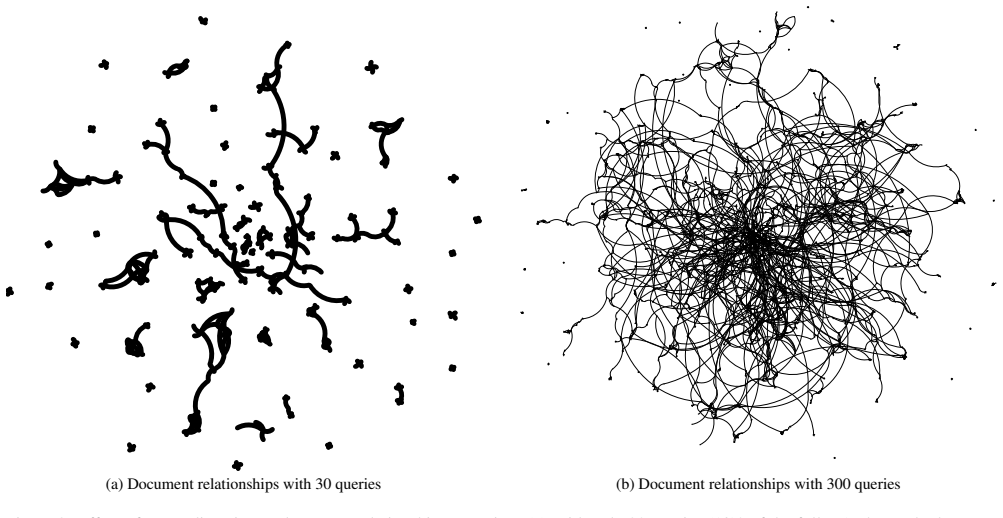
Summary. The paper proposes EDR-MQ, an unsupervised framework that extracts document relationships from a corpus by marginalizing over user queries. It introduces MC-RAG, a two-retriever RAG in which the second retriever conditions on the first retrieved document, and defines p(zi,zj) = sum_x p_eta1(zi|x) p_eta2(zj|zi,x) p(x) (Eq. 5) as the joint probability that documents zi and zj are related. Algorithm 1 constructs a relationship matrix R by accumulating products of the two retrievers' scores over N queries. Experiments on SciFact are qualitative: network visualizations with 30 vs 300 queries, TF-IDF comparisons, edge-bundling plots, and a cross-domain example involving neutrophil extracellular traps. The paper claims that query diversity improves relationship discovery and that the method outperforms traditional similarity-based approaches.
Significance. The underlying intuition—that documents co-retrieved across diverse queries are likely related—is reasonable and could support a practical, unsupervised co-occurrence mining tool. The conditional-retrieval mechanism is a sensible way to capture dependencies between documents, and the problem of taxonomy-free relation extraction is well motivated. However, the manuscript's central formal claim is that Eq. (5) estimates a joint probability, and that claim is unsupported by the mathematical definitions. In addition, the experimental section contains no quantitative metrics, no ground-truth comparison, and no held-out validation, so the stated superiority over TF-IDF is not demonstrated. No code or data are released and no formal proofs are provided, so the paper in its current form does not provide a citable, verifiable contribution despite the appealing idea.
major comments (4)
- [§3.2, Eq. (5)] The central probabilistic identity is not justified. ColBERT's score in Eq. (3) is an unnormalized sum of per-token max dot products; no softmax, temperature, or normalization over the corpus is given, so p_eta1(zi|x) and p_eta2(zj|zi,x) are not conditional probability mass functions. Consequently Eq. (5) does not define a joint probability, and the R matrix in Algorithm 1 (line 11) is an unnormalized weighted co-occurrence tally whose scale depends on embedding magnitudes and on the top-k cutoff. Dividing by N as in Eq. (6) would only rescale the tally. The paper offers no proof or approximation argument that this quantity estimates p(zi,zj), so the probabilistic grounding of the framework is unsupported.
- [§3.2.1, Algorithm 1 and Eq. (6)] Even accepting Eq. (6) as the intended estimator, the algorithm does not implement it: line 11 accumulates raw products without the 1/N factor, and it only sums over the top-k retrieved sets rather than over the whole corpus. In addition, the matrix is never symmetrized, although a joint probability p(zi,zj) must be symmetric in its arguments; because the second retriever is conditioned on zi, R[i,j] and R[j,i] will generally differ. These gaps need to be resolved before R can be interpreted as an estimate of a joint distribution.
- [§4.2–4.4] The experimental section contains no quantitative evaluation. There are no precision/recall numbers, no comparison tables, no held-out query or document pairs, and no downstream task; the claims that EDR-MQ 'outperforms' TF-IDF (Abstract) and that 300 queries produce 'more comprehensive' structure (Figure 3) rest entirely on visual inspection of Gephi layouts, which depend on layout parameters (Table 1) and are not accompanied by any cluster-quality or edge-bundling statistics. This is a load-bearing gap because the abstract and conclusion explicitly claim demonstrated effectiveness.
- [§4.4, Figure 4] The cross-domain example is a single anecdote chosen post hoc; without a systematic evaluation against category labels or known relation types, it cannot validate the claim that the method 'transcends traditional categorical boundaries.' A concrete fix would be to use SciFact's claim-evidence annotations as ground truth and report retrieval-centric metrics (e.g., the fraction of high-R pairs that are claim-evidence pairs) and compare against TF-IDF and dense baselines.
minor comments (5)
- [§2.2 and §3.1] Eq. (3) repeats Eq. (2) with changed notation; the paper should present a single definition of the ColBERT similarity and state explicitly whether sim(q,d) in Eq. (3) is exactly the score used to rank documents.
- [§3.1] The notation p_eta1 and p_eta2 suggests learned parameters, but no training procedure, parameter initialization, or fine-tuning protocol is described; clarify whether the retrievers are off-the-shelf ColBERT models and whether any adaptation to the corpus is performed.
- [§4.1 and §4.2] The experiments use 300 queries without explaining why this subset was chosen from the 1,409 SciFact claims or how it was sampled; a sentence on the selection procedure and its stability would improve reproducibility.
- [References] Reference [1] contains the phrase 'Information Processing Society of Japan' in an apparently malformed form, and reference [12] uses 'abs/2411.01751' without the full journal or venue details; the bibliography should be cleaned and made consistent.
- [Algorithm 1, line 11] The comment 'Accumulate joint probability' is misleading given the preceding discussion; the comment should be changed to 'Accumulate score product' unless proper normalization is added.
Circularity Check
The 'joint probability' relation matrix is, by the paper's own equations, exactly the query-marginalized retrieval co-occurrence tally, and the experiments confirm the estimator by inspecting the estimator.
-
self definitional
[Section 3.2, Eq. (5)-(6); Algorithm 1, lines 9-11; Section 4.2]
"p(zi, zj) ≈ 1/N Σ_n p_η1(zi|x_n)p_η2(zj|zi,x_n) ... The resulting joint probabilities p(zi, zj) form a relationship matrix that captures the strength of associations ... R[i, j] ← R[i, j] + p1 · p2 ▷ Accumulate joint probability"
The extracted relation p(zi,zj) is defined by Eq. (6) as the query-marginalized product of the two retrieval scores, and Algorithm 1 accumulates exactly that product into R. Thus R is not an estimator of an independently defined relational quantity; it is, by construction, the weighted co-occurrence tally of the retrieval chain. When Section 4.2 then presents the resulting network as evidence that query diversity reveals meaningful relationships, it is inspecting the same aggregated input that was defined as the output. No external labels, held-out queries, or downstream prediction task test the co-occurrence-implies-relation assumption, so the central claim is self-confirming.
-
self definitional
[Section 3.1, Eq. (3)-(5); Algorithm 1, lines 9-11]
"pη1 (zi|x) and pη2 (zj|zi, x), which return distributions over text passages given input x and (zi, x), respectively ... p(zi, zj) = Σ_x pη1 (zi|x)pη2 (zj|zi, x)p(x)"
The paper calls pη1 and pη2 'distributions over text passages,' but the retriever scores are ColBERT similarities defined in Eq. (3) as sums of max token dot products. These are unnormalized similarity scores, not probability mass functions, and no softmax or temperature normalization is specified. Therefore Eq. (5) is not a marginalization of probabilities; the 'joint probability' is a definitional relabeling of a normalized weighted co-occurrence tally. The probabilistic framing is assumed by notation rather than derived, so the central claim 'estimating joint probabilities' reduces by construction to accumulating raw retrieval-score products.
full rationale
The paper contains no self-citation chain or imported uniqueness theorem; the circularity is internal to the framework's definitions. The central estimator p(zi,zj) is defined in Eq. (6) as the query-marginalized product of two ColBERT retrieval scores, and Algorithm 1 accumulates exactly that product into R. The claimed discovery of meaningful document relationships is therefore an inspection of the same co-occurrence tally that was defined as the estimator. The experiments compare R against TF-IDF networks visually and show that more queries create a more connected R, but this confirms only that a larger average includes more pairs; it does not externally validate that co-occurrence implies a true document relation. In addition, because the retriever scores are unnormalized similarity sums, calling Eq. (5) a joint probability is a definitional relabeling rather than a derived probabilistic result. The underlying hypothesis that retrieval co-occurrence indicates relationship is empirically testable in principle, but the paper provides no such test, so the central claim reduces by construction to a weighted co-occurrence tally. Score 7 reflects this partial-by-construction circularity without alleging authorial intent or reliance on self-citations.
Assumptions & free parameters
free parameters (2)
- top-k retrieval count =
5 in visualizations
- number of queries N =
300
assumptions (5)
- domain assumption The collected query set is representative of diverse user perspectives, with uniform prior p(x)=1/N.
- domain assumption Co-occurrence of two documents in conditional retrieval across queries indicates a semantic relationship.
- ad hoc to paper ColBERT similarity scores can be interpreted as conditional probabilities over documents.
- ad hoc to paper Concatenating the query and first document embeddings, [zi;x], is a valid conditioning mechanism for the second retriever.
- domain assumption SciFact claims can serve as user queries.
Cite this review
Pith. "Pith review of Extracting Document Relations from Search Corpus by Marginalizing over User Queries." pith.science (2026). https://pith.science/paper/2UDX2LKA
@misc{pith2026250710726,
  author       = {Pith},
  title        = {Pith review of: Extracting Document Relations from Search Corpus by Marginalizing over User Queries},
  year         = {2026},
  howpublished = {\url{https://pith.science/paper/2UDX2LKA}},
  note         = {Machine review of arXiv:2507.10726}
}
read the original abstract
Understanding relationships between documents in large-scale corpora is essential for knowledge discovery and information organization. However, existing approaches rely heavily on manual annotation or predefined relationship taxonomies. We propose EDR-MQ (Extracting Document Relations by Marginalizing over User Queries), a novel framework that discovers document relationships through query marginalization. EDR-MQ is based on the insight that strongly related documents often co-occur in results across diverse user queries, enabling us to estimate joint probabilities between document pairs by marginalizing over a collection of queries. To enable this query marginalization approach, we develop Multiply Conditioned Retrieval-Augmented Generation (MC-RAG), which employs conditional retrieval where subsequent document retrievals depend on previously retrieved content. By observing co-occurrence patterns across diverse queries, EDR-MQ estimates joint probabilities between document pairs without requiring labeled training data or predefined taxonomies. Experimental results show that our query marginalization approach successfully identifies meaningful document relationships, revealing topical clusters, evidence chains, and cross-domain connections that are not apparent through traditional similarity-based methods. Our query-driven framework offers a practical approach to document organization that adapts to different user perspectives and information needs.
Figures


Figures from the paper (3 more)


Reference graph
Works this paper leans on
-
[1]
Focus+ context edge bundling for network visualization
KEIICHI AKIY AMA, HIDEYUKI FUJITA, TADASHI OMORI, and TAKAHIKO SHINTANI. Focus+ context edge bundling for network visualization. Journal of Information Processing Society of Japan, 65(3):667–676, 2024. 8
work page 2024
-
[2]
Business insights using rag–llms: a review and case study
Muhammad Arslan, Saba Munawar, and Christophe Cruz. Business insights using rag–llms: a review and case study. Journal of Decision Systems, pages 1–30, 2024. 1
work page 2024
-
[3]
Towards Improving the Explainability of Text-based Information Retrieval with Knowledge Graphs
Boqi Chen, Kua Chen, Yujing Yang, Afshin Amini, 8 Bharat Saxena, Cecilia Ch ´avez-Garc´ıa, Majid Babaei, Amir Feizpour, and D´aniel Varr´o. Towards improving the explain- ability of text-based information retrieval with knowledge graphs. arXiv preprint arXiv:2301.06974, 2023. 1
work page Pith review arXiv 2023
-
[4]
Doc- ument AI: benchmarks, models and applications
Lei Cui, Yiheng Xu, Tengchao Lv, and Furu Wei. Doc- ument AI: benchmarks, models and applications. CoRR, abs/2111.08609, 2021. 1
arXiv 2021
-
[5]
BERT: pre-training of deep bidirectional trans- formers for language understanding
Jacob Devlin, Ming-Wei Chang, Kenton Lee, and Kristina Toutanova. BERT: pre-training of deep bidirectional trans- formers for language understanding. In Proceedings of the 2019 Conference of the North American Chapter of the Association for Computational Linguistics: Human Lan- guage Technologies, NAACL-HLT 2019, Minneapolis, MN, USA, June 2-7, 2019, Volu...
work page 2019
-
[6]
Dense passage retrieval for open-domain question answering
Vladimir Karpukhin, Barlas Oguz, Sewon Min, Patrick Lewis, Ledell Wu, Sergey Edunov, Danqi Chen, and Wen- tau Yih. Dense passage retrieval for open-domain question answering. In Proceedings of the 2020 Conference on Em- pirical Methods in Natural Language Processing, EMNLP 2020, Online, November 16-20, 2020, pages 6769–6781. As- sociation for Computationa...
work page 2020
-
[7]
Colbert: Efficient and effective passage search via contextualized late interaction over BERT
Omar Khattab and Matei Zaharia. Colbert: Efficient and effective passage search via contextualized late interaction over BERT. In Proceedings of the 43rd International ACM SIGIR conference on research and development in Informa- tion Retrieval, SIGIR 2020, Virtual Event, China, July 25-30, 2020, pages 39–48. ACM, 2020. 2
work page 2020
-
[8]
Mike Lewis, Yinhan Liu, Naman Goyal, Marjan Ghazvinine- jad, Abdelrahman Mohamed, Omer Levy, Veselin Stoy- anov, and Luke Zettlemoyer. BART: denoising sequence-to- sequence pre-training for natural language generation, trans- lation, and comprehension. In Proceedings of the 58th An- nual Meeting of the Association for Computational Linguis- tics, ACL 2020...
work page 2020
Show all 14 references
-
[9]
Retrieval-augmented genera- tion for knowledge-intensive NLP tasks
Patrick Lewis, Ethan Perez, Aleksandra Piktus, Fabio Petroni, Vladimir Karpukhin, Naman Goyal, Heinrich K¨uttler, Mike Lewis, Wen-tau Yih, Tim Rockt¨aschel, Sebas- tian Riedel, and Douwe Kiela. Retrieval-augmented genera- tion for knowledge-intensive NLP tasks. InAdvances in N...
2020
-
[10]
Colin Raffel, Noam Shazeer, Adam Roberts, Katherine Lee, Sharan Narang, Michael Matena, Yanqi Zhou, Wei Li, and Peter J. Liu. Exploring the limits of transfer learning with a unified text-to-text transformer. J. Mach. Learn. Res., 21: 140:1–140:67, 2020. 2
2020
-
[11]
Fact or fiction: Verifying scientific claims
David Wadden, Shanchuan Lin, Kyle Lo, Lucy Lu Wang, Madeleine van Zuylen, Arman Cohan, and Hannaneh Ha- jishirzi. Fact or fiction: Verifying scientific claims. In Proceedings of the 2020 Conference on Empirical Meth- ods in Natural Language Processing, EMNLP 2020, Online, Nove...
2020
-
[12]
Ragviz: Di- agnose and visualize retrieval-augmented generation
Tevin Wang, Jingyuan He, and Chenyan Xiong. Ragviz: Di- agnose and visualize retrieval-augmented generation. CoRR, abs/2411.01751, 2024. 2
2024 arXiv
-
[13]
Graph-based hierarchical relevance matching signals for ad- hoc retrieval
Xueli Yu, Weizhi Xu, Zeyu Cui, Shu Wu, and Liang Wang. Graph-based hierarchical relevance matching signals for ad- hoc retrieval. In Proceedings of the Web Conference 2021 , pages 778–787, 2021. 1
2021
-
[14]
Edge bundling in information visualization
Hong Zhou, Panpan Xu, Xiaoru Yuan, and Huamin Qu. Edge bundling in information visualization. Tsinghua Science and Technology, 18(2):145–156, 2013. 5 9
2013
Reviewed August 6, 2026 · model on record in the stance chip above.
Discussion (0). Continue with ORCID to comment.