REVIEW 1 major objections 1 minor 59 references
Rotation-Equivariant Self-Supervised Method in Image Denoising
T0 review · 1 major / 1 minor · reviewed 2026-08-07 · deepseek-v4-flash
Pith's one-line read This paper claims that replacing every convolution in a U-Net with rotation-equivariant Fconv layers yields an approximately rotation-equivariant denoiser whose error vanishes as resolution grows, and that this built-in rotation prior…
desk verdict A useful empirical finding about rotation-equivariant self-supervised denoising, but the stated Theorem 3 guarantee is vacuous for ReLU networks. read the letter →
The pith
A machine-rendered reading of the paper's core claim, the machinery that carries it, and where it could break.
The reading
What carries the argument
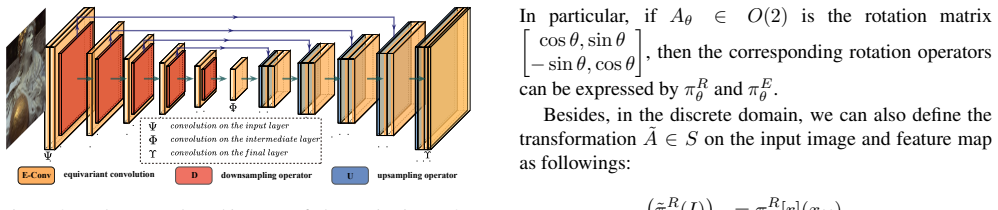
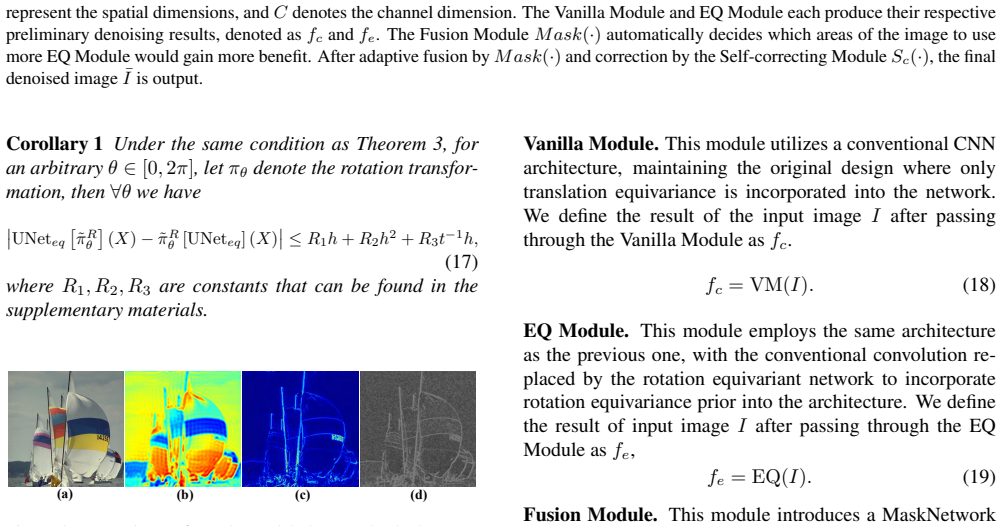
The load-bearing object is the Fconv rotation-equivariant convolution, a Fourier series expansion based filter parametrization that makes convolutions equivariant to rotations in the continuous domain and only approximately equivariant after discretization. The proof machinery decomposes the U-Net into blocks, one equivariant convolution plus a downsampling operator per downsampling block, and one upsampling operator plus two equivariant convolutions per upsampling block, and bounds each block's equivariance error using first-order smoothness bounds on feature maps. These block errors are then accumulated into the whole-network bound. The adaptive part is a MaskNetwork that produces a per-pixel mask fusing the vanilla branch output and the equivariant branch output element-wise, followed by a residual self-correcting block.
What would settle it
Train the N2N-EQ network and measure its relative rotation equivariance error $\|UNet(\tilde{\pi}_\theta(X))-\tilde{\pi}_\theta(UNet(X))\|/\|UNet(\tilde{\pi}_\theta(X))\|$ at increasing input resolutions. The bound in Theorem 3 predicts the error should decline at the rate $O(h)$ plus $O(h^2)$; if the measured error does not shrink as the resolution increases, the theoretical guarantee does not describe the trained network.
Extended reading notes
Core claim
The core claim is that the U-Net, despite its upsampling and downsampling layers, can be made a reliable rotation-equivariant network simply by replacing all convolutions with Fconv layers. Theorem 1 bounds the equivariance error of max-pooling and stride downsampling by $2\sqrt{2}Gh$, Theorem 2 bounds nearest-neighbor and bilinear upsampling by $2(\sqrt{2}+1)Gh$, and Theorem 3 accumulates blockwise errors into a whole-network bound $R_1h + R_2h^2$ under smoothness conditions on feature maps and filters; Corollary 1 extends the bound to arbitrary rotation angles. The empirical discovery is that the resulting N2N-EQ, N2V-EQ, and R2R-EQ networks consistently improve PSNR over the vanilla baselines, and that the AdaReNet mask, which mixes the equivariant and vanilla outputs, improves them further. The paper also claims that among tested equivariant convolution designs, Fconv's Fourier-series parametrization is the one that preserves enough representation accuracy for low-level vision.
Load-bearing premise
The error bounds assume the network's internal feature maps and filters vary smoothly, with bounded slopes and curvatures; trained ReLU networks are piecewise linear, so the constants in the bound may not be small or even finite for the network actually trained.
Editorial extensions
If this is right
- A U-Net with all convolutions replaced by Fconv layers is approximately rotation equivariant, with whole-network error bounded by $R_1h + R_2h^2$, which vanishes as the input resolution grows.
- Downsampling and upsampling layers contribute equivariance error only at order $O(h)$; because the equivariant convolutions contribute $O(h^2)$, the sampling operators become the dominant error source at finite resolution.
- The equivariant versions of Noise2Noise, Noise2Void, and Recorrupted-to-Recorrupted beat their vanilla baselines on Gaussian denoising (for instance, N2V-EQ raises BSD500 PSNR from 28.17 to 29.05 dB at $\sigma=25$).
- A learned mask that fuses the equivariant and vanilla branch outputs yields further consistent gains, using the vanilla branch more near high-frequency edges and the equivariant branch in smooth regions.
- Without rotation augmentation, the adaptive equivariant network produces the largest improvements, indicating that the architecture-level prior partially substitutes for data augmentation.
Reading between the lines
- Beyond the tested methods, the same convolution-replacement recipe should transfer to other U-Net-based self-supervised restoration tasks, such as inpainting or medical-image reconstruction, because the theoretical argument concerns the U-Net skeleton rather than the denoising loss.
- The mask's observed preference for vanilla output near high-frequency edges implies a testable correlation: mask values should track local gradient magnitude, and forcing the mask to be uniform should reproduce the behavior of the equivariant branch alone.
- Because the proof assumes smooth activations while ReLU is piecewise linear, one could test whether smoother activations such as SiLU give smaller measured equivariance errors, which would indicate whether the bound governs real trained networks.
- The specific constants $R_1$, $R_2$, and $R_3$ are stated in the supplementary material, so the size of the bound, not just its $O(h)$ scaling, can be checked there.
Editorial analysis
A structured set of objections, weighed in public.
Referee Report
Summary. This manuscript proposes to incorporate rotation-equivariant convolutions (Fconv) into self-supervised image denoising networks. It states theorems bounding the equivariance error introduced by downsampling and upsampling operations (Theorems 1 and 2) and by a full U-Net with Fconv layers and ReLU activations (Theorem 3 and Corollary 1). It then introduces AdaReNet, which fuses a vanilla CNN branch and an equivariant branch through a learned mask and a self-correcting module, with a loss combining the main denoising objective and per-branch regularizers. Experiments on Noise2Noise, Noise2Void, and R2R report PSNR/SSIM improvements over the vanilla baselines on several Gaussian-noise benchmarks, along with ablations on the choice of equivariant convolution and on rotation augmentation. The code is publicly released.
Significance. If the theoretical claims can be repaired, the paper makes a useful contribution by introducing rotation-equivariant priors into self-supervised denoising at the network architecture level. The empirical results are broadly positive, the ablations across equivariant convolution families are informative, and the public code is a practical asset. The adaptive fusion idea is a reasonable response to the fact that natural images are only locally rotation-equivariant. However, the central theoretical guarantee, which is presented as the paper's headline contribution, is not established as stated because the smoothness assumptions of Theorem 3 are incompatible with the ReLU activation used in the experiments; this issue must be resolved before the 'rigorous theoretical analysis' claim can be accepted.
major comments (1)
- [Section 3.1.1, Eq. (4) and (5)] The notation in Eq. (4) treats the feature map as a function on E(2) = R2 ⋊ O(2), while Eq. (3) defines it on R2 × S. The relation between these two domains, and the precise definition of the action πE_\tilde{A} on e(x,A), should be stated more carefully, because the subsequent error bounds depend on which function space and transformation action is used. In particular, after discretization, the sampled feature map is only defined on a finite set of rotations S, and the continuous rotation of such a sample is not unique; the paper should specify how ilde{π}^E_\tilde{A}(F) is computed in the analysis.
minor comments (1)
- [Abstract and Introduction] The claim of being the 'first time' with 'comprehensive theoretical analysis' should be tempered, since the theoretical analysis as stated is not valid for ReLU networks; the novelty claim can stand, but it should not be tied to an unproven guarantee.
Circularity Check
No circular derivation: the U-Net equivariance bounds are derived from stated smoothness assumptions and prior published Fconv equivariance results; the main validity concern is a smoothness gap with ReLU, not circularity.
full rationale
The paper's derivation chain is not circular. Theorem 3 bounds the full U-Net equivariance error by R1h + R2h^2 using (i) the Fconv layer equivariance error from the published work of Xie et al. [49], (ii) new bounds for downsampling and upsampling in Theorems 1 and 2, and (iii) block-wise composition over the U-Net. The target result — the equivariance error of the complete U-Net — is not assumed by any of these inputs. The Fconv result is cited from prior published work by overlapping authors, but it is a parameter-free, externally published derivation about the convolution layer itself and does not include the present U-Net conclusion; it is therefore independent support rather than a circular input. The decomposition of the network into downsampling blocks and upsampling blocks is a mathematical construction, not a fitting step, and the constants R1, R2, R3 are stated to depend on the assumed smoothness bounds and network sizes, not on the test data. The hyperparameters alpha1 = alpha2 = 0.1 in the loss are empirical settings, not quantities fitted to the benchmark predictions. There is a genuine correctness concern: condition (15) requires the latent input functions and filters to have uniformly bounded Hessians, while the theorem explicitly uses ReLU activations, and ReLU networks produce piecewise-linear feature maps whose Hessian is not uniformly bounded; this means the advertised finite equivariance guarantee may not apply to the trained network. That concern, however, is about the validity of an assumption, not about an equation or prediction reducing to its own inputs. No fitted parameter is renamed as a prediction, no uniqueness theorem from the authors is imported to forbid alternatives, and no known result is merely relabeled. Accordingly, the paper receives a low circularity score reflecting only the same-group citations, not a circular argument.
Assumptions & free parameters
free parameters (2)
- Number of rotation group elements t (subgroup size)
- Loss weights alpha_1 and alpha_2 =
0.1 each
assumptions (5)
- domain assumption Images and intermediate feature maps are cell-center discretizations of smooth functions with bounded gradient and Hessian (Eqs. (2)-(3) and conditions (8), (12), (15)).
- standard math Fconv from Xie et al. [49] is exactly rotation equivariant in the continuous domain and has small discretization error.
- standard math ReLU pointwise nonlinearity commutes with the rotation action and therefore contributes no equivariance error.
- domain assumption The continuous-domain definitions of maxpooling, stride downsampling, nearest-neighbor and bilinear upsampling in Eqs. (6)-(11) faithfully model the discrete operators used in the implementation.
- domain assumption The U-Net can be decomposed into downsampling and upsampling blocks with exactly the stated numbers of E-Conv layers, as in Eq. (14).
Cite this review
Pith. "Pith review of Rotation-Equivariant Self-Supervised Method in Image Denoising." pith.science (2026). https://pith.science/paper/2UGOZY3B
@misc{pith2026250519618,
  author       = {Pith},
  title        = {Pith review of: Rotation-Equivariant Self-Supervised Method in Image Denoising},
  year         = {2026},
  howpublished = {\url{https://pith.science/paper/2UGOZY3B}},
  note         = {Machine review of arXiv:2505.19618}
}
read the original abstract
Self-supervised image denoising methods have garnered significant research attention in recent years, for this kind of method reduces the requirement of large training datasets. Compared to supervised methods, self-supervised methods rely more on the prior embedded in deep networks themselves. As a result, most of the self-supervised methods are designed with Convolution Neural Networks (CNNs) architectures, which well capture one of the most important image prior, translation equivariant prior. Inspired by the great success achieved by the introduction of translational equivariance, in this paper, we explore the way to further incorporate another important image prior. Specifically, we first apply high-accuracy rotation equivariant convolution to self-supervised image denoising. Through rigorous theoretical analysis, we have proved that simply replacing all the convolution layers with rotation equivariant convolution layers would modify the network into its rotation equivariant version. To the best of our knowledge, this is the first time that rotation equivariant image prior is introduced to self-supervised image denoising at the network architecture level with a comprehensive theoretical analysis of equivariance errors, which offers a new perspective to the field of self-supervised image denoising. Moreover, to further improve the performance, we design a new mask mechanism to fusion the output of rotation equivariant network and vanilla CNN-based network, and construct an adaptive rotation equivariant framework. Through extensive experiments on three typical methods, we have demonstrated the effectiveness of the proposed method.
Figures


Figures from the paper (3 more)


Reference graph
Works this paper leans on
-
[1]
Renoir–a dataset for real low-light image noise reduction
Josue Anaya and Adrian Barbu. Renoir–a dataset for real low-light image noise reduction. Journal of Visual Commu- nication and Image Representation, 51:144–154, 2018. 1
work page 2018
-
[2]
Real image denoising with feature attention
Saeed Anwar and Nick Barnes. Real image denoising with feature attention. In Proceedings of the IEEE/CVF inter- national conference on computer vision , pages 3155–3164,
-
[3]
Noise2self: Blind denoising by self-supervision
Joshua Batson and Loic Royer. Noise2self: Blind denoising by self-supervision. In International Conference on Machine Learning, pages 524–533. PMLR, 2019. 1, 3
work page 2019
-
[4]
A non-local algorithm for image denoising
Antoni Buades, Bartomeu Coll, and J-M Morel. A non-local algorithm for image denoising. In 2005 IEEE computer so- ciety conference on computer vision and pattern recognition (CVPR’05), pages 60–65. Ieee, 2005. 2
work page 2005
-
[5]
Antoni Buades, Bartomeu Coll, and Jean-Michel Morel. Non-local means denoising. Image Processing On Line , 1: 208–212, 2011. 2
work page 2011
-
[6]
GAN2GAN: Generative Noise Learning for Blind Denoising with Single Noisy Images
Sungmin Cha, Taeeon Park, and Taesup Moon. Gan2gan: Generative noise learning for blind image denoising with sin- gle noisy images. arXiv preprint arXiv:1905.10488, 3, 2019. 1, 2, 3
work page Pith review arXiv 1905
-
[7]
Spatial- adaptive network for single image denoising
Meng Chang, Qi Li, Huajun Feng, and Zhihai Xu. Spatial- adaptive network for single image denoising. In Computer Vision–ECCV 2020: 16th European Conference, Glasgow, UK, August 23–28, 2020, Proceedings, Part XXX 16 , pages 171–187. Springer, 2020. 1, 3
work page 2020
-
[8]
Group equivariant convo- lutional networks
Taco Cohen and Max Welling. Group equivariant convo- lutional networks. In International conference on machine learning, pages 2990–2999. PMLR, 2016. 3, 7
work page 2016
Show all 59 references
-
[9]
Image denoising by sparse 3-d transform- domain collaborative filtering
Kostadin Dabov, Alessandro Foi, Vladimir Katkovnik, and Karen Egiazarian. Image denoising by sparse 3-d transform- domain collaborative filtering. IEEE Transactions on image processing, 16(8):2080–2095, 2007. 2
2007
-
[10]
Kodak lossless true color image suite
Rich Franzen. Kodak lossless true color image suite. source: http://r0k. us/graphics/kodak, 4(2):9, 1999. 7, 8
1999
-
[11]
Rotation equivariant proximal operator for deep unfolding methods in image restoration
Jiahong Fu, Qi Xie, Deyu Meng, and Zongben Xu. Rotation equivariant proximal operator for deep unfolding methods in image restoration. IEEE Transactions on Pattern Analysis and Machine Intelligence, 2024. 2, 4
2024
-
[12]
Weighted nuclear norm minimization with applica- tion to image denoising
Shuhang Gu, Lei Zhang, Wangmeng Zuo, and Xiangchu Feng. Weighted nuclear norm minimization with applica- tion to image denoising. In Proceedings of the IEEE con- ference on computer vision and pattern recognition , pages 2862–2869, 2014. 2
2014
-
[13]
Weighted nuclear norm min- imization and its applications to low level vision
Shuhang Gu, Qi Xie, Deyu Meng, Wangmeng Zuo, Xi- angchu Feng, and Lei Zhang. Weighted nuclear norm min- imization and its applications to low level vision. Interna- tional journal of computer vision, 121:183–208, 2017. 2
2017
-
[14]
Toward convolutional blind denoising of real pho- tographs
Shi Guo, Zifei Yan, Kai Zhang, Wangmeng Zuo, and Lei Zhang. Toward convolutional blind denoising of real pho- tographs. In Proceedings of the IEEE/CVF conference on computer vision and pattern recognition, pages 1712–1722,
-
[15]
Deep residual learning for image recognition
Kaiming He, Xiangyu Zhang, Shaoqing Ren, and Jian Sun. Deep residual learning for image recognition. In Proceed- ings of the IEEE conference on computer vision and pattern recognition, pages 770–778, 2016. 2
2016
-
[16]
Measurement of signal intensities in the presence of noise in mr images
R Mark Henkelman. Measurement of signal intensities in the presence of noise in mr images. Medical physics, 12(2): 232–233, 1985. 1
1985
-
[17]
Hexaconv
Emiel Hoogeboom, Jorn WT Peters, Taco S Cohen, and Max Welling. Hexaconv. In International Conference on Learn- ing Representations, 2018. 3
2018
-
[18]
Neighbor2neighbor: Self-supervised de- noising from single noisy images
Tao Huang, Songjiang Li, Xu Jia, Huchuan Lu, and Jianzhuang Liu. Neighbor2neighbor: Self-supervised de- noising from single noisy images. In Proceedings of the IEEE/CVF conference on computer vision and pattern recognition, pages 14781–14790, 2021. 1, 2, 3
2021
-
[19]
Foc- net: A fractional optimal control network for image de- noising
Xixi Jia, Sanyang Liu, Xiangchu Feng, and Lei Zhang. Foc- net: A fractional optimal control network for image de- noising. In Proceedings of the IEEE/CVF conference on computer vision and pattern recognition, pages 6054–6063,
-
[20]
Transfer learning from synthetic to real-noise denois- ing with adaptive instance normalization
Yoonsik Kim, Jae Woong Soh, Gu Yong Park, and Nam Ik Cho. Transfer learning from synthetic to real-noise denois- ing with adaptive instance normalization. In Proceedings of the IEEE/CVF conference on computer vision and pattern recognition, pages 3482–3492, 2020. 1
2020
-
[21]
Noise2void-learning denoising from single noisy images
Alexander Krull, Tim-Oliver Buchholz, and Florian Jug. Noise2void-learning denoising from single noisy images. In Proceedings of the IEEE/CVF conference on computer vi- sion and pattern recognition, pages 2129–2137, 2019. 1, 3, 7, 8
2019
-
[22]
Probabilistic noise2void: Unsuper- vised content-aware denoising
Alexander Krull, Tom ´aˇs Vi ˇcar, Mangal Prakash, Manan Lalit, and Florian Jug. Probabilistic noise2void: Unsuper- vised content-aware denoising. Frontiers in Computer Sci- ence, 2:5, 2020. 1
2020
-
[23]
Backpropagation applied to handwrit- ten zip code recognition.Neural computation, 1(4):541–551,
Yann LeCun, Bernhard Boser, John S Denker, Donnie Henderson, Richard E Howard, Wayne Hubbard, and Lawrence D Jackel. Backpropagation applied to handwrit- ten zip code recognition.Neural computation, 1(4):541–551,
-
[24]
Gradient-based learning applied to document recog- nition
Yann LeCun, L ´eon Bottou, Yoshua Bengio, and Patrick Haffner. Gradient-based learning applied to document recog- nition. Proceedings of the IEEE , 86(11):2278–2324, 1998. 4
1998
-
[25]
Universal denoising networks: a novel cnn architecture for image denoising
Stamatios Lefkimmiatis. Universal denoising networks: a novel cnn architecture for image denoising. In Proceed- ings of the IEEE conference on computer vision and pattern recognition, pages 3204–3213, 2018. 3
2018
-
[26]
Noise2noise: Learning image restoration without clean data
Jaakko Lehtinen, Jacob Munkberg, Jon Hasselgren, Samuli Laine, Tero Karras, Miika Aittala, and Timo Aila. Noise2noise: Learning image restoration without clean data. arXiv preprint arXiv:1803.04189, 2018. 1, 3, 5, 7
2018 arXiv
-
[27]
Fm2s: Self- supervised fluorescence microscopy denoising with single noisy image
Jizhihui Liu, Qixun Teng, and Junjun Jiang. Fm2s: Self- supervised fluorescence microscopy denoising with single noisy image. arXiv preprint arXiv:2412.10031, 2024. 7
2024
-
[28]
Shaking noise exploration and elimination for detecting local flaws of steel wire ropes based on magnetic flux leakages
Zhiliang Liu and Liyuan Ren. Shaking noise exploration and elimination for detecting local flaws of steel wire ropes based on magnetic flux leakages. IEEE Transactions on Industrial Electronics, 70(4):4206–4216, 2022. 1 9
2022
-
[29]
Ex- act transform-domain noise variance for collaborative filter- ing of stationary correlated noise
Ymir M ¨akinen, Lucio Azzari, and Alessandro Foi. Ex- act transform-domain noise variance for collaborative filter- ing of stationary correlated noise. In 2019 IEEE interna- tional conference on image processing (ICIP) , pages 185–
2019
-
[30]
Rotation equivariant vector field networks
Diego Marcos, Michele V olpi, Nikos Komodakis, and Devis Tuia. Rotation equivariant vector field networks. In Pro- ceedings of the IEEE International Conference on Computer Vision, pages 5048–5057, 2017. 3
2017
-
[31]
A database of human segmented natural images and its application to evaluating segmentation algorithms and measuring ecological statistics
David Martin, Charless Fowlkes, Doron Tal, and Jitendra Malik. A database of human segmented natural images and its application to evaluating segmentation algorithms and measuring ecological statistics. In Proceedings Eighth IEEE International Conference on Computer Vision. IC...
2001
-
[32]
Noisier2noise: Learning to denoise from unpaired noisy data
Nick Moran, Dan Schmidt, Yu Zhong, and Patrick Coady. Noisier2noise: Learning to denoise from unpaired noisy data. In Proceedings of the IEEE/CVF Conference on Com- puter Vision and Pattern Recognition , pages 12064–12072,
-
[33]
Recorrupted-to-recorrupted: unsupervised deep learning for image denoising
Tongyao Pang, Huan Zheng, Yuhui Quan, and Hui Ji. Recorrupted-to-recorrupted: unsupervised deep learning for image denoising. In Proceedings of the IEEE/CVF con- ference on computer vision and pattern recognition , pages 2043–2052, 2021. 1, 2, 3, 7, 8
2021
-
[34]
Densely connected hierarchical network for image denoising
Bumjun Park, Songhyun Yu, and Jechang Jeong. Densely connected hierarchical network for image denoising. In Pro- ceedings of the IEEE/CVF conference on computer vision and pattern recognition workshops, pages 0–0, 2019. 1
2019
-
[35]
Benchmarking denoising algorithms with real photographs
Tobias Plotz and Stefan Roth. Benchmarking denoising algorithms with real photographs. In Proceedings of the IEEE conference on computer vision and pattern recogni- tion, pages 1586–1595, 2017. 1
2017
-
[36]
Self2self with dropout: Learning self-supervised denoising from single image
Yuhui Quan, Mingqin Chen, Tongyao Pang, and Hui Ji. Self2self with dropout: Learning self-supervised denoising from single image. In Proceedings of the IEEE/CVF con- ference on computer vision and pattern recognition , pages 1890–1898, 2020. 3
2020
-
[37]
Image denoising using complex-valued deep cnn
Yuhui Quan, Yixin Chen, Yizhen Shao, Huan Teng, Yong Xu, and Hui Ji. Image denoising using complex-valued deep cnn. Pattern Recognition, 111:107639, 2021. 3
2021
-
[38]
U- net: Convolutional networks for biomedical image segmen- tation
Olaf Ronneberger, Philipp Fischer, and Thomas Brox. U- net: Convolutional networks for biomedical image segmen- tation. In Medical image computing and computer-assisted intervention–MICCAI 2015: 18th international conference, Munich, Germany, October 5-9, 2015, proceedings, pa...
2015
-
[39]
Pdo-econvs: Partial differential operator based equivari- ant convolutions
Zhengyang Shen, Lingshen He, Zhouchen Lin, and Jinwen Ma. Pdo-econvs: Partial differential operator based equivari- ant convolutions. In International Conference on Machine Learning, pages 8697–8706. PMLR, 2020. 2, 3, 7
2020
-
[40]
Pdo-es2cnns: Partial differential operator based equivariant spherical cnns
Zhengyang Shen, Tiancheng Shen, Zhouchen Lin, and Jin- wen Ma. Pdo-es2cnns: Partial differential operator based equivariant spherical cnns. In Proceedings of the AAAI Con- ference on Artificial Intelligence, pages 9585–9593, 2021. 3
2021
-
[41]
Deep image prior
Dmitry Ulyanov, Andrea Vedaldi, and Victor Lempitsky. Deep image prior. In Proceedings of the IEEE conference on computer vision and pattern recognition, pages 9446–9454,
-
[42]
Deep gaussian conditional random field network: A model-based deep network for discriminative denoising
Raviteja Vemulapalli, Oncel Tuzel, and Ming-Yu Liu. Deep gaussian conditional random field network: A model-based deep network for discriminative denoising. InProceedings of the IEEE conference on computer vision and pattern recog- nition, pages 4801–4809, 2016. 1
2016
-
[43]
High-frequency component helps explain the generaliza- tion of convolutional neural networks
Haohan Wang, Xindi Wu, Zeyi Huang, and Eric P Xing. High-frequency component helps explain the generaliza- tion of convolutional neural networks. In Proceedings of the IEEE/CVF conference on computer vision and pattern recognition, pages 8684–8694, 2020. 7
2020
-
[44]
Blind2unblind: Self-supervised image denoising with visible blind spots
Zejin Wang, Jiazheng Liu, Guoqing Li, and Hua Han. Blind2unblind: Self-supervised image denoising with visible blind spots. In Proceedings of the IEEE/CVF conference on computer vision and pattern recognition, pages 2027–2036,
2027
-
[45]
General e (2)-equivariant steerable cnns
Maurice Weiler and Gabriele Cesa. General e (2)-equivariant steerable cnns. Advances in neural information processing systems, 32, 2019. 3, 7
2019
-
[46]
Learning steerable filters for rotation equivariant cnns
Maurice Weiler, Fred A Hamprecht, and Martin Storath. Learning steerable filters for rotation equivariant cnns. In Proceedings of the IEEE Conference on Computer Vision and Pattern Recognition, pages 849–858, 2018. 2, 3
2018
-
[47]
Harmonic networks: Deep translation and rotation equivariance
Daniel E Worrall, Stephan J Garbin, Daniyar Turmukham- betov, and Gabriel J Brostow. Harmonic networks: Deep translation and rotation equivariance. In Proceedings of the IEEE Conference on Computer Vision and Pattern Recogni- tion, pages 5028–5037, 2017. 3
2017
-
[48]
Unpaired learning of deep image denoising
Xiaohe Wu, Ming Liu, Yue Cao, Dongwei Ren, and Wang- meng Zuo. Unpaired learning of deep image denoising. In European conference on computer vision , pages 352–368. Springer, 2020. 1
2020
-
[49]
Fourier series expansion based filter parametrization for equivariant convolutions
Qi Xie, Qian Zhao, Zongben Xu, and Deyu Meng. Fourier series expansion based filter parametrization for equivariant convolutions. IEEE Transactions on Pattern Analysis and Machine Intelligence, 45(4):4537–4551, 2022. 2, 3, 4, 7
2022
-
[50]
Real-world noisy image denoising: A new bench- mark
Jun Xu, Hui Li, Zhetong Liang, David Zhang, and Lei Zhang. Real-world noisy image denoising: A new bench- mark. arXiv preprint arXiv:1804.02603, 2018. 1
2018 arXiv
-
[51]
Noisy-as-clean: Learning self- supervised denoising from corrupted image
Jun Xu, Yuan Huang, Ming-Ming Cheng, Li Liu, Fan Zhu, Zhou Xu, and Ling Shao. Noisy-as-clean: Learning self- supervised denoising from corrupted image. IEEE Transac- tions on Image Processing, 29:9316–9329, 2020. 1, 2, 3
2020
-
[52]
Dual adversarial network: Toward real-world noise removal and noise generation
Zongsheng Yue, Qian Zhao, Lei Zhang, and Deyu Meng. Dual adversarial network: Toward real-world noise removal and noise generation. In Computer Vision–ECCV 2020: 16th European Conference, Glasgow, UK, August 23–28, 2020, Proceedings, Part X 16, pages 41–58. Springer, 2020. 3
2020
-
[53]
Learning enriched features for real image restoration and enhancement
Syed Waqas Zamir, Aditya Arora, Salman Khan, Munawar Hayat, Fahad Shahbaz Khan, Ming-Hsuan Yang, and Ling Shao. Learning enriched features for real image restoration and enhancement. In Computer Vision–ECCV 2020: 16th European Conference, Glasgow, UK, August 23–28, 2020, Proce...
2020
-
[54]
On single image scale-up using sparse-representations
Roman Zeyde, Michael Elad, and Matan Protter. On single image scale-up using sparse-representations. In Curves and 10 Surfaces: 7th International Conference, Avignon, France, June 24-30, 2010, Revised Selected Papers 7 , pages 711–
2010
-
[55]
Unleashing the power of self-supervised image denoising: A comprehensive review
Dan Zhang, Fangfang Zhou, Felix Albu, Yuanzhou Wei, Xiao Yang, Yuan Gu, and Qiang Li. Unleashing the power of self-supervised image denoising: A comprehensive review. arXiv preprint arXiv:2308.00247, 2023. 1, 3
2023 arXiv
-
[56]
Beyond a gaussian denoiser: Residual learning of deep cnn for image denoising
Kai Zhang, Wangmeng Zuo, Yunjin Chen, Deyu Meng, and Lei Zhang. Beyond a gaussian denoiser: Residual learning of deep cnn for image denoising. IEEE transactions on image processing, 26(7):3142–3155, 2017. 1, 3
2017
-
[57]
Ffdnet: Toward a fast and flexible solution for cnn-based image denoising
Kai Zhang, Wangmeng Zuo, and Lei Zhang. Ffdnet: Toward a fast and flexible solution for cnn-based image denoising. IEEE Transactions on Image Processing, 27(9):4608–4622,
-
[58]
Oriented response networks
Yanzhao Zhou, Qixiang Ye, Qiang Qiu, and Jianbin Jiao. Oriented response networks. In Proceedings of the IEEE Conference on Computer Vision and Pattern Recognition , pages 519–528, 2017. 3 11
2017
-
[730]
Springer, 2012. 7, 8
2012
Reviewed August 7, 2026 · model on record in the stance chip above.
Discussion (0). Continue with ORCID to comment.