Displacement-Field-Driven Semimetal-Superconductor Transition in Magic-Angle Twisted Trilayer Graphene
Pith reviewed 2026-06-26 15:09 UTC · model grok-4.3
The pith
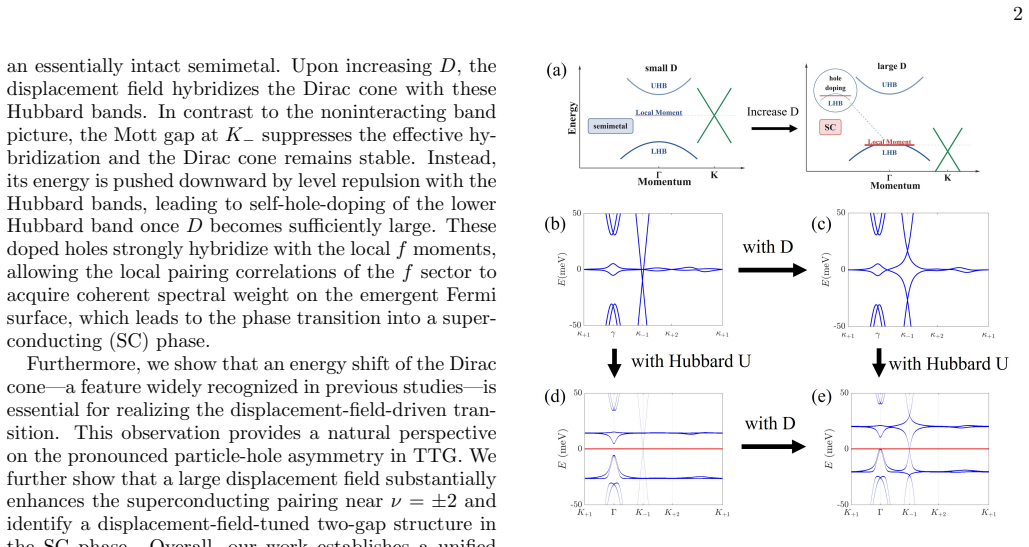
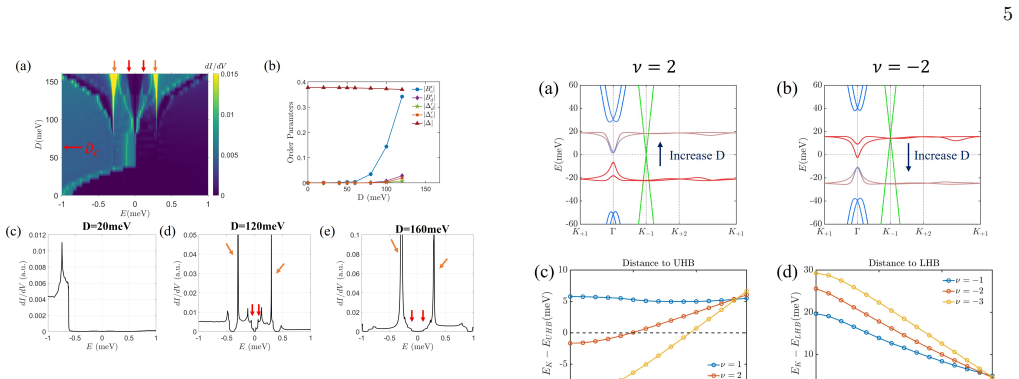
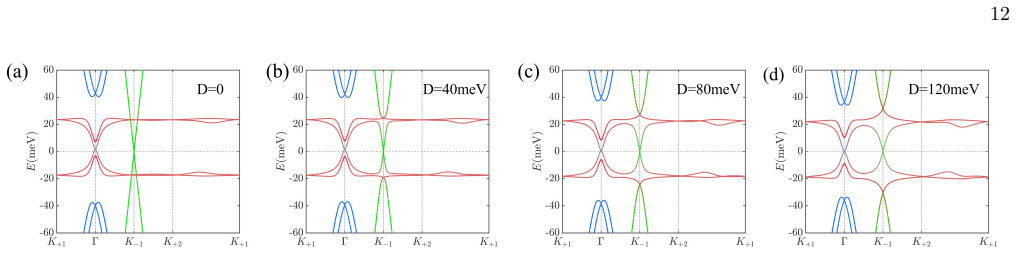
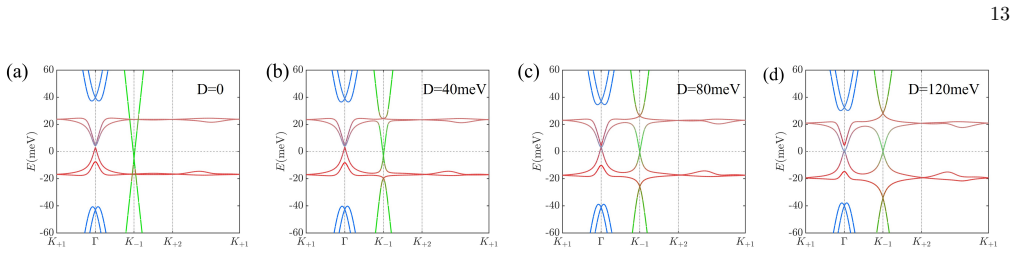
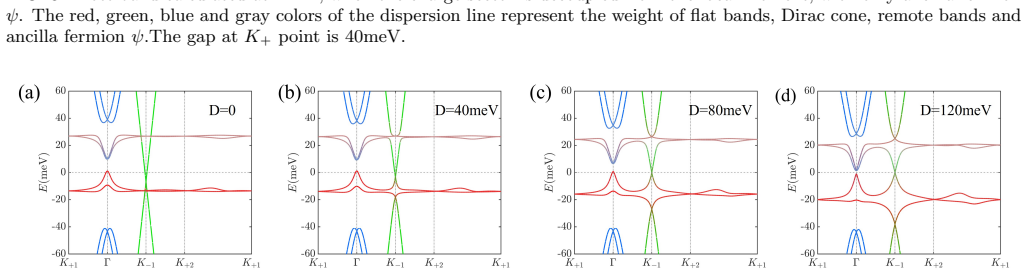
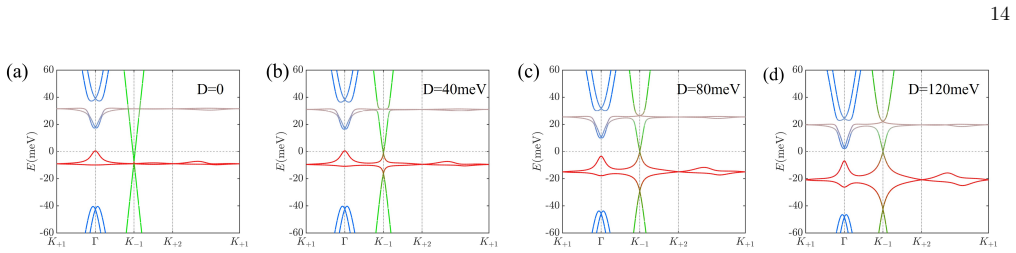
The displacement field drives a semimetal-to-superconductor transition in magic-angle twisted trilayer graphene at fillings ν=±2 through Dirac-cone energy shift and self-doping.
A machine-rendered reading of the paper's core claim, the machinery that carries it, and where it could break.
Core claim
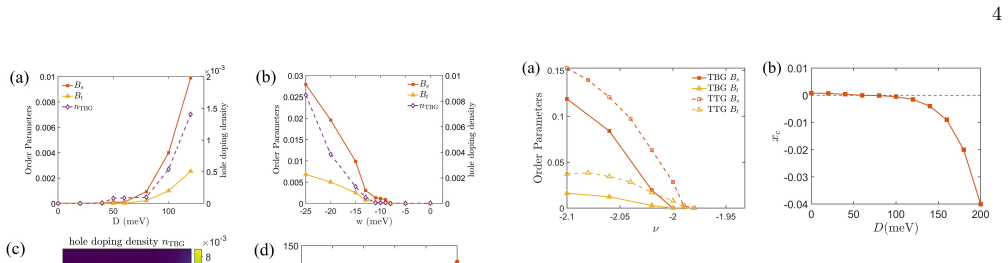
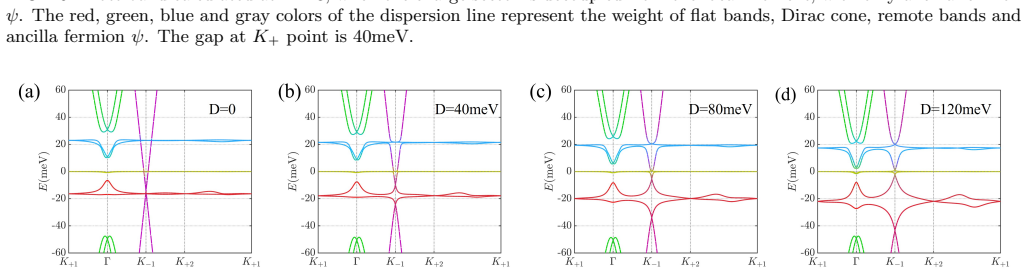
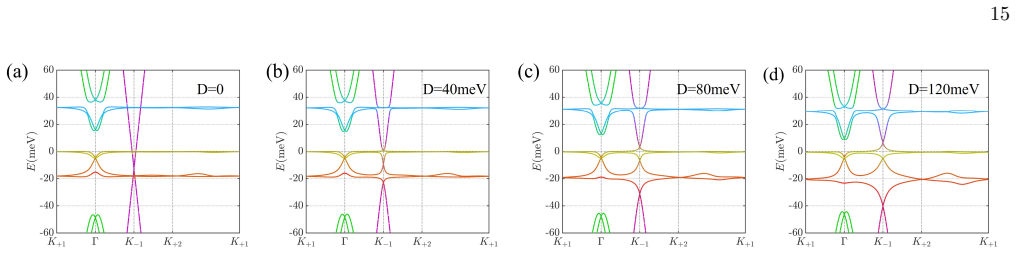
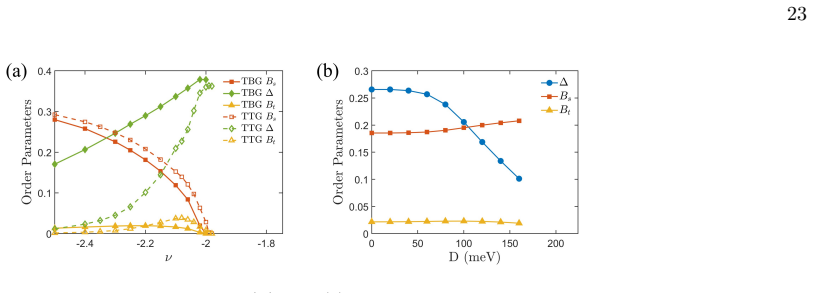
The dominant effect of the displacement field is an energy shift of the Dirac cone and self-doping into the TBG sector. At filling ν=±2, increasing D drives a transition from a semimetal into a superconducting state. The calculation also finds enhancement of superconductivity by D near ν=±2 together with particle-hole asymmetry of the phase diagram, yielding a unified account of electric-field-tunable superconductivity, Mottness, and heavy-fermion-like behavior.
What carries the argument
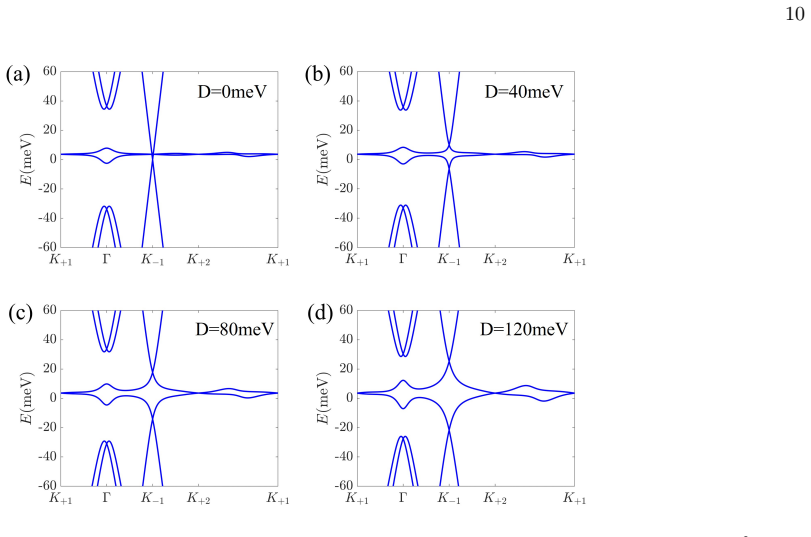
The displacement-field-induced energy shift of the Dirac cone, which produces self-doping into the TBG sector.
If this is right
- Superconductivity near ν=±2 strengthens with rising displacement field.
- The overall phase diagram acquires particle-hole asymmetry.
- Electric fields can tune among semimetal, Mott, and superconducting states through the same self-doping channel.
Where Pith is reading between the lines
- The same Dirac-cone shift mechanism may operate in other twisted multilayer stacks that combine flat bands with a dispersive cone.
- Spectroscopic tracking of the Dirac-cone position versus D at fixed filling would directly test whether self-doping occurs as predicted.
- Transport signatures of the transition should appear as a function of D at fixed ν=±2 and could be compared with the calculated phase boundaries.
Load-bearing premise
The dominant effect of the displacement field is an energy shift of the Dirac cone and self-doping into the TBG sector rather than enhanced hybridization.
What would settle it
A band-structure measurement or slave-particle calculation that shows hybridization effects dominating the Dirac-cone shift, with no semimetal-superconductor transition appearing at ν=±2 as D rises, would falsify the central claim.
Figures
read the original abstract
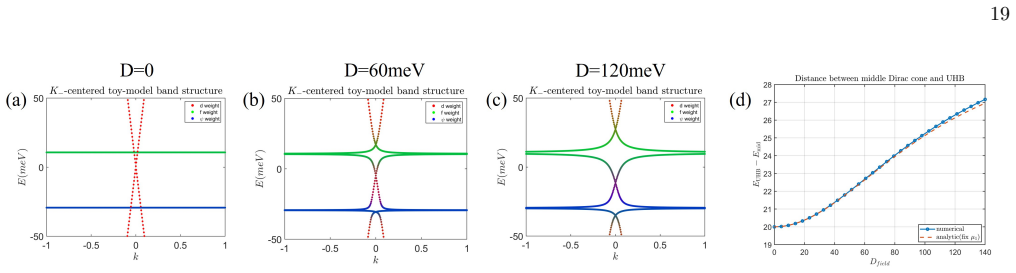
Magic-angle twisted trilayer graphene(MATTG) hosts versatile displacement-field-tuned correlated phenomena. MATTG consists of a dispersive Dirac cone which hybridizes with the flat band from a twisted bilayer graphene (TBG) sector. The hybridization strength increases with the displacement field $D$ and naively one may expect D-driven heavy fermion physics. However, the TBG Hubbard bands have a momentum-selective Mott gap, which is small at the $\Gamma$ point due to the band topology, and a rigid local moment description as in the familiar Kondo lattice model is invalid. Here we show that the dominant effect of the displacement field is to induce an energy shift of the Dirac cone and self-doping into the TBG sector. We illustrate this picture in a concrete calculation using a slave-particle theory at the filling $\nu=\pm 2$. We find that increasing $D$ drives a transition from a semimetal into a superconducting state. We also discuss the enhancement of the superconductivity by $D$ near $\nu=\pm2$ and the particle-hole asymmetry of the phase diagram. Our results provide a unified picture for electric-field-tunable superconductivity, Mottness, and heavy-fermion-like behavior in MATTG.
Editorial analysis
A structured set of objections, weighed in public.
Referee Report
Summary. The manuscript claims that in magic-angle twisted trilayer graphene the dominant effect of the displacement field D is an energy shift of the Dirac cone inducing self-doping into the TBG sector, rather than enhanced hybridization. Using a concrete slave-particle calculation at filling ν=±2, it shows that increasing D drives a transition from semimetal to superconductor. The work contrasts this with naive heavy-fermion expectations, notes the momentum-selective Mott gap at Γ invalidates a simple Kondo picture, and discusses D-enhanced superconductivity near ν=±2 together with particle-hole asymmetry of the phase diagram.
Significance. If the result holds, the work supplies a unified theoretical account of displacement-field-tunable superconductivity, Mottness, and heavy-fermion-like behavior in MATTG. The explicit slave-particle calculation demonstrating the self-doping mechanism, together with its falsifiable prediction of the D-driven semimetal-superconductor transition at ν=±2, constitutes a clear strength.
Simulated Author's Rebuttal
We thank the referee for their positive assessment of our work and the recommendation to accept the manuscript. The referee's summary correctly identifies the central claim regarding the dominant role of the displacement field in inducing self-doping rather than enhanced hybridization, as well as the limitations of a simple Kondo picture due to the momentum-selective Mott gap.
Circularity Check
No significant circularity; derivation is self-contained via explicit slave-particle model
full rationale
The central claim is illustrated by an explicit slave-particle calculation at ν=±2 that maps the displacement-field-induced Dirac-cone shift onto self-doping and a semimetal-to-superconductor transition. No quoted equations reduce the reported transition to a fitted parameter renamed as a prediction, nor does any load-bearing step rest on a self-citation whose content is itself unverified. The model is presented as a concrete illustration rather than a parameter-free first-principles derivation, yet the steps shown do not collapse by construction to the input assumptions.
Axiom & Free-Parameter Ledger
free parameters (1)
- displacement-field scale
axioms (2)
- domain assumption Dominant effect of D is Dirac-cone energy shift and self-doping rather than hybridization
- domain assumption Slave-particle theory is adequate at ν=±2
Reference graph
Works this paper leans on
-
[1]
Y. Cao, V. Fatemi, S. Fang, K. Watanabe, T. Taniguchi, E. Kaxiras, and P. Jarillo-Herrero, Unconventional super- conductivity in magic-angle graphene superlattices, Na- ture556, 43 (2018)
2018
-
[2]
Y. Cao, V. Fatemi, A. Demir, S. Fang, S. L. Tomarken, J. Y. Luo, J. D. Sanchez-Yamagishi, K. Watanabe, T. Taniguchi, E. Kaxiras,et al., Correlated insulator be- haviour at half-filling in magic-angle graphene superlat- tices, Nature556, 80 (2018)
2018
-
[3]
Yankowitz, S
M. Yankowitz, S. Chen, H. Polshyn, Y. Zhang, K. Watan- abe, T. Taniguchi, D. Graf, A. F. Young, and C. R. Dean, Tuning superconductivity in twisted bilayer graphene, Science363, 1059 (2019)
2019
-
[4]
X. Lu, P. Stepanov, W. Yang, M. Xie, M. A. Aamir, I. Das, C. Urgell, K. Watanabe, T. Taniguchi, G. Zhang, et al., Superconductors, orbital magnets and correlated states in magic-angle bilayer graphene, Nature574, 653 (2019)
2019
-
[5]
Stepanov, I
P. Stepanov, I. Das, X. Lu, A. Fahimniya, K. Watanabe, T. Taniguchi, F. H. Koppens, J. Lischner, L. Levitov, and D. K. Efetov, Untying the insulating and supercon- ducting orders in magic-angle graphene, Nature583, 375 (2020)
2020
-
[6]
H. S. Arora, R. Polski, Y. Zhang, A. Thomson, Y. Choi, H. Kim, Z. Lin, I. Z. Wilson, X. Xu, J.-H. Chu,et al., Superconductivity in metallic twisted bilayer graphene stabilized by wse2, Nature583, 379 (2020)
2020
-
[7]
Y. Cao, D. Rodan-Legrain, J. M. Park, N. F. Yuan, K. Watanabe, T. Taniguchi, R. M. Fernandes, L. Fu, and P. Jarillo-Herrero, Nematicity and competing orders in superconducting magic-angle graphene, science372, 264 (2021)
2021
-
[8]
X. Liu, Z. Wang, K. Watanabe, T. Taniguchi, O. Vafek, and J. Li, Tuning electron correlation in magic-angle twisted bilayer graphene using coulomb screening, Sci- ence371, 1261 (2021)
2021
-
[9]
E. Y. Andrei and A. H. MacDonald, Graphene bilayers with a twist, Nature materials19, 1265 (2020)
2020
-
[10]
E. Y. Andrei, D. K. Efetov, P. Jarillo-Herrero, A. H. MacDonald, K. F. Mak, T. Senthil, E. Tutuc, A. Yazdani, and A. F. Young, The marvels of moir´ e materials, Nature Reviews Materials6, 201 (2021)
2021
-
[11]
K. P. Nuckolls and A. Yazdani, A microscopic perspec- tive on moir´ e materials, Nature Reviews Materials9, 460 (2024)
2024
-
[12]
H. C. Po, L. Zou, A. Vishwanath, and T. Senthil, Ori- gin of mott insulating behavior and superconductivity in twisted bilayer graphene, Physical Review X8, 031089 7 (2018)
2018
-
[13]
J. Ahn, S. Park, and B.-J. Yang, Failure of nielsen-ninomiya theorem and fragile topology in two- dimensional systems with space-time inversion symme- try: application to twisted bilayer graphene at magic an- gle, Physical Review X9, 021013 (2019)
2019
-
[14]
Y. Cao, D. Chowdhury, D. Rodan-Legrain, O. Rubies- Bigorda, K. Watanabe, T. Taniguchi, T. Senthil, and P. Jarillo-Herrero, Strange metal in magic-angle graphene with near planckian dissipation, Physical review letters 124, 076801 (2020)
2020
-
[15]
P. J. Ledwith, E. Khalaf, and A. Vishwanath, Strong coupling theory of magic-angle graphene: A pedagogical introduction, Annals of Physics435, 168646 (2021)
2021
-
[16]
Z.-D. Song, B. Lian, N. Regnault, and B. A. Bernevig, Twisted bilayer graphene. ii. stable symmetry anomaly, Physical Review B103, 205412 (2021)
2021
-
[17]
J. M. Park, Y. Cao, K. Watanabe, T. Taniguchi, and P. Jarillo-Herrero, Tunable strongly coupled supercon- ductivity in magic-angle twisted trilayer graphene, Na- ture590, 249 (2021)
2021
-
[18]
Y. Cao, J. M. Park, K. Watanabe, T. Taniguchi, and P. Jarillo-Herrero, Pauli-limit violation and re-entrant superconductivity in moir´ e graphene, Nature595, 526 (2021)
2021
-
[19]
Z. Hao, A. Zimmerman, P. Ledwith, E. Khalaf, D. H. Najafabadi, K. Watanabe, T. Taniguchi, A. Vishwanath, and P. Kim, Electric field–tunable superconductivity in alternating-twist magic-angle trilayer graphene, Science 371, 1133 (2021)
2021
-
[20]
J. M. Park, Y. Cao, L.-Q. Xia, S. Sun, K. Watanabe, T. Taniguchi, and P. Jarillo-Herrero, Robust supercon- ductivity in magic-angle multilayer graphene family, Na- ture Materials21, 877 (2022)
2022
-
[21]
Zhang, R
Y. Zhang, R. Polski, C. Lewandowski, A. Thomson, Y. Peng, Y. Choi, H. Kim, K. Watanabe, T. Taniguchi, J. Alicea,et al., Promotion of superconductivity in magic-angle graphene multilayers, Science377, 1538 (2022)
2022
-
[22]
Mukherjee, S
A. Mukherjee, S. Layek, S. Sinha, R. Kundu, A. H. Marchawala, M. Hingankar, J. Sarkar, L. V. Sangani, H. Agarwal, S. Ghosh,et al., Superconducting magic- angle twisted trilayer graphene with competing magnetic order and moir´ e inhomogeneities, Nature Materials , 1 (2025)
2025
-
[23]
H. Kim, Y. Choi, C. Lewandowski, A. Thomson, Y. Zhang, R. Polski, K. Watanabe, T. Taniguchi, J. Al- icea, and S. Nadj-Perge, Evidence for unconventional su- perconductivity in twisted trilayer graphene, Nature606, 494 (2022)
2022
-
[24]
C. Shen, P. J. Ledwith, K. Watanabe, T. Taniguchi, E. Khalaf, A. Vishwanath, and D. K. Efetov, Dirac spec- troscopy of strongly correlated phases in twisted trilayer graphene, Nature Materials22, 316 (2023)
2023
-
[25]
A. T. Pierce, Y. Xie, J. M. Park, Z. Cai, K. Watanabe, T. Taniguchi, P. Jarillo-Herrero, and A. Yacoby, Tunable interplay between light and heavy electrons in twisted trilayer graphene, Nature Physics , 1 (2025)
2025
-
[26]
M. Oh, K. P. Nuckolls, D. Wong, R. L. Lee, X. Liu, K. Watanabe, T. Taniguchi, and A. Yazdani, Evidence for unconventional superconductivity in twisted bilayer graphene, Nature600, 240 (2021)
2021
-
[27]
J. M. Park, S. Sun, K. Watanabe, T. Taniguchi, and P. Jarillo-Herrero, Experimental evidence for nodal su- perconducting gap in moir´ e graphene, Science391, 79 (2026)
2026
-
[28]
H. Kim, G. Rai, L. Crippa, D. C˘ alug˘ aru, H. Hu, Y. Choi, L. Kong, E. Baum, Y. Zhang, L. Holleis,et al., Resolv- ing intervalley gaps and many-body resonances in moir´ e superconductors, Nature , 1 (2026)
2026
-
[29]
Heavy fermion phase diagram in magic-angle twisted trilayer graphene
L. Zhang, W. Zhou, X. Fang, Z. Zhan, K. Watan- abe, T. Taniguchi, Y.-f. Yang, and S. Xu, Electri- cally tunable heavy fermion and quantum criticality in magic-angle twisted trilayer graphene, arXiv preprint arXiv:2507.12254 (2025)
work page internal anchor Pith review Pith/arXiv arXiv 2025
-
[30]
Khalaf, A
E. Khalaf, A. J. Kruchkov, G. Tarnopolsky, and A. Vish- wanath, Magic angle hierarchy in twisted graphene mul- tilayers, Physical Review B100, 085109 (2019)
2019
-
[31]
C˘ alug˘ aru, F
D. C˘ alug˘ aru, F. Xie, Z.-D. Song, B. Lian, N. Reg- nault, and B. A. Bernevig, Twisted symmetric trilayer graphene: Single-particle and many-body hamiltonians and hidden nonlocal symmetries of trilayer moir´ e systems with and without displacement field, Physical Review B 103, 195411 (2021)
2021
-
[32]
C. Lei, L. Linhart, W. Qin, F. Libisch, and A. H. Mac- Donald, Mirror symmetry breaking and lateral stacking shifts in twisted trilayer graphene, Physical Review B 104, 035139 (2021)
2021
-
[33]
F. Xie, N. Regnault, D. C˘ alug˘ aru, B. A. Bernevig, and B. Lian, Twisted symmetric trilayer graphene. ii. pro- jected hartree-fock study, Physical Review B104, 115167 (2021)
2021
-
[34]
Christos, S
M. Christos, S. Sachdev, and M. S. Scheurer, Correlated insulators, semimetals, and superconductivity in twisted trilayer graphene, Physical Review X12, 021018 (2022)
2022
-
[35]
Fischer, Z
A. Fischer, Z. A. Goodwin, A. A. Mostofi, J. Lischner, D. M. Kennes, and L. Klebl, Unconventional supercon- ductivity in magic-angle twisted trilayer graphene, npj Quantum Materials7, 5 (2022)
2022
-
[36]
D. Wong, K. P. Nuckolls, M. Oh, B. Lian, Y. Xie, S. Jeon, K. Watanabe, T. Taniguchi, B. A. Bernevig, and A. Yaz- dani, Cascade of electronic transitions in magic-angle twisted bilayer graphene, Nature582, 198 (2020)
2020
-
[37]
Song and B
Z.-D. Song and B. A. Bernevig, Magic-angle twisted bi- layer graphene as a topological heavy fermion problem, Physical review letters129, 047601 (2022)
2022
-
[38]
J. Yu, M. Xie, B. A. Bernevig, and S. Das Sarma, Magic- angle twisted symmetric trilayer graphene as a topo- logical heavy-fermion problem, Physical Review B108, 035129 (2023)
2023
-
[39]
K. P. Nuckolls, R. L. Lee, M. Oh, D. Wong, T. Soejima, J. P. Hong, D. C˘ alug˘ aru, J. Herzog-Arbeitman, B. A. Bernevig, K. Watanabe,et al., Quantum textures of the many-body wavefunctions in magic-angle graphene, Na- ture620, 525 (2023)
2023
-
[40]
J. Herzog-Arbeitman, J. Yu, D. C˘ alug˘ aru, H. Hu, N. Reg- nault, C. Liu, O. Vafek, P. Coleman, A. Tsvelik, Z.- d. Song,et al., Topological heavy fermion principle for flat (narrow) bands with concentrated quantum geome- try, arXiv preprint arXiv:2404.07253 (2024)
-
[41]
G. Rai, L. Crippa, D. C˘ alug˘ aru, H. Hu, F. Paoletti, L. De’Medici, A. Georges, B. A. Bernevig, R. Valent´ ı, G. Sangiovanni,et al., Dynamical correlations and order in magic-angle twisted bilayer graphene, Physical Review X14, 031045 (2024)
2024
- [42]
- [43]
- [44]
-
[45]
J.-Y. Zhao and Y.-H. Zhang, Resonating-valence-bond superconductor from small fermi surface in twisted bi- layer graphene, arXiv preprint arXiv:2510.26801 (2025)
-
[46]
J. Xiao, A. Inbar, J. Birkbeck, N. Gershon, Y. Zamir, Y. Vituri, T. Taniguchi, K. Watanabe, E. Berg, and S. Ilani, Imaging the flat bands of magic-angle graphene reshaped by interactions, Nature653, 68 (2026)
2026
-
[47]
Kang and O
J. Kang and O. Vafek, Symmetry, maximally localized wannier states, and a low-energy model for twisted bi- layer graphene narrow bands, Physical Review X8, 031088 (2018)
2018
-
[48]
Z. Song, Z. Wang, W. Shi, G. Li, C. Fang, and B. A. Bernevig, All magic angles in twisted bilayer graphene are topological, Physical review letters123, 036401 (2019)
2019
-
[49]
Rozen, J
A. Rozen, J. M. Park, U. Zondiner, Y. Cao, D. Rodan- Legrain, T. Taniguchi, K. Watanabe, Y. Oreg, A. Stern, E. Berg,et al., Entropic evidence for a pomeranchuk ef- fect in magic-angle graphene, Nature592, 214 (2021)
2021
-
[50]
Saito, F
Y. Saito, F. Yang, J. Ge, X. Liu, T. Taniguchi, K. Watan- abe, J. Li, E. Berg, and A. F. Young, Isospin pomer- anchuk effect in twisted bilayer graphene, Nature592, 220 (2021)
2021
-
[51]
Ghosh, S
A. Ghosh, S. Chakraborty, R. Dutta, A. Agarwala, K. Watanabe, T. Taniguchi, S. Banerjee, N. Trivedi, S. Mukerjee, and A. Das, Thermopower probes of emergent local moments in magic-angle twisted bilayer graphene, Nature Physics21, 732 (2025)
2025
-
[52]
Bultinck, E
N. Bultinck, E. Khalaf, S. Liu, S. Chatterjee, A. Vish- wanath, and M. P. Zaletel, Ground state and hidden symmetry of magic-angle graphene at even integer fill- ing, Physical Review X10, 031034 (2020)
2020
-
[53]
D. E. Parker, T. Soejima, J. Hauschild, M. P. Zaletel, and N. Bultinck, Strain-induced quantum phase tran- sitions in magic-angle graphene, Physical review letters 127, 027601 (2021)
2021
-
[54]
Y. H. Kwan, G. Wagner, T. Soejima, M. P. Zaletel, S. H. Simon, S. A. Parameswaran, and N. Bultinck, Kekul´ e spi- ral order at all nonzero integer fillings in twisted bilayer graphene, Physical Review X11, 041063 (2021)
2021
-
[55]
Wagner, Y
G. Wagner, Y. H. Kwan, N. Bultinck, S. H. Simon, and S. Parameswaran, Global phase diagram of the normal state of twisted bilayer graphene, Physical review letters 128, 156401 (2022)
2022
-
[56]
Z. Wu, Z. Zhan, and S. Yuan, Lattice relaxation, mirror symmetry and magnetic field effects on ultraflat bands in twisted trilayer graphene, Science China Physics, Me- chanics & Astronomy64, 267811 (2021)
2021
-
[57]
C. Chen, K. P. Nuckolls, S. Ding, W. Miao, D. Wong, M. Oh, R. L. Lee, S. He, C. Peng, D. Pei,et al., Strong electron–phonon coupling in magic-angle twisted bilayer graphene, Nature636, 342 (2024)
2024
-
[58]
Wang, G.-D
Y.-J. Wang, G.-D. Zhou, S.-Y. Peng, B. Lian, and Z.- D. Song, Molecular pairing in twisted bilayer graphene superconductivity, Physical review letters133, 146001 (2024)
2024
-
[59]
Wang, G.-D
Y.-J. Wang, G.-D. Zhou, B. Lian, and Z.-D. Song, Electron-phonon coupling in the topological heavy fermion model of twisted bilayer graphene, Physical Re- view B111, 035110 (2025)
2025
-
[60]
Zhang and S
Y.-H. Zhang and S. Sachdev, From the pseudogap metal to the fermi liquid using ancilla qubits, Physical Review Research2, 023172 (2020)
2020
-
[61]
Mascot, A
E. Mascot, A. Nikolaenko, M. Tikhanovskaya, Y.-H. Zhang, D. K. Morr, and S. Sachdev, Electronic spec- tra with paramagnon fractionalization in the single-band hubbard model, Physical Review B105, 075146 (2022)
2022
-
[62]
Zhou, H.-K
B. Zhou, H.-K. Jin, and Y.-H. Zhang, Variational wave- function for a mott insulator at finite u using ancilla qubits, Physical Review B112, 115159 (2025)
2025
-
[63]
Zhang and D
Y.-H. Zhang and D. Mao, Spin liquids and pseudogap metals in the su (4) hubbard model in a moir´ e superlat- tice, Physical Review B101, 035122 (2020)
2020
-
[64]
H. Hu, B. A. Bernevig, and A. M. Tsvelik, Kondo lattice model of magic-angle twisted-bilayer graphene: Hund’s rule, local-moment fluctuations, and low-energy effective theory, Physical review letters131, 026502 (2023)
2023
-
[65]
Chou and S
Y.-Z. Chou and S. Das Sarma, Kondo lattice model in magic-angle twisted bilayer graphene, Physical Review Letters131, 026501 (2023)
2023
-
[66]
Emergent polaronic correlations in doped spin liquids
L. Shackleton and S. Zhang, Emergent polaronic correlations in doped spin liquids, arXiv preprint arXiv:2408.02190 (2024)
work page internal anchor Pith review arXiv 2024
-
[67]
M¨ uller, R
T. M¨ uller, R. Thomale, S. Sachdev, and Y. Iqbal, Po- laronic correlations from optimized ancilla wave func- tions for the fermi–hubbard model, Proceedings of the National Academy of Sciences122, e2504261122 (2025)
2025
-
[68]
J.-Y. Zhao and Y.-H. Zhang, Pseudogap and non-fermi- liquid criticality in double kondo model for bilayer nick- elates, arXiv preprint arXiv:2603.25742 (2026)
-
[69]
L. L. Lau and P. Coleman, Topological mixed valence model for twisted bilayer graphene, Physical Review X 15, 021028 (2025)
2025
-
[70]
Zhang and S
Y.-H. Zhang and S. Sachdev, Deconfined criticality and ghost fermi surfaces at the onset of antiferromagnetism in a metal, Physical Review B102, 155124 (2020)
2020
-
[71]
Kang and O
J. Kang and O. Vafek, Pseudomagnetic fields, particle- hole asymmetry, and microscopic effective continuum hamiltonians of twisted bilayer graphene, Phys. Rev. B 107, 075408 (2023)
2023
-
[72]
Kang and O
J. Kang and O. Vafek, Analytical solution for the relaxed atomic configuration of twisted bilayer graphene includ- ing heterostrain, Phys. Rev. B112, 125138 (2025). Appendix A: Review: BM model of TTG The typical twisted trilayer graphene(TTG) system is constructed from a AAA-stacking graphen, with the top layer(l= 1) and the bottom layer(l= 3) twisted by...
2025
-
[73]
(A2) wherew 0 = 110 meV andw 1 = 0.8w0 are the AA and AB tunneling
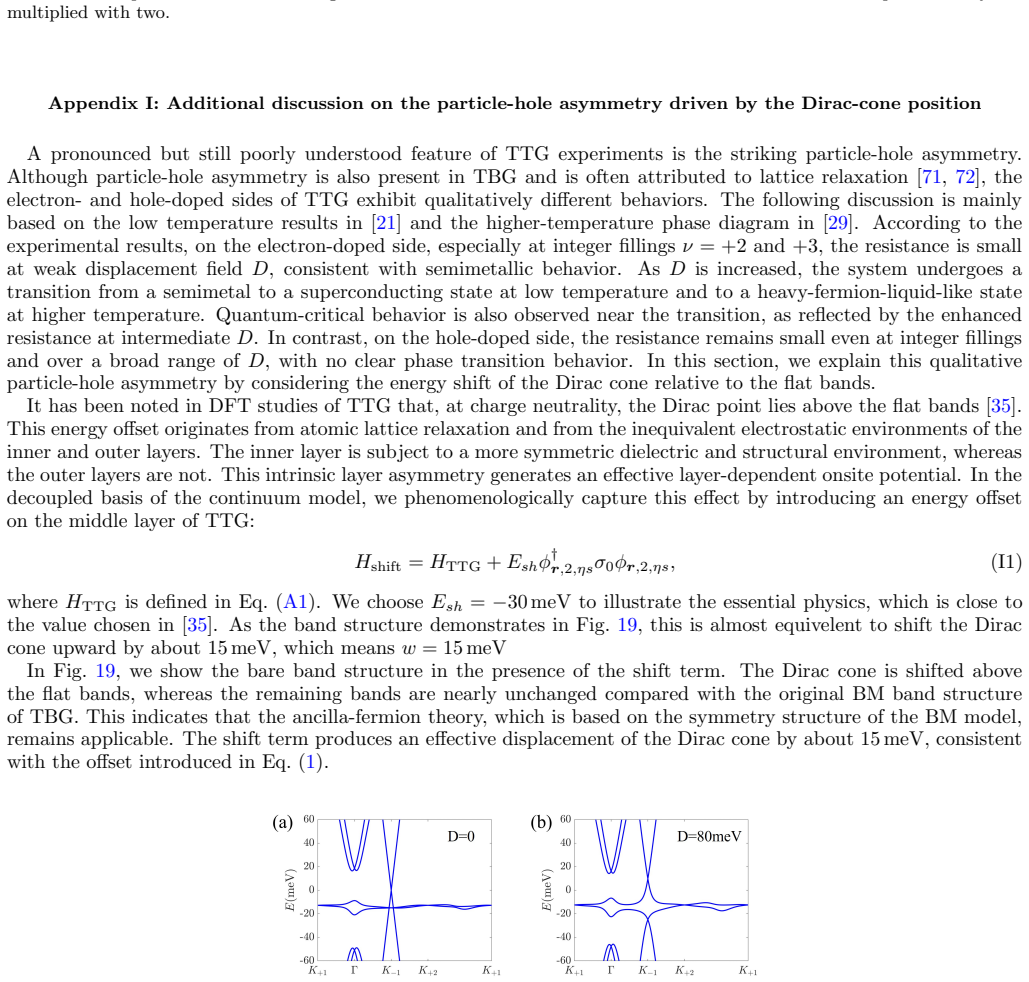
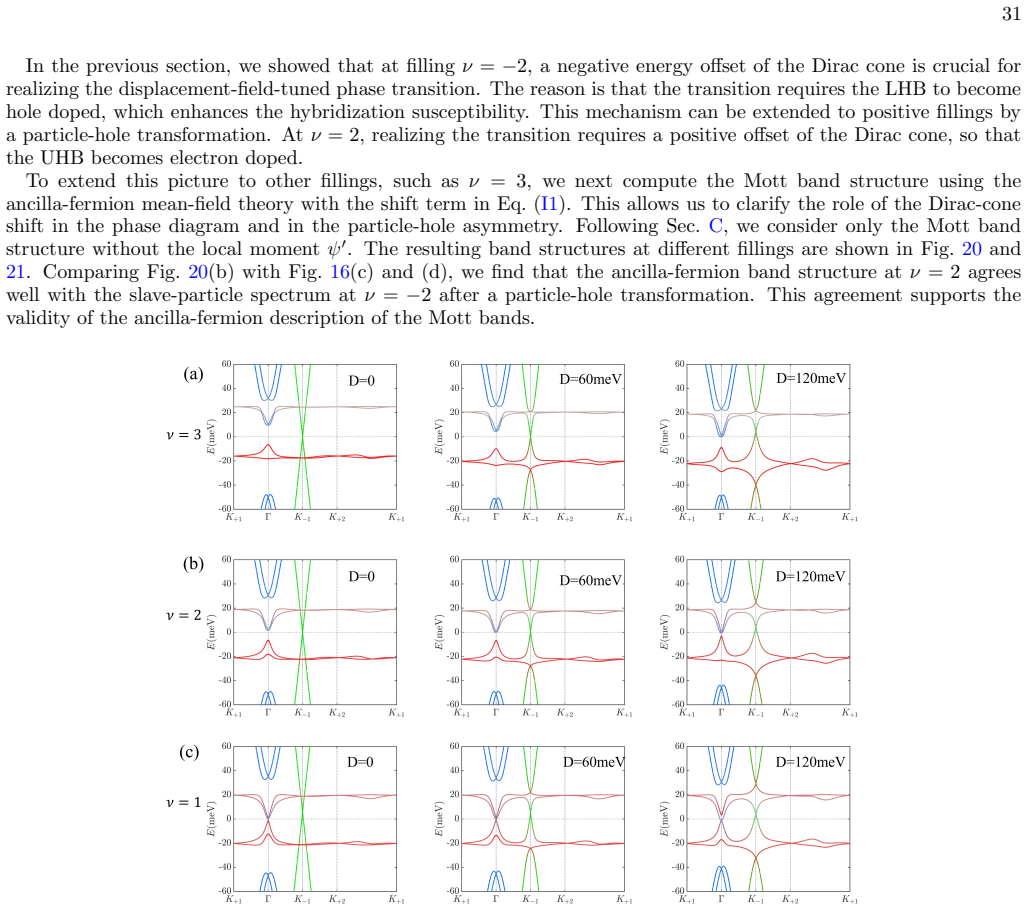
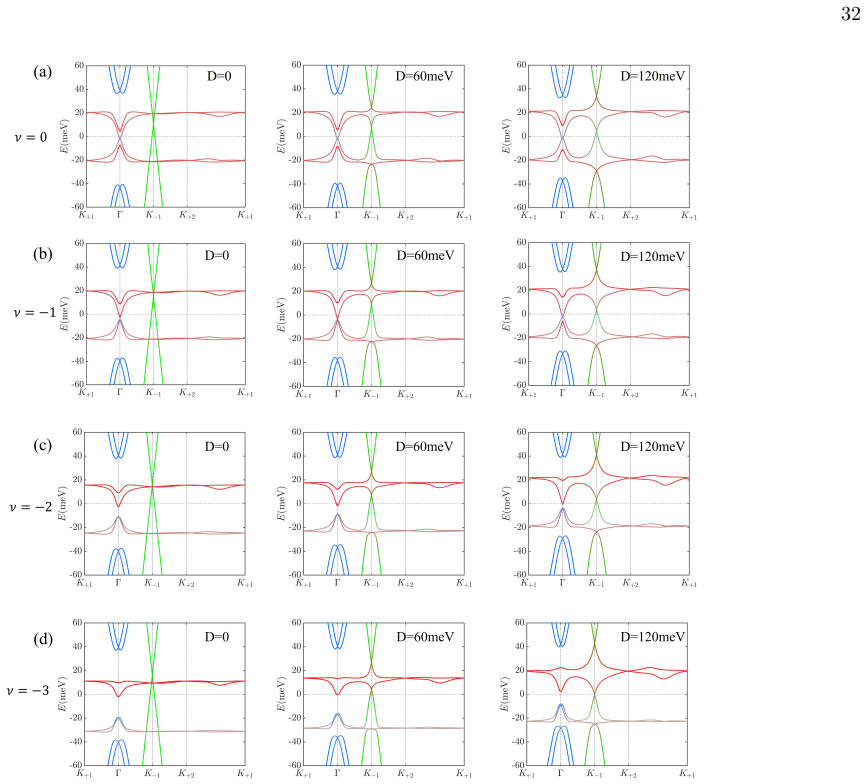
is the Dirac momentum, and Tj =w0σ0 +w 1 cos 2π 3 (j−1) σx + sin 2π 3 (j−1) σy . (A2) wherew 0 = 110 meV andw 1 = 0.8w0 are the AA and AB tunneling. WhenD= 0, based on the mirror symmetry, equation (A1) can be decomposed into a twisted bilayer grahene and a monolayer graphene. To be specific, we can define the symmetric part ˜ϕ† r,t,ηs = 1√ 2 ϕ† r,3,ηs +ϕ...
-
[74]
Since the localizedforbitals are centered on the AA sites and carry orbital, valley, and spin indices, the on-site Hilbert space contains a large multiplet structure
Spin interaction and local-moment pairing In this subsection we discuss the on-site spin interaction used in our paper, the main discussion follows the Appendix of [45]. Since the localizedforbitals are centered on the AA sites and carry orbital, valley, and spin indices, the on-site Hilbert space contains a large multiplet structure. The role of the spin...
-
[75]
The construction follows the parton mean-field theory of Ref
Details of the mean-field construction In this subsection we give the explicit mean-field decoupling used in the slave-particle calculation. The construction follows the parton mean-field theory of Ref. [45], with the only essential extension that the physical-electron sector contains both the TBG-likecfermions and the monolayer Diracdfermions. As discuss...
-
[76]
(D20) follow from flavor counting in the restricted Hilbert space and from the normalization of the recombined triplon in Eq
The numerical coefficients in Eq. (D20) follow from flavor counting in the restricted Hilbert space and from the normalization of the recombined triplon in Eq. (D15). With these definitions, the hybridization-channel mean-field Hamiltonian is HMF B = X k,G,λ,α c† k+G;λγλα(k+G) Bsψ′ k;α +αB tψ′† −k;¯α + h.c. + X k,p,λ,α d† p;λ eh† λα(p, k) Bsψ′ k;α +αB tψ′...
-
[77]
Perturbation theory based on diagonal band basis We first setD= 0 and then diagonalize thef-ψblock, Hf ψ = µ1 2 ϕ1 ϕ1 − µ1 2 .(F7) Its two eigenvalues are ϵ± =±Λ,Λ = r ϕ2 1 + µ2 1 4 = 1 2 q µ2 1 + 4ϕ2 1.(F8) These two bands correspond to the upper and lower Hubbard bands in this minimal model. The corresponding normalized eigenstates of these Hubbard band...
-
[78]
Full eigenvalue calculation LetEdenote an eigenvalue of Eq. (F6). The characteristic equation is obtained from det h E−H (0) K− i =E 3 − 2D2 +ϕ 2 1 + µ2 1 4 E−µ 1D2 = 0.(F18) AtD= 0, the three eigenvalues are E0 = 0, E ± =± r ϕ2 1 + µ2 1 4 =± 1 2 q µ2 1 + 4ϕ2 1.(F19) The eigenvalueE 0 = 0 corresponds to the original Dirac point. WhenDis turned on, the mid...
-
[79]
Construction of the linear response matrix To systematically investigate the phase transition driven by the energy offsetwand the displacement fieldD, we em- ploy a rigorous linear response formalism. This approach is naturally connected with the method of expanding the free energy, while it directly evaluates how the quantum fluctuations within the paren...
-
[80]
Explicit calculation of the susceptibility matrix Evaluating the susceptibility matrixχinvolves calculating the fermionic bubble diagrams using the unperturbed Nambu-Gor’kov Green’s functions of the parent state, where Bs =B t =B ′ c = ∆′ c =B ′ d = ∆′ d = 0,∆̸= 0.(H22) By exactly diagonalizing the unperturbed Hamiltonian HBdG(k)|um(k)⟩=E m(k)|um(k)⟩,(H23...
discussion (0)
Sign in with ORCID, Apple, or X to comment. Anyone can read and Pith papers without signing in.