From Optical Breakdown to Bubble Inception: A Coupled Plasma-Thermal Framework for Nanosecond Laser-Induced Cavitation in Water
Pith reviewed 2026-05-25 02:55 UTC · model grok-4.3
The pith
Bubble inception in nanosecond laser cavitation arises from plasma-induced thermoelastic acoustic relaxation that creates transient tensile pressures, with the initial cavity inheriting the plasma shape rather than starting spherical.
A machine-rendered reading of the paper's core claim, the machinery that carries it, and where it could break.
Core claim
The model shows that bubble inception is governed primarily by plasma-induced thermoelastic acoustic relaxation, which generates transient tensile rarefaction pressures sufficient for cavitation on nanosecond timescales, while residual thermal energy sustains subsequent bubble growth. Because energy deposition is spatially anisotropic under moving breakdown conditions, the initial cavity inherits the plasma morphology rather than emerging as a spherical nucleus. Comparison with time-resolved experiments demonstrates that the coupled framework captures both early time cavity formation and longtime bubble expansion more accurately than plasma-only or thermal-only models.
What carries the argument
coupled plasma-thermal framework that unifies free-electron dynamics, plasma absorption, thermoelastic acoustic response, residual thermal energy retention, and post-inception bubble evolution
If this is right
- Transient tensile rarefaction pressures from plasma acoustic relaxation enable cavitation on nanosecond timescales.
- Residual thermal energy from the plasma sustains bubble growth after the initial cavity forms.
- The initial cavity shape matches the anisotropic morphology of the moving plasma region.
- The unified description matches experimental cavity formation and expansion timing more closely than plasma-only or thermal-only models.
- The framework supplies physically grounded initial conditions for multiscale simulations of laser-driven material transport.
Where Pith is reading between the lines
- Controlling laser parameters to alter plasma shape could allow deliberate control over the geometry of the starting cavity in applications.
- The same plasma-thermal coupling may predict cavitation behavior in other transparent liquids under comparable laser conditions.
- Direct linkage of breakdown-scale deposition to continuum dynamics could simplify initial conditions in larger-scale models of laser processing.
Load-bearing premise
The model assumes that spatially anisotropic energy deposition under moving breakdown directly sets the initial cavity shape and that thermoelastic acoustic relaxation alone produces tensile pressures sufficient for cavitation without extra nucleation sites or thresholds.
What would settle it
High-speed imaging that shows the initial cavity forming as a sphere even when the plasma breakdown path is elongated, or direct pressure measurements indicating that acoustic rarefaction waves remain above the cavitation threshold throughout the nanosecond window.
Figures



read the original abstract
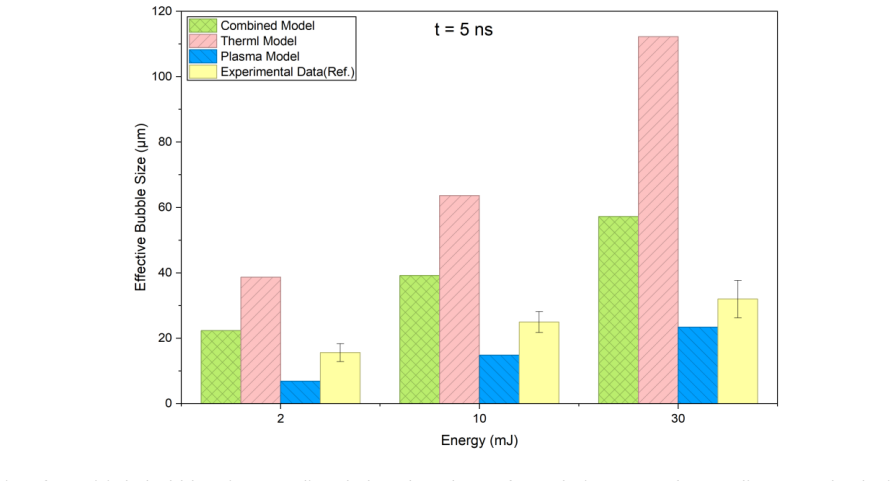
Laser-induced cavitation under nanosecond optical breakdown is central to applications such as laser-induced forward transfer, microsurgery, and microfluidic actuation, yet the physical origin of the earliest cavity and its connection to subsequent bubble growth remain unresolved. Existing models typically describe bubble formation either as a plasma-driven mechanical response or as a thermally driven nucleation process, without resolving how these mechanisms interact during inception. Here, we developed a coupled plasma-thermal framework that unifies free-electron dynamics, plasma absorption, thermoelastic acoustic response, residual thermal energy retention, and post-inception bubble evolution within a single description. The model shows that bubble inception is governed primarily by plasma-induced thermoelastic acoustic relaxation, which generates transient tensile rarefaction pressures sufficient for cavitation on nanosecond timescales, while residual thermal energy sustains subsequent bubble growth. Because energy deposition is spatially anisotropic under moving breakdown conditions, the initial cavity inherits the plasma morphology rather than emerging as a spherical nucleus. Comparison with time-resolved experiments demonstrates that the coupled framework captures both early time cavity formation and longtime bubble expansion more accurately than plasma-only or thermal-only models. These results establish a predictive link between breakdown-scale energy deposition and continuum bubble dynamics, providing physically grounded initial conditions for multiscale modeling and improved control of laser driven material transport processes.
Editorial analysis
A structured set of objections, weighed in public.
Referee Report
Summary. The manuscript develops a coupled plasma-thermal framework integrating free-electron dynamics, plasma absorption, thermoelastic acoustic response, residual thermal energy, and post-inception bubble evolution for nanosecond laser-induced cavitation in water. It claims that bubble inception is governed primarily by plasma-induced thermoelastic acoustic relaxation generating transient tensile rarefaction pressures sufficient for cavitation on nanosecond timescales, with residual thermal energy sustaining later growth; the initial cavity inherits the spatially anisotropic plasma morphology under moving breakdown rather than forming as a spherical nucleus. The coupled model is asserted to match time-resolved experiments more accurately than plasma-only or thermal-only models, establishing a predictive link between breakdown-scale deposition and continuum bubble dynamics.
Significance. If the central claim on the magnitude and sufficiency of thermoelastic tensile pressures holds, the work would provide a unified mechanism linking plasma dynamics directly to cavitation inception and growth, supplying physically grounded initial conditions for multiscale simulations in applications such as microsurgery and microfluidic actuation. The explicit treatment of anisotropic energy deposition under moving breakdown as determining non-spherical cavity morphology would represent a substantive advance over decoupled models.
major comments (2)
- [Abstract] Abstract: the claim that the coupled framework 'captures both early time cavity formation and longtime bubble expansion more accurately than plasma-only or thermal-only models' is unsupported by any quantitative error metrics, description of data exclusion rules, or details on how parameters were chosen and validated; this directly affects the load-bearing assertion of model superiority.
- [Abstract] Abstract: the assertion that plasma-induced thermoelastic acoustic relaxation 'generates transient tensile rarefaction pressures sufficient for cavitation on nanosecond timescales' provides no computed pressure amplitudes, the precise cavitation threshold applied, or the closure of the acoustic wave equation with the plasma absorption term, leaving the central mechanism unverified in magnitude.
Simulated Author's Rebuttal
We thank the referee for the detailed and constructive report. We address each major comment below and indicate where revisions will be made to strengthen the presentation of the central claims.
read point-by-point responses
-
Referee: [Abstract] Abstract: the claim that the coupled framework 'captures both early time cavity formation and longtime bubble expansion more accurately than plasma-only or thermal-only models' is unsupported by any quantitative error metrics, description of data exclusion rules, or details on how parameters were chosen and validated; this directly affects the load-bearing assertion of model superiority.
Authors: The abstract summarizes results whose quantitative support appears in the Results section through direct comparison of simulated and measured bubble radii at multiple time points. We agree that the abstract would be strengthened by explicit reference to these metrics. In revision we will add a concise statement noting the improved agreement (e.g., lower deviation from experimental radii) and will ensure the Methods section explicitly states that all acquired experimental datasets were retained without exclusion and that parameter values were validated against independent breakdown-threshold measurements. revision: yes
-
Referee: [Abstract] Abstract: the assertion that plasma-induced thermoelastic acoustic relaxation 'generates transient tensile rarefaction pressures sufficient for cavitation on nanosecond timescales' provides no computed pressure amplitudes, the precise cavitation threshold applied, or the closure of the acoustic wave equation with the plasma absorption term, leaving the central mechanism unverified in magnitude.
Authors: The pressure amplitudes, the cavitation threshold employed, and the manner in which the plasma absorption term enters the acoustic source are derived and reported in the main text (thermoelastic model section and associated figures). We acknowledge that these values are not restated in the abstract. In revision we will insert the key magnitudes and a brief indication of the coupling into the abstract so that the central mechanism is quantified at the summary level. revision: yes
Circularity Check
No circularity: abstract presents framework claims without equations, fits, or self-citations
full rationale
The provided abstract describes a coupled plasma-thermal model and its conclusions about bubble inception via thermoelastic relaxation and anisotropic energy deposition, but contains no equations, parameter-fitting procedures, self-citations, or derivation steps. Without visible mathematical structure or load-bearing reductions to inputs, no instances of self-definitional claims, fitted inputs called predictions, or ansatz smuggling can be identified. The central claim is stated as an output of the framework rather than shown to reduce to its own assumptions by construction. This matches the expectation that most papers are non-circular when no explicit chain is inspectable.
Axiom & Free-Parameter Ledger
Reference graph
Works this paper leans on
-
[1]
J. Noack and A. Vogel, “Laser-induced plasma formation in water at nanosecond to femtosecond time scales: calculation of thresholds, absorption coefficients, and energy density,” IEEE J. Quantum Electron., vol. 35, no. 8, pp. 1156–1167, 1999, doi: 10.1109/3.777215
-
[2]
Mechanisms of pulsed laser ablation of biological tissues,
A. Vogel and V. Venugopalan, “Mechanisms of pulsed laser ablation of biological tissues,” Chem. Rev., vol. 103, no. 2, pp. 577–644, 2003, doi: 10.1021/cr010379n
-
[3]
Mechanisms of femtosecond laser nanosurgery of cells and tissues,
A. Vogel, J. Noack, G. Hüttman, and G. Paltauf, “Mechanisms of femtosecond laser nanosurgery of cells and tissues,” Appl. Phys. B, vol. 81, no. 8, pp. 1015–1047, 2005, doi: 10.1007/s00340-005- 2036-6
-
[4]
Early dynamics of laser-induced plasma and cavitation bubble in water,
Z. Jia et al., “Early dynamics of laser-induced plasma and cavitation bubble in water,” Spectrochim. Acta Part B At. Spectrosc., vol. 206, Aug. 2023, doi: 10.1016/j.sab.2023.106713
-
[5]
Lasersonic® LIFT process for large area digital printing,
G. Hennig et al., “Lasersonic® LIFT process for large area digital printing,” Journal of Laser Micro Nanoengineering, vol. 7, no. 3, pp. 299–305, Nov. 2012, doi: 10.2961/jlmn.2012.03.0012
-
[6]
Laser- generated liquid microjets: Correlation between bubble dynamics and liquid ejection,
A. Patrascioiu, J. M. Fernández-Pradas, A. Palla-Papavlu, J. L. Morenza, and P. Serra, “Laser- generated liquid microjets: Correlation between bubble dynamics and liquid ejection,” Microfluid. Nanofluidics, vol. 16, no. 1–2, pp. 55–63, 2014, doi: 10.1007/s10404-013-1218-5
-
[7]
Laser-Induced Forward Transfer: Fundamentals and Applications,
P. Serra and A. Piqué, “Laser-Induced Forward Transfer: Fundamentals and Applications,” Jan. 01, 2019, Wiley-Blackwell. doi: 10.1002/admt.201800099
-
[8]
A State-of-the-Art Review of Laser-Assisted Bioprinting and its Future Research Trends,
C. Dou, V. Perez, J. Qu, A. Tsin, B. Xu, and J. Li, “A State-of-the-Art Review of Laser-Assisted Bioprinting and its Future Research Trends,” Oct. 01, 2021, John Wiley and Sons Inc. doi: 10.1002/cben.202000037
-
[9]
Laser-induced forward transfer hydrogel printing: A defined route for highly controlled process,
V. Yusupov et al., “Laser-induced forward transfer hydrogel printing: A defined route for highly controlled process,” Int. J. Bioprint., vol. 6, no. 3, pp. 1–16, 2020, doi: 10.18063/IJB.V6I3.271
-
[10]
3D printing of conducting polymers,
H. Yuk et al., “3D printing of conducting polymers,” Nat. Commun., vol. 11, no. 1, pp. 4–11, 2020, doi: 10.1038/s41467-020-15316-7
-
[11]
J. Qu, C. Dou, B. Xu, J. Li, Z. Rao, and A. Tsin, “Printing quality improvement for laser-induced forward transfer bioprinting: Numerical modeling and experimental validation,” Physics of Fluids, vol. 33, no. 7, Jul. 2021, doi: 10.1063/5.0054675
-
[12]
S. Zhou, C. Dou, J. Li, Q. Zhang, Q. Dai, and B. Xu, “Experimental investigation of various energy-absorbing layer materials and sodium alginate viscosities on the jet formation in laser- induced-forward-transfer (LIFT) bioprinting,” J. Appl. Phys., vol. 133, no. 20, May 2023, doi: 10.1063/5.0145737
-
[13]
S. Zhou and B. Xu, “A CFD study of the Influence of Porous Structure Placement on Jet Formation in Laser-Induced-Forward-Transfer (LIFT) Printing,” 2025. 32
work page 2025
-
[14]
Simulation of the inverse bremsstrahlung absorption by plasma plume in laser penetration welding,
Y. Zhang, F. Wang, J. Liu, and J. Sun, “Simulation of the inverse bremsstrahlung absorption by plasma plume in laser penetration welding,” Chem. Phys. Lett., vol. 793, Apr. 2022, doi: 10.1016/j.cplett.2022.139434
-
[15]
Laser induced cavitation: Plasma generation and breakdown shockwave,
G. Sinibaldi et al., “Laser induced cavitation: Plasma generation and breakdown shockwave,” Physics of Fluids, vol. 31, no. 10, Oct. 2019, doi: 10.1063/1.5119794
-
[16]
Q. Fang and X. H. Hu, “Modeling of Skin Tissue Ablation by Nanosecond Pulses from Ultraviolet to Near-Infrared and Comparison with Experimental Results,” IEEE J. Quantum Electron., vol. 40, no. 1, pp. 69–77, Jan. 2004, doi: 10.1109/JQE.2003.820837
-
[17]
Numerical modeling of plasma formation in skin tissues induced by nanosecond pulsed laser,
H. Delibasic, V. Petrovic, I. Petrovic, C. Molpeceres, and S. Lauzurica, “Numerical modeling of plasma formation in skin tissues induced by nanosecond pulsed laser,” European Physical Journal D, vol. 75, no. 5, pp. 1–6, 2021, doi: 10.1140/epjd/s10053-021-00170-z
-
[18]
Spatio-temporal evolution of uranium emission in laser-produced plasmas,
S. S. Harilal, P. K. Diwakar, N. L. Lahaye, and M. C. Phillips, “Spatio-temporal evolution of uranium emission in laser-produced plasmas,” Spectrochim. Acta Part B At. Spectrosc., vol. 111, pp. 1–7, Jul. 2015, doi: 10.1016/j.sab.2015.06.003
-
[19]
A. Vogel, K. Nahen, D. Theisen, and J. Noack, “Plasma formation in water by picosecond and nanosecond Nd:YAG laser pulses - Part I: Optical breakdown at threshold and superthreshold irradiance,” IEEE Journal on Selected Topics in Quantum Electronics, vol. 2, no. 4, pp. 847–859, 1996, doi: 10.1109/2944.577307
-
[20]
Bubble formation modeling during laser direct writing of glycerol solutions,
R. Xiong, Z. Zhang, J. Shen, Y. Lin, Y. Huang, and D. B. Chrisey, “Bubble formation modeling during laser direct writing of glycerol solutions,” J. Micro Nanomanuf., vol. 3, no. 1, Mar. 2015, doi: 10.1115/1.4029264
-
[21]
P. G. Debenedetti, Metastable Liquids: Concepts and Principles. 1996
work page 1996
-
[22]
Kashchiev, Nucleation: Basic Theory with Applications
D. Kashchiev, Nucleation: Basic Theory with Applications. Butterworth-Heinemann, 2000
work page 2000
-
[23]
Numerical study of laser-induced cavitation bubble with consideration of chemical reactions,
C. Wang, H. Yan, R. Zhang, F. Chen, and F. Liu, “Numerical study of laser-induced cavitation bubble with consideration of chemical reactions,” Ultrason. Sonochem., vol. 109, Oct. 2024, doi: 10.1016/j.ultsonch.2024.107007
-
[24]
H. P. Hoeppe et al., “Femtosecond laser-induced optical breakdown and cavitation dynamics in water imaged with an x-ray free-electron laser,” Phys. Rev. Res., vol. 7, no. 3, Jul. 2025, doi: 10.1103/c91c-zrm7
-
[25]
The Gilmore-NASG model to predict single-bubble cavitation in compressible liquids,
F. Denner, “The Gilmore-NASG model to predict single-bubble cavitation in compressible liquids,” Ultrason. Sonochem., vol. 70, Jan. 2021, doi: 10.1016/j.ultsonch.2020.105307
-
[26]
The Kirkwood-Bethe hypothesis for bubble dynamics, cavitation and underwater explosions,
F. Denner, “The Kirkwood-Bethe hypothesis for bubble dynamics, cavitation and underwater explosions,” May 2024, doi: 10.1063/5.0209167. 33
-
[27]
Breakdown threshold and localized electron density in water induced by ultrashort laser pulses,
C. H. Fan, J. Sun, and J. P. Longtin, “Breakdown threshold and localized electron density in water induced by ultrashort laser pulses,” J. Appl. Phys., vol. 91, no. 4, pp. 2530–2536, 2002, doi: 10.1063/1.1433929
-
[28]
P. K. Kennedy, “A First-Order Model for Computation of Laser-Induced Breakdown Thresholds in Ocular and Aqueous Media: Part I-Theory,” 1995
work page 1995
-
[29]
Photoacoustic Monopole Radiation in One, Two, and Three Dimensions
G. J. Diebold, T. Sun, and M. I. Khan, “Photoacoustic Monopole Radiation in One, Two, and Three Dimensions.”
-
[30]
Influence of inertial confinement on laser-induced bubble generation and shock wave emission
X.-X. Liang and A. Vogel, “Influence of inertial confinement on laser-induced bubble generation and shock wave emission.” [Online]. Available: https://orcid.org/0000-0002-8325-1627
-
[31]
International Tables of the Surface Tension of Water
N. B. Vargaftik, B. N. Volkov, and L. D. Voljak, “International Tables of the Surface Tension of Water.” [Online]. Available: http://jpcrd.aip.org/about/rights_and_permissions
-
[32]
R. A. Van Gorder, “Dynamics of the Rayleigh-Plesset equation modelling a gas-filled bubble immersed in an incompressible fluid,” J. Fluid Mech., vol. 807, pp. 478–508, 2016, doi: 10.1017/jfm.2016.640
-
[33]
The Dynamics of Cavitation Bubbles,
M. S. Plesset and C. Pasadena, “The Dynamics of Cavitation Bubbles,” 9AD
-
[34]
C. E. . Brennen, Cavitation and bubble dynamics. Oxford University Press, 1995
work page 1995
-
[35]
Laser generation of high-amplitude stress waves in materials,
B. P. Fairand and A. H. Clauer, “Laser generation of high-amplitude stress waves in materials,” J. Appl. Phys., vol. 50, no. 3, pp. 1497–1502, 1979, doi: 10.1063/1.326137
-
[36]
N. Linz, S. Freidank, X. X. Liang, and A. Vogel, “Laser-induced plasma formation and cavitation in water: from nanoeffects to extreme states of matter,” Reports on Progress in Physics, vol. 88, no. 8, Aug. 2025, doi: 10.1088/1361-6633/adedb3
-
[37]
Photoacoustic cavitation in spherical and cylindrical absorbers,
G. Paltauf and H. Schmidt-Kloiber, “Photoacoustic cavitation in spherical and cylindrical absorbers,” Appl. Phys. A, vol. 68, pp. 525–531, 1999, doi: 10.1007/s003399900033
-
[38]
S. Fujikawa and T. Akamatsu, “Effects of the non-equilibrium condensation of vapour on the pressure wave produced by the collapse of a bubble in a liquid,” J. Fluid Mech., vol. 97, no. 3, pp. 481–512, 1980, doi: 10.1017/S0022112080002662
discussion (0)
Sign in with ORCID, Apple, or X to comment. Anyone can read and Pith papers without signing in.