The magnetic field in the Milky Way Galaxy: from large to small scales
Pith reviewed 2026-06-25 20:44 UTC · model grok-4.3
The pith
SKA-Mid polarization survey will produce the most complete picture of the Milky Way's magnetic field in the southern Galactic hemisphere from large to small scales.
A machine-rendered reading of the paper's core claim, the machinery that carries it, and where it could break.
Core claim
The dense RM grid and images of diffuse emission will allow us to determine the most complete picture of the magnetic field in the southern Galactic hemisphere from large to small scales.
What carries the argument
The SKA-Mid polarization survey delivering an all-sky RM grid at ~100 sources per square degree together with multi-scale total intensity, polarized intensity, and RM images of diffuse emission.
If this is right
- The survey data will address fundamental questions on how magnetic fields are generated and evolve in the Galaxy.
- It will clarify how magnetic fields influence other components such as gas and cosmic rays.
- The resulting maps will span the full range of spatial scales from large galactic structures to small interstellar features in the southern hemisphere.
- This dataset can serve as a reference for modeling magnetic fields in external galaxies.
Where Pith is reading between the lines
- Matching southern maps with existing or future northern hemisphere data could produce a full-sky model of the Milky Way's magnetic field.
- The high source density may support statistical analyses of magnetic field fluctuations and turbulence on small scales.
- The multi-scale images could test predictions from galactic dynamo simulations at both large and small scales.
Load-bearing premise
The SKA-Mid polarization survey will achieve an all-sky RM grid density of about 100 per square degree and produce total intensity, polarized intensity, and RM images of diffuse emission covering scales from about 10 arcseconds upward after combination with single-dish observations.
What would settle it
If the delivered RM grid density falls well below 100 sources per square degree or the combined images fail to recover the full range of spatial scales from 10 arcseconds upward, the claim of obtaining the most complete picture would not hold.
Figures
read the original abstract
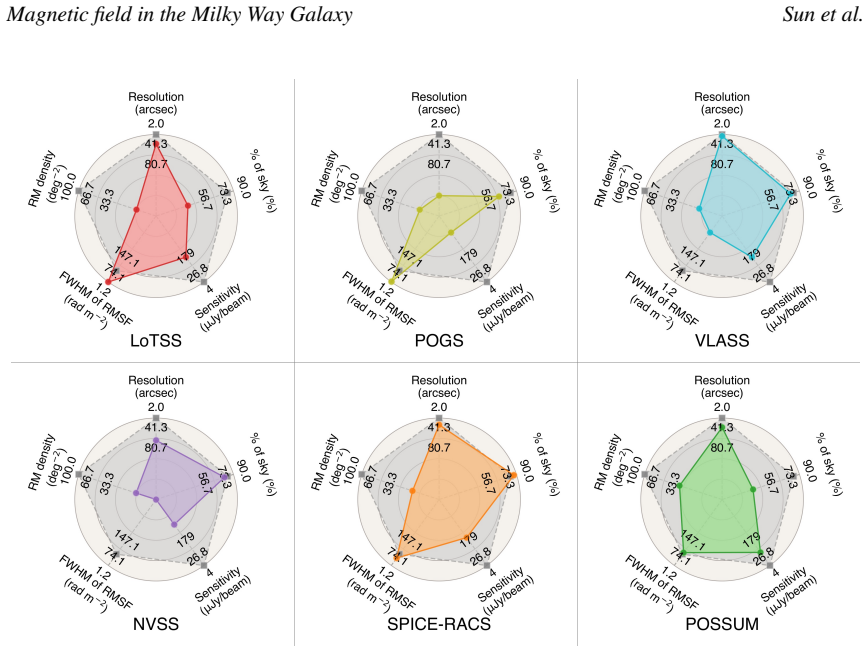
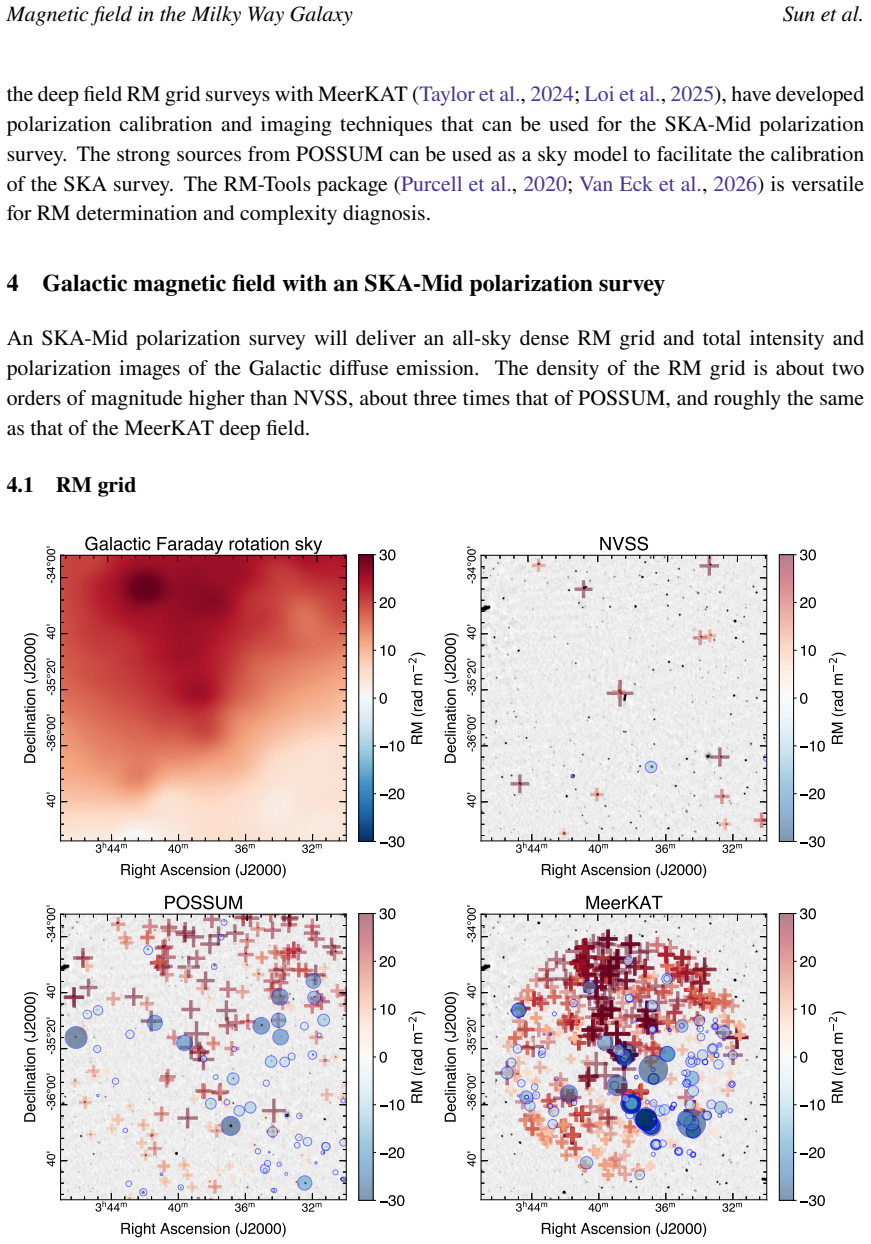
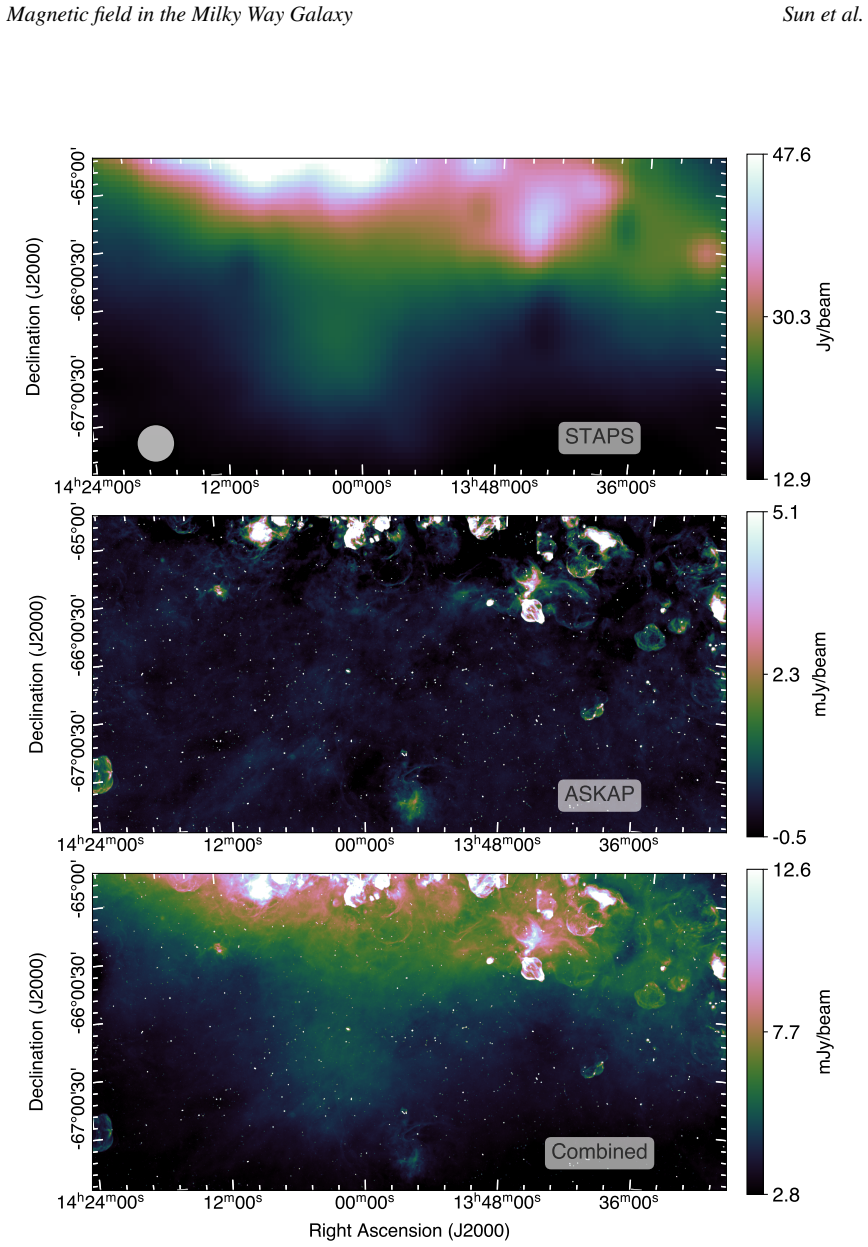
The Milky Way is the galaxy in which we can study its magnetic field to the finest details, providing an ideal laboratory to understand the fundamental questions: how magnetic field is generated and evolves, and how it influences other components in the Galaxy. An SKA-Mid polarization survey will produce an all-sky rotation measure (RM) grid with a density of about 100 per square degree, which is approximately two orders of magnitude larger than what is currently available, and produce total intensity, polarized intensity, and RM all-sky images of diffuse emission covering scales from about 10 arcseconds upward after combination with single-dish observations. The dense RM grid and images of diffuse emission will allow us to determine the most complete picture of the magnetic field in the southern Galactic hemisphere from large to small scales.
Editorial analysis
A structured set of objections, weighed in public.
Referee Report
Summary. The manuscript is a forward-looking perspective that describes the anticipated products of an SKA-Mid polarization survey and their implications for Milky Way magnetic-field studies. It states that the survey will deliver an all-sky RM grid at a density of ~100 sources per square degree (two orders of magnitude above current catalogs) together with total-intensity, polarized-intensity, and RM images of diffuse emission on scales from ~10 arcsec upward once combined with single-dish data. These products are projected to yield the most complete picture of the magnetic field in the southern Galactic hemisphere from large to small scales.
Significance. If the quoted survey specifications are realized, the resulting RM grid and diffuse-emission maps would provide a step-change in data density and angular-scale coverage for Galactic magnetism, enabling tighter constraints on field generation, evolution, and coupling to other ISM components across the southern sky. The manuscript correctly aligns its projections with publicly documented SKA survey plans and does not introduce new derivations or fitted parameters.
minor comments (1)
- [Abstract] Abstract: the quoted RM density and resolution figures would benefit from an explicit citation to the relevant SKA survey design documents or white papers so that readers can directly verify the numbers.
Simulated Author's Rebuttal
We thank the referee for their positive review of the manuscript and their recommendation to accept. The report contains no major comments requiring a point-by-point response.
Circularity Check
No circularity; forward-looking survey projection with no derivations
full rationale
The paper is a perspective piece describing anticipated SKA-Mid survey capabilities and their expected scientific impact on mapping the Galactic magnetic field. It contains no equations, no fitted parameters, no predictions derived from data, and no self-citations used to justify load-bearing claims. The central statement about obtaining the 'most complete picture' is an explicit forward-looking expectation, not a result obtained by reducing inputs to outputs via any chain. No steps match any of the enumerated circularity patterns.
Axiom & Free-Parameter Ledger
Reference graph
Works this paper leans on
-
[1]
doi: 10.1017/pasa.2021.4. B. D. Ball et al.MNRAS, 524(1):1396–1421, Sept
-
[2]
doi: 10.1093/mnras/stad1953. B. D. Ball et al.ApJ, 988(1):75, July
-
[3]
doi: 10.3847/1538-4357/addc63. R. Beck and B. M. Gaensler.New Astron. Rev., 48(11-12):1289–1304, Dec
-
[4]
Pattern Recognition132, 108894 (December 2022).https://doi.org/10.1016/j
doi: 10.1016/j. newar.2004.09.013. R. Beck, A. Shukurov, D. Sokoloff, and R. Wielebinski.A&A, 411:99–107, Nov
work page doi:10.1016/j 2004
-
[5]
doi: 10.1051/0004-6361:20031101. A. Berger et al.A&A, 693:A202, Jan
-
[6]
doi: 10.1051/0004-6361/202245733. F. Boulanger et al.JCAP, 2018(8):049, Aug
-
[7]
doi: 10.1088/1475-7516/2018/08/049. A. Bracco, M. Padovani, and D. Galli.A&A, 686:A52, June
-
[8]
doi: 10.1051/0004-6361/ 202449625. A. Brandenburg and E. Ntormousi.ARA&A, 61:561–606, Aug
-
[9]
M.A.BrentjensandA.G.deBruyn.A&A,441(3):1217–1228,Oct.2005
doi: 10.1146/ annurev-astro-071221-052807. M.A.BrentjensandA.G.deBruyn.A&A,441(3):1217–1228,Oct.2005. doi: 10.1051/0004-6361: 20052990. J. C. Brown and A. R. Taylor.ApJL, 563(1):L31–L34, Dec
-
[10]
doi: 10.1086/338358. B. J. Burn.MNRAS, 133:67, Jan
-
[11]
doi: 10.1093/mnras/133.1.67. E. Carretti et al.MNRAS, 489(2):2330–2354, Oct
-
[12]
doi: 10.1093/mnras/stz806. A. P. Curtin, J. M. Weisberg, and J. M. Rankin.ApJ, 975(2):217, Nov
-
[13]
doi: 10.3847/1538-4357/ac94ce. A. Erceg et al.A&A, 663:A7, July
-
[14]
doi: 10.1051/0004-6361/202142244. K. Ferrière and P. Terral.A&A, 561:A100, Jan
-
[15]
doi: 10.1051/0004-6361/201322966. B. M. Gaensler et al.ApJ, 549(2):959–978, Mar
-
[16]
doi: 10.1086/319468. B. M. Gaensler et al.Nature, 478(7368):214–217, Oct
-
[17]
doi: 10.1038/nature10446. B. M. Gaensler et al.PASA, 42:e091, June
-
[18]
doi: 10.1017/pasa.2025.10031. J. L. Han.ARA&A, 55(1):111–157, Aug
-
[19]
doi: 10.1146/annurev-astro-091916-055221. J. L. Han, R. N. Manchester, and G. J. Qiao.MNRAS, 306(2):371–380, June
-
[20]
doi: 10.1046/j. 1365-8711.1999.02544.x. J. L. Han, R. N. Manchester, W. van Straten, and P. Demorest.ApJSS, 234(1):11, Jan
work page doi:10.1046/j 1999
-
[21]
doi: 10.3847/1538-4365/aa9c45. M.Haverkorn. InA.Lazarian,E.M.deGouveiaDalPino,andC.Melioli,editors,MagneticFields in Diffuse Media, volume 407 ofAstrophysics and Space Science Library, page 483, Jan
-
[22]
doi: 10.1007/978-3-662-44625-6_17. M. Haverkorn, P. Katgert, and A. G. de Bruyn.A&A, 356:L13–L16, Apr
-
[23]
doi: 10.48550/ arXiv.astro-ph/0003260. M. Haverkorn, J. C. Brown, B. M. Gaensler, and N. M. McClure-Griffiths.ApJ, 680(1):362–370, June
-
[24]
doi: 10.1086/587165. M. Haverkorn et al. InAdvancing Astrophysics with the Square Kilometre Array (AASKA14), page 96, Apr
-
[25]
doi: 10.22323/1.215.0096. G. Heald et al.Galaxies, 8(3):53, July
-
[26]
doi: 10.3390/galaxies8030053. 20 Magnetic field in the Milky Way Galaxy Sun et al. T. Hoang and A. Lazarian.ApJ, 831(2):159, Nov
-
[27]
doi: 10.3847/0004-637X/831/2/159. T. Hoang and B. Truong.ApJ, 965(2):183, Apr
-
[28]
doi: 10.3847/1538-4357/ad2a56. A. Hopkins et al.PASA, 42:e071, May
-
[29]
doi: 10.1017/pasa.2025.10042. S. Hutschenreuter et al.A&A, 657:A43, Jan
-
[30]
doi: 10.1051/0004-6361/202140486. T. R. Jaffe.Galaxies, 7(2):52, Apr
-
[31]
doi: 10.3390/galaxies7020052. T. R. Jaffe et al.MNRAS, 401(2):1013–1028, Jan
-
[32]
doi: 10.1111/j.1365-2966.2009.15745.x. R. Jansson and G. R. Farrar.ApJL, 761(1):L11, Dec
-
[33]
doi: 10.1088/2041-8205/761/1/L11. S. Jiao et al.Science China Physics, Mechanics, and Astronomy, 65(9):299511, Sept
-
[34]
doi: 10.1007/s11433-021-1902-3. M.Johnston-Hollittetal. InAdvancingAstrophysicswiththeSquareKilometreArray(AASKA14), page 92, Apr
-
[35]
doi: 10.22323/1.215.0092. A. Khadir et al.ApJ, 977(2):276, Dec
-
[36]
doi: 10.3847/1538-4357/ad8ddf. J. Koda et al.PASP, 131(999):054505, May
-
[37]
doi: 10.1088/1538-3873/ab047e. M. Krause et al.A&A, 639:A112, July
-
[38]
doi: 10.1051/0004-6361/202037780. M. Lacy et al.PASP, 132(1009):035001, Mar
-
[39]
doi: 10.1088/1538-3873/ab63eb. A. Lazarian, K. H. Yuen, and D. Pogosyan.ApJ, 974(2):237, Oct
-
[41]
doi: 10.3847/1538-4357/ac09e4. D. Li et al.IEEE Microwave Magazine, 19(3):112–119, Apr
-
[42]
doi: 10.1109/MMM.2018. 2802178. F. Loi et al.A&A, 694:A125, Feb
-
[43]
doi: 10.1051/0004-6361/202451711. Y. K. Ma et al.MNRAS, 487(3):3432–3453, Aug
-
[44]
doi: 10.1093/mnras/stz1325. Y. K. Ma, S. A. Mao, A. Ordog, and J. C. Brown.MNRAS, 497(3):3097–3117, Sept
-
[45]
doi: 10.1093/mnras/staa2105. Y. K. Ma et al.MNRAS, 541(1):306–336, July
-
[46]
doi: 10.1093/mnras/staf1000. Y.K.Maetal. InAdvancingAstrophysicswiththeSKA–II(AASKAII).2026. arXivsearch: Report number AASKAII/Ma01. E. Maconi et al.A&A, 698:A84, June
-
[47]
doi: 10.1051/0004-6361/202451477. S. A. Mao et al.ApJ, 714(2):1170–1186, May
-
[48]
doi: 10.1088/0004-637X/714/2/1170. S. A. Mao et al.ApJ, 755(1):21, Aug
-
[49]
doi: 10.1088/0004-637X/755/1/21. S. A. Mao et al. InAdvancing Astrophysics with the SKA – II (AASKAII)
-
[50]
doi: 10.1093/mnrasl/ slv176. A. H. Minter and S. R. Spangler.ApJ, 458:194, Feb
-
[51]
doi: 10.1086/176803. S. K. Ocker and J. M. Cordes.arXiv e-prints, art. arXiv:2602.11838, Feb
work page internal anchor Pith review Pith/arXiv arXiv doi:10.1086/176803
-
[52]
doi: 10.48550/ arXiv.2602.11838. A. Ordog, J. C. Brown, R. Kothes, and T. L. Landecker.A&A, 603:A15, July
-
[53]
doi: 10.3847/1538-3881/adc929. A. Ordog et al.ApJSS, 282(2):53, Feb
-
[54]
doi: 10.3847/1538-4365/ae2471. S. P. O’Sullivan et al.MNRAS, 519(4):5723–5742, Mar
-
[55]
doi: 10.1093/mnras/stac3820. L. S. Oswald et al.MNRAS, 540(3):2112–2130, July
-
[56]
21 Magnetic field in the Milky Way Galaxy Sun et al
doi: 10.1093/mnras/staf645. 21 Magnetic field in the Milky Way Galaxy Sun et al. A. Pandhi et al.ApJ, 982(2):146, Apr
-
[57]
doi: 10.3847/1538-4357/adb8e3. K.Pattleetal. InS.Inutsukaetal.,editors,ProtostarsandPlanetsVII,volume534ofAstronomical Society of the Pacific Conference Series, page 193, July
-
[58]
doi: 10.48550/arXiv.2203.11179. V. Pelgrims, J. F. Macías-Pérez, and F. Ruppin.A&A, 652:A130, Aug
-
[59]
doi: 10.1051/0004-6361/201528033. A. Plunkett et al.PASP, 135(1045):034501, Mar
-
[60]
doi: 10.1088/1538-3873/acb9bd. I. Prandoni and N. Seymour. InAdvancing Astrophysics with the Square Kilometre Array (AASKA14), page 67, Apr
-
[61]
doi: 10.22323/1.215.0067. C.R.Purcelletal.RM-Tools: Rotationmeasure(RM)synthesisandStokesQU-fitting.Astrophysics Source Code Library, record ascl:2005.003, May
-
[62]
doi: 10.1051/0004-6361/202348993. U. Rau, N. Naik, and T. Braun.AJ, 158(1):3, July
-
[63]
doi: 10.3847/1538-3881/ab1aa7. C. J. Riseley et al.PASA, 37:e029, July
-
[64]
doi: 10.1017/pasa.2020.20. L. Rudnick and F. N. Owen.ApJ, 785(1):45, Apr
-
[65]
doi: 10.1088/0004-637X/785/1/45. D. H. F. M. Schnitzeler.MNRAS, 409(1):L99–L103, Nov
-
[66]
doi: 10.1111/j.1745-3933.2010. 00957.x. D. H. F. M. Schnitzeler et al.MNRAS, 485(1):1293–1309, May
-
[67]
doi: 10.1093/mnras/stz092. A. Seta and C. Federrath.MNRAS, 499(2):2076–2086, Dec
-
[68]
doi: 10.1093/mnras/staa2978. A. Seta and C. Federrath.MNRAS, 502(2):2220–2237, Apr
-
[69]
doi: 10.1093/mnras/stab128. A. M. Shukurov and K. Subramanian.Astrophysical Magnetic Fields: From Galaxies to the Early Universe
-
[70]
D.D.Sokoloffetal.MNRAS,299(1):189–206,Aug.1998.doi: 10.1046/j.1365-8711.1998.01782.x
doi: 10.1017/9781139046657. D.D.Sokoloffetal.MNRAS,299(1):189–206,Aug.1998.doi: 10.1046/j.1365-8711.1998.01782.x. J. M. Stil, A. R. Taylor, and C. Sunstrum.ApJ, 726(1):4, Jan
-
[71]
doi: 10.1088/0004-637X/726/ 1/4. K. Subramanian.Reports on Progress in Physics, 79(7):076901, July
-
[72]
doi: 10.1051/0004-6361/202453326. X.H.SunandW.Reich.A&A,507(2):1087–1105,Nov.2009.doi: 10.1051/0004-6361/200912539. X. H. Sun et al.A&A, 463(3):993–1007, Mar
-
[73]
doi: 10.1051/0004-6361:20066001. X. H. Sun, W. Reich, A. Waelkens, and T. A. Enßlin.A&A, 477(2):573–592, Jan
-
[74]
doi: 10.1051/0004-6361:20078671. X. H. Sun et al.ApJ, 811(1):40, Sept. 2015a. doi: 10.1088/0004-637X/811/1/40. X. H. Sun et al.AJ, 149(2):60, Feb. 2015b. doi: 10.1088/0004-6256/149/2/60. X.-H. Sun et al.Research in Astronomy and Astrophysics, 22(12):125011, Dec
-
[75]
doi: 10.1088/1674-4527/ac9d27. M. Tahani et al. InAdvancing Astrophysics with the SKA – II (AASKAII)
-
[76]
doi: 10.1093/mnras/stae169. A. J. M. Thomson et al.PASA, 40:e040, Aug
-
[77]
doi: 10.1017/pasa.2023.38. A. J. M. Thomson et al.arXiv e-prints, art. arXiv:2605.16917, May
work page internal anchor Pith review Pith/arXiv arXiv doi:10.1017/pasa.2023.38 2023
-
[78]
doi: 10.48550/arXiv. 22 Magnetic field in the Milky Way Galaxy Sun et al. 2605.16917. L. N. Tram and T. Hoang.Frontiers in Astronomy and Space Sciences, 9:923927, Oct
work page internal anchor Pith review Pith/arXiv arXiv doi:10.48550/arxiv
-
[79]
doi: 10.3389/fspas.2022.923927. B. Truong and T. Hoang.ApJ, 981(1):83, Mar
-
[80]
doi: 10.3847/1538-4357/adb423. M. Unger and G. R. Farrar.ApJ, 970(1):95, July
-
[81]
doi: 10.3847/1538-4357/ad4a54. C. L. Van Eck et al.ApJ, 728(2):97, Feb
discussion (0)
Sign in with ORCID, Apple, or X to comment. Anyone can read and Pith papers without signing in.