Temporal Dynamical Quantum Phase Transition in Dicke Model with Trapped Ions
Pith reviewed 2026-06-30 10:04 UTC · model grok-4.3
The pith
Trapped ions coupled to a motional mode realize temporal dynamical quantum phase transitions in the generalized Dicke model.
A machine-rendered reading of the paper's core claim, the machinery that carries it, and where it could break.
Core claim
Temporal non-analyticities in the rate function of the Loschmidt echo are observed in the quench dynamics of a generalized Dicke model implemented with trapped ions, showing quantitative agreement with theoretical predictions for both symmetric and asymmetric initial states, and the effects of spin dissipation are characterized.
What carries the argument
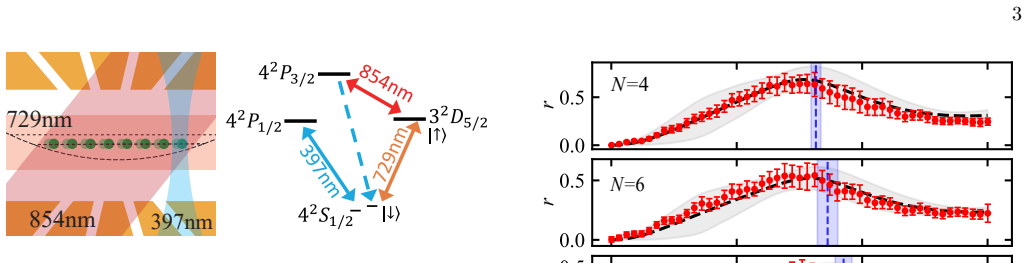
The generalized Dicke Hamiltonian realized by coupling a linear chain of 40Ca+ ions to the collective center-of-mass motional mode, with the rate function of the Loschmidt echo serving as the indicator of dynamical quantum phase transitions.
If this is right
- DQPTs occur in asymmetric spin subspaces in addition to symmetric ones.
- Spin dissipation influences the observed dynamics but does not eliminate the non-analytic features.
- The trapped-ion platform enables study of complex out-of-equilibrium phenomena in spin-boson systems.
Where Pith is reading between the lines
- This setup could be extended to probe DQPTs in other spin-boson models beyond the Dicke case.
- Quantitative agreement suggests the simulator can be used to test theoretical predictions in regimes hard to access classically.
Load-bearing premise
The trapped-ion chain coupled to the center-of-mass mode accurately realizes the generalized Dicke Hamiltonian without dominant uncontrolled experimental errors or deviations that would alter the observed non-analyticities.
What would settle it
A measurement of the rate function showing no temporal turn-around points or significant deviation from the predicted times of non-analyticities would falsify the claim of observing the DQPTs.
Figures
read the original abstract
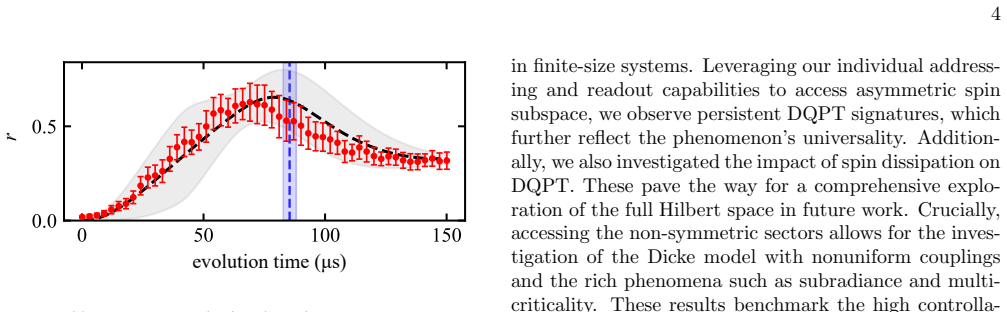
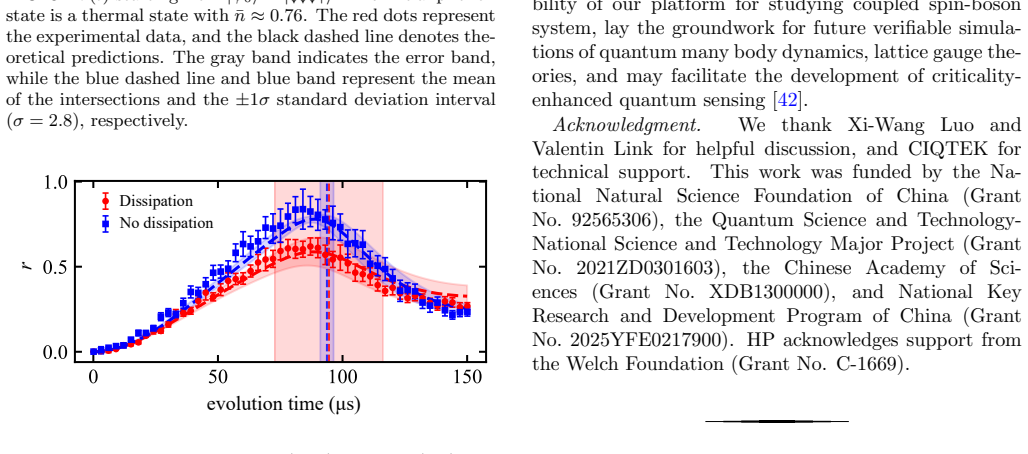
Temporal non-analyticities in the rate function of the Loschmidt echo manifests a class of dynamical quantum phase transitions (DQPTs) that has emerged as a powerful framework for understanding far-from-equilibrium many-body dynamics. While such DQPT has been extensively studied theoretically in spin-boson systems such as the Dicke model, their experimental observation remains elusive. In particular, the dynamics of DQPT in asymmetric spin subspaces and under the influence of spin dissipation are largely unexplored. Here, we report an experimental study of temporal DQPT in a generalized Dicke model using a trapped-ion quantum simulator. By coupling a linear chain of $\rm{^{40}Ca^{+}}$ ions to a collective center-of-mass motional mode, we probe the quench dynamics starting from both symmetric and asymmetric initial states. We extract the rate function and identify temporal turn-around points that are in quantitative agreement with theoretical predictions. Additionally, we investigate the impact of spin dissipation on these dynamics. Our results establish an experimental platform for probing complex many-body out-of-equilibrium phenomena and advance the development of hybrid oscillator-spin quantum simulators.
Editorial analysis
A structured set of objections, weighed in public.
Referee Report
Summary. The paper reports an experimental realization of temporal dynamical quantum phase transitions (DQPTs) via non-analyticities in the Loschmidt-echo rate function I(t) = −log|L(t)| in a generalized Dicke model. Using a linear chain of 40Ca+ ions coupled to the center-of-mass motional mode, the authors quench from both symmetric and asymmetric initial spin states, extract the rate function, identify temporal turn-around points claimed to agree quantitatively with theory, and examine the effect of spin dissipation.
Significance. If the mapping to the target Hamiltonian is accurate enough to preserve the non-analytic points and the quantitative agreement survives a full accounting of documented ion-trap imperfections, the result would constitute a notable experimental platform for DQPTs in spin-boson systems, particularly the previously unexplored asymmetric-subspace and dissipative cases.
major comments (1)
- [Abstract] The central claim of quantitative agreement between observed turn-around points and theory (Abstract) rests on the assumption that the trapped-ion chain + COM mode realizes the generalized Dicke Hamiltonian with errors small enough not to round or shift the non-analyticities in I(t). The manuscript must demonstrate, with explicit error budgets or simulations that fold in Lamb-Dicke deviations, residual micromotion, laser drift, and motional heating, that these imperfections do not alter the locations of the reported temporal non-analytic points for both symmetric and asymmetric subspaces.
minor comments (1)
- Clarify the precise definition and extraction procedure for the rate function I(t) and the criterion used to identify turn-around points.
Simulated Author's Rebuttal
We thank the referee for the careful reading of our manuscript and for the constructive major comment. We address the point below and agree that additional analysis is warranted to support the central claim.
read point-by-point responses
-
Referee: [Abstract] The central claim of quantitative agreement between observed turn-around points and theory (Abstract) rests on the assumption that the trapped-ion chain + COM mode realizes the generalized Dicke Hamiltonian with errors small enough not to round or shift the non-analyticities in I(t). The manuscript must demonstrate, with explicit error budgets or simulations that fold in Lamb-Dicke deviations, residual micromotion, laser drift, and motional heating, that these imperfections do not alter the locations of the reported temporal non-analytic points for both symmetric and asymmetric subspaces.
Authors: We acknowledge that the current version of the manuscript does not contain an explicit, comprehensive error budget or set of simulations that fold in all the listed imperfections (Lamb-Dicke deviations, residual micromotion, laser drift, and motional heating) and explicitly verify that they leave the reported turn-around points unchanged. This is a fair and important criticism of the central claim. In the revised manuscript we will add a dedicated subsection (in the main text or supplementary material) that provides quantitative error budgets for each imperfection together with numerical simulations of the Loschmidt-echo rate function under the perturbed Hamiltonian. These simulations will confirm that the locations of the temporal non-analyticities remain unaltered within the experimental uncertainty for both the symmetric and asymmetric subspaces. revision: yes
Circularity Check
No circularity: experimental measurements compared to external theory
full rationale
This is an experimental observation paper. The central claims rest on measured Loschmidt-echo rate functions and turn-around points extracted from trapped-ion quench dynamics, compared against theoretical predictions. No derivation chain, fitted-parameter prediction, or self-citation load-bearing step is described; the mapping to the generalized Dicke Hamiltonian is presented as a physical realization whose fidelity is an empirical question, not a mathematical reduction internal to the paper's equations.
Axiom & Free-Parameter Ledger
Reference graph
Works this paper leans on
-
[1]
Polkovnikov, K
A. Polkovnikov, K. Sengupta, A. Silva, and M. Vengalat- tore, Rev. Mod. Phys.83, 863 (2011)
2011
-
[2]
Eisert, M
J. Eisert, M. Friesdorf, and C. Gogolin, Nat. Phys.11, 124 (2015)
2015
-
[3]
Heyl, Rep
M. Heyl, Rep. Prog. Phys.81, 054001 (2018)
2018
-
[4]
M. Heyl, A. Polkovnikov, and S. Kehrein, Phys. Rev. Lett.110, 135704 (2013)
2013
-
[5]
Jurcevic, H
P. Jurcevic, H. Shen, P. Hauke, C. Maier, T. Brydges, C. Hempel, B. P. Lanyon, M. Heyl, R. Blatt, and C. F. Roos, Phys. Rev. Lett.119, 080501 (2017)
2017
-
[6]
Sciolla and G
B. Sciolla and G. Biroli, Phys. Rev. Lett.105, 220401 (2010)
2010
-
[7]
Klinder, H
J. Klinder, H. Keßler, M. Wolke, L. Mathey, and A. Hem- merich, Proc. Natl. Acad. Sci. U.S.A.112, 3290 (2015)
2015
-
[8]
Zhiqiang, C
Z. Zhiqiang, C. H. Lee, R. Kumar, K. J. Arnold, S. J. Masson, A. S. Parkins, and M. D. Barrett, Optica4, 424 (2017)
2017
-
[9]
Link and W
V. Link and W. T. Strunz, Phys. Rev. Lett.125, 143602 (2020)
2020
-
[10]
Fl¨ aschner, D
N. Fl¨ aschner, D. Vogel, M. Tarnowski, B. S. Vermersch, D. S. W¨ ullner, K. Sengstock, M. Heyl, and C. Weiten- berg, Nat. Phys.14, 265 (2018)
2018
-
[11]
T. Tian, Y. Ke, L. Zhang, S. Lin, Z. Shi, P. Huang, C. Lee, and J. Du, Phys. Rev. B100, 024310 (2019)
2019
-
[12]
Kirton, M
P. Kirton, M. M. Roses, J. Keeling, and E. G. Dalla Torre, Adv. Quantum Technol.2, 1800043 (2019). 5
2019
-
[13]
Hybrid Oscillator-Qubit Quantum Processors: Simulating Fermions, Bosons, and Gauge Fields,
E. Crane, K. C. Smith, T. Tomesh, A. Eickbusch, J. M. Martyn, S. K¨ uhn, L. Funcke, M. A. DeMarco, I. L. Chuang, N. Wiebe,et al., Hybrid oscillator-qubit quan- tum processors: Simulating fermions, bosons, and gauge fields, arXiv:2409.03747
-
[14]
Giustino, Rev
F. Giustino, Rev. Mod. Phys.89, 015003 (2017)
2017
-
[15]
T. Ritz, A. Damjanovi´ c, and K. Schulten, ChemPhysChem3, 243 (2002)
2002
-
[16]
K. Sun, M. Kang, H. Nuomin, G. Schwartz, D. N. Be- ratan, K. R. Brown, and J. Kim, Nat. Commun.16, 4042 (2025)
2025
-
[17]
K. Kaur, T. S´ epulcre, N. Roch, I. Snyman, S. Florens, and S. Bera, Physical Review Letters127, 237702 (2021)
2021
-
[18]
Baumann, C
K. Baumann, C. Guerlin, F. Brennecke, and T. Esslinger, Nature464, 1301 (2010)
2010
-
[19]
X. Chen, Z. Wu, M. Jiang, X.-Y. L¨ u, X. Peng, and J. Du, Nat. Commun.12, 6281 (2021)
2021
-
[20]
Z. Wu, C. Hu, T. Wang, Y. Chen, Y. Li, L. Zhao, X.-Y. L¨ u, and X. Peng, Phys. Rev. Lett.133, 173602 (2024)
2024
-
[21]
Leibfried, R
D. Leibfried, R. Blatt, C. Monroe, and D. Wineland, Rev. Mod. Phys.75, 281 (2003)
2003
-
[22]
Safavi-Naini, R
A. Safavi-Naini, R. J. Lewis-Swan, J. G. Bohnet, M. G¨ arttner, K. A. Gilmore, J. E. Jordan, J. Cohn, J. K. Freericks, A. M. Rey, and J. J. Bollinger, Phys. Rev. Lett. 121, 040503 (2018)
2018
-
[23]
B. Bullock, S. R. Muleady, J. F. Lilieholm, Y. Zhang, A. Safavi-Naini, R. J. Lewis-Swan, J. J. Bollinger, A. M. Rey, and A. L. Carter, Quantum simulation of the dicke model in a two-dimensional ion crystal: chaos, quantum thermalization, and revivals, arXiv:2602.06114
-
[24]
S.-A. Guo, J. Ye, J.-Y. Tan, Z.-W. Zhang, L. Zhang, Y.-Y. Chen, Y.-L. Xu, C. Zhang, Y. Jiang, B.-X. Qi, et al., Quantum simulation of thermalization dynamics of a nonuniform dicke model, arXiv:2603.27627
work page internal anchor Pith review Pith/arXiv arXiv
-
[25]
Guo, Y.-K
S.-A. Guo, Y.-K. Wu, J. Ye, L. Zhang, W.-Q. Lian, R. Yao, Y. Wang, R.-Y. Yan, Y.-J. Yi, Y.-L. Xu,et al., Nature630, 613 (2024)
2024
-
[26]
Mivehvar, Phys
F. Mivehvar, Phys. Rev. Lett.132, 073602 (2024)
2024
-
[27]
Xu, F.-X
Y. Xu, F.-X. Sun, W. Zhang, Q. He, and H. Pu, Phys. Rev. Lett.133, 233604 (2024)
2024
-
[28]
Boneberg, I
M. Boneberg, I. Lesanovsky, and F. Carollo, Phys. Rev. A106, 012212 (2022)
2022
-
[29]
H¨ affner, C
H. H¨ affner, C. F. Roos, and R. Blatt, Phys. Rep.469, 155 (2008)
2008
-
[30]
J. I. Cirac and P. Zoller, Phys. Rev. Lett.74, 4091 (1995)
1995
-
[31]
Mølmer and A
K. Mølmer and A. Sørensen, Phys. Rev. Lett.82, 1835 (1999)
1999
-
[32]
Porras and J
D. Porras and J. I. Cirac, Phys. Rev. Lett.92, 207901 (2004)
2004
-
[33]
Lamata, J
L. Lamata, J. Le´ on, T. Sch¨ atz, and E. Solano, Phys. Rev. Lett.98, 253005 (2007)
2007
-
[34]
J. S. Pedernales, I. Lizuain, S. Felicetti, G. Romero, L. Lamata, and E. Solano, Sci. Rep.5, 15472 (2015)
2015
-
[35]
J. Cohn, A. Safavi-Naini, R. J. Lewis-Swan, J. G. Bohnet, M. G¨ arttner, K. A. Gilmore, J. E. Jordan, A. M. Rey, J. J. Bollinger, and J. K. Freericks, New J. Phys.20, 055013 (2018)
2018
-
[36]
M. Gegg, A. Carmele, A. Knorr, and M. Richter, New J. Phys.20, 013006 (2018)
2018
-
[37]
Verstraete, M
F. Verstraete, M. M. Wolf, and J. I. Cirac, Nat. Phys.5, 633 (2009)
2009
-
[38]
M¨ uller, S
M. M¨ uller, S. Diehl, G. Pupillo, and P. Zoller, Adv. At. Mol. Opt. Phys.61, 1 (2012)
2012
-
[39]
ˇZunkoviˇ c, M
B. ˇZunkoviˇ c, M. Heyl, M. Knap, and A. Silva, Phys. Rev. Lett.120, 130601 (2018)
2018
-
[40]
J. C. Halimeh, N. Mueller, J. Knolle, Z. Papi´ c, and Z. Davoudi, Quantum simulation of out-of-equilibrium dynamics in gauge theories, arXiv:2509.03586
work page internal anchor Pith review Pith/arXiv arXiv
-
[41]
T. V. Zache, N. Mueller, J. T. Schneider, F. Jendrze- jewski, J. Berges, and P. Hauke, Phys. Rev. Lett.122, 050403 (2019)
2019
-
[42]
Y. Chu, S. Zhang, B. Yu, and J. Cai, Phys. Rev. Lett. 126, 010502 (2021)
2021
-
[43]
Gamel and D
O. Gamel and D. F. V. James, Phys. Rev. A82, 052106 (2010)
2010
-
[44]
Cai, Z.-D
M.-L. Cai, Z.-D. Liu, W.-D. Zhao, Y.-K. Wu, Q.-X. Mei, Y. Jiang, L. He, X. Zhang, Z.-C. Zhou, and L.-M. Duan, Nat. Commun.12, 1126 (2021)
2021
-
[45]
D. J. Wineland, C. Monroe, W. M. Itano, D. Leibfried, B. E. King, and D. M. Meekhof, J. Res. Natl. Inst. Stand. Technol.103, 259 (1998)
1998
-
[46]
Reiter and A
F. Reiter and A. S. Sørensen, Phys. Rev. A85, 032111 (2012). 6 Supplemental Materials for: Temporal Dynamical Quantum Phase Transition in Dicke Model with Trapped Ions Ji Bian,1,∗ Wei Wu,1,∗ Zihan Xie,1,2 Mengxiang Zhang,3 Yi Li,1,2,4 Yue Li,1 Rixin Yao,1,5 Yuqi Zhou,1,2 Xu Cheng,1,2 Han Pu,6,† and Yiheng Lin 1,2,5,‡ 1Laboratory of Spin Magnetic Resonance...
2012
-
[47]
Following initial state preparation, measure the blue-sideband (BSB) oscillations after waiting times of 0, 100, 300, and 500µs, respectively
-
[48]
For each measured curve, heating causes signifi- cant distortion at long evolution times, whereas the early-time evolution closely approximates a case where heating is negligible. Therefore, the first quarter of each curve is fitted using a thermal phonon distribution model, without a heating rate, to extract the approximate mean phonon number for differe...
-
[49]
This generates a new set of basis curves, such that the BSB evolution curve of a mixed phonon state can be represented as a weighted sum of these basis
Substitute this estimated heating rate into the mas- ter equation of the BSB oscillations to calculate the evolution of individual Fock states under heating. This generates a new set of basis curves, such that the BSB evolution curve of a mixed phonon state can be represented as a weighted sum of these basis
-
[50]
This yields a new set of mean phonon numbers and a refined heating rate
Extend the fitting range by an additional quarter and use the newly obtained basis curves to fit the data for different waiting times. This yields a new set of mean phonon numbers and a refined heating rate
-
[51]
Continue this process until the heating rate converges: specifically, until the difference of rrr N=4 N=6 N=8 evolution time (μs) FIG
Iteratively repeat steps 3 and 4 while progressively expanding the data window until the entire dataset is covered. Continue this process until the heating rate converges: specifically, until the difference of rrr N=4 N=6 N=8 evolution time (μs) FIG. S4. Theoreticalr(black dashed lines) corresponding to N= 4,6,8 in the main text, and representativer + (re...
-
[52]
Obtain the average phonon number of the initial phonon state
Fit the BSB oscillation data with zero waiting time, using the above estimated heating rate and the corresponding basis curves. Obtain the average phonon number of the initial phonon state. The heating rates are fitted to be{3009±349,5547± 947,8415±1482,1032±164}phonons/s, corresponding to cases of 4 ions in Fig.2 and|↓↓↓↑⟩(sharing the same heat- 9 r evol...
discussion (0)
Sign in with ORCID, Apple, or X to comment. Anyone can read and Pith papers without signing in.