REVIEW 1 major objections 9 minor 18 references
Connection between the winding number and the Chern number
T0 review · 1 major / 9 minor · reviewed 2026-08-14 · deepseek-v4-flash
Pith's one-line read The 2D Chern number of a QWZ-type insulator equals the difference between the 1D winding numbers along the two chiral-symmetric momentum lines.
desk verdict The core identity is a known result, the proof has a fixable parity error, and the extended-QWZ verification misapplies the winding classification to negative hoppings; the first half is a useful expository treatment. read the letter →
The pith
A machine-rendered reading of the paper's core claim, the machinery that carries it, and where it could break.
The reading
What carries the argument
The load-bearing object is the half-Brillouin-zone integral of the Berry curvature, converted by Stokes' theorem into the difference of Zak phases $\gamma(p_2)=\int_0^{2\pi} dp_1\,\langle p,-|i\partial_1|p,-\rangle$. On the two chiral-symmetric lines $p_2=0$ and $p_2=\pi$, where $h_3=0$, the Zak phase is quantized as $\gamma=\pi\nu$, and the evenness of the Berry curvature in $p_2$ makes the strip integral equal to $C/2$; combining these steps yields $\nu(0)-\nu(\pi)=C$. For the extended SSH side, the argument uses the factorization $h(p)=t_2(e^{ip}-s_1)(e^{ip}-s_2)$: winding numbers are read off from which roots $s_i$ lie inside the unit circle, and edge-state counts follow from the normalizability condition $|s_i|<1$ for chiral zero modes.
What would settle it
Numerically integrate the Berry curvature on a discretized Brillouin zone for the extended QWZ model, sweep $(\bar{t}_0,\bar{t}_1,\bar{t}_2)$ through the regions in Eqs. (77)-(81), and compare the resulting Chern number with $\nu(0)-\nu(\pi)$ computed from the root locations of the two associated 1D chains; the identity stands if they agree everywhere. A sharper test is to use a two-band model with $h_3=m+\sin p_2$ at $m\ne 0$, where the chiral-symmetric lines are not at $p_2=0,\pi$ and the curvature need not be even, and check whether any two-line generalization still reproduces the numerically exact Chern number.
Extended reading notes
Core claim
The paper's central result is the identity $\nu(0)-\nu(\pi)=C$, connecting the 2D Chern number of a two-band Chern insulator to a difference of 1D winding numbers. The derivation integrates the Berry curvature over the momentum strip $0\le p_2\le \pi$, $0\le p_1<2\pi$; because the curvature is even in $p_2$ for the models considered, the strip integral is $C/2$, and Stokes' theorem converts it into $\gamma(0)-\gamma(\pi)$, the difference of Zak phases. On the lines $p_2=0$ and $p_2=\pi$ the chiral symmetry is restored ($h_3=0$), so each Zak phase is quantized to $\pi$ times a winding number, giving the identity. The paper verifies the relation for the QWZ model and for an extended QWZ model with next-nearest-neighbor hopping, and provides phase diagrams with Chern numbers from $-2$ to $2$. Its companion claim is that finite SSH and extended SSH chains obey bulk-edge correspondence only when the unit cell is chosen consistently with each boundary; the corresponding winding numbers $\nu$ and $1-\nu$ predict the edge-state counts on the left and right edges, as confirmed numerically and applied to zigzag and armchair carbon nanotubes.
Load-bearing premise
The identity $\nu(0)-\nu(\pi)=C$ depends on the Berry curvature being even in $p_2$ and on chiral symmetry being restored along the two lines $p_2=0$ and $p_2=\pi$ so that the Zak phases quantize; in the models studied this follows from $h_3=\sin p_2$, but a generic two-band Chern insulator need not satisfy either condition, and then the simple difference formula can fail.
Editorial extensions
If this is right
- The Chern number of QWZ-type insulators can be determined from the 1D winding numbers along the two chiral-symmetric momentum lines, giving a direct construction principle for Chern insulators from 1D topological chains.
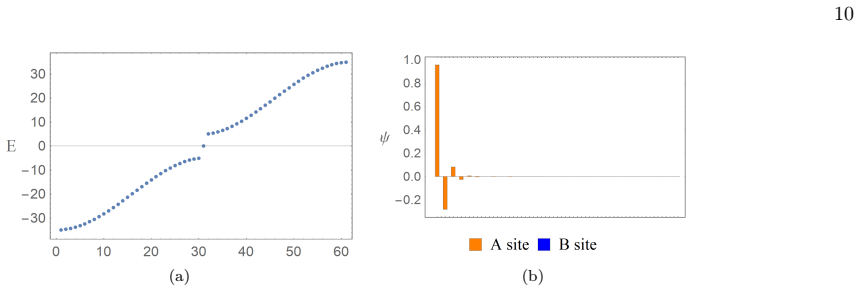
- For a finite SSH chain with an odd number of sites, the single edge state is explained: the left and right boundaries correspond to different unit-cell conventions, with winding numbers $\nu$ and $1-\nu$ predicting the edge-state counts.
- For extended SSH models, winding numbers can be $2$, $1$, $0$, or $-1$, and finite chains show matching numbers of edge states on each boundary, including exact zero-energy modes when the two boundary windings differ.
- Edge states in carbon nanotubes are boundary-sensitive: zigzag versus zigzag-beard and armchair versus armchair-beard terminations are distinguished by the winding numbers of the effective 1D chains, predicting where edge states appear.
- A generalized form of the identity holds when two lines $p_{2A}$ and $p_{2B}$ restore chiral symmetry, expressing $C$ through winding numbers at those lines; the paper expects analogous differences to relate Weyl points to 2D Chern numbers in three dimensions.
Reading between the lines
- This suggests a practical numerical shortcut: in any two-band model with chiral-symmetric slices, the Chern number can be computed from 1D winding numbers on those slices, avoiding gauge fixing over the full Brillouin zone.
- The same half-strip logic might transfer to Floquet topological insulators, where two time-slices or quasienergy gaps play the role of the chiral lines, yielding a similar difference formula.
- The boundary-dependent unit-cell rule means bulk-edge correspondence attaches to the chosen termination, not just to the infinite Hamiltonian; automatically generated tight-binding models with dangling bonds may need explicit boundary-aware winding numbers.
- Photonic or cold-atom simulators of the SSH/QWZ family could test the finite-chain predictions by counting edge states on each boundary as hoppings are tuned across the $\nu=2$, $\nu=1$, and $\nu=-1$ regimes.
Signed reviews
Editorial analysis
A structured set of objections, weighed in public.
Referee Report
Summary. This paper addresses two related questions in the topological-insulator literature. Section II studies the bulk-edge correspondence for finite chains of the SSH and extended SSH models with nearest- and next-nearest-neighbor hoppings. The authors show that the apparent ambiguity of the 1D winding number under unit-cell redefinitions is resolved when the unit cell is chosen consistently with each boundary: the winding numbers of the two boundary-adapted unit cells predict the numbers of edge states on the two edges of a finite chain. The counting is verified numerically for winding numbers up to 2, including an odd-length chain with left/right winding numbers 2 and -1, and is applied to predict which carbon-nanotube edges support edge states. Section III promotes the SSH/Rice-Mele models to the QWZ model by interpreting the pumping parameter as p2 and derives the identity nu(0)-nu(pi)=C (Eq. (68)) relating the 1D winding numbers on the chiral-symmetric lines p2=0 and p2=pi to the 2D Chern number. The derivation integrates the Berry curvature over the strip 0<=p2<=pi, uses its evenness in p2 to identify the strip integral with pi*C, applies Stokes' theorem in a single gauge patch, and uses the Zak-phase quantization gamma=pi*nu on the two lines. An extended QWZ model with next-nearest-neighbor hopping is then analyzed, with Chern numbers ranging from -2 to 2, and the consistency of the Chern-number phase diagrams with the winding-number formulas is claimed.
Significance. If correct, Eq. (68) is a clean, testable bridge between a 1D winding-number invariant and the 2D Chern number, and the boundary-adapted unit-cell analysis gives a practical resolution of the unit-cell ambiguity in finite-chain bulk-edge correspondence. Strengths include an analytic derivation of Eq. (68) with explicit gauge-patch bookkeeping, numerical verification of the edge-state counting in the extended SSH model, concrete falsifiable predictions for carbon-nanotube edge states, and a substantive application to the extended QWZ phase diagrams (77)-(81). I also checked the parity step directly: for h=(x+cos p2+cos p1, sin p1, sin p2) each nonzero term of the Berry-curvature numerator is even in p2 (the term containing h3=sin p2 multiplies it by sin^2 p2), and 2*omega^3 is even, so the reviewer's parity objection does not land; the same term-by-term argument applies to Eq. (72). The main defect is that the auxiliary formulas (73)-(74) silently extend a classification derived for t2>0 to negative t2, where they produce wrong values; this breaks the claimed consistency check for the extended QWZ model in a whole parameter region.
major comments (1)
- [Sec. III, Eqs. (73)-(74); claim after Eq. (81)] The winding-number classification of Eqs. (25)-(34) was derived under the explicit assumption t1, t2 > 0 ('Without lost of generality, we may make t1 and t2 positive', Eq. (25)), but Eqs. (73)-(74) apply it to arbitrary t2 without stating any restriction. The conditions are not sign-robust: for (t0,t1,t2) = (-2, 1, -1.5), Eq. (73) gives nu(0)=0 via its third branch, whereas h(p1,0) = -1 + e^{ip1} - 1.5 e^{2ip1} = -1.5 (z - r1)(z - r2) has |r1|^2 = |r2|^2 = 2/3 < 1, so the true winding number is nu(0)=2. Consequently, the statement that the results in Eqs. (77)-(81) 'are consistent with those in Eqs. (73) and (74)' is false as written for t2 < 0, and the extended-QWZ demonstration of Eq. (68) is incomplete in that regime. The repair is local: the ellipse-orientation argument of Eqs. (31)-(34) gives nu=2 when |t2+t0|>t1 and t2^2>t0^2, nu=0 when |t2+t0|>t1 and t2^2<t0^2, and nu=1 when |t2+t0|<t1 (for t1>0 and arbitrary-sign t0, t2); Eqs. (73)-(74) should be restated with these conditions and the consistency check repeated. I note that with the corrected values the identity (68) still holds in the counterexample (nu(0)=2, nu(pi)=0, and C=2 from the t2 < -t1/2 sector of the phase diagram), so the central claim is not in question.
minor comments (9)
- [Sec. III, before Eq. (66)] The statement that the Berry curvature is even in p2 is correct for the vectors in Eqs. (57) and (72), but it is asserted without proof; since terms such as h3 (d1h x d2h)_3 = cos p1 sin^2 p2 appear in the numerator, the parity is not obvious at a glance, and a one-line term-by-term demonstration (numerator and 2*omega^3 both even) would make the step self-contained.
- [Sec. III, before Eq. (66)] With the normalization C = (1/2pi) integral_BZ B in Eq. (58), the integral of the curvature over the half-strip 0<=p2<=pi equals pi*C, not C/2; the subsequent equation gamma(0)-gamma(pi)=pi*C is consistent only with pi*C, so 'C/2' appears to be a typo.
- [Eq. (74)] The third branch of Eq. (74) reads t2 - |t0 + 1| < 0, but comparison with Eq. (73) and with t0(pi) = t0 - 1 shows it should read t2 - |t0 - 1| < 0.
- [Paragraph after Eq. (81)] 'We may still relate it to the 1D winding numbers at p2A and p2A' should read 'at p2A and p2B'.
- [Abstract] The momentum strip is described as '0 <= p1 2pi', which is missing a relation symbol and should read 0 <= p1 < 2pi, and 'we show a identity' should be 'we show an identity'.
- [Sec. II, Eq. (25)] 'Without lost of generality' should be 'Without loss of generality', and 'through out the paper' should be 'throughout'; the paper should also flag explicitly at Eqs. (73)-(74) that the classification conditions are sign-sensitive in t2, which is the source of the error discussed in the major comment.
- [Sec. III, Eqs. (82)-(83)] As printed, these equations give C = C_I + C_II = 0 if nu_I and nu_II are both read as the same winding number; the text presumably intends nu_I and nu_II to be winding numbers in the two unit-cell/gauge conventions (with nu_I = -nu_II), but this is never stated, and the sign conventions should be checked and spelled out.
- [Sec. III, after Eq. (81)] The generalization is conditional on the existence of two chiral-symmetric lines p2A and p2B on which the gauge patches are well defined; this is acknowledged in the text but deserves more prominence, since for a generic h3 without two such zero-lines no simple difference formula is claimed.
- [References] Reference [13] is a course-note URL; a standard textbook or review reference for the two-gauge-patch construction of the Chern number would be more appropriate for a journal publication.
Circularity Check
No significant circularity: the central Chern/winding identity is derived from Berry curvature and verified by direct computation; the one self-citation is non-load-bearing.
full rationale
The central result, Eq. (68), is not an input in disguise. It is derived by integrating the Berry curvature over the momentum strip, applying Stokes' theorem to obtain γ(0)-γ(π)=πC, and then using the independent quantization γ=πν on the chiral-symmetric lines p2=0 and p2=π. The extended-QWZ verification computes C directly from the vorticities and signs of the rotated off-diagonal function at its zeroes, while ν(0) and ν(π) are computed independently from the 1D winding formulas for the corresponding extended SSH polynomials; the two sides are therefore evaluated from separate constructions rather than by fitting or definition. Section II contains numerical checks of edge-state predictions against winding numbers, with no fitted parameter renamed as a prediction. The only self-citation is Ref. [8] (H. C. Kao), used for the characteristic-equation condition for chiral zero modes; that condition also follows from the recurrence relations written in the manuscript and is not the target result, so it is not load-bearing. The paper also states its own generalization limitation after Eq. (81), requiring the existence of chiral-symmetric lines p2A and p2B. A possible proof defect is the assertion that the Berry curvature is even in p2 when only its p1-integral is even; this is a technical repair issue rather than a circular reduction. No step equates the claimed identity to its own conclusion by construction.
Assumptions & free parameters
assumptions (3)
- domain assumption Zak phase quantization: on a 1D chiral-symmetric line h3=0, the Zak phase equals π times the winding number modulo 2π.
- standard math Stokes theorem on the Berry connection with two gauge patches captures the Chern number through boundary contributions.
- domain assumption Chiral zero modes of the extended SSH model correspond to roots of t0+t1 s+t2 s^2=0 with |s|<1.
Cite this review
Pith. "Pith review of Connection between the winding number and the Chern number." pith.science (2026). https://pith.science/paper/2VGQZEXB
@misc{pith2026190806700,
  author       = {Pith},
  title        = {Pith review of: Connection between the winding number and the Chern number},
  year         = {2026},
  howpublished = {\url{https://pith.science/paper/2VGQZEXB}},
  note         = {Machine review of arXiv:1908.06700}
}
abstract
Bulk-edge correspondence is one of the most distinct properties of topological insulators. In particular, the 1D winding number $\n$ has a one-to-one correspondence to the number of edge states in a chain of topological insulators with boundaries. By properly choosing the unit cells, we carry out numerical calculation to show explicitly in the extended SSH model that the winding numbers corresponding to the left and right unit cells may be used to predict the numbers of edge states on the two boundaries in a finite chain. Moreover, by drawing analogy between the SSH model and QWZ model, we show that the extended SSH model may be generalized to the extended QWZ model. By integrating the ``magnetic field'' over the momentum strip $0\le p_2 \le \pi, 0\le p_1 2\pi$ in the Brillouin zone, we show a identity relating the 2D Chern number and the difference between the 1D winding numbers at $p_2=0 $ and $p_2 =\pi$.
Figures


Figures from the paper (9 more)





Reference graph
Works this paper leans on
-
[1]
M. Z. Hasan and C. L. Kane, Rev. Mod. Phy.,82, (2010); X.-L. Qi and S.-C. Zhang, Rev. Mod. Phy.,83, (2011)
work page 2010
-
[2]
W. P. Su, J. R. Schrieffer, and A. J. Heeger, Phys. Rev. Lett.42, 1698, (1979)
work page 1979
-
[3]
These two wave functions are related by a phase factor:|p,−⟩II =e−iφ(p)|p,−⟩I, where,φ(p) = arg(h)
In gaugeI, the wave functions|p,−⟩I is not well-defined at the north pole whereh = 0 and h3 is positive; while in gaugeII, the wave function|p,−⟩II is not well-defined at the south pole whereh = 0 and h3 is negative. These two wave functions are related by a phase factor:|p,−⟩II =e−iφ(p)|p,−⟩I, where,φ(p) = arg(h). When the system is in the topological phas...
-
[4]
J. K. Asboth, L. Oroszlany, and A. Palyi, arXiv:1509.02295
-
[5]
Thouless, Quantization of particle transport
D.J. Thouless, Quantization of particle transport. Phys. Rev. B27, 6083–6087 (1983)
work page 1983
-
[6]
R. D. King-Smith and D. Vanderbilt, Phys. Rev. B47, 1651 (1993); D. Vanderbilt and R. D. King-Smith, Phys. Rev. B 48, 4442 (1993)
work page 1993
- [7]
-
[8]
J.-W. Rhim, J. Behrends, and J. H. Bardarson, Phys. Rev. B95, 035421 (2017)
work page 2017
Show all 18 references
-
[9]
H. C. Kao, Phys. Rev. B90, 245435 (2014)
2014
-
[10]
L. E. F. Foa Torres, S. ROCHE, and J.-C. Charlier,Introduction to Graphene-Based Nanomaterials From Electronic Structure to Quantum Transport (Cambridge university press 2014)
2014
- [11]
-
[12]
R. S. K. Mong and V. Shivamoggi Phys. Rev. B83, 125109 (2011)
2011
-
[13]
A. P. Schnyder, S. Ryu, A. Furusaki, and A. W. W. Ludwig, Phys. Rev. B78, 195125 (2008); A. Kitaev, AIP Conf. Proc. 1134, 22 (2009); A. P. Schnyder, S. Ryu, A. Furusaki, and A. W. W. Ludwig, AIP Conf. Proc. 1134, 10 (2009). 20
2008
-
[14]
http://www-personal.umich.edu/~sunkai/teaching/Fall_2013/chapter5.pdf
-
[15]
M. V. Berry, Proc. R. Soc. Lond. A.392, 45, (1984)
1984
-
[16]
Fu and C
L. Fu and C. L. Kane, Phys. Rev. B74, 195312, (2006)
2006
-
[17]
Fu, L., and C. L. Kane, Phys. Rev. B76, 045302, (2007); Fu, L., C. L. Kane, and E. J. Mele, Phys. Rev. Lett.98, 106803, (2007)
2007
-
[18]
Y.-L Lee, F. Zhao, T. Cao, J. Ihm, and S. G. Louie Nano Lett.18, 7247 (2018);K.-S. Lin and M.-Y. Chou, Nano Lett.18, 7254 (2018)
2018
Reviewed August 14, 2026 · model on record in the stance chip above.
Discussion (0). Continue with ORCID to comment.