Size effects of a nanoobject in magnetic field
Pith reviewed 2026-05-25 14:56 UTC · model grok-4.3
The pith
The first correction to the energy spectrum of electrons in a rectangular nano-parallelepiped vanishes for any magnetic-field orientation.
A machine-rendered reading of the paper's core claim, the machinery that carries it, and where it could break.
Core claim
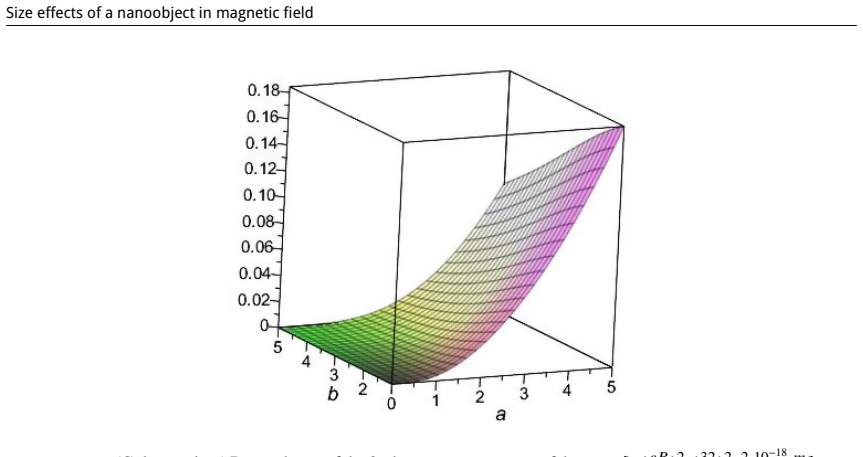
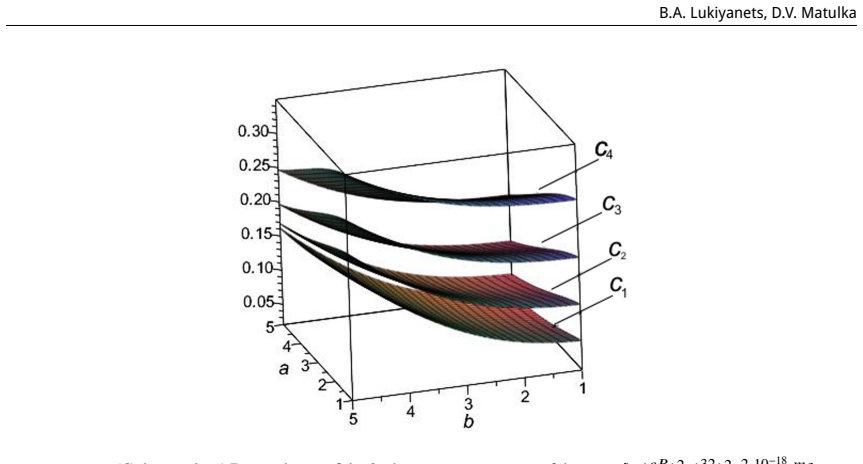
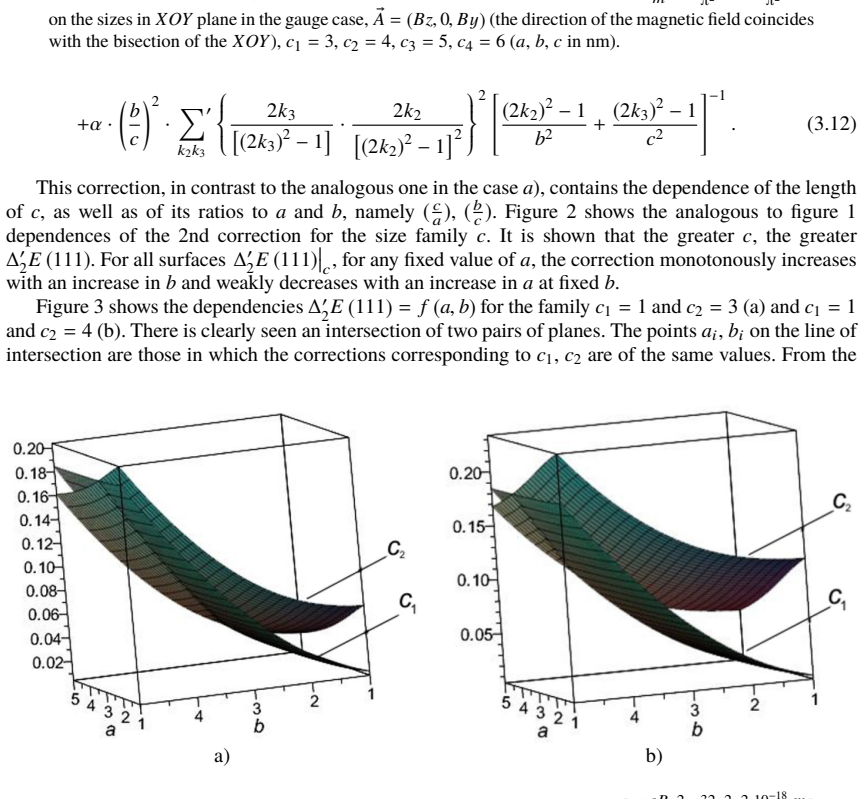
Within first-order perturbation theory the linear-in-B correction to every energy eigenvalue is zero for both the Landau gauge with B along c and the gauge with A = (B z, 0, α B y). The quadratic correction in the second gauge depends explicitly on the length c and on the aspect ratios a/c, b/c; for certain discrete values of a and b the quadratic shift is independent of c.
What carries the argument
Perturbative expansion of the kinetic term that contains the vector potential, evaluated between the exact zero-field eigenfunctions of the three-dimensional infinite rectangular well.
If this is right
- The spectrum receives no shift linear in B regardless of field direction.
- When the vector potential has components that couple the x and y directions, the quadratic shift depends on the out-of-plane length c.
- Special base-plane dimensions exist that make the quadratic shift identical for different values of c.
- The dependence on c disappears in the gauge where B lies strictly along the c axis.
Where Pith is reading between the lines
- Device designers could choose base dimensions to render the magnetic response insensitive to small variations in height.
- The result supplies a concrete test for whether real nanoobjects behave as ideal infinite wells before higher-order or boundary effects intervene.
- The same perturbative framework could be applied to other confining potentials whose zero-field states are known exactly.
Load-bearing premise
The nanoobject is an ideal rectangular box whose unperturbed states are exactly those of a particle in a three-dimensional infinite well, and the magnetic field is weak enough that perturbation theory applies.
What would settle it
Measurement of a nonzero linear term in B in the energy levels of a rectangular quantum dot or wire would contradict the claim that the first-order correction vanishes for any orientation.
Figures
read the original abstract
A theoretical analysis of physical properties of the effect of size of a nanoobject in the form of a rectangular parallelepiped whose sides $a$, $b$, $c$, are oriented along the $OX$, $OY$, $OZ$, respectively, is carried out. In the framework of the perturbation theory, changes in the electronic spectrum of the nanoobject caused by an external magnetic field $\vec{B}$, depending on its size, are analyzed. We consider two cases of the fields which are described 1) by the Landau gauge, $\vec{A}(\vec{r})=\left(0,Bx,0\right)$ ($\vec{B}$ is oriented along the side $c$) and 2) by $\vec{A}(\vec{r})=\left(Bz,0,\alpha By\right)$ ($\alpha$ is a parameter; at $\alpha = 0$, $\vec{B}$ is directed along $OX$ axis, and at $\alpha = 1$, $\vec{B}$ is directed along the diagonal in $XOY$ plane). Firstly, it is shown that the first correction to the spectrum is zero, regardless of $\vec{B}$ orientation. Secondly, it is established that, in contrast to the case of the field orientation 1), where the correction does not depend on the length of $c$, in the case 2) such correction depends both on $c$ and on its ratios to the lengths of $a$ and $b$. There was found the existence of such nanoobject sizes in $XOY$ plane at which the corrections to the spectrum are the same for different lengths of $c$ of the nanoobject.
Editorial analysis
A structured set of objections, weighed in public.
Referee Report
Summary. The manuscript analyzes the electronic spectrum of a rectangular parallelepiped nanoobject modeled as a particle in a 3D infinite well, subjected to a uniform magnetic field via two vector-potential choices. Using non-degenerate perturbation theory, it shows that the first-order correction vanishes for any orientation. The second-order correction is independent of the length c when B is along z (Landau gauge A=(0,Bx,0)), but depends on c and the aspect ratios a/b/c for the second gauge A=(Bz,0,α B y). Special (a,b) values are reported at which the second-order shift becomes independent of c.
Significance. If the explicit sums are correct, the work supplies parameter-free analytic expressions for the leading diamagnetic shift in a solvable confined geometry. The symmetry argument for the vanishing linear term and the identification of aspect ratios that decouple the quadratic shift from one dimension are directly usable for interpreting size-dependent magnetospectroscopy in lithographic nanostructures.
minor comments (3)
- Abstract: the sentence 'There was found the existence of such nanoobject sizes...' is grammatically awkward and should be rephrased for clarity (e.g., 'We identify nanoobject sizes in the XOY plane...').
- The manuscript should state the regime of validity of the perturbation expansion (i.e., ħω_c ≪ level spacing set by a,b,c) and give a numerical example of the maximum B for which the reported O(B²) term remains the leading correction.
- Notation for the quantum numbers (n_x, n_y, n_z) and the explicit form of the unperturbed wavefunctions should be introduced once in the main text rather than assumed from the abstract.
Simulated Author's Rebuttal
We thank the referee for the careful reading and positive assessment of our manuscript on size effects of a rectangular parallelepiped nanoobject in a magnetic field. The recommendation for minor revision is noted. No explicit major comments were provided in the report, so we have no points requiring rebuttal or clarification at this time.
Circularity Check
No significant circularity identified
full rationale
The derivation applies non-degenerate perturbation theory directly to the known eigenstates of the 3D infinite well. The first-order term vanishes by symmetry of real wavefunctions under the given vector potentials; this is an immediate consequence of the matrix-element definition and is not imposed by any self-definition or prior result. Second-order corrections are explicit sums over overlap integrals whose dependence on a, b, c follows algebraically from the unperturbed wavefunctions and the chosen gauges; no parameter is fitted and then relabeled as a prediction. No self-citations appear as load-bearing premises, and the special (a,b) ratios that make the shift independent of c are straightforward numerical consequences of those integrals. The calculation is therefore self-contained against external benchmarks.
Axiom & Free-Parameter Ledger
axioms (2)
- domain assumption Electrons inside the nanoobject obey the Schrödinger equation for a particle in a three-dimensional rectangular infinite well whose eigenfunctions and eigenvalues are known exactly.
- domain assumption The magnetic field is weak enough that first-order perturbation theory is valid and the vector potential can be introduced via minimal substitution without altering the boundary conditions.
Reference graph
Works this paper leans on
-
[1]
InTRoduCTIon The influence of the shape and size of nanoobjects on their physical properties (electronic, optical, optoelectric, and others) is an important problem in modern nanotechnology. Theelectronicspectrumofcrystalsisthebasisofmicroelectronics.Itisknownthatthespectrumofan infinitecrystalisquasi-continuous,whilethespectrumofananosizedcrystalisnoticeab...
work page internal anchor Pith review Pith/arXiv arXiv 1906
-
[2]
Model.CAlCulATIonS Letusconsiderananoobjectoftheshapeofarectangularparallelepipedwiththesides a, b, clocated along OX, OY, OZ axes, respectively. Let the potential energy of an electron in it be the sum of three terms U (®r)= U(x) + U(y) + U(z) , (2.1) where each of them is an infinite deep square well, i.e., U(s) = { 0, if s = x∈[ 0, a]or y∈[ 0, b]or z∈[ ...
-
[3]
3hIFToFlevelSbyAMAgneTIC 1eld Using (2.9), we consider the shift of stationary states caused by the magnetic field: ∆E(nanbnc)≡⟨nanbnc|ˆH|nanbnc⟩− ⣨ nanbnc ˆH0 + eℏ 2m ®B®σ nanbnc ⟩ =⟨nanbnc|ˆH1|nanbnc⟩ + Õ′ nx ny nz ⟨nanbnc|ˆH1|nxnynz⟩⟨nxnynz|ˆH1|nanbnc⟩ Ena nb nc− Enx ny nz . (3.1) Let us analyze two cases of the magnetic field®B orientation: a) the Landa...
-
[4]
ConCluSIonS The analysis of the electron spectrum of a nanoobject and of the shape of rectangular parallelepiped placed in an external magnetic field, depending on the size of the object, indicates that (1) in the framework of perturbation theory, the correction to the spectrum appears only from the second term onward; (2) the magnitudes of the corrections...
-
[5]
Stoll T., Maioli P., Crut A., Del Fatti N., Vallée F., Eur. Phys. J. B, 2014,87, No. 11, 260, doi:10.1140/epjb/e2014-50515-4
-
[6]
Pradeep T. (Ed.), Understanding Nanoscience and Nanotechnology, Tata Mcgraw-hill Publishing Company Limited, New Delhi, 2007
work page 2007
-
[7]
(Ed.), CRC Press, Boca Raton, 2011, 21
Yamamoto N., In: Handbook of Nanophysics: Nanoelectronics and Nanophotonics, Sattler K.D. (Ed.), CRC Press, Boca Raton, 2011, 21
work page 2011
-
[8]
(Ed.), CRC Press, Boca Raton, 2011, 24
CottanchinE.,BroyerM.,LermeJ.,PellarinM.,In:HandbookofNanophysics:NanoelectronicsandNanopho- tonics, Sattler K.D. (Ed.), CRC Press, Boca Raton, 2011, 24
work page 2011
-
[9]
(Ed.), CRC Press, Boca Raton, 2011, 32
Kobayashi K., In: Handbook of Nanophysics: Nanoelectronics and Nanophotonics, Sattler K.D. (Ed.), CRC Press, Boca Raton, 2011, 32
work page 2011
-
[10]
IssendorffB.,In:HandbookofNanophysics:ClustersandFullerens,SattlerK.D.(Ed.),CRCPress,BocaRaton, 2011, 6
work page 2011
-
[11]
(Ed.), CRC Press, Boca Raton, 2011, 2
Anto B.T., Wong L.-Y., Png P.-O., Sivaramakrishnan S., Chua L.L., Ho P.K.H., In: Handbook of Nanophysics: Functional Nanomaterials, Sattler K.D. (Ed.), CRC Press, Boca Raton, 2011, 2
work page 2011
-
[12]
(Ed.), CRC Press, Boca Raton, 2011, 7
Morozowska A., Eliseev E.A., In: Handbook of Nanophysics: Functional Nanomaterials, Sattler K.D. (Ed.), CRC Press, Boca Raton, 2011, 7
work page 2011
-
[13]
(Ed.), Handbook of Nanophysics, CRC Press, Boca Raton, 2011
Sattler K.D. (Ed.), Handbook of Nanophysics, CRC Press, Boca Raton, 2011
work page 2011
-
[14]
Singh M., Goyal M., Devlal K., J. Taibah Univ. Sci., 2018,12, No. 4, 470–475, doi:10.1080/16583655.2018.1473946
-
[15]
Abdulsattar M.A., Hussein M.T., Jamal R.K., Kasim T., Adv. Mater. Phys. Chem., 2012,2, No. 4, 267–274, doi:10.4236/ampc.2012.24039
- [16]
-
[17]
LifshitzE.,SiebbelesL.,Phys.Chem.Chem.Phys.,2014, 16,No.47,25677–25678,doi:10.1039/C4CP90174F
-
[18]
23704-7 B.A.,UkIyANeTS,D.6.-ATULkA
Helmlinger J., Sengstock C., Groß-Heitfeld C., Mayer C., Schildhauer T.A., Köller M., Epple M., RSC Adv., 2016, 6, 18490–18501, doi:10.1039/C5RA27836H. 23704-7 B.A.,UkIyANeTS,D.6.-ATULkA
-
[19]
(Ed.), Springer-Verlag, New York, 2009, 193–212
Li J., Wei S.H., In: Toward Functional Nanomaterials, Wang Z.M. (Ed.), Springer-Verlag, New York, 2009, 193–212
work page 2009
-
[20]
Holovatsky V.A., Voitsekhivska O.M., Yakhnevych M.Ya., Physica E, 2017,93, 295–300, doi:10.1016/j.physe.2017.06.019
-
[21]
Holovatsky V.A., Holovatskyi I.V., Yakhnevych M.Ya., Physica E, 2018,104, 58–63, doi:10.1016/j.physe.2018.07.020
-
[22]
Davydov A.S., Quantum Mechanics, Pergamon Press, Oxford, New York, 1976
work page 1976
-
[23]
Grundmann M., The Physics of Semiconducnors, Springer, Cham, 2006
work page 2006
-
[24]
Prudnikov A.B., Brychkov Yu.A., Marichev O.I., Integrals and Series, CRC Press, Amsterdam, 1992. РозмIрнI ефекти в нанооб’єктах у магнIтному полI Б.А.ЛукIянець,Д.В.Матулка НацIональний унIверситет“ЛьвIвська полIтехнIка”,вул.С.Бандери,12,79000ЛьвIв,Україна Проведений теоретичний аналIз впливу розмIрIв на фIзичнI властивостI нанооб’єкта у виглядI прямоку- т...
work page 1992
discussion (0)
Sign in with ORCID, Apple, or X to comment. Anyone can read and Pith papers without signing in.