REVIEW 2 major objections 6 minor 43 references
Systematically Measuring Ultra-Diffuse Galaxies. VIII. Misfits, Miscasts, and Miscreants
T0 review · 2 major / 6 minor · reviewed 2026-08-07 · deepseek-v4-flash
Pith's one-line read Re-examining all 7,070 SMUDGes ultra-diffuse galaxy candidates by eye, the paper classifies 517 as mergers, ring galaxies, tidal debris, or contaminants, leaving 6,553 as viable undisturbed UDG candidates.
desk verdict A useful, honest reclassification of the SMUDGes catalog that uncovers a few genuinely interesting subclasses, but the clean-sample count rests on unaudited visual labels. read the letter →
The pith
A machine-rendered reading of the paper's core claim, the machinery that carries it, and where it could break.
The reading
What carries the argument
The central object is the classification table itself, a line-matched table that replaces the original binary Rejected flag with a Class label for each of the 7,070 detections. The classification is carried by visual morphological inspection of Legacy Survey images, supplemented for 577 objects by deeper Hyper Suprime-Cam imaging and, in a minority of cases, by spectroscopic or estimated redshifts. The working categories carry the argument: assigning an object to Class D, TDW, OM, PM, R, T, or C is what produces both the clean sample of 6,553 and the identification of the merger and ring subclasses. The physical hypotheses that give the classes meaning—tidal deformation, polar-axis collision ring formation, and tidal debris concentration—are borrowed from the established literature on ring galaxies and galaxy interactions.
What would settle it
Blindly reclassify a random subset of the catalog that includes both flagged and Class G objects using deeper images of uniform depth, and compare the class assignments; if the 6,553 count shifts by more than a few percent, or if the tidal bridges and rings that define the merger and ring classes vanish in the deeper data, the paper's classification claims would be overturned.
Extended reading notes
Core claim
The paper's central claim is that the SMUDGes catalog of ultra-diffuse galaxy candidates, although produced by automated detection and single-Sérsic profile fitting, is a mixture of genuinely undisturbed diffuse galaxies and a diverse set of objects that only full visual inspection can separate. Of the 7,070 candidates, 6,553 are classified as viable undisturbed UDG candidates (Class G), leaving 517 flagged objects. These include 56 tidally distorted galaxies and 10 tidal dwarfs, 8 ongoing mergers and 7 post-mergers of low-surface-brightness galaxies, 29 dwarf ring galaxies and 2 smoke ring systems, 132 background galaxies, 157 tidal debris objects, 81 cirrus detections, and small numbers of artifacts, stars, outer-disk overdensities, emission-line regions, and one duplicate. The paper further argues that the flagged subclasses are not uniformly junk: the tidally distorted and merger systems trace a plausible interaction-driven UDG formation pathway, and the ring galaxies may be the products of nearly polar-axis collisions with companions so faint that they are currently undetected, possibly dark subhalos.
Load-bearing premise
The load-bearing premise is that visual inspection of low signal-to-noise images reliably separates the classes—the paper's own caveat is that classifications 'still depend on visual assessments, often made using low signal-to-noise detections,' with deeper imaging for only 577 of 7,070 objects—so the class counts and the 6,553 clean-sample number stand or fall with those visual judgments.
Editorial extensions
If this is right
- Researchers should select the 6,553 Class G objects as the clean working sample and exclude the flagged contaminants from UDG statistics, while treating the parameters of the tidally affected systems as unreliable.
- The 66 tidally affected galaxies remain low-surface-brightness galaxies and may settle into regular UDGs later, supporting interaction-driven formation of at least some UDGs.
- The 15 ongoing and post-merger systems, along with the excess of close Class G pairs, indicate that UDG mergers occur and may produce the largest UDGs; isolated pairs could eventually constrain UDG halo masses at radii well beyond the effective radius.
- The 29 dwarf ring galaxies motivate simulations of low-mass, near-polar-axis collisions; if the perturbers are extremely faint or dark, these objects could trace the low end of the stellar-to-halo mass relation.
- Deeper imaging from upcoming surveys is expected to flag additional objects among the current 6,553, so the clean sample is a best estimate under current data rather than a final census.
Reading between the lines
- Because the paper warns that tidally distorted and ring objects have unreliable single-Sérsic parameters, a direct extension would be to recompute published UDG axis-ratio, size, and luminosity distributions using only the 6,553 Class G objects; if the flagged populations skew those distributions, earlier statistical conclusions about UDG shapes and environments would need revision.
- If the dwarf ring galaxies are indeed collision remnants, their ring diameters and the absence of bright perturbers could be turned into a statistical probe of dark subhalos below the stellar-mass detection threshold; the paper calls for simulations but does not quantify this census.
- The 15 merger candidates plus the statistical excess of close Class G pairs could provide a training set for automated identification of low-surface-brightness interactions in future wide surveys, making the next generation of UDG catalogs easier to clean at the source.
Editorial analysis
A structured set of objections, weighed in public.
Referee Report
Summary. This paper presents a visual reclassification of all 7,070 SMUDGes candidate ultra-diffuse galaxies using Legacy Survey imaging, supplemented by deeper HSC images for 577 objects and some spectroscopic redshifts. The authors assign one of 19 morphological labels to each object, identify subclasses including low-surface-brightness mergers (8 ongoing, 7 post-merger), dwarf ring galaxies (29), tidally distorted systems (56), and various contaminants, and conclude that 6,553 candidates remain viable undisturbed UDG candidates. They provide example images and a line-matched classification table.
Significance. If the classifications are reliable, this is a valuable community resource: it is the first systematic, object-by-object morphological audit of a large UDG catalog, and it highlights rare subclasses (LSB mergers, dwarf rings) that are promising targets for follow-up spectroscopy and hydrodynamical simulations. The paper ships a line-matched table, verifiable arithmetic (the class percentages sum to about 100% and match the quoted counts), and candid statements of the limitations of visual classification. The main weakness is the absence of a quantitative reliability assessment for the labels.
major comments (2)
- [§2, Table 2, and §5] The central deliverable is the classification of all 7,070 candidates, culminating in the 6,553-object clean sample, but the paper provides no quantitative validation of the visual classifications. The authors state in §2 that 'our classifications still depend on visual assessments, often made using low signal-to-noise detections' and that deeper HSC imaging is available for only 577 objects, yet no inter-rater agreement, no quantitative morphological criteria, and no confidence flags are reported. Because the small subclasses (OM = 8, PM = 7, R = 29, TDW = 10) are especially sensitive to a handful of misclassifications, and because the 6,553 count is the complement of the flagged classes, the absence of a reproducibility assessment leaves the headline number an unaudited estimate. I request an explicit reliability analysis: for example, independent blind reclassification of a random subset by a second examiner (or a quantitative morphological classifier comparison), with agreement rates and the resulting uncertainty on the flagged fraction. Without this, the clean-sample claim is not falsifiable at the precision implied by the abstract.
- [§3.1.2 and §3.4.1] The distinction between Class = TDW (tidal dwarf galaxies, 10 objects) and Class = T (tidal debris, 157 objects) is not operationally defined. In §3.1.2 the authors state that 'it is difficult to assess whether a low surface brightness enhancement is truly a gravitationally bound system,' and none of the TDWs have spectroscopic redshifts; moreover, the text notes that for the majority of the TDWs the inferred r_e > 7 kpc, 'suggest[ing] that the majority of these are not true galaxies.' This internal evidence blurs the boundary between TDW and T. I request that the authors either state explicit, reproducible criteria that separate TDW from T (e.g., detection of a tidal bridge, or a boundness indicator) or combine these classes and present the combined count with an upper-limit caveat. The current presentation gives false precision to a class that the authors themselves admit is difficult to establish.
minor comments (6)
- [§4] In §4, 'SMDUGes' is a typo for 'SMUDGes' (see 're-visiting the SMDUGes catalog').
- [Throughout] The Sérsic profile is typeset as 'S´ ersic' with an unintended space; use a consistent LaTeX macro (e.g., 'S\'ersic').
- [§3.1.1] The text writes 'The fraction of such systems is modest (∼57/7070)' after reporting 56 Class = D objects; use 56/7070 or state that the value is approximate.
- [Table 2] Table 2 gives percentages only; adding the integer counts would help readers verify the numbers quoted in the text (e.g., D = 56, T = 157, R = 29).
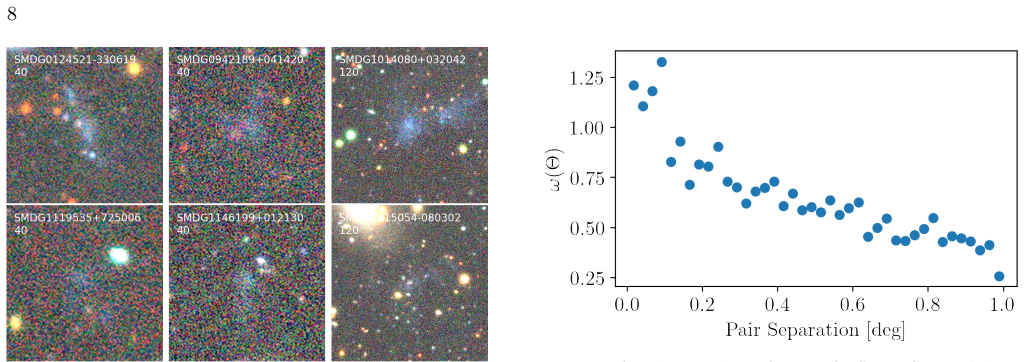
- [Figure 8] Figure 8 is described as 'demonstrat[ing] an increasing statistical excess' of close pairs, but no error bars, uncertainties, or significance level are shown; the text later says the results are 'meant only to substantiate' close pairs, so soften the caption or add a significance estimate.
- [Table 1] The classification table is essential to the paper, but only the first 10 rows are printed; please provide the full machine-readable table as a data file (e.g., in the journal's data repository or as an ancillary file) and state its availability explicitly.
Circularity Check
No significant circularity: the paper's classifications are an independent visual re-examination, not derived from the fitted parameters they critique.
full rationale
The paper's deliverable is a classification of 7,070 previously cataloged candidates. The classifications are assigned by visual inspection of Legacy Survey images and, for 577 objects, deeper HSC imaging; they are not computed from the Sersic parameters that define the parent SMUDGes catalog. The statement that 6,553 objects are unflagged is the arithmetic complement of the flagged categories, not a prediction derived from those categories. No fitted parameter is renamed as a prediction, and no uniqueness claim rests on a self-citation. The paper does rely on earlier SMUDGes papers for the candidate list and pipeline, and it cites the authors' own redshift-estimation technique, but those inputs are not the source of the new classification labels. The acknowledged subjectivity of visual classification and the limited availability of deeper imaging are correctness and uncertainty concerns, not circularity. Accordingly, no circular steps are identified.
Assumptions & free parameters
assumptions (4)
- standard math Flat ΛCDM cosmology with parameters from Hinshaw et al. (2013).
- domain assumption The SMUDGes selection criteria (central surface brightness fainter than 24 mag/arcsec^2 and effective radius greater than 5.3 arcsec) define a useful UDG candidate sample.
- domain assumption Visual morphological features (tidal bridges, shells, rings, tails) are reliable indicators of physical interactions at these low surface brightness levels.
- domain assumption Spectroscopic redshifts from the compiled sources are correct, and matches within 5.3 arcsec are genuine associations.
invented entities (1)
-
Dark subhalo perturbers
Cite this review
Pith. "Pith review of Systematically Measuring Ultra-Diffuse Galaxies. VIII. Misfits, Miscasts, and Miscreants." pith.science (2026). https://pith.science/paper/2W45XLZD
@misc{pith2026250524755,
  author       = {Pith},
  title        = {Pith review of: Systematically Measuring Ultra-Diffuse Galaxies. VIII. Misfits, Miscasts, and Miscreants},
  year         = {2026},
  howpublished = {\url{https://pith.science/paper/2W45XLZD}},
  note         = {Machine review of arXiv:2505.24755}
}
read the original abstract
We re-examine the 7,070 candidate ultra-diffuse galaxies (UDGs) in the SMUDGes survey and provide classifications based on their visual morphology. Among the more interesting cases, we identify objects along a low surface brightness galaxy merger sequence (ongoing mergers (8) and post-mergers (7)) and a distinct set of dwarf ring galaxies (29). The ring galaxies are hypothesized to be the result of nearly polar-axis collisions, but the responsible companions are undetected. We also highlight objects in the catalog that appear to be tidally affected (66), thereby cautioning that their cataloged parameters may be unreliable. Finally, we identify contaminants of various types in the catalog, leaving 6,553 as viable undisturbed UDG candidates. We discuss all categories and provide example images of the more interesting ones.
Figures


Figures from the paper (4 more)



Reference graph
Works this paper leans on
-
[1]
2022, PASJ, 74, 247, doi:10.1093/pasj/psab122 Astropy Collaboration, Robitaille, T
Aihara, H., AlSayyad, Y., Ando, M., et al. 2022, PASJ, 74, 247, doi:10.1093/pasj/psab122 Astropy Collaboration, Robitaille, T. P., Tollerud, E. J., et al. 2013, A&A, 558, A33, doi:10.1051/0004-6361/201322068
-
[2]
Barnes, J. E., & Hernquist, L. 1992, Nature, 360, 715, doi:10.1038/360715a0
doi:10.1038/360715a0 1992
-
[3]
Bennet, P., Sand, D. J., Zaritsky, D., et al. 2018, ApJ, 866, L11, doi:10.3847/2041-8213/aadedf
-
[4]
Bullock, J. S., & Boylan-Kolchin, M. 2017, ARA&A, 55, 343, doi:10.1146/annurev-astro-091916-055313
-
[5]
2017, ApJ, 838, 93, doi:10.3847/1538-4357/aa671c
Burkert, A. 2017, ApJ, 838, 93, doi:10.3847/1538-4357/aa671c
-
[6]
Buzzo, M. L., Hilker, M., Zanella, A., et al. 2025, arXiv e-prints, arXiv:2505.15910, doi:10.48550/arXiv.2505.15910
work page Pith review arXiv doi:10.48550/arxiv.2505.15910 2025
-
[7]
Cannon, R. D., Lloyd, C., & Penston, M. V. 1970, The Observatory, 90, 153
work page 1970
-
[8]
Carleton, T., Errani, R., Cooper, M., et al. 2019, Monthly Notices of the Royal Astronomical Society, 485, 382, doi:10.1093/mnras/stz383 DESI Collaboration, Abdul-Karim, M., Adame, A. G., et al. 2025, arXiv e-prints, arXiv:2503.14745, doi:10.48550/arXiv.2503.14745
Show all 43 references
-
[9]
J., Lang, D., et al
Dey, A., Schlegel, D. J., Lang, D., et al. 2019, AJ, 157, 168, doi:10.3847/1538-3881/ab089d
2019 doi
-
[10]
A., & Mirabel, I
Duc, P. A., & Mirabel, I. F. 1994, A&A, 289, 83
1994
-
[11]
G., Kaufman, M., & Thomasson, M
Elmegreen, B. G., Kaufman, M., & Thomasson, M. 1993, ApJ, 412, 90, doi:10.1086/172903
1993 doi
-
[12]
Fosbury, R. A. E., & Hawarden, T. G. 1977, MNRAS, 178, 473, doi:10.1093/mnras/178.3.473
1977 doi
-
[13]
B., Guerrero, M
Goldman, D. B., Guerrero, M. A., Chu, Y.-H., & Gruendl, R. A. 2004, AJ, 128, 1711, doi:10.1086/424623
2004 doi
-
[14]
R., et al
Heesters, N., M¨ uller, O., Marleau, F. R., et al. 2023, A&A, 676, A33, doi:10.1051/0004-6361/202346441
2023 doi
-
[15]
2013, ApJS, 208, 19, doi:10.1088/0067-0049/208/2/19
Hinshaw, G., Larson, D., Komatsu, E., et al. 2013, ApJS, 208, 19, doi:10.1088/0067-0049/208/2/19
2013 doi
-
[16]
D., Charlton, J
Hunsberger, S. D., Charlton, J. C., & Zaritsky, D. 1996, ApJ, 462, 50, doi:10.1086/177126
1996 doi
-
[17]
Hunter, J. D. 2007, Computing in Science and Engineering, 9, 90, doi:10.1109/MCSE.2007.55
2007 doi
-
[18]
2021, MNRAS, 507, 6140, doi:10.1093/mnras/stab2527
Inoue, S., Yoshida, N., & Hernquist, L. 2021, MNRAS, 507, 6140, doi:10.1093/mnras/stab2527
2021 doi
-
[19]
J., & Combes, F
Jog, C. J., & Combes, F. 2009, Phys. Rep., 471, 75, doi:10.1016/j.physrep.2008.12.002
2009 doi
-
[20]
G., Bennet, P., Mutlu-Pakdil, B., et al
Jones, M. G., Bennet, P., Mutlu-Pakdil, B., et al. 2021, ApJ, 919, 72, doi:10.3847/1538-4357/ac0975
2021 doi
-
[21]
Kadowaki, J., Zaritsky, D., & Donnerstein, R. L. 2017, ApJ, 838, L21, doi:10.3847/2041-8213/aa653d
2017 doi
-
[22]
L., et al
Kadowaki, J., Zaritsky, D., Donnerstein, R. L., et al. 2021, ApJ, 923, 257, doi:10.3847/1538-4357/ac2948
2021 doi
-
[23]
2024, ApJ, 975, 91, doi:10.3847/1538-4357/ad77cf
Karunakaran, A., Motiwala, K., Spekkens, K., et al. 2024, ApJ, 975, 91, doi:10.3847/1538-4357/ad77cf
2024 doi
-
[24]
J., Zaritsky, D., Lambert, M., & Donnerstein, R
Khim, D. J., Zaritsky, D., Lambert, M., & Donnerstein, R. 2024, AJ, 168, 45, doi:10.3847/1538-3881/ad4ed3
2024 doi
-
[25]
J., Zaritsky, D., & Donnerstein, R
Lambert, M., Khim, D. J., Zaritsky, D., & Donnerstein, R. 2024, AJ, 167, 61, doi:10.3847/1538-3881/ad0f25
2024 doi
-
[26]
S., et al
Liao, S., Gao, L., Frenk, C. S., et al. 2019, MNRAS, 490, 5182, doi:10.1093/mnras/stz2969
2019 doi
-
[27]
1976, ApJ, 209, 382, doi:10.1086/154730 SMUDGes Detritus 9
Lynds, R., & Toomre, A. 1976, ApJ, 209, 382, doi:10.1086/154730 SMUDGes Detritus 9
1976 doi
-
[28]
F., Nelson, E., & Petrillo, K
Madore, B. F., Nelson, E., & Petrillo, K. 2009, ApJS, 181, 572, doi:10.1088/0067-0049/181/2/572
2009 doi
-
[29]
2012, MNRAS, 420, 1158, doi:10.1111/j.1365-2966.2011.20098.x
Mapelli, M., & Mayer, L. 2012, MNRAS, 420, 1158, doi:10.1111/j.1365-2966.2011.20098.x
2012
-
[30]
F., Dottori, H., & Lutz, D
Mirabel, I. F., Dottori, H., & Lutz, D. 1992, A&A, 256, L19
1992
-
[31]
Oke, J. B. 1964, ApJ, 140, 689, doi:10.1086/147960
1964 doi
- [32]
-
[33]
Oliphant, T. E. 2007, Computing in Science and Engineering, 9, 10, doi:10.1109/MCSE.2007.58
2007 doi
-
[34]
R., Habas, R., et al
Poulain, M., Marleau, F. R., Habas, R., et al. 2022, A&A, 659, A14, doi:10.1051/0004-6361/202142012
2022 doi
-
[35]
R., & White, S
Rix, H.-W. R., & White, S. D. M. 1989, MNRAS, 240, 941, doi:10.1093/mnras/240.4.941 Sandoval Ascencio, L., Cooper, M. C., Zaritsky, D., et al. 2025, arXiv e-prints, arXiv:2502.00117, doi:10.48550/arXiv.2502.00117 van der Walt, S., Colbert, S. C., & Varoquaux, G. 2011, Computin...
-
[36]
White, S. D. M. 1981, MNRAS, 195, 1037, doi:10.1093/mnras/195.4.1037
1981 doi
-
[37]
White, S. D. M., Huchra, J., Latham, D., & Davis, M. 1983, MNRAS, 203, 701, doi:10.1093/mnras/203.3.701
1983 doi
-
[38]
G., Adelman, J., Anderson, Jr., J
York, D. G., Adelman, J., Anderson, Jr., J. E., et al. 2000, AJ, 120, 1579, doi:10.1086/301513
2000 doi
-
[39]
2017, MNRAS, 464, L110, doi:10.1093/mnrasl/slw198
Zaritsky, D. 2017, MNRAS, 464, L110, doi:10.1093/mnrasl/slw198
2017 doi
-
[40]
2023a, ApJS, 267, 27, doi:10.3847/1538-4365/acdd71 —
Zaritsky, D., Donnerstein, R., Dey, A., et al. 2023a, ApJS, 267, 27, doi:10.3847/1538-4365/acdd71 —. 2019, ApJS, 240, 1, doi:10.3847/1538-4365/aaefe9 —. 2021, ApJS —. 2022, ApJS
2019 doi
-
[41]
P., Jaff´ e, Y
Zaritsky, D., Crossett, J. P., Jaff´ e, Y. L., et al. 2023b, MNRAS, 524, 1431, doi:10.1093/mnras/stad1964
-
[42]
2008, ApJ, 683, 1085, doi:10.1086/587448
Zuckerman, B., Melis, C., Song, I., et al. 2008, ApJ, 683, 1085, doi:10.1086/587448
2008 doi
-
[43]
1956, Ergebnisse der exakten Naturwissenschaften, 29, 344 This paper was built using the Open Journal of As- trophysics LATEX template
Zwicky, F. 1956, Ergebnisse der exakten Naturwissenschaften, 29, 344 This paper was built using the Open Journal of As- trophysics LATEX template. The OJA is a journal which provides fast and easy peer review for new papers in the astro-phsection of the arXiv, making the revie...
1956
Reviewed August 7, 2026 · model on record in the stance chip above.
Discussion (0). Sign in to comment.