REVIEW 4 major objections 5 minor 40 references
MZEN: Multi-Zoom Enhanced NeRF for 3-D Reconstruction with Unknown Camera Poses
T0 review · 4 major / 5 minor · reviewed 2026-08-05 · deepseek-v4-flash
Pith's one-line read MZEN is a training schedule and camera model that lets pose-free NeRF reconstruct fine detail from image sets spanning multiple zoom levels.
desk verdict Coherent idea and a real application, but the experimental tables are internally inconsistent and the central empirical claim is unsupported. read the letter →
The pith
A machine-rendered reading of the paper's core claim, the machinery that carries it, and where it could break.
The reading
What carries the argument
The central machinery is the zoom-scaled pinhole camera model with effective intrinsics $K_k^{\mathrm{eff}}=\operatorname{diag}(\xi_k f_x,\xi_k f_y,1)$, combined with a three-phase training schedule. The scalar $\xi_k$ separates optical magnification from base focal length, preventing translation/focal-length/zoom compensation; the schedule first locks a metric frame with wide-field views, then uses a crop-and-match pose-priming step to seed each zoom-in pose from its best wide-field counterpart, and finally refines everything together.
What would settle it
Capture a zoom-in image at magnification $\xi$ deliberately offset from the wide-field frame's optical center, then run Phase B: the crop-and-match in Eq. (3) selects the wide-field frame with smallest RGB error, but a large offset makes the copied pose wrong and the pose-only refinement cannot recover the true translation; measuring pose error against ground-truth cameras would decide whether pose priming requires centered zoom shots.
Extended reading notes
Core claim
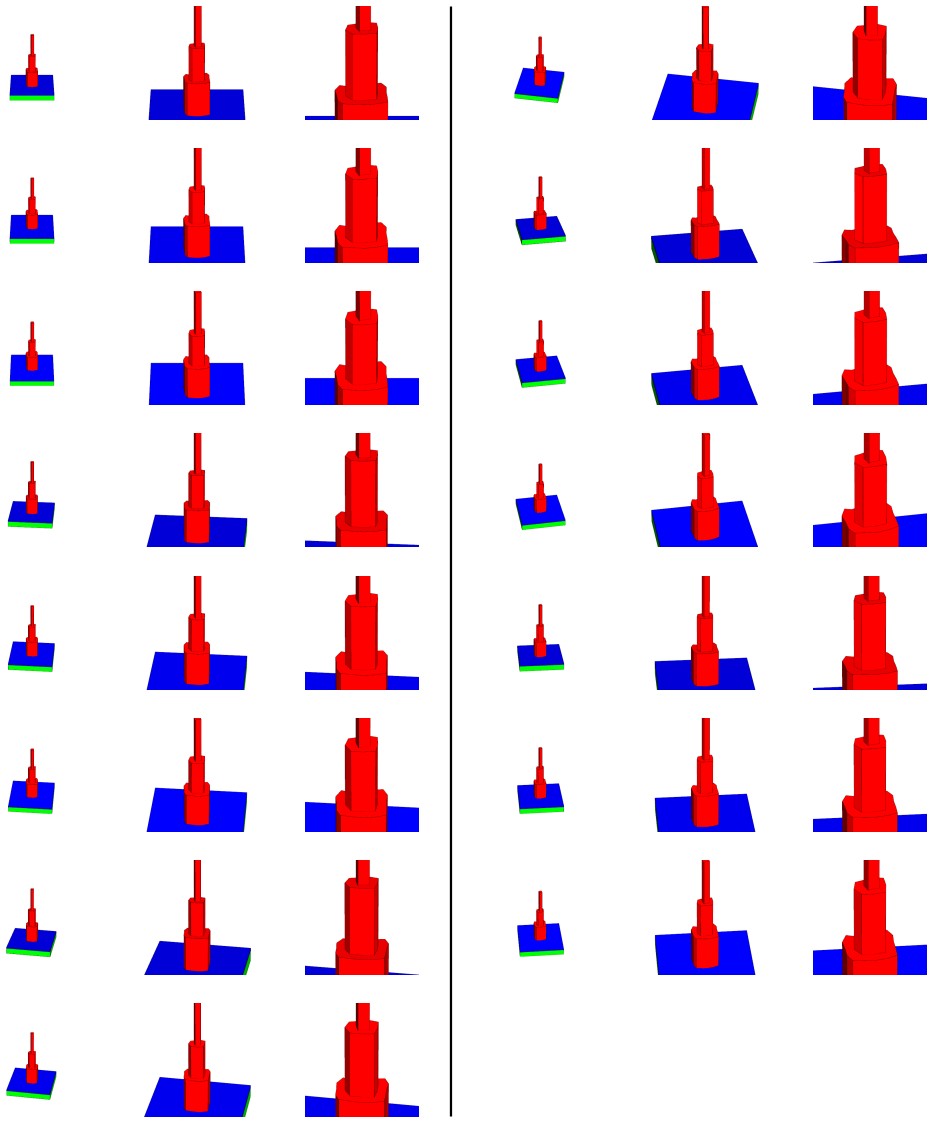
The paper claims NeRF-style 3D reconstruction can handle image sets mixing wide-field views and high-magnification close-ups, where zoomed frames have little overlap and standard pose-free NeRF becomes unstable. MZEN adds a learnable zoom scalar $\xi_k$ to the pinhole model, making each view's effective intrinsics $\operatorname{diag}(\xi_k f_x,\xi_k f_y,1)$, and trains in three phases: wide-field-only pose bootstrap; zoom-in pose priming by matching a central $1/\xi_k$ crop to the best wide-field frame and copying its pose; joint refinement of all poses, zooms, and the radiance field. On eight forward-facing scenes (synthetic chips, real SEM of MEMS, BLEFF objects), the full schedule beats
Load-bearing premise
The load-bearing premise is that every zoom-in frame is essentially the central $1/\xi$ crop of some wide-field frame taken from the same optical center, so copying that frame's pose is a good starting point; if zoomed views are off-center or the optical center shifts with magnification, pose priming has no anchor.
Editorial extensions
If this is right
- Any pose-free NeRF backbone can be wrapped in MZEN's three-phase schedule to accept multi-zoom inputs.
- Fixed-resolution sensors can expose fine detail through zoom-in shots without needing a gigapixel wide-field frame or external pose calibration.
- To match 4x optical-zoom detail, MZEN needs about two native-resolution frames per scene area instead of sixteen pixels from a single high-resolution capture, an 8x compute/memory reduction.
- On real SEM imagery, the staged schedule suppresses the ghosting and pose collapse that occur when all zoom levels are optimized together.
- The learned zoom scalars deviate 5-15% from dial readings, so the model can absorb intrinsic drift between magnifications during joint refinement.
Reading between the lines
- Extension the authors leave implicit: Phase B's crop-and-match could be generalized to search over crop offsets, which would let MZEN handle off-center zoom views rather than requiring the zoomed frame to be centered.
- Because MZEN is defined as a schedule around any pose-free NeRF, the same bootstrap-prime-refine loop could be tested on other neural scene representations such as 3D Gaussian splatting, where pose-free multi-scale training faces the same instability.
- The reported 5-15% zoom-scalar drift predicts that the model is partially absorbing unmodeled intrinsic changes; a calibrated camera could verify whether the learned focal lengths match the true magnification ratio.
- The two proposed metrics, GSS and LSS, are 2-3x more sensitive to the recovered high-frequency detail than SSIM, so they could serve as standard evaluation for future multi-scale reconstruction benchmarks.
Editorial analysis
A structured set of objections, weighed in public.
Referee Report
Summary. The paper proposes MZEN, a three-phase NeRF training framework for multi-zoom image sets with unknown camera poses. MZEN augments the pinhole model with a learnable per-view zoom scalar, bootstraps poses from wide-field views only (Phase A), registers each zoom-in view by copying the pose of its best-matching central crop from the wide-field set (Phase B, Eq. 3), and then jointly refines all parameters (Phase C). The paper introduces the FF-MZN dataset of eight forward-facing scenes (two BLEFF, four TCAD, two real SEM) and reports that MZEN outperforms pose-free baselines across all scenes and metrics, with PSNR gains up to 28.4% and LPIPS reductions up to 222%. The central claim is empirical: consistent gains over five baselines on eight multi-zoom scenes.
Significance. The problem is well motivated: industrial and SEM imaging naturally produces wide-field plus zoom-in views with little overlap, which is challenging for pose-free NeRF. The zoom-scaled pinhole model and the staged bootstrap-register-refine schedule are reasonable ideas, and Appendix D gives a standard PL-based convergence-rate argument for pose priming. The FF-MZN benchmark, if valid, would be a useful contribution. However, the central empirical evidence as printed is not valid: Tables 1-3 contain exact numerical duplicates across differently named scenes, and the reported LPIPS reductions exceed 100%, which is arithmetically impossible for a nonnegative distance. The synthetic half of the benchmark is also generated under exactly the centered-crop/same-extrinsic assumption that Phase B relies on, so it does not test pose priming under the off-center/drift conditions that the paper itself acknowledges as unsupported. The significance of the claimed result therefore cannot be assessed from this manuscript.
major comments (4)
- [Section 4, Tables 1-3] The quantitative evaluation is internally inconsistent. The 'Round Table' rows in Table 1 are numerically identical to the 'Tower' rows in Table 2 and the 'Box' rows in Table 3 for every configuration and every metric (e.g., Config 1 NeRF--: PSNR 25.05, SSIM 0.929, LPIPS 0.108; Config 4: PSNR 27.74, SSIM 0.963, LPIPS 0.045). The same exact duplication holds for Root/Pillars/Beams. This contradicts the claim in Section 4 of eight distinct scenes and '40 scene-metric combinations'. Either the tables are copy-paste errors or the scenes are not distinct; both possibilities invalidate the load-bearing empirical claim that MZEN consistently outperforms baselines across eight scenes.
- [Abstract, Section 4, Appendix C] LPIPS reduction values greater than 100% are invalid. LPIPS is a nonnegative distance, so a 'reduction' cannot exceed 100%. The Abstract claims 'reducing LPIPS by up to 222%'; Section 4 states 'LPIPS drops by 2.2-222%'; Appendix C reports percentages such as -195.1%, -236.6%, and -832.4%. These numbers cannot be derived from the nonnegative LPIPS values in the per-zoom tables. This indicates a formula error in the reported improvement percentages and overstates the headline gains.
- [Appendix E vs. Section 3, Eq. (3)] The benchmark is partly circular for the pose-priming claim. Appendix E.3 states that for BLEFF scenes the 2x and 4x views are generated by centered cropping and resizing a single 4x master with identical camera extrinsics across zoom levels; Appendix E.2 states the TCAD triplets are rendered with identical extrinsics. Thus for six of the eight scenes, the central-crop surrogate in Eq. (3) is exact by construction, and Phase B is handed the correct pose family without testing drift or off-center crops. The real SEM scenes do provide a valid test, but the paper's own Conclusion acknowledges that off-center crops are unsupported. The broad claim of robustness across eight scenes is therefore overstated; results should be separated by whether the construction satisfies the centered-crop assumption.
- [Section 4, Evaluation protocol] The paper never reports pose estimation error. The text says test poses are obtained by running MZEN's pose-registration on held-out frames, and all metrics are image-quality metrics between rendered and ground-truth views. Since the paper's contribution is explicitly a pose strategy, the absence of any direct pose-accuracy evaluation (rotation/translation error against known synthetic extrinsics, or against the SEM drift budget given in Appendix E.1) leaves a key part of the claim unsupported. This would be important even if the tables were corrected.
minor comments (5)
- [Figure 2 caption] The caption says 'Because the ground-truth cameras are unknown' for scenes where the TCAD synthetic cameras are in fact known (Appendix E.2). Please clarify which scenes have unknown ground-truth poses.
- [Section 4, Config 3] The statement that Config 3 scores are within -1.0% PSNR of Config 1 is hard to verify from the duplicated tables. The comparison would be clearer if the tables were regenerated and the percentage changes were computed from the corrected values.
- [Section 3, Eq. (4)] Eq. (4) writes L_pose over all zoom-in images but the text says only (R_j, t_j, xi_j) are optimized, with intrinsics fixed. Consider writing the loss with the frozen parameters explicit to avoid ambiguity.
- [Appendix C] The phrase 'ranks first in 542/600 metric entries' needs a precise definition of 'entries'; it is unclear how 600 is counted across 120 per-zoom evaluations and 5 metrics.
- [Tables 1-3 formatting] Table 3's caption says 'Box and Beams SEM dataset' but the label 'SEM dataset' is missing from Table 2, whose TCAD rows are captioned only in text. The duplicated numbers make the scene labels especially confusing; please verify the mapping between scene names and reported results.
Circularity Check
Synthetic benchmark construction hands Phase B pose priming its answer on 6 of 8 scenes; Appendix D's convergence proof assumes the benefit it claims to show.
-
self definitional
[Section 3, Phase B (Eq. 3); Appendix E.2/E.3 (FF-MZN dataset construction)]
"For each wide-field image with indices g ≤ Nout we extract the central 1/ξj crop and bilinearly resize it to the native resolution, producing the surrogate view ˜Ig→j. g⋆(j) = arg min ... ∥Ij − ˜Ig→j∥² ... so we copy its rotation and translation (Rj, tj) ← (R(A)g⋆(j), t(A)g⋆(j)). [Appendix E:] I(4×) = Cropc,360×260(I HR). ... both zoom-in views (2× and 4×) are generated by cropping and resizing, ensuring realistic magnification while preserving the same camera pose across all three levels."
On the TCAD and BLEFF scenes, every zoom-in image is defined as a centered crop (or render) with the same extrinsic pose as a wide-field frame. Phase B's crop-and-match then minimizes MSE against the exact generative source: the winning surrogate is the wide-field frame from which the zoom-in image was made, and the copied (R,t) is the ground-truth pose by construction. Thus the 'pose-free' evaluation on 6 of 8 scenes does not estimate unknown poses; it inverts the dataset-generation procedure. The claimed benefit of pose priming on those scenes is therefore forced by the benchmark design rather than independently demonstrated.
-
self definitional
[Appendix D.1–D.3 (Theoretical Analysis of Pose Priming)]
"In addition, we assume the initialization used to start Phase B lies within B(r⋆). This is precisely what pose priming is designed to ensure: by copying (R, t) from the nearest wide-field view, the initial pose is a small crop-induced perturbation of Π⋆j ... We copy (R, t, f) from the best wide-field counterpart and incur only crop-misregistration error δ ≪ σrand ... Therefore, pose priming reaches the same loss in far fewer iterations."
The convergence comparison reduces to the assumption δ ≪ σrand, where δ is defined as the error of pose priming. The proof does not derive that copying the wide-field pose yields a small error; it stipulates it ('we copy ... and incur only crop-misregistration error δ ≪ σrand') and then concludes T_seed/T_rand = log(δ²/ε)/log(σ²_rand/ε) ≪ 1. The conclusion that pose priming is faster is thus contained in the premise, making the 'theoretical justification' definitional rather than evidence for the method's benefit.
full rationale
The paper's central empirical claim is that MZEN 'consistently outperforms' pose-free baselines across eight FF-MZN scenes. The main evidence is partially self-confirming: for the six synthetic scenes (four TCAD, two BLEFF), the dataset is explicitly constructed so that camera extrinsics are identical across zoom levels and zoom-in images are centered crops of the same high-resolution render. Phase B pose priming then matches each zoom-in image to the wide-field view from which it was generated and copies the known pose. Pose recovery on those scenes is not an independent test of the method; it is a read-out of the generation procedure. The two real SEM scenes are not constructed this way and provide independent content, but the main tables (Tables 1–3) contain exact duplicate rows across differently named scenes (e.g., Round Table = Tower = Box), so the reported 'eight scene' evidence is unreliable, and the appendix reports LPIPS reductions exceeding 100%, which is arithmetically impossible for a nonnegative distance. The Appendix D convergence proof is also circular in that it assumes the primed initialization is inside the local basin and then concludes priming converges faster. There is no significant self-citation chain; the circularity is in the benchmark construction and in the pose-priming analysis. Overall, the method's core mechanism is not shown to be wrong, but its headline quantitative support is partially forced by construction, warranting a score of 6.
Assumptions & free parameters
free parameters (3)
- per-image zoom scalar ξ_k =
initialized from dial reading; deviates 5-15% after Phase C
- shared focal length f and principal point c =
learned
- camera extrinsics (R_k, t_k) =
learned
assumptions (4)
- domain assumption Wide-field images in Phase A share sufficient overlap for a pose-free NeRF solver to converge to a metric reconstruction.
- ad hoc to paper Each zoom-in frame is a centered crop of a wide-field frame from the same optical center, so the MSE surrogate match (Eq. 3) yields the correct pose.
- standard math The photometric loss is locally strongly convex and satisfies the PL condition near the optimum, and the primed initialization lies in that basin.
- domain assumption A rough per-image zoom estimate ξ_k is available (camera dial or apparent-size comparison).
Cite this review
Pith. "Pith review of MZEN: Multi-Zoom Enhanced NeRF for 3-D Reconstruction with Unknown Camera Poses." pith.science (2026). https://pith.science/paper/2WC5YR5N
@misc{pith2026250805819,
  author       = {Pith},
  title        = {Pith review of: MZEN: Multi-Zoom Enhanced NeRF for 3-D Reconstruction with Unknown Camera Poses},
  year         = {2026},
  howpublished = {\url{https://pith.science/paper/2WC5YR5N}},
  note         = {Machine review of arXiv:2508.05819}
}
abstract
Neural Radiance Fields (NeRF) methods excel at 3D reconstruction from multiple 2D images, even those taken with unknown camera poses. However, they still miss the fine-detailed structures that matter in industrial inspection, e.g., detecting sub-micron defects on a production line or analyzing chips with Scanning Electron Microscopy (SEM). In these scenarios, the sensor resolution is fixed and compute budgets are tight, so the only way to expose fine structure is to add zoom-in images; yet, this breaks the multi-view consistency that pose-free NeRF training relies on. We propose Multi-Zoom Enhanced NeRF (MZEN), the first NeRF framework that natively handles multi-zoom image sets. MZEN (i) augments the pin-hole camera model with an explicit, learnable zoom scalar that scales the focal length, and (ii) introduces a novel pose strategy: wide-field images are solved first to establish a global metric frame, and zoom-in images are then pose-primed to the nearest wide-field counterpart via a zoom-consistent crop-and-match procedure before joint refinement. Across eight forward-facing scenes$\unicode{x2013}$synthetic TCAD models, real SEM of micro-structures, and BLEFF objects$\unicode{x2013}$MZEN consistently outperforms pose-free baselines and even high-resolution variants, boosting PSNR by up to $28 \%$, SSIM by $10 \%$, and reducing LPIPS by up to $222 \%$. MZEN, therefore, extends NeRF to real-world factory settings, preserving global accuracy while capturing the micron-level details essential for industrial inspection.
Figures


Figures from the paper (10 more)




Reference graph
Works this paper leans on
-
[1]
Abd Al Rahman, M.; and Mousavi, A. 2020. A Review and Analysis of Automatic Optical Inspection and Quality Monitoring Methods in Electronics Industry . IEEE Access, 8: 183192--183271
work page 2020
-
[2]
Albanese, A.; Nardello, M.; Fiacco, G.; and Brunelli, D. 2022. Tiny machine learning for high accuracy product quality inspection . IEEE Sensors Journal, 23(2): 1575--1583
work page 2022
-
[3]
T.; Mildenhall, B.; Tancik, M.; Hedman, P.; Martin-Brualla, R.; and Srinivasan, P
Barron, J. T.; Mildenhall, B.; Tancik, M.; Hedman, P.; Martin-Brualla, R.; and Srinivasan, P. P. 2021. Mip-NeRF: A Multiscale Representation for Anti-Aliasing Neural Radiance Fields . In Proceedings of the IEEE/CVF International Conference on Computer Vision, 5855--5864
work page 2021
-
[4]
T.; Mildenhall, B.; Verbin, D.; Srinivasan, P
Barron, J. T.; Mildenhall, B.; Verbin, D.; Srinivasan, P. P.; and Hedman, P. 2022. Mip-NeRF 360: Unbounded Anti-Aliased Neural Radiance Fields . In Proceedings of the IEEE/CVF Conference on Computer Vision and Pattern Recognition, 5470--5479
work page 2022
-
[5]
T.; Mildenhall, B.; Verbin, D.; Srinivasan, P
Barron, J. T.; Mildenhall, B.; Verbin, D.; Srinivasan, P. P.; and Hedman, P. 2023. Zip-NeRF: Anti-Aliased Grid-Based Neural Radiance Fields . In Proceedings of the IEEE/CVF International Conference on Computer Vision, 19697--19705
work page 2023
-
[6]
Bian, W.; Wang, Z.; Li, K.; Bian, J.-W.; and Prisacariu, V. A. 2023. NoPe-NeRF: Optimising Neural Radiance Field with No Pose Prior . In Proceedings of the IEEE/CVF Conference on Computer Vision and Pattern Recognition, 4160--4169
work page 2023
-
[7]
Bouchard, M. B.; Voleti, V.; Mendes, C. S.; Lacefield, C.; Grueber, W. B.; Mann, R. S.; Bruno, R. M.; and Hillman, E. M. 2015. Swept confocally-aligned planar excitation (SCAPE) microscopy for high-speed volumetric imaging of behaving organisms . Nature Photonics, 9(2): 113--119
work page 2015
-
[8]
Chng, S.-F.; Garg, R.; Saratchandran, H.; and Lucey, S. 2024. Invertible Neural Warp for NeRF . In European Conference on Computer Vision, 405--421. Springer
work page 2024
Show all 40 references
-
[9]
Fei, B.; Xu, J.; Zhang, R.; Zhou, Q.; Yang, W.; and He, Y. 2024. 3D Gaussian Splatting as New Era: A Survey . IEEE Transactions on Visualization and Computer Graphics
2024
-
[10]
Fu, X.; Xu, Y.; Wang, S.; Lu, H.; Li, J.; Li, Y.; Su, H.; and Liu, S. 2024. NanoNeRF: Robot-assisted Nanoscale 360° reconstruction with neural radiance field under scanning electron microscope . In IEEE/RSJ International Conference on Intelligent Robots and Systems, 1343--1348. IEEE
2024
-
[11]
C.; Ridge, J
Gray, P. C.; Ridge, J. T.; Poulin, S. K.; Seymour, A. C.; Schwantes, A. M.; Swenson, J. J.; and Johnston, D. W. 2018. Integrating Drone Imagery into High Resolution Satellite Remote Sensing Assessments of Estuarine Environments . Remote Sensing, 10(8): 1257
2018
-
[12]
Han, Y.; Yu, T.; Yu, X.; Xu, D.; Zheng, B.; Dai, Z.; Yang, C.; Wang, Y.; and Dai, Q. 2024. Super-NeRF: view-consistent detail generation for NeRF super-resolution . IEEE Transactions on Visualization and Computer Graphics
2024
-
[13]
He, K.; Sun, J.; and Tang, X. 2012. Guided Image Filtering . IEEE Transactions on Pattern Analysis and Machine Intelligence, 35(6): 1397--1409
2012
-
[14]
Jeong, Y.; Ahn, S.; Choy, C.; Anandkumar, A.; Cho, M.; and Park, J. 2021. Self-Calibrating Neural Radiance Fields . In Proceedings of the IEEE/CVF International Conference on Computer Vision, 5846--5854
2021
-
[15]
Jin, P.; and Li, X. 2015. Correction of image drift and distortion in a scanning electron microscopy . Journal of Microscopy, 260(3): 268--280
2015
-
[16]
Karimi, H.; Nutini, J.; and Schmidt, M. 2016. Linear Convergence of Gradient and Proximal-Gradient Methods Under the Polyak- ojasiewicz Condition . In Joint European Conference on Machine Learning and Knowledge Discovery in Databases, 795--811. Springer
2016
-
[17]
Lee, Y.; and Lee, J. 2014. Accurate Automatic Defect Detection Method Using Quadtree Decomposition on SEM Images . IEEE Transactions on Semiconductor Manufacturing, 27(2): 223--231
2014
-
[18]
Lin, C.-H.; Ma, W.-C.; Torralba, A.; and Lucey, S. 2021. BARF: Bundle-Adjusting Neural Radiance Fields . In Proceedings of the IEEE/CVF International Conference on Computer Vision, 5741--5751
2021
-
[19]
Ma, L.; Li, X.; Liao, J.; Zhang, Q.; Wang, X.; Wang, J.; and Sander, P. V. 2022. Deblur-NeRF: Neural Radiance Fields from Blurry Images . In Proceedings of the IEEE/CVF Conference on Computer Vision and Pattern Recognition, 12861--12870
2022
-
[20]
P.; and Barron, J
Mildenhall, B.; Hedman, P.; Martin-Brualla, R.; Srinivasan, P. P.; and Barron, J. T. 2022. NeRF in the Dark: High Dynamic Range View Synthesis from Noisy Raw Images . In Proceedings of the IEEE/CVF Conference on Computer Vision and Pattern Recognition, 16190--16199
2022
-
[21]
P.; Tancik, M.; Barron, J
Mildenhall, B.; Srinivasan, P. P.; Tancik, M.; Barron, J. T.; Ramamoorthi, R.; and Ng, R. 2021. NeRF: Representing Scenes as Neural Radiance Fields for View Synthesis . Communications of the ACM, 65(1): 99--106
2021
-
[22]
M \"u ller, T.; Evans, A.; Schied, C.; and Keller, A. 2022. Instant Neural Graphics Primitives with a Multiresolution Hash Encoding . ACM Transactions on Graphics, 41(4): 1--15
2022
-
[23]
Mur-Artal, R.; Montiel, J. M. M.; and Tardos, J. D. 2015. ORB-SLAM: A Versatile and Accurate Monocular SLAM System . IEEE Transactions on Robotics, 31(5): 1147--1163
2015
-
[24]
Nakamae, K. 2021. Electron microscopy in semiconductor inspection. Measurement Science and Technology, 32(5): 052003
2021
-
[25]
Pambrun, J.-F.; and Noumeir, R. 2015. Limitations of the SSIM quality metric in the context of diagnostic imaging . In IEEE International Conference on Image Processing, 2960--2963. IEEE
2015
-
[26]
T.; and Martin-Brualla, R
Park, K.; Henzler, P.; Mildenhall, B.; Barron, J. T.; and Martin-Brualla, R. 2023. Camp: Camera preconditioning for neural radiance fields . ACM Transactions on Graphics (TOG), 42(6): 1--11
2023
-
[27]
Rade, J.; Herron, E.; Sarkar, S.; Sarkar, A.; and Krishnamurthy, A. 2024. 3D Reconstruction of Protein Structures from Multi-view AFM Images using Neural Radiance Fields (NeRFs) . In Proceedings of the IEEE/CVF Conference on Computer Vision and Pattern Recognition, 8290--8295
2024
-
[28]
Ranftl, R.; Bochkovskiy, A.; and Koltun, V. 2021. Vision Transformers for Dense Prediction . In Proceedings of the IEEE/CVF International Conference on Computer Vision, 12179--12188
2021
-
[29]
Sakamoto, H.; Nishimura, M.; Teplov, A.; Leung, G.; Ntiamoah, P.; Cesmecioglu, E.; Kawata, N.; Ohnishi, T.; Kareem, I.; Shia, J.; et al. 2022. A pilot study of micro-CT-based whole tissue imaging (WTI) on endoscopic submucosal dissection (ESD) specimens . Scientific Reports, 1...
2022
-
[30]
L.; and Frahm, J.-M
Sch\" o nberger, J. L.; and Frahm, J.-M. 2016. Structure-From-Motion Revisited . In Proceedings of the IEEE/CVF Conference on Computer Vision and Pattern Recognition
2016
-
[31]
Setiadi, D. R. I. M. 2021. PSNR vs SSIM: imperceptibility quality assessment for image steganography . Multimedia Tools and Applications, 80(6): 8423--8444
2021
-
[32]
a ber, F.; Nakath, D.; and K \
She, M.; Seegr \"a ber, F.; Nakath, D.; and K \"o ser, K. 2024. Refractive COLMAP: Refractive Structure-from-Motion Revisited . In IEEE/RSJ International Conference on Intelligent Robots and Systems, 12816--12823. IEEE
2024
-
[33]
Synopsys, Inc. 2025. Sentaurus TCAD . https://www.synopsys.com/manufacturing/tcad.html. Accessed: 2025-07-22
2025
-
[34]
Van Vlasselaer, N.; Keelson, B.; Scafoglieri, A.; and Cattrysse, E. 2024. Exploring reliable photogrammetry techniques for 3D modeling in anatomical research and education . Anatomical Sciences Education, 17(3): 674--682
2024
-
[35]
Wang, M.; Zheng, S.; Li, X.; and Qin, X. 2014. A new image denoising method based on Gaussian filter . In International Conference on Information Science, Electronics and Electrical Engineering, volume 1, 163--167. IEEE
2014
-
[36]
C.; Sheikh, H
Wang, Z.; Bovik, A. C.; Sheikh, H. R.; and Simoncelli, E. P. 2004. Image quality assessment: from error visibility to structural similarity . IEEE Transactions on Image Processing, 13(4): 600--612
2004
-
[37]
Wang, Z.; Wu, S.; Xie, W.; Chen, M.; and Prisacariu, V. A. 2021. NeRF--: Neural Radiance Fields Without Known Camera Parameters . arXiv preprint arXiv:2102.07064
2021 arXiv
-
[38]
Yariv, L.; Gu, J.; Kasten, Y.; and Lipman, Y. 2021. Volume Rendering of Neural Implicit Surfaces . Advances in Neural Information Processing Systems, 34: 4805--4815
2021
-
[39]
Zhang, K.; Riegler, G.; Snavely, N.; and Koltun, V. 2020. NeRF++: Analyzing and Improving Neural Radiance Fields . arXiv preprint arXiv:2010.07492
2020 arXiv
-
[40]
A.; Shechtman, E.; and Wang, O
Zhang, R.; Isola, P.; Efros, A. A.; Shechtman, E.; and Wang, O. 2018. The Unreasonable Effectiveness of Deep Features as a Perceptual Metric . In Proceedings of the IEEE/CVF Conference on Computer Vision and Pattern Recognition, 586--595
2018
Reviewed August 5, 2026 · model on record in the stance chip above.
Discussion (0). Sign in to comment.