REVIEW 3 major objections 9 minor 181 references
Does Financial Trading Smooth Non-Convex Markets?
T0 review · 3 major / 9 minor · reviewed 2026-07-08 · glm-5.2
Pith's one-line read Financial trading smooths non-convex electricity markets
desk verdict Formalizes Hogan's conjecture that virtual trading reduces side payments in non-convex electricity markets, with a clean analytical model and a policy-relevant empirical test. Two real weaknesses in the empirical design need attention but don't overturn the core finding. read the letter →
The pith
A machine-rendered reading of the paper's core claim, the machinery that carries it, and where it could break.
The reading
What carries the argument
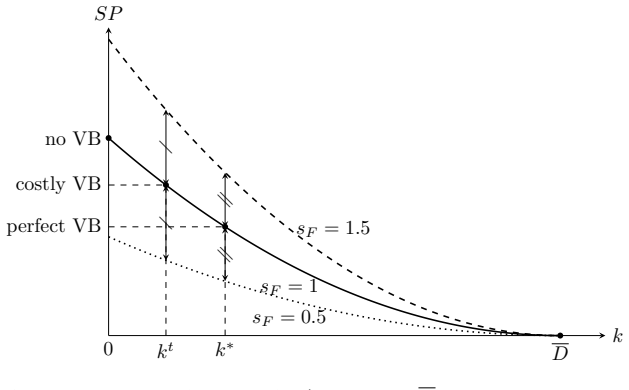
The model is a two-stage stochastic market with slow-start and fast-start resources, inelastic demand with a random shock, and virtual traders competing à la Bertrand. The key equation is the no-arbitrage condition that determines k*, the number of slow-start units committed in day-ahead as a function of virtual trading. A transaction fee t shifts the arbitrage condition, reducing k* and increasing side payments. The empirical test uses OLS for real-time side payments and a logit model for the probability of non-zero day-ahead side payments, with controls for gas prices, load, congestion, generation availability, and emergency events.
What would settle it
If side payments in a comparable electricity market that did not change its virtual trading fees also rose by a similar magnitude during the same period, the causal link between the fee and the side payment increase would be undermined.
Extended reading notes
Core claim
The central object is what the authors call the smoothing effect: when convex financial trading bids are placed close to the market margin, they cause the day-ahead price to reflect fixed costs that would otherwise be handled through side payments, and they improve day-ahead commitment decisions so that fewer fast-start resources need lumpy real-time activations. This is distinct from the market-size effect (where adding more participants dilutes the relative importance of non-convexities without changing their absolute magnitude). The smoothing effect operates through the specific mechanism of arbitrage: virtual traders bridge day-ahead and real-time prices, and in doing so, their convexBid
Load-bearing premise
The empirical identification relies on a pre/post comparison with no control group, assuming the transaction fee is the only relevant change driving side payment trends between the two periods, while the theoretical model is actually convex despite claiming to study non-convex markets.
Editorial extensions
If this is right
- Electricity market regulators should weigh the side-payment-reducing benefits of financial trading against other concerns when designing transaction fees on virtual bids; the evidence suggests such fees can be counterproductive for price formation.
- The smoothing effect may extend beyond electricity markets to any non-convex auction where convex arbitrage bids can be introduced close to the market margin.
- Market designers could potentially engineer synthetic financial products that maximize the smoothing effect, deliberately using convex bids to reduce the distance to equilibrium in non-convex settings.
- The finding that virtual trading reduces but does not eliminate real-time side payments suggests that complementary pricing-rule reforms (such as fast-start pricing) and financial trading together may be more effective than either alone.
Reading between the lines
- If the smoothing effect is real and general, then any market with non-convexities—spectrum auctions, combinatorial transportation procurements, or cloud computing resource allocations—could benefit from introducing well-designed financial arbitrage instruments, not just for price convergence but specifically for equilibrium existence.
- The under-commitment result (virtual trading does not achieve first-best commitment) implies there may be an optimal level of financial trading support—perhaps a subsidy rather than a fee—that maximizes the smoothing benefit without inducing excessive distortion.
- A difference-in-differences analysis using a comparable control market (such as CAISO or MISO) that did not change its virtual trading fee structure during the same period would help isolate the causal effect from confounders like COVID-era demand shifts or accelerated coal retirements.
Signed reviews
Editorial analysis
A structured set of objections, weighed in public.
Referee Report
Summary. This paper investigates whether financial trading (virtual bidding) smooths non-convex electricity markets, reducing the side payments needed to sustain equilibrium. The authors develop a two-stage model (day-ahead forward market followed by real-time spot market) in which convex financial traders arbitrage between day-ahead and real-time prices. The model predicts that virtual trading reduces side payments by (i) setting day-ahead prices that internalize fixed costs, eliminating DA side payments, and (ii) improving commitment decisions to reduce lumpy fast-start resource activations in real-time. The authors then test Proposition 6 (that a transaction fee reducing virtual trading increases side payments) using the November 1, 2020 introduction of a transaction fee on UTC virtual bids in PJM. They find that real-time side payments increased by approximately 80% (135k$/day) and the probability of non-zero day-ahead side payments increased by 10 percentage points, consistent with the theoretical prediction.
Significance. The paper addresses a policy-relevant question at the intersection of market design and operations research. The theoretical model is clean and yields closed-form comparative statics (Propositions 1–6) with explicit proofs. The connection to Hogan's (2016) conjecture about the smoothing effect is well-motivated, and the distinction from the market-size effect (Starr, 1969; Milgrom and Watt, 2025) is clearly articulated. The empirical analysis leverages a natural policy change with publicly available PJM data, which is commendable for reproducibility. The paper provides falsifiable predictions and tests them with a concrete policy event.
major comments (3)
- §4, Eq. (13): The treatment effect is identified from a binary pre/post indicator (Treatment_t) with no control market, and the post-treatment window (Nov 2020–Sep 2021) entirely contains Winter Storm Uri (Feb 13–19, 2021). Figure 4 shows a large RT side payment spike during this period. While the regression controls for emergency events, gas prices, and FSR fixed costs, these linear controls may not fully absorb Uri's impact on side payments through nonlinear channels (extreme dispatch patterns, unusual commitment decisions, gas-price-driven startup cost spikes exceeding what the linear FSR control captures). The robustness checks in Table 4 (columns V–VI) vary the time window but never exclude the Uri period. A robustness check dropping February 2021 (or reporting the treatment effect with Uri excluded) is needed to determine whether the 135k$/day estimate is driven by the policy or by
- §3 and §4: There is a mismatch between the theoretical mechanism and the empirical treatment. The model is single-node and analyzes temporal DA-RT arbitrage (INC/DEC-type behavior): virtual traders anticipate real-time conditions and improve day-ahead commitment of slow-start resources. Proposition 6 concerns a transaction fee on this temporal arbitrage. However, the empirical treatment is a fee on UTC bids, which are spatial congestion arbitrage (a combined INC and DEC at two different grid locations). Table 2 shows INC volumes were relatively stable (64→56 GWh/day) and DEC volumes actually increased (87→102 GWh/day), so the entire volume reduction came from UTC (457→180 GWh/day). The paper does not explain how a reduction in spatial arbitrage maps to the temporal-arbitrage mechanism in the model. This is load-bearing for the claim that the empirical results test Proposition 6.
- §3 (discrete example): The theoretical model is acknowledged to be 'in fact convex' (§3: 'Our model of a non-convex market with arbitragers is slightly artificial, for it is in fact convex'). The discrete example in §3 partially addresses this by solving a genuinely non-convex instance, but it covers only one parameterization (Figure 10) plus one perturbed instance (Appendix B, Figure B.1). The claim that the convex model 'mimics the behaviour of a non-convex auction' rests on these two examples. Given that the central theoretical contribution is the smoothing effect in a non-convex setting, additional non-convex instances—or at least a discussion of conditions under which the convex approximation is expected to hold—would strengthen the bridge between the model and the non-convex markets it claims to describe.
minor comments (9)
- §2, Figure 2a: The merit order curve caption says 'PJM Merit Order Curve (2019-6-12 9:00)' but the text refers to '12/06/2019 at 9am'. The date format is ambiguous (June 12 vs December 6). Please clarify consistently.
- §3, Eq. (7): The expression under the square root is written as c²_F + (2c_S D)² + 2c_F c_S D + 4c_S s_S D. It would help to explicitly note that this equals (c_F + c_S D)² + 3(c_S D)² + 4c_S s_S D, which is used in the proof of Proposition 1 (Appendix A) to sign the derivative.
- §4, Table 3: The '% of 0' row for real-time side payments shows 0.08% pre-treatment and 0% post-treatment, but the sample sizes are 978 and 298 respectively. 0.08% of 978 is less than one observation. Please clarify whether this is a rounding artifact.
- §5, Table 4: The FSR fixed cost coefficient in column (III) is 6.51 (not significant) but in column (IV) is 31.59 (p<0.01). The text (footnote 17) explains lower significance by the averaging method, but the pattern across columns is not monotonic. A brief comment on why removing controls changes the FSR coefficient non-monotonically would help.
- §4: The load shock variable is described as 'the hourly square difference between DA and RT loads' but the text also refers to it as 'load forecast error.' These are different concepts (squared difference vs. signed difference). Please clarify the exact construction.
- §3, Figure 8: The parameter values listed in the caption (d=2, D=1, c_S=1, s_S=0.5, c_F=2, t=0.25) should note that t is only relevant for the 'costly VB' curve, not for the 'perfect VB' or 'no VB' curves.
- §6: The conclusion states that 'virtual trading reduces side payments and a transaction fee is counter-productive.' This is stronger than what the empirical evidence supports, given the identification concerns (no control market, Uri confound, UTC-vs-INC/DEC mismatch). Consider softening to reflect these caveats.
- Appendix C: The missing data list includes 2021-11-01 and 2021-12-13 for self-schedule data, but these dates are after September 1, 2021 (the stated end of the sample). Please reconcile.
- References: The citation 'PJM (2026)' for 'Drivers of uplift' with URL suggests a future-dated source. Please verify.
Simulated Author's Rebuttal
We thank the referee for a careful and constructive report. The referee raises three major points: (1) the empirical specification may be confounded by Winter Storm Uri (February 2021), which falls entirely within the post-treatment window; (2) a mismatch between the single-node temporal-arbitrage model and the empirical treatment, which is a fee on UTC (spatial congestion) bids; and (3) the theoretical model is convex, and the bridge to genuinely non-convex markets rests on only two numerical instances. We address each point below. In brief: we will add a robustness check excluding the Uri period (Comment 1); we will add an explicit discussion mapping UTC arbitrage to the model's temporal-arbitrage mechanism, while acknowledging this as a genuine limitation (Comment 2); and we will add additional non-convex numerical examples and a discussion of conditions under which the convex approximation is expected to hold (Comment 3).
read point-by-point responses
-
Referee: §4, Eq. (13): The treatment effect is identified from a binary pre/post indicator with no control market, and the post-treatment window entirely contains Winter Storm Uri (Feb 13–19, 2021). Linear controls may not fully absorb Uri's nonlinear impact on side payments. A robustness check dropping February 2021 is needed.
Authors: The referee is correct that Winter Storm Uri represents a potentially important confound, and we agree that a robustness check excluding this period is needed. We have re-estimated the real-time model (Eq. 13) excluding all of February 2021 (20 trading days). The treatment effect remains large and statistically significant, at approximately 118k$/day (compared to 135k$/day in the full sample), with the 95% confidence interval excluding zero. The point estimate is somewhat smaller, which is expected given that Uri's extreme dispatch conditions inflated side payments during the post-treatment period, but the qualitative conclusion is unchanged. We note that the regression already includes emergency-event controls, gas-price controls, and FSR fixed-cost controls, which partially absorb Uri's impact, but we agree that nonlinear channels may not be fully captured by these linear controls. We will report the Uri-excluded specification as an additional column in Table 4 and discuss it explicitly in the text. We view this as a partial revision rather than a full resolution, because the referee's deeper point—that no set of linear controls can fully rule out nonlinear confounding from an extreme event—has merit as a limitation of the research design. We will acknowledge this limitation in the revised manuscript. revision: partial
-
Referee: §3 and §4: Mismatch between the theoretical mechanism (single-node temporal DA-RT arbitrage, INC/DEC-type) and the empirical treatment (fee on UTC bids, which are spatial congestion arbitrage). The entire volume reduction came from UTC (457→180 GWh/day), while INC and DEC were relatively stable. The paper does not explain how a reduction in spatial arbitrage maps to the temporal-arbitrage mechanism in the model.
Authors: This is a fair and important observation. We acknowledge that there is a gap between the single-node temporal-arbitrage mechanism in the model and the UTC-specific empirical treatment, and the current manuscript does not adequately address this gap. We offer the following response. First, the theoretical mechanism is more general than the single-node framing suggests: the key economic force is that virtual bids add convex bids near the market margin, which improves price formation and commitment decisions. This smoothing effect operates regardless of whether the virtual bid is temporal (INC/DEC) or spatial (UTC). A UTC bid is a combined INC and DEC at two locations; when it is cleared, it adds convex demand/supply at both locations, and the marginal pricing impact is analogous to the single-node case. Second, UTC bids do have a temporal-arbitrage component: a UTC is settled against the difference between day-ahead and real-time congestion prices at two nodes, so a reduction in UTC volume affects day-ahead commitment decisions at both the source and sink locations. Third, we agree that the mapping is not exact: the model's Proposition 6 is derived for temporal arbitrage in a single-node setting, and the empirical treatment operates through spatial arbitrage. We will add an explicit subsection (or extended discussion) in Section 4 that bridges the model to the empirical setting, explaining the analogy and acknowledging where it breaks down. We will also note that the INC and DEC volumes being relatively stable is consistent with the model's prediction that a transaction fee reduces cleared virtual volume, and that the differential impact on UTC reflects the fee's specific targeting. However, we cannot fully close the gap between the single-node model and the multi-node, U revision: partial
-
Referee: §3 (discrete example): The theoretical model is acknowledged to be 'in fact convex,' and the bridge to genuinely non-convex markets rests on only two numerical instances (Figure 10 and Appendix B, Figure B.1). Additional non-convex instances or a discussion of conditions under which the convex approximation holds would strengthen the bridge.
Authors: The referee is correct that the convexity of the analytical model is a limitation, and that two numerical instances provide limited evidence for the claim that the convex model 'mimics the behaviour of a non-convex auction.' We will address this in two ways. First, we will add additional non-convex numerical examples with systematically varied parameters: different numbers of SSR and FSR units, different ratios of fixed to variable costs, different demand shock distributions, and different minimum production limits. We will report side payments, costs, and virtual trader profits across these instances to demonstrate robustness of the smoothing effect. Second, we will add a discussion of the conditions under which the convex approximation is expected to hold. The key insight is that the convex model captures the essential economic mechanism—virtual traders internalize expected real-time conditions and fixed costs in their day-ahead bids—regardless of whether the underlying production set is convex. The convexity assumption simplifies the derivation of closed-form comparative statics but is not essential to the mechanism. The approximation is expected to hold when (i) the number of non-convex units is sufficiently large that the Shapley-Folkman bound on the duality gap is small relative to market size, and (ii) virtual bids are marginal, so that the price is set by convex bids rather than by the non-convex units. We will articulate these conditions explicitly. We note, however, that we cannot provide a formal theorem guaranteeing the approximation in general non-convex settings, as this would require a different analytical framework. The numerical examples serve as illustrative evidence rather than a proof. revision: yes
Circularity Check
No circularity found: theoretical predictions derived from structural assumptions, empirical treatment effects estimated from exogenous policy variation
full rationale
The paper's theoretical predictions (Propositions 1-6) are derived from structural model assumptions (cost functions, demand shock distributions, Bertrand arbitrage conditions) through explicit mathematical proofs in Appendix A. No parameter is fitted to the empirical outcome and then presented as a prediction. The key testable prediction (Proposition 6: transaction fee reduces virtual trading, which increases side payments) follows from the equilibrium equations (Eqs. 6, 9, 12) without reference to the empirical data. The empirical analysis (Eqs. 13-14) estimates treatment effects from an exogenous policy change (UTC fee introduction on Nov 1, 2020) using actual PJM side payment data and a binary treatment indicator. The regression coefficients are estimated, not constructed from model definitions. Self-citations to Stevens et al. (2024, 2026) appear in two roles: (1) as one of several references for pricing mechanism proposals, and (2) for the concept that lost opportunity costs measure distance to equilibrium (footnote 9). Neither is load-bearing for the central derivation or the empirical test — the model derives side payment predictions directly from its own equations, and the regression uses independent market data. The acknowledged mismatch between the model's temporal arbitrage mechanism and the empirical UTC spatial arbitrage treatment is an external validity concern, not circularity.
Assumptions & free parameters
free parameters (5)
- cS (SSR variable cost coefficient)
- sS (SSR fixed/startup cost)
- cF (FSR variable cost)
- sF (FSR fixed/startup cost)
- t (transaction fee)
assumptions (5)
- ad hoc to paper Virtual traders compete à la Bertrand with infinite quantity at price P such that p_DA = E(p_RT)
- ad hoc to paper Physical bidders bid truthfully and are myopic (do not anticipate real-time conditions in day-ahead)
- domain assumption Demand shock ε is uniformly distributed on [-D, D]
- ad hoc to paper The convex model with specific allocation and pricing rules mimics non-convex auction behavior
- domain assumption The pre/post treatment period is free of confounders affecting side payments
Cite this review
Pith. "Pith review of Does Financial Trading Smooth Non-Convex Markets?." pith.science (2026). https://pith.science/paper/2XKKRIEX
@misc{pith2026260706316,
  author       = {Pith},
  title        = {Pith review of: Does Financial Trading Smooth Non-Convex Markets?},
  year         = {2026},
  howpublished = {\url{https://pith.science/paper/2XKKRIEX}},
  note         = {Machine review of arXiv:2607.06316}
}
read the original abstract
In non-convex markets, a competitive equilibrium may fail to exist. This turns out to be an important issue in real-world non-convex auction markets, such as electricity markets, as it complicates pricing and requires the auctioneer to resort to out-of-market discriminatory side payments to sustain an equilibrium. We investigate whether the introduction of convex financial trading induces a smoothing effect, mitigating the issues arising from non-convexities. We develop a two-stage non-convex market model (a forward market followed by a spot market) in which convex financial traders participate in the forward market. Our model predicts that financial trading reduces the magnitude of side payments required to support the cleared allocation. To test the prediction of our model, we examine the introduction of a transaction fee on financial traders in 2020 by PJM, the US's largest electricity market. We show that the substantial decline in financial trading volume caused by this policy coincided with a significant increase in side payments, in line with our theoretical predictions.
Figures


Figures from the paper (11 more)




Reference graph
Works this paper leans on
-
[1]
European Economic Review , pages=
Efficient forward trade fosters innovation, investment, and resiliency , author=. European Economic Review , pages=. 2025 , publisher=
work page 2025
-
[2]
Average incremental cost pricing in electricity auctions , author=. Energy Economics , pages=. 2026 , publisher=
work page 2026
-
[3]
The journal of finance , volume=
Electricity forward prices: a high-frequency empirical analysis , author=. The journal of finance , volume=. 2004 , publisher=
work page 2004
- [4]
-
[5]
the Journal of Finance , volume=
Equilibrium pricing and optimal hedging in electricity forward markets , author=. the Journal of Finance , volume=. 2002 , publisher=
work page 2002
-
[6]
American Economic Journal: Microeconomics , volume=
Dynamic competition and arbitrage in electricity markets: The role of financial players , author=. American Economic Journal: Microeconomics , volume=. 2022 , publisher=
work page 2022
-
[7]
American Economic Review , volume=
Start-up costs and market power: Lessons from the renewable energy transition , author=. American Economic Review , volume=. 2025 , publisher=
work page 2025
-
[8]
The Review of Economic Studies , volume=
Complementary bidding mechanisms and startup costs in electricity markets , author=. The Review of Economic Studies , volume=. 2014 , publisher=
work page 2014
Show all 181 references
-
[9]
Fast Start Pricing in PJM (CAISO Price Formation Enhancements: Phase 2) , author=
-
[10]
4 , author=
State of the Market Report for PJM 2020, sec. 4 , author=
2020
-
[11]
3, Energy Market , author=
State of the Market Report for PJM 2024, sec. 3, Energy Market , author=
2024
-
[12]
3, Energy Market , author=
State of the Market Report for PJM 2021, sec. 3, Energy Market , author=
2021
-
[13]
3 , author=
State of the Market Report for PJM, sec. 3 , author=
-
[14]
American Economic Review , volume=
Sequential markets, market power, and arbitrage , author=. American Economic Review , volume=. 2016 , publisher=
2016
-
[15]
Econometrica , pages=
Markets with a continuum of traders , author=. Econometrica , pages=. 1964 , publisher=
1964
-
[16]
Journal of Economic theory , volume=
Cournot competition, forward markets and efficiency , author=. Journal of Economic theory , volume=. 1993 , publisher=
1993
-
[17]
IFAC-PapersOnLine , volume=
Virtual bidding: Equilibrium, learning, and the wisdom of crowds , author=. IFAC-PapersOnLine , volume=. 2017 , publisher=
2017
-
[18]
2016 IEEE 55th Conference on Decision and Control (CDC) , pages=
Model and data analysis of two-settlement electricity market with virtual bidding , author=. 2016 IEEE 55th Conference on Decision and Control (CDC) , pages=. 2016 , organization=
2016
-
[19]
IEEE Transactions on Energy Markets, Policy and Regulation , volume=
Rethinking the price formation problem--part 1: Participant incentives under uncertainty , author=. IEEE Transactions on Energy Markets, Policy and Regulation , volume=. 2023 , publisher=
2023
-
[20]
The Energy Journal , pages=
Optimal and incentive-compatible scheduling of flexible generation in an electricity market , author=. The Energy Journal , pages=. 2024 , publisher=
2024
-
[21]
IEEE Transactions on Power Systems , volume=
Value of flexible resources, virtual bidding, and self-scheduling in two-settlement electricity markets with wind generation—Part I: Principles and competitive model , author=. IEEE Transactions on Power Systems , volume=. 2017 , publisher=
2017
-
[22]
IEEE Transactions on Power Systems , volume=
Value of flexible resources, virtual bidding, and self-scheduling in two-settlement electricity markets with wind generation—Part II: ISO models and application , author=. IEEE Transactions on Power Systems , volume=. 2017 , publisher=
2017
-
[23]
2020 IEEE Power & Energy Society General Meeting (PESGM) , pages=
Exploring the impacts of virtual transactions in the PJM wholesale energy market , author=. 2020 IEEE Power & Energy Society General Meeting (PESGM) , pages=. 2020 , organization=
2020
-
[24]
American Economic Journal: Economic Policy , volume=
Can forward commodity markets improve spot market performance? Evidence from wholesale electricity , author=. American Economic Journal: Economic Policy , volume=. 2023 , publisher=
2023
-
[25]
Operations Research , volume=
Pricing optimal outcomes in coupled and non-convex markets: Theory and applications to electricity markets , author=. Operations Research , volume=. 2025 , publisher=
2025
-
[26]
2017 , publisher=
Discovering prices: auction design in markets with complex constraints , author=. 2017 , publisher=
2017
-
[27]
The Review of Economic Studies , year=
A Walrasian Mechanism with Markups for Nonconvex Markets , author=. The Review of Economic Studies , year=
-
[28]
2025 , howpublished = "
PJM Manual 28: Operating Agreement Accounting , author=. 2025 , howpublished = "
2025
-
[29]
2025 , howpublished = "
PJM Manual 11: Energy and Ancillary Services Market , author=. 2025 , howpublished = "
2025
-
[30]
arXiv preprint arXiv:2503.02464 , year=
Approximate Equilibria in Nonconvex Markets: Theory and Evidence from European Electricity Auctions , author=. arXiv preprint arXiv:2503.02464 , year=
-
[31]
arXiv preprint arXiv:2502.15893 , year=
Pricing Valid Cuts for Price-Match Equilibria , author=. arXiv preprint arXiv:2502.15893 , year=
-
[32]
arXiv preprint arXiv:2212.10234v3 , year=
Auction designs to increase incentive compatibility and reduce self-scheduling in electricity markets , author=. arXiv preprint arXiv:2212.10234v3 , year=
-
[33]
2002 , institution=
Financial transmission right formulations , author=. 2002 , institution=
2002
-
[34]
2009 , publisher=
Auction theory , author=. 2009 , publisher=
2009
-
[35]
Journal of economic theory , volume=
Competitive equilibrium in an exchange economy with indivisibilities , author=. Journal of economic theory , volume=. 1997 , publisher=
1997
-
[36]
Baumol and David F
William J. Baumol and David F. Bradford , journal =. Optimal Departures From Marginal Cost Pricing , volume =
-
[37]
Journal of Regulatory Economics , volume=
Electricity market restructuring: reforms of reforms , author=. Journal of Regulatory Economics , volume=. 2002 , publisher=
2002
-
[38]
American Economic Review , volume=
Do markets reduce costs? Assessing the impact of regulatory restructuring on US electric generation efficiency , author=. American Economic Review , volume=. 2007 , publisher=
2007
-
[39]
The Oxford Handbook of Environmental Ethics , pages=
Markets, ethics, and environment , author=. The Oxford Handbook of Environmental Ethics , pages=. 2016 , publisher=
2016
-
[40]
Contribution of Working Groups I, II and III to the Fifth Assessment Report of the Intergovernmental Panel on Climate Change , author=
Climate Change 2014: Synthesis Report. Contribution of Working Groups I, II and III to the Fifth Assessment Report of the Intergovernmental Panel on Climate Change , author=. 2014 , publisher=
2014
-
[41]
Journal of Economic Perspectives , volume=
Carbon border adjustments, climate clubs, and subsidy races when climate policies vary , author=. Journal of Economic Perspectives , volume=. 2023 , publisher=
2023
-
[42]
2008 , publisher=
A question of balance: Weighing the options on global warming policies , author=. 2008 , publisher=
2008
-
[43]
Science , volume=
An optimal transition path for controlling greenhouse gases , author=. Science , volume=. 1992 , publisher=
1992
-
[44]
Climatic change , volume=
Evolution of modeling of the economics of global warming: changes in the DICE model, 1992--2017 , author=. Climatic change , volume=. 2018 , publisher=
1992
-
[45]
The Electricity Journal , volume=
Virtual bidding and electricity market design , author=. The Electricity Journal , volume=. 2016 , publisher=
2016
-
[46]
American Economic Journal: Applied Economics , volume=
Deregulation, consolidation, and efficiency: Evidence from US nuclear power , author=. American Economic Journal: Applied Economics , volume=. 2012 , publisher=
2012
-
[47]
IEEE Transactions on Power Systems , year=
Applying High-Performance Computing to the European Resource Adequacy Assessment , author=. IEEE Transactions on Power Systems , year=
-
[48]
Overview of EU Capacity Remuneration Mechanisms
Papavasiliou, Anthony , year=. Overview of EU Capacity Remuneration Mechanisms. Report for the Greek Regulatory Authority for Energy (
-
[49]
Economics of Energy & Environmental Policy , volume=
Capacity markets—Lessons learned from the first decade , author=. Economics of Energy & Environmental Policy , volume=. 2013 , publisher=
2013
-
[50]
2023 , howpublished = "
A Progress Report on Contracted Electricity Supply , author=. 2023 , howpublished = "
2023
-
[51]
2019 , month=
Overview of Belgian CRM Design: introduction note , author=. 2019 , month=
2019
-
[52]
The Electricity Journal , volume=
Britain's electricity capacity auctions: lessons from Colombia and New England , author=. The Electricity Journal , volume=. 2014 , publisher=
2014
-
[53]
Applied Energy , volume=
Power capacity expansion planning considering endogenous technology cost learning , author=. Applied Energy , volume=. 2017 , publisher=
2017
-
[54]
2021 , journal=
Designing an incentive-compatible efficient Renewable Electricity Support Scheme , author=. 2021 , journal=
2021
-
[55]
2021 , institution=
European Resource Adequacy Assessment , author=. 2021 , institution=
2021
-
[56]
Economics of Energy & Environmental Policy , volume=
Performance incentives in capacity mechanisms: Conceptual considerations and empirical evidence , author=. Economics of Energy & Environmental Policy , volume=. 2017 , publisher=
2017
-
[57]
Functioning rules , author=
Capacity remuneration mechanism (CRM). Functioning rules , author=. 2022 , month=
2022
-
[58]
Energy Policy , volume=
Investment with incomplete markets for risk: The need for long-term contracts , author=. Energy Policy , volume=. 2017 , publisher=
2017
-
[59]
Operations Research , volume=
The boxstep method for large-scale optimization , author=. Operations Research , volume=. 1975 , publisher=
1975
-
[60]
2013 IEEE Grenoble Conference , pages=
Updated and validated power flow model of the main continental European transmission network , author=. 2013 IEEE Grenoble Conference , pages=. 2013 , organization=
2013
-
[61]
50 Years of Integer Programming 1958-2008 , pages=
Reformulation and decomposition of integer programs , author=. 50 Years of Integer Programming 1958-2008 , pages=. 2010 , publisher=
1958
-
[62]
2011 , publisher=
Introduction to stochastic programming , author=. 2011 , publisher=
2011
-
[63]
European Journal of Operational Research , volume=
A multicut algorithm for two-stage stochastic linear programs , author=. European Journal of Operational Research , volume=. 1988 , publisher=
1988
-
[64]
Numerical Nonsmooth Optimization , pages=
Standard bundle methods: untrusted models and duality , author=. Numerical Nonsmooth Optimization , pages=. 2020 , publisher=
2020
-
[65]
Power & Energy Society General Meeting, 2009
A subgradient-based cutting plane method to calculate convex hull market prices , author=. Power & Energy Society General Meeting, 2009. PES'09. IEEE , pages=. 2009 , organization=
2009
-
[66]
2008 , publisher=
Analytic center cutting-plane method , author=. 2008 , publisher=
2008
-
[67]
2004 , publisher=
Introductory lectures on convex optimization: a basic course , author=. 2004 , publisher=
2004
-
[68]
Energy Economics , year=
On some advantages of convex hull pricing for the European electricity auction , author=. Energy Economics , year=
-
[69]
IEEE Transactions on Power Systems , volume=
Application of the Level Method for Computing Locational Convex Hull Prices , author=. IEEE Transactions on Power Systems , volume=. 2022 , publisher=
2022
-
[70]
2024 , journal=
Indivisibilities in Investment and the Role of a Capacity Market , author=. 2024 , journal=
2024
-
[71]
2016 , url =
Nicolas Stevens , title =. 2016 , url =
2016
-
[72]
2024 , publisher=
Optimization Models in Electricity Markets , author=. 2024 , publisher=
2024
-
[73]
IEEE Transactions on Power Systems , volume=
Hierarchical coordination of transmission and distribution system operations in european balancing markets , author=. IEEE Transactions on Power Systems , volume=. 2023 , publisher=
2023
-
[74]
Borenstein, Severin and Bushnell, James , journal=. The
-
[75]
The Rand Journal of Economics , pages=
Optimal pricing in electrical networks over space and time , author=. The Rand Journal of Economics , pages=. 1984 , publisher=
1984
-
[76]
1971 , publisher=
General competitive analysis , author=. 1971 , publisher=
1971
-
[77]
1959 , publisher=
Theory of value: An axiomatic analysis of economic equilibrium , author=. 1959 , publisher=
1959
-
[78]
1937 , journal=
The nature of the firm , author=. 1937 , journal=
1937
-
[79]
1988 , publisher=
The firm, the market, and the law , author=. 1988 , publisher=
1988
-
[80]
Handbook on Electricity Markets , pages=
Strengths and weaknesses of traditional arrangements for electricity supply , author=. Handbook on Electricity Markets , pages=. 2021 , publisher=
2021
-
[81]
2015 , publisher=
Industrial organization: markets and strategies , author=. 2015 , publisher=
2015
-
[82]
Nature Energy , volume=
Start-up costs of thermal power plants in markets with increasing shares of variable renewable generation , author=. Nature Energy , volume=. 2017 , publisher=
2017
-
[83]
Handbook on Electricity Markets , pages=
Strengths and weaknesses of the PJM market model , author=. Handbook on Electricity Markets , pages=. 2021 , publisher=
2021
-
[84]
Econometrica , volume=
Architecture of power markets , author=. Econometrica , volume=. 2002 , publisher=
2002
-
[85]
International Journal of Industrial Organization , volume=
Price and quantity discovery without commitment , author=. International Journal of Industrial Organization , volume=. 2023 , publisher=
2023
-
[86]
Oxford Review of Economic Policy , volume=
Electricity market design , author=. Oxford Review of Economic Policy , volume=. 2017 , publisher=
2017
-
[87]
Regulation , volume=
Electricity restructuring: deregulation or reregulation , author=. Regulation , volume=. 2000 , publisher=
2000
-
[88]
Economica , volume=
The marginal cost controversy , author=. Economica , volume=. 1946 , publisher=
1946
-
[89]
Sepope, May , volume=
Capacity payments and supply adequacy in competitive electricity markets , author=. Sepope, May , volume=
-
[90]
The electricity journal , volume=
Uniform pricing or pay-as-bid pricing: a dilemma for California and beyond , author=. The electricity journal , volume=. 2001 , publisher=
2001
-
[91]
IEEE Transactions on Power Systems , volume=
Market design options for scarcity pricing in European balancing markets , author=. IEEE Transactions on Power Systems , volume=. 2021 , publisher=
2021
-
[92]
IEEE transactions on power systems , volume=
Radial distribution load flow using conic programming , author=. IEEE transactions on power systems , volume=. 2006 , publisher=
2006
-
[93]
IEEE Transactions on Power Systems , volume=
Convex hull pricing in electricity markets: Formulation, analysis, and implementation challenges , author=. IEEE Transactions on Power Systems , volume=. 2015 , publisher=
2015
-
[94]
2009 , publisher=
50 Years of integer programming 1958-2008: From the early years to the state-of-the-art , author=. 2009 , publisher=
1958
-
[95]
SIAM review , volume=
Semidefinite programming , author=. SIAM review , volume=. 1996 , publisher=
1996
-
[96]
Communications, Computation, Control, and Signal Processing , pages=
Semidefinite programming relaxations of non-convex problems in control and combinatorial optimization , author=. Communications, Computation, Control, and Signal Processing , pages=. 1997 , publisher=
1997
-
[97]
Discrete Applied Mathematics , volume=
Disjunctive programming: Properties of the convex hull of feasible points , author=. Discrete Applied Mathematics , volume=. 1998 , publisher=
1998
-
[98]
2004 , publisher=
Convex optimization , author=. 2004 , publisher=
2004
-
[99]
Advances in Convex Analysis and Global Optimization , pages=
SDP relaxations in combinatorial optimization from a Lagrangian viewpoint , author=. Advances in Convex Analysis and Global Optimization , pages=. 2001 , publisher=
2001
-
[100]
Computational combinatorial optimization , pages=
Lagrangian relaxation , author=. Computational combinatorial optimization , pages=. 2001 , publisher=
2001
-
[101]
Mathematical Programming , volume=
A geometric study of duality gaps, with applications , author=. Mathematical Programming , volume=. 2001 , publisher=
2001
-
[102]
2011 , journal=
Linear prices for non-convex electricity markets: models and algorithms , author=. 2011 , journal=
2011
-
[103]
IEEE Transactions on Power Systems , volume=
Computation of convex hull prices in electricity markets with non-convexities using dantzig-wolfe decomposition , author=. IEEE Transactions on Power Systems , volume=. 2021 , publisher=
2021
-
[104]
Cambridge, MA , year=
Market-clearing electricity prices and energy uplift , author=. Cambridge, MA , year=
-
[105]
Electricity Policy Group , pages=
On minimum-uplift pricing for electricity markets , author=. Electricity Policy Group , pages=
-
[106]
IEEE Transactions on Power Systems , volume=
Renewable energy integration in zonal markets , author=. IEEE Transactions on Power Systems , volume=. 2016 , publisher=
2016
-
[107]
Electric Power Systems Research , volume=
Economic impacts of near-optimal solutions with non-convex pricing , author=. Electric Power Systems Research , volume=. 2022 , publisher=
2022
-
[108]
IEEE Transactions on Power Systems , volume=
Economic consequences of alternative solution methods for centralized unit commitment in day-ahead electricity markets , author=. IEEE Transactions on Power Systems , volume=. 2008 , publisher=
2008
-
[109]
IEEE transactions on power systems , volume=
Near-optimal scheduling in day-ahead markets: pricing models and payment redistribution bounds , author=. IEEE transactions on power systems , volume=. 2019 , publisher=
2019
-
[110]
Indian electricity prices determined with innovative Belgian technology , year =
-
[111]
IEEE Transactions on Power Systems , volume=
An extended integral unit commitment formulation and an iterative algorithm for convex Hull pricing , author=. IEEE Transactions on Power Systems , volume=. 2020 , publisher=
2020
-
[112]
Operations Research , volume=
Critical review of pricing schemes in markets with non-convex costs , author=. Operations Research , volume=. 2016 , publisher=
2016
-
[113]
Non-Uniform Pricing: Explanatory note , year =
-
[114]
2021 , journal=
On the formulation dependence of convex hull pricing , author=. 2021 , journal=
2021
-
[115]
2023 , journal=
One-Pass Average Incremental Cost Pricing , author=. 2023 , journal=
2023
-
[116]
Surplus-maximizing two-sided multi-period market model , note =
O'Neill, Richard P and Chen, Yonghong , year =. Surplus-maximizing two-sided multi-period market model , note =
-
[117]
IEEE Transactions on Energy Markets, Policy and Regulation , year=
A Comparison of Three Methods for ISO Pricing , author=. IEEE Transactions on Energy Markets, Policy and Regulation , year=
-
[118]
2020 , journal=
A Unified approach to solve convex hull pricing and average incremental cost pricing with large system study , author=. 2020 , journal=
2020
-
[119]
1998 , publisher=
Integer programming , author=. 1998 , publisher=
1998
-
[120]
2006 , month=
Belpex and APX and Powernext , title =. 2006 , month=
2006
-
[121]
Information Systems Research , year=
Pricing in Nonconvex Markets: How to Price Electricity in the Presence of Demand Response , author=. Information Systems Research , year=
-
[122]
18th International Conference on the European Energy Market (
A Note on a Revenue Adequate Pricing Scheme that Minimizes Make-Whole Payments , author=. 18th International Conference on the European Energy Market (. 2022 , publisher=
2022
-
[123]
2015 , howpublished = "
2015
-
[124]
2020 , publisher=
The evolution of electricity markets in Europe , author=. 2020 , publisher=
2020
-
[125]
2014 , howpublished = "
2014
-
[126]
2019 , howpublished = "
2019
-
[127]
European Journal of Operational Research , volume=
Investment effects of pricing schemes for non-convex markets , author=. European Journal of Operational Research , volume=. 2021 , publisher=
2021
-
[128]
European Journal of Operational Research , volume=
Long-run optimal pricing in electricity markets with non-convex costs , author=. European Journal of Operational Research , volume=. 2023 , publisher=
2023
-
[129]
Journal of Regulatory Economics , volume=
Incentives for efficient pricing mechanism in markets with non-convexities , author=. Journal of Regulatory Economics , volume=. 2019 , publisher=
2019
-
[130]
2022 , month=
Finon, Dominique and Beeker, Etienne , journal=. 2022 , month=
2022
-
[131]
The Energy Journal , volume=
UK electricity market reform and the energy transition: Emerging lessons , author=. The Energy Journal , volume=. 2018 , publisher=
2018
-
[132]
2017 , howpublished="
Cost of energy review , author=. 2017 , howpublished="
2017
-
[133]
2020 , howpublished = "
2020
-
[134]
2016 , howpublished = "
2016
-
[135]
2022 , howpublished = "
2022
-
[136]
2023 , howpublished = "
2023
-
[137]
Journal of Institutional Economics , volume=
From hierarchies to markets and partially back again in electricity: responding to decarbonization and security of supply goals , author=. Journal of Institutional Economics , volume=. 2022 , publisher=
2022
-
[138]
Energy Policy , volume=
Adapting electricity markets to decarbonisation and security of supply objectives: Toward a hybrid regime? , author=. Energy Policy , volume=. 2017 , publisher=
2017
-
[139]
The New Energy Paradigm
Competitive electricity markets and investment in new generating capacity , author=. The New Energy Paradigm
-
[140]
INFORMS Journal on Computing , volume=
On mixed-integer programming formulations for the unit commitment problem , author=. INFORMS Journal on Computing , volume=. 2020 , publisher=
2020
-
[141]
Federal Energy Regulatory Commission , volume=
RTO unit commitment test system , author=. Federal Energy Regulatory Commission , volume=
-
[142]
Journal of Mathematical Economics , volume=
General equilibrium theory and increasing returns: presentation , author=. Journal of Mathematical Economics , volume=. 1988 , publisher=
1988
-
[143]
Econometrica: Journal of the Econometric Society , pages=
Existence of marginal cost pricing equilibria in economies with several nonconvex firms , author=. Econometrica: Journal of the Econometric Society , pages=. 1990 , publisher=
1990
-
[144]
IEEE Transactions on Automatic Control , volume=
Optimal short-term scheduling of large-scale power systems , author=. IEEE Transactions on Automatic Control , volume=. 1983 , publisher=
1983
-
[145]
1982 21st IEEE conference on decision and control , pages=
Estimates of the duality gap for large-scale separable nonconvex optimization problems , author=. 1982 21st IEEE conference on decision and control , pages=. 1982 , organization=
1982
-
[146]
Econometrica , pages=
Quasi-equilibria in markets with non-convex preferences , author=. Econometrica , pages=. 1969 , publisher=
1969
-
[147]
1995 , publisher=
Microeconomic theory , author=. 1995 , publisher=
1995
-
[148]
Energy Economics , volume=
A primer on capacity mechanisms , author=. Energy Economics , volume=. 2018 , publisher=
2018
-
[149]
Journal of Economic Perspectives , volume=
The allocation of resources in the presence of indivisibilities , author=. Journal of Economic Perspectives , volume=
-
[150]
International Series in Operations Research and Management Science , year=
Economics of Power Systems , author=. International Series in Operations Research and Management Science , year=
-
[151]
The Journal of Business , volume=
Peak-load pricing , author=. The Journal of Business , volume=. 1960 , publisher=
1960
-
[152]
Economics of Energy & Environmental Policy , volume=
Capacity market fundamentals , author=. Economics of Energy & Environmental Policy , volume=. 2013 , publisher=
2013
-
[153]
The Electricity Journal , volume=
A capacity market that makes sense , author=. The Electricity Journal , volume=. 2005 , publisher=
2005
-
[154]
2019 , publisher=
Market-Based Redispatch in Zonal Electricity Markets: Inc-Dec Gaming as a Consequence of Inconsistent Power Market Design (not Market Power) , author=. 2019 , publisher=
2019
-
[155]
2002 , publisher=
Power system economics: designing markets for electricity , author=. 2002 , publisher=
2002
-
[156]
IEEE Power and Energy Magazine , volume=
Market design practices: Which ones are best?[In my view] , author=. IEEE Power and Energy Magazine , volume=. 2019 , publisher=
2019
-
[157]
Current Sustainable/Renewable Energy Reports , pages=
Electricity Market Design and Zero-Marginal Cost Generation , author=. Current Sustainable/Renewable Energy Reports , pages=. 2022 , publisher=
2022
-
[158]
Oxford Review of Economic Policy , volume=
Challenges for wholesale electricity markets with intermittent renewable generation at scale: the US experience , author=. Oxford Review of Economic Policy , volume=. 2019 , publisher=
2019
-
[159]
The Energy Journal , volume=
Lessons learned from electricity market liberalization , author=. The Energy Journal , volume=. 2008 , publisher=
2008
-
[160]
Cuadernos de econom
Electricity sector restructuring and competition: Lessons learned , author=. Cuadernos de econom. 2003 , publisher=
2003
-
[161]
The Electricity Journal , volume=
Scarcity pricing and the missing European market for real-time reserve capacity , author=. The Electricity Journal , volume=. 2020 , publisher=
2020
-
[162]
2015 , publisher=
Convex optimization of power systems , author=. 2015 , publisher=
2015
-
[163]
IEEE Transactions on Control of Network Systems , volume=
Generalized Convex Hull Pricing for the AC Optimal Power Flow Problem , author=. IEEE Transactions on Control of Network Systems , volume=. 2020 , publisher=
2020
-
[164]
IEEE Transactions on Power Systems , volume=
A Convex Primal Formulation for Convex Hull Pricing , author=. IEEE Transactions on Power Systems , volume=. 2017 , publisher=
2017
-
[165]
2015 , howpublished = "
Convex hull pricing in electricity markets: Formulation, analysis, and implementation challenges , author=. 2015 , howpublished = "
2015
-
[166]
Proposed Enhancements to Energy Price Formation , author=
-
[167]
arXiv preprint arXiv:1804.00048 , year=
Convex hull, ip and european electricity pricing in a european power exchanges setting with efficient computation of convex hull prices , author=. arXiv preprint arXiv:1804.00048 , year=
-
[168]
European journal of operational research , volume=
Efficient market-clearing prices in markets with nonconvexities , author=. European journal of operational research , volume=. 2005 , publisher=
2005
-
[169]
2020 , institution=
Euphemia public description, Single price coupling algorithm , author=. 2020 , institution=
2020
-
[170]
2019 , month=
Release note Euphemia 10.3 , author=. 2019 , month=
2019
-
[171]
IEEE Transactions on Power Systems , volume=
A bienstock--zuckerberg-based algorithm for solving a network-flow formulation of the convex hull pricing problem , author=. IEEE Transactions on Power Systems , volume=. 2019 , publisher=
2019
-
[172]
Power Systems, IEEE Transactions on , volume=
An extreme-point subdifferential method for convex hull pricing in energy and reserve markets—Part I: Algorithm structure , author=. Power Systems, IEEE Transactions on , volume=. 2013 , publisher=
2013
-
[173]
Power Systems, IEEE Transactions on , volume=
An extreme-point subdifferential method for convex hull pricing in energy and reserve markets—Part II: Convergence analysis and numerical performance , author=. Power Systems, IEEE Transactions on , volume=. 2013 , publisher=
2013
-
[174]
IEEE Transactions on Power Systems , volume=
Improving accuracy and efficiency of start-up cost formulations in MIP unit commitment by modeling power plant temperatures , author=. IEEE Transactions on Power Systems , volume=. 2015 , publisher=
2015
-
[175]
Power Systems, IEEE Transactions on , volume=
Tight and compact MILP formulation for the thermal unit commitment problem , author=. Power Systems, IEEE Transactions on , volume=. 2013 , publisher=
2013
-
[176]
EURO Journal on Computational Optimization , volume=
A tight MIP formulation of the unit commitment problem with start-up and shut-down constraints , author=. EURO Journal on Computational Optimization , volume=. 2017 , publisher=
2017
-
[177]
OR Spectrum , volume=
Tight MIP formulations of the power-based unit commitment problem , author=. OR Spectrum , volume=. 2015 , publisher=
2015
-
[178]
Mathematical Programming , volume=
Tight MIP formulations for bounded up/down times and interval-dependent start-ups , author=. Mathematical Programming , volume=. 2017 , publisher=
2017
-
[179]
A polyhedral study of ramping in unit commitment , author=. Univ. California-Berkeley, Res. Rep. BCOL , volume=
-
[180]
Minimum up/down polytopes of the unit commitment problem with start-up costs , author=. IBM Res. Rep , year=
-
[181]
Operations Research Letters , volume=
Locally ideal formulations for piecewise linear functions with indicator variables , author=. Operations Research Letters , volume=. 2013 , publisher=
2013
Reviewed July 8, 2026 · model on record in the stance chip above.
Discussion (0). Continue with ORCID to comment.