REVIEW 5 major objections 5 minor 1 cited by
Model Context Protocols in Adaptive Transport Systems: A Survey
T0 review · 5 major / 5 minor · reviewed 2026-08-05 · deepseek-v4-flash
Pith's one-line read This survey argues that fragmented adaptive transport systems are already converging on the Model Context Protocol as their standardized integration layer.
desk verdict Useful literature-organizing survey whose central unification claim is assumed, not shown; the taxonomy is the real contribution. read the letter →
The pith
A machine-rendered reading of the paper's core claim, the machinery that carries it, and where it could break.
The reading
What carries the argument
MCP is an open protocol standard that lets AI clients discover, negotiate, and exchange context with servers through JSON-RPC 2.0 messages over persistent sessions. In this paper it is the load-bearing unification mechanism: its standardized client-server interface, dynamic capability advertisement, and tool orchestration are what would bridge protocol-level adaptation with context-aware decision-making, replacing point-to-point adapters and domain-specific middleware.
What would settle it
Take an urban intersection scenario from Section 1.2, implement MCP over a realistic V2X communication stack (e.g., in a network simulator with live sensor feeds and emergency-vehicle preemption), and measure end-to-end context-exchange latency, message overhead, and failure recovery against a baseline using existing point-to-point or message-broker integration. If MCP's overhead misses the hard real-time deadlines or degrades reliability below the legacy baseline, the convergence-to-MCP claim is empirically refuted.
Extended reading notes
Core claim
The paper's central claim is that MCP's design—persistent client-server sessions, JSON-RPC 2.0 messaging, capability negotiation, and semantic context representation—already matches what adaptive transport systems need, and that existing research has been moving toward this architecture without naming it. It organizes the field into five categories (adaptive protocol mechanisms, context-aware frameworks, unification models, transport system integration, and MCP-enabled architectures) and reads prior work as implicit convergence. The stated conclusion is that traditional transport protocols have reached the limits of isolated adaptation, and that MCP's semantic interoperability makes it the c
Load-bearing premise
The whole argument depends on the assumption that MCP, a protocol designed for AI applications to talk to tools and data sources, can be transplanted into safety-critical transport systems without a fundamental redesign—yet the paper offers no implementation, simulation, or benchmark showing that its persistent sessions and JSON-RPC message overhead can meet transport latency, reliability, and safety requirements.
Editorial extensions
If this is right
- If MCP is the natural convergence point, transport researchers can stop inventing new domain-specific integration protocols and instead extend one standard.
- Context silos (sensor telemetry, driver state, network telemetry) could be published and consumed as semantically tagged MCP resources across vehicles, roadside units, and clouds.
- Safety-critical coordination at intersections could in principle run over MCP's persistent sessions, with capability negotiation replacing pre-configured ad hoc links.
- The window for shaping MCP is open now, while the protocol is still being standardized, making the roadmap's timing actionable.
- Any deployed MCP-enabled transport system would make the claimed unification testable rather than architectural.
Reading between the lines
- The survey's own caveats imply MCP would need a transport-specific performance profile: JSON-RPC text overhead, persistent-session costs, and semantic routing latency are acknowledged risks that no current benchmark resolves.
- A concrete testable extension is to run MCP over existing V2X or VANET stacks in simulation and compare message latency, overhead, and reliability against point-to-point and message-broker baselines.
- The convergence thesis predicts that successful transport integration systems, whether or not they use MCP, will independently evolve persistent context-exchange sessions with capability discovery; that prediction is checkable against current designs.
- The paper's roadmap treats quantum communication and post-quantum cryptography as future directions, which implies the authors expect MCP's transport binding to change as the underlying network physics change rather than being fixed.
Editorial analysis
A structured set of objections, weighed in public.
Referee Report
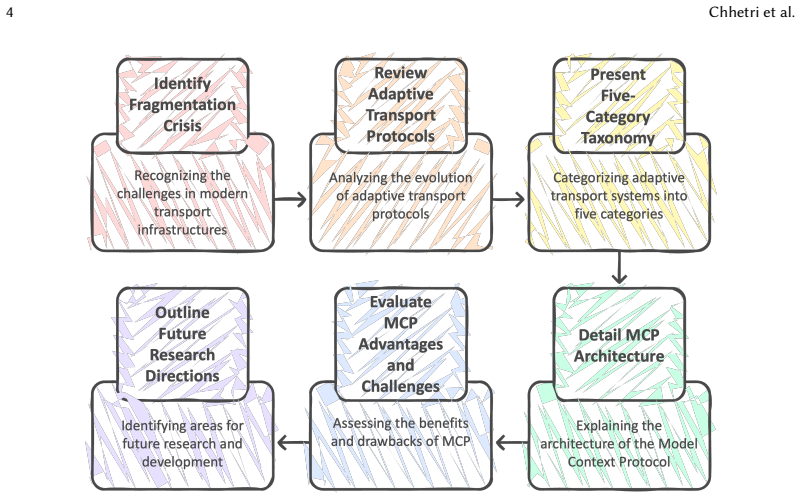
Summary. The paper claims to be the first systematic survey of the Model Context Protocol (MCP) as a unifying paradigm for adaptive transport systems. It proposes a five-category taxonomy (adaptive protocol mechanisms, context-aware frameworks, unification models, transport system integration, and MCP-enabled architectures), reviews background work in adaptive transport and context-aware computing, and asserts three findings: that traditional transport protocols have reached the limits of isolated adaptation, that MCP's client-server and JSON-RPC structure enables semantic interoperability, and that AI-driven transport demands MCP-like integration. It closes with a research roadmap and a companion GitHub repository. The paper contains no original experiments, simulations, benchmarks, formal models, or corpus-based analysis; Section 7 discusses evaluation methodologies in general terms without applying them to MCP.
Significance. If the convergence thesis were established, this could be a useful roadmap for MCP standardization in transport systems. The taxonomy is a reasonable organizing device, and the paper is candid about overhead, security, and standardization challenges in Sections 5 and 8. The companion repository and the broad bibliography are useful community resources. However, the central claims are asserted rather than demonstrated: the 'systematic' methodology is absent, the semantic-interoperability claim conflates syntactic message structure with shared meaning, and the transfer of MCP to safety-critical transport is assumed without any quantitative or architectural evidence. These are load-bearing, not cosmetic, weaknesses.
major comments (5)
- [Abstract; §1.4; §10] The paper describes itself as a 'first systematic investigation' and 'systematic analysis of research spanning 26 years,' but it provides no search strategy, database list, inclusion/exclusion criteria, screening protocol, or coding scheme. The reader cannot reproduce the literature selection or verify that the taxonomy was derived systematically rather than ad hoc. For a survey in a journal such as ACM Computing Surveys, this missing methodology directly undermines the central claim of systematicity.
- [Abstract; §4.2; Box 1; Table 2] The claim that 'MCP's client-server and JSON-RPC structure enables semantic interoperability' is not established. JSON-RPC 2.0 defines message syntax—requests, results, errors, notifications—but syntax alone does not provide shared meaning. Semantic interoperability requires shared ontologies, data models, or schema agreements, which the paper does not show MCP provides. Table 2 itself notes that SOA/REST offers only 'syntactic interoperability,' yet the MCP row asserts semantic interoperability without evidence. This is a load-bearing logical gap.
- [§1.2; §4.1; §4.2; §5.2; §6.1] The transferability of MCP to safety-critical adaptive transport is assumed, not shown. MCP's cited transports are stdio and Streamable HTTP (§4.2), and the paper admits in §5.2 that JSON-RPC's text encoding can cause bandwidth inefficiencies and in §4.1 that persistent bidirectional connections add overhead. Safety-critical V2X applications require bounded latencies and high reliability, but no implementation, simulation, or benchmark anywhere in the paper demonstrates that MCP meets these requirements. The urban intersection scenario in §1.2 is illustrative, not evidence.
- [Abstract; §1.3; §10] The 'implicit convergence toward MCP-like architectures' thesis is an interpretive overlay rather than a finding. The cited MCP surveys ([13,14,16]) address AI-tool integration and agent interoperability, not adaptive transport systems. The paper does not map specific prior transport mechanisms (e.g., congestion control, context-aware middleware) to specific MCP mechanisms to justify the convergence claim. Without that mapping, the conclusion is a restatement of the authors' framing rather than an inference from the surveyed literature.
- [§7; Table 4] Section 7 is titled 'Performance Analysis and Evaluation,' but it contains no evaluation of MCP or of the paper's proposed unification framework. Table 4 lists generic methodologies (simulation, testbed, analytical, trace-driven, hybrid) with examples from unrelated transport and adaptation work; no MCP-specific metric, dataset, baseline, or result is reported. Consequently, the abstract's statement that MCP is 'uniquely suited' to AI-driven transport has no empirical support within the manuscript.
minor comments (5)
- [§1.5] The organization text says 'Sections 5 through 4 analyze each category in detail,' which is reversed; it should be 'Sections 4 and 5' or similar.
- [Title page; §1.4; §3] There are typographical errors: 'SHRIYANK SOMV ANSHI' has an extra space, and 'Context-A ware Frameworks' appears in §1.4 and the Section 3 header. These should be corrected.
- [References] Reference [58] uses placeholder authors 'First Author and Second Author' and lacks a venue, and reference [97] appears unrelated to the QUIC/HTTP3 claim it is cited to support in §6.6. Several references are non-archival web pages; for a survey, archival sources or stable DOIs are preferable.
- [Box 1] The JSON-RPC example appears generic rather than MCP-specific. If Box 1 is meant to illustrate MCP's resource-read pattern, include MCP-specific method names and fields; otherwise clarify that it is generic JSON-RPC.
- [Table 3] The 'MCP-Inspired Mechanisms' column lists analogies rather than demonstrated implementations. Label them as 'proposed analogies' or 'parallels' to avoid implying that these mechanisms are already realized in transport systems.
Circularity Check
The 'convergence toward MCP' finding is built into the authors' five-category taxonomy; no fitted predictions or load-bearing self-citations, but the central unification claim is an interpretive re-labeling rather than an independent result.
-
renaming known result
[Section 1.4 Contribution (1); Section 3; Abstract]
"A taxonomy is introduced that organizes the field into five categories: Adaptive Protocol Mechanisms, Context-Aware Frameworks, Unification Models, Transport System Integration, and MCP-Enabled Architectures. This taxonomy highlights connections across domains and demonstrates how prior developments have implicitly converged toward MCP-like solutions."
The convergence conclusion is an output of the authors' own classification, not an external datum. Section 3 states the taxonomy's aim is 'to highlight how these categories relate to the emerging role of the MCP,' and Table 3 retroactively labels transport features 'MCP-Inspired Mechanisms' (e.g., 'lifecycle management for trips akin to context sessions'). Having defined the endpoint as MCP, the paper then reports that existing work has 'implicitly converged' to MCP; the finding reduces to the framing. The MCP-side properties themselves are externally cited, so this is partial rather than total circularity.
full rationale
The paper contains no equations, no fitted parameters, and no load-bearing self-citations: the MCP architecture facts come from external MCP surveys ([13,14,16,63]) and the transport facts from transport literature, both of which are legitimate external support. The manuscript itself repeatedly concedes the absence of an MCP-in-transport validation: Section 7 contains only generic evaluation methodology and Table 4, with no implementation, simulation, or benchmark; Sections 4.1, 5.2, 6.1, and 6.2 explicitly acknowledge overhead, latency, bandwidth, and standardization costs. Those are validity/support concerns, not circularity. The one circular-adjacent move is the self-fulfilling taxonomy used to infer that prior work has 'implicitly converged' to MCP-like solutions: the classification imposes MCP as the endpoint and then reports convergence as a discovery. Since this is a survey-organizing judgment rather than a derived prediction or fitted result, the circularity score is moderate (3), not higher.
Assumptions & free parameters
assumptions (3)
- domain assumption MCP as described by Anthropic and prior preprints is a stable, correctly characterized protocol.
- domain assumption The surveyed literature is representative and fairly classified into the five-category taxonomy.
- ad hoc to paper Semantic interoperability follows from a JSON-RPC message structure with metadata.
Cite this review
Pith. "Pith review of Model Context Protocols in Adaptive Transport Systems: A Survey." pith.science (2026). https://pith.science/paper/2XLSFQVM
@misc{pith2026250819239,
  author       = {Pith},
  title        = {Pith review of: Model Context Protocols in Adaptive Transport Systems: A Survey},
  year         = {2026},
  howpublished = {\url{https://pith.science/paper/2XLSFQVM}},
  note         = {Machine review of arXiv:2508.19239}
}
read the original abstract
The rapid expansion of interconnected devices, autonomous systems, and AI applications has created severe fragmentation in adaptive transport systems, where diverse protocols and context sources remain isolated. This survey provides the first systematic investigation of the Model Context Protocol (MCP) as a unifying paradigm, highlighting its ability to bridge protocol-level adaptation with context-aware decision making. Analyzing established literature, we show that existing efforts have implicitly converged toward MCP-like architectures, signaling a natural evolution from fragmented solutions to standardized integration frameworks. We propose a five-category taxonomy covering adaptive mechanisms, context-aware frameworks, unification models, integration strategies, and MCP-enabled architectures. Our findings reveal three key insights: traditional transport protocols have reached the limits of isolated adaptation, MCP's client-server and JSON-RPC structure enables semantic interoperability, and AI-driven transport demands integration paradigms uniquely suited to MCP. Finally, we present a research roadmap positioning MCP as a foundation for next-generation adaptive, context-aware, and intelligent transport infrastructures.
Figures


Figures from the paper (1 more)

Forward citations
Cited by 1 Pith paper
-
Model Context Protocol (MCP) Tool Descriptions Are Smelly! Towards Improving AI Agent Efficiency with Augmented MCP Tool Descriptions
Most MCP tool descriptions (97.1%) contain quality smells, and augmenting them improves agent success by a median of 5.85 percentage points at a 67.46% increase in execution steps.
Reference graph
Works this paper leans on
-
[1]
Beyond tcp: The evolution of internet transport protocols, 2015
Olivier Bonaventure. Beyond tcp: The evolution of internet transport protocols, 2015. Keynote, October 2015 CNSM
2015
-
[2]
Quic – a vehicle for transport protocol evolution, 2018
Ericsson. Quic – a vehicle for transport protocol evolution, 2018. Accessed: 2025-06-24
2018
-
[3]
Adaptive defense against various network attacks
Cliff C Zou, Nick Duffield, Don Towsley, and Weibo Gong. Adaptive defense against various network attacks. IEEE Journal on Selected Areas in Communications , 24(10):1877–1888, 2006
2006
-
[4]
A context-aware approach to wireless transmission adaptation
Veljko Pejovic and Elizabeth M Belding. A context-aware approach to wireless transmission adaptation. In 2011 8th Annual IEEE Communications Society Conference on Sensor, Mesh and Ad Hoc Communications and Networks , pages 592–600. IEEE, 2011
2011
-
[5]
Protocol wars: How unifying iot protocols can save the iot from chaos, 2025
Talking IoT. Protocol wars: How unifying iot protocols can save the iot from chaos, 2025. Accessed: 2025-06-24
2025
-
[6]
A survey on context-aware multi-agent systems: techniques, challenges and future directions
Hung Du, Srikanth Thudumu, Rajesh Vasa, and Kon Mouzakis. A survey on context-aware multi-agent systems: techniques, challenges and future directions. arXiv preprint arXiv:2402.01968, 2024
arXiv 2024
-
[7]
Context aware middleware architectures: Survey and challenges
Xin Li, Martina Eckert, José-Fernán Martinez, and Gregorio Rubio. Context aware middleware architectures: Survey and challenges. Sensors, 15(8):20570–20607, 2015
2015
-
[8]
https://cordis.europa.eu/ project/id/101117675, 2023
Adaptive transport systems with holistic representation of supply and demand (adapt-or). https://cordis.europa.eu/ project/id/101117675, 2023. European Commission, CORDIS, Project Fact Sheet, HORIZON-ERC
Show all 111 references
-
[9]
Adaptive transportation and logistics (adapt-or), 2025
Maritime and Transport Technology Department, TU Delft. Adaptive transportation and logistics (adapt-or), 2025. Accessed: 2025-06-24
2025
-
[10]
A framework for integrating intelligent transportation systems with smart city infrastructure
F Alanazi and M Alenezi. A framework for integrating intelligent transportation systems with smart city infrastructure. J. Infrastruct. Policy Dev , 8(5), 2024
2024
-
[11]
A unifying modelling framework to simulate the spatial economic transport interaction process at urban and national scales
Francesco Russo and Giuseppe Musolino. A unifying modelling framework to simulate the spatial economic transport interaction process at urban and national scales. Journal of Transport Geography , 24:189–197, 2012
2012
-
[12]
Introducing the model context protocol, 2024
Anthropic. Introducing the model context protocol, 2024. Accessed: 2025-06-24. ACM Comput. Surv., Vol. 1, No. 1, Article . Publication date: September 2025. 26 Chhetri et al
2024
-
[14]
Abul Ehtesham, Aditi Singh, Gaurav Kumar Gupta, and Saket Kumar. A survey of agent interoperability protocols: Model context protocol (mcp), agent communication protocol (acp), agent-to-agent protocol (a2a), and agent network protocol (anp), 2025
2025
-
[15]
Advancing multi-agent systems through model context protocol: Architecture, implementation, and applications
Naveen Krishnan. Advancing multi-agent systems through model context protocol: Architecture, implementation, and applications. arXiv preprint arXiv:2504.21030, 2025
2025 arXiv
-
[16]
A survey on model context protocol: Architecture, state-of-the-art, challenges and future directions
Partha Pratim Ray. A survey on model context protocol: Architecture, state-of-the-art, challenges and future directions. Authorea Preprints, 2025
2025
-
[17]
standard
Eric He, Pascale Vicat-Blanc Primet, and Michael Welzl. A survey of transport protocols other than “standard” tcp. Technical Report GFD-I.055, Global Grid Forum, 2005. Accessed: 2025-06-24
2005
-
[18]
On transport layer adaptation in heterogeneous wireless data networks
Aravind Velayutham, Hung-Yun Hsieh, and Raghupathy Sivakumar. On transport layer adaptation in heterogeneous wireless data networks. In International Workshop on Quality of Service , pages 69–80. Springer, 2005
2005
-
[19]
A survey on context-aware systems
Matthias Baldauf, Schahram Dustdar, and Florian Rosenberg. A survey on context-aware systems. International Journal of ad Hoc and ubiquitous Computing , 2(4):263–277, 2007
2007
-
[20]
Real-time adaptive traffic signal control in a connected and automated vehicle environment: optimisation of signal planning with reinforcement learning under vehicle speed guidance
Saeed Maadi, Sebastian Stein, Jinhyun Hong, and Roderick Murray-Smith. Real-time adaptive traffic signal control in a connected and automated vehicle environment: optimisation of signal planning with reinforcement learning under vehicle speed guidance. Sensors, 22(19):7501, 2022
2022
-
[21]
Adaptive transit design: Optimizing fixed and demand responsive multi-modal transportation via continuous approximation
Giovanni Calabrò, Andrea Araldo, Simon Oh, Ravi Seshadri, Giuseppe Inturri, and Moshe Ben-Akiva. Adaptive transit design: Optimizing fixed and demand responsive multi-modal transportation via continuous approximation. Transportation Research Part A: Policy and Practice , 171:1...
2023
-
[22]
A model- based adaptive planning framework using surrogate modelling for urban transport systems under uncertainty
Orlando Roman, Tanvi Maheshwari, Canh Do, Bryan Adey, Pieter Fourie, Qiming Ye, and Prateek Bansal. A model- based adaptive planning framework using surrogate modelling for urban transport systems under uncertainty. A vailable at SSRN 5020996, 2024
2024
-
[23]
An adaptive system architecture for multimodal intelligent transportation systems
Muhammad Farooq, Nima Afraz, and Fatemeh Golpayegani. An adaptive system architecture for multimodal intelligent transportation systems. arXiv preprint arXiv:2402.08817, 2024
2024 arXiv
-
[24]
Adaptive urban traffic signal control based on enhanced deep reinforcement learning
Changjian Cai and Min Wei. Adaptive urban traffic signal control based on enhanced deep reinforcement learning. Scientific reports, 14(1):14116, 2024
2024
-
[25]
Vissim study: Comparing adaptive and traditional traffic systems’ efficiency and environmental impact
Md Akhtar Hossain, Nabil Hasan, and Kumar Sowrave Pujan. Vissim study: Comparing adaptive and traditional traffic systems’ efficiency and environmental impact. A vailable at SSRN 4836046, 2024
2024
-
[26]
Reinforcement learning based adaptive control method for traffic lights in intelligent transportation
Zhongyi Huang. Reinforcement learning based adaptive control method for traffic lights in intelligent transportation. Alexandria Engineering Journal, 106:381–391, 2024
2024
-
[27]
Reinforcement learning for adaptive traffic signal control: Turn-based and time-based approaches to reduce congestion
Muhammad Tahir Rafique, Ahmed Mustafa, and Hasan Sajid. Reinforcement learning for adaptive traffic signal control: Turn-based and time-based approaches to reduce congestion. arXiv preprint arXiv:2408.15751, 2024
2024 arXiv
-
[28]
A deep reinforcement learning approach to adaptive traffic lights management
Andrea Vidali, Luca Crociani, Giuseppe Vizzari, Stefania Bandini, et al. A deep reinforcement learning approach to adaptive traffic lights management. In Woa, pages 42–50, 2019
2019
-
[29]
Adaptive parameterized control for coordinated traffic management using reinforcement learning
Dingshan Sun, Anahita Jamshidnejad, and Bart De Schutter. Adaptive parameterized control for coordinated traffic management using reinforcement learning. IFAC-PapersOnLine, 56(2):5463–5468, 2023
2023
-
[30]
Enhancing transportation agility through neuroadaptive AI and behavioural decision intelligence
Eias Al-Humdan. Enhancing transportation agility through neuroadaptive AI and behavioural decision intelligence. Transportation Research Interdisciplinary Perspectives , 31:101468, 2025
2025
-
[31]
Quic transmission protocol: Test-bed design, implementation and experi- mental evaluation
Ma’moun Mansour, Sahel Alouneh, et al. Quic transmission protocol: Test-bed design, implementation and experi- mental evaluation. Journal of Electrical Engineering , 72(1):20–28, 2021
2021
-
[32]
Quic vs tcp: A performance evaluation over lte with ns-3
Apostolos Kyratzis and Panayotis Cottis. Quic vs tcp: A performance evaluation over lte with ns-3. Communications and Network, 14:12–22, 01 2022
2022
-
[33]
A brief review of multipath tcp for vehicular networks
Luomeng Chao, Celimuge Wu, Tsutomu Yoshinaga, Wugedele Bao, and Yusheng Ji. A brief review of multipath tcp for vehicular networks. Sensors, 21(8):2793, 2021
2021
-
[34]
Multipath tcp: from theory to practice
Sébastien Barré, Christoph Paasch, and Olivier Bonaventure. Multipath tcp: from theory to practice. InNETWORKING 2011: 10th International IFIP TC 6 Networking Conference, Valencia, Spain, May 9-13, 2011, Proceedings, Part I 10 , pages 444–457. Springer, 2011
2011
-
[35]
Analyzing the modeling of context with ontologies
Reto Krummenacher, Holger Lausen, Thomas Strang, and Jacek Kopecky. Analyzing the modeling of context with ontologies. VDE Verlag Proceedings, pages 11–22, 2007
2007
-
[36]
Ontology-based high-level context inference for human behavior identification
Claudia Villalonga, Muhammad Asif Razzaq, Wajahat Ali Khan, Hector Pomares, Ignacio Rojas, Sungyoung Lee, and Oresti Banos. Ontology-based high-level context inference for human behavior identification. Sensors, 16(10):1617, 2016
2016
-
[37]
An ontology oriented architecture for context aware services adaptation
Hatim Guermah, Tarik Fissaa, Hatim Hafiddi, Mahmoud Nassar, and Abdelaziz Kriouile. An ontology oriented architecture for context aware services adaptation. arXiv preprint arXiv:1404.3280, 2014. ACM Comput. Surv., Vol. 1, No. 1, Article . Publication date: September 2025. Mode...
2014 arXiv
-
[38]
A proposed ontology-based generic context model for ubiquitous learning
Benmesbah Ouissem, Mahnane Lamia, and Mohamed Hafidi. A proposed ontology-based generic context model for ubiquitous learning. International Journal of Web-Based Learning and Teaching Technologies (IJWLTT) , 16(3):47–64, 2021
2021
-
[39]
A middleware for context-aware agents in ubiquitous computing environments
Anand Ranganathan and Roy H Campbell. A middleware for context-aware agents in ubiquitous computing environments. In ACM/IFIP/USENIX International Conference on Distributed Systems Platforms and Open Distributed Processing, pages 143–161. Springer, 2003
2003
-
[40]
Adaptive middleware for context-aware applications in smart-homes
Markus C Huebscher and Julie A McCann. Adaptive middleware for context-aware applications in smart-homes. In Proceedings of the 2nd workshop on Middleware for pervasive and ad-hoc computing , pages 111–116, 2004
2004
-
[41]
Toward fair and efficient congestion control: Machine learning aided congestion control (mlacc)
Ahmed Elbery, Yi Lian, and Geng Li. Toward fair and efficient congestion control: Machine learning aided congestion control (mlacc). In Proceedings of the 7th Asia-Pacific Workshop on Networking , pages 88–94, 2023
2023
-
[42]
Pbq-enhanced quic: Quic with deep reinforce- ment learning congestion control mechanism
Zhifei Zhang, Shuo Li, Yiyang Ge, Ge Xiong, Yu Zhang, and Ke Xiong. Pbq-enhanced quic: Quic with deep reinforce- ment learning congestion control mechanism. Entropy, 25(2):294, 2023
2023
-
[43]
Survey of protocols and mechanisms for enhanced transport over long fat pipes
Eric He, Rajkumar Kettimuthu, Y Gu, S Hegde, M Welzl, P Vicat-Blanc Primet, J Leigh, and C Xiong. Survey of protocols and mechanisms for enhanced transport over long fat pipes. In Global Grid Forum White paper Draft (work in progress), Data Transport Research Group , 2003
2003
-
[44]
Evaluation of an adaptive transport protocol
Benjamin Atkin and Kenneth P Birman. Evaluation of an adaptive transport protocol. In IEEE INFOCOM 2003. Twenty-second Annual Joint Conference of the IEEE Computer and Communications Societies (IEEE Cat. No. 03CH37428) , volume 3, pages 2323–2333. IEEE, 2003
2003
-
[45]
Adaptive network protocol selection: A machine-learning approach
Hamidreza Anvari. Adaptive network protocol selection: A machine-learning approach. 2023
2023
-
[46]
Context-aware network, 2025
DevX. Context-aware network, 2025. Accessed: 2025-06-24
2025
-
[47]
Context-aware travel support during unplanned public transport disturbances
Åse Jevinger, Emil Johansson, Jan A Persson, and Johan Holmberg. Context-aware travel support during unplanned public transport disturbances. In VEHITS 2023-9th International Conference on Vehicle Technology and Intelligent Transport Systems, April 26-28, 2023, Prague, Czech R...
2023
-
[48]
Context-aware domain adaptation for time series anomaly detection (2023)
KH Lai et al. Context-aware domain adaptation for time series anomaly detection (2023)
2023
-
[49]
Dynamic-fact: A dynamic framework for adaptive context-aware translation
Chen Linqing and Wang Weilei. Dynamic-fact: A dynamic framework for adaptive context-aware translation. In Proceedings of the 22nd Chinese National Conference on Computational Linguistics , pages 665–676, 2023
2023
-
[50]
Dynamic adaptation of networked reconfigurable systems
Ram Kumar, Soheil Ghiasi, and Mani Srivastava. Dynamic adaptation of networked reconfigurable systems. In Workshop on Software Support for Reconfigurable Systems (SSRS) , 2003
2003
-
[51]
Technical report, GovLoop and Ciena, 2020
Network modernization: The promise of the adaptive network. Technical report, GovLoop and Ciena, 2020. Accessed: 2025-06-24
2020
-
[52]
Smart moves: Transforming urban transit with unified access systems, 2025
ELATEC. Smart moves: Transforming urban transit with unified access systems, 2025. Accessed: 2025-06-24
2025
-
[53]
The transport layer: tutorial and survey
Sami Iren, Paul D Amer, and Phillip T Conrad. The transport layer: tutorial and survey. ACM Computing Surveys (CSUR), 31(4):360–404, 1999
1999
-
[54]
Why are standardization and protocols crucial in data communication and networking?, 2025
Hamptons College. Why are standardization and protocols crucial in data communication and networking?, 2025. Accessed: 2025-06-24
2025
-
[55]
Communication protocol, 2025
Wikipedia contributors. Communication protocol, 2025. Accessed: 2025-06-24
2025
-
[56]
Adaptive placement for in-memory storage functions
Ankit Bhardwaj, Chinmay Kulkarni, and Ryan Stutsman. Adaptive placement for in-memory storage functions. USENIX ATC ’20 Conference Presentation, University of Utah, 2020. Accessed: 2025-06-24
2020
-
[57]
Decentralized application- level adaptive scheduling for multi-instance dnns on open mobile devices
Hsin-Hsuan Sung, Jou-An Chen, Wei Niu, Jiexiong Guan, Bin Ren, and Xipeng Shen. Decentralized application- level adaptive scheduling for multi-instance dnns on open mobile devices. In Proceedings of the 2023 USENIX Annual Technical Conference (USENIX ATC ’23), pages 865–877, B...
2023
-
[58]
Semantic representation of context model
First Author and Second Author. Semantic representation of context model. 2016. PDF available at: d1wqtxts1xzle7.cloudfront.net
2016
-
[59]
Contextml: A light-weight context representation and context management schema
Michael Knappmeyer, Saad Liaquat Kiani, Cristina Frà, Boris Moltchanov, and Nigel Baker. Contextml: A light-weight context representation and context management schema. In IEEE 5th International Symposium on Wireless Pervasive Computing 2010, pages 367–372, 2010
2010
-
[60]
Proceedings of the Tenth International Conference on Creative Content Technologies (CONTENT 2018) , Barcelona, Spain, February 18–22 2018
IARIA. Proceedings of the Tenth International Conference on Creative Content Technologies (CONTENT 2018) , Barcelona, Spain, February 18–22 2018. Steering Committee: Raouf Hamzaoui, De Montfort University; Dan Tamir, Texas State University; Mu-Chun Su, National Central University
2018
-
[61]
Model context protocol (mcp) an overview, 2025
Phil Schmid. Model context protocol (mcp) an overview, 2025. Accessed: 2025-06-24
2025
-
[62]
Contextual metadata in practice
Martin Svensson. Contextual metadata in practice. In 2009 First International Conference on Advances in Multimedia , pages 12–17, 2009
2009
-
[63]
The rapid proliferation of large-language-model services is constrained by three long-standing barriers: stateless integration interfaces,
Partha Pratim Ray. The rapid proliferation of large-language-model services is constrained by three long-standing barriers: stateless integration interfaces, ... TechRxiv, April 2025. Preprint, available online
2025
-
[64]
Eghan, Manel Grichi, William G
Aaditya Bhatia, Ellis E. Eghan, Manel Grichi, William G. Cavanagh, Zhen Ming (Jack) Jiang, and Bram Adams. Towards a change taxonomy for machine learning pipelines: Empirical study of ml pipelines and forks related to ACM Comput. Surv., Vol. 1, No. 1, Article . Publication dat...
2025
-
[65]
paper-search-mcp: A mcp for searching and downloading academic papers from multiple sources like arxiv, pubmed, biorxiv, etc
openags. paper-search-mcp: A mcp for searching and downloading academic papers from multiple sources like arxiv, pubmed, biorxiv, etc. https://github.com/openags/paper-search-mcp, 2025. MIT License, Accessed: 2025-06-24
2025
-
[66]
Scalable mcp server-client architecture with fastmcp in microservices
Manmohan Alla. Scalable mcp server-client architecture with fastmcp in microservices. Journal Of Multidisciplinary, 5(7):823–829, 2025
2025
-
[67]
Context-aware systems: A literature review and classification
Jong-yi Hong, Eui-ho Suh, and Sung-Jin Kim. Context-aware systems: A literature review and classification. Expert Systems with applications, 36(4):8509–8522, 2009
2009
-
[68]
Understanding and using context
Anind K Dey. Understanding and using context. Personal and ubiquitous computing , 5(1):4–7, 2001
2001
-
[69]
Deep learning sensor fusion for autonomous vehicle perception and localization: A review
Jamil Fayyad, Mohammad A Jaradat, Dominique Gruyer, and Homayoun Najjaran. Deep learning sensor fusion for autonomous vehicle perception and localization: A review. Sensors, 20(15):4220, 2020
2020
-
[70]
A comparative review on multi-modal sensors fusion based on deep learning
Qin Tang, Jing Liang, and Fangqi Zhu. A comparative review on multi-modal sensors fusion based on deep learning. Signal Processing, 213:109165, 2023
2023
-
[71]
Perception and sensing for autonomous vehicles under adverse weather conditions: A survey
Yuxiao Zhang, Alexander Carballo, Hanting Yang, and Kazuya Takeda. Perception and sensing for autonomous vehicles under adverse weather conditions: A survey. ISPRS Journal of Photogrammetry and Remote Sensing , 196:146–177, 2023
2023
-
[72]
A survey and framework of cooperative perception: From heterogeneous singleton to hierarchical cooperation
Zhengwei Bai, Guoyuan Wu, Matthew J Barth, Yongkang Liu, Emrah Akin Sisbot, Kentaro Oguchi, and Zhitong Huang. A survey and framework of cooperative perception: From heterogeneous singleton to hierarchical cooperation. IEEE Transactions on Intelligent Transportation Systems , 2024
2024
-
[73]
Toward autonomous vehicles: A survey on cooperative vehicle-infrastructure system
Yangjie Ji, Zewei Zhou, Ziru Yang, Yanjun Huang, Yuanjian Zhang, Wanting Zhang, Lu Xiong, and Zhuoping Yu. Toward autonomous vehicles: A survey on cooperative vehicle-infrastructure system. Iscience, 27(5), 2024
2024
-
[74]
Mobile edge computing for v2x architectures and applications: A survey
Lucas Bréhon-Grataloup, Rahim Kacimi, and André-Luc Beylot. Mobile edge computing for v2x architectures and applications: A survey. Computer Networks, 206:108797, 2022
2022
-
[75]
A survey on vehicular task offloading: Classification, issues, and challenges
Manzoor Ahmed, Salman Raza, Muhammad Ayzed Mirza, Abdul Aziz, Manzoor Ahmed Khan, Wali Ullah Khan, Jianbo Li, and Zhu Han. A survey on vehicular task offloading: Classification, issues, and challenges. Journal of King Saud University-Computer and Information Sciences , 34(7):4...
2022
-
[76]
Vehicle-to-everything (v2x) in the autonomous vehicles domain– a technical review of communication, sensor, and ai technologies for road user safety
Syed Adnan Yusuf, Arshad Khan, and Riad Souissi. Vehicle-to-everything (v2x) in the autonomous vehicles domain– a technical review of communication, sensor, and ai technologies for road user safety. Transportation Research Interdisciplinary Perspectives, 23:100980, 2024
2024
-
[77]
Feature pyramid bilstm: Using smartphone sensors for transportation mode detection
Qinrui Tang and Hao Cheng. Feature pyramid bilstm: Using smartphone sensors for transportation mode detection. Transportation Research Interdisciplinary Perspectives , 26:101181, 2024
2024
-
[78]
A survey on local transport mode detection on the edge of the network
Mahdieh Kamalian, Paulo Ferreira, and Eric Jul. A survey on local transport mode detection on the edge of the network. Applied Intelligence, 52(14):16021–16050, 2022
2022
-
[79]
Review and evaluation of methods in transport mode detection based on gps tracking data
Paria Sadeghian, Johan Håkansson, and Xiaoyun Zhao. Review and evaluation of methods in transport mode detection based on gps tracking data. Journal of Traffic and Transportation Engineering (English Edition) , 8(4):467–482, 2021
2021
-
[80]
A survey on vision-based driver distraction analysis
Wanli Li, Jing Huang, Guoqi Xie, Fakhri Karray, and Renfa Li. A survey on vision-based driver distraction analysis. Journal of Systems Architecture, 121:102319, 2021
2021
-
[81]
Mental models of driver monitoring systems: perceptions of monitoring capabilities in an online us-based sample
Michael A Nees and Claire Liu. Mental models of driver monitoring systems: perceptions of monitoring capabilities in an online us-based sample. Transportation research part F: traffic psychology and behaviour , 91:484–498, 2022
2022
-
[82]
Pedestrian intention prediction for autonomous vehicles: A comprehensive survey
Neha Sharma, Chhavi Dhiman, and Seema Indu. Pedestrian intention prediction for autonomous vehicles: A comprehensive survey. Neurocomputing, 508:120–152, 2022
2022
-
[83]
Pedestrian intention estimation and trajectory prediction based on data and knowledge-driven method
Jincao Zhou, Xin Bai, Weiping Fu, Benyu Ning, and Rui Li. Pedestrian intention estimation and trajectory prediction based on data and knowledge-driven method. IET Intelligent Transport Systems , 18(2):315–331, 2024
2024
-
[84]
A comprehensive review of deep learning techniques for interaction- aware trajectory prediction in urban autonomous driving
Iago Pachêco Gomes and Denis Fernando Wolf. A comprehensive review of deep learning techniques for interaction- aware trajectory prediction in urban autonomous driving. Neurocomputing, page 131014, 2025
2025
-
[85]
A survey of autonomous vehicle behaviors: Trajectory planning algorithms, sensed collision risks, and user expectations
Taokai Xia and Hui Chen. A survey of autonomous vehicle behaviors: Trajectory planning algorithms, sensed collision risks, and user expectations. Sensors, 24(15):4808, 2024
2024
-
[86]
Transport behavior-mining from smartphones: a review
Valentino Servizi, Francisco C Pereira, Marie K Anderson, and Otto A Nielsen. Transport behavior-mining from smartphones: a review. European transport research review, 13(1):57, 2021
2021
-
[87]
A comprehensive survey on sdn and blockchain-based secure vehicular networks
Indukuri Mani Varma and Neetesh Kumar. A comprehensive survey on sdn and blockchain-based secure vehicular networks. Vehicular Communications, 44:100663, 2023
2023
-
[88]
In-band network telemetry: A survey
Lizhuang Tan, Wei Su, Wei Zhang, Jianhui Lv, Zhenyi Zhang, Jingying Miao, Xiaoxi Liu, and Na Li. In-band network telemetry: A survey. Computer Networks, 186:107763, 2021
2021
-
[89]
Routing protocols in vehicular adhoc networks (vanets): A comprehensive survey
Muhammad Sohail, Zohaib Latif, Shahzeb Javed, Sujit Biswas, Sahar Ajmal, Umer Iqbal, Mohsin Raza, and Abd Ullah Khan. Routing protocols in vehicular adhoc networks (vanets): A comprehensive survey. Internet of things, 23:100837, 2023
2023
-
[90]
Graph neural network for traffic forecasting: A survey.Expert systems with applications, 207:117921, 2022
Weiwei Jiang and Jiayun Luo. Graph neural network for traffic forecasting: A survey.Expert systems with applications, 207:117921, 2022. ACM Comput. Surv., Vol. 1, No. 1, Article . Publication date: September 2025. Model Context Protocols in Adaptive Transport Systems: A Survey 29
2022
-
[91]
Enhancement of traffic forecasting through graph neural network-based information fusion techniques
Shams Forruque Ahmed, Sweety Angela Kuldeep, Sabiha Jannat Rafa, Javeria Fazal, Mahfara Hoque, Gang Liu, and Amir H Gandomi. Enhancement of traffic forecasting through graph neural network-based information fusion techniques. Information Fusion, 110:102466, 2024
2024
-
[92]
Software-defined networking in vehicular networks: A survey
Tesnim Mekki, Issam Jabri, Abderrezak Rachedi, and Lamia Chaari. Software-defined networking in vehicular networks: A survey. Transactions on Emerging Telecommunications Technologies, 33(10):e4265, 2022
2022
-
[93]
Edge computing for vehicle to everything: a short review
Mohd Fikri Azli Abdullah, Sumendra Yogarayan, Siti Fatimah Abdul Razak, Afizan Azman, Anang Hudaya Muhamad Amin, and Mazrah Salleh. Edge computing for vehicle to everything: a short review. F1000Research, 10:1104, 2023
2023
-
[94]
Edge computing based applications in vehicular environments: Comparative study and main issues
Leo Mendiboure, Mohamed-Aymen Chalouf, and Francine Krief. Edge computing based applications in vehicular environments: Comparative study and main issues. Journal of Computer Science and Technology , 34(4):869–886, 2019
2019
-
[95]
Model context protocol (mcp): Landscape, security threats, and future research directions
Xinyi Hou, Yanjie Zhao, Shenao Wang, and Haoyu Wang. Model context protocol (mcp): Landscape, security threats, and future research directions. arXiv preprint arXiv:2503.23278, 2025
2025 arXiv
-
[96]
Inside the mcp protocol: Revolutionizing data communication and system interoperability.World Journal of Advanced Research and Reviews , 26(1):3055–3071, 2025
Piyush Patil. Inside the mcp protocol: Revolutionizing data communication and system interoperability.World Journal of Advanced Research and Reviews , 26(1):3055–3071, 2025
2025
-
[97]
Unified world models: Coupling video and action diffusion for pretraining on large robotic datasets, 2025
Chuning Zhu, Raymond Yu, Siyuan Feng, Benjamin Burchfiel, Paarth Shah, and Abhishek Gupta. Unified world models: Coupling video and action diffusion for pretraining on large robotic datasets, 2025
2025
-
[98]
A survey of network protocol fuzzing: Model, techniques and directions
Shihao Jiang, Yu Zhang, Junqiang Li, Hongfang Yu, Long Luo, and Gang Sun. A survey of network protocol fuzzing: Model, techniques and directions. arXiv preprint arXiv:2402.17394, 2024
2024 arXiv
-
[99]
A survey of the model context protocol (mcp): Standardizing context to enhance large language models (llms)
Aditi Singh, Abul Ehtesham, Saket Kumar, and Tala Talaei Khoei. A survey of the model context protocol (mcp): Standardizing context to enhance large language models (llms). 2025
2025
-
[100]
A survey on concept drift adaptation
João Gama, Indr˙e Žliobait˙e, Albert Bifet, Mykola Pechenizkiy, and Abdelhamid Bouchachia. A survey on concept drift adaptation. ACM computing surveys (CSUR), 46(4):1–37, 2014
2014
-
[101]
Network survey, 2025
Network Survey. Network survey, 2025. Wireless Protocol Survey Android App, Accessed: 2025-06-24
2025
-
[102]
Adaptive protocols for information dissemination in wireless sensor networks
Wendi Rabiner Heinzelman, Joanna Kulik, and Hari Balakrishnan. Adaptive protocols for information dissemination in wireless sensor networks. In Proceedings of the 5th annual ACM/IEEE international conference on Mobile computing and networking, pages 174–185, 1999
1999
-
[103]
Building today’s and tomorrow’s intelligent transportation systems,
Intelligent Transportation Society of America. Building today’s and tomorrow’s intelligent transportation systems,
-
[104]
Challenges and opportunities of implementing intelligent transportation systems, 2024
XenaTech. Challenges and opportunities of implementing intelligent transportation systems, 2024. Accessed: 2025-07-12
2024
-
[105]
Gao report 2023: Intelligent transportation system (its) challenges, 2023
ITSDigest. Gao report 2023: Intelligent transportation system (its) challenges, 2023. Accessed: 2025-07-12
2023
-
[106]
The gateway dtls attack, 2024
Geldner. The gateway dtls attack, 2024. Accessed: 2025-07-12
2024
-
[107]
Evaluation of challenges to the adoption of intelligent transportation system for urban smart mobility
Ahsan Waqar, Abdulaziz H Alshehri, Fayez Alanazi, Saleh Alotaibi, and Hamad R Almujibah. Evaluation of challenges to the adoption of intelligent transportation system for urban smart mobility. Research in Transportation Business & Management, 51:101060, 2023
2023
-
[108]
Survey of interoperability challenges in the internet of vehicles
Paul Agbaje, Afia Anjum, Arkajyoti Mitra, Emmanuel Oseghale, Gedare Bloom, and Habeeb Olufowobi. Survey of interoperability challenges in the internet of vehicles. IEEE Transactions on Intelligent Transportation Systems , 23(12):22838–22861, 2022
2022
-
[109]
Mobility data–standards and specifications for interoperability
Sisinnio Concas, Vishal C Kummetha, and Lisa Staes. Mobility data–standards and specifications for interoperability. Technical report, 2024
2024
-
[110]
Paper on adaptive federated learning accepted to jsac
Network and Penn State University Security Research Group. Paper on adaptive federated learning accepted to jsac. https://nsrg.cse.psu.edu/2019/02/11/paper-on-adaptive-federated-learning-accepted-to-jsac/, 2019. Accessed: 2025-06-24
2019
-
[111]
Acm launches new journal on autonomous transportation systems, 2022
Association for Computing Machinery. Acm launches new journal on autonomous transportation systems, 2022. Accessed: 2025-06-24. Received 26 August 2025 ACM Comput. Surv., Vol. 1, No. 1, Article . Publication date: September 2025
2022
-
[2024]
Accessed: 2025-07-12
2025
Reviewed August 5, 2026 · model on record in the stance chip above.
Discussion (0). Sign in to comment.