REVIEW 4 major objections 6 minor 133 references
Light Scalars in the Extended Georgi-Machacek Model
T0 review · 4 major / 6 minor · reviewed 2026-08-07 · deepseek-v4-flash
Pith's one-line read A global fit of the Georgi-Machacek and extended Georgi-Machacek models finds that the 95 GeV diphoton and bottom-quark excesses are compatible with the 125 GeV Higgs data, while the ditau excess is not, and it sets upper bounds on the additional scalar masses.
desk verdict A useful, largely sound global fit of the GM/eGM models with a 95 GeV scalar; its headline mass bounds rest on NLO unitarity/BFB cuts imported from the authors' own preprint, so treat as conditional until those constraints are independently checkable. read the letter →
The pith
A machine-rendered reading of the paper's core claim, the machinery that carries it, and where it could break.
The reading
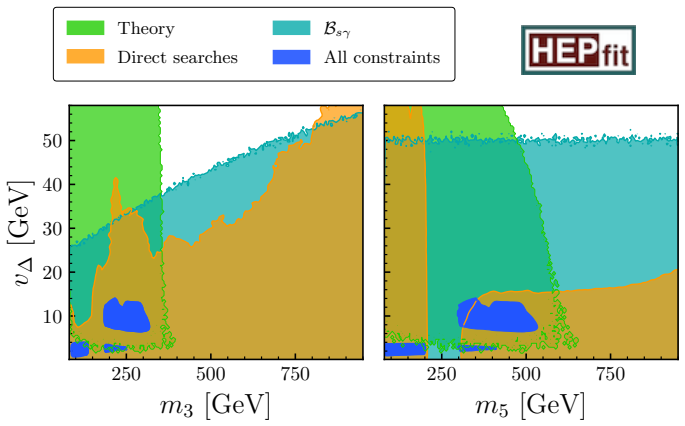
The main results are that the diphoton and bottom-quark excesses can be accommodated together with all the 125 GeV Higgs measurements, whereas the tau-pair excess is incompatible with those measurements in both models. The fit also produces strong limits on the remaining new scalars: in the eGM model, the triplet vacuum expectation value must be below about 12 GeV when other scalars are lighter than 160 GeV, and about 20 GeV when they are heavier; the additional scalars cannot be much heavier than about 600 GeV. In the simpler GM model the limits are tighter, for example the quintet and triplet masses are below about 530 and 320 GeV.
These constraints matter because they show where to look for new scalars and rule out large regions of parameter space. The analysis depends on theoretical constraints from the authors' previous work, which are not re-derived in this paper, and on the choice to exclude the tau excess from the combined fit after showing it is inconsistent.
Extended reading notes
Core claim
The paper's central results are the posterior constraints from the combined fit: in the eGM model the triplet VEV cannot exceed 12 GeV for BSM scalar masses below 160 GeV (about 20 GeV above), the additional BSM scalar masses cannot exceed roughly 600 GeV, and in the GM model m5 < 530 GeV and m3 < 320 GeV; simultaneously, the 95 GeV diphoton and bb excesses are 'well compatible' with the 125 GeV Higgs data, while the ditau excess is incompatible. If correct, these numbers define the surviving parameter space of both models.
Load-bearing premise
The paper applies the NLO unitarity and bounded-from-below constraints derived in the authors' previous work Ref. [126] as hard cuts in the fit, without re-deriving or validating them here. The central mass bounds, e.g., mF++ < 600 GeV in eGM and m5 < 530 GeV, m3 < 320 GeV in GM, are directly produced by these theoretical cuts. If those constraints are incomplete, incorrectly implemented, or too aggressive, the reported bounds would be weakened. This assumption is structurally distinct from the final constraints: it is the input that produces them.
Editorial analysis
A structured set of objections, weighed in public.
Referee Report
Summary. This paper performs global Bayesian fits of the CP-conserving Georgi-Machacek (GM) and extended Georgi-Machacek (eGM) models in the presence of a light CP-even scalar with mass in the 90–100 GeV range, using the HEPfit/BAT framework. The fits combine 125 GeV Higgs signal strengths, 95 GeV excess data (diphoton, bbbar, ditau), LHC direct search limits, B-physics observables (B→Xsγ and Rγ), and theoretical constraints from NLO unitarity and bounded-from-below conditions that are imported from the authors' previous preprint Ref. [126] as hard cuts. The main results are posterior bounds on the triplet VEV and BSM scalar masses: in the eGM model, vχ≲12 GeV for BSM masses below 160 GeV and ≲20 GeV above, with mF++<600 GeV, mF0<580 GeV, mH+<590 GeV, and mA<350 GeV; in the GM model, vΔ≲4 GeV at low mass and ≲15 GeV at high mass, with m5<530 GeV and m3<320 GeV. The paper also claims that the 95 GeV diphoton and bbbar excesses are well compatible with 125 GeV Higgs data, while the CMS ditau excess is incompatible, and that ditau data are therefore excluded from the combined fit.
Significance. If the central bounds are correct, they provide a useful and nontrivial map of the surviving parameter space of two popular triplet-extended scalar models with a light scalar, and they sharpen the phenomenological status of the 95 GeV excesses. The use of the open-source HEPfit framework and the presentation of posterior regions for many mass and mixing planes are strengths, as is the inclusion of one-loop B-physics contributions in the eGM model. However, the two headline claims — the stringent mass and VEV bounds, and the incompatibility of the ditau excess — rest respectively on constraints taken verbatim from a self-cited preprint and on a post-hoc exclusion of the ditau data. These dependencies make the central quantitative claims difficult to verify from the manuscript alone and require either re-derivation, code/benchmark release, or a quantitative compatibility test.
major comments (4)
- [Sec. V.B and Sec. VI] The theoretical constraints—NLO 2→2 S-matrix unitarity at 1 TeV, NLO corrections small relative to LO, perturbativity, and bounded-from-below checks for three-field directions—are imposed as hard cuts by referring to Ref. [126] without reproducing or validating them. The headline mass bounds of Sec. VI (mF++<600 GeV, mF0<580 GeV, mH+<590 GeV, m5<530 GeV, m3<320 GeV) and the triplet VEV limits are directly produced by these cuts. Please include a self-contained summary of the constraints (or release the code/benchmark tables) and demonstrate the sensitivity of the quoted bounds to reasonable variations of the cut implementation, for example comparing LO-only unitarity with the NLO criterion or varying the scale at which the constraints are imposed.
- [Abstract, Appendix B, Sec. VI] The conclusion that the CMS ditau excess is incompatible with the 125 GeV Higgs signal strength data is not derived from a fit that includes the ditau measurement. The ditau signal strength is excluded from the combined fit, and the incompatibility is inferred from the non-overlap of posterior regions in the κ_H^f versus κ_H^V plane (Fig. 8). This is a qualitative visual argument, not a quantitative compatibility statement. Please either perform a fit that includes μ_ττ and report the resulting posterior or Bayes factor, or compute a quantitative measure of the overlap between the h-signal-strength-only and ditau-allowed regions, and state the conclusion accordingly.
- [Sec. VI and Conclusions] The paper states in Sec. V.A that the light scalar mass m_H (or m1) is varied in [90,100] GeV, but the Conclusions say the quoted bounds are obtained 'Fixing m1 or mH = 95.4 GeV'. These are different analyses and can give different limits. Please clarify which procedure produced the numbers in the abstract and Conclusions, and if the bounds are from a scan over the 90–100 GeV window, show the dependence on the light scalar mass; if they are from a fixed 95.4 GeV point, state this explicitly in the abstract and in the relevant figure captions.
- [Table 2] The prior for λχ in the eGM model is restricted to [0,4π] while all other quartic couplings are sampled in [−4π,4π]. No justification is provided for this one-sided prior. If this restriction is not forced by the theory (e.g., by the BFB conditions already imposed), it could artificially truncate the parameter space and influence the reported mass and VEV bounds. Please justify the prior choice or remove the restriction and assess the impact on the results.
minor comments (6)
- [Sec. V.C] The treatment of direct search limits via a Gaussian likelihood with a standard deviation chosen so that R_direct = 1 is excluded at 95% CL is an approximation; please state the associated systematic uncertainty or cite the procedure more precisely, since several of the quoted bounds rely on it.
- [Sec. IV.B.4] The sentence 'we exclude the possibility that the non-custodial singlet is responsible' is confusing; the intended meaning is presumably that states outside the custodial-singlet sector (fiveplet/triplet) do not couple to fermions and hence cannot be produced via gluon fusion. Please rephrase.
- [Eq. (13) and Fig. 2] The B-physics analysis uses one-loop Wilson coefficients while comparing to NNLO SM predictions; the footnote acknowledges higher-order corrections may be significant. Since Bsγ is claimed to provide a dominant constraint at low charged-scalar mass, please state the expected theoretical uncertainty from the missing higher-order BSM contributions, or soften the corresponding bounds accordingly.
- [Table 4] Several rows for pp→H±,F±→τ±ν are duplicated; please remove the redundant entries.
- [Fig. 4 caption] The caption lists 'No constraints', 'Direct searches', 'Theory', and 'All constraints' but the figure legend order does not match the description in the text; please make the color labeling unambiguous.
- [General] The text consistently uses '95.4% probability' and 'excluded at a 95.4% probability' for what are marginalized Bayesian credible intervals; this language is more frequentist than Bayesian and may mislead readers. Please use '95.4% credible interval' or 'posterior probability' throughout.
Circularity Check
The eGM and GM mass and triplet-VEV bounds are imposed as hard cuts imported from the authors' own Ref. [126], so the headline constraints are largely inherited from that self-citation; however, the 95 GeV compatibility statements rest on independent external LHC, LEP, and B-physics data.
-
self citation load bearing
[Section V.B, 'Theoretical constraints'; results in Section VI and Conclusions]
"From theoretical perspective, we incorporate the constraints given in Ref. [126] in our fits: ... The S-matrix eigenvalues for 2→2 scattering, including NLO corrections, must satisfy unitarity bounds at 1 TeV. We also require NLO corrections to be small relative to the LO eigenvalues."
The paper's headline bounds — m_F++ < 600 GeV, m_F0 < 580 GeV, m_H+ < 590 GeV in eGM, and m_5 < 530 GeV, m_3 < 320 GeV in GM, plus the triplet-VEV limits — are the 95.4% posterior boundaries of a fit whose allowed region is carved out by these hard cuts. The cuts are not re-derived or validated in this manuscript; the paper explicitly delegates with 'For a comprehensive analysis of how theoretical constraints influence the parameter space, we refer the reader to Ref. [126]' and concludes with 'Incorporating our recently calculated NLO unitarity and BFB conditions [126]...'. Thus the central quantitative output is the same constraint set restated as an output through a same-author citation, rather than an independent derivation presented here.
full rationale
This is a global-fit paper, so the reported values are posterior constraints rather than predictions, and I found no equation-level reduction in which an output is defined in terms of an output. The 95 GeV diphoton/b-bbar compatibility result is a genuine overlap between external LHC/LEP signal-strength inputs and the 125 GeV Higgs data, and the ditau incompatibility similarly follows from external data. The main circularity concern is the theoretical block: every mass and VEV limit in the central results is produced by applying the NLO unitarity and bounded-from-below cuts of Ref. [126] as hard cuts, and the paper repeatedly refers the reader to that same-author work instead of reproducing or validating the constraints. Because the prior volume is defined by those cuts, the headline mass bounds are inherited from the self-citation chain. I therefore score 4: the self-citation is genuinely load-bearing for the central quantitative claims, but the paper also has independent empirical content, and no fully self-definitional or fitted-input-as-prediction step is exhibited.
Assumptions & free parameters
free parameters (6)
- Triplet VEV vDelta (GM) / vChi (eGM) =
varied, posterior constrained to below ~20 GeV
- Mixing angle alpha =
varied in [0, pi/2] for light-H scenario
- Mixing angle delta (eGM) =
varied in [-pi/2, pi/2]
- Quartic couplings (lambda3, lambda5 in GM; lambdaChi, lambdaTildeChi, kappa1, kappa3 in eGM) =
varied in [-4pi, 4pi] (lambdaChi in [0, 4pi])
- Light scalar mass m1/mH =
varied in [90, 100] GeV
- BSM scalar masses (m3, m5 in GM; mH+, mF+, mF0, mF++, mA in eGM) =
varied in [80, 1000] GeV
assumptions (6)
- domain assumption The scalar sector beyond the SM is exactly the GM or eGM model, with no other new physics.
- domain assumption Custodial symmetry is preserved: vChi = vXi and Eq. (2) constraints hold for eGM; GM imposes degenerate multiplet masses.
- domain assumption The 125.09 GeV scalar is the heavier CP-even custodial singlet and the 90-100 GeV scalar is the lighter singlet.
- domain assumption NLO unitarity and BFB constraints from Ref. [126] are valid and implemented as flat likelihood cuts.
- domain assumption The linearized B->Xs gamma predictions (Eq. 13) from Ref. [148] apply to the eGM model with two charged scalars.
- domain assumption Theoretical sigma*B predictions for neutral and charged scalars can be rescaled from the (Aligned-)2HDM results to GM/eGM.
Cite this review
Pith. "Pith review of Light Scalars in the Extended Georgi-Machacek Model." pith.science (2026). https://pith.science/paper/2XSFO6PF
@misc{pith2026250606427,
  author       = {Pith},
  title        = {Pith review of: Light Scalars in the Extended Georgi-Machacek Model},
  year         = {2026},
  howpublished = {\url{https://pith.science/paper/2XSFO6PF}},
  note         = {Machine review of arXiv:2506.06427}
}
abstract
We perform global fits of the CP-conserving Georgi-Machacek (GM) and extended Georgi-Machacek (eGM) models, incorporating a light CP-even beyond the Standard Model (BSM) scalar within the mass range of $90$ GeV to $100$ GeV. These fits combine the Higgs signal strengths and direct search limits from ATLAS and CMS at $\sqrt{s} = 8$ and $13$ TeV, $B$-physics observables, and theoretical constraints arising from next-to-leading order (NLO) unitarity and BFB constraints. From the global fit, we show that the LHC diphoton and LEP $b\bar{b}$ excesses around $95$ GeV are well compatible with the $125$ GeV Higgs data. Whereas the CMS ditau excess is incompatible with the $125$ GeV Higgs signal strength data in both the CP-conserving GM and eGM models. We present the results from the combined fit, including the $95$ GeV Higgs signal strength data. In the eGM model, the triplet VEV cannot exceed $12$ GeV for additional BSM scalar masses below $160$ GeV and approximately $20$ GeV for additional BSM scalar masses above $160$ GeV. The masses of additional BSM scalars cannot exceed $600$ GeV. The maximum mass splitting is of around $120$ GeV within the members of each custodial multiplet, and up to $250$ GeV between the members of different multiplets. In the GM model, these constraints become more stringent: the triplet VEV is limited to below $15$ GeV, which tightens to $4$ GeV once the BSM scalar masses are below $160$ GeV. Masses of the quintet $m_5$ and the triplet $m_3$ are restricted to be below $530$ GeV and $320$ GeV, respectively. A mass hierarchy, $m_5 > m_3$, is favoured in the high-mass region, with the mass splitting constrained to be less than $210$ GeV.
Figures


Figures from the paper (6 more)




Reference graph
Works this paper leans on
-
[126]
Next-to-Leading Order Unitarity Fits in the Extended Georgi-Machacek Model
D. Chowdhury, P. Mondal and S. Samanta,Next-to-Leading Order Unitarity Fits in the Extended Georgi-Machacek Model,2404.18996
-
[1]
In recent years, the CMS collaboration has conducted searches for light Higgs bosons decaying into two photons using LHC data at both 8 TeV [29] and 13 TeV [30]
The CMS and ATLAS diphoton excess Diphoton searches at the LHC are among the most promising avenues for detecting additional neutral Higgs bosons with masses below 125 GeV. In recent years, the CMS collaboration has conducted searches for light Higgs bosons decaying into two photons using LHC data at both 8 TeV [29] and 13 TeV [30]. By combining the 8 TeV...
-
[2]
The excess was most prominent at a mass hypothesis of 100 GeV, with local and global significances of 3.1σand 2.7σ, respectively
The CMS ditau excess The CMS collaboration observed an excess over the expected background in light Higgs boson searches involving ditau final states, consistent with a mass of∼95 GeV under the assumption of gluon fusion production [36]. The excess was most prominent at a mass hypothesis of 100 GeV, with local and global significances of 3.1σand 2.7σ, res...
-
[3]
The corresponding signal strength,µ bb i , is given in Table 1
LEP excess The LEP reported a mild excess with a local significance of 2.3σin thee +e− →Z(Φ→b ¯b) searches [34, 35], compatible with a scalar resonance at 95.4 GeV. The corresponding signal strength,µ bb i , is given in Table 1. Signal V alue Correlation matrix L Detector Sourcestrength [fb−1] µγγ ggF 0.47±0.20 1−0.52 132.0 CMS [31, 32]µγγ VBF 0.06±0.70−0...
-
[4]
Both models feature three CP-even and one CP-odd scalar states, with two of the CP-even states being custodial singlets
GM/eGM interpretation of the excesses at 95 GeV Here, we investigate the possibility of a neutral BSM scalar state with a mass of approximately 95 GeV within the CP-conserving GM and eGM models, assessing its ability to explain the excesses reported by CMS, ATLAS, and LEP. Both models feature three CP-even and one CP-odd scalar states, with two of the CP-...
-
[5]
(σ· B)th =σ th(X→Φ)× B th(Φ→Y)
For a given process,X→Φ→Y, we compute the theoretical production cross-section of a scalar particle Φ (=A, F 0, H±, F±, F±±), and multiply it by its branching fraction to a specific decay channel, i.e. (σ· B)th =σ th(X→Φ)× B th(Φ→Y). 5 In our analysis, stability bounds refer to the scalar potential being bounded from below. The bound from metasta- bility ...
-
[6]
Following [159, 167], we define the ratio, Rdirect = (σ· B)th (σ· B)obs ,(17) where (σ· B)obs denotes the observed 95% confidence level (CL) exclusion limits onσ· B, as provided by experimental collaborations. To compare the theoretical prediction with these experimental bounds, we treat the ratioR direct as Gaussian-distributed variables under the null h...
arXiv 2012
-
[28]
A. Crivellin, S. Ashanujjaman, S. Banik, G. Coloretti, S.P. Maharathy and B. Mellado,Growing evidence for a Higgs triplet*,Chin. Phys. C49(2025) 053107 [2404.14492]. [29]CMScollaboration,Search for new resonances in the diphoton final state in the mass range between 80 and 115 GeV in pp collisions at √s= 8TeV,CMS-PAS-HIG-14-037. [30]CMScollaboration,Searc...
arXiv 2025
Show all 133 references
-
[37]
Cacciapaglia, A
G. Cacciapaglia, A. Deandrea, S. Gascon-Shotkin, S. Le Corre, M. Lethuillier and J. Tao,Search for a lighter Higgs boson in Two Higgs Doublet Models,JHEP12(2016) 068 [1607.08653]
2016 arXiv
-
[38]
J. Cao, X. Guo, Y. He, P. Wu and Y. Zhang,Diphoton signal of the light Higgs boson in natural NMSSM,Phys. Rev. D95(2017) 116001 [1612.08522]
2017 arXiv
-
[39]
Fox and N
P.J. Fox and N. Weiner,Light Signals from a Lighter Higgs,JHEP08(2018) 025 [1710.07649]
2018 arXiv
-
[40]
D. Liu, J. Liu, C.E.M. Wagner and X.-P. Wang,A Light Higgs at the LHC and the B-Anomalies, JHEP06(2018) 150 [1805.01476]
2018 arXiv
-
[41]
Domingo, S
F. Domingo, S. Heinemeyer, S. Paßehr and G. Weiglein,Decays of the neutral Higgs bosons into SM fermions and gauge bosons in theCP-violating NMSSM,Eur. Phys. J. C78(2018) 942 [1807.06322]
2018 arXiv
-
[42]
Biek¨ otter, M
T. Biek¨ otter, M. Chakraborti and S. Heinemeyer,A 96 GeV Higgs boson in the N2HDM,Eur. Phys. J. C80(2020) 2 [1903.11661]
2020 arXiv
-
[43]
Cline and T
J.M. Cline and T. Toma,Pseudo-Goldstone dark matter confronts cosmic ray and collider anomalies, Phys. Rev. D100(2019) 035023 [1906.02175]
2019 arXiv
-
[44]
Kundu, S
A. Kundu, S. Maharana and P. Mondal,A 96 GeV scalar tagged to dark matter models,Nucl. Phys. B955(2020) 115057 [1907.12808]
2020 arXiv
-
[45]
Sachdeva and S
D. Sachdeva and S. Sadhukhan,Discussing 125 GeV and 95 GeV excess in light radion model,Phys. Rev. D101(2020) 055045 [1908.01668]
2020 arXiv
-
[46]
J. Cao, X. Jia, Y. Yue, H. Zhou and P. Zhu,96 GeV diphoton excess in seesaw extensions of the natural NMSSM,Phys. Rev. D101(2020) 055008 [1908.07206]
2020 arXiv
-
[47]
Abdelalim, B
A.A. Abdelalim, B. Das, S. Khalil and S. Moretti,Di-photon decay of a light Higgs state in the BLSSM,Nucl. Phys. B985(2022) 116013 [2012.04952]
2022 arXiv
-
[48]
Biek¨ otter, A
T. Biek¨ otter, A. Grohsjean, S. Heinemeyer, C. Schwanenberger and G. Weiglein,Possible indications for new Higgs bosons in the reach of the LHC: N2HDM and NMSSM interpretations,Eur. Phys. J. C82(2022) 178 [2109.01128]
2022 arXiv
-
[49]
Crivellin, Y
A. Crivellin, Y. Fang, O. Fischer, S. Bhattacharya, M. Kumar, E. Malwa et al.,Accumulating evidence for the associated production of a new Higgs boson at the LHC,Phys. Rev. D108(2023) 115031 [2109.02650]
2023 arXiv
-
[50]
Heinemeyer, C
S. Heinemeyer, C. Li, F. Lika, G. Moortgat-Pick and S. Paasch,Phenomenology of a 96 GeV Higgs boson in the 2HDM with an additional singlet,Phys. Rev. D106(2022) 075003 [2112.11958]
2022 arXiv
-
[51]
Biek¨ otter, S
T. Biek¨ otter, S. Heinemeyer and G. Weiglein,Mounting evidence for a 95 GeV Higgs boson,JHEP 08(2022) 201 [2203.13180]
2022 arXiv
-
[52]
Biek¨ otter, S
T. Biek¨ otter, S. Heinemeyer and G. Weiglein,Excesses in the low-mass Higgs-boson search and the W-boson mass measurement,Eur. Phys. J. C83(2023) 450 [2204.05975]. 23
2023 arXiv
-
[53]
Benbrik, M
R. Benbrik, M. Boukidi, S. Moretti and S. Semlali,Explaining the 96 GeV Di-photon anomaly in a generic 2HDM Type-III,Phys. Lett. B832(2022) 137245 [2204.07470]
2022
-
[54]
Iguro, T
S. Iguro, T. Kitahara and Y. Omura,Scrutinizing the 95–100 GeV di-tau excess in the top associated process,Eur. Phys. J. C82(2022) 1053 [2205.03187]
2022 arXiv
-
[55]
Iguro, T
S. Iguro, T. Kitahara, Y. Omura and H. Zhang,Chasing the two-Higgs doublet model in the di-Higgs boson production,Phys. Rev. D107(2023) 075017 [2211.00011]
2023 arXiv
-
[56]
Kundu, A
A. Kundu, A. Le Yaouanc, P. Mondal and F. Richard,Searches for scalars at LHC and interpretation of the findings, in2022 ECF A Workshop on e+e- Higgs/EW/Top factories, 11, 2022 [2211.11723]
2022 arXiv
-
[57]
W. Li, H. Qiao and J. Zhu,Light Higgs boson in the NMSSM confronted with the CMS di-photon and di-tau excesses*,Chin. Phys. C47(2023) 123102 [2212.11739]
2023 arXiv
-
[58]
Biek¨ otter, S
T. Biek¨ otter, S. Heinemeyer and G. Weiglein,The CMS di-photon excess at 95 GeV in view of the LHC Run 2 results,Phys. Lett. B846(2023) 138217 [2303.12018]
2023 arXiv
-
[59]
Azevedo, T
D. Azevedo, T. Biek¨ otter and P.M. Ferreira,2HDM interpretations of the CMS diphoton excess at 95 GeV,JHEP11(2023) 017 [2305.19716]
2023 arXiv
-
[60]
Escribano, V.M
P. Escribano, V.M. Lozano and A. Vicente,Scotogenic explanation for the 95 GeV excesses,Phys. Rev. D108(2023) 115001 [2306.03735]
2023 arXiv
-
[61]
Biek¨ otter, S
T. Biek¨ otter, S. Heinemeyer and G. Weiglein,95.4 GeV diphoton excess at ATLAS and CMS,Phys. Rev. D109(2024) 035005 [2306.03889]
2024 arXiv
-
[62]
Belyaev, R
A. Belyaev, R. Benbrik, M. Boukidi, M. Chakraborti, S. Moretti and S. Semlali,Explanation of the hints for a 95 GeV Higgs boson within a 2-Higgs Doublet Model,JHEP05(2024) 209 [2306.09029]
2024
-
[63]
Ashanujjaman, S
S. Ashanujjaman, S. Banik, G. Coloretti, A. Crivellin, B. Mellado and A.-T. Mulaudzi,SU(2)L triplet scalar as the origin of the 95 GeV excess?,Phys. Rev. D108(2023) L091704 [2306.15722]
2023
-
[64]
Aguilar-Saavedra, H.B
J.A. Aguilar-Saavedra, H.B. Cˆ amara, F.R. Joaquim and J.F. Seabra,Confronting the 95 GeV excesses within the U(1)’-extended next-to-minimal 2HDM,Phys. Rev. D108(2023) 075020 [2307.03768]
2023 arXiv
-
[65]
Dutta, J
J. Dutta, J. Lahiri, C. Li, G. Moortgat-Pick, S.F. Tabira and J.A. Ziegler,Dark matter phenomenology in 2HDMS in light of the 95 GeV excess,Eur. Phys. J. C84(2024) 926 [2308.05653]
2024 arXiv
-
[66]
Ellwanger and C
U. Ellwanger and C. Hugonie,Additional Higgs Bosons near 95 and 650 GeV in the NMSSM,Eur. Phys. J. C83(2023) 1138 [2309.07838]
2023 arXiv
-
[67]
J. Cao, X. Jia, J. Lian and L. Meng,95 GeV diphoton and bb¯excesses in the general next-to-minimal supersymmetric standard model,Phys. Rev. D109(2024) 075001 [2310.08436]
2024 arXiv
-
[68]
Borah, S
D. Borah, S. Mahapatra, P.K. Paul and N. Sahu,Scotogenic U(1)Lµ-Lτorigin of (g-2)µ, W-mass anomaly and 95 GeV excess,Phys. Rev. D109(2024) 055021 [2310.11953]
2024 arXiv
-
[69]
Ahriche, M.L
A. Ahriche, M.L. Bellilet, M.O. Khojali, M. Kumar and A.-T. Mulaudzi,Scale invariant scotogenic model: CDF-II W-boson mass and the 95 GeV excesses,Phys. Rev. D110(2024) 015025 [2311.08297]
2024 arXiv
-
[70]
Arcadi, G
G. Arcadi, G. Busoni, D. Cabo-Almeida and N. Krishnan,Is there a scalar or pseudoscalar at 95 GeV?,Phys. Rev. D110(2024) 115028 [2311.14486]
2024 arXiv
-
[71]
Ahriche,95 GeV excess in the Georgi-Machacek model: Single or twin peak resonance,Phys
A. Ahriche,95 GeV excess in the Georgi-Machacek model: Single or twin peak resonance,Phys. Rev. D110(2024) 035010 [2312.10484]
2024 arXiv
-
[72]
Chen, C.-W
T.-K. Chen, C.-W. Chiang, S. Heinemeyer and G. Weiglein,95 GeV Higgs boson in the Georgi-Machacek model,Phys. Rev. D109(2024) 075043 [2312.13239]
2024 arXiv
-
[73]
Dev, R.N
P.S.B. Dev, R.N. Mohapatra and Y. Zhang,Explanation of the 95 GeVγγand bb¯excesses in the minimal left-right symmetric model,Phys. Lett. B849(2024) 138481 [2312.17733]
2024 arXiv
-
[74]
J. Cao, X. Jia and J. Lian,Unified interpretation of the muon g-2 anomaly, the 95 GeV diphoton, and bb¯excesses in the general next-to-minimal supersymmetric standard model,Phys. Rev. D110 (2024) 115039 [2402.15847]
2024 arXiv
-
[75]
Kalinowski and W
J. Kalinowski and W. Kotlarski,Interpreting 95 GeV di-photon/b bexcesses as a lightest Higgs boson of the MRSSM,JHEP07(2024) 037 [2403.08720]
2024 arXiv
-
[76]
Ellwanger and C
U. Ellwanger and C. Hugonie,Nmssm with correct relic density and an additional 95 GeV Higgs boson,Eur. Phys. J. C84(2024) 526 [2403.16884]
2024 arXiv
-
[77]
Ellwanger, C
U. Ellwanger, C. Hugonie, S.F. King and S. Moretti,NMSSM explanation for excesses in the search for neutralinos and charginos and a 95 GeV Higgs boson,Eur. Phys. J. C84(2024) 788 [2404.19338]. 24
2024 arXiv
-
[78]
Yaser Ayazi, M
S. Yaser Ayazi, M. Hosseini, S. Paktinat Mehdiabadi and R. Rouzbehi,Vector dark matter and LHC constraints, including a 95 GeV light Higgs boson,Phys. Rev. D110(2024) 055004 [2405.01132]
2024 arXiv
-
[79]
Benbrik, M
R. Benbrik, M. Boukidi and S. Moretti,Superposition of CP-even and CP-odd Higgs resonances: Explaining the 95 GeV excesses within a two-Higgs-doublet model,Phys. Rev. D110(2024) 115030 [2405.02899]
2024
-
[80]
Arhrib, K.H
A. Arhrib, K.H. Phan, V.Q. Tran and T.-C. Yuan,When Standard Model Higgs Meets Its Lighter 95 GeV Higgs,2405.03127
-
[81]
Ge, F.-Y
Z.-f. Ge, F.-Y. Niu and J.-L. Yang,The origin of the 95 GeV excess in the flavor-dependentU(1) X model,Eur. Phys. J. C84(2024) 548 [2405.07243]
2024 arXiv
-
[82]
Yang, M.-H
J.-L. Yang, M.-H. Guo, W.-H. Zhang, H.-B. Zhang and T.-F. Feng,Explaining the possible 95 GeV excesses in the B-L symmetric SSM,2406.01926
-
[83]
Lian,95 GeV excesses in the Z3-symmetric next-to-minimal supersymmetric standard model, Phys
J. Lian,95 GeV excesses in the Z3-symmetric next-to-minimal supersymmetric standard model, Phys. Rev. D110(2024) 115018 [2406.10969]
2024 arXiv
-
[84]
Gao, X.-F
J. Gao, X.-F. Han, J. Ma, L. Wang and H. Xu,95 GeV Higgs boson and spontaneous CP-violation at the finite temperature,Phys. Rev. D110(2024) 115045 [2408.03705]
2024
-
[85]
Khanna, S
A. Khanna, S. Moretti and A. Sarkar,Explaining 95 (or so) GeV Anomalies in the 2-Higgs Doublet Model Type-I,2409.02587
-
[86]
Ait-Ouazghour, M
B. Ait-Ouazghour, M. Chabab and K. Goure,Unified Interpretation of 95 GeV Excesses in the Two Higgs Doublet type II Seesaw Model,2410.11140
-
[87]
Gao, S.-M
S. Gao, S.-M. Zhao, S. Di, X.-X. Dong and T.-F. Feng,A 95 GeV Higgs Boson in theU(1) X model, 2411.13261
-
[88]
Kundu, P
A. Kundu, P. Mondal and G. Moultaka,Indications for new scalar resonances at the LHC and a possible interpretation,2411.14126
-
[89]
Mondal, S
T. Mondal, S. Moretti and P. Sanyal,On the CP Nature of the ‘95 GeV’ Anomalies,2412.00474
-
[90]
Banik, G
S. Banik, G. Coloretti, A. Crivellin and H.E. Haber,Correlating A→γγwith electric dipole moments in the two Higgs doublet model in light of the diphoton excesses at 95 GeV and 152 GeV,Phys. Rev. D111(2025) 075021 [2412.00523]
2025 arXiv
-
[91]
Hmissou, S
A. Hmissou, S. Moretti and L. Rahili,Investigating the 95 GeV Higgs Boson Excesses within the I(1+2)HDM,2502.03631
-
[92]
X. Du, H. Liu and Q. Chang,Interpretation of 95 GeV Excess within the Georgi-Machacek Model in Light of Positive Definiteness Constraints,2502.06444
-
[93]
Z. Li, N. Liu and B. Zhu,Interplay of95GeV Diphoton Excess and Dark Matter in Supersymmetric Triplet Model,2504.21273
-
[94]
H. Xu, Y. Wang, X.-F. Han and L. Wang,95 GeV Higgs boson and nano-Hertz gravitational waves from domain walls in the N2HDM,2505.03592
-
[95]
Benbrik, M
R. Benbrik, M. Boukidi, K. Kahime, S. Moretti, L. Rahili and B. Taki,Exploring Potential Higgs Resonances at 650 GeV and 95 GeV in the 2HDM Type III,2505.07811
-
[96]
Georgi and M
H. Georgi and M. Machacek,Doubly charged Higgs bosons,Nucl. Phys. B262(1985) 463
1985
-
[97]
Chanowitz and M
M.S. Chanowitz and M. Golden,Higgs Boson Triplets With M (W) = M (Z)cosθω,Phys. Lett. B 165(1985) 105
1985
-
[98]
Gunion, R
J.F. Gunion, R. Vega and J. Wudka,Higgs triplets in the standard model,Phys. Rev. D42(1990) 1673
1990
-
[99]
Gunion, R
J.F. Gunion, R. Vega and J. Wudka,Naturalness problems for rho = 1 and other large one loop effects for a standard model Higgs sector containing triplet fields,Phys. Rev. D43(1991) 2322
1991
-
[100]
M. Aoki, S. Kanemura and K. Yagyu,Testing the Higgs triplet model with the mass difference at the LHC,Phys. Rev. D85(2012) 055007 [1110.4625]
2012 arXiv
-
[101]
Kanemura and K
S. Kanemura and K. Yagyu,Radiative corrections to electroweak parameters in the Higgs triplet model and implication with the recent Higgs boson searches,Phys. Rev. D85(2012) 115009 [1201.6287]
2012 arXiv
-
[102]
Chiang and K
C.-W. Chiang and K. Yagyu,Testing the custodial symmetry in the Higgs sector of the Georgi-Machacek model,JHEP01(2013) 026 [1211.2658]
2013 arXiv
-
[103]
M. Aoki, S. Kanemura, M. Kikuchi and K. Yagyu,Radiative corrections to the Higgs boson couplings in the triplet model,Phys. Rev. D87(2013) 015012 [1211.6029]
2013 arXiv
-
[104]
Englert, E
C. Englert, E. Re and M. Spannowsky,Triplet Higgs boson collider phenomenology after the LHC, Phys. Rev. D87(2013) 095014 [1302.6505]. 25
2013 arXiv
-
[105]
Englert, A
C. Englert, A. Freitas, M.M. M¨ uhlleitner, T. Plehn, M. Rauch, M. Spira et al.,Precision Measurements of Higgs Couplings: Implications for New Physics Scales,J. Phys. G41(2014) 113001 [1403.7191]
2014 arXiv
-
[106]
Hartling, K
K. Hartling, K. Kumar and H.E. Logan,The decoupling limit in the Georgi-Machacek model,Phys. Rev. D90(2014) 015007 [1404.2640]
2014 arXiv
-
[107]
Garcia-Pepin, S
M. Garcia-Pepin, S. Gori, M. Quiros, R. Vega, R. Vega-Morales and T.-T. Yu,Supersymmetric Custodial Higgs Triplets and the Breaking of Universality,Phys. Rev. D91(2015) 015016 [1409.5737]
2015 arXiv
-
[108]
Hartling, K
K. Hartling, K. Kumar and H.E. Logan,Indirect constraints on the Georgi-Machacek model and implications for Higgs boson couplings,Phys. Rev. D91(2015) 015013 [1410.5538]
2015 arXiv
-
[109]
Chiang, A.-L
C.-W. Chiang, A.-L. Kuo and T. Yamada,Searches of exotic Higgs bosons in general mass spectra of the Georgi-Machacek model at the LHC,JHEP01(2016) 120 [1511.00865]
2016 arXiv
-
[110]
Chiang, A.-L
C.-W. Chiang, A.-L. Kuo and K. Yagyu,One-loop renormalized Higgs boson vertices in the Georgi-Machacek model,Phys. Rev. D98(2018) 013008 [1804.02633]
2018 arXiv
-
[111]
Chiang, G
C.-W. Chiang, G. Cottin and O. Eberhardt,Global fits in the Georgi-Machacek model,Phys. Rev. D 99(2019) 015001 [1807.10660]
2019 arXiv
-
[112]
Banerjee, G
A. Banerjee, G. Bhattacharyya and N. Kumar,Impact of Yukawa-like dimension-five operators on the Georgi-Machacek model,Phys. Rev. D99(2019) 035028 [1901.01725]
2019 arXiv
-
[113]
Ghosh, S
N. Ghosh, S. Ghosh and I. Saha,Charged Higgs boson searches in the Georgi-Machacek model at the LHC,Phys. Rev. D101(2020) 015029 [1908.00396]
2020 arXiv
-
[114]
Ashanujjaman and K
S. Ashanujjaman and K. Ghosh,Revisiting type-II see-saw: present limits and future prospects at LHC,JHEP03(2022) 195 [2108.10952]
2022
-
[115]
de Lima, D
C.H. de Lima, D. Stolarski and Y. Wu,Status of negative coupling modifiers for extended Higgs sectors,Phys. Rev. D105(2022) 035019 [2111.02533]
2022 arXiv
-
[116]
Kundu, P
A. Kundu, P. Mondal and P.B. Pal,Custodial symmetry, the Georgi-Machacek model, and other scalar extensions,Phys. Rev. D105(2022) 115026 [2111.14195]
2022 arXiv
-
[117]
Kanemura and K
S. Kanemura and K. Yagyu,Implication of the W boson mass anomaly at CDF II in the Higgs triplet model with a mass difference,Phys. Lett. B831(2022) 137217 [2204.07511]
2022 arXiv
-
[118]
Mondal,Enhancement of the W boson mass in the Georgi-Machacek model,Phys
P. Mondal,Enhancement of the W boson mass in the Georgi-Machacek model,Phys. Lett. B833 (2022) 137357 [2204.07844]
2022 arXiv
-
[119]
Chen, C.-W
T.-K. Chen, C.-W. Chiang, C.-T. Huang and B.-Q. Lu,Updated constraints on the Georgi-Machacek model and its electroweak phase transition and associated gravitational waves,Phys. Rev. D106 (2022) 055019 [2205.02064]
2022 arXiv
-
[120]
Ashanujjaman, K
S. Ashanujjaman, K. Ghosh and R. Sahu,Low-mass doubly charged Higgs bosons at the LHC,Phys. Rev. D107(2023) 015018 [2211.00632]
2023
-
[121]
Ghosh and B
R. Ghosh and B. Mukhopadhyaya,Some new observations for the Georgi-Machacek scenario with triplet Higgs scalars,Phys. Rev. D107(2023) 035031 [2212.11688]
2023 arXiv
-
[122]
Chen, C.-W
T.-K. Chen, C.-W. Chiang and K. Yagyu,CP violation in a model with Higgs triplets,JHEP06 (2023) 069 [2303.09294]
2023 arXiv
-
[123]
Chakraborti, D
M. Chakraborti, D. Das, N. Ghosh, S. Mukherjee and I. Saha,New physics implications of vector boson fusion searches exemplified through the Georgi-Machacek model,Phys. Rev. D109(2024) 015016 [2308.02384]
2024 arXiv
-
[124]
D. Das, A. Kundu, M. Levy, A.M. Prasad, I. Saha and A. Sarkar,Sign of the hZZ coupling and implication for new physics,Phys. Lett. B857(2024) 139002 [2402.09352]
2024 arXiv
-
[125]
de Lima and D
C.H. de Lima and D. Stolarski,Influence of new states in searches for negative gauge-Higgs couplings,JHEP10(2024) 180 [2404.10815]
2024 arXiv
-
[127]
C.-T. Lu, X. Wang, X. Wei and Y. Wu,Probing long-lived doubly charged scalar in the Georgi-Machacek model at the LHC and in far detectors,JHEP02(2025) 149 [2410.19561]
2025 arXiv
-
[128]
Ashanujjaman, S
S. Ashanujjaman, S. Banik, G. Coloretti, A. Crivellin, S.P. Maharathy and B. Mellado,Anatomy of the real Higgs triplet model,JHEP04(2025) 003 [2411.18618]
2025
-
[129]
Ashanujjaman, A
S. Ashanujjaman, A. Crivellin, S.P. Maharathy and A. Thapa,LHC Signatures of the Generic Georgi-Machacek Model,2503.01974. 26
-
[130]
Shang, Y
L. Shang, Y. Wang, X. Du, B. Yang and S. Moretti,Tripletino-like WIMP Dark Matter in the Supersymmetric Georgi-Machacek Model,2503.02653
-
[131]
C.-T. Lu, Y. Wu and S. Xu,Dark Matter and Electroweak Phase Transition in theZ 2 Symmetric Georgi-Machacek Model,2504.10930
-
[132]
Henderson,Future Physics Prospects with the CMS Detector at the High-Luminosity LHC, SciPost Phys
C. Henderson,Future Physics Prospects with the CMS Detector at the High-Luminosity LHC, SciPost Phys. Proc.(2022) 111
2022
-
[133]
Bizo´ n, U
W. Bizo´ n, U. Haisch, L. Rottoli, Z. Gillis, B. Moser and P. Windischhofer,Addendum to: Constraints on the quartic Higgs self-coupling from double-Higgs production at future hadron colliders [JHEP 10 (2019) 267],JHEP02(2024) 170 [2402.03463]
2019 arXiv
-
[134]
Stylianou and G
P. Stylianou and G. Weiglein,Constraints on the trilinear and quartic Higgs couplings from triple Higgs production at the LHC and beyond,Eur. Phys. J. C84(2024) 366 [2312.04646]
2024 arXiv
-
[135]
Torndal, J
J.M. Torndal, J. List, D. Ntounis and C. Vernieri,Higgs self-coupling measurement at futuree +e− colliders,PoSEPS-HEP2023(2024) 406 [2311.16774]
2024 arXiv
-
[136]
Celada, T
E. Celada, T. Giani, J. ter Hoeve, L. Mantani, J. Rojo, A.N. Rossia et al.,Mapping the SMEFT at High-Energy Colliders: from LEP and the (HL-)LHC to the FCC-ee,2404.12809
-
[137]
Aime et al.,Muon Collider Physics Summary,2203.07256
C. Aime et al.,Muon Collider Physics Summary,2203.07256. [138]Muon Collidercollaboration,The physics case of a 3 TeV muon collider stage,2203.07261
-
[139]
Forslund and P
M. Forslund and P. Meade,High precision higgs from high energy muon colliders,JHEP08(2022) 185 [2203.09425]
2022 arXiv
-
[140]
Bhattacharyya, B
S. Bhattacharyya, B. Bhattacherjee, C. Bose, D. Chowdhury and S. Mukherjee,Tagging ultra-boosted jets at FCC-hh using machine learning techniques,2501.06702. [141]Linear Collider Visioncollaboration,A Linear Collider Vision for the Future of Particle Physics,2503.19983. [142]H...
2023
-
[143]
Hewett,Can b —>s gamma close the supersymmetric Higgs production window?,Phys
J.L. Hewett,Can b —>s gamma close the supersymmetric Higgs production window?,Phys. Rev. Lett.70(1993) 1045 [hep-ph/9211256]
1993 arXiv
-
[144]
Barger, M.S
V.D. Barger, M.S. Berger and R.J.N. Phillips,Implications of b —>s gamma decay measurements in testing the MSSM Higgs sector,Phys. Rev. Lett.70(1993) 1368 [hep-ph/9211260]
1993 arXiv
-
[145]
Buras, M
A.J. Buras, M. Misiak, M. Munz and S. Pokorski,Theoretical uncertainties and phenomenological aspects of B —>X(s) gamma decay,Nucl. Phys. B424(1994) 374 [hep-ph/9311345]
1994 arXiv
-
[146]
Branco, P.M
G.C. Branco, P.M. Ferreira, L. Lavoura, M.N. Rebelo, M. Sher and J.P. Silva,Theory and phenomenology of two-Higgs-doublet models,Phys. Rept.516(2012) 1 [1106.0034]
2012 arXiv
-
[147]
Hermann, M
T. Hermann, M. Misiak and M. Steinhauser, ¯B→X sγin the Two Higgs Doublet Model up to Next-to-Next-to-Leading Order in QCD,JHEP11(2012) 036 [1208.2788]
2012 arXiv
-
[148]
Misiak, A
M. Misiak, A. Rehman and M. Steinhauser,Towards B→X sγat the NNLO in QCD without interpolation in m c,JHEP06(2020) 175 [2002.01548]
2020 arXiv
-
[149]
Misiak et al.,Updated NNLO QCD predictions for the weak radiative B-meson decays,Phys
M. Misiak et al.,Updated NNLO QCD predictions for the weak radiative B-meson decays,Phys. Rev. Lett.114(2015) 221801 [1503.01789]
2015 arXiv
-
[150]
Czakon, P
M. Czakon, P. Fiedler, T. Huber, M. Misiak, T. Schutzmeier and M. Steinhauser,The(Q 7, Q1,2) contribution to B→X sγatO α2 s ,JHEP04(2015) 168 [1503.01791]
2015 arXiv
-
[151]
Misiak and M
M. Misiak and M. Steinhauser,Weak radiative decays of the B meson and bounds onM H ± in the Two-Higgs-Doublet Model,Eur. Phys. J. C77(2017) 201 [1702.04571]
2017 arXiv
-
[152]
Misiak and M
M. Misiak and M. Steinhauser,NNLO QCD corrections to the anti-B —>X(s) gamma matrix elements using interpolation in m(c),Nucl. Phys. B764(2007) 62 [hep-ph/0609241]
2007 arXiv
-
[153]
Misiak et al.,Estimate ofB( ¯B→X sγ)atO(α 2 s),Phys
M. Misiak et al.,Estimate ofB( ¯B→X sγ)atO(α 2 s),Phys. Rev. Lett.98(2007) 022002 [hep-ph/0609232]
2007 arXiv
-
[154]
Gunawardana and G
A. Gunawardana and G. Paz,Reevaluating uncertainties in B→X sγdecay,JHEP11(2019) 141 [1908.02812]
2019 arXiv
-
[155]
Ciuchini, G
M. Ciuchini, G. Degrassi, P. Gambino and G.F. Giudice,Next-to-leading QCD corrections to B→X sγ: Standard model and two Higgs doublet model,Nucl. Phys. B527(1998) 21 [hep-ph/9710335]
1998 arXiv
-
[156]
Chetyrkin, M
K.G. Chetyrkin, M. Misiak and M. Munz,Weak radiative B meson decay beyond leading logarithms, Phys. Lett. B400(1997) 206 [hep-ph/9612313]. 27
1997 arXiv
-
[157]
Hou and R.S
W.-S. Hou and R.S. Willey,Effects of Charged Higgs Bosons on the Processes b —>s Gamma, b —>s g* and b —>s Lepton+ Lepton-,Phys. Lett. B202(1988) 591
1988
-
[158]
Grinstein, R.P
B. Grinstein, R.P. Springer and M.B. Wise,Strong Interaction Effects in Weak Radiative ¯BMeson Decay,Nucl. Phys. B339(1990) 269
1990
-
[159]
Chowdhury and O
D. Chowdhury and O. Eberhardt,Update of Global Two-Higgs-Doublet Model Fits,JHEP05(2018) 161 [1711.02095]. [160]ATLAScollaboration,ATLAS searches for additional scalars and exotic Higgs boson decays with the LHC Run 2 dataset,2405.04914
2018 arXiv
-
[161]
De Blas et al.,HEPfit: a code for the combination of indirect and direct constraints on high energy physics models,Eur
J. De Blas et al.,HEPfit: a code for the combination of indirect and direct constraints on high energy physics models,Eur. Phys. J. C80(2020) 456 [1910.14012]
2020 arXiv
-
[162]
Caldwell, D
A. Caldwell, D. Kollar and K. Kroninger,BAT: The Bayesian Analysis Toolkit,Comput. Phys. Commun.180(2009) 2197 [0808.2552]
2009 arXiv
-
[163]
de Blas, M
J. de Blas, M. Ciuchini, E. Franco, S. Mishima, M. Pierini, L. Reina et al.,Electroweak precision observables and Higgs-boson signal strengths in the Standard Model and beyond: present and future, JHEP12(2016) 135 [1608.01509]. [164]LEP Higgs Working Group for Higgs boson sear...
2016 arXiv
-
[167]
Cacchio, D
V. Cacchio, D. Chowdhury, O. Eberhardt and C.W. Murphy,Next-to-leading order unitarity fits in Two-Higgs-Doublet models with softZ 2 breaking,JHEP11(2016) 026 [1609.01290]
2016 arXiv
-
[168]
Coutinho, A
A.M. Coutinho, A. Karan, V. Miralles and A. Pich,Light scalars within theCP-conserving Aligned-two-Higgs-doublet model,JHEP02(2025) 057 [2412.14906]
2025 arXiv
-
[169]
Djouadi, J
A. Djouadi, J. Kalinowski and P.M. Zerwas,Two and three-body decay modes of SUSY Higgs particles,Z. Phys. C70(1996) 435 [hep-ph/9511342]. [170]CMScollaboration,A Search for a Doubly-Charged Higgs Boson inppCollisions at √s= 7TeV, Eur. Phys. J. C72(2012) 2189 [1207.2666]. [171]...
1996 arXiv
Reviewed August 7, 2026 · model on record in the stance chip above.
Discussion (0). Sign in to comment.