REVIEW 3 major objections 4 minor 14 references
Quantum optical experiments towards atom-photon entanglement
T0 review · 3 major / 4 minor · reviewed 2026-08-06 · deepseek-v4-flash
Pith's one-line read A single optically trapped rubidium atom and a single photon it emits are entangled, with an entanglement fidelity of 0.82, verified through correlations in complementary measurement bases.
desk verdict Careful theory and methods chapters, but the posted text truncates before the experimental results, so the headline 0.82 fidelity claim is not evidenced in this manuscript. read the letter →
The pith
A machine-rendered reading of the paper's core claim, the machinery that carries it, and where it could break.
The reading
What carries the argument
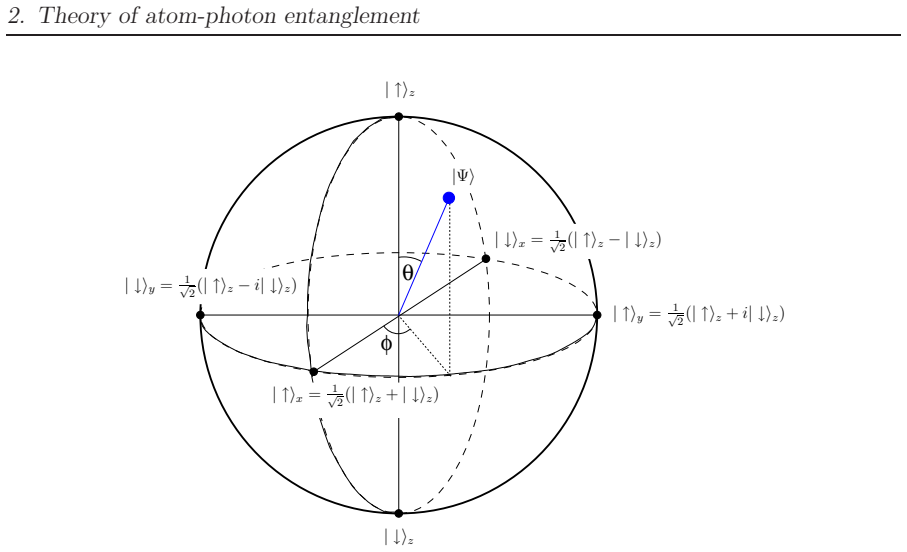
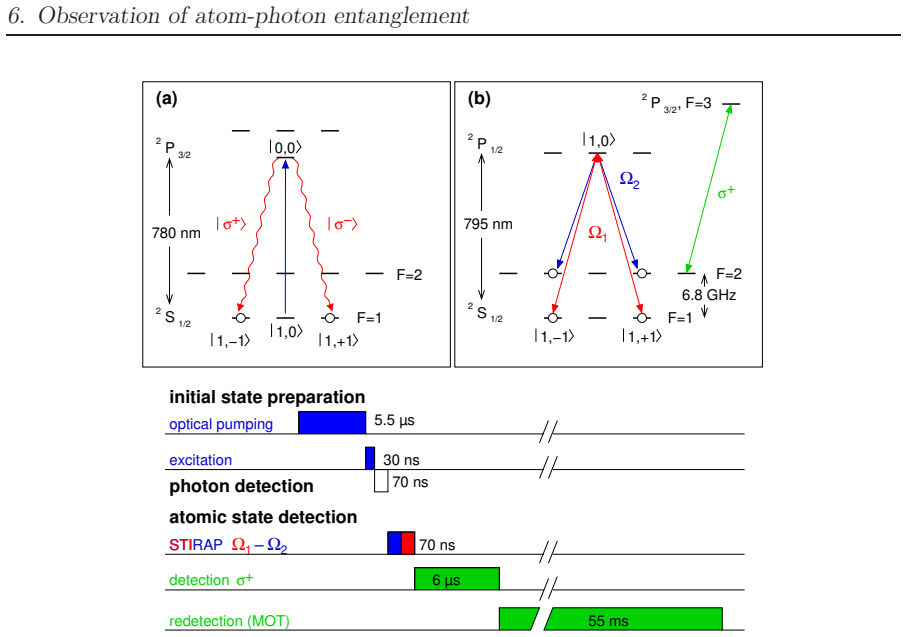
The central mechanism is spontaneous emission from a single excited state with two equally probable, indistinguishable decay paths: decay to |1,−1⟩ emits a σ+ photon, while decay to |1,+1⟩ emits a σ− photon. Angular-momentum conservation creates the correlation between photon polarization and atomic Zeeman state, and indistinguishability of the paths creates the coherence; collecting light along the quantization axis removes the π decay channel, leaving |Ψ+⟩. The atomic state is read out with a phase-sensitive STIRAP pulse whose polarization angle sets the measurement basis, and the photon is analyzed with a rotatable half-wave plate and polarizing beam splitter.
What would settle it
Measure the atom-photon correlation fidelity while sweeping the magnetic field from below 100 mGauss upward: if coherence relies on spectral indistinguishability, the fidelity should fall from 0.82 toward 0.5 as the Zeeman splitting approaches the 6 MHz natural linewidth, and a direct spectral resolution of the σ+ and σ− emission lines would reveal any resolvable splitting that contradicts the claim.
Extended reading notes
Core claim
The central experimental claim is that a single optically trapped 87Rb atom, after excitation to the 2P3/2, |0,0⟩ state, spontaneously decays into the entangled atom-photon state |Ψ+⟩ = 1/√2 (|1,−1⟩|σ+⟩ + |1,+1⟩|σ−⟩) with an entanglement fidelity of 0.82. The author argues that, because the residual magnetic field is below 100 mGauss, the Zeeman splitting between the mF=±1 ground states is two orders of magnitude smaller than the natural linewidth, so the two decay channels are spectrally indistinguishable and the required coherence is preserved. Detection along the quantization axis selects only the σ± decay channels, leaving a maximally entangled state, and correlated measurements of photon polarization and atomic spin in complementary bases certify entanglement.
Load-bearing premise
The two decay paths must be spectrally indistinguishable; the experiment assumes the residual magnetic field is below 100 mGauss so the Zeeman splitting of mF=±1 is much smaller than the natural linewidth, and if that fails the state degrades from an entangled superposition to a mixture.
Editorial extensions
If this is right
- The generated state, with fidelity 0.82, exceeds the 0.5 threshold for entanglement and lies above the 0.78 fidelity needed to violate a Bell inequality under a white-noise model, making it a candidate building block for a loophole-free test.
- Two such atom-photon sources could be combined by sending each photon to an intermediate Bell-state measurement, leaving the two distant atoms entangled even though they never interacted.
- The atomic readout based on STIRAP and destructive push-out achieves a minimum detection efficiency of 0.95, close to the near-perfect atom detection needed to close the detection loophole.
- Remote state preparation of a single atom becomes feasible, since the emitted photon carries the full spin information of the atom and can be transported over long distances.
- A direct corollary of the fidelity result is that the atom-photon pair is a usable interface for mapping quantum information between a stable matter qubit and a photonic communication channel.
Reading between the lines
- A natural control experiment would be to sweep the magnetic field upward from the sub-100 mGauss regime: the entanglement fidelity should drop toward 0.5 as the Zeeman splitting approaches the natural linewidth, directly testing the spectral-indistinguishability assumption.
- The same polarization-defined STIRAP readout could be reused as a general phase-sensitive atomic qubit measurement in other atom-photon or atom-atom entanglement protocols.
- The fidelity estimate assumes a white-noise admixture; a full two-qubit tomography would reveal whether the remaining infidelity is noise-like or comes from coherent errors such as residual π-photon contamination or imperfect STIRAP transfer.
- Improving the collection geometry, which the thesis notes can raise the maximal fidelity to 0.99, would bring the same setup close to the threshold for a loophole-free Bell test with two separated atoms.
Editorial analysis
A structured set of objections, weighed in public.
Referee Report
Summary. The manuscript is a dissertation by Markus Weber reporting on experiments towards atom-photon entanglement with a single optically trapped 87Rb atom. The theory sections (Chapters 2–4) develop the Weisskopf–Wigner treatment of spontaneous emission, the resulting atom-photon state of Eq. (6.1), a four-level optical Bloch model for resonance fluorescence, and a STIRAP-based scheme for measuring atomic Zeeman superposition states. Chapter 5 demonstrates state preparation and detection with a raw fringe visibility of 0.57±0.01, corrected to 0.71±0.01 under a three-level model. Chapter 6 describes the entanglement generation process and states that the residual magnetic field is below 100 mGauss, making the two decay channels spectrally indistinguishable. The abstract claims that the generated atom-photon state yields an entanglement fidelity of 0.82. However, the posted text truncates in the middle of §6.2, and the section '6.3 Experimental results' listed in the table of contents is absent, so no correlation data, no fidelity calculation, and no error analysis are actually provided.
Significance. If the experimental claim holds, this is a significant milestone: it would be a direct observation of entanglement between a single localized neutral atom and a single spontaneously emitted photon at a telecommunication-compatible wavelength, an important step toward quantum repeaters and loophole-free Bell tests. The manuscript gives credit where due for careful technical work: the four-level optical Bloch equations are aligned with a published PRA article, the measured g^(2)(0)=0.02±0.14 demonstrates single-atom antibunching, and the hyperfine-state detection efficiency of 0.95±0.01 is quantified. The STIRAP-based atomic-state detection is described in detail with an explicit visibility measurement. However, the central assertion of the paper—the entanglement fidelity of 0.82—is not supported by any data in the posted text, and the reported fidelity appears to rely on model corrections and a Werner-state ansatz. The significance of the work therefore cannot be assessed from the submitted manuscript alone.
major comments (3)
- [§6.2/§6.3] The posted text truncates mid-sentence in §6.2 (after 'until a photon is de…'), and the table-of-contents entry '6.3 Experimental results' has no corresponding content. This is the central evidence for the paper's claim: correlation measurements in complementary bases, the calculation of the entanglement fidelity 0.82, error bars, background subtraction, and detection-efficiency corrections. Without this section the abstract's assertion 'It is shown, that the generated atom-photon state yields an entanglement fidelity of 0.82' is unsubstantiated. The authors must provide the complete experimental-results section, including raw coincidence counts in at least two mutually unbiased bases, the fitted visibilities, and the explicit formula used to convert visibilities into fidelity.
- [Eq. (2.27) and Sec. 5.3.4] The fidelity derivation appears to rest on the Werner-state ansatz ρ = p|Ψ+⟩⟨Ψ+| + (1−p)I/4, with F = p + (1−p)/4 (Eqs. 2.27–2.28), and on model-corrected STIRAP visibilities: Sec. 5.3.4 reports a raw visibility of 0.57±0.01, corrected to 0.71±0.01 by a numerical three-level model that accounts for imperfect state preparation and imperfect STIRAP transfer. The manuscript does not show how these intermediate numbers combine to yield the quoted 0.82, nor does it justify the white-noise assumption. The reported fidelity is therefore an inferred, model-dependent quantity rather than a directly measured one. The authors should present the measured two-particle correlation probabilities in the σz, σx, and σy bases, the background subtraction, and a transparent error propagation to F, and they should state whether the Werner-state ansatz is assumed or derived from the data.
- [§5.3.3 vs §6.2] There is an inconsistency in the residual magnetic field: §5.3.3 reports a Larmor-precession measurement of 132 mGauss and an upper bound of 300 mGauss, while §6.2 states that the residual field is smaller than 100 mGauss. The spectral indistinguishability of the two decay channels, and hence the coherence of the entangled state of Eq. (6.1), depends on this value. The manuscript must either reconcile these numbers or report the dedicated in-situ magnetic-field measurement used for the entanglement runs, including the uncertainty.
minor comments (4)
- [Eq. (3.40)] The notation for the mean kinetic energy, 'Ekin = ... = (110 ± 15)+14 −25 µK ·kB', is confusing; the result should be written as k_B T = (110 ± 15_stat) μK with a separate systematic error.
- [Fig. 5.15 and §5.3.4] The caption of Fig. 5.15 states that the prepared state is (|1,−1⟩+|1,+1⟩)/√2, whereas the text and Eq. (5.19) define the prepared state as (|1,−1⟩−|1,+1⟩)/√2; the sign convention should be made consistent throughout.
- [General] Reference [35] appears to be a published report of the same or closely related result; the manuscript should clarify the relation between this dissertation and [35], and state what new material the present arXiv posting adds.
- [§3.2.2] The phrase 'red-detuned from the cycling transition ... up to 5 natural linewidths' should be reworded for clarity, e.g., 'red-detuned by up to 5 natural linewidths from the cycling transition'.
Circularity Check
No significant circularity: the atom-photon entanglement state is derived from first-principles angular-momentum conservation and stated indistinguishability conditions; the 0.82 fidelity claim is unauditable because §6.3 is truncated, but no circular reduction can be exhibited.
full rationale
The derivation chain from spontaneous emission to the entangled state (Eqs. 2.39–2.41 and 6.1) uses angular-momentum conservation, Clebsch–Gordan coefficients, and the stated spectral-indistinguishability condition (residual magnetic field <100 mG, Zeeman splitting two orders of magnitude below the natural linewidth). None of these inputs contains the target entanglement fidelity, so the generation mechanism is not circular. The fidelity definition (Eq. 2.25) is a standard measure, and the lower-bound expression (Eq. 2.26) is cited from [35] as a mathematical inequality; even if [35] is same-group work, this citation is not load-bearing because the inequality is a parameter-free mathematical statement that does not assume the measured fidelity. The Werner-state ansatz (Eq. 2.27) is explicitly described as a model of imperfect detection, with Eq. 2.28 following by direct substitution; the available text never shows this ansatz being fitted to data and then renamed as the 0.82 result. The STIRAP visibility correction in Sec. 5.3.4 is an efficiency calibration obtained from a simplified three-level master equation; it is not used in the posted text as an input that predicts the atom-photon correlations. The experimental-results section (§6.3) is truncated before any fidelity calculation, raw correlation histogram, or error bar appears, so a claimed reduction of the 0.82 fidelity to a fitted parameter cannot be quoted or exhibited. Absence of evidence is an evidential gap, not circularity.
Assumptions & free parameters
free parameters (3)
- single-particle loss rate gamma =
0.2 s^-1
- motional correlation decay amplitude A and time constant tau0 =
tau0 = 1.8 microseconds (A not stated)
- STIRAP correction fractions =
84 percent population in F=1, 5 percent leakage
assumptions (4)
- domain assumption The prepared atom-photon state is a Werner-like mixture rho = p|Psi+><Psi+| + (1-p)I/4
- domain assumption Detection along the quantization axis collects only sigma-plus and sigma-minus photons, so the pi channel is absent
- domain assumption STIRAP transfer is adiabatic and state-selective with no population leakage
- standard math Weisskopf-Wigner spontaneous emission and the quantum regression theorem
Cite this review
Pith. "Pith review of Quantum optical experiments towards atom-photon entanglement." pith.science (2026). https://pith.science/paper/2XZVJUIP
@misc{pith2026250722166,
  author       = {Pith},
  title        = {Pith review of: Quantum optical experiments towards atom-photon entanglement},
  year         = {2026},
  howpublished = {\url{https://pith.science/paper/2XZVJUIP}},
  note         = {Machine review of arXiv:2507.22166}
}
read the original abstract
In 1935 EPR used the assumption of local realism to conclude in a Gedankenexperiment with two entangled particles that quantum mechanics is not complete. Based on this idea Bell constructed an inequality whereby experimental tests could distinguish between quantum mechanics and local-realistic theories. Many experiments have since been done that are consistent with quantum mechanics, disproving the concept of local realism. But all these tests suffered from loopholes allowing a local-realistic explanation of the experimental observations. In this context, of special interest is entanglement between different quantum objects like atoms and photons, because it allows one to entangle distant atoms by the interference of photons. The resulting space-like separation together with the almost perfect detection efficiency of the atoms will allow a first event-ready Bell test closing detection and locality loopholes. The primary goal of the present thesis was the experimental realization of entanglement between a single localized atom and a single spontaneously emitted photon. In the experiment a single optically trapped R87 atom is excited to a state which has two selected decay channels. In the following spontaneous decay a photon is emitted coherently with equal probability into both decay channels. This accounts for perfect correlations between the polarization state of the emitted photon and the Zeeman state of the atom after spontaneous decay. Because these decay channels are spectrally and in all other degrees of freedom indistinguishable, the spin state of the atom is entangled with the polarization state of the photon. To verify entanglement, appropriate correlation measurements in complementary bases of the photon polarization and the internal quantum state of the atom were performed. It is shown, that the generated atom-photon state yields an entanglement fidelity of 0.82.
Figures


Figures from the paper (56 more)










Reference graph
Works this paper leans on
-
[117]
T. A. Laine and S. Stenholm. Adiabatic processes in three-leve l systems. Phys. Rev. A , 53:2501, 1996
work page 1996
-
[118]
N. V. Vitanov and S. Stenholm. Population transfer via a decay ing state. Phys. Rev. A , 56:1463, 1997
work page 1997
-
[119]
N. V. Vitanov and S. Stenholm. Analytic properties and effectiv e two-level prob- lems in stimulated Raman adiabatic passage. Phys. Rev. A , 55:648, 1997
work page 1997
-
[120]
R. G. Unanyan, M. Fleischhauer, B. W. Shore, and K. Bergman n. Robust creation and phase-sensitive probing of superposition states via stimulated Raman adia- batic passage (STIRAP) with degenerate dark states. Opt. Commun. , 155:144, 1998
work page 1998
- [121]
-
[122]
R. G. Unanyan, B. W. Shore, and K. Bergmann. Laser-driven population transfer in four-level atoms: Consequences of non-Abelian geometrical ad iabatic phase factors. Phys. Rev. A , 59:2910, 1999
work page 1999
-
[123]
F. Vewinger, M. Heinz, R. G. Fernandez, V. Vitanov, and K. Be rgmann. Creation and Measurement of a Coherent Superposition of Quantum States . Phys. Rev. Lett., 91:213001, 2003
work page 2003
- [124]
Show all 14 references
-
[125]
Boschi, S
D. Boschi, S. Branca, F. De Martini, L. Hardy, and S. Popescu . Experimental Realization of Teleporting an Unknown Pure Quantum State via Dual C lassical and Einstein-Podolsky-Rosen Channels. Phys. Rev. Lett. , 80:1121, 1998
1998
-
[126]
A. K. Pati. Remote state preparation and measurement of a s ingle photon. arXiv:quant-ph/0212164, 2002
2002 arXiv
-
[127]
Michler, K
M. Michler, K. Mattle, H. Weinfurter, and A. Zeilinger. Interfe rometric Bell-state analysis. Phys. Rev. A , 53:R1209, 1996
1996
-
[128]
Y. L. Lim and A. Beige. Photon polarisation entanglement from d istant dipole sources. arXiv:quant-ph/0308095, 2003
2003 arXiv
-
[129]
J. Volz, M. Weber, D. Schlenk, W. Rosenfeld, J. Vrana, K. Sau cke, C. Kurtsiefer, and H. Weinfurter. Atom-photon entanglement: towards a loopho le-free test of Bell’s inequality. to be published , 2005
2005
-
[130]
M. Schulz. Tightly confined atoms in optical dipole traps . PhD thesis, Universit¨ at Innsbruck, 2002. 115
2002
Reviewed August 6, 2026 · model on record in the stance chip above.
Discussion (0). Continue with ORCID to comment.