REVIEW 3 major objections 4 minor 1 cited by
A Structure-Preserving Numerical Method for Harmonic Maps Between High-genus Surfaces
T0 review · 3 major / 4 minor · reviewed 2026-08-05 · deepseek-v4-flash
Pith's one-line read For closed surfaces of genus at least two, this paper proves that a discrete harmonic map defined with canonical hyperbolic edge weights exists, is unique within each homotopy class, and is an embedding, and it provides a Riemannian gradien
desk verdict A genuinely useful algorithm for hyperbolic harmonic maps when the input is Delaunay, but the paper's general-case workaround (arbitrary positive weight reset) is outside the theory. read the letter →
The pith
A machine-rendered reading of the paper's core claim, the machinery that carries it, and where it could break.
The reading
What carries the argument
The central object is the canonical hyperbolic edge weight, a per-edge scalar constructed from the angles and lengths of the source hyperbolic triangulation (formula (2.8)); it generalizes the Euclidean cotangent weights and carries the structure-preserving properties of the method—positivity (equivalent to the Delaunay condition) yields injectivity, and the weights make discrete isometries harmonic. The second load-bearing mechanism is the Riemannian gradient flow on the product space of lifted vertex positions in the Poincaré disk: the exponential map keeps iterates inside the disk, while the Fuchsian-group constraint on the universal cover enforces the chosen homotopy class on the quotien
What would settle it
Take a genus-2 surface and a congruent target with a known isometry between them; if the algorithm's output does not coincide with that isometry, the harmonicity-of-isometries claim fails. Alternatively, take a deliberately non-Delaunay triangulation, run the algorithm twice with two different positive reset values for the negative weights, and check whether the two outputs are the same embedding; if they differ or one is non-injective, the central theorem does not cover the implemented algorithm.
Extended reading notes
Core claim
On the paper's own terms, the discovery is that the right discretization of the Dirichlet energy for maps between hyperbolic surfaces is obtained by replacing Euclidean cotangent weights with canonical hyperbolic weights built from the corner angles and edge lengths of the source triangulation. With positive edge weights, the paper's Theorem 2.1 guarantees a unique discrete harmonic map in each homotopy class of the triangulation, it is the unique minimizer of the energy D_c(f)=1/2 ∑ c_ij ℓ_ij^2 over geodesic realizations, and it is an embedding. The weights are positive exactly when the input triangulation is Delaunay, so injectivity is baked into the discretization; and they are the geomet
Load-bearing premise
The theoretical guarantees require all canonical edge weights to be positive, which is equivalent to the input triangulation being Delaunay (the empty-circle condition); for non-Delaunay inputs the algorithm resets negative weights to arbitrary positive numbers, and the paper does not analyze whether uniqueness, embeddedness, or isometry-harmonicity survives that reset.
Editorial extensions
If this is right
- If the input triangulation is Delaunay (positive weights), the output discrete harmonic map is guaranteed to be an embedding, not merely locally injective.
- For arbitrary input triangulated surfaces, a discrete-uniformization preprocessing step produces a conformally equivalent hyperbolic Delaunay surface, so the method applies to general genus-2-and-higher meshes.
- The discrete map inherits the smooth theory's isometry property: when the target is isometric to the source, the computed harmonic map is that isometry.
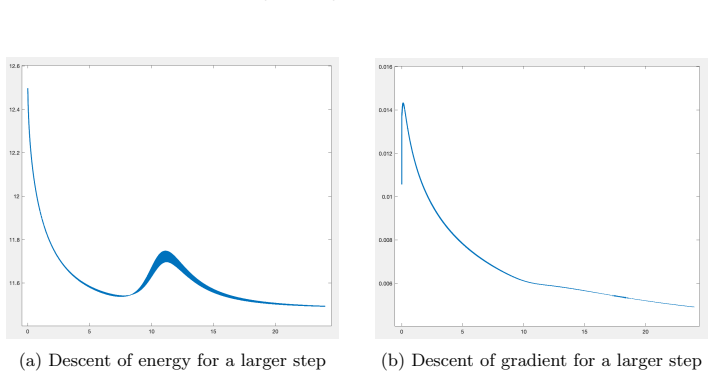
- With a sufficiently small time step and an initialization close enough to the solution, gradient descent converges at least linearly; the reported energy and gradient plots exhibit this asymptotic rate.
- Because the output satisfies the Fuchsian-group constraint globally, it enables remeshing of high-genus surfaces without partitioning them into simply connected pieces.
Reading between the lines
- A direct test not reported in the paper is to run the algorithm on an isometric pair of hyperbolic surfaces and check whether the output coincides with the known isometry; the theory predicts it should, so this would sharply test the structure-preserving claim.
- The weight-reset heuristic for non-Delaunay inputs is an unanalyzed gap: the paper does not establish that resetting negative weights to arbitrary positive numbers still yields uniqueness, embeddedness, or isometry-harmonicity, so applications on non-Delaunay meshes cannot rely on the main theorem.
- Because the energy is proper and its sublevel sets are compact, the gradient-norm stopping criterion gives a rigorous closeness certificate in principle; turning it into a practical a posteriori error bound would be a natural extension.
- The convergence theorem is local (small step, close initialization), but the experiments suggest a sizable basin of attraction; a step-size schedule or line search that provably preserves convergence while enlarging the basin would be a valuable algorithmic extension.
Editorial analysis
A structured set of objections, weighed in public.
Referee Report
Summary. The manuscript proposes a structure-preserving numerical method for computing discrete harmonic maps between closed hyperbolic surfaces of genus at least two. The method minimizes a discrete Dirichlet energy (2.3) over geodesic realizations of the 1-skeleton of a triangulated surface in a target hyperbolic surface, using canonical hyperbolic edge weights (2.8). The paper builds on Colin de Verdière's theorem to claim existence, uniqueness and embeddedness of the discrete harmonic map for positive weights, and on Lam's canonical-weight theory to claim that isometries remain harmonic. The numerical scheme lifts the map to the universal cover, enforces equivariance (3.2), and performs Riemannian gradient descent with exponential-map updates (3.9)-(3.10). The authors report experiments on genus-2 and genus-3 surfaces and an application to remeshing.
Significance. If the stated guarantees held, this would be a useful contribution to geometry processing: a global, intrinsic harmonic map for high-genus surfaces with a principled generalization of cotangent weights and a convergence-rate statement. The paper's use of canonical hyperbolic edge weights is a genuine structural idea, and the remeshing application indicates potential practical value. However, the theoretical core is largely imported from prior work, and the paper's own algorithmic modification for non-Delaunay inputs is not covered by the imported theorems. The claims are therefore currently conditional rather than established.
major comments (3)
- [§3, negative-edge-weight reset] The theoretical guarantees in Theorem 2.1, §2.3.2 and §3.3 hold only when all canonical edge weights are positive, which is equivalent to the input triangulation being Delaunay. The algorithm states: 'In case the initial surface is not a Delaunay triangulation, the weight of some edges may be negative. To ensure that the final map is an embedding, we will reset the weight of these edges to a prescribed positive number.' This reset changes the energy (2.3) from the canonical energy: the minimizer is no longer the discrete harmonic map associated with the canonical weights, and the harmonicity-of-isometries property (Theorem 2.2) is not preserved. Positivity alone only yields existence, uniqueness and embeddedness for the modified, non-canonical weight system. The paper needs either to restrict the algorithm to Delaunay inputs (e.g., by actually performing edge flips as guaranteed by Theor
- [§3.3, Theorem 3.2 applicability] The convergence-rate claim relies on Boumal's theorem for a smooth function on a Riemannian manifold with a retraction. The implemented iteration, however, does not simply run Riemannian gradient descent on D^|V|: it updates one representative of each vertex via the exponential map (3.9) and synchronizes all other representatives via deck transformations (3.10). This coupled iteration is asserted to be equivalent to a Riemannian gradient descent on the quotient manifold or on the equivariant submanifold, but no proof or reference is given for that equivalence, nor is it shown that the synchronized update is a retraction. The statement that 'the special update (3.10) ensures that the map f_t induces a well-defined geodesic realization' is necessary but not sufficient. Without a direct argument, the claimed 'at least linear convergence' from Section 3.3 is not established for the actual al
- [§2.4 vs §3] There is an internal inconsistency in the pipeline. Section 2.4 invokes the discrete uniformization theorem to obtain a Delaunay triangulation, and §2.3.2 states that positive canonical weights are equivalent to Delaunay. Yet the algorithm in §3 does not implement edge flips; instead it resets negative weights. If the initial surface is already Delaunay after uniformization, the reset case should not occur; if it is not Delaunay, the algorithm is outside the theoretical framework. The paper should clarify the precise role of discrete uniformization in the algorithm and either guarantee Delaunayness or remove the reset step in favor of flips.
minor comments (4)
- [§3, first paragraph] The phrase 'flat discrete hyperbolic metric' is confusing: a hyperbolic metric has curvature -1 and is not flat. Please rephrase.
- [§3.2, Eq. (3.4)] The Euclidean-coordinate derivative formula is presented before the Riemannian treatment; since the optimization is Riemannian, it would be cleaner to state from the outset that Euclidean partial derivatives are only used for the initial map and that all descent updates use the Riemannian gradient.
- [§3.3, Theorem 3.2] Typo: 'These exists a neighborhood' should be 'There exists a neighborhood'. Also, the theorem statement would benefit from a compactness/hypothesis check: the result is local, and the paper should explicitly identify the neighborhood in the product manifold where the iterates remain.
- [§4.2, figures] The text refers to 'Fig. 8c' and 'Fig. 8d' as local regions of the initial and output maps, but the figure captions are not fully consistent with this description. Please verify the figure numbering and labels.
Circularity Check
No circularity found: external theorems carry the derivation; the negative-weight reset is a consistency caveat, not a circular step.
full rationale
The paper's derivation chain is self-contained in the sense required here: the central existence/uniqueness/embeddedness statement (Theorem 2.1) is taken from Colin de Verdière [7], the canonical edge-weight formula (2.8) and the isometry-harmonicity property (Theorem 2.2) are imported from published work [20,27] by co-author Lam, and the convergence-rate theorem (Theorem 3.2) is Boumal's external result. No step fits a parameter to the target data and then reports it as a prediction; the energy (2.3), gradient (3.6)-(3.7), and update (3.9) are all explicit and not obtained by inverting the desired output. The self-citations are load-bearing but independent: [27] is a published, parameter-free theorem whose assumptions do not include the present algorithm's output, so under the hard rules it does not raise the circularity score. The one genuine caveat in the manuscript is in Section 3: for non-Delaunay inputs, negative canonical weights are 'reset ... to a prescribed positive number.' This means the algorithm minimizes a modified energy, and the canonical-weight guarantees (e.g., harmonicity of isometries) no longer apply; however, this is a correctness/consistency limitation of the algorithm's scope, not a circular derivation. No equation is reused as its own conclusion.
Assumptions & free parameters
free parameters (3)
- step_size_tau =
not specified
- reset_weight_value =
not specified
- stopping_threshold_epsilon =
not specified
assumptions (8)
- standard math Discrete uniformization theorem (Gu-Guo-Luo-Sun-Wu): every closed triangulated genus g>=2 surface with a piecewise Euclidean metric has a unique hyperbolic Delaunay geodesic triangulation in its discrete conformal class.
- standard math Colin de Verdiere's theorem: for a topological triangulation on a closed non-positive curvature surface with positive edge weights, there exists a unique discrete harmonic map in a given homotopy class, and it is an embedding.
- standard math Poincare polygon theorem: a paired geodesic polygon satisfying the cycle condition generates a Fuchsian group and a fundamental domain.
- domain assumption The canonical hyperbolic edge weights (Lam's formula, equation 2.8) ensure harmonicity of isometries (Theorem 2.2).
- ad hoc to paper Resetting negative edge weights to an arbitrary positive number preserves the theoretical guarantees of the discrete harmonic map.
- ad hoc to paper The Riemannian gradient descent with synchronized boundary updates on the universal cover is equivalent to a Riemannian gradient descent on the quotient surface, so Boumal's convergence theorem applies.
- standard math Hyperbolic Ricci flow converges to the uniformization metric (Chow-Luo).
- domain assumption The Hessian of the discrete Dirichlet energy at the discrete harmonic map is positive definite (Kajigaya-Tanaka).
Cite this review
Pith. "Pith review of A Structure-Preserving Numerical Method for Harmonic Maps Between High-genus Surfaces." pith.science (2026). https://pith.science/paper/2YHNYACN
@misc{pith2026250901256,
  author       = {Pith},
  title        = {Pith review of: A Structure-Preserving Numerical Method for Harmonic Maps Between High-genus Surfaces},
  year         = {2026},
  howpublished = {\url{https://pith.science/paper/2YHNYACN}},
  note         = {Machine review of arXiv:2509.01256}
}
read the original abstract
Motivated by geometry processing for surfaces with non-trivial topology, we study discrete harmonic maps between closed surfaces of genus at least two. Harmonic maps provide a natural framework for comparing surfaces by minimizing distortion. Unlike conformal or isometric maps-which may not exist between surfaces with different geometries-harmonic maps always exist within a fixed homotopy class and yield optimal homeomorphisms when the target surface has negative curvature. We develop a structure-preserving algorithm to compute harmonic maps from a triangulated surface to a reference hyperbolic surface. The method minimizes Dirichlet energy over geodesic realizations of the surface graph into the target hyperbolic surface in the homotopy class of a homeomorphism. A central feature of our framework is the use of canonical edge weights derived from the hyperbolic metric, which generalize the classical cotangent weights from the Euclidean setting. These weights preserve injectivity and ensure that isometries remain harmonic in the discrete theory, reflecting their classical behavior.
Figures


Figures from the paper (11 more)




Forward citations
Cited by 1 Pith paper
-
Morphing Graphs on Hyperbolic Surfaces
First algorithm for morphing geodesic graph embeddings on hyperbolic surfaces, built on a generalized Tutte embedding theorem and hyperbolic mean value coordinates.
Reference graph
Works this paper leans on
-
[1]
S. Angenent, S. Haker, A. Tannenbaum, and R. Kikinis , Conformal geometry and brain flattening, in Medical Image Computing and Computer-Assisted Intervention–MICCAI’99: Second International Conference, Cambridge, UK, September 19-22, 1999. Proceedings 2, Springer, 1999, pp. 271–278
work page 1999
-
[2]
R. Bajcsy and S. Kovaˇciˇc, Multiresolution elastic matching , Computer vision, graphics, and image processing, 46 (1989), pp. 1–21
work page 1989
-
[3]
M. F. Beg, M. I. Miller, A. Trouv ´e, and L. Younes , Computing large deformation metric mappings via geodesic flows of diffeomorphisms , International journal of computer vision, 61 (2005), pp. 139–157
work page 2005
-
[4]
A. I. Bobenko, U. Pinkall, and B. A. Springborn , Discrete conformal maps and ideal hyperbolic polyhedra, Geom. Topol., 19 (2015), pp. 2155–2215, https://doi.org/10.2140/gt. 2015.19.2155, https://doi.org/10.2140/gt.2015.19.2155
doi:10.2140/gt 2015
-
[5]
Boumal, An introduction to optimization on smooth manifolds, Cambridge University Press, 2023
N. Boumal, An introduction to optimization on smooth manifolds, Cambridge University Press, 2023
2023
-
[6]
B. Chow and F. Luo, Combinatorial ricci flows on surfaces , Journal of Differential Geometry, 63 (2003), pp. 97–129
work page 2003
-
[7]
Colin de Verdi`ere, Comment rendre g´ eod´ esique une triangulation d’une surface?, Enseign
Y. Colin de Verdi`ere, Comment rendre g´ eod´ esique une triangulation d’une surface?, Enseign. Math. (2), 37 (1991), pp. 201–212
work page 1991
-
[8]
C. R. Collins and K. Stephenson , A circle packing algorithm , Computational Geometry, 25 22 ZHIPENG ZHU, W AI YEUNG LAM, AND LOK MING LUI Fig. 14: The two remeshed surfaces (2003), pp. 233–256
work page 2003
Show all 48 references
-
[9]
Desbrun, M
M. Desbrun, M. Meyer, and P. Alliez , Intrinsic parameterizations of surface meshes , in Computer graphics forum, vol. 21, Wiley Online Library, 2002, pp. 209–218
2002
-
[10]
R. J. Duffin, Distributed and lumped networks , J. Math. Mech., 8 (1959), pp. 793–826, https: //doi.org/10.1512/iumj.1959.8.58051, https://doi.org/10.1512/iumj.1959.8.58051
1959 doi
-
[11]
M. Eck, T. DeRose, T. Duchamp, H. Hoppe, M. Lounsbery, and W. Stuetzle , Multires- olution analysis of arbitrary meshes , in Proceedings of the 22nd annual conference on Computer graphics and interactive techniques, 1995, pp. 173–182
1995
-
[12]
Erickson and P
J. Erickson and P. Lin , A Toroidal Maxwell-Cremona-Delaunay Correspondence , in 36th International Symposium on Computational Geometry (SoCG 2020), S. Cabello and D. Z. Chen, eds., vol. 164 of Leibniz International Proceedings in Informatics (LIPIcs), Dagstuhl, Germany, 2020,...
2020 doi
-
[13]
M. S. Floater , Parametrization and smooth approximation of surface triangulations , Com- puter aided geometric design, 14 (1997), pp. 231–250
1997
-
[14]
Gaster, B
J. Gaster, B. Loustau, and L. Monsaingeon , Computing discrete equivariant har- monic maps , 2018, https://arxiv.org/abs/1810.11932, https://arxiv.org/abs/1810.11932. arXiv:1810.11932
2018 arXiv
-
[15]
S. J. Gortler, C. Gotsman, and D. Thurston , Discrete one-forms on meshes and ap- plications to 3d mesh parameterization , Computer Aided Geometric Design, 23 (2006), pp. 83–112
2006
-
[16]
X. Gu, R. Guo, F. Luo, J. Sun, and T. Wu, A discrete uniformization theorem for polyhedral surfaces II , J. Differential Geom., 109 (2018), pp. 431–466, https://doi.org/10.4310/jdg/ 1531188190, https://doi.org/10.4310/jdg/1531188190
2018
-
[17]
Gu and S.-T
X. Gu and S.-T. Yau , Global conformal surface parameterization, in Proceedings of the 2003 Eurographics/ACM SIGGRAPH symposium on Geometry processing, 2003, pp. 127–137
2003
-
[18]
Haker, L
S. Haker, L. Zhu, A. Tannenbaum, and S. Angenent , Optimal mass transport for registra- tion and warping , International Journal of computer vision, 60 (2004), pp. 225–240
2004
-
[19]
Isenburg and P
M. Isenburg and P. Lindstrom , Streaming meshes , in VIS 05. IEEE Visualization, 2005., IEEE, 2005, pp. 231–238
2005
-
[20]
Izmestiev and W
I. Izmestiev and W. Y. Lam , Discrete laplacians – spherical and hyperbolic , J. Lond. Math. Soc. (2), (2025), https://doi.org/10.1112/jlms.70235
2025 doi
-
[21]
M. Jin, J. Kim, F. Luo, and X. Gu , Discrete surface ricci flow , IEEE Transactions on Visu- alization and Computer Graphics, 14 (2008), pp. 1030–1043
2008
-
[22]
Jost , Harmonic maps between surfaces , vol
J. Jost , Harmonic maps between surfaces , vol. 1062 of Lecture Notes in Mathematics, Springer-Verlag, Berlin, 1984, https://doi.org/10.1007/BFb0100160, https://doi.org/10. 1007/BFb0100160. NUMERICAL METHOD FOR HARMONIC MAPS BETWEEN HYPERBOLIC SURF ACES23
1984 doi
-
[23]
J. Jost , Riemannian geometry and geometric analysis , Universitext, Springer, Cham, seventh ed., 2017, https://doi.org/10.1007/978-3-319-61860-9, https://doi.org/10.1007/ 978-3-319-61860-9
2017 doi
-
[24]
Kajigaya and R
T. Kajigaya and R. Tanaka , Uniformizing surfaces via discrete harmonic maps , Ann. H. Lebesgue, 4 (2021), pp. 1767–1807, https://doi.org/10.5802/ahl.116, https://doi.org/10. 5802/ahl.116
2021 doi
-
[25]
Kotani and T
M. Kotani and T. Sunada, Standard realizations of crystal lattices via harmonic maps, Trans. Amer. Math. Soc., 353 (2001), pp. 1–20, https://doi.org/10.1090/S0002-9947-00-02632-5, https://doi.org/10.1090/S0002-9947-00-02632-5
2001 doi
-
[26]
W. Y. Lam, Delaunay decompositions minimizing energy of weighted toroidal graphs , Discrete Comput. Geom., (2024), https://doi.org/10.1007/s00454-024-00699-x
2024 doi
-
[27]
W. Y. Lam, Discrete harmonic maps between hyperbolic surfaces, Calc. Var. Partial Differential Equations, (2025), https://arxiv.org/abs/2405.02205. To appear
2025 arXiv
-
[28]
R. Li, T. Tang, and P. Zhang , Moving mesh methods in multiple dimensions based on har- monic maps , Journal of Computational Physics, 170 (2001), pp. 562–588
2001
-
[29]
L. M. Lui, K. C. Lam, T. W. Wong, and X. Gu , Texture map and video compression using beltrami representation, SIAM Journal on Imaging Sciences, 6 (2013), pp. 1880–1902
2013
-
[30]
L. M. Lui and C. Wen , Geometric registration of high-genus surfaces , SIAM Journal on Imaging Sciences, 7 (2014), pp. 337–365
2014
-
[31]
L. M. Lui, T. W. Wong, W. Zeng, X. Gu, P. M. Thompson, T. F. Chan, and S. T. Yau, Detection of shape deformities using yamabe flow and beltrami coefficients , Inverse Problems and Imaging, 4 (2010), pp. 311–333
2010
-
[32]
Luo , Combinatorial Yamabe flow on surfaces , Commun
F. Luo , Combinatorial Yamabe flow on surfaces , Commun. Contemp. Math., 6 (2004), pp. 765–780, https://doi.org/10.1142/S0219199704001501, https://doi.org/10. 1142/S0219199704001501
2004 doi
-
[33]
Marchandise, C
E. Marchandise, C. C. de Wiart, W. Vos, C. Geuzaine, and J.-F. Remacle , High- quality surface remeshing using harmonic maps—part ii: Surfaces with high genus and of large aspect ratio, International Journal for Numerical Methods in Engineering, 86 (2011), pp. 1303–1321
2011
-
[34]
D. B. Mumford and J. Shah , Optimal approximations by piecewise smooth functions and as- sociated variational problems, Communications on pure and applied mathematics, (1989)
1989
-
[35]
T. Ng, X. Gu, and L. Lui , Teichm¨ uller extremal map of multiply-connected domains using beltrami holomorphic flow , Journal of Scientific Computing, 60 (2014), pp. 249–275
2014
-
[36]
Persson and G
P.-O. Persson and G. Strang , A simple mesh generator in matlab , SIAM review, 46 (2004), pp. 329–345
2004
-
[37]
Pinkall and K
U. Pinkall and K. Polthier , Computing discrete minimal surfaces and their conjugates , Experimental mathematics, 2 (1993), pp. 15–36
1993
-
[38]
Remacle, C
J.-F. Remacle, C. Geuzaine, G. Compere, and E. Marchandise , High-quality surface remeshing using harmonic maps , International Journal for Numerical Methods in Engi- neering, 83 (2010), pp. 403–425
2010
-
[39]
T. W. Sederberg and F. Chen , Implicitization using moving curves and surfaces , in Pro- ceedings of the 22nd annual conference on Computer graphics and interactive techniques, 1995, pp. 301–308
1995
-
[40]
W. T. Tutte, How to draw a graph, Proceedings of the London Mathematical Society, 3 (1963), pp. 743–767
1963
-
[41]
V aillant, M
M. V aillant, M. I. Miller, L. Younes, and A. Trouv ´e, Statistics on diffeomorphisms via tangent space representations, NeuroImage, 23 (2004), pp. S161–S169
2004
-
[42]
W ang, Y
S. W ang, Y. W ang, M. Jin, X. D. Gu, and D. Samaras, Conformal geometry and its appli- cations on 3d shape matching, recognition, and stitching , IEEE Transactions on Pattern Analysis and Machine Intelligence, 29 (2007), pp. 1209–1220
2007
-
[43]
G. Xu, B. Mourrain, R. Duvigneau, and A. Galligo , Parameterization of computational domain in isogeometric analysis: methods and comparison , Computer Methods in Applied Mechanics and Engineering, 200 (2011), pp. 2021–2031
2011
-
[44]
W. Zeng, L. M. Lui, F. Luo, T. F.-C. Chan, S.-T. Yau, and D. X. Gu , Computing quasi- conformal maps using an auxiliary metric and discrete curvature flow , Numerische Math- ematik, 121 (2012), pp. 671–703
2012
-
[45]
Zhang and M
D. Zhang and M. Hebert , Harmonic maps and their applications in surface matching , in Proceedings. 1999 IEEE Computer Society Conference on Computer Vision and Pattern Recognition (Cat. No PR00149), vol. 2, IEEE, 1999, pp. 524–530
1999
-
[46]
Zhang, R
M. Zhang, R. Liao, A. V. Dalca, E. A. Turk, J. Luo, P. E. Grant, and P. Golland , Frequency diffeomorphisms for efficient image registration , in Information Processing in Medical Imaging: 25th International Conference, IPMI 2017, Boone, NC, USA, June 25-30, 24 ZHIPENG ZHU, W ...
2017
-
[47]
Zhou and A
Q. Zhou and A. Jacobson, Thingi10k: A dataset of 10,000 3d-printing models , arXiv preprint arXiv:1605.04797, (2016)
2016 arXiv
-
[48]
Z. Zhu, G. P. Choi, and L. M. Lui , Parallelizable global quasi-conformal parameterization of multiply connected surfaces via partial welding , SIAM Journal on Imaging Sciences, 15 (2022), pp. 1765–1807
2022
Reviewed August 5, 2026 · model on record in the stance chip above.
Discussion (0). Continue with ORCID to comment.