REVIEW 4 minor 140 references
Interpretive agreement is convex combination of signal models, completed by cosine similarity.
Reviewed by Pith at T0; open to challenge. T0 means a machine referee read the full paper against a public rubric. the ladder, T0–T4 →
T0 review · grok-4.5
2026-07-11 05:48 UTC pith:2YXOP4X7
load-bearing objection Clean geometric order on interpretive disagreement with a sharp convex-hull characterization and unique cosine completion; solid theory paper.
Agreement and Diversity in Interpretation
The pith
A machine-rendered reading of the paper's core claim, the machinery that carries it, and where it could break.
Core claim
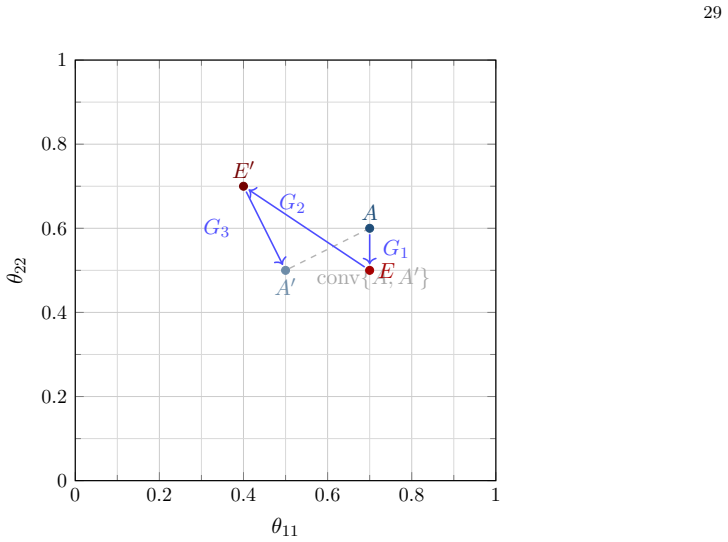
A pair of subjective signal structures is more agreeable than another if and only if each structure in the more agreeable pair is a convex combination of the two structures in the less agreeable pair; this inclusion preorder is prior-independent, and its unique rotation-invariant strict completion ranks pairs by cosine similarity of the induced joint distributions over states and signals.
What carries the argument
The inclusion preorder: the cone of surplus vectors that both agents accept ex-ante under one pair of models contains the corresponding cone under another pair, which dualizes to the convex-hull condition on the models themselves.
Load-bearing premise
The reservation payoff is a fixed common number, so every possible surplus vector can be realized by some finite decision problem; if the reservation must instead come from an action that is already optimal under the prior, full cone inclusion is only sufficient, not necessary.
What would settle it
Construct two pairs of binary experiments that are not related by convex combination yet induce nested cones of jointly acceptable surplus vectors under some full-support prior, or find a rotation-invariant completion of the inclusion preorder that is not ordered by cosine similarity.
Editorial analysis
A structured set of objections, weighed in public.
Referee Report
Summary. The paper studies joint decision-making by two agents who share prior, state space, actions, payoffs, reservation payoff, and Bayesian updating, but may disagree about signal likelihoods. It defines an inclusion preorder over pairs of subjective models: (m, m') is more agreeable than (m̂, m̂') if the cone of jointly acceptable surplus vectors under the former contains that under the latter, uniformly across decision problems. Proposition 1 shows this is equivalent to each model in the more agreeable pair being a convex combination of the two models in the less agreeable pair, and that the comparison is prior-independent. Proposition 5 shows that the unique rotation-invariant strict completion of the (incomplete) inclusion preorder is ranking by cosine similarity of the induced joint distributions. Applications establish that greater agreement shrinks speculative-trade transfer intervals (Proposition 2), expands a suitably normalized ex-ante Pareto frontier (Proposition 3), and enlarges the set of single-model rationalizations (Proposition 4). The order is independent of Blackwell dominance and selects quadratic over KL-type Bregman divergences among rotation-invariant comparisons.
Significance. If the characterizations hold, the paper supplies a clean, decision-theoretic, prior-free partial order on interpretive disagreement that is grounded in joint participation constraints rather than ad-hoc statistical distance. The convex-hull representation (Proposition 1) and the uniqueness of the cosine completion under rotation invariance (Proposition 5) are transparent and rest on standard dual-cone and separating-hyperplane arguments that are fully written out in Appendix A. The applications give the order immediate economic content for speculative trade, Pareto frontiers, and external rationalizability. The careful treatment of the reservation-payoff spanning assumption (footnote 6 and Online Appendix B.2) and the explicit comparison with Blackwell and Bregman divergences further strengthen the contribution. The results are machine-checkable from the written proofs and require no free parameters.
minor comments (4)
- In the abstract and introduction the phrase "selects quadratic over KL-type Bregman divergences" is slightly loose; Proposition 9 shows that the only rotation-invariant Bregman divergence on the sphere is a multiple of squared Euclidean distance (hence cosine). A one-sentence clarification would prevent misreading.
- Figure 1 and Figure 2 are helpful, but the captions could more explicitly state the coordinates (θ11, θ22) and the meaning of the dashed segments so that a reader skimming the figures alone can recover the geometry.
- A few minor typos appear (e.g., "suprlus" near the end of §4.2, "won" for "down" in the same paragraph). A careful proof-reading pass would catch them.
- The online appendix material on introspection-proofness (B.1) and the prior-optimal reservation variant (B.2) is useful; a brief pointer in the main-text conclusion would help readers locate it.
Circularity Check
No significant circularity: inclusion preorder and cosine uniqueness are derived characterizations, not restatements of inputs.
full rationale
The paper is pure decision theory with no data, fitted parameters, or empirical predictions. The inclusion preorder is defined directly from ex-ante participation cones C(p_m, p_m') (Definition 2). Proposition 1 then derives the equivalent convex-hull representation on models via dual-cone geometry and the fact that probability vectors force coefficients to sum to one; the prior-cancellation argument shows the comparison is intrinsic to the experiments. Proposition 5 defines a rotation-invariant strict completion by three axioms (extension of inclusion, rotation invariance of cones, strictness for strict rotated inclusions) and proves uniqueness by reducing to the aperture of the normal cone, which is exactly the angle (hence cosine) between the belief vectors. Both results are standard convex-geometry characterizations; neither is forced by construction from its own definition, nor does any load-bearing step rest on a self-citation uniqueness theorem or an ansatz. Applications (speculative-trade nesting, normalized Pareto expansion, rationalizing-model enlargement) are direct corollaries. The reservation-spanning assumption is explicitly flagged and relaxed in Online Appendix B.2 without circularity. No steps match the enumerated circularity patterns.
Axiom & Free-Parameter Ledger
axioms (4)
- domain assumption Agents share a common prior p over a finite state space Ω, a common finite action set and utility, a common reservation payoff ū, and Bayesian updating; they may differ only in signal likelihoods m(s|ω).
- domain assumption Finite decision problems with a fixed scalar reservation payoff span the entire surplus space R^{Ω×S}.
- standard math Standard convex analysis: dual of a cone generated by two vectors is the intersection of the corresponding half-spaces; separating hyperplane theorem for compact convex sets.
- domain assumption Disagreement is dogmatic: agents do not entertain a common model of uncertainty over signal structures that could restore agreement.
invented entities (2)
-
Inclusion preorder ⪰_I on pairs of subjective models
no independent evidence
-
Rotation-invariant cosine completion ⪰_RIC
no independent evidence
read the original abstract
We study joint decision-making when agents agree on all primitives other than signal likelihoods. We propose a decision-theoretic measure of interpretive disagreement: a pair of subjective models is more agreeable than another if, uniformly across decision problems, it supports a larger set of signal-contingent plans that both agents weakly prefer ex-ante to the common reservation payoff. We show that this measure is prior independent and can be represented as an inclusion preorder over pairs of subjective models: each model in the more agreeable pair is a convex combination of the two models in the less agreeable pair. We then show that the measure's unique rotation-invariant scalar completion is cosine similarity. Applications show that greater agreement reduces speculative-trade wedges, expands a normalized version of the ex-ante Pareto frontier, and enlarges the set of single-model rationalizations. Our order is independent of Blackwell dominance and selects quadratic over KL-type Bregman divergences.
Figures

Reference graph
Works this paper leans on
-
[1]
Bohren, J Aislinn and Hauser, Daniel N , year=
-
[2]
2000 , publisher=
Billot, Antoine and Chateauneuf, Alain and Gilboa, Itzhak and Tallon, Jean-Marc , journal=. 2000 , publisher=
2000
-
[3]
2008 , publisher=
Rigotti, Luca and Shannon, Chris and Strzalecki, Tomasz , journal=. 2008 , publisher=
2008
-
[4]
2005 , publisher=
Rigotti, Luca and Shannon, Chris , journal=. 2005 , publisher=
2005
-
[5]
2014 , publisher=
Brunnermeier, Markus K and Simsek, Alp and Xiong, Wei , journal=. 2014 , publisher=
2014
-
[6]
2014 , publisher=
Gilboa, Itzhak and Samuelson, Larry and Schmeidler, David , journal=. 2014 , publisher=
2014
-
[7]
1978 , publisher=
Harrison, J Michael and Kreps, David M , journal=. 1978 , publisher=
1978
-
[8]
1951 , publisher=
Kullback, Solomon and Leibler, Richard A , journal=. 1951 , publisher=
1951
-
[9]
1967 , publisher=
Bregman, Lev M , journal=. 1967 , publisher=
1967
-
[10]
Aumann, Robert J , journal=
-
[11]
1983 , publisher=
Sebenius, James K and Geanakoplos, John , journal=. 1983 , publisher=
1983
-
[12]
Malmendier, Ulrike and Nagel, Stefan and Yan, Zhen , year=
-
[13]
2018 , publisher=
Hansen, Stephen and McMahon, Michael and Prat, Andrea , journal=. 2018 , publisher=
2018
-
[14]
Kaminski, Alexa and Macaulay, Alistair and Song, Wenting , year=
-
[15]
Braghieri, Luca , title =
-
[16]
Howes, Cooper and i Carreras, Marc Dordal and Coibion, Olivier and Gorodnichenko, Yuriy , year=
-
[17]
2021 , volume =
Heidhues, Paul and K. 2021 , volume =
2021
-
[18]
2023 , volume =
Frick, Mira and Iijima, Ryota and Ishii, Yuhta , title =. 2023 , volume =
2023
-
[19]
Aislinn and Hauser, Daniel N
Bohren, J. Aislinn and Hauser, Daniel N. , title =. 2021 , volume =
2021
-
[20]
2021 , note =
Esponda, Ignacio and Pouzo, Demian and Yamamoto, Yuichi , title =. 2021 , note =
2021
-
[21]
Aislinn , title =
Bohren, J. Aislinn , title =. 2016 , volume =
2016
-
[22]
2020 , volume =
Frick, Mira and Iijima, Ryota and Ishii, Yuhta , title =. 2020 , volume =
2020
-
[23]
2016 , volume =
Esponda, Ignacio and Pouzo, Demian , title =. 2016 , volume =
2016
-
[24]
2021 , volume =
Fudenberg, Drew and Lanzani, Giacomo and Strack, Philipp , title =. 2021 , volume =
2021
-
[25]
2025 , journal =
Esponda, Ignacio and Pouzo, Demian , title =. 2025 , journal =
2025
-
[26]
1991 , volume =
Nyarko, Yaw , title =. 1991 , volume =
1991
-
[27]
2025 , howpublished =
Tamuz, Omer , title =. 2025 , howpublished =
2025
-
[28]
2024 , volume =
Frick, Mira and Iijima, Ryota and Ishii, Yuhta , title =. 2024 , volume =
2024
-
[29]
2022 , volume =
Frick, Mira and Iijima, Ryota and Ishii, Yuhta , title =. 2022 , volume =
2022
-
[30]
Aislinn and Hauser, Daniel N
Bohren, J. Aislinn and Hauser, Daniel N. , title =. 2025 , volume =
2025
-
[31]
1995 , publisher=
Kandel, Eugene and Pearson, Neil D , journal=. 1995 , publisher=
1995
-
[32]
1999 , publisher=
Bamber, Linda Smith and Barron, Orie E and Stober, Thomas L , journal=. 1999 , publisher=
1999
-
[33]
1994 , publisher=
Morris, Stephen , journal=. 1994 , publisher=
1994
-
[34]
1982 , publisher=
Milgrom, Paul and Stokey, Nancy , journal=. 1982 , publisher=
1982
-
[35]
Au, Pak Hung , title =
-
[36]
Aislinn Bohren and Alex Imas , year =
Cuimin Ba and J. Aislinn Bohren and Alex Imas , year =
-
[37]
Mira Frick and Ryota Iijima and Yuhta Ishii , year =
-
[38]
Aislinn Bohren and Daniel N
J. Aislinn Bohren and Daniel N. Hauser , year =
-
[39]
Chambers and Yusufcan Masatlioglu and Collin Raymond , year =
Christopher P. Chambers and Yusufcan Masatlioglu and Collin Raymond , year =
-
[40]
Davide Bordoli , year =
-
[41]
Braghieri, Luca , journal=
-
[42]
von Beringe, Konstantin and Whitmeyer, Mark , journal=
-
[43]
Morris, Stephen and Shin, Hyun Song , journal=
-
[44]
Milgrom, Paul and Shannon, Chris , title =
-
[45]
Yu, Feiyang and Moehring, Alex and Banerjee, Oishi and Salz, Tobias and Agarwal, Nikhil and Rajpurkar, Pranav , journal=
-
[46]
Green, Ben and Chen, Yiling , journal=
-
[47]
Eiermann, Martin and Fitzpatrick, Maria and Sadowski, Katharine and Wildeman, Christopher , journal=
-
[48]
de Clippel, Geoffroy and Zhang, Xu , title =
-
[49]
Quah and Bruno Strulovici , journal =
John K.-H. Quah and Bruno Strulovici , journal =
-
[50]
2012 , number =
Ray, Debraj and Robson, Arthur , title =. 2012 , number =
2012
-
[51]
2010 , number =
Xia, Bianjun , title =. 2010 , number =
2010
-
[52]
2004 , Month =
Hopkins, Ed and Kornienko, Tatiana , Title =. 2004 , Month =
2004
-
[53]
Seel, Christian and Strack, Philipp , journal=
-
[54]
2016 , Month =
Gentzkow, Matthew and Kamenica, Emir , Title =. 2016 , Month =
2016
-
[55]
Kolotilin, Anton and Mylovanov, Tymofiy and Zapechelnyuk, Andriy and Li, Ming , title =
-
[56]
2015 , Month =
Boleslavsky, Raphael and Cotton, Christopher , Title =. 2015 , Month =
2015
-
[57]
Yucheng Ding and Tianle Zhang. 2018
2018
-
[58]
Whitmeyer, Mark , journal=
-
[59]
2022 , publisher=
Chan, David C and Gentzkow, Matthew and Yu, Chuan , journal=. 2022 , publisher=
2022
-
[60]
Peter Klibanoff and Massimo Marinacci and Sujoy Mukerji , journal =
-
[61]
, title =
Epstein, Larry G. , title =. 2006 , month =
2006
-
[62]
Gul, Faruk and Pesendorfer, Wolfgang , title =
-
[63]
Siniscalchi, Marciano , title =
-
[64]
Machina and David Schmeidler , journal =
Mark J. Machina and David Schmeidler , journal =
-
[65]
Machina , journal =
Mark J. Machina , journal =
-
[66]
2012 , Month =
Ortoleva, Pietro , Title =. 2012 , Month =
2012
-
[67]
Grether , journal =
David M. Grether , journal =
-
[68]
Kleiner, Andreas and Moldovanu, Benny and Strack, Philipp and Whitmeyer, Mark , journal=
-
[69]
Stahl , journal =
Dale O. Stahl , journal =
-
[70]
Tyrrell , year=
Rockafellar, R. Tyrrell , year=
-
[71]
Blackwell, David. 1951
1951
-
[72]
Radner, Roy and Stiglitz, Joseph , Year =
-
[73]
Edwards, Ward , Year =
-
[74]
Schrag , journal =
Matthew Rabin and Joel L. Schrag , journal =
-
[75]
Wakker, Peter , journal =
-
[76]
Safra, Zvi and Sulganik, Eyal , journal =
-
[77]
1950 , publisher=
Wald, Abraham , booktitle=. 1950 , publisher=
1950
-
[78]
1995 , publisher=
Morris, Stephen , journal=. 1995 , publisher=
1995
-
[79]
Deimen, Inga and Mora, Ernesto Rivera , journal=
-
[80]
1966 , publisher=
Berk, Robert H , journal=. 1966 , publisher=
1966
discussion (0)
Sign in with ORCID, Apple, or X to comment. Anyone can read and Pith papers without signing in.