Floquet Topological Phases and Anomalous Hall Signatures in Irradiated Two-dimensional d_(xy)-Wave Altermagnets
Pith reviewed 2026-06-26 03:30 UTC · model grok-4.3
The pith
A single driving parameter β switches irradiated d_xy altermagnets between Chern phases of magnitude 2 and 4 via distinct gap-closing points.
A machine-rendered reading of the paper's core claim, the machinery that carries it, and where it could break.
Core claim
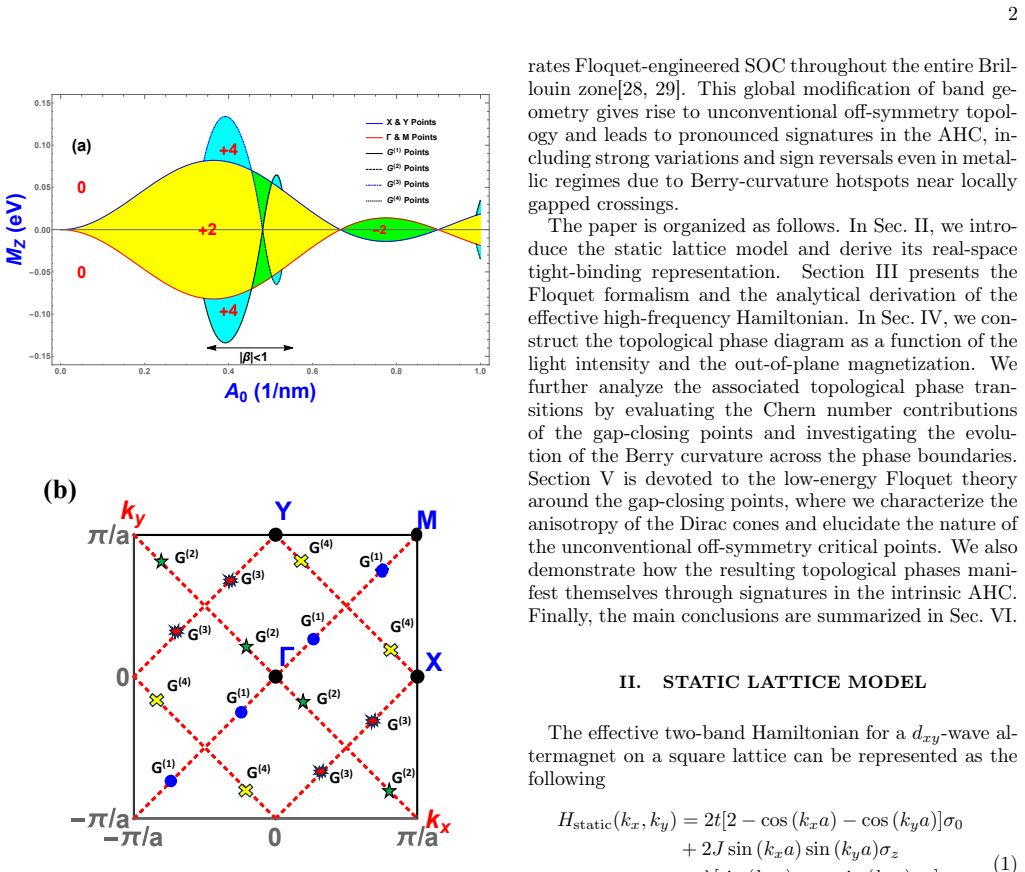
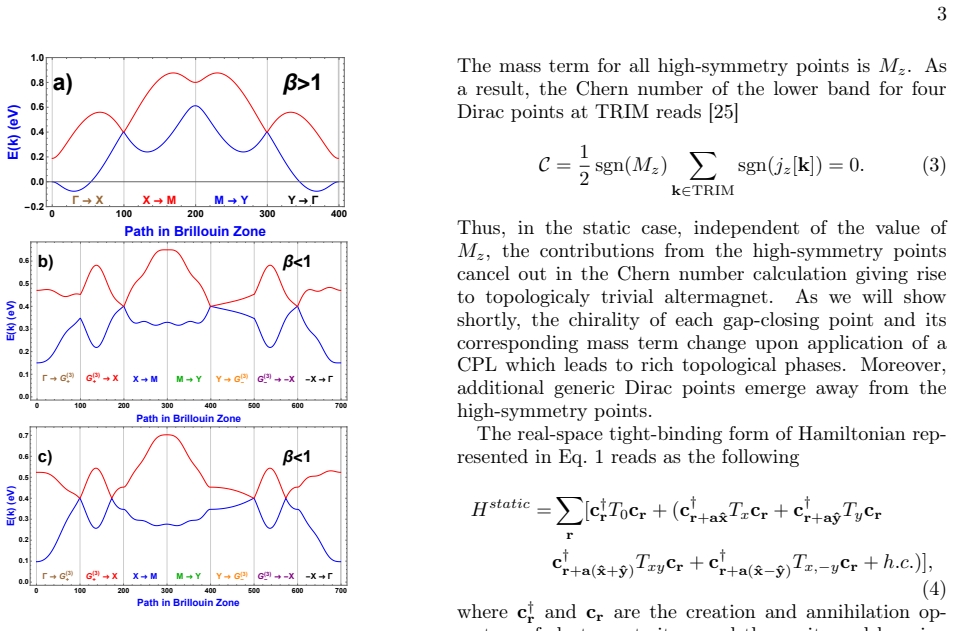
Using a lattice Floquet formulation, the system is governed by a driving parameter β that controls the emergence of distinct gap-closing points and associated topological phases. For |β|>1, topology is dominated by anisotropic Dirac points at high symmetry points, leading to Chern phases with |C|=2. For |β|<1, light-induced off-symmetry G points appear in four families in the Brillouin zone, enabling higher Chern phases up to |C|=4. Low-energy analysis reveals that high symmetry points host anisotropic massive Dirac fermions, while G points realize generalized two-dimensional anisotropic Dirac points with fully momentum-dependent pseudospin structure, leading to distinct Berry curvature dist
What carries the argument
the driving parameter β that controls the emergence of distinct gap-closing points and associated topological phases
If this is right
- For |β|>1 anisotropic Dirac points at high-symmetry momenta produce Chern phases with |C|=2.
- For |β|<1 four families of light-induced G points support Chern phases reaching |C|=4.
- High-symmetry points host anisotropic massive Dirac fermions while G points have fully momentum-dependent pseudospin texture.
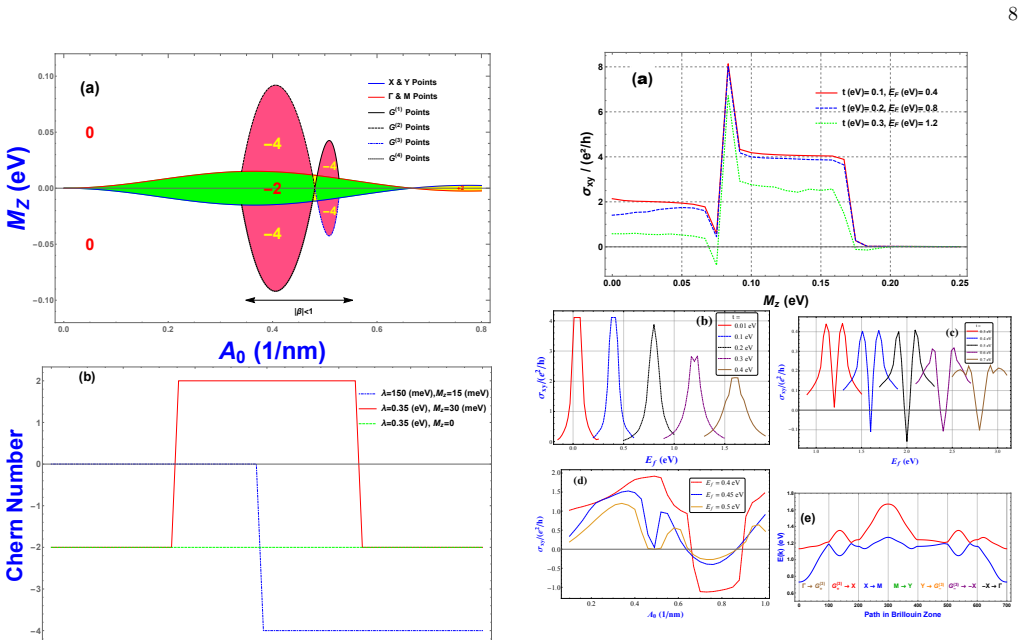
- Anomalous Hall conductivity develops sharp features associated with Berry curvature accumulation near the gap-closing regions.
Where Pith is reading between the lines
- The distinct momentum dependence of the pseudospin texture at G points versus high-symmetry points implies different responses to disorder or finite temperature in transport.
- The same optical protocol could be applied to other altermagnetic point-group symmetries to generate families of light-tunable Chern phases.
Load-bearing premise
The lattice Floquet formulation with off-resonant circularly polarized light and extrinsic exchange coupling from a proximate ferromagnet accurately captures the driven system's gap-closing points and Berry curvature.
What would settle it
Spectroscopic detection of gap-closing points at the predicted off-symmetry G locations for driving strengths with |β|<1, together with a jump in the anomalous Hall conductivity from |C|=2 to |C|=4, would confirm the central claim.
Figures
read the original abstract
We study Floquet topological phases in two-dimensional $d_{xy}$-wave altermagnets driven by off-resonant circularly polarized light and subject to an out-of-plane magnetization induced via extrinsic exchange coupling from a proximate ferromagnet. Using a lattice Floquet formulation, we show that the system is governed by a driving parameter $\beta$ that controls the emergence of distinct gap-closing points and associated topological phases. For $|\beta|>1$, topology is dominated by anisotropic Dirac points at high symmetry points, leading to Chern phases with $|\mathcal{C}|=2$. For $|\beta|<1$, light-induced off-symmetry $G$ points appear in four families in the Brillouine zone, enabling higher Chern phases up to $|\mathcal{C}|=4$. Low-energy analysis reveals that high symmetry points host anisotropic massive Dirac fermions, while $G$ points realize generalized two-dimensional anisotropic Dirac points with fully momentum-dependent pseudospin structure, leading to distinct Berry curvature distributions. In the metallic regime, the anomalous Hall conductivity provides an experimental signature of these Floquet topological phases, exhibiting sharp features associated with Berry curvature accumulation near local gap-closing regions.
Editorial analysis
A structured set of objections, weighed in public.
Referee Report
Summary. The manuscript studies Floquet topological phases in two-dimensional d_xy-wave altermagnets under off-resonant circularly polarized light plus extrinsic out-of-plane magnetization from a proximate ferromagnet. A lattice Floquet effective Hamiltonian is introduced whose gap-closing loci are controlled by a single driving parameter β. For |β|>1 the topology is set by anisotropic Dirac points at high-symmetry points, producing Chern phases with |C|=2; for |β|<1 four families of light-induced off-symmetry G points appear, enabling phases up to |C|=4. Low-energy Dirac models are derived for both classes of points, and the anomalous Hall conductivity is computed in the metallic regime as an experimental signature tied to Berry-curvature accumulation near the gap closings.
Significance. If the central results hold, the work supplies a concrete route to light-tunable higher-Chern-number phases in altermagnets and identifies distinct Berry-curvature distributions arising from high-symmetry versus off-symmetry gap closings. The lattice Floquet formulation with an explicit, tunable β parameter yields falsifiable predictions for the two regimes and directly links them to measurable anomalous Hall features.
minor comments (1)
- Abstract, line 8: 'Brillouine zone' is a typographical error and should read 'Brillouin zone'.
Simulated Author's Rebuttal
We thank the referee for their concise and accurate summary of our manuscript, for highlighting its significance in providing a route to light-tunable higher-Chern phases in altermagnets, and for recommending minor revision. No major comments were listed in the report.
Circularity Check
No significant circularity in derivation chain
full rationale
The paper introduces a standard lattice Floquet effective Hamiltonian for the driven altermagnet system, with driving parameter β treated as an external input. Gap-closing loci are located by solving det(H_eff(k,β))=0 at high-symmetry and off-symmetry points, and Chern numbers follow from direct integration of Berry curvature over the Brillouin zone. No self-definitional relations, fitted parameters renamed as predictions, or load-bearing self-citations appear; the reported phases for |β|>1 versus |β|<1 emerge from solving the model's equations rather than reducing to inputs by construction. The analysis is self-contained against external benchmarks.
Axiom & Free-Parameter Ledger
free parameters (1)
- β
axioms (2)
- domain assumption The driven system is accurately described by a time-periodic lattice Hamiltonian under off-resonant circularly polarized light.
- domain assumption Out-of-plane magnetization arises from extrinsic exchange coupling to a proximate ferromagnet and can be treated as a static term.
Reference graph
Works this paper leans on
-
[1]
Asanexample, considertheyellowregionatlowintensity regime shown in Fig
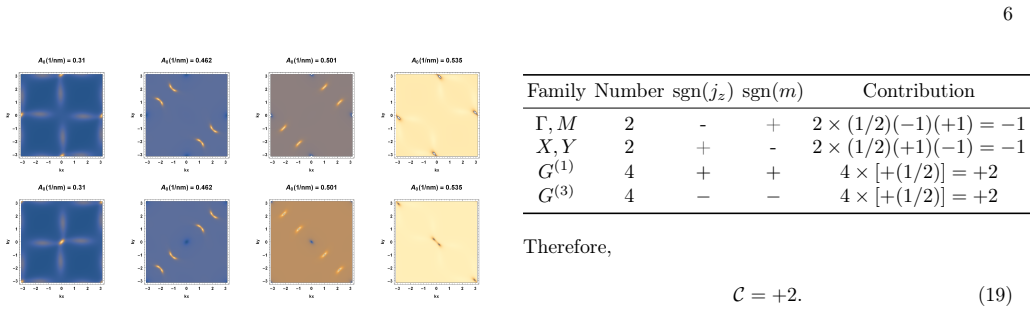
Regime |β| > 1: TRIM-dominated phases In this regime, only the four TRIM points contribute. Asanexample, considertheyellowregionatlowintensity regime shown in Fig. 1(a) for the right-handed CPL with β > 1. The contributions are summarized as Family sgn(jz) sgn( m) Contribution Γ, M + + 2 × (1/2)(+1)(+1) = +1 X, Y − − 2 × (1/2)(−1)(−1) = +1 6 FIG. 3: Evolu...
-
[2]
1(a), there are yellow regions in in- termediate intensities with|β| < 1
Regime |β| < 1: TRIM and G Points As shown in Fig. 1(a), there are yellow regions in in- termediate intensities with|β| < 1. In these regions both types of Dirac points (TRIM+G points) contribute in the Chern number. The contribution in the intervalβ ∈ [0, 1] is given as Family Number sgn(jz) sgn( m) Contribution Γ, M 2 - + 2 × (1/2)(−1)(+1) = −1 X, Y 2 +...
-
[3]
In particular, in the cyan region of Fig
Regime |β| < 1: Floquet-induced high-Chern phases When |β| < 1, off-symmetry Dirac points appear and contribute to the topology. In particular, in the cyan region of Fig. 1(a), the TRIM contributions cancel, and the Chern number is entirely determined by theGpoints. The contributions for interval β ∈ [0, 1] are summa- rized as Family Number sgn(jz) sgn( m...
-
[4]
Dirac” contri- bution (present even whendz is constant or quadratic), while dxjx + dyjy is a
Berry curvature decomposition The Berry curvature of the lower band for a two-band model is Ωz(q∥) = 1 2 d · (∂qx d × ∂qy d) |d|3 . (23) Writing ji = (∂qx d × ∂qy d)i for i = x, y, z, we have Ωz = ΩDirac + Ωgeom. where ΩDirac = dzjz/(2|d|3) and Ωgeom = ( dxjx + dyjy)/(2|d|3). The termdzjz is the usual “Dirac” contri- bution (present even whendz is constan...
-
[5]
II using the parameterγ = |β| and the sign factor s = sign[sin(kxa) cos(kxa)]
Velocity matrices and anisotropy For concreteness, we list the velocity matrices for each family in Table. II using the parameterγ = |β| and the sign factor s = sign[sin(kxa) cos(kxa)]. The eigenvalues of M∥ = VT ∥ V∥ for all G families are identical: Λ2 1 ± |2γ − 1| 2 , where Λ = 2 λ′a√γ. Thus the in-plane anisotropy ratio is ηG(γ) = 1 + |2γ − 1| 1 − |2γ...
-
[6]
Smejkal, J
L. Smejkal, J. Sinova, and T. Jungwirth, Beyond Con- ventional Ferromagnetism and Antiferromagnetism: A Phase with Nonrelativistic Spin and Crystal Rotation Symmetry, Phys. Rev. X12, 031042 (2022)
2022
-
[7]
Smejkal, J
L. Smejkal, J. Sinova, and T. Jungwirth, Emerging Re- search Landscape of Altermagnetism, Phys. Rev. X12, 040501 (2022)
2022
-
[8]
C. Song, H. Bai, Z. Zhou, L. Han, H. Reichlova, J. Hugo Dil, J. Liu, X. Chen, and F. Pan, Altermagnets as a New Class of Functional Materials, Nat. Rev. Mater.10, 473 (2025)
2025
-
[9]
H. Bai, W. Feng, S. Liu, L. Smejkal, Y. Mokrousov, and Y. Yao, Altermagnetism: Exploring New Frontiers in Magnetism and Spintronics, Adv. Funct. Mater.34, 2409327 (2024)
2024
-
[10]
M. Roig, A. Kreisel, Y. Yu, B. M. Andersen, and D. F. Agterberg, Minimal Models for Altermagnetism, Phys. Rev. B110, 144412 (2024)
2024
-
[11]
Z. Feng, X. Zhou, L. Šmejkal, L. Wu, Z. Zhu, H. Guo, R. González-Hernández, X. Wang, H. Yan, P. Qin, X. Zhang, H. Zhou, X. Chen, H. Yang, and Y. Yao, An Anomalous Hall Effect in Altermagnetic Ruthenium Dioxide, Nat. Electron.5, 735 (2022)
2022
-
[12]
Šmejkal, R
L. Šmejkal, R. González-Hernández, T. Jungwirth, and J. Sinova, Crystal Time-Reversal Symmetry Breaking and Spontaneous Hall Effect in Collinear Antiferromag- nets, Sci. Adv.6, eaaz8809 (2020)
2020
-
[13]
Guo, Z.-X
P.-J. Guo, Z.-X. Liu, and Z.-Y. Lu, Quantum Anomalous Hall Effect in Collinear Antiferromagnetism, npj Com- put. Mater.9, 70 (2023)
2023
-
[14]
B. Wu, J. Liu, Y. Li, Z. Wang, C. Liu, and S. Zhang, Quantum Anomalous Hall Effect in an Antiferromagnetic Monolayer of MoO, Phys. Rev. B107, 214419 (2023)
2023
-
[15]
Y. Liu, J. Li, and Q. Liu, Chern-Insulator Phase in An- tiferromagnets, Nano Lett.23, 8650 (2023)
2023
-
[16]
W. Zhu, H. Bai, L. Han, F. Pan, and C. Song, Tun- able Quantum Anomalous Hall Effect via Crystal Order in Spin-Splitting Antiferromagnets, Nano Lett.25, 5672 (2025)
2025
-
[17]
Oka and H
T. Oka and H. Aoki, Photovoltaic Hall Effect in Graphene, Phys. Rev. B79, 081406 (2009)
2009
-
[18]
Kitagawa, T
T. Kitagawa, T. Oka, A. Brataas, L. Fu, and E. Dem- ler, Transport Properties of Nonequilibrium Systems un- der the Application of Light: Photoinduced Quantum Hall Insulators without Landau Levels, Phys. Rev. B84, 235108 (2011)
2011
-
[19]
M. S. Rudner, N. H. Lindner, E. Berg, and M. Levin, Anomalous Edge States and the Bulk-Edge Correspon- dence for Periodically Driven Two-Dimensional Systems, Phys. Rev. X3, 031005 (2013)
2013
-
[20]
M. S. Rudner and N. H. Lindner, Band Structure Engi- neeringandNon-EquilibriumDynamicsinFloquetTopo- logical Insulators, Nat. Rev. Phys.2, 229 (2020)
2020
-
[21]
Bukov, L
M. Bukov, L. D’Alessio, and A. Polkovnikov, Universal High-FrequencyBehaviorofPeriodicallyDrivenSystems: From Dynamical Stabilization to Floquet Engineering, Adv. Phys.64, 139 (2015)
2015
-
[22]
Eckardt and E
A. Eckardt and E. Anisimovas, High-Frequency Approx- imation for Periodically Driven Quantum Systems from a Floquet-Space Perspective, New J. Phys.17, 093039 (2015)
2015
-
[23]
S. A. A. Ghorashi and Q. Li, Dynamical Generation of Higher-Order Spin-Orbit Couplings, Topology and Per- sistent Spin Texture in Light-Irradiated Altermagnets, Phys. Rev. Lett.135, 236702, (2025)
2025
-
[24]
X. Zou, X. Feng, Y. Dai, B. Huang, and C. Niu, Floquet Quantum Anomalous Hall Effect with In-Plane Magneti- zation in Two-Dimensional Altermagnets, ACS Nano19, 35575 (2025)
2025
-
[25]
Oppeneer, Spin polarization engineering in d-wave altermagnets, Phys
Mohsen Yarmohammadi, Marco Berritta, Marin Bukov, Libor Šmejkal, Jacob Linder, Peter M. Oppeneer, Spin polarization engineering in d-wave altermagnets, Phys. Rev. B.113, L060403 (2026)
2026
-
[26]
Yuping Tian, Chen-Hao Zhao, Chao-Bo Wang, Binyuan Zhang, Xiangru Kong, Wei-Jiang Gong, Optically Driven Orbital Hall Transport in Floquet Odd-Parity Collinear Altermagnets with High Chern Numbers, arXiv:2603.11483 (2026)
arXiv 2026
-
[27]
M. Ganguli ,A. Jana, A. Narayan, Tunable topology, Hall response, and spin-textures in bicircularly polarized light illuminated altermagnets, Phys. Rev. B - Accepted 5 June, doi.org/10.1103/6jv2-nmnn (2026)
-
[28]
B. D. Hoi, T. Tien, D. Q. Khoa, H. Viet, N. T. Dung, Optical tuning of spin-resolved van Hove singularities in Rashba altermagnets using bicircularly polarized light, Phys. Lett. A.584, 15, 131718 (2026). 12
2026
-
[29]
F. D. M. Haldane, Model for a Quantum Hall Effect with- out Landau Levels: Condensed-Matter Realization of the ’Parity Anomaly’, Phys. Rev. Lett.61, 2015 (1988)
2015
-
[30]
Sticlet, F
D. Sticlet, F. Piéchon, J. N. Fuchs, P. Kalugin, and P. Simon, Geometrical Engineering of Complex Phases in Graphene, Phys. Rev. B85, 165456 (2012)
2012
-
[31]
Zhang, R
Y. Zhang, R. Li, Y. Bai, Z. Zhang, and collaborators, Floquet Quantum Anomalous Hall Effect with Tunable and High Chern Numbers in Two-Dimensional Antifer- romagnet KMnBi, Nano Lett.25, 4180 (2025)
2025
-
[32]
F. D. M. Haldane, Berry Curvature on the Fermi Surface: Anomalous Hall Effect as a Topological Fermi-Liquid Property, Phys. Rev. Lett.93, 206602 (2004)
2004
-
[33]
S. S. Dabiri, H. Cheraghchi, A. Sadeghi, Floquet states and optical conductivity of an irradiated two-dimensional topological insulator, Phys. Rev. B.106, 165423(2022)
2022
-
[34]
Cheraghchi, Floquet-Engineered Chern Insulator in two-dimensional dx2−y2-Wave Altermagnets, Phys
H. Cheraghchi, Floquet-Engineered Chern Insulator in two-dimensional dx2−y2-Wave Altermagnets, Phys. Rev. B. 15, 155439 (2025)
2025
-
[35]
J. H. Shirley, Solution of the Schrödinger Equation with a Hamiltonian Periodic in Time, Phys. Rev.138, B979 (1965)
1965
-
[36]
Mikami, S
T. Mikami, S. Kitamura, K. Yasuda, N. Tsuji, T. Oka, and H. Aoki, Brillouin-Wigner Theory for High-Frequency Expansion in Periodically Driven Sys- tems: Application to Floquet Topological Insulators, Phys. Rev. B93, 144307 (2016)
2016
-
[37]
Fukui, Y
T. Fukui, Y. Hatsugai, and H. Suzuki, Chern Numbers in Discretized Brillouin Zone: Efficient Method of Com- puting (Spin) Hall Conductances, J. Phys. Soc. Jpn.74, 1674 (2005)
2005
discussion (0)
Sign in with ORCID, Apple, or X to comment. Anyone can read and Pith papers without signing in.