REVIEW 3 major objections 4 minor 3 cited by
Multilingual and Multi-Aspect Hate Speech Analysis
T0 review · 3 major / 4 minor · reviewed 2026-08-14 · deepseek-v4-flash
Pith's one-line read A new trilingual dataset labels five aspects of hate speech
desk verdict The trilingual multi-aspect dataset is a real contribution, but the paper's own agreement numbers don't support the benchmark claims built on top of it. read the letter →
The pith
A machine-rendered reading of the paper's core claim, the machinery that carries it, and where it could break.
The reading
What carries the argument
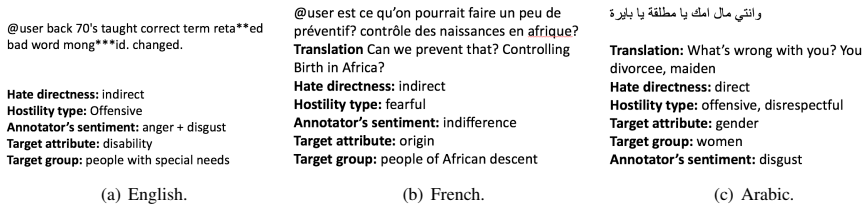
The central object is the five-aspect annotation schema, with each aspect forming a classification task: directness, hostility type (multilabel), target attribute, target group, and annotator sentiment (multilabel). The dataset's design—comparable corpora built through iterative search-word revision, five annotators per tweet, majority-vote aggregation with multilabel allowance for subjective tasks—carries the argument. The experimental machinery is the Sluice-network multitask architecture (a model that learns what to share between loosely related tasks) over Babylon cross-lingual embeddings that align the three languages.
What would settle it
Re-annotate a random sample of several hundred released tweets with expert annotators using the same guidelines, without showing them the crowd labels, and check whether experts reproduce the majority-vote labels and the reported language-level patterns; if expert agreement with the crowd labels is close to chance, the resource's ground-truth value collapses.
Extended reading notes
Core claim
The central discovery is a new public resource: a comparable trilingual dataset of English, French, and Arabic tweets with five fine-grained annotation layers, assembled by iterative keyword selection in each language and labeled by five native speakers per tweet. The paper treats each annotation aspect as a separate classification task and shows that multilingual multitask training yields gains in specific configurations, especially for target-group classification in all three languages and for hostility-type classification when paired with target attributes. It also documents cross-linguistic differences in the targets of hate speech and introduces annotator sentiment as a measurable aspect, which the paper claims no earlier hate speech dataset attempts to capture.
Load-bearing premise
The load-bearing premise is that a majority vote of five crowd annotators produces trustworthy ground-truth labels even though the measured annotator agreement is very low (Krippendorff alpha of 0.153 for English, 0.244 for French, and 0.202 for Arabic).
Editorial extensions
If this is right
- With the released labels, a hate-speech detector can be trained to predict directness, hostility type, target attribute, target group, and annotator sentiment in English, French, and Arabic under one schema.
- The annotator-sentiment layer makes reader reaction measurable, giving moderation and social-science research a variable that earlier datasets lack.
- Multilingual training improves target-group classification in all three languages, so the dataset demonstrates a path for low-resource hate-speech tasks to borrow signal from other languages.
- Joint training of target attribute and hostility type raises hostility-type F1 slightly in every language, and joint training with annotator sentiment raises Arabic macro-F1, indicating correlated annotation aspects that can be exploited.
- For the simple two-class directness task, single-language single-task models outperform multilingual and multitask settings, suggesting not every aspect benefits from sharing.
Reading between the lines
- A natural next step the paper does not take is to use the annotator-sentiment labels as a harm signal, prioritizing moderation cases by emotional impact instead of by coarse hostility category.
- Because the reported annotator agreement is low, modeling each annotator as a noisy labeler rather than collapsing to majority votes could produce cleaner labels and reveal which aspects are inherently subjective.
- The absence of sexual-orientation and special-needs labels in the Arabic subset may reflect annotation vocabulary and cultural sensitivities rather than true tweet content; collecting target names in annotators' own words could separate these effects.
- Extending the same five-aspect schema to code-mixed or additional languages would test whether the cross-lingual patterns reported here generalize beyond English, French, and Arabic.
Signed reviews
Editorial analysis
A structured set of objections, weighed in public.
Referee Report
Summary. The paper introduces a trilingual (English, French, Arabic) Twitter hate speech dataset with approximately 13,000 tweets annotated along five aspects: directness, hostility type, target attribute, target group, and annotator sentiment. The authors describe their data collection and annotation process, report label distributions, and evaluate single-task, multilingual, and multitask neural models (chiefly Sluice networks with Babylon embeddings) on all five classification tasks. The paper claims to be the first trilingual multi-aspect hate speech dataset and the first to examine annotator reactions to hate speech. It also releases code and anonymized tweet text.
Significance. If the dataset's labels are reliable, this is a genuinely useful resource for multilingual hate speech research: it provides fine-grained, multi-aspect annotations in three languages, includes a pilot-based label refinement process, and makes code and anonymized data publicly available. The exploration of multitask learning across these aspects is also a reasonable contribution. However, the central value of the paper hinges on label quality; with the reported inter-annotator agreement as low as α=0.153, the dataset's reliability is not yet established. The paper also ships code and data, which is a strength, but the experimental evaluation lacks any uncertainty quantification, reducing confidence in the reported multitask gains.
major comments (3)
- [Section 3.5] The reported average Krippendorff alphas (0.153 for English, 0.244 for French, 0.202 for Arabic) are far below conventional reliability thresholds (e.g., 0.667 for tentative conclusions), yet the paper uses majority-vote labels as ground truth for all subsequent experiments. The only justification, that these values are 'comparable to existing complex annotations (Sanguinetti et al., 2018)', is given without reporting the comparison values. The paper must report per-aspect agreement, agreement on the specific majority-vote labels used for training, and a discussion of how low agreement affects the validity of the dataset and the evaluation results.
- [Section 4.2] All reported results come from a single 80/10/10 split with no variance estimation or significance testing. Consequently, the claimed multitask improvements (e.g., 0.03, 0.05, 0.01 for hostility type, 0.25 macro-F1 for Arabic target group) may be attributable to chance. The authors should report results over multiple random seeds or cross-validation folds and, where possible, significance tests such as paired bootstrap.
- [Section 3.5] The multilabel majority-vote rule is problematic when agreement is low: for the hostility type task with six labels and five annotators, a label can appear in the final annotation with only two annotator votes, and two such labels can both be included. This can produce label sets that are numerical artifacts of dispersion rather than stable human judgments. The paper should examine the distribution of annotator votes underlying each majority label and consider alternative aggregation schemes (e.g., requiring a minimum number of agreeing annotators).
minor comments (4)
- [Section 3.5 (Target group paragraph)] The text says 'Table 1 shows the counts of the five categories' but the relevant statistics are in Table 2; the table reference is incorrect.
- [Section 4.2] The abbreviation 'MTSL' is used in the text before it is defined; please define all model abbreviations at first use (e.g., in Section 4.1).
- [Section 3.3] The description of how native-speaker annotators were verified and how 'scams' were detected would benefit from more precision, since the annotation quality is the foundation of the dataset.
- [Section 3.2] The authors mention that masking user names and URLs and removing emojis may remove context, but the possible effect on annotation quality is not quantified; a brief discussion of this trade-off would be helpful.
Circularity Check
No circularity: the paper's claims are empirical dataset construction and benchmark evaluation, with no derivation that reduces to its inputs.
full rationale
This is an empirical resource paper. The central claims are that the authors release a new trilingual multi-aspect hate speech dataset and that it is the first to include several annotation facets including annotator reactions. There is no mathematical derivation chain whose conclusion is equivalent to an input. The classification experiments train models on the annotation schema and evaluate on a held-out split of the same schema, which is standard supervised learning, not circular reasoning: the labels are the training signal, and the test set measures generalization to unseen tweets annotated under the same scheme. The choice of Babylon embeddings over MUSE is a model-selection decision based on observed performance on this data, not a fitted parameter renamed as a prediction. The paper makes no load-bearing appeal to the authors' own prior work; the multitask architecture is cited from Ruder et al. (2017), an external source, and the dataset novelty claim is supported by a literature comparison that is externally checkable. The low inter-annotator agreement values (Krippendorff alpha 0.153, 0.244, 0.202) are a reliability and validity concern for the ground-truth labels, and the paper itself acknowledges the issue by calling the scores 'comparable to existing complex annotations'; but low agreement is not circularity. Nothing in the paper defines a quantity in terms of the quantity it is supposed to predict, fits a parameter to a subset and then predicts a closely related forced quantity, or smuggles an ansatz in via a self-citation. Therefore no circular step is present, and the appropriate score is 0.
Assumptions & free parameters
free parameters (3)
- Sluice network hyperparameters =
hidden_dim=200, lr=0.1, noise_std=2, cross-stitch=imbalanced
- Per-class classification thresholds =
tuned per binary class on dev split
- Choice between Babylon and MUSE embeddings =
Babylon selected
assumptions (4)
- domain assumption Crowd-sourced majority vote is a valid ground truth for hate speech aspects.
- domain assumption Babylon cross-lingual embeddings align English, French, and Arabic sufficiently for parameter sharing.
- domain assumption Sluice networks as described by Ruder et al. (2017) are suitable for the five loosely related tasks.
- domain assumption The hourglass of emotions model provides an appropriate taxonomy for annotator sentiment.
invented entities (2)
-
Fearful out of ignorance label
-
Annotator sentiment task
Cite this review
Pith. "Pith review of Multilingual and Multi-Aspect Hate Speech Analysis." pith.science (2026). https://pith.science/paper/2Z2YZNYX
@misc{pith2026190811049,
  author       = {Pith},
  title        = {Pith review of: Multilingual and Multi-Aspect Hate Speech Analysis},
  year         = {2026},
  howpublished = {\url{https://pith.science/paper/2Z2YZNYX}},
  note         = {Machine review of arXiv:1908.11049}
}
read the original abstract
Current research on hate speech analysis is typically oriented towards monolingual and single classification tasks. In this paper, we present a new multilingual multi-aspect hate speech analysis dataset and use it to test the current state-of-the-art multilingual multitask learning approaches. We evaluate our dataset in various classification settings, then we discuss how to leverage our annotations in order to improve hate speech detection and classification in general.
Figures
Forward citations
Cited by 3 Pith papers
-
Explainable AI: XAI-Guided Context-Aware Data Augmentation
XAI-guided augmentation that replaces the least important words, identified by Integrated Gradients, with back-translated synonyms or paraphrases improves hate speech and sentiment classification accuracy by up to 8 p...
-
Advancing Content Moderation: Evaluating Large Language Models for Detecting Sensitive Content Across Text, Images, and Videos
A broad benchmark finds that general-purpose LLMs often outperform dedicated moderation APIs and prior CNN/LSTM baselines on text, image, and video content detection.
-
A Survey on Automatic Online Hate Speech Detection in Low-Resource Languages
A survey cataloging datasets, features, and machine-learning methods for automatic hate speech detection in low-resource languages, organized by world region, with an overview of open challenges.
Reference graph
Works this paper leans on
-
[1]
, " * write output.state after.block = add.period write newline
ENTRY address author booktitle chapter doi edition editor howpublished institution journal key month note number organization pages publisher school series title type url volume year label extra.label sort.label short.list INTEGERS output.state before.all mid.sentence after.sentence after.block FUNCTION init.state.consts #0 'before.all := #1 'mid.sentence...
-
[2]
write newline
" write newline "" before.all 'output.state := FUNCTION n.dashify 't := "" t empty not t #1 #1 substring "-" = t #1 #2 substring "--" = not "--" * t #2 global.max substring 't := t #1 #1 substring "-" = "-" * t #2 global.max substring 't := while if t #1 #1 substring * t #2 global.max substring 't := if while FUNCTION word.in bbl.in capitalize " " * FUNCT...
-
[3]
Nuha Albadi, Maram Kurdi, and Shivakant Mishra. 2018. Are they our brothers? analysis and detection of religious hate speech in the arabic twittersphere. In Proceedings of ASONAM\/ . IEEE Computer Society, pages 69--76
work page 2018
-
[4]
Isabelle Augenstein, Sebastian Ruder, and Anders S gaard. 2018. Multi-task learning of pairwise sequence classification tasks over disparate label spaces. In Proceedings of NAACL\/ . Association for Computational Linguistics, pages 1896--1906
work page 2018
-
[5]
Aditya Bohra, Deepanshu Vijay, Vinay Singh, Syed Sarfaraz Akhtar, and Manish Shrivastava. 2018. A dataset of hindi-english code-mixed social media text for hate speech detection. In Proceedings of the Second Workshop on Computational Modeling of People's Opinions, Personality, and Emotions in Social Media\/ . Association for Computational Linguistics, pag...
work page 2018
-
[6]
Erik Cambria, Andrew Livingstone, and Amir Hussain. 2011. The hourglass of emotions. In COST 2102 Training School\/ . Springer, volume 7403 of Lecture Notes in Computer Science\/ , pages 144--157
work page 2011
-
[7]
Despoina Chatzakou, Nicolas Kourtellis, Jeremy Blackburn, Emiliano De Cristofaro, Gianluca Stringhini, and Athena Vakali. 2017. Mean birds: Detecting aggression and bullying on twitter. In Proceedings of WebSci '17\/ . ACM, pages 13--22
work page 2017
-
[8]
Ronan Collobert, Jason Weston, L \' e on Bottou, Michael Karlen, Koray Kavukcuoglu, and Pavel P. Kuksa. 2011. Natural language processing (almost) from scratch. Journal of Machine Learning Research\/ 12:2493--2537
work page 2011
Show all 34 references
-
[9]
Macy, and Ingmar Weber
Thomas Davidson, Dana Warmsley, Michael W. Macy, and Ingmar Weber. 2017. Automated hate speech detection and the problem of offensive language. In Proceedings of ICWSM\/ . pages 512--515
2017
-
[10]
Wang, and Elizabeth Belding
Mai ElSherief, Vivek Kulkarni, Dana Nguyen, William Y. Wang, and Elizabeth Belding. 2018. Hate lingo: A target-based linguistic analysis of hate speech in social media. In Proceedings of ICWSM\/
2018
-
[11]
Antigoni - Maria Founta, Constantinos Djouvas, Despoina Chatzakou, Ilias Leontiadis, Jeremy Blackburn, Gianluca Stringhini, Athena Vakali, Michael Sirivianos, and Nicolas Kourtellis. 2018. Large scale crowdsourcing and characterization of twitter abusive behavior. In Proceedin...
2018
-
[12]
Thiago Galery, Efstathios Charitos, and Ye Tian. 2018. Aggression identification and multi lingual word embeddings. In Proceedings of the First Workshop on Trolling, Aggression and Cyberbullying\/ . Association for Computational Linguistics, pages 74--79
2018
-
[13]
Banjo, Alexandra Berlinger, Siddharth Bhagwan, Cody Buntain, Paul Cheakalos, Alicia A
Jennifer Golbeck, Zahra Ashktorab, Rashad O. Banjo, Alexandra Berlinger, Siddharth Bhagwan, Cody Buntain, Paul Cheakalos, Alicia A. Geller, Quint Gergory, Rajesh Kumar Gnanasekaran, Raja Rajan Gunasekaran, Kelly M. Hoffman, Jenny Hottle, Vichita Jienjitlert, Shivika Khare, Rya...
2017
-
[14]
Kazuma Hashimoto, caiming xiong, Yoshimasa Tsuruoka, and Richard Socher. 2017. A joint many-task model: Growing a neural network for multiple nlp tasks. In Proceedings of EMNLP\/ . Association for Computational Linguistics, pages 1923--1933
2017
-
[15]
Cynthia Van Hee, Els Lefever, Ben Verhoeven, Julie Mennes, Bart Desmet, Guy De Pauw, Walter Daelemans, and V \' e ronique Hoste. 2015. Detection and fine-grained classification of cyberbullying events. In Proceedings of RANLP\/ . pages 672--680
2015
-
[16]
Filip Klubi c ka and Raquel Fernandez. 2018. Examining a hate speech corpus for hate speech detection and popularity prediction. In Proceedings LREC\/
2018
-
[17]
Nane Kratzke. 2017. The \#BTW17 Twitter Dataset - Recorded Tweets of the Federal Election Campaigns of 2017 for the 19th German Bundestag . Data\/ 2(4)
2017
-
[18]
Guillaume Lample, Alexis Conneau, Ludovic Denoyer, and Marc'Aurelio Ranzato. 2017. Unsupervised machine translation using monolingual corpora only. arXiv preprint arXiv:1711.00043\/
2017 arXiv
-
[19]
Le, Ilya Sutskever, Oriol Vinyals, and Lukasz Kaiser
Thang Luong, Quoc V. Le, Ilya Sutskever, Oriol Vinyals, and Lukasz Kaiser. 2016. Multi-task sequence to sequence learning. In International Conference on Learning Representations\/
2016
-
[20]
Shervin Malmasi and Marcos Zampieri. 2018. Challenges in discriminating profanity from hate speech. J. Exp. Theor. Artif. Intell.\/ 30(2):187--202
2018
-
[21]
Ryan Martin, Kelsey Ryan Coyier, Leah Vansistine, and Kelly Schroeder. 2012. Anger on the internet: The perceived value of rant-sites. Cyberpsychology, behavior and social networking\/ 16
2012
-
[22]
Graham Neubig, Chris Dyer, Yoav Goldberg, Austin Matthews, Waleed Ammar, Antonios Anastasopoulos, Miguel Ballesteros, David Chiang, Daniel Clothiaux, Trevor Cohn, Kevin Duh, Manaal Faruqui, Cynthia Gan, Dan Garrette, Yangfeng Ji, Lingpeng Kong, Adhiguna Kuncoro, Gaurav Kumar, ...
2017 arXiv
-
[23]
Chikashi Nobata, Joel Tetreault, Achint Thomas, Yashar Mehdad, and Yi Chang. 2016. Abusive language detection in online user content. In Proceedings of WWW '16\/ . International World Wide Web Conferences Steering Committee, pages 145--153
2016
-
[24]
Ji Ho Park, Jamin Shin, and Pascale Fung. 2018. Reducing gender bias in abusive language detection. In Proceedings of EMNLP\/ . Association for Computational Linguistics, pages 2799--2804
2018
-
[25]
Hao Peng, Sam Thomson, and Noah A. Smith. 2017. Deep multitask learning for semantic dependency parsing. In Proceedings of the 55th Annual Meeting of the Association for Computational Linguistics (Volume 1: Long Papers)\/ . Association for Computational Linguistics, pages 2037--2048
2017
-
[26]
Jing Qian, Mai ElSherief, Elizabeth Belding, and William Yang Wang. 2018. Hierarchical cvae for fine-grained hate speech classification. In Proceedings of EMNLP\/ . Association for Computational Linguistics, pages 3550--3559
2018
-
[27]
Bj \" o rn Ross, Michael Rist, Guillermo Carbonell, Benjamin Cabrera, Nils Kurowsky, and Michael Wojatzki. 2017. Measuring the reliability of hate speech annotations: The case of the european refugee crisis. CoRR\/ abs/1701.08118
2017 arXiv
-
[28]
Sebastian Ruder, Joachim Bingel, Isabelle Augenstein, and Anders S gaard. 2017. Sluice networks: Learning what to share between loosely related tasks. arXiv preprint arXiv:1705.08142\/
2017 arXiv
-
[29]
Manuela Sanguinetti, Fabio Poletto, Cristina Bosco, Viviana Patti, and Marco Stranisci. 2018. An italian twitter corpus of hate speech against immigrants. In LREC\/ . European Language Resources Association (ELRA)
2018
-
[30]
Anna Schmidt and Michael Wiegand. 2017. A survey on hate speech detection using natural language processing. In Proceedings of the Fifth International Workshop on Natural Language Processing for Social Media\/ . Association for Computational Linguistics, pages 1--10
2017
-
[31]
Smith, David H
Samuel L. Smith, David H. P. Turban, Steven Hamblin, and Nils Y. Hammerla. 2017. Offline bilingual word vectors, orthogonal transformations and the inverted softmax. CoRR\/ abs/1702.03859
2017 arXiv
-
[32]
Wiktor Soral, Michał Bilewicz, and Mikołaj Winiewski. 2017. Exposure to hate speech increases prejudice through desensitization. Aggressive Behavior\/ 44
2017
-
[33]
Zeerak Waseem, Thomas Davidson, Dana Warmsley, and Ingmar Weber. 2017. Understanding abuse: A typology of abusive language detection subtasks. In Proceedings of the First Workshop on Abusive Language Online\/ . Association for Computational Linguistics, pages 78--84
2017
-
[34]
Zeerak Waseem and Dirk Hovy. 2016. Hateful symbols or hateful people? predictive features for hate speech detection on twitter. In Proceedings of the NAACL Student Research Workshop\/ . The Association for Computational Linguistics, pages 88--93
2016
Reviewed August 14, 2026 · model on record in the stance chip above.
Discussion (0). Continue with ORCID to comment.