REVIEW 3 major objections 6 minor 48 references
Reversed Attention: On The Gradient Descent Of Attention Layers In GPT
T0 review · 3 major / 6 minor · reviewed 2026-08-11 · deepseek-v4-flash
Pith's one-line read The paper claims that the softmax derivative in GPT attention, called Reversed Attention, is an implicit attention map that reveals how gradient descent would edit attention, and that its norms rank head importance while averaged maps can…
desk verdict RA is a real and useful object with two new applications, but the batched formula in Eq. 17 does not compute what it claims and the empirical support needs robustness work before the central claims can be trusted. read the letter →
The pith
A machine-rendered reading of the paper's core claim, the machinery that carries it, and where it could break.
The reading
What carries the argument
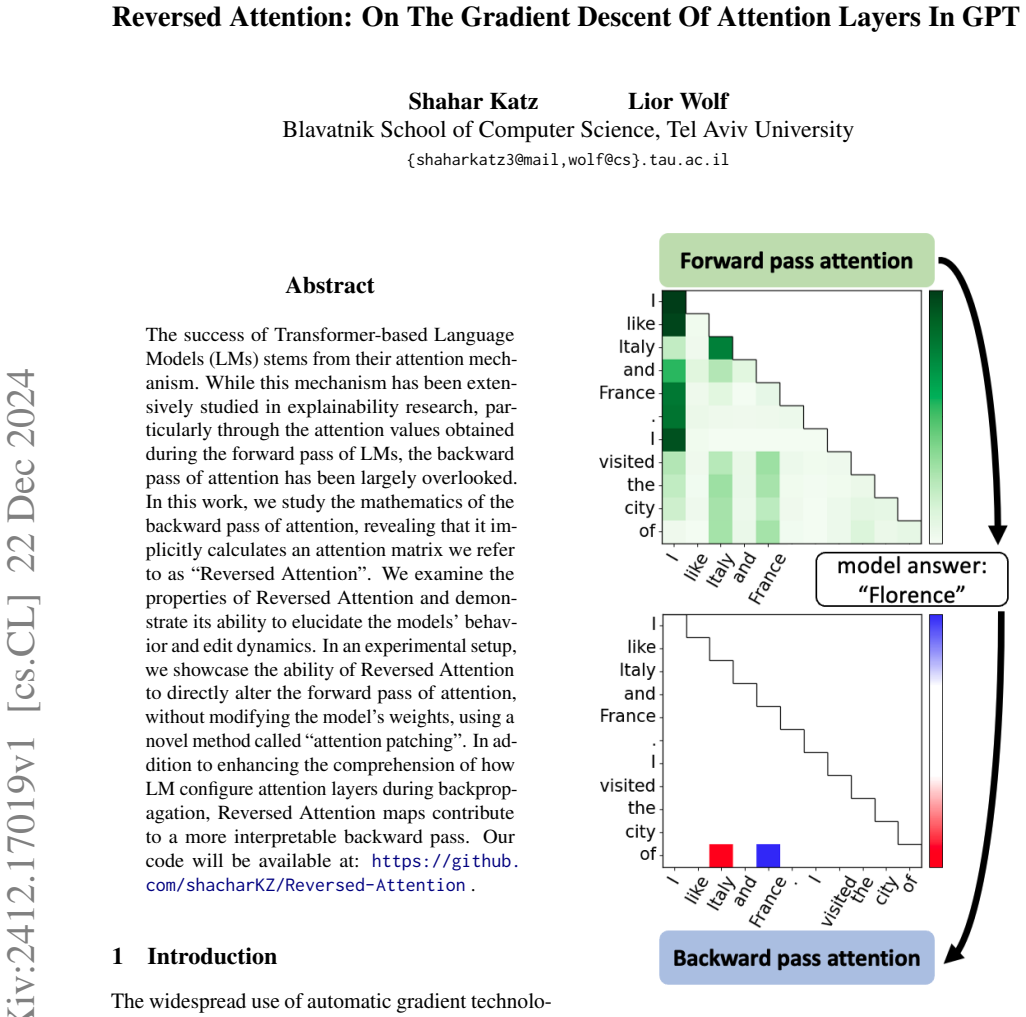
The central object is the Reversed Attention (RA) matrix $R$, the derivative of the softmax attention scores with respect to their logits, assembled from per-token VJPs. Concretely, $R = A \odot (\tilde{E}^\top - \mathrm{diag}(A\tilde{E}^\top))^\top \sqrt{h/d}$ with $\tilde{E} = \Delta \hat{W}_o^\top V^\top$, where $A$ is the forward attention, $\Delta$ holds the output-projection VJPs, $\hat{W}_o$ is the output projection, and $V$ holds the value vectors. Because $A$ is lower-triangular (causal masking), $R$ is lower-triangular too, and $R$ plays the role of an attention matrix in the backward pass: it multiplies forward keys $K$ to form query VJPs and transposed rows multiply forward queries $Q$ to form key VJPs. The paper's argument is that this matrix is what gradient descent would edit if it took a step: positive entries push the corresponding query and key together under a negative learning rate, negative entries push them apart.
What would settle it
Run attention patching on a test set whose prompt lengths or templates differ from the 25 training examples: if the accuracy gains vanish (or degrade to the no-patch baseline), the premise that averaged RA maps are task-level editing instructions fails. Alternatively, compare the signed entries of $R$ for a single head against the actual change in forward attention after one genuine gradient step on that head; if positive RA entries do not correspond to increased attention under a negative learning rate, RA is not what gradient descent would do.
Extended reading notes
Core claim
On the paper's own terms, the central discovery is that the derivative of the softmax operation inside each GPT attention head, $R = A \odot (\tilde{E}^\top - \mathrm{diag}(A\tilde{E}^\top))^\top \sqrt{h/d}$, is a triangular, attention-like matrix whose rows are the VJPs that gradient descent would use to update the query and key projections. Positive entries of $R$ mark query–key pairs whose attention score GD would increase (for a negative learning rate) and negative entries mark pairs it would decrease. The paper demonstrates two consequences: the per-head norm of $R$ ranks the importance of attention heads for a given prediction, competitive with causal mediation in perturbation tests; and the average of $R$ over 25 same-format examples, injected additively into the forward attention with a negative learning rate, improves task accuracy on several ICL and fact-relation tasks without touching weights. The authors present RA as what the backward pass is 'really doing' when a GPT is asked to move its prediction toward a target token.
Load-bearing premise
RA maps averaged over 25 labeled examples of one fixed template (same length and format) are assumed to generalize to held-out examples of that task; the paper tests this only on simple, templated ICL and fact-relation tasks, without variance estimates or heterogeneous inputs.
Editorial extensions
If this is right
- RA norm per head provides an ordering of attention-head importance that performs competitively with causal mediation in perturbation tests, at the cost of one forward and one backward pass instead of one forward pass per head.
- Averaging RA maps over a small set of same-length, same-format examples and adding them into the forward attention of a frozen model improves accuracy on several ICL tasks, sometimes matching few-shot prompting without showing any examples.
- RA maps are sparse and target-specific: changing the editing target changes which token pair a head amplifies, suggesting the backward pass localizes task-relevant information per inference.
- Because close-to-zero RA scores yield near-zero VJPs and gradients, focusing on high-RA-normal heads captures most of the gradient-descent update.
Reading between the lines
- One implicit extension is that RA could serve as a general-purpose attribution method for any differentiable attention-based model, not just decoder-only GPT; the derivation only relies on the structure of softmax attention, so encoder-decoder or bidirectional attention would produce analogous matrices.
- RA patching's reliance on fixed-length templates is a constraint the paper acknowledges; a natural extension is to align RA maps across variable-length inputs (e.g., by position or by attention heads' token roles), which would let the method apply to open-ended generation.
- A direct test the paper does not run is whether the signed pattern of $R$ predicts the actual change in forward attention after one real gradient step on a head; if the two signs systematically disagree, RA would be an interpretability heuristic rather than an exact editing plan.
- Because RA is computed from a loss that selects a target token, it is essentially a gradient-based saliency map for the attention sublayer; combining RA norms with gradient×input-style scaling could yield even sharper head rankings than the plain norm.
Editorial analysis
A structured set of objections, weighed in public.
Referee Report
Summary. The paper studies the backward pass of attention layers in GPT models. It derives the vector-Jacobian products for the attention weight matrices and identifies the derivative of the attention softmax, denoted R and termed "Reversed Attention" (RA), as an implicit attention map. The authors argue that RA encodes how gradient descent would edit attention, and they use RA norms to rank attention heads in a perturbation test and to perform "attention patching," where averaged RA maps are injected into forward attention to steer predictions without weight updates. Experiments are conducted on GPT2-xl, OPT, GPT-j, and Llama2-7B across in-context learning and fact-relation tasks.
Significance. If the central derivation is corrected, the paper offers a cheap, single-backward-pass signal for attention-head localization and a no-weight-update intervention mechanism, which are attractive properties for interpretability research. The scalar softmax-derivative derivation (Eqs. 12-15 and 18-19) is correct, and the perturbation test provides an external benchmark that does not rely on the RA definition itself. The paper also compares across multiple models and tasks, which strengthens the empirical picture. However, the batched definition of R in Eq. 17 is mathematically inconsistent with the scalar formula, so the paper as written does not actually define the object it claims to study. The relationship between attention patching and a single gradient descent step on attention logits also deserves explicit recognition, since it affects how novel and how explanatory the intervention is.
major comments (3)
- [Section 4, Eq. (17)] Equation (17) is not equivalent to the row-wise formula in Eq. (15), and the statement "hence R_j = r_j" is false. In Eq. (17), the term diag(A tilde E^T) subtracts the scalar c_j = sum_k A_{j,k} tilde E_{j,k} only from the diagonal entry of row j after the transposition, yielding row j of R as A_j ⊙ tilde E_j - c_j A_{j,j} e_j. The correct softmax derivative requires subtracting c_j from every entry of the row, i.e., A_j ⊙ (tilde E_j - c_j 1). To make this concrete, for A = [[0.5,0.5],[0,1]] and tilde E = [[a,b],[c,d]], Eq. (15) gives row 1 = [0.25(a-b), -0.25(a-b)], while Eq. (17) gives [0.25(a-b), 0.5b]. This is a load-bearing error: any reader implementing RA from the paper's formal definition will compute a different object from the softmax derivative. The authors must correct the batched formula (e.g., by using a row-wise subtraction of the vector of row sums of A ⊙ tilde E) or explicitly state that all experiments use the scalar/autograd form.
- [Section 5.3] The attention-patching method injects a multiple of the RA map into the forward attention scores. Since R is the derivative of the loss with respect to the attention logits (up to the scaling factor), adding λ R with negative λ is exactly a gradient descent step on the attention logits. The paper should state this equivalence and discuss its consequences. In particular, the success of attention patching should be framed as evidence that a first-order approximation of a loss-minimizing edit can steer the model, rather than as independent evidence that RA reflects the model's "desired attention" in a broader sense. This does not invalidate the results, but it is central to the interpretation and novelty of contribution (v).
- [Sections 5.2-5.3 and Appendices B-C] The empirical validations assume that RA maps averaged over 25 examples from a single task template are stable and transferable to held-out examples. The paper does not report variance across example subsets or across random seeds, and the patching results depend on a fixed learning rate of -30 without a sensitivity analysis. Since the head-ranking and patching claims rest on this transferability, the authors should provide error bars or multiple-split results for the AUC values in Tables 1-12 and a learning-rate sensitivity study for the patching results in Table 13.
minor comments (6)
- [Section 4, Eqs. (8) and (10)] The outer-product order in the update equation for W_o is inconsistent with the surrounding notation: Eq. (9) writes δ_o × x_o^T, but the derivation of Eq. (11) requires x_o^T × δ_o. Please correct the notation.
- [Section 4, text after Eq. (16)] The sentence "In Equation 16 we defined R" is inaccurate; Eq. (16) defines tilde E, while R is defined in Eq. (17).
- [Tables 1 and 2] The method name is misspelled as "Casual Mediation" in several table headers; it should be "Causal Mediation."
- [Section 5.3 and Appendix C] Using the term "learning rate" for the scalar that scales the injected RA map is potentially confusing, since no parameter update is performed; consider renaming it "injection strength" or "patching coefficient."
- [Section 3 and Limitations] The paper describes the analysis as "assumption-free full GPT models," but it omits LayerNorm and, in later experiments, uses models with RoPE. The Limitations section acknowledges some of this, but the earlier claim should be softened to avoid overstatement.
- [Appendix B] The perturbation test uses AUC as the summary statistic, but the tables do not report standard deviations or significance tests. Given that some differences between methods appear small, this makes it hard to judge whether RA's advantage over CM is reliable.
Circularity Check
Attention patching is a near-tautological gradient-step validation, but the core head-ranking claim rests on an independent perturbation benchmark.
-
fitted input called prediction
[Section 5.3 (Attention patching) and Appendix C (Attention Patching), building on Eq. 15/17 in Section 4.]
"In Equation 16 we defined R as the softmax derivative. ... For each test example and for each attention head, we add (inject) the RA map to the forward pass attention map, using a learning rate as a scaling factor. ... If we inject forward pass maps, a successful learning rate is a positive number. For reversed attention, a negative learning rate would improve the model."
RA is defined as the VJP of the loss through the attention softmax, i.e., the gradient of the loss w.r.t. the pre-softmax attention logits. Patching averages RA over 25 training examples and injects it into the forward attention with a negative learning rate, which is at least an approximate gradient-descent step on the same loss that was used to define RA. The observed improvement ('a negative learning rate would improve the model') is therefore the expected consequence of moving along the loss gradient, not an independent confirmation that RA is an interpretable 'desired attention' map. The held-out transfer is not guaranteed, so the reduction is partial, and the perturbation benchmark in Section 5.2 provides independent support for the head-ranking claim.
full rationale
The mathematical derivation of RA from the softmax VJP is a standard chain-rule computation and is not circular by itself. The head-ranking validation in Section 5.2 uses an external perturbation benchmark (AUC of progressively unmasking heads) and does not reduce to the definition of RA, so the central interpretability claim has independent content. The one partially circular element is attention patching in Section 5.3/Appendix C: RA is defined as the loss derivative, and injecting it with a negative learning rate is close to taking a gradient step on that same loss, making the patching success a near-tautological validation rather than independent evidence. Because the injection is described as acting on the forward attention map (not exactly the logits) and the transfer to held-out examples is empirical, I score this as partial circularity rather than full reduction. No load-bearing self-citation was found; the Katz et al. (2024) reference in Related Work is contextual. The Eq. 17 batched-formula discrepancy is a mathematical correctness issue, not a circularity, and is not scored here.
Assumptions & free parameters
free parameters (3)
- RA attention patching learning rate =
-30
- FA attention patching learning rate =
1
- Number of examples for averaging RA maps =
25
assumptions (4)
- standard math Backpropagation and the Jacobian of the softmax function
- domain assumption Causal, lower-triangular attention mask
- domain assumption LayerNorm omitted from the mathematical walk-through
- domain assumption Next-token cross-entropy loss with a chosen target token
invented entities (1)
-
Reversed Attention (RA) matrix R
independent evidence
Cite this review
Pith. "Pith review of Reversed Attention: On The Gradient Descent Of Attention Layers In GPT." pith.science (2026). https://pith.science/paper/2ZAVAUDE
@misc{pith2026241217019,
  author       = {Pith},
  title        = {Pith review of: Reversed Attention: On The Gradient Descent Of Attention Layers In GPT},
  year         = {2026},
  howpublished = {\url{https://pith.science/paper/2ZAVAUDE}},
  note         = {Machine review of arXiv:2412.17019}
}
read the original abstract
The success of Transformer-based Language Models (LMs) stems from their attention mechanism. While this mechanism has been extensively studied in explainability research, particularly through the attention values obtained during the forward pass of LMs, the backward pass of attention has been largely overlooked. In this work, we study the mathematics of the backward pass of attention, revealing that it implicitly calculates an attention matrix we refer to as "Reversed Attention". We examine the properties of Reversed Attention and demonstrate its ability to elucidate the models' behavior and edit dynamics. In an experimental setup, we showcase the ability of Reversed Attention to directly alter the forward pass of attention, without modifying the model's weights, using a novel method called "attention patching". In addition to enhancing the comprehension of how LM configure attention layers during backpropagation, Reversed Attention maps contribute to a more interpretable backward pass.
Figures


Figures from the paper (9 more)


Reference graph
Works this paper leans on
-
[1]
URL: " 'urlintro :=
ENTRY address author booktitle chapter edition editor howpublished institution journal key month note number organization pages publisher school series title type volume year eprint doi pubmed url lastchecked label extra.label sort.label short.list INTEGERS output.state before.all mid.sentence after.sentence after.block STRINGS urlintro eprinturl eprintpr...
-
[2]
write newline
" write newline "" before.all 'output.state := FUNCTION n.dashify 't := "" t empty not t #1 #1 substring "-" = t #1 #2 substring "--" = not "--" * t #2 global.max substring 't := t #1 #1 substring "-" = "-" * t #2 global.max substring 't := while if t #1 #1 substring * t #2 global.max substring 't := if while FUNCTION word.in bbl.in capitalize " " * FUNCT...
-
[3]
Marco Ancona, Enea Ceolini, Cengiz \"O ztireli, and Markus Gross. 2018. Towards better understanding of gradient-based attribution methods for deep neural networks. In 6th International Conference on Learning Representations, ICLR 2018, Vancouver, BC, Canada, April 30-May 3, 2018, Conference Track Proceedings. OpenReview. net
work page 2018
-
[4]
Oren Barkan, Edan Hauon, Avi Caciularu, Ori Katz, Itzik Malkiel, Omri Armstrong, and Noam Koenigstein. 2021. Grad-sam: Explaining transformers via gradient self-attention maps. In Proceedings of the 30th ACM International Conference on Information & Knowledge Management, pages 2882--2887
work page 2021
-
[5]
Tom Brown, Benjamin Mann, Nick Ryder, Melanie Subbiah, Jared D Kaplan, Prafulla Dhariwal, Arvind Neelakantan, Pranav Shyam, Girish Sastry, Amanda Askell, et al. 2020. Language models are few-shot learners. Advances in neural information processing systems, 33:1877--1901
2020
-
[6]
Damai Dai, Yutao Sun, Li Dong, Yaru Hao, Shuming Ma, Zhifang Sui, and Furu Wei. 2023. Why can gpt learn in-context? language models implicitly perform gradient descent as meta-optimizers. In ICLR 2023 Workshop on Mathematical and Empirical Understanding of Foundation Models
work page 2023
-
[7]
Qingxiu Dong, Lei Li, Damai Dai, Ce Zheng, Zhiyong Wu, Baobao Chang, Xu Sun, Jingjing Xu, and Zhifang Sui. 2022. A survey on in-context learning. arXiv preprint arXiv:2301.00234
arXiv 2022
-
[8]
N Elhage, N Nanda, C Olsson, T Henighan, N Joseph, B Mann, A Askell, Y Bai, A Chen, T Conerly, et al. 2021. https://transformer-circuits.pub/2021/framework/index.html A mathematical framework for transformer circuits
work page 2021
Show all 48 references
-
[9]
Mor Geva, Avi Caciularu, Kevin Wang, and Yoav Goldberg. 2022. Transformer feed-forward layers build predictions by promoting concepts in the vocabulary space. In Proceedings of the 2022 Conference on Empirical Methods in Natural Language Processing, pages 30--45
2022
-
[10]
Almog Gueta, Elad Venezian, Colin Raffel, Noam Slonim, Yoav Katz, and Leshem Choshen. 2023. https://doi.org/10.18653/v1/2023.findings-emnlp.95 Knowledge is a region in weight space for fine-tuned language models . In Findings of the Association for Computational Linguistics: E...
2023 doi
-
[11]
Suchin Gururangan, Ana Marasovic, Swabha Swayamdipta, Kyle Lo, Iz Beltagy, Doug Downey, and Noah A Smith. 2020. Don't stop pretraining: Adapt language models to domains and tasks. In 58th Annual Meeting of the Association for Computational Linguistics, ACL 2020, pages 8342--83...
2020
-
[12]
Dan Hendrycks, Collin Burns, Steven Basart, Andy Zou, Mantas Mazeika, Dawn Song, and Jacob Steinhardt. 2021. Measuring massive multitask language understanding. In International Conference on Learning Representations
2021
-
[13]
Evan Hernandez, Arnab Sen Sharma, Tal Haklay, Kevin Meng, Martin Wattenberg, Jacob Andreas, Yonatan Belinkov, and David Bau. 2024. Linearity of relation decoding in transformer language models. In Proceedings of the 2024 International Conference on Learning Representations
2024
-
[14]
Sarthak Jain and Byron C Wallace. 2019. Attention is not explanation. In Proceedings of the 2019 Conference of the North American Chapter of the Association for Computational Linguistics: Human Language Technologies, Volume 1 (Long and Short Papers), pages 3543--3556
2019
-
[15]
Shahar Katz and Yonatan Belinkov. 2023. https://doi.org/10.18653/v1/2023.findings-emnlp.939 VISIT : Visualizing and interpreting the semantic information flow of transformers . In Findings of the Association for Computational Linguistics: EMNLP 2023, pages 14094--14113, Singap...
2023 doi
-
[16]
Shahar Katz, Yonatan Belinkov, Mor Geva, and Lior Wolf. 2024. https://doi.org/10.18653/v1/2024.emnlp-main.142 Backward lens: Projecting language model gradients into the vocabulary space . In Proceedings of the 2024 Conference on Empirical Methods in Natural Language Processin...
2024 doi
-
[17]
Guillaume Lample, Alexis Conneau, Marc'Aurelio Ranzato, Ludovic Denoyer, and Herv \'e J \'e gou. 2018. Word translation without parallel data. In International Conference on Learning Representations
2018
-
[18]
Y Le Cun. 1988. A theoretical framework for backpropagation. In Proceedings of the 1988 Connectionist Models Summer School
1988
-
[19]
Xinyin Ma, Gongfan Fang, and Xinchao Wang. 2023. Llm-pruner: On the structural pruning of large language models. Advances in neural information processing systems, 36:21702--21720
2023
-
[20]
Dougal Maclaurin. 2016. Modeling, inference and optimization with composable differentiable procedures. Ph.D. thesis
2016
-
[21]
Arvind Mahankali, Tatsunori B Hashimoto, and Tengyu Ma. 2023. One step of gradient descent is provably the optimal in-context learner with one layer of linear self-attention. arXiv preprint arXiv:2307.03576
2023 arXiv
-
[22]
Kevin Meng, David Bau, Alex Andonian, and Yonatan Belinkov. 2022. Locating and editing factual associations in GPT . Advances in Neural Information Processing Systems, 36
2022
-
[23]
Kevin Meng, Arnab Sen Sharma, Alex Andonian, Yonatan Belinkov, and David Bau. 2023. Mass-editing memory in a transformer. International Conference on Learning Representations
2023
-
[24]
Aaron Mueller, Jannik Brinkmann, Millicent Li, Samuel Marks, Koyena Pal, Nikhil Prakash, Can Rager, Aruna Sankaranarayanan, Arnab Sen Sharma, Jiuding Sun, et al. 2024. The quest for the right mediator: A history, survey, and theoretical grounding of causal interpretability. ar...
2024
-
[25]
Kim Anh Nguyen, Sabine Schulte im Walde, and Ngoc Thang Vu. 2017. Distinguishing antonyms and synonyms in a pattern-based neural network. In Proceedings of the 15th Conference of the European Chapter of the Association for Computational Linguistics: Volume 1, Long Papers. Asso...
2017
-
[26]
Adam Paszke, Sam Gross, Francisco Massa, Adam Lerer, James Bradbury, Gregory Chanan, Trevor Killeen, Zeming Lin, Natalia Gimelshein, Luca Antiga, et al. 2019. Pytorch: An imperative style, high-performance deep learning library. Advances in neural information processing systems, 32
2019
-
[27]
Alec Radford, Karthik Narasimhan, Tim Salimans, and Ilya Sutskever. 2018. Improving language understanding by generative pre-training
2018
-
[28]
Alec Radford, Jeff Wu, Rewon Child, David Luan, Dario Amodei, and Ilya Sutskever. 2019. Language models are unsupervised multitask learners. OpenAI blog
2019
-
[29]
Sofia Serrano and Noah A Smith. 2019. Is attention interpretable? In Proceedings of the 57th Annual Meeting of the Association for Computational Linguistics, pages 2931--2951
2019
-
[30]
K Simonyan, A Vedaldi, and A Zisserman. 2014. Deep inside convolutional networks: visualising image classification models and saliency maps. In Proceedings of the International Conference on Learning Representations (ICLR). ICLR
2014
-
[31]
Jianlin Su, Murtadha Ahmed, Yu Lu, Shengfeng Pan, Wen Bo, and Yunfeng Liu. 2024. Roformer: Enhanced transformer with rotary position embedding. Neurocomputing, 568:127063
2024
-
[32]
Davoud Ataee Tarzanagh, Yingcong Li, Christos Thrampoulidis, and Samet Oymak. 2023. Transformers as support vector machines. arXiv preprint arXiv:2308.16898
2023 arXiv
-
[33]
Yuandong Tian, Yiping Wang, Beidi Chen, and Simon Du. 2023. Scan and snap: Understanding training dynamics and token composition in 1-layer transformer. arXiv preprint arXiv:2305.16380
2023 arXiv
-
[34]
Eric Todd, Millicent L Li, Arnab Sen Sharma, Aaron Mueller, Byron C Wallace, and David Bau. 2023. Function vectors in large language models. arXiv preprint arXiv:2310.15213
2023 arXiv
-
[35]
Hugo Touvron, Louis Martin, Kevin Stone, Peter Albert, Amjad Almahairi, Yasmine Babaei, Nikolay Bashlykov, Soumya Batra, Prajjwal Bhargava, Shruti Bhosale, et al. 2023. Llama 2: Open foundation and fine-tuned chat models. arXiv preprint arXiv:2307.09288
2023 arXiv
-
[36]
Ashish Vaswani, Noam Shazeer, Niki Parmar, Jakob Uszkoreit, Llion Jones, Aidan N Gomez, ukasz Kaiser, and Illia Polosukhin. 2017. Attention is all you need. Advances in neural information processing systems, 30
2017
-
[37]
Jesse Vig, Sebastian Gehrmann, Yonatan Belinkov, Sharon Qian, Daniel Nevo, Yaron Singer, and Stuart Shieber. 2020. Investigating gender bias in language models using causal mediation analysis. Advances in Neural Information Processing Systems, 33:12388--12401
2020
-
[38]
Elena Voita, Javier Ferrando, and Christoforos Nalmpantis. 2023. Neurons in large language models: Dead, n-gram, positional. arXiv preprint arXiv:2309.04827
2023 arXiv
-
[39]
Ben Wang and Aran Komatsuzaki. 2021. GPT-J-6B: A 6 Billion Parameter Autoregressive Language Model . https://github.com/kingoflolz/mesh-transformer-jax
2021
-
[40]
Kevin Ro Wang, Alexandre Variengien, Arthur Conmy, Buck Shlegeris, and Jacob Steinhardt. 2023. Interpretability in the wild: a circuit for indirect object identification in gpt-2 small. In The Eleventh International Conference on Learning Representations
2023
-
[41]
Thomas Wolf, Lysandre Debut, Victor Sanh, Julien Chaumond, Clement Delangue, Anthony Moi, Pierric Cistac, Tim Rault, R \'e mi Louf, Morgan Funtowicz, et al. 2019. Huggingface's transformers: State-of-the-art natural language processing. arXiv preprint arXiv:1910.03771
2019 arXiv
-
[42]
Guangxuan Xiao, Yuandong Tian, Beidi Chen, Song Han, and Mike Lewis. 2023. Efficient streaming language models with attention sinks. In The Twelfth International Conference on Learning Representations
2023
-
[43]
Rowan Zellers, Ari Holtzman, Yonatan Bisk, Ali Farhadi, and Yejin Choi. 2019. Hellaswag: Can a machine really finish your sentence? In Proceedings of the 57th Annual Meeting of the Association for Computational Linguistics, pages 4791--4800
2019
-
[44]
Fred Zhang and Neel Nanda. 2023. Towards best practices of activation patching in language models: Metrics and methods. arXiv preprint arXiv:2309.16042
2023 arXiv
-
[45]
Susan Zhang, Stephen Roller, Naman Goyal, Mikel Artetxe, Moya Chen, Shuohui Chen, Christopher Dewan, Mona Diab, Xian Li, Xi Victoria Lin, et al. 2022. Opt: Open pre-trained transformer language models. arXiv preprint arXiv:2205.01068
2022 arXiv
-
[46]
@esa (Ref
\@ifxundefined[1] #1\@undefined \@firstoftwo \@secondoftwo \@ifnum[1] #1 \@firstoftwo \@secondoftwo \@ifx[1] #1 \@firstoftwo \@secondoftwo [2] @ #1 \@temptokena #2 #1 @ \@temptokena \@ifclassloaded agu2001 natbib The agu2001 class already includes natbib coding, so you should ...
-
[47]
\@lbibitem[] @bibitem@first@sw\@secondoftwo \@lbibitem[#1]#2 \@extra@b@citeb \@ifundefined br@#2\@extra@b@citeb \@namedef br@#2 \@nameuse br@#2\@extra@b@citeb \@ifundefined b@#2\@extra@b@citeb @num @parse #2 @tmp #1 NAT@b@open@#2 NAT@b@shut@#2 \@ifnum @merge>\@ne @bibitem@firs...
-
[48]
@open @close @open @close and [1] URL: #1 \@ifundefined chapter * \@mkboth \@ifxundefined @sectionbib * \@mkboth * \@mkboth\@gobbletwo \@ifclassloaded amsart * \@ifclassloaded amsbook * \@ifxundefined @heading @heading NAT@ctr thebibliography [1] @ \@biblabel @NAT@ctr \@bibset...
Reviewed August 11, 2026 · model on record in the stance chip above.
Discussion (0). Continue with ORCID to comment.