REVIEW 2 major objections 4 minor 2 cited by
Sensitivity-Adapted Closed-Loop Optimization for High-Fidelity Controlled-Z Gates in Superconducting Qubits
T0 review · 2 major / 4 minor · reviewed 2026-08-11 · deepseek-v4-flash
Pith's one-line read A sensitivity-adaptive closed-loop optimizer, combined with signal pre-distortion, pushes controlled-Z gate error to 0.09(10)% in a 64 ns pulse on fixed-frequency superconducting qubits, reaching average gate fidelities above 99.9%.
desk verdict A solid experimental calibration study with a real engineering payoff, but the 99.9% fidelity headline overreaches its own error bar and the unmeasured coupler leakage keeps that claim from being established. read the letter →
The pith
A machine-rendered reading of the paper's core claim, the machinery that carries it, and where it could break.
The reading
What carries the argument
The central object is the flux pulse together with the feedback loop that shapes it. The gate itself is produced by the conditional frequency shift $\xi$, tuned by threading external flux $\Phi_{\mathrm{ext}}$ through the coupler's SQUID loop so that the $|11\rangle$ state accumulates a $\pi$ phase; how fast the pulse traverses the avoided crossing at $\Phi^{\star}$ decides how much population leaks to the $|1,01\rangle$ and $|2,00\rangle$ states and whether Landau-Zener-Stückelberg interference returns it. The feedback loop is a CMA-ES optimizer (covariance-matrix-adaptation evolution strategy) minimizing an ORBIT cost function built from randomized-benchmarking sequences, with the sensitivity $S = dE/d\epsilon$ kept near its maximum by increasing the number of Clifford gates $N$ whenever the mean cost drops below 0.2. Pulse shapes are parametrized as Gaussian-square, Fourier-series, or piecewise-constant-slope (PiCoS) forms; the Fourier envelope is $\Phi(t) = A \sum_{n=1}^{N} \lambda_n \left(1 - \cos\left(2\pi n (t - t_p/2)/\tau_w\right)\right)$ with few coefficients. The last ingredient is distortion correction: an extended cryoscope protocol (a pulse-based measurement of the flux-line step response) measures the coupler's response through the fixed-frequency qubit, and four exponential IIR filters plus a 72-tap FIR filter running in real time on the arbitrary waveform generator compress the flux-line response time from 2.5 µs to 10 ns.
What would settle it
Measure the coupler-state population after the optimized 64 ns Fourier pulse: a device whose tunable coupler is coupled to its own readout resonator could reveal, in a Ramsey or population-measurement sequence, whether a non-negligible fraction of the population sits in the $|1,01\rangle$ or $|2,00\rangle$ states at the end of the pulse. If a substantial fraction is found and does not coherently return to the qubit subspace, the reported 0.09(10)% underestimates the true gate error; if the coupler is found empty, the interleaved-randomized-benchmarking number is a faithful measure of gate fidelity. A leakage-sensitive variant of randomized benchmarking that tracks these states would serve the same purpose without new hardware.
Extended reading notes
Core claim
The paper's central claim is that closed-loop optimization with an adaptive cost function, combined with signal pre-distortion, reaches average controlled-Z gate fidelities above 99.9%: reoptimized 64 ns Fourier-series pulses achieve $\epsilon_{\mathrm{Fourier,C}} = 0.09(10)\%$ gate error. The gate is implemented by adiabatically sweeping a tunable coupler's frequency so that the conditional frequency shift $\xi$ — the extra phase accumulated by the $|11\rangle$ state relative to the other computational states — integrates to $\pi$, while Landau-Zener-Stückelberg interference recovers population that leaks through avoided crossings during the outbound and return passages. The paper compares three pulse parametrizations: a Gaussian-square pulse reaching about 4.79% error; a Fourier-series pulse at 0.62(15)% error before correction and 0.09(10)% after pre-distortion; and a piecewise-constant-slope (PiCoS) pulse at 0.25(9)% before correction and 0.21(9)% at a shorter 20 ns pulse plus a 12 ns buffer after correction. The authors interpret the converged pulse shapes as encoding the hardware's systematic errors, in particular low-pass filtering of the flux line with time constants up to 2.5 µs, and show that correcting this transfer function in real time on the waveform generator is what unlocks the sub-0.1% regime. The same closed-loop scheme is proposed for tune-up and recalibration of superconducting quantum processors.
Load-bearing premise
The central number assumes that interleaved randomized benchmarking reports the true gate error even though the experiment never directly checks for population leaking into the coupler: if population leaves the two qubits during the 64 ns pulse and returns only during the measurement, the reported error could be smaller than the actual gate error, a limitation the paper states explicitly in Section IV.
Editorial extensions
If this is right
- If the 0.09(10)% error holds, the CZ gate ceases to be the fidelity bottleneck on this architecture: a 64 ns two-qubit gate at 99.9% average fidelity on fixed-frequency transmons with a tunable coupler is practical, and the same closed-loop recipe can be applied to every qubit pair on a chip.
- The adaptive sensitivity rule removes the need to preset the benchmarking depth: the optimizer starts at short sequences suitable for poor candidates and lengthens them as candidates improve, so one run carries the gate from roughly 50% error to the 0.1% regime without manual retuning.
- Recalibration after parameter drift can reuse the converged covariance matrices, and the identified distortion model shortens later optimizations (from 12 h to 4.5 h in the demonstrated case), supporting the paper's proposal of interleaving optimization with algorithmic tasks to track drift in real time.
- The parametrization comparison indicates that control complexity and hardware correction are partly interchangeable: before pre-distortion the 21-parameter PiCoS pulse beats the simpler Fourier pulse, while after pre-distortion the simpler Fourier pulse reaches the lowest error, suggesting that adding correction hardware can buy simpler pulses.
Reading between the lines
- The headline number's own uncertainty is large: at 0.09(10)%, the measured error is within one standard deviation of zero, so the claim of 'above 99.9%' would be sharpened by a longer interleaved randomized benchmarking run or by an independent fidelity estimate that does not rely on the same leakage-blind decay model.
- Because the paper's stated limitation is that coupler states cannot be read out, a decisive follow-up is to run the identical optimization on a device where the coupler has its own dispersive readout; if population is found to linger in the coupler after the 64 ns pulse, both the 0.09% number and the leakage-free interpretation of the converged pulse would need revision.
- The converged pulse shapes are described as encoding the flux-line transfer function, so one could formalize the pipeline to output, in a single run, both the optimal pulse and an empirical distortion model usable for open-loop design on future chips — turning what is here a two-step procedure (optimize, then characterize) into a single self-characterizing calibration.
Editorial analysis
A structured set of objections, weighed in public.
Referee Report
Summary. The paper reports closed-loop, sensitivity-adaptive CMA-ES optimization of controlled-Z gates on fixed-frequency transmons coupled through a tunable coupler. Three pulse parametrizations (Gaussian-square, Fourier-series, and PiCoS) are compared using ORBIT/RB-derived costs, and the authors identify flux-line distortions with an extended cryoscope protocol, apply IIR/FIR pre-distortion, and report a final interleaved randomized benchmarking error of 0.09(10)% for a 64 ns Fourier-series pulse, summarized as "average gate fidelities above 99.9%". The appendices provide device parameters, leakage and ZZ-phase characterization, optimization details and runtime analysis, and a description of the distortion-correction filter model.
Significance. If the headline error is unbiased, this is a useful practical demonstration: a 64 ns CZ gate with roughly 0.1% error on fixed-frequency transmons with a tunable coupler, obtained by combining black-box closed-loop optimization with independent line-distortion characterization. The strengths of the paper are the explicit sensitivity-adaptive cost schedule, the systematic comparison across parametrizations, and the cryoscope-based IIR/FIR correction with an independently measured step response. The main caveat is that the fidelity metric is qubit-only interleaved randomized benchmarking, with an unmeasured coupler-leakage channel, so the "above 99.9%" claim is not yet fully established.
major comments (2)
- [Section IV, final paragraph; Fig. 4(c)] The headline claim rests on interleaved randomized benchmarking, which records only qubit states. The manuscript explicitly states that the coupler states are not directly measurable on the current device and that numerical simulations identify coupler states as the dominant leakage channel, and the earlier Fourier-series pulse already shows leakage signatures in IRB. For the final Fourier,C pulse, only "minimal indications of leakage" are reported, without a quantitative bound or a leakage-robust analysis. Since leaked coupler population that returns to |0> at readout is counted as a successful RB outcome, an unquantified leakage of order 0.1% would directly move the reported 0.09(10)% error across the 99.9% boundary. Please provide either a leakage-robust RB estimate, a numerical master-equation bound on coupler population during the 64 ns pulse, or an explicitly weakened claim that does not assert fidelity above 99.9%.
- [Section V, first and last paragraphs; Section IV, Fig. 4(c)] The statement "average gate fidelities above 99.9%" is not supported by the reported IRB error epsilon_Fourier,C = 0.09(10)%. With the stated uncertainty, the interval extends to about 0.19% error (99.81% fidelity) or beyond, so the data do not demonstrate that the fidelity is above 99.9%. Please report the uncertainty model used for the IRB estimates and either soften the claim to "about 99.9%" or provide a confidence-level statement for exceeding the 99.9% threshold.
minor comments (4)
- [Table II] The row labels in Table II appear transposed relative to the text: the row with np=8 and 0.52(15)% should be the Fourier-series pulse, the row with np=21 and 0.25(9)% should be the PiCoS pulse, the row with np=8 and 0.09(10)% should be Fourier,C, and the row with np=21 and 0.21(9)% should be PiCoS,C.
- [Section III and Section IV] The parameter count for the Fourier-series decomposition is inconsistent: Section III states eight parameters, Section IV says "five Fourier-components", and Table II (as printed) lists np=21 for the Fourier row; please state the count consistently in all three places.
- [Fig. 3 caption] The caption contains the duplicated phrase "as shown is shown in Fig. 3(c)", and the shading change used to indicate sensitivity updates is not explained in the caption.
- [Section IV, paragraph on PiCoS pulse] The sentence reporting the PiCoS 20 ns pulse with a 12 ns buffer would benefit from explicitly stating whether the 0.21(9)% error refers to the total gate duration or only the active pulse width, since the table lists tp=20 ns and tb=12 ns separately.
Circularity Check
No significant circularity: the optimization and benchmarking share an RB-family metric, but the pulse shapes are experimental calibration results rather than predictions, and the distortion correction rests on an independent cryoscope measurement.
full rationale
The paper's central claims are experimental: closed-loop CMA-ES optimization of parametrized flux pulses and interleaved randomized benchmarking of the resulting gates. No equation in the paper reduces a purported prediction to a fitted input. The cost used during optimization is an ORBIT/RB sequence fidelity, and the final reported error is also obtained from interleaved RB; this shared metric family is standard practice for closed-loop tune-up followed by benchmarking, not a circular derivation, because the optimizer genuinely searches over pulse parameters and the final error is a measured characterization of the implemented gate. The sensitivity-adaptive schedule is a heuristic for choosing the RB sequence length and is not used as evidence for the final fidelity. The flux-line distortion correction is supported by an independent time-domain cryoscope measurement of the step response, with fitted IIR/FIR parameters that are not derived from the final gate error. The main weakness identified in the manuscript is the lack of direct coupler-state readout, so leakage into the coupler is not experimentally verified; that is a validity or correctness risk for the 99.9% claim, but it is not circularity. Self-citations appear in the method lineage, notably for ORBIT-based cost functions and leakage signatures, but the ORBIT protocol originates in the external work of Kelly et al. and the leakage-detection interpretation is also supported by external references, so the self-citations are not load-bearing in a way that forces the conclusion. Overall, the derivation chain is self-contained experimental calibration and characterization, with no fitted parameter renamed as a prediction and no definitional circularity.
Assumptions & free parameters
free parameters (3)
- IIR filter amplitudes A_i and time constants τ_i =
A = [-0.021, -0.012, -0.393, +0.595], τ = [846, 151, 36.0, 21.6] ns
- Optimized pulse parameters (node amplitudes, Fourier coefficients, width, amplitude, Z-rotation phases) =
Not tabulated; shown in Fig. 4
- Cost-function hyperparameters: sensitivity threshold 0.2, Clifford count N, population P=4+4log(Np), M=80, shots=128 =
N=2 to 12; P=13 for 21 parameters; threshold 0.2
assumptions (5)
- domain assumption Hamiltonian Eq. (1) with 3 qubit levels and 4 coupler levels accurately describes the device
- domain assumption Randomized benchmarking fidelity follows F(N)=A F_C^N + B with F_C = F_SQ^8.5 * F_CZ^1.5 and uncorrelated errors
- domain assumption Adiabatic and Landau-Zener-Stückelberg models correctly predict leakage recovery
- domain assumption The measured qubit-frequency response to flux pulses via Q1 accurately represents the coupler's flux response
- ad hoc to paper IIR/FIR filter model (Eqs. D1, D2) captures all relevant flux-line distortion
Cite this review
Pith. "Pith review of Sensitivity-Adapted Closed-Loop Optimization for High-Fidelity Controlled-Z Gates in Superconducting Qubits." pith.science (2026). https://pith.science/paper/2ZDDL4OK
@misc{pith2026241217454,
  author       = {Pith},
  title        = {Pith review of: Sensitivity-Adapted Closed-Loop Optimization for High-Fidelity Controlled-Z Gates in Superconducting Qubits},
  year         = {2026},
  howpublished = {\url{https://pith.science/paper/2ZDDL4OK}},
  note         = {Machine review of arXiv:2412.17454}
}
read the original abstract
Achieving fast and high-fidelity qubit operations is crucial for unlocking the potential of quantum computers. In particular, reaching low gate errors in two-qubit gates has been a long-standing challenge in the field of superconducting qubits due to their typically long duration relative to coherence times. To realize fast gates, we utilize the hybridization between fixed-frequency superconducting qubits with a strongly interacting coupler mode that is tunable in frequency. To reduce population leakage during required adiabatic passages through avoided level crossings, we employ a sensitivity-adaptive closed-loop optimization method to design complex pulse shapes. We compare the performance of Gaussian-square, Fourier-series, and piecewise-constant-slope (PiCoS) pulse parametrizations and are able to reach 99.9 % controlled-Z gate fidelity using a 64 ns long Fourier-series pulse defined by only seven parameters. These high-fidelity values are achieved by analyzing the optimized pulse shapes to identify and systematically mitigate signal-line distortions in the experiment. To improve the convergence speed of the optimization we implement an adaptive cost function, which continuously maximizes the sensitivity. The demonstrated method can be used for tune-up and recalibration of superconducting quantum processors.
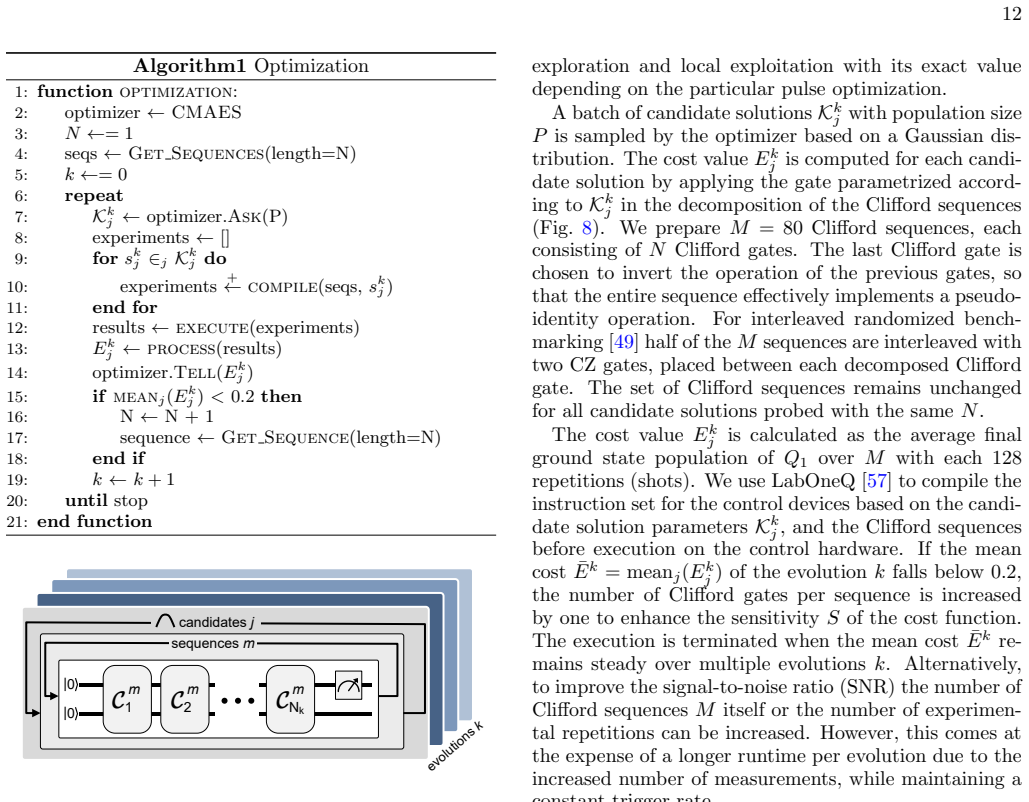
Figures


Figures from the paper (8 more)




Forward citations
Cited by 2 Pith papers
-
Transmon Phase Gates Controlled by Superconducting Soliton DAC
A soliton-based superconducting DAC performs 5.6 ns transmon S-gates with 0.05% excitation error and strong noise rejection, limited in multi-DAC chips by 1.6% non-local phase errors from EMI.
-
Spectator Leakage Elimination in CZ Gates via Tunable Coupler Interference on a Superconducting Quantum Processor
A tunable-coupler control scheme block-diagonalizes the effective Hamiltonian, confining CZ gate dynamics to a two-level subspace and suppressing spectator-induced leakage to roughly 10^-4.
Reference graph
Works this paper leans on
-
[1]
M. Kjaergaard, M. E. Schwartz, J. Braum¨ uller, P. Krantz, J. I. Wang, S. Gustavsson, and W. D. Oliver, Superconducting qubits: Current state of play, Annual Review of Condensed Matter Physics 11, 369 (2020)
work page 2020
-
[2]
Krinner, N
S. Krinner, N. Lacroix, A. Remm, A. Di Paolo, E. Genois, C. Leroux, C. Hellings, S. Lazar, F. Swiadek, J. Her- rmann, et al. , Realizing repeated quantum error correc- tion in a distance-three surface code, Nature 605, 669 (2022)
2022
-
[3]
Google Quantum AI, Suppressing quantum errors by scaling a surface code logical qubit, Nature 614, 676 (2023)
2023
-
[4]
A. P. Place, L. V. Rodgers, P. Mundada, B. M. Smitham, M. Fitzpatrick, Z. Leng, A. Premkumar, J. Bryon, A. Vrajitoarea, S. Sussman, et al. , New material plat- form for superconducting transmon qubits with coher- ence times exceeding 0.3 milliseconds, Nature communi- cations 12, 1779 (2021)
work page 2021
-
[5]
C. Wang, X. Li, H. Xu, Z. Li, J. Wang, Z. Yang, Z. Mi, X. Liang, T. Su, C. Yang, et al., Towards practical quan- tum computers: Transmon qubit with a lifetime ap- proaching 0.5 milliseconds, npj Quantum Information 8, 3 (2022)
work page 2022
-
[6]
R. T. Gordon, C. E. Murray, C. Kurter, M. Sandberg, S. A. Hall, K. Balakrishnan, R. Shelby, B. Wacaser, A. A. Stabile, et al. , Environmental radiation impact on life- times and quasiparticle tunneling rates of fixed-frequency transmon qubits, Applied Physics Letters 120, 074002 (2022)
work page 2022
-
[7]
H. Deng, Z. Song, R. Gao, T. Xia, F. Bao, X. Jiang, H.-S. Ku, Z. Li, X. Ma, J. Qin, et al., Titanium nitride film on sapphire substrate with low dielectric loss for supercon- ducting qubits, Phys. Rev. Appl. 19, 024013 (2023)
work page 2023
-
[8]
M. Bal, A. A. Murthy, S. Zhu, F. Crisa, X. You, Z. Huang, T. Roy, J. Lee, D. v. Zanten, R. Pilipenko, et al. , Systematic improvements in transmon qubit co- herence enabled by niobium surface encapsulation, npj Quantum Information 10, 43 (2024)
work page 2024
Show all 74 references
-
[9]
Bialczak, M
R. Bialczak, M. Ansmann, M. Hofheinz, M. Lenander, E. Lucero, M. Neeley, A. O’Connell, D. Sank, H. Wang, M. Weides, et al., Fast tunable coupler for superconduct- ing qubits, Phys. Rev. Lett. 106, 060501 (2011)
2011
-
[10]
D. C. McKay, S. Filipp, A. Mezzacapo, E. Magesan, J. M. Chow, and J. M. Gambetta, A universal gate for fixed- frequency qubits via a tunable bus, Phys. Rev. Appl. 6, 064007 (2016)
2016
-
[11]
G. B. P. Huber, F. A. Roy, L. Koch, I. Tsitsilin, J. Schirk, N. J. Glaser, N. Bruckmoser, C. Schweizer, J. Romeiro, G. Krylov, et al. , Parametric multi-element coupling ar- chitecture for coherent and dissipative control of super- conducting qubits, arXiv 2403.02203 (2024)
2024
-
[12]
Rigetti and M
C. Rigetti and M. Devoret, Fully microwave-tunable uni- versal gates in superconducting qubits with linear cou- plings and fixed transition frequencies, Phys. Rev. B 81, 134507 (2010)
2010
-
[13]
J. M. Chow, A. D. C´ orcoles, J. M. Gambetta, C. Rigetti, B. R. Johnson, J. A. Smolin, J. R. Rozen, G. A. Keefe, M. B. Rothwell, M. B. Ketchen, et al. , Simple all- microwave entangling gate for fixed-frequency supercon- ducting qubits, Phys. Rev. Lett. 107, 080502 (2011)
2011
-
[14]
J. M. Chow, J. M. Gambetta, A. W. Cross, S. T. Merkel, C. Rigetti, and M. Steffen, Microwave-activated conditional-phase gate for superconducting qubits, New Journal of Physics 15, 115012 (2013)
2013
-
[15]
H. Paik, A. Mezzacapo, M. Sandberg, D. T. McClure, B. Abdo, A. D. C´ orcoles, O. Dial, D. F. Bogorin, B. Plourde, M. Steffen, et al. , Experimental demon- stration of a resonator-induced phase gate in a multi- qubit circuit-QED system, Phys. Rev. Lett. 117, 250502 (2016)
2016
-
[16]
Foxen, C
B. Foxen, C. Neill, A. Dunsworth, P. Roushan, B. Chiaro, A. Megrant, J. Kelly, Z. Chen, K. Satzinger, R. Barends, et al., Demonstrating a continuous set of two-qubit gates for near-term quantum algorithms, Phys. Rev. Lett. 125, 120504 (2020)
2020
-
[17]
Y. Sung, L. Ding, J. Braum¨ uller, A. Veps¨ al¨ ainen, B. Kan- nan, M. Kjaergaard, A. Greene, G. O. Samach, C. Mc- Nally, D. Kim, et al., Realization of high-fidelity CZ and ZZ-free iswap gates with a tunable coupler, Phys. Rev. X 11, 021058 (2021)
2021
-
[18]
Marxer, A
F. Marxer, A. Veps¨ al¨ ainen, S. W. Jolin, J. Tuorila, A. Landra, C. Ockeloen-Korppi, W. Liu, O. Ahonen, A. Auer, L. Belzane, et al., Long-distance transmon cou- pler with CZ-gate fidelity above 99.8 %, PRX Quantum 4, 010314 (2023)
2023
-
[19]
J. Koch, T. M. Yu, J. Gambetta, A. A. Houck, D. I. Schuster, J. Majer, A. Blais, M. H. Devoret, S. M. Girvin, et al. , Charge-insensitive qubit design derived from the cooper pair box, Phys. Rev. A 76, 042319 (2007)
2007
-
[20]
F. Yan, P. Krantz, Y. Sung, M. Kjaergaard, D. Camp- bell, J. I. J. Wang, T. P. Orlando, S. Gustavsson, and W. D. Oliver, A tunable coupling scheme for implement- 8 ing high-fidelity two-qubit gates, Phys. Rev. Appl. 10, 054062 (2018)
2018
-
[21]
M. C. Collodo, J. Herrmann, N. Lacroix, C. K. Ander- sen, A. Remm, S. Lazar, J.-C. Besse, T. Walter, A. Wall- raff, and C. Eichler, Implementation of conditional phase gates based on tunable ZZ interactions, Phys. Rev. Lett. 125, 240502 (2020)
2020
-
[22]
Y. Xu, J. Chu, J. Yuan, J. Qiu, Y. Zhou, L. Zhang, X. Tan, Y. Yu, S. Liu, J. Li, et al. , High-fidelity, high- scalability two-qubit gate scheme for superconducting qubits, Phys. Rev. Lett. 125, 240503 (2020)
2020
-
[23]
Stehlik, D
J. Stehlik, D. M. Zajac, D. L. Underwood, T. Phung, J. Blair, S. Carnevale, D. Klaus, G. A. Keefe, A. Carniol, M. Kumph, et al. , Tunable coupling architecture for fixed-frequency transmon superconducting qubits, Phys. Rev. Lett. 127, 080505 (2021)
2021
-
[24]
N. J. Glaser, F. Roy, and S. Filipp, Controlled-controlled- phase gates for superconducting qubits mediated by a shared tunable coupler, Phys. Rev. Appl. 19, 044001 (2023)
2023
-
[25]
R. Li, K. Kubo, Y. Ho, Z. Yan, Y. Nakamura, and H. Goto, Realization of high-fidelity cz gate based on a double-transmon coupler, Phys. Rev. X 14, 041050 (2024)
2024
-
[26]
Mundada, G
P. Mundada, G. Zhang, T. Hazard, and A. Houck, Sup- pression of qubit crosstalk in a tunable coupling super- conducting circuit, Phys. Rev. Appl. 12, 054023 (2019)
2019
-
[27]
E. A. Sete, A. Q. Chen, R. Manenti, S. Kulshreshtha, and S. Poletto, Floating tunable coupler for scalable quantum computing architectures, Phys. Rev. Appl. 15, 064063 (2021)
2021
-
[28]
Chu and F
J. Chu and F. Yan, Coupler-assisted controlled-phase gate with enhanced adiabaticity, Phys. Rev. Appl. 16, 054020 (2021)
2021
-
[29]
J. M. Martinis and M. R. Geller, Fast adiabatic qubit gates using only σz control, Phys. Rev. A 90, 022307 (2014)
2014
-
[30]
Khaneja, T
N. Khaneja, T. Reiss, C. Kehlet, T. Schulte-Herbr¨ uggen, and S. J. Glaser, Optimal control of coupled spin dy- namics: design of nmr pulse sequences by gradient as- cent algorithms, Journal of magnetic resonance 172, 296 (2005)
2005
-
[31]
D. M. Reich, M. Ndong, and C. P. Koch, Monotoni- cally convergent optimization in quantum control using krotov’s method, The Journal of chemical physics 136, 104103 (2012)
2012
-
[32]
Doria, T
P. Doria, T. Calarco, and S. Montangero, Optimal control technique for many-body quantum dynamics, Phys. Rev. Lett. 106, 190501 (2011)
2011
-
[33]
Machnes, E
S. Machnes, E. Ass´ emat, D. Tannor, and F. K. Wilhelm, Tunable, flexible, and efficient optimization of control pulses for practical qubits, Phys. Rev. Lett. 120, 150401 (2018)
2018
-
[34]
Wittler, F
N. Wittler, F. Roy, K. Pack, M. Werninghaus, A. S. Roy, D. J. Egger, S. Filipp, F. K. Wilhelm, and S. Machnes, Integrated tool set for control, calibration, and charac- terization of quantum devices applied to superconducting qubits, Phys. Rev. Appl. 15, 034080 (2021)
2021
-
[35]
Werninghaus, D
M. Werninghaus, D. J. Egger, F. Roy, S. Machnes, F. K. Wilhelm, and S. Filipp, Leakage reduction in fast super- conducting qubit gates via optimal control, npj Quantum Information 7, 14 (2021)
2021
-
[36]
Sheldon, L
S. Sheldon, L. S. Bishop, E. Magesan, S. Filipp, J. M. Chow, and J. M. Gambetta, Characterizing errors on qubit operations via iterative randomized benchmarking, Phys. Rev. A 93, 012301 (2016)
2016
-
[37]
Krantz, M
P. Krantz, M. Kjaergaard, F. Yan, T. P. Orlando, S. Gus- tavsson, and W. D. Oliver, A quantum engineer’s guide to superconducting qubits, Applied physics reviews 6, 021318 (2019)
2019
-
[38]
D. C. McKay, C. J. Wood, S. Sheldon, J. M. Chow, and J. M. Gambetta, Efficient z gates for quantum comput- ing, Phys. Rev. A 96, 022330 (2017)
2017
-
[39]
Ganzhorn, D
M. Ganzhorn, D. Egger, P. Barkoutsos, P. Ollitrault, G. Salis, N. Moll, M. Roth, A. Fuhrer, P. Mueller, S. Wo- erner, et al., Gate-efficient simulation of molecular eigen- states on a quantum computer, Phys. Rev. Appl. 11, 044092 (2019)
2019
-
[40]
Q. Ding, A. V. Oppenheim, P. T. Boufounos, S. Gus- tavsson, J. A. Grover, T. A. Baran, and W. D. Oliver, Pulse design of baseband flux control for adiabatic controlled-phase gates in superconducting circuits, arXiv 2407.02722 (2024)
2024 arXiv
-
[41]
S. N. Shevchenko, S. Ashhab, and F. Nori, Landau- zener-st¨ uckelberg interferometry, Physics Reports 492, 1 (2010)
2010
-
[42]
Zener, Non-adiabatic crossing of energy levels, Proc
C. Zener, Non-adiabatic crossing of energy levels, Proc. R. Soc. Lond. A 137, 696 (1932)
1932
-
[43]
Gefen and D
Y. Gefen and D. Thouless, Zener transitions and energy dissipation in small driven systems, Phys. Rev. Lett. 59, 1752 (1987)
1987
-
[44]
Kelly, R
J. Kelly, R. Barends, B. Campbell, Y. Chen, Z. Chen, B. Chiaro, A. Dunsworth, A. G. Fowler, I.-C. Hoi, E. Jef- frey, et al. , Optimal quantum control using randomized benchmarking, Phys. Rev. Lett. 112, 240504 (2014)
2014
-
[45]
N. J. Glaser, Optimal control of entangling gates in su- perconducting tunable-coupler architectures, (2021)
2021
-
[46]
Hansen, The CMA evolution strategy: A tutorial, arXiv 1604.00772 (2016)
N. Hansen, The CMA evolution strategy: A tutorial, arXiv 1604.00772 (2016)
2016 arXiv
-
[47]
J. A. Nelder and R. Mead, A simplex method for function minimization, The computer journal 7, 308 (1965)
1965
-
[48]
D. C. Liu and J. Nocedal, On the limited memory BFGS method for large scale optimization, Mathematical pro- gramming 45, 503 (1989)
1989
-
[49]
Magesan, J
E. Magesan, J. M. Gambetta, B. R. Johnson, C. A. Ryan, J. M. Chow, S. T. Merkel, M. P. Da Silva, G. A. Keefe, M. B. Rothwell, T. A. Ohki, et al. , Efficient measure- ment of quantum gate error by interleaved randomized benchmarking, Phys. Rev. Lett. 109, 080505 (2012)
2012
-
[50]
H. Ball, T. M. Stace, S. T. Flammia, and M. J. Biercuk, Effect of noise correlations on randomized benchmarking, Phys. Rev. A 93, 022303 (2016)
2016
-
[51]
C. J. Wood and J. M. Gambetta, Quantification and characterization of leakage errors, Phys. Rev. A 97, 032306 (2018)
2018
-
[52]
J. J. Wallman, M. Barnhill, and J. Emerson, Robust char- acterization of leakage errors, New Journal of Physics18, 043021 (2016)
2016
-
[53]
M. A. Rol, F. Battistel, F. K. Malinowski, C. C. Bultink, B. M. Tarasinski, R. Vollmer, N. Haider, N. Muthusubra- manian, A. Bruno, B. M. Terhal,et al., Fast, high-fidelity conditional-phase gate exploiting leakage interference in weakly anharmonic superconducting qubits, Phys...
2019
-
[54]
M. A. Rol, L. Ciorciaro, F. K. Malinowski, B. M. Tarasin- ski, R. E. Sagastizabal, C. C. Bultink, Y. Salathe, N. Haandbæk, J. Sedivy, et al. , Time-domain charac- terization and correction of on-chip distortion of control 9 pulses in a quantum processor, Applied Physics Letter...
2020 doi
-
[55]
Zurich Instruments AG, HDA WG user manual
-
[56]
M. A. Nielsen, A simple formula for the average gate fi- delity of a quantum dynamical operation, Physics Letters A 303, 249 (2002)
2002
-
[57]
Zurich Instruments AG, zhinst/laboneq (2024)
2024
-
[58]
Rist` e, J
D. Rist` e, J. G. van Leeuwen, H.-S. Ku, K. W. Lehn- ert, and L. DiCarlo, Initialization by measurement of a superconducting quantum bit circuit, Phys. Rev. Lett. 109, 050507 (2012)
2012
-
[59]
Magnard, P
P. Magnard, P. Kurpiers, B. Royer, T. Walter, J.-C. Besse, S. Gasparinetti, M. Pechal, J. Heinsoo, S. Storz, A. Blais, et al., Fast and unconditional all-microwave re- set of a superconducting qubit, Phys. Rev. Lett. 121, 060502 (2018)
2018
-
[60]
M. D. Reed, B. R. Johnson, A. A. Houck, L. DiCarlo, J. M. Chow, D. I. Schuster, L. Frunzio, and R. J. Schoelkopf, Fast reset and suppressing spontaneous emis- sion of a superconducting qubit, Applied Physics Letters 96, 10.1063/1.3435463 (2010)
2010 doi
-
[61]
Geerlings, Z
K. Geerlings, Z. Leghtas, I. M. Pop, S. Shankar, L. Frun- zio, R. J. Schoelkopf, M. Mirrahimi, and M. H. Devoret, Demonstrating a driven reset protocol for a supercon- ducting qubit, Phys. Rev. Lett. 110, 120501 (2013)
2013
-
[62]
Haupt and S
R. Haupt and S. Haupt, Practical Genetic Algo- rithms,Appendix I: Test Functions (John Wiley & Sons, Ltd, 2003) pp. 205–209
2003
-
[63]
Back, Evolutionary Algorithms in Theory and Prac- tice: Evolution Strategies, Evolutionary Programming, Genetic Algorithms (Oxford University Press, 1996)
T. Back, Evolutionary Algorithms in Theory and Prac- tice: Evolution Strategies, Evolutionary Programming, Genetic Algorithms (Oxford University Press, 1996)
1996
-
[64]
Wigington and N
R. Wigington and N. Nahman, Transient analysis of coaxial cables considering skin effect, Proceedings of the IRE 45, 166 (1957)
1957
-
[65]
Nahman, A discussion on the transient analysis of coaxial cables considering high-frequency losses, IRE Transactions on Circuit Theory 9, 144 (1962)
N. Nahman, A discussion on the transient analysis of coaxial cables considering high-frequency losses, IRE Transactions on Circuit Theory 9, 144 (1962)
1962
-
[66]
S. H. Sack and D. J. Egger, Large-scale quantum ap- proximate optimization on nonplanar graphs with ma- chine learning noise mitigation, Phys. Rev. Res.6, 013223 (2024)
2024
-
[67]
Tilly, H
J. Tilly, H. Chen, S. Cao, D. Picozzi, K. Setia, Y. Li, E. Grant, L. Wossnig, I. Rungger, G. H. Booth, et al. , The variational quantum eigensolver: A review of meth- ods and best practices, Physics Reports 986, 1 (2022). 10 Appendix A: Experimental setup The qubits are contro...
2022
-
[68]
The sequence fidelity of the Clifford-based cost func- tion depends on the number of Clifford gates N and follows the form F (N ) = A (FC)N + B [49]
ORBIT cost function The cost function for the optimization is derived from randomized benchmarking sequences of fixed length [44]. The sequence fidelity of the Clifford-based cost func- tion depends on the number of Clifford gates N and follows the form F (N ) = A (FC)N + B [4...
-
[69]
Optimization algorithm The pulse optimization procedure is carried out using the CMA-ES optimizer [46], as outlined in Algorithm
-
[70]
The parameters are normalized based on the expected optimization range
First, the CMA-ES optimizer is initialized with the parameter set Kk j to be optimized, along with the re- spective hyperparameters, such as their initial values and search range. The parameters are normalized based on the expected optimization range. The choice of the ini- ti...
-
[71]
Optimization run time The optimization duration is primarily determined by the number of evolutions kmax and the time required per optimization step, i.e., per evolution k. The dura- tion is limited from below by the time needed to ex- ecute the quantum circuits, including sin...
-
[72]
However, the increased num- ber of parameters to be optimized also affects the evolu- tions kmax required for convergence, thereby impacting the overall optimization duration
Convergence speed Increasing the complexity of the pulse shape can yield higher-fidelity solutions. However, the increased num- ber of parameters to be optimized also affects the evolu- tions kmax required for convergence, thereby impacting the overall optimization duration. T...
-
[73]
The original protocol determines the response of the flux 14 i 1 2 3 4 Ai −0.021 −0.012 −0.393 +0 .595 τi (ns) 846 151 36 .0 21 .6 Tab
Signal line characterization The transients of the flux pulses are characterized by an extension of the cryoscope protocol described in [54]. The original protocol determines the response of the flux 14 i 1 2 3 4 Ai −0.021 −0.012 −0.393 +0 .595 τi (ns) 846 151 36 .0 21 .6 Tab....
-
[74]
With no correction the total errors of the multi-gate measurement are 16 .6(24) % (up from the in- dividual error 0 .62(15) %) for the Fourier-series pulses, respectively
Gate fidelity effects Since flux pulses are exclusively used within CZ gates, we evaluate the impact of flux distortions by interleaving two CZ gates – instead of a single CZ gate – between the Clifford gates in the interleaved randomized benchmark- ing sequence, such that the...
Reviewed August 11, 2026 · model on record in the stance chip above.
Discussion (0). Continue with ORCID to comment.