REVIEW 4 major objections 7 minor 32 references
DUCX: Decomposing Unfairness in Tool-Using Chest X-ray Agents
T0 review · 4 major / 7 minor · reviewed 2026-08-02 · deepseek-v4-flash
Pith's one-line read Tool-using chest X-ray agents exhibit subgroup disparities in tool usage, transition patterns, and reasoning—disparities that end-to-end fairness metrics cannot predict.
desk verdict A useful empirical audit of process-level fairness in medical agents, but the causal 'decomposition' is not established by the metrics. read the letter →
The pith
A machine-rendered reading of the paper's core claim, the machinery that carries it, and where it could break.
The reading
What carries the argument
The central object is the stage-wise fairness decomposition. Tool-exposure bias (ΔTEB) is defined as the accuracy gap between subgroups conditioned on the event that a particular tool appears in the trajectory; tool-transition bias (ΔTTB) is the difference between estimated Markov transition matrices of tool-to-tool routing per subgroup; LLM-reasoning bias is the max-min gap across subgroups in response-level features (judge-assigned reasoning quality, hedging-word counts, and demographic-term counts). These three metrics partition the agent trajectory into exposure, routing, and synthesis stages, so that a measured disparity can be mapped to the stage most responsible.
What would settle it
For a fixed agent, compare ΔTEB computed from its natural trajectories with ΔTEB computed after forcing both subgroups to use the same tools on matched questions (or after randomizing tool exposure). If the forced-exposure gap is near zero while the natural one is large, the measured 'tool-exposure bias' is really a routing artifact.
Extended reading notes
Core claim
On the paper's own terms: tool-using chest X-ray agents exhibit distinct subgroup disparities in tool usage, transition patterns, and reasoning traces that are not predictable from end-to-end evaluation alone, and these disparities can be separated into tool-exposure, tool-transition, and LLM-reasoning bias. The key claim is that end-to-end fairness metrics (accuracy gap, demographic parity, equalized odds) average over heterogeneous trajectories and therefore conceal where unfairness originates. The decomposition shows, for example, that conditioning on segmentation-tool availability yields subgroup accuracy gaps as high as 50% even when overall accuracy gaps are small.
Load-bearing premise
The tool-exposure metric assumes that comparing accuracy only on cases where the agent already chose to use a tool isolates the tool's own bias, but the agent's choice itself depends on query difficulty and subgroup, so the gap can reflect routing selection rather than the tool's utility.
Editorial extensions
If this is right
- End-to-end fairness metrics alone understate or miss subgroup disparities in tool-using medical agents.
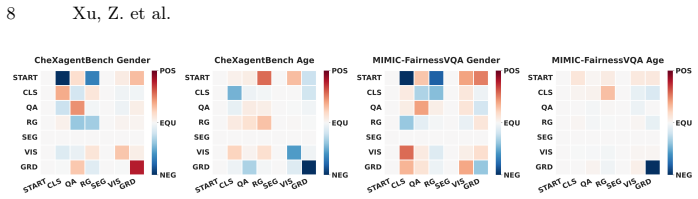
- Disparity can originate at any of three distinct stages: which tool is used, which tool chain is followed, and how the final answer is phrased.
- The stage in which disparities concentrate shifts with dataset and sensitive attribute (e.g., segmentation tools on one benchmark, visualizer on another).
- Different reasoning-bias measures are independent: a model can show no demographic framing gap yet have large hedging gaps.
- The decomposition provides modular intervention targets for debiasing agentic medical systems.
Reading between the lines
- If the decomposition holds, fairness audits of medical agents should log and analyze trajectories (tool calls, transitions, reasoning text), not just final predictions.
- The confounding of tool exposure with agent routing suggests a sharper test: randomizing or counterfactually re-assigning tool access across groups could verify whether the exposure gap is a property of the tool or of the selection policy.
- The findings likely generalize beyond chest X-rays: any LLM-driven pipeline that chooses among specialist modules could harbor stage-level demographic bias.
- A testable extension: applying stage-targeted debiasing (e.g., equalizing transition matrices or exposure rates) should reduce end-to-end equalized odds more than outcome-level postprocessing alone.
Editorial analysis
A structured set of objections, weighed in public.
Referee Report
Summary. The paper proposes DUCX, a stage-wise fairness audit framework for tool-using chest X-ray agents built on MedRAX. It defines three process-level bias metrics—tool-exposure bias (subgroup accuracy gap conditioned on tool invocation), tool-transition bias (difference in Markov transition matrices over tool calls), and LLM reasoning bias (subgroup gaps in judge-scored reasoning quality, hedging frequency, and demographic term usage)—and reports end-to-end fairness metrics (ACC, ΔACC, DP, EoD, FUT) across five driver LLMs and two benchmarks (CheXAgentBench and a newly curated MIMIC-FairnessVQA). The central claim is that agentic unfairness arises at intermediate stages and cannot be predicted from end-to-end evaluation alone, motivating process-level audits and targeted mitigation.
Significance. The topic is timely: as medical AI moves from standalone models to agentic pipelines, existing fairness audits that only examine final predictions may miss disparities introduced by tool routing and reasoning. The paper's main contribution is a concrete evaluation recipe with released code and a new demographic-aware VQA benchmark, plus a systematic comparison across five backbones. If the decomposition claims held, this would be a useful step toward process-level fairness auditing in clinical agents. The authors also deserve credit for reporting bootstrapped confidence intervals and for openly acknowledging the confounding role of exposure rates, even though, as argued below, the acknowledgment is insufficient for the paper's central attribution claim.
major comments (4)
- [Sec. 2.3, Eq. (2)] The tool-exposure bias ΔTEB(A) conditions on E_A(τ)=1, i.e., on the agent having chosen to invoke tool A. Tool invocation is a decision made by the same agent under evaluation and depends on the query, image, and prior context. If cases routed to a tool differ in difficulty across groups—for instance, if female patients are routed to segmentation only on harder cases—the accuracy gap among exposed instances measures a mixture of tool utility and routing selection, not a clean tool-level disparity. The paper reports exposure rates, but reporting the rate does not adjust for case-mix; it only makes the confounding visible. Because the abstract and Sec. 2.3 claim that the framework 'decomposes' end-to-end bias into tool-exposure, transition, and reasoning sources, this metric's causal or confound-adjusted status is load-bearing. The authors should either (a) define a causal estimand and adj
- [Sec. 2.3, Eqs. (2)–(5)] The word 'decomposition' is not supported by any formal relationship. End-to-end bias is reported as ΔACC/DP/EoD; tool-exposure bias is a conditional accuracy gap; tool-transition bias is a matrix difference P^(g1)−P^(g2); reasoning bias is a set of response-feature gaps. These quantities are not connected by any identity, inequality, or accounting equation that would allow a reader to attribute a share of end-to-end bias to each stage. The central claim in the abstract—that the framework 'separates end-to-end bias from three agent-specific sources'—therefore overstates what the metrics establish. At minimum, the paper should either derive a plug-in relation (e.g., how ΔACC relates to exposure-conditioned gaps and exposure-rate differences) or soften the claim to 'three complementary process-level audits,' rather than a decomposition.
- [Table 2] Several reported reasoning-bias gaps have confidence intervals that include zero or are extremely wide. For example, under Gender on CheXAgentBench, Qwen3VL has ΔHedge = 534.95 with CI [3.58, 1438.18]; on MIMIC-FairnessVQA, Qwen3VL Age ΔHedge is 1165.50 with CI [89.77, 3893.21]. A gap whose 95% CI spans more than two orders of magnitude is not evidence of a robust 'distinct subgroup disparity.' Likewise, in Table 1, EoD values of 20.79% carry CIs [8.91, 33.72] and 16.89% CIs [7.96, 26.50], indicating substantial uncertainty. The qualitative conclusion that 'intermediate behaviors exhibit distinct subgroup disparities' is not uniformly supported by the inferential statistics. The authors should apply multiple-comparison corrections, report effect sizes with tighter bounds (e.g., by increasing resamples or using analytic standard errors), and restrict strong claims to effects whose CIs exc
- [Sec. 2.3, Eq. (4) and Fig. 3] Tool-transition bias is defined as a full matrix difference ΔTTB = P^(g1) − P^(g2), but no scalar summary, significance test, or overall magnitude is provided. The narrative in Sec. 3 relies on visual inspection of the matrices (e.g., 'female patients are more likely to proceed directly from the Classifier or Report Generator'), without any test of whether the observed transition differences exceed sampling variability. Given that the agent trajectories are finite and tool-call counts are modest, a permutation test or a norm-based summary (e.g., total variation distance with bootstrap CI) is needed before claiming 'distinct tool transition patterns.' This is especially important because the transition analysis is one of the three pillars of the proposed decomposition.
minor comments (7)
- [Abstract] The abstract calls the method 'DUCK' while the title and the rest of the text call it 'DUCX.' This inconsistency should be fixed.
- [Sec. 2.4] The footnote 'Dataset is provided here' contains no URL; a working link or repository identifier should be added.
- [Sec. 2.3, Eq. (3)] The Markov transition matrix is defined over the tool set T, but Fig. 3 includes a 'START' state. The equation and the figure should be aligned: either add a START row/column in Eq. (3) or explain how initial transitions are encoded.
- [Sec. 3, Fig. 2] The violin plots are described as distributions across driver LLMs, but the number of LLMs is only five; the resulting distributions are quite coarse. Consider plotting individual points or using a strip chart to avoid over-interpreting density shapes.
- [Sec. 2.3, LLM reasoning bias] The 'JudgeGap' metric adapts an MT-Bench prompt [31] to medical chest X-ray reasoning, but the validity of an LLM judge for this domain is not established. The paper should include a small human-validation or inter-judge agreement analysis, or at least acknowledge this limitation prominently.
- [Sec. 3, Table 2] Table 2 states 'All values are multiplied by 100,' but the formatting of CIs is inconsistent (e.g., some entries read '0.10[0.30,21.70]', with a misplaced decimal). This is hard to parse and should be cleaned.
- [Introduction, Sec. 1] The phrase 'tool-used based agentic frameworks' (also used in the abstract) is grammatically awkward; 'tool-using agentic frameworks' is clearer.
Circularity Check
No significant circularity: the audit's metrics are defined on observed trajectories and external labels, and no headline result is constructed from a fitted parameter or self-citation chain.
full rationale
The paper is an empirical fairness audit rather than a derivation. Its headline findings are direct measurements of metrics defined on agent trajectories and benchmark labels: tool-exposure bias (Eq. 2), tool-transition bias (Eqs. 3-4), and LLM reasoning bias (Eq. 5) are all computed from executed tool calls, transition counts, and response texts, with no free parameter fitted to the reported disparities. The end-to-end metrics (ACC, DP, EoD, FUT) are adopted from the authors' prior FairMedFM work [14], but this is a metric-definition citation, not a load-bearing proof; the central claim about intermediate, process-level disparities would be unchanged under standard alternative definitions. The paper reports exposure rates alongside ΔTEB, acknowledging that conditioning on agent-chosen tool use may reflect routing selection rather than tool utility; this is a causal/validity limitation, not circularity. There is no uniqueness theorem, no ansatz smuggled via self-citation, and no renaming of a known result presented as a derivation. The observed conditional gaps are descriptive findings, not predictions forced by the definitions. Score 1 reflects the minor, non-load-bearing self-citation for metric adoption.
Assumptions & free parameters
free parameters (3)
- Age threshold (60 years)
- Hedge cue lexicon
- Demographic term lexicon
assumptions (5)
- domain assumption Tool exposure is exogenous to subgroup-specific question difficulty and agent state (Eq. 2)
- domain assumption Agent execution logs faithfully reveal objective tool utility and routing
- domain assumption First-order Markov transition matrices capture routing differences
- domain assumption LLM judge scores (DeepSeek) are demographic-neutral measures of reasoning quality
- domain assumption MIMIC-FairnessVQA generated questions and labels are correct after manual verification
Cite this review
Pith. "Pith review of DUCX: Decomposing Unfairness in Tool-Using Chest X-ray Agents." pith.science (2026). https://pith.science/paper/2ZDU4UOY
@misc{pith2026260300777,
  author       = {Pith},
  title        = {Pith review of: DUCX: Decomposing Unfairness in Tool-Using Chest X-ray Agents},
  year         = {2026},
  howpublished = {\url{https://pith.science/paper/2ZDU4UOY}},
  note         = {Machine review of arXiv:2603.00777}
}
read the original abstract
Fairness in medical agents is becoming critical as tool-using clinical AI systems orchestrate specialized vision and language modules for tasks such as chest X-ray question answering. While these medical AI agents can improve flexibility, their added pipeline complexity also creates new pathways for demographic bias beyond standalone models. We present DUCK, Decomposing Unfairness in Chest X-ray agents, a systematic audit of fairness in tool-using chest X-ray agents instantiated with MedRAX. To localize where disparities arise, we introduce a stage-wise fairness decomposition that separates end-to-end bias from three agent-specific sources: tool exposure bias, or utility gaps conditioned on tool presence; tool transition bias, or subgroup differences in tool-routing patterns; and model reasoning bias, or subgroup differences in synthesis behaviors. Extensive experiments on tool-using agentic frameworks across five driver backbones reveal that demographic gaps persist in end-to-end performance, with equalized odds up to 20.79% and the lowest fairness-utility tradeoff down to 28.65%. Intermediate behaviors, including tool usage, transition patterns, and reasoning traces, exhibit distinct subgroup disparities that are not predictable from end-to-end evaluation alone. For example, conditioned on segmentation-tool availability, the subgroup utility gap reaches as high as 50%. Our findings underscore the need for process-level fairness auditing and debiasing to ensure the equitable deployment of clinical agentic systems. Code: https://github.com/Nanboy-Ronan/DUCK.
Figures


Reference graph
Works this paper leans on
-
[1]
Journal of biomedical informatics43(6), 953–961 (2010)
Agarwal, S., Yu, H.: Detecting hedge cues and their scope in biomedical text with conditional random fields. Journal of biomedical informatics43(6), 953–961 (2010)
2010
-
[2]
arXiv preprint arXiv:2511.21631 (2025)
Bai, S., Cai, Y., Chen, R., Chen, K., Chen, X., Cheng, Z., Deng, L., Ding, W., Gao, C., Ge, C., et al.: Qwen3-vl technical report. arXiv preprint arXiv:2511.21631 (2025)
arXiv 2025
-
[3]
arXiv preprint arXiv:2507.06261 (2025)
Comanici, G., Bieber, E., Schaekermann, M., Pasupat, I., Sachdeva, N., Dhillon, I., Blistein, M., Ram, O., Zhang, D., Rosen, E., et al.: Gemini 2.5: Pushing the frontier with advanced reasoning, multimodality, long context, and next generation agentic capabilities. arXiv preprint arXiv:2507.06261 (2025)
arXiv 2025
-
[4]
In: Proceedings of the 6th Workshop on Gender Bias in Natural Language Processing (GeBNLP)
Derner, E., De La Fuente, S.S., Gutiérrez, Y., Pozo, P.M., Oliver, N.M.: Leveraging large language models to measure gender representation bias in gendered language corpora. In: Proceedings of the 6th Workshop on Gender Bias in Natural Language Processing (GeBNLP). pp. 468–483 (2025)
2025
-
[5]
In: Forty-second International Conference on Machine Learning (2025),https://openreview.net/forum?id=JiFfij5iv0
Fallahpour, A., Ma, J., Munim, A., Lyu, H., WANG, B.: MedRAX: Medical rea- soning agent for chest x-ray. In: Forty-second International Conference on Machine Learning (2025),https://openreview.net/forum?id=JiFfij5iv0
2025
-
[6]
Hugging Face Dataset (2025),https: //huggingface.co/datasets/wanglab/chest-agent-bench
Fallahpour, A., et al.: Chestagentbench. Hugging Face Dataset (2025),https: //huggingface.co/datasets/wanglab/chest-agent-bench
2025
-
[7]
Radiology: Artificial Intelligence5(6), e230060 (2023)
Glocker, B., Jones, C., Roschewitz, M., Winzeck, S.: Risk of bias in chest radio- graphy deep learning foundation models. Radiology: Artificial Intelligence5(6), e230060 (2023)
2023
-
[8]
arXiv preprint arXiv:2407.21783 (2024)
Grattafiori, A., Dubey, A., Jauhri, A., Pandey, A., Kadian, A., Al-Dahle, A., Let- man, A., Mathur, A., Schelten, A., Vaughan, A., et al.: The llama 3 herd of models. arXiv preprint arXiv:2407.21783 (2024)
arXiv 2024
Show all 32 references
-
[9]
Journal of Medical Internet Research27, e57257 (2025) 10 Xu, Z
Hanna, J.J., Wakene, A.D., Johnson, A.O., Lehmann, C.U., Medford, R.J.: Assess- ing racial and ethnic bias in text generation by large language models for health care–related tasks: Cross-sectional study. Journal of Medical Internet Research27, e57257 (2025) 10 Xu, Z. et al
2025
-
[10]
Advances in neural information processing systems29(2016)
Hardt, M., Price, E., Srebro, N.: Equality of opportunity in supervised learning. Advances in neural information processing systems29(2016)
2016
-
[11]
In: AMIA Annual Symposium Proceedings
Jackson, N.J., Yan, C., Malin, B.A.: Enhancement of fairness in ai for chest x-ray classification. In: AMIA Annual Symposium Proceedings. vol. 2024, p. 551 (2025)
2024
-
[12]
In: International Conference on Medical Image Computing and Computer-Assisted Intervention
Jin, R., Deng, W., Chen, M., Li, X.: Debiased noise editing on foundation models for fair medical image classification. In: International Conference on Medical Image Computing and Computer-Assisted Intervention. pp. 164–174. Springer (2024)
2024
-
[13]
arXiv preprint arXiv:2506.18140 (2025)
Jin, R., Huang, G., Shen, X., Zhang, Q., Tan, Y.S., Li, X.: See-in-pairs: Ref- erence image-guided comparative vision-language models for medical diagnosis. arXiv preprint arXiv:2506.18140 (2025)
2025
-
[14]
Advances in Neural Information Processing Systems37, 111318–111357 (2024)
Jin, R., Xu, Z., Zhong, Y., Yao, Q., QI, D., Zhou, S.K., Li, X.: Fairmedfm: fair- ness benchmarking for medical imaging foundation models. Advances in Neural Information Processing Systems37, 111318–111357 (2024)
2024
-
[15]
Scientific data6(1), 317 (2019)
Johnson, A.E., Pollard, T.J., Berkowitz, S.J., Greenbaum, N.R., Lungren, M.P., Deng, C.y., Mark, R.G., Horng, S.: Mimic-cxr, a de-identified publicly available database of chest radiographs with free-text reports. Scientific data6(1), 317 (2019)
2019
-
[16]
i’m not sure, but
Kim, S.S., Liao, Q.V., Vorvoreanu, M., Ballard, S., Vaughan, J.W.: " i’m not sure, but...": Examining the impact of large language models’ uncertainty expression on user reliance and trust. In: Proceedings of the 2024 ACM conference on fairness, accountability, and transparenc...
2024
-
[17]
Advances in Neural Information Processing Systems37, 79410–79452 (2024)
Kim, Y., Park, C., Jeong, H., Chan, Y.S., Xu, X., McDuff, D., Lee, H., Ghassemi, M., Breazeal, C., Park, H.W.: Mdagents: An adaptive collaboration of llms for medical decision-making. Advances in Neural Information Processing Systems37, 79410–79452 (2024)
2024
-
[18]
Proceedings of the National Academy of Sciences117(23), 12592–12594 (2020)
Larrazabal, A.J., Nieto, N., Peterson, V., Milone, D.H., Ferrante, E.: Gender im- balance in medical imaging datasets produces biased classifiers for computer-aided diagnosis. Proceedings of the National Academy of Sciences117(23), 12592–12594 (2020)
2020
-
[19]
arXiv preprint arXiv:2601.08584 (2026)
Liu, A.H., Khandelwal, K., Subramanian, S., Jouault, V., Rastogi, A., Sadé, A., Jeffares, A., Jiang, A., Cahill, A., Gavaudan, A., et al.: Ministral 3. arXiv preprint arXiv:2601.08584 (2026)
2026 arXiv
-
[20]
NPJ digital medicine6(1), 172 (2023)
Liu, M., Ning, Y., Teixayavong, S., Mertens, M., Xu, J., Ting, D.S.W., Cheng, L.T.E., Ong, J.C.L., Teo, Z.L., Tan, T.F., et al.: A translational perspective to- wards clinical ai fairness. NPJ digital medicine6(1), 172 (2023)
2023
-
[21]
Nature medicine27(12), 2176–2182 (2021)
Seyyed-Kalantari, L., Zhang, H., McDermott, M.B., Chen, I.Y., Ghassemi, M.: Underdiagnosisbiasofartificialintelligencealgorithmsappliedtochestradiographs in under-served patient populations. Nature medicine27(12), 2176–2182 (2021)
2021
-
[22]
arXiv preprint arXiv:2407.08811 (2024)
Sharma, N.: Cxr-agent: Vision-language models for chest x-ray interpretation with uncertainty aware radiology reporting. arXiv preprint arXiv:2407.08811 (2024)
2024 arXiv
-
[23]
Big Data Mining and Analytics8(2), 496–517 (2025)
Wang, P., Lu, W., Lu, C., Zhou, R., Li, M., Qin, L.: Large language model for medical images: A survey of taxonomy, systematic review, and future trends. Big Data Mining and Analytics8(2), 496–517 (2025)
2025
-
[24]
(eds.) Findings of the Association for Computational Linguistics: ACL 2025
Wang, W., Ma, Z., Wang, Z., Wu, C., Ji, J., Chen, W., Li, X., Yuan, Y.: A survey of LLM-based agents in medicine: How far are we from baymax? In: Che, W., Nabende, J., Shutova, E., Pilehvar, M.T. (eds.) Findings of the Association for Computational Linguistics: ACL 2025. pp. 1...
2025 doi
-
[25]
arXiv preprint arXiv:2410.01089 (2024)
Wu, P., Liu, C., Chen, C., Li, J., Bercea, C.I., Arcucci, R.: Fmbench: Benchmarking fairness in multimodal large language models on medical tasks. arXiv preprint arXiv:2410.01089 (2024)
2024 arXiv
-
[26]
npj Digital Medicine7(1), 286 (2024)
Xu, Z., Li, J., Yao, Q., Li, H., Zhao, M., Zhou, S.K.: Addressing fairness issues in deep learning-based medical image analysis: a systematic review. npj Digital Medicine7(1), 286 (2024)
2024
-
[27]
In: International Conference on Medical Image Computing and Computer-Assisted Intervention
Xu, Z., Zhao, S., Quan, Q., Yao, Q., Zhou, S.K.: Fairadabn: Mitigating unfair- ness with adaptive batch normalization and its application to dermatological dis- ease classification. In: International Conference on Medical Image Computing and Computer-Assisted Intervention. pp....
2023
-
[28]
arXiv preprint arXiv:2505.09388 (2025)
Yang, A., Li, A., Yang, B., Zhang, B., Hui, B., Zheng, B., Yu, B., Gao, C., Huang, C., Lv, C., et al.: Qwen3 technical report. arXiv preprint arXiv:2505.09388 (2025)
2025 arXiv
-
[29]
Yao, S., Zhao, J., Yu, D., Du, N., Shafran, I., Narasimhan, K.R., Cao, Y.: React: Synergizingreasoningandactinginlanguagemodels.In:Theeleventhinternational conference on learning representations (2022)
2022
-
[30]
In: Conference on health, inference, and learning
Zhang, H., Dullerud, N., Roth, K., Oakden-Rayner, L., Pfohl, S., Ghassemi, M.: Improving the fairness of chest x-ray classifiers. In: Conference on health, inference, and learning. pp. 204–233. PMLR (2022)
2022
-
[31]
Advances in neural information processing systems36, 46595–46623 (2023)
Zheng, L., Chiang, W.L., Sheng, Y., Zhuang, S., Wu, Z., Zhuang, Y., Lin, Z., Li, Z., Li, D., Xing, E., et al.: Judging llm-as-a-judge with mt-bench and chatbot arena. Advances in neural information processing systems36, 46595–46623 (2023)
2023
-
[32]
Proceedings of the IEEE109(5), 820–838 (2021)
Zhou, S.K., Greenspan, H., Davatzikos, C., Duncan, J.S., Van Ginneken, B., Mad- abhushi, A., Prince, J.L., Rueckert, D., Summers, R.M.: A review of deep learning in medical imaging: Imaging traits, technology trends, case studies with progress highlights, and future promises. ...
2021
Reviewed August 2, 2026 · model on record in the stance chip above.
Discussion (0). Sign in to comment.