REVIEW 3 major objections 4 minor 151 references
SN 2021fxy's fast silicon features slow at t^(-0.1), far shallower than the ejecta's expected t^(-0.2).
Reviewed by Pith at T0; open to challenge. T0 means a machine referee read the full paper against a public rubric. the ladder, T0–T4 →
T0 review · deepseek-v4-flash
2026-08-01 17:44 UTC pith:2ZJWV25I
load-bearing objection A careful early-time dataset for SN 2021fxy supports—but doesn't nail down—the idea that detached Si II HVFs evolve more slowly than the photosphere, since the slow evolution is measured relative to a t0 that assumes the very profile being questioned. the 3 major comments →
Optical observations on the young Type Ia SN 2021fxy with detached high velocity features
The pith
A machine-rendered reading of the paper's core claim, the machinery that carries it, and where it could break.
Core claim
For the young normal-luminosity Type Ia SN 2021fxy, the paper establishes that the velocities of the detached high-velocity Si II λ6355 absorption features follow a power-law decline with exponent β≈0.09–0.1 when measured relative to an explosion epoch t0 = −17.6 ± 0.5 days (derived by fitting the photospheric Si II velocities to a t^(-0.22) law expected for an n=10 density profile). The Ca II IRT HVFs decline with β≈0.11. These exponents are significantly shallower than the photospheric exponent of ≈0.22, and comparison spectra of SN 2009ig and SN 2012fr fall within the same fit, suggesting a common t^(-0.1) evolution for detached Si II HVFs. The paper interprets this as evidence that HVFs
What carries the argument
The central analytical tool is a double-Gaussian fit to the Si II λ6355 and Ca II IRT absorption profiles in the early spectra, separating the detached high-velocity component from the photospheric component. The kinematic argument then rests on the homologous-expansion power-law relation v_ph ∝ t_exp^(-2/(n−1)): with an assumed outer density slope n=10, the photospheric velocity should fall as t_exp^(-0.22). Fitting that law to the early photospheric velocities fixes the explosion epoch t0, and with t0 held as a Gaussian prior the HVF velocities are fit independently to v ∝ t_exp^(−β), yielding β≈0.1.
Load-bearing premise
The entire exponent comparison assumes that the photospheric Si II velocities obey v ∝ t_exp^(-0.22) with n=10, and uses that assumption to set the explosion time t0; if the true outer density profile differs or the early photospheric absorption is contaminated by the strong HVF, the derived t0—and hence the HVF exponent β≈0.1—could shift toward the photospheric value.
What would settle it
Take a well-observed early SN Ia with an independently determined explosion time (e.g., from shock breakout or a very well-sampled rise) and measure the HVF velocities on spectra from before -5 days. If, with that independent t0, the HVF velocities decline as t_exp^(-0.22) like the photosphere, the paper's decoupling claim would be refuted. Alternatively, redo the fit with a free PVF exponent instead of fixing -0.22: if the resulting HVF exponent becomes consistent with -0.2, the claimed dichotomy is an artifact of the prior.
If this is right
- If the HVF velocity exponent is genuinely ~0.1, the HVF-bearing material is not simply the outermost shell of the standard n=10 ejecta; it is a distinct component with its own, much steeper density profile (n' ≈ 20 or more).
- The similarity of SN 2021fxy, SN 2009ig, and SN 2012fr in the same diagram suggests that a t^(-0.1) decline may be a common signature of detached Si II HVFs, giving a convenient observable to test explosion models.
- The slow, coherent ~10-day evolution of the HVFs is hard to explain by a thin circumstellar shell interaction, which would last only a few days; the paper therefore argues against CSM as the origin of these HVFs.
- The derived 56Ni mass of 0.58 ± 0.14 solar masses and normal light-curve parameters place SN 2021fxy among normal-luminosity SNe Ia, so the HVF phenomenon is not restricted to peculiar objects.
Where Pith is reading between the lines
- If the t^(-0.1) law is universal for detached Si II HVFs, the 'velocity plateau' reported for SN 2021aefx at later phases may be the same slow decline rather than a physical plateau; the paper itself hints at this re-interpretation.
- The exponent of the HVF velocity is measured relative to a time origin that already carries the n=10 assumption. An independent explosion epoch—from very early multi-band light curves or a detected shock breakout—would test whether the HVF exponent itself is model-independent.
- A testable corollary is that the implied density structure for HVFs (n'≈20) should imprint observable line-profile asymmetries; high-resolution early spectra could distinguish a detached blob from a smooth power-law extension.
Editorial analysis
A structured set of objections, weighed in public.
Referee Report
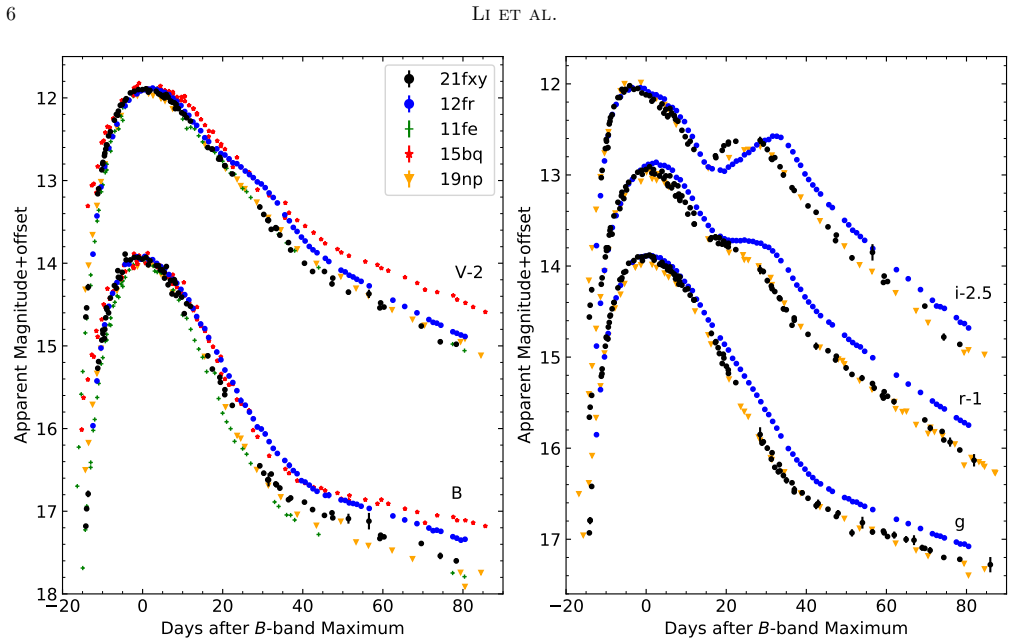
Summary. The paper presents new optical photometry and low-resolution spectroscopy of SN 2021fxy, a young, normal-luminosity Type Ia supernova in NGC 5018, covering roughly −14 d to +78 d relative to B-band maximum. It derives light-curve parameters, a distance, a peak luminosity, and a 56Ni mass. The early spectra show prominent, detached high-velocity features (HVFs) of Si II λ6355 and Ca II IRT. Gaussian decomposition yields velocities for both the photospheric (PVF) and high-velocity components. In Section 5.1, assuming homologous expansion with a standard n=10 outer density profile, the authors fit the explosion time t0 = −17.6±0.5 d from the early PVF velocities with the power-law index fixed to −0.22. Using this t0 as a Gaussian prior, they then fit the HVF velocities and obtain β_Si = 0.09±0.03 and β_Ca = 0.11±0.01, which are shallower than the assumed PVF β≈0.22. They interpret this as evidence that the HVFs form in intrinsic ejecta structures decoupled from the bulk outer ejecta, possibly connected to deflagration blobs or He-shell detonation ashes, and they discuss and disfavor a CSM-interaction origin. The measured HVF evolution is compared with SN 2009ig and SN 2012fr, which show a consistent t^−0.1 behavior.
Significance. If the central comparison is robust, the paper provides a new observational constraint on the outermost ejecta of SNe Ia: detached Si II HVFs may evolve as t^−0.1 rather than tracking the t^−0.22 photospheric evolution expected for an n=10 polytropic outer layer. This would be a useful diagnostic for explosion models and would favor intrinsic density/abundance structures over CSM interaction. The early-time dataset itself is valuable, combining LJT and TNT photometry, Swift UVOT data, and a well-sampled early spectral sequence. The authors also make a reasonable attempt to compare with previous objects and are appropriately cautious in some places, explicitly flagging the unreliability of the derived steep density profile. However, the central claim rests on a time origin that is derived under the very n=10 assumption being tested, and the sensitivity of the HVF slope to plausible shifts in t0 is not adequately explored. Because the different interpretations (decoupled structures vs. a common outer envelope) hinge on the slope difference, the robustness of this point needs to be established before the astrophysical conclusion can be accepted.
major comments (3)
- [Section 5.1, velocity power-law fits] The HVF exponent β_Si is measured relative to t0 = −17.6±0.5 d, but t0 itself is obtained by fitting the PVF velocities with the power-law index fixed to the n=10 value of −0.22. The comparison β_HVF ≈ 0.1 vs. β_PVF ≈ 0.22 is therefore not a measurement of a difference from independent data; it is a comparison between a fitted exponent and an exponent that was imposed on the same t0. The Gaussian prior on t0 propagates the statistical uncertainty of ±0.5 d, but it does not cover the systematic possibility that the n=10 assumption, or the PVF decomposition, is incorrect. A shift of ±1 d in t0 — plausible given the weak −13.6 d PVF point — changes β_Si by roughly 0.02–0.04, comparable to the quoted statistical error and moving the value toward β_PVF. The authors should fit t0 as a free parameter (with the PVF exponent free as well), or at minimum report β_Si for a grid of t0 values coverin
- [Table 3, early PVF at −13.6 d] The t0 fit relies on five early PVF measurements, the earliest of which (t = −13.6 d) has pEW = 14±8 Å for the PVF component, formally consistent with zero, while the HVF at that epoch has pEW = 128±8 Å. The −13.6 d point is the most influential because it fixes the early evolution, yet it is the least secure: at R≈300 the Gaussian decomposition of a weak PVF overlapping a strong HVF is degenerate. Removing this point or changing the assumed continuum/window could shift t0 by more than the quoted statistical uncertainty. Since all HVF exponents are measured relative to t0, the central claim is directly sensitive to this single weak measurement. The authors should test the robustness of both t0 and β_Si by excluding the −13.6 d point, by varying the Gaussian component structure, and by assigning a systematic uncertainty to t0 from these variations.
- [Section 5.1, last paragraph] The paper itself states that the derived steep density profile n′ = 22+10−5 is unreliable and that "any physical derivation based on this profile may [be] unreliable." This caveat is appropriate, but it highlights that the astrophysical interpretation in Section 5.2 (intrinsic blobs, He-shell ashes, or decoupled outer structures) is supported mainly by the β_HVF vs. β_PVF slope difference, not by the profile itself. Given that this slope difference depends on the assumed t0 and on the fixed n=10 PVF index, the manuscript should present the slope comparison as the primary observational result and make the model-dependent n′ interpretation explicitly subordinate. As written, the conclusion that HVFs are "density structures independent of the outermost region" goes beyond what the current, t0-dependent analysis can securely support.
minor comments (4)
- [Section 6 (Conclusion)] The phrase "~2,5000 km s−1" should read "~25,000 km s−1."
- [Section 1, first paragraph] "he empirical standardization" should be "The empirical standardization."
- [Table A4 caption and Section 2.2] The instrument is written as "YFSOC" in Table A4 but as "YFOSC" in Section 2; unify the notation. Also, several table captions place a space before "able" (e.g., "T able 1").
- [Figure 2 and Section 2.2] The caption states "first spectra from TNS marked in green" and "around the maximum light marked in blue" — the grammar is slightly awkward, and it is unclear whether one or two spectra from DerKacy et al. (2023) are included. Please clarify.
Circularity Check
No significant circularity: the HVF slope is a free fit to measured velocities and is checked against external SNe; only minor non-load-bearing self-citations appear.
full rationale
The central claim—that the Si II λ6355 HVF velocities evolve as ~t^-0.1 while the photospheric component follows the assumed n=10 expectation ~t^-0.22—is not circular by construction. In Section 5.1 the authors first fit the early PVFs with a power law v ∝ (t−t0)^(-0.22±0.02), fixing the exponent to the n=10 theoretical value and deriving t0 = −17.6±0.5 d. They then fit the HVF velocities with v ∝ t_exp^-β using that t0 as a Gaussian prior, obtaining β_Si = 0.09±0.03 and β_Ca = 0.11±0.01. The HVF exponent is therefore a free parameter estimated from the measured HVF velocities, not algebraically forced by the assumed PVF exponent. The comparison to β ≈ 0.22 is a comparison to an external theoretical expectation, not to a fitted value from the same data. The shared t0 introduces a possible systematic coupling—if the n=10 assumption or early PVF measurements are unreliable, t0 and hence β_HVF could shift—but this is a robustness/correctness concern, not a definitional circularity. The paper independently checks the HVF evolution against SN 2009ig and SN 2012fr data, and its interpretation is also supported by independent theoretical work (e.g., Harvey et al. 2026; Kasen 2010; Chevalier 1982). The self-citations to Li et al. 2026 appear in literature surveys and as one of several supporting references for the delayed-detonation/CSM discussion; the HVF slope measurement does not depend on that citation. The paper itself cautions that physical derivations from the inferred steep profile are unreliable and that the origin cannot be uniquely constrained, which further indicates the authors are not presenting a forced result.
Axiom & Free-Parameter Ledger
free parameters (5)
- t0 (explosion epoch relative to B-band maximum) =
-17.6 ± 0.5 days
- β_Si (Si II λ6355 HVF power-law index) =
0.09 ± 0.03
- β_Ca (Ca II IRT HVF power-law index) =
0.11 ± 0.01
- E(B−V)_host =
0.014 ± 0.06 mag
- Rise time t_r =
16.9 ± 0.5 days
axioms (6)
- domain assumption Outer SN Ia ejecta follow a homologous power-law density profile ρ ∝ r^−n with n=10, giving v_ph ∝ t_exp^{−2/(n−1)} = t_exp^{−0.22}.
- domain assumption Absorption minima from Gaussian decomposition trace the physical velocities of the HVF and PVF components.
- domain assumption SALT2/SNooPy templates and the Lira-Phillips relation describe normal SNe Ia and can be used to estimate distance and host extinction.
- standard math Arnett's law relates peak bolometric luminosity and rise time to synthesized 56Ni mass.
- domain assumption UV and NIR flux at maximum are ~15% and ~5% of the optical flux, based on normal SN Ia templates.
- domain assumption Ca II IRT line strengths follow the optically thin 1:9:5 ratio.
read the original abstract
We present optical observations on the young type Ia supernova (SN Ia) SN 2021fxy obtained within a few days after the explosion, with a focus on its prominent high-velocity features (HVFs). It reached a $B$-band maximum of $M_{\rm max}(B) = -19.36\pm0.31$ mag, corresponding to a bolometric luminosity of $\sim 1.3\times10^{43}~\rm{erg~s^{-1}}$ with a synthesized $^{56}$Ni mass of $0.58\pm0.14$ M$_{\odot}$. The early spectra exhibit strong HVFs of intermediate-mass elements that are significantly detached from the photospheric components. In particular, the velocity of the Si II $\lambda6355$ HVFs follows a power-law evolution ($\beta \approx 0.1$), shallower than the expected photospheric velocity evolution expected for an assumed $n=10$ density profile ($\beta \approx 0.22$) under homologous expansion. This behavior is consistent with the HVFs forming in intrinsic ejecta structures at least partially decoupled from the bulk outer ejecta, providing a possible constraint on the explosion physics of SNe Ia.
Figures




Reference graph
Works this paper leans on
-
[1]
emcee: The MCMC Hammer. , keywords =. doi:10.1086/670067 , archivePrefix =. 1202.3665 , primaryClass =
-
[2]
The Zwicky Transient Facility: System Overview, Performance, and First Results. , keywords =. doi:10.1088/1538-3873/aaecbe , archivePrefix =. 1902.01932 , primaryClass =
Pith/arXiv arXiv 1902
-
[3]
The Zwicky Transient Facility: Science Objectives. , keywords =. doi:10.1088/1538-3873/ab006c , archivePrefix =. 1902.01945 , primaryClass =
Pith/arXiv arXiv 1902
-
[4]
ATLAS: A High-cadence All-sky Survey System. , keywords =. doi:10.1088/1538-3873/aabadf , archivePrefix =. 1802.00879 , primaryClass =
-
[5]
The Sloan Digital Sky Survey Photometric System. , keywords =. doi:10.1086/117915 , adsurl =
-
[6]
, keywords =
A two-parameter luminosity correction for Type IA supernovae. , keywords =
-
[7]
A Precise Distance Indicator: Type IA Supernova Multicolor Light-Curve Shapes. , keywords =. doi:10.1086/178129 , archivePrefix =. astro-ph/9604143 , primaryClass =
-
[8]
SN 2012ij: A Low-luminosity Type Ia Supernova and Evidence for a Continuous Distribution from a 91bg-like Explosion to Normal Ones. , keywords =. doi:10.3847/1538-4357/ac4e17 , archivePrefix =. 2201.06066 , primaryClass =
-
[9]
SN 1986G bridging the gap between normal and subluminous SNe Ia
Abundance stratification in Type Ia supernovae - V. SN 1986G bridging the gap between normal and subluminous SNe Ia. , keywords =. doi:10.1093/mnras/stw2114 , archivePrefix =. 1608.05244 , primaryClass =
-
[10]
Calcium versus silicon ejecta velocities and decline rates in supernovae Ia: the role of high-velocity features. , keywords =. doi:10.1093/mnras/staf2281 , archivePrefix =. 2511.23305 , primaryClass =
-
[11]
ZTF SN Ia DR2: The spectral diversity of Type Ia supernovae in a volume-limited sample. , keywords =. doi:10.1051/0004-6361/202450386 , archivePrefix =. 2407.06828 , primaryClass =
-
[12]
Lightcurve Modelling of 2,205 ZTF DR2 Type -0.5ex Supernovae: Implications for SN Ia Physics and Cosmology. arXiv e-prints , keywords =. doi:10.48550/arXiv.2602.02677 , archivePrefix =. 2602.02677 , primaryClass =
-
[13]
Type Ia Supernova Progenitor Properties and their Host Galaxies. , keywords =. doi:10.3847/1538-4357/ad4702 , archivePrefix =. 2311.03473 , primaryClass =
-
[14]
Exploring the origins of high-velocity features in SNe Ia with the spectral synthesis code TARDIS. , keywords =. doi:10.1051/0004-6361/202555042 , archivePrefix =. 2512.13791 , primaryClass =
-
[15]
Type Ia supernova spectral features in the context of their host galaxy properties. , keywords =. doi:10.1093/mnras/stu2121 , archivePrefix =. 1410.0091 , primaryClass =
-
[16]
SN 2003du: Signatures of the Circumstellar Environment in a Normal Type Ia Supernova?. , keywords =. doi:10.1086/383488 , archivePrefix =. astro-ph/0309639 , primaryClass =
-
[17]
g-mode Excitation During the Pre-explosive Simmering of Type Ia Supernovae. , keywords =. doi:10.1088/2041-8205/738/1/L5 , archivePrefix =. 1105.0936 , primaryClass =
Pith/arXiv arXiv 2041
-
[18]
SN 2023ehl: A Normal Type Ia Supernova with High-velocity Features. , keywords =. doi:10.3847/1538-4357/adcf1b , adsurl =
-
[19]
Production of Silicon on Mass-increasing White Dwarfs: Possible Origin of High-velocity Features in Type Ia Supernovae. , keywords =. doi:10.3847/1538-4357/aad327 , archivePrefix =. 1807.03938 , primaryClass =
-
[20]
Can the Helium-detonation Model Explain the Observed Diversity of Type Ia Supernovae?. , keywords =. doi:10.3847/1538-4357/abc9b5 , archivePrefix =. 2011.07240 , primaryClass =
Pith/arXiv arXiv 2011
-
[21]
Multidimensional Parameter Study of Double Detonation Type Ia Supernovae Originating from Thin Helium Shell White Dwarfs. , keywords =. doi:10.3847/1538-4357/ac07a2 , archivePrefix =. 2101.12330 , primaryClass =
-
[22]
Observational Predictions for Sub-Chandrasekhar Mass Explosions: Further Evidence for Multiple Progenitor Systems for Type Ia Supernovae. , keywords =. doi:10.3847/1538-4357/aafb6a , archivePrefix =. 1811.07127 , primaryClass =
-
[23]
Constraining the Source of the High-velocity Ejecta in Type Ia SN 2019ein. , keywords =. doi:10.3847/1538-4357/ab8e3f , archivePrefix =. 2003.05946 , primaryClass =
Pith/arXiv arXiv 2003
-
[24]
High-Velocity Features in Type Ia Supernovae from a Compact Circumstellar Shell. , keywords =. doi:10.1093/mnras/stw3383 , adsurl =
-
[25]
SN 2024gy: Multiepoch Spectroscopic Features Suggestive of Delayed Detonation in a Type Ia Supernova. , keywords =. doi:10.3847/1538-4357/ae1ba0 , archivePrefix =. 2508.01428 , primaryClass =
-
[26]
Three-dimensional delayed-detonation models with nucleosynthesis for Type Ia supernovae. , keywords =. doi:10.1093/mnras/sts402 , archivePrefix =. 1211.3015 , primaryClass =
-
[27]
Discovery of the Fastest Early Optical Emission from Overluminous SN Ia 2020hvf: A Thermonuclear Explosion within a Dense Circumstellar Environment. , keywords =. doi:10.3847/2041-8213/ac375f , archivePrefix =. 2111.09470 , primaryClass =
Pith/arXiv arXiv 2041
-
[28]
Self-similar solutions for the interaction of stellar ejecta with an external medium. , keywords =. doi:10.1086/160126 , adsurl =
-
[29]
The core normal Type Ia supernova 2019np - an overall spherical explosion with an aspherical surface layer and an aspherical ^ 56 Ni core. , keywords =. doi:10.1093/mnras/stad172 , archivePrefix =. 2301.04721 , primaryClass =
-
[30]
Spectroscopic Observations of SN 2012fr: A Luminous, Normal Type Ia Supernova with Early High-velocity Features and a Late Velocity Plateau. , keywords =. doi:10.1088/0004-637X/770/1/29 , archivePrefix =. 1302.2926 , primaryClass =
-
[31]
High-velocity Line Forming Regions in the Type Ia Supernova 2009ig. , keywords =. doi:10.1088/0004-637X/777/1/40 , archivePrefix =. 1302.3537 , primaryClass =
-
[32]
Seeing the Collision of a Supernova with Its Companion Star. , keywords =. doi:10.1088/0004-637X/708/2/1025 , archivePrefix =. 0909.0275 , primaryClass =
-
[33]
Origin of High-velocity Ejecta, Excess Emission, and Redward Color Evolution in the Infant Type Ia Supernova 2021aefx. , keywords =. doi:10.3847/1538-4357/ad0640 , archivePrefix =. 2304.00625 , primaryClass =
-
[34]
What can we Learn from the Rising Light Curves of Radioactively Powered Supernovae?. , keywords =. doi:10.1088/0004-637X/769/1/67 , archivePrefix =. 1210.3032 , primaryClass =
-
[35]
Transient Name Server Discovery Report , keywords =
Transient Discovery Report for 2021-03-17. Transient Name Server Discovery Report , keywords =
2021
-
[36]
ZTF SN Ia DR2: High-velocity components in the Si II 6355. , keywords =. doi:10.1051/0004-6361/202449746 , archivePrefix =. 2502.04448 , primaryClass =
-
[37]
High-velocity features of calcium and silicon in the spectra of Type Ia supernovae. , keywords =. doi:10.1093/mnras/stv1011 , archivePrefix =. 1502.07278 , primaryClass =
-
[38]
High-velocity features in Type Ia supernova spectra. , keywords =. doi:10.1093/mnras/stt1892 , archivePrefix =. 1307.0563 , primaryClass =
-
[39]
SN 2024gy: Multi-epoch Spectroscopic Features Suggestive of Delayed Detonation in a Type Ia Supernova. arXiv e-prints , keywords =. doi:10.48550/arXiv.2508.01428 , archivePrefix =. 2508.01428 , primaryClass =
-
[40]
Observations of the very young Type Ia Supernova 2019np with early-excess emission. , keywords =. doi:10.1093/mnras/stac1525 , archivePrefix =. 2205.15596 , primaryClass =
-
[41]
SN 2021fxy: mid-ultraviolet flux suppression is a common feature of Type Ia supernovae. , keywords =. doi:10.1093/mnras/stad1171 , archivePrefix =. 2212.06195 , primaryClass =
-
[42]
The Cold and Dusty Circumstellar Matter around Fast-expanding Type Ia Supernovae. , keywords =. doi:10.3847/1538-4357/ab26b5 , archivePrefix =. 1810.11936 , primaryClass =
-
[43]
The Rise Time of Normal and Subluminous Type Ia Supernovae. , keywords =. doi:10.1088/0004-637X/745/1/44 , archivePrefix =. 1109.5757 , primaryClass =
-
[44]
The rising light curves of Type Ia supernovae. , keywords =. doi:10.1093/mnras/stu2314 , archivePrefix =. 1411.1064 , primaryClass =
-
[45]
Evidence for Type Ia Supernova Diversity from Ultraviolet Observations with the Hubble Space Telescope. , keywords =. doi:10.1088/0004-637X/749/2/126 , archivePrefix =. 1110.5809 , primaryClass =
-
[46]
Improved cosmological constraints from a joint analysis of the SDSS-II and SNLS supernova samples. , keywords =. doi:10.1051/0004-6361/201423413 , archivePrefix =. 1401.4064 , primaryClass =
-
[47]
Transient Name Server Classification Report , keywords =
SIRAH Transient Classification Report for 2021-03-18. Transient Name Server Classification Report , keywords =
2021
-
[48]
Measuring Reddening with Sloan Digital Sky Survey Stellar Spectra and Recalibrating SFD. , keywords =. doi:10.1088/0004-637X/737/2/103 , archivePrefix =. 1012.4804 , primaryClass =
-
[49]
Image Subtraction in Fourier Space. , keywords =. doi:10.3847/1538-4357/ac7394 , archivePrefix =. 2109.09334 , primaryClass =
-
[50]
Kinematics of the Local Universe. XIII. 21-cm line measurements of 452 galaxies with the Nan c ay radiotelescope, JHK Tully-Fisher relation, and preliminary maps of the peculiar velocity field. , keywords =. doi:10.1051/0004-6361:20066187 , archivePrefix =. astro-ph/0611626 , primaryClass =
-
[51]
Cosmological Constraints from Measurements of Type Ia Supernovae Discovered during the First 1.5 yr of the Pan-STARRS1 Survey. , keywords =. doi:10.1088/0004-637X/795/1/44 , archivePrefix =. 1310.3828 , primaryClass =
-
[52]
SN 2015bq: A Luminous Type Ia Supernova with Early Flux Excess. , keywords =. doi:10.3847/1538-4357/ac323f , archivePrefix =. 2110.08752 , primaryClass =
-
[53]
Photometric and Spectroscopic Properties of Type Ia Supernova 2018oh with Early Excess Emission from the Kepler 2 Observations. , keywords =. doi:10.3847/1538-4357/aaec74 , archivePrefix =. 1811.10056 , primaryClass =
-
[54]
SN 2021fxy: Mid-Ultraviolet Flux Suppression is a Common Feature of Type Ia Supernovae
SN 2021fxy: Mid-Ultraviolet Flux Suppression is a Common Feature of Type Ia Supernovae. arXiv e-prints , keywords =. doi:10.48550/arXiv.2212.06195 , archivePrefix =. 2212.06195 , primaryClass =
work page internal anchor Pith review Pith/arXiv arXiv doi:10.48550/arxiv.2212.06195
-
[55]
Analysis of the Flux and Polarization Spectra of the Type Ia Supernova SN 2001el: Exploring the Geometry of the High-Velocity Ejecta. , keywords =. doi:10.1086/376601 , archivePrefix =. astro-ph/0301312 , primaryClass =
-
[56]
SN 2012fr: Ultraviolet, Optical, and Near-infrared Light Curves of a Type Ia Supernova Observed within a Day of Explosion. , keywords =. doi:10.3847/1538-4357/aabaf8 , archivePrefix =. 1803.10095 , primaryClass =
-
[57]
Research in Astronomy and Astrophysics , keywords =
The photometric system of the Tsinghua-NAOC 80-cm telescope at NAOC Xinglong Observatory. Research in Astronomy and Astrophysics , keywords =. doi:10.1088/1674-4527/12/11/012 , archivePrefix =. 1205.6529 , primaryClass =
-
[58]
The Astronomer's Telegram , year = 2021, month = mar, volume =
Introducing POISE: Precision Observations of Infant Supernova Explosions. The Astronomer's Telegram , year = 2021, month = mar, volume =
2021
-
[59]
Environments of Type Ia Supernovae with Different Relative Equivalent Widths of the Si II Feature in Their Spectra. , keywords =. doi:10.3847/1538-4357/acad77 , archivePrefix =. 2212.12093 , primaryClass =
-
[60]
Constraints on dark energy with the LOSS SN Ia sample. , keywords =. doi:10.1093/mnras/stt893 , archivePrefix =. 1307.0824 , primaryClass =
-
[61]
The Carnegie Supernova Project: Light-curve Fitting with SNooPy. , keywords =. doi:10.1088/0004-6256/141/1/19 , archivePrefix =. 1010.4040 , primaryClass =
-
[62]
Spectral Sequences of Type Ia Supernovae. I. Connecting Normal and Subluminous SNe Ia and the Presence of Unburned Carbon. , keywords =. doi:10.3847/1538-4357/aa8309 , adsurl =
-
[63]
The luminous, peculiar SN 1991T
Abundance stratification in Type Ia supernovae - IV. The luminous, peculiar SN 1991T. , keywords =. doi:10.1093/mnras/stu1777 , archivePrefix =. 1409.0116 , primaryClass =
-
[64]
, keywords =
Epochs of maximum light and bolometric light curves of type Ia supernovae. , keywords =
-
[65]
Spectroscopic Observations and Analysis of the Peculiar SN 1999aa. , keywords =. doi:10.1086/421747 , archivePrefix =. astro-ph/0404393 , primaryClass =
-
[66]
The Spectroscopic Diversity of Type Ia Supernovae. , keywords =. doi:10.1088/0004-6256/143/5/126 , archivePrefix =. 1203.4832 , primaryClass =
-
[67]
K-Corrections and Spectral Templates of Type Ia Supernovae. , keywords =. doi:10.1086/518232 , archivePrefix =. astro-ph/0703529 , primaryClass =
-
[68]
arXiv e-prints , keywords =
On SN 2003fg: The Probable Super-Chandrasekhar-Mass SN Ia. arXiv e-prints , keywords =
-
[69]
The Luminous and Carbon-rich Supernova 2006gz: A Double Degenerate Merger?. , keywords =. doi:10.1086/523301 , archivePrefix =. 0709.1501 , primaryClass =
-
[70]
SN 2002cx: The Most Peculiar Known Type Ia Supernova. , keywords =. doi:10.1086/374200 , archivePrefix =. astro-ph/0301428 , primaryClass =
-
[71]
Spectropolarimetry of the Peculiar Type Ia Supernova 2005hk. , keywords =. doi:10.1086/504117 , archivePrefix =. astro-ph/0603083 , primaryClass =
-
[72]
Hubble Space Telescope and Ground-based Observations of the Type Iax Supernovae SN 2005hk and SN 2008A. , keywords =. doi:10.1088/0004-637X/786/2/134 , archivePrefix =. 1309.4457 , primaryClass =
-
[73]
Research in Astronomy and Astrophysics , keywords =
The THU-NAOC transient survey: the performance and results from the first year. Research in Astronomy and Astrophysics , keywords =. doi:10.1088/1674-4527/15/2/006 , archivePrefix =. 1411.3431 , primaryClass =
-
[74]
The Swift Ultra-Violet/Optical Telescope. , keywords =. doi:10.1007/s11214-005-5095-4 , archivePrefix =. astro-ph/0507413 , primaryClass =
-
[75]
Type Ia Supernovae, Theory and Cosmology , year = 2000, editor =
The Progenitors of Type Ia Supernovae. Type Ia Supernovae, Theory and Cosmology , year = 2000, editor =
2000
-
[76]
High luminosity, slow ejecta and persistent carbon lines: SN 2009dc challenges thermonuclear explosion scenarios. , keywords =. doi:10.1111/j.1365-2966.2010.18107.x , archivePrefix =. 1011.5665 , primaryClass =
arXiv 2010
-
[77]
The Infrared Light Curve of SN 2011fe in M101 and the Distance to M101. , keywords =. doi:10.1088/0004-637X/754/1/19 , archivePrefix =. 1205.3828 , primaryClass =
-
[78]
Research in Astronomy and Astrophysics , year = 2015, month = jun, volume =
Rapid instrument exchanging system for the Cassegrain focus of the Lijiang 2.4-m Telescope. Research in Astronomy and Astrophysics , year = 2015, month = jun, volume =. doi:10.1088/1674-4527/15/6/014 , adsurl =
-
[79]
Surface Radioactivity or Interactions? Multiple Origins of Early-excess Type Ia Supernovae and Associated Subclasses. , keywords =. doi:10.3847/1538-4357/aadb9a , archivePrefix =. 1808.06343 , primaryClass =
-
[80]
The Relationship between Infrared, Optical, and Ultraviolet Extinction. , keywords =. doi:10.1086/167900 , adsurl =
discussion (0)
Sign in with ORCID, Apple, or X to comment. Anyone can read and Pith papers without signing in.